


Introduction
Early career investigators (ECIs) in health-related fields are often faced with challenges that can hinder their ability to successfully navigate the expectations of academia including teaching, grant acquisition, research project completion, and service. Significant hurdles include securing research funding, building independent research agendas, and establishing professional networks. Obtaining a mentored career development award (K award) is itself a competitive achievement. Yet even among these ECIs, the path to securing an R01-equivalent grant remains highly competitive. Studies show that less than half of K award recipients successfully transition to independent NIH funding despite significant institutional support and individual effort [Reference Conte and Omary1]. This has led to a significant proportion of early career researchers reporting feelings of burnout and stress, largely due to workload demands, the pressure to publish, and maintaining optimal work–life balance [Reference Primack, Dilmore and Switzer2].
Mentorship remains a critical factor in navigating these challenges, as high quality and frequency of mentorship has been positively linked to higher success rates and co-authored publications [Reference Esbenshade, Kahalley and Baertschiger3]. Traditional dyadic mentorship, where a senior faculty member advises a junior colleague, is a common approach to mentoring though alternative approaches, including peer mentorship and team-based mentorship, have gained attention in recent years. However, access to mentorship is often limited and understanding of what constitutes effective mentorship is lacking [Reference Sambunjak, Straus and Marušić4]. A study involving 457 early-and mid-career faculty members revealed that a substantial portion either lacked a mentor or participated in informal mentorship arrangements. Common challenges included limited mentor availability, insufficient commitment, and advice that was often non-specific or not actionable [Reference Sarabipour, Niemi and Burgess5].
Additionally, interdisciplinary research has gained increasing popularity in recent years due to its ability to address complex, multifaceted problems utilizing diverse perspectives and various skill sets. However, challenges such as communication barriers, terminology differences, and difficulty securing funding can hinder success [Reference Klein6]. The ability of interdisciplinary research to foster innovation and answer comprehensive research questions makes it an important skill set for an ECI.
The academic landscape requires ECIs to rapidly develop a wide range of skills beyond their disciplinary expertise. These include grant writing, budget management, project leadership, research ethics, and navigating institutional policies. While some institutions offer professional development programs, there is no consensus on the core competencies ECIs should acquire or how training should be structured and evaluated [Reference Fleming, Burnham and Huskins7]. Some programs focus on research and grant development (e.g., NIH K-series career development awards), while others address soft skills like communication and leadership. Addressing these gaps through systematic research and innovation will be crucial for creating an academic environment where ECIs can thrive. Therefore, our objective was to discover the practices for mentorship in research partnerships in health-related interdisciplinary research are described in the literature.
The Current study
Mentorship is commonly offered as a part of research-focused career development programs. Our study was guided by frameworks for traditional mentorship that are often dyadic in nature and field-specific as well as interdisciplinary models that prioritize training and mentorship related to skills necessary for group success [Reference Olivero8]. Notably, interdisciplinary mentorship involves multiple mentors who interact with each other and extends beyond traditional advisor/advisee or supervisee/supervisor roles. As such, this scoping review was conducted to identify common practices in interdisciplinary mentorship and components of mentorship programs for ECIs. We also wanted to better understand how training for early career ECIs may have shifted from pre-to post-COVID. However, we realized that the data from the included articles was mostly from pre-COVID. Finally, we were interested in how programs were evaluating their success. As such, we sought to answer the following research questions.
What mentorship practices for ECIs conducting health-related interdisciplinary clinical and translational research are described in the literature?
How do these mentorship programs evaluate their success?
Methods
Protocol & registration
Although no formal protocol was prospectively registered, this review was conducted using a structured methodological plan developed in collaboration with expert librarians and informed by established scoping review guidance [Reference Munn, Peters, Stern, Tufanaru, McArthur and Aromataris9]. We report the planned and implemented review procedures explicitly, including the search strategy, eligibility criteria, screening process, data extraction, and synthesis, and transparently describe subsequent refinements to the scope.
Eligibility criteria
Records were eligible for inclusion in the current review if they met all of the following criteria: (1) Mentorship regarding interdisciplinary research conduct must be for early career employees, postdoctoral scholars, fellows, residents, or other audiences that have received a doctorate degree. Records were included even if other populations (e.g., students) were also targeted or if other training was involved, though training (formal or informal) was not a requirement; (2) Research mentorship must be health-related, including but not limited to allied health, public health, clinical care, elder care, mental health; (3) Records must include an outcome or evaluation of the mentorship; (4) mentorship program must have been implemented in the United States, (5) Records must be available in English; (6) Records must be focused on the clinical / translational research context, (7) published between 2014 and 2024; and (8) Must be a journal article.
Records were excluded if they met any of the following criteria:
-
1. No mentorship targeting early career population: mentorship targets students (K-12 populations, undergraduate students, graduate students) or interns; senior or mid-career scholars and excludes early career scholars
-
2. Mentorship is not focused on research: mentorship for practice or other non-research related activities
-
3. No evaluation, outcome, or result: narratives
-
4. Health profession outside of scope: military context; careers that do not require doctoral level training (e.g., paramedics, medical assistants); animal health professions; alternative medicine professions (e.g., acupuncture, doulas)
-
5. Context other than clinical or translational research: research with no clinical or translational application
-
6. Wrong publication type: reviews; conference proceeding; protocols; commentaries, personal narratives, editorials, books, book chapters, etc.
-
7. Not in English and no translation available
Our initial scope was broader, however to better answer our specific research questions, we performed an additional screening prior to extraction to limit manuscripts to those focused on clinical and translational research mentorship for only early career faculty in the United States.
Search and information sources
To identify potentially relevant articles, the following bibliographic databases were searched with a date limit of January 01, 2014 to December 31, 2024: Academic Search Complete, CINAHL, ERIC, Education Research Complete, PsycINFO, SocIndex were run separately on the EBSCOhost platform; a multi-database search was performed for the content in Biological Science Collection – Database & Index, Coronavirus Research Database, Ethnic Newswatch, and GenderWatch on the ProQuest platform; PubMed; Scopus; and Web of Science Core Collection.
The search strategies were drafted by RS and CCC and further refined through team discussions. The search was peer reviewed by two information professionals experienced in evidence synthesis. Final searches for all databases were executed between May 07 and 10, 2024. The full search strategies are reported according to PRISMA-S in the Supplemental Material Tables S1–S11. The results were imported into Covidence and duplicate records were automatically removed.
Selection of sources of evidence
All unique records were reviewed against the eligibility criteria by a minimum of two independent screeners (LHS, JH, JLM, or CJC). Screeners established reliability through two rounds of pilot screening. In the title and abstract screening, reviewers included records for which more information was required to determine relevance to criteria. Likewise, records with non-English titles and/or abstracts were included so that full text translations could be sought. At the full text review stage, reviewers assessed the text to ensure it did not violate the exclusion criteria listed above. Then, in a second round of full-text review, the articles that met the initial inclusion criteria were further screened for geographic region (i.e., United States) and focus on only ECIs. In both title and abstract screening and full text review, conflicts were resolved through discussion.
Data extraction (process & data items)
Data were extracted in Covidence. One member of the research team extracted the data and then a second researcher reviewed the data and made any necessary edits or changes before discussing each study for consensus (LHS, JH, JLM, or CJC). For manuscripts that were conducted in the United States with early career faculty, we proceeded to extract data on the field, number of participants, program components and program outcomes. Program components extracted were guided by frameworks of traditional and interdisciplinary mentorship and included activities related to career development as well as individual and group mentoring [Reference Olivero8,Reference Guise, Geller, Regensteiner, Raymond and Nagel10]. A complete list of data items sought is included in Supplemental Material, Table S12.
Critical appraisal of individual sources of evidence
We did not conduct a formal critical appraisal of each individual source of evidence since our focus was on identifying the scope of mentorship programs; however, in the results section we identify overall themes related the sources of evidence that met inclusion criteria [Reference Munn, Peters, Stern, Tufanaru, McArthur and Aromataris9,Reference Tricco, Lillie and Zarin11].
Synthesis of results
We organized the manuscripts by the name of the mentoring program and summarized the purpose of the program, the program components, and the outcomes that were measured.
Results
Critical appraisal of individual sources of evidence
Some manuscripts assessed developmental outcomes-including mentoring quality, self-efficacy, confidence, collaboration, preparedness, career clarity, professional networks, and institutional support-but these were generally self-reported, based on small samples, or evaluated without comparison groups. Satisfaction was particularly common but provides limited evidence of sustained behavioral or career benefits, while collaboration was often described narratively rather than measured formally.
Most manuscripts reported uncontrolled studies of the mentorship program, only three used external or historical comparison groups, and none directly compared mentoring models. Outcomes such as mentoring competency, career satisfaction, belonging, scientific identity, and long-term research retention were also rarely assessed.
Selection of sources of evidence
A total of 21 manuscripts met the inclusion criteria (Figure 1); the articles described 19 unique mentoring and professional development programs designed to support the development of early career faculty in biomedical and health-related fields in the USA. The programs had 6 to 268 participants (median: 16 participants) with programs with more participants typically including several cohorts of participants.
PRISMA diagram of information flow through the scoping review with the number of manuscripts (n) included throughout record identification, title and abstract screening, and full-text screening.

Figure 1. Long description
Database searches identified 3,752 records: Scopus (854), ProQuest (689), Web of Science (525), PubMed (511), CINAHL (451), Academic Search Complete (333), PsycINFO (163), Education Research Complete (127), ERIC (72), and SocINDEX (27). After removing 2,277 duplicates, 1,475 records underwent title/abstract screening; 1,255 were excluded. Of 220 full texts assessed, 161 were excluded for population (73), no evaluation/outcome/result (51), non-research mentorship (22), conference format (10), language (3), or review design (2). A second screen excluded 38 articles for non-US location (16) or lack of early-career focus (22). Twenty-one articles were included in the review.
Characteristics of sources of evidence
The 21 articles that met all criteria were peer-reviewed. The articles were published in specialty journals such as the Journal of Women’s Health and Academic Medicine as well as more interdisciplinary outlets including the Journal of Interprofessional Care and Clinical and Translational Science. A description of each article goes beyond the scope of this manuscript; however, each included article is denoted with an asterisk in the reference list. Outcomes and main findings from each study are highlighted in Supplementary Table S13.
Results of individual sources of evidence
The 19 programs focused on the impact of mentoring on network creation, professional development, peer-reviewed publications, and networking skills. The mentoring models implemented within each program ranged from predominantly individual (n = 7) to group (n = 1) or a combination of the two (n = 11). A full summary of the program reported results, by manuscript, is provided in Supplementary Table S13. We identified 11 mixed methods, 2 qualitative and 7 quantitative analyses that were used to evaluate the mentoring programs. Across the programs, both mentors and mentees shared their experiences during the interventions with both groups reporting overly positive results.
All eleven of the manuscripts using mixed methods reported positive findings. Some notable findings include an evaluation of “The First National Institutes of Health Institutional Training Program in Emergency Care Research,” which found that the program increased both the number of publications per scholar as well as the rigor of scholar’s science [Reference Newgard, Morris and Smith12]. Participants reported that comprehensive mentorship, collaboration, and protected time were important to their successes [Reference Newgard, Morris and Smith12]. The “Tideswell-AGS-ADGAP Emerging Leaders in Aging Program” reported that even after the program ended some scholars intentionally continued sharing speaking opportunities, providing peer mentorship, and co-authoring manuscripts; acting as a community of national colleagues [Reference Chang, Lundebjerg and Abrams13]. Similarly, many of the trainees from the “HIV and Drug Abuse Prevention Research Ethics Training Institute” (RETI) continued to collaborate professionally with faculty and other trainees after completion of their Mentored Research Projects after indicating one of the most rewarding aspects of the RETI was the mentoring they received [Reference Fisher and Yuko14].
There were seven manuscripts that used quantitative methods to evaluate their programs. All seven manuscripts reported mostly positive results related to the program. Some highlights include the “Cancer Research Network’s Scholars Program,” which reported that after participation over 50% of cohort I (n = 14) and cohort II (n = 14) participants led research programs, won grants, and worked in leadership roles. Despite the success of the program and the positive experiences within it, some scholars described a sense of isolation and did not feel the institutional value of health equity research outside of the program [Reference Buist, Field and Banegas15]. The “Aging Researchers in Early Stages” (ARIES) program found that success was increased by fostering interdisciplinary, peer mentoring and support between early-stage researchers [Reference Ouchi, Bhasin and Orkaby16]. The “Building Research Capacity in Vascular Biology” program also found that interdisciplinary collaborations, as well as institutional support and a focus on networking, were key elements of success [Reference Rounds, Harrington and McNamara17].
The two manuscripts using only qualitative methods for evaluation both reported positive findings. The “Novel Programs to Support Mentoring in Sex Differences Research” program reported that trainees were overwhelmingly satisfied with both the programs and courses offered. Trainees specifically highlighted opportunities to provide and receive peer mentorship and cross disciplinary exposures and interactions as advantageous aspects of the intervention [Reference McRae-Clark, Brady and Lee-Chavarria18]. The “Pilot Research Project Program” detailed transdisciplinary success in bringing together faculty members from different disciplines who generally have minimal opportunities for interactions. The intervention was also able to expand the research pipeline using partnerships with public health practitioners and other community partners to increase the number of early stage investigators conducting behavioral health disparities research [Reference Cruz, Borrego and Page-Reeves19].
Across all programs, three common themes were identified. The first being the guidance mentoring has on the scholar’s (i.e., ECI’s) ability to develop professional relationships [Reference Newgard, Morris and Smith12,Reference Kimberly, Rounds, Harrington and McNamara20–Reference Seaman, Thomas, Wong, Lazris, Belin and Schenker22]. Second, across programs, mentoring resulted in additional grants written, submitted, and published [Reference Fisher and Yuko14,Reference Buist, Field and Banegas15,Reference Rasmussen-Torvik, Daniels and Herzog23,Reference Libby, Hosokawa, Fairclough, Prochazka, Jones and Ginde24]. Lastly, for the programs that utilized it, cross-disciplinary and interdisciplinary interactions were cited as integral to the success found and was often recommended as something to be fostered in future programs [Reference Ouchi, Bhasin and Orkaby16,Reference Rounds, Harrington and McNamara17,Reference Rasmussen-Torvik, Daniels and Herzog23,Reference Hager, St Hill, Prunuske, Swanoski, Anderson and Lutfiyya25].
Program components and outcomes data
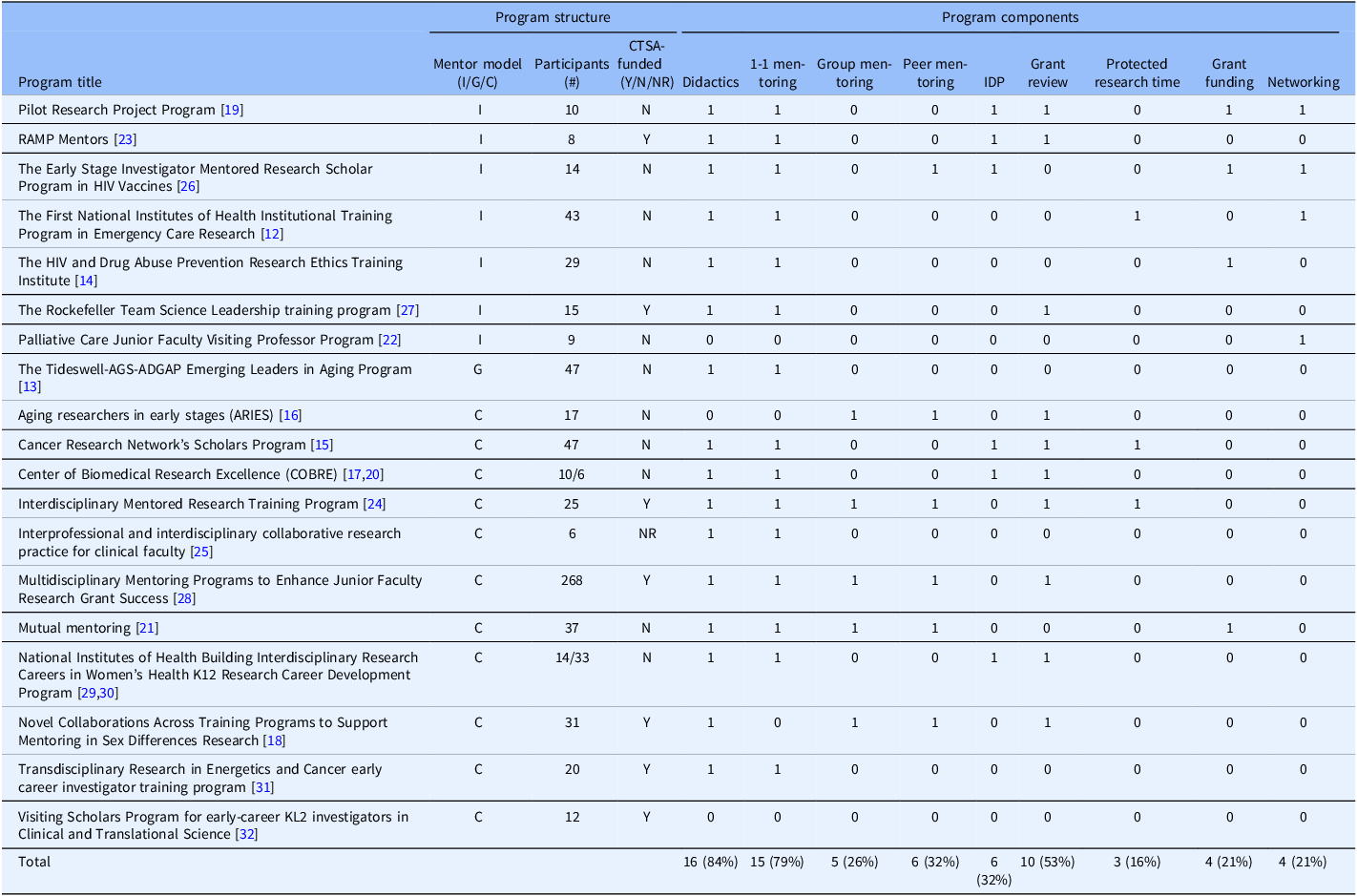
The majority of the programs included didactic training for participants (n = 16) focused mostly on research productivity, grant writing, and overall professional development (Table 1). Mentoring was a program component that was delivered in a variety of ways, including one-on-one mentoring (n = 15), group mentoring (n = 5), and peer mentoring (n = 6). Grant review opportunities occurred in half of the programs (n = 10). Other less common components that were present in some programs included individual development plans (n = 6), funds and resources to conduct research (n = 4), protected time for research (n = 3), and campus visits for visiting scholars (n = 3) or networking receptions (n = 1).
Program component summary table for manuscripts selected for extraction. Inclusion of program components such as didactics, 1-1 mentoring, group mentoring, peer mentoring, individual development plans (IDP), grant review panels, protected research time, grant funding, and networking opportunities were identified and tallied. The specific mentoring model implemented by each program is indicated as I – Individual, G – Group, or C – Combination. Funding through a dedicated CTSA program is indicated as Y – Yes, N – No, or NR – Not Reported. Note, other sources of funding may have been reported in the manuscript, though not summarized here

Table 1. Long description
Table 1 summarizes 19 early-career research mentoring programs, including mentoring model, number of participants, CTSA funding, and nine program components. Mentoring models were classified as individual, group, or combination approaches. Programs varied substantially in size and structure. Didactics and one-to-one mentoring were the most common components, reported in 16 (84%) and 15 (79%) programs, respectively. Grant review was included in 10 (53%) programs. Individual development plans and peer mentoring were each included in 6 (32%), while group mentoring was included in 5 (26%). Grant funding and networking opportunities were each included in 4 (21%), and protected research time was least common, appearing in 3 (16%) programs. CTSA funding status was also reported for each program as yes, no, or not reported.
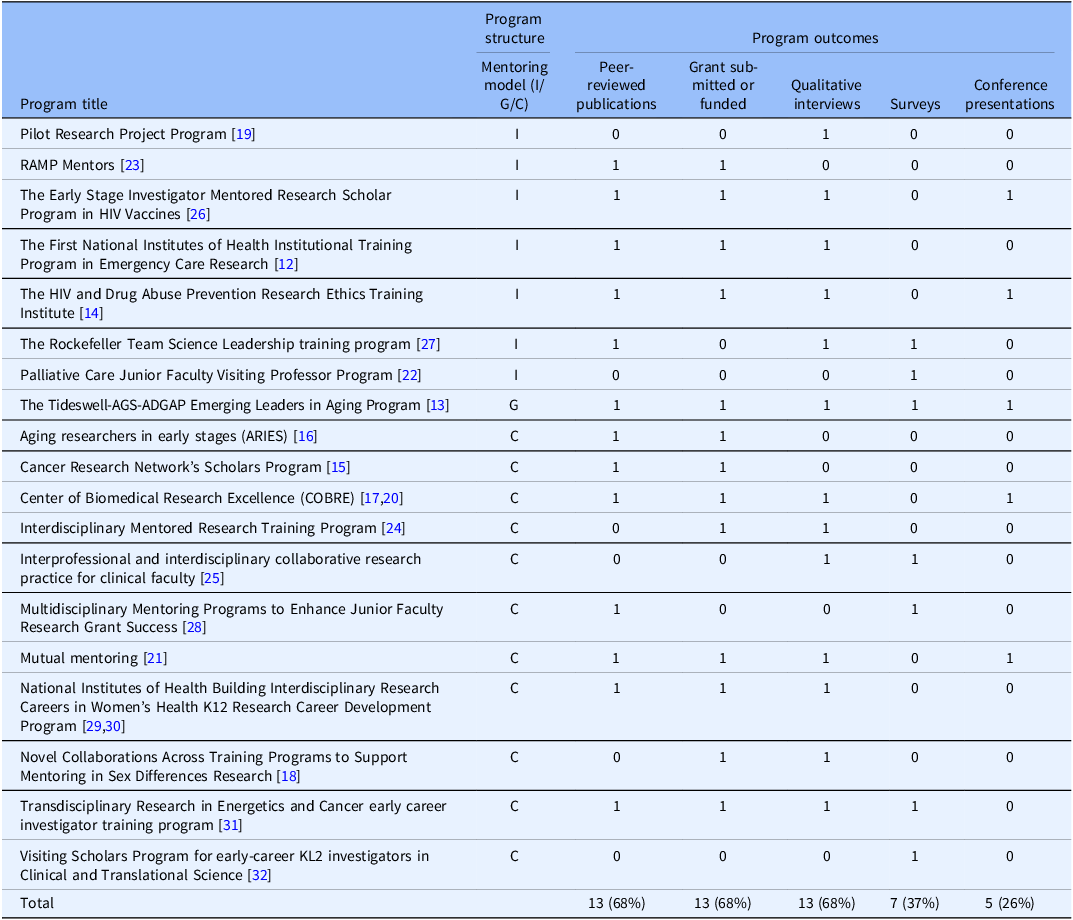
As illustrated in Table 2, program outcomes were assessed differently across the manuscripts. Many programs assessed success based on the number of grants that scholars submitted and/or had funded (n = 13) and the number of peer-reviewed publications (n = 13) the scholars had by the end of the program or in a certain follow-up window after completion of the program. It was also common for outcomes to be assessed based on qualitative reports (e.g., interviews with participants) (n = 13). Some programs also included participant surveys (n = 7) addressing concepts such as satisfaction and knowledge acquisition. Conference presentations were a less common metric of success used in five of the programs.
Program outcome(s) summary table. Manuscripts included for extraction were assessed for qualitative and quantitative measures of programmatic success, including peer-reviewed publications, grants submitted/funded, qualitative interviews, surveys, and conference presentations resulting from scholar’s participation in the program. The specific mentoring model implemented by each program is indicated as I – Individual, G – Group, or C – Combination

Table 2. Long description
Table 2 summarizes outcomes reported across 19 early-career research mentoring programs, organized by individual, group, or combination mentoring models. Five outcomes were assessed: peer-reviewed publications, grants submitted or funded, qualitative interviews, surveys, and conference presentations. Peer-reviewed publications, grant submissions or funding, and qualitative interviews were the most frequently reported outcomes, each occurring in 13 programs (68%). Surveys were reported in 7 programs (37%), while conference presentations were reported least frequently, occurring in 5 programs (26%). Programs varied in the number and combination of outcomes used to assess programmatic success.
Relationships between program components and reported outcomes
Programs reporting improvements in publications, grant submissions, or grant funding generally combined mentoring with other career-development components, particularly didactics, structured grant or manuscript review, protected research time, research support, and opportunities for interdisciplinary collaboration. Programs incorporating individual mentoring alongside group, peer, or team-based mentoring commonly reported broader professional networks, interdisciplinary collaborations, increased research confidence, and continued engagement with program colleagues. Peer and cohort mentoring were particularly associated with collaborative learning, grant feedback, network development, and participants’ later transition into mentoring or leadership roles.
Several programs illustrate these patterns. The Cancer Research Network Scholars Program combined individual mentoring with didactics, an individual development plan, grant review, and protected research time and reported subsequent grant attainment, research leadership, and career advancement. The Interdisciplinary Mentored Research Training Program combined individual, group, and peer mentoring with didactics, grant review, and protected time and reported research productivity and continued professional collaboration. Similarly, the multidisciplinary grant-development program paired individual mentors with senior reviewers, peer working groups, grant-writing support, and an internal study section and reported higher NIH funding rates than a historical institutional benchmark.
The two evaluations of the CPVB COBRE program reported complementary outcomes: one emphasized longitudinal publications, grants, and career progression, whereas the other assessed mentoring quality, research self-efficacy, interdisciplinary collaboration, and preparedness. The two BIRCWH evaluations similarly examined both developmental outcomes – such as confidence, perceived support, and satisfaction – and objective outcomes, including publications, funding, and interdisciplinary collaboration. Collectively, these findings indicate that programs with multilevel mentoring and substantial career-development infrastructure reported both academic productivity and developmental benefits. However, none of the manuscripts directly compared mentoring models, and mentoring was generally delivered together with several other program components; therefore, the contribution of any individual mentoring model or component could not be isolated.
Discussion
Summary of evidence
We identified 21 articles and 19 programs in the United States focused on training and mentorship in interdisciplinary, health-related research for ECIs in the context of clinical and translational research. For ease of review, we focused on programs based in the U.S. Many programs included formal didactics and mentoring as major components of training. Outcome assessments varied across programs, indicating the lack of standardized success measures and creating difficulty with inter-program comparisons. As many programs were relatively young, outcomes discussed were short term, such as reporting grant submissions and peer reviewed publication records during or immediately after program participation. Long term impact measures have yet to be determined and it would be helpful for future studies to present long term results. Additionally, many programs had a small number of participants, limiting the ability to observe and discuss trends, and ultimately the generalizability of findings.
We also saw a notable gap in initiatives specifically tailored to ECIs. While interdisciplinary collaboration and mentorship are acknowledged as critical components of scientific advancement, few programs focus exclusively on supporting ECIs in this regard. Many programs that appeared in our search but deemed ineligible were intended for baccalaureate and graduate students, or were open to a wide range of participants across multiple academic levels, from students to senior faculty. This lack of targeted support may limit the development of ECIs, who often face unique challenges in establishing interdisciplinary networks and securing sustained mentorship. More focused program development could enhance career progression and collaborative capacity during a pivotal stage of academic growth.
It was also notable that most programs despite a translational and interdisciplinary focus, included aspects of traditional mentoring such as the dyadic relationship focused on career development as opposed to group mentoring and mentorship with multiple mentors across disciplines. With a shift towards cross-disciplinary research, mentoring programs must incorporate new practices that prioritize that support ECIs as individuals and as members of research teams [Reference Olivero8].
Limitations
Although we undertook a comprehensive review of the literature to answer our research question, there are several limitations to report. We focused on publications only from the last ten years. This was purposeful to minimize influences attributable to technology and technological advances. However, it means we cannot consider the approaches described in or trends associated with articles published before 2014. We also recognize that the COVID-19 pandemic substantially influenced how research was performed, rapidly escalating the proliferation of team science. Likewise, the COVID-19 pandemic re-shaped mentorship and research meeting practices shifting from a dominant in-person to teleconference culture in a very short period [Reference Junn, Whitman and Wasnik33]. Even the ways in which collaborators interacted was impacted. Collaboration across institutions and even within institutions has shifted in the ways that Zoom and other telecommunication platforms facilitate work across teams and may reduce barriers to scheduling meetings [Reference Johnson, Gandhi and Fuchs34]. These changes have continued to evolve since 2020 and the data reported in the articles that met inclusion criteria were mostly from before the COVID-19 pandemic. Thus, we were unable to categorize and capture effects of the pandemic into our analysis. The limited post-COVID data was consistent with findings from other studies seeking to examine the impact of COVID on ECIs [Reference Lokhtina, Castelló and Lambrechts35].
We also chose to limit the search to only records that explicitly used a term related to mentorship (Mentor* OR Protégé* OR Mentee*) in the title, abstract, or keywords. This was deliberate as mentorship is distinct from related concepts like coaching, advising, apprenticeships, etc. However, this means we did not consider references that describe relevant practices of mentorship using other terms.
Furthermore, we only included programs taking place in the United States to control for differences in US based research compared to international research training and culture. Therefore, important trends or approaches in international contexts are not included in this study. Likewise, the findings may not be generalizable to those outside of the US. Selected programs focused solely on doctorate-level researchers that had completed their post-graduate training and were engaged in early career or junior faculty positions at their respective institutions. These constraints limit generalizability to professionals engaged in post-graduate training in medicine such as residents or fellows or within academia such as undergraduate, graduate and post-doctoral students.
Important limitations also arose from the underlying evidence base. Publications, grant submissions, awards, and subsequent funding were the most common measures of success. Although meaningful indicators of academic productivity and research independence, these outcomes are incomplete measures of mentoring effectiveness and may also reflect participant selection, protected time, funding, institutional infrastructure, access to collaborators, and career maturation. Because mentoring was typically embedded within broader career-development programs, its independent contribution could not be isolated. One study found increased grant submissions and awards without improved proposal-to-award success, suggesting greater application activity or persistence rather than improved funding success per proposal [Reference Libby, Hosokawa, Fairclough, Prochazka, Jones and Ginde24]. In addition, interdisciplinary, multicomponent mentoring programs were associated with productivity and professional development, but evidence that mentoring itself caused these outcomes-or that one mentoring model was superior remains limited.
Lastly, we included only programs with reported outcomes and metrics in order to gauge effectiveness of mentorship (i.e., productivity, grants awarded). As a consequence, newer programs within the US that do not yet have outcome data to report are not represented. Within academic medicine and more broadly healthcare research, we also did not include programs focused solely on mentorship in the generation and development of quality improvement research projects.
Conclusions
Overall, the literature reveals a scarcity of guidance on effective mentoring practices ECI engaged in interdisciplinary health research beyond established institutional and individual career development awards. Our review shows that most documented mentorship efforts arise from NIH-funded translational science programs, underscoring both their value and the growing need for more diverse, interdisciplinary models amid a shifting federal landscape. These findings highlight the importance of expanding mentorship and training opportunities for ESIs and point to ways that institutions, foundations, and industry partners can strengthen professional development support. Future evaluations should pair objective measures of productivity, advancement, and research-career retention with validated developmental and relational outcomes. Longitudinal analyses with appropriate comparison groups are also needed to distinguish the effects of mentoring from those of broader program infrastructure. Such investment is essential to help emerging scientists thrive in evolving research environments and to sustain the advancement of clinical and translational science.
Study highlights
-
• What is the current knowledge on the topic?
Beyond formal institutional (KLs and K12) and individual career development awards (e.g., K08, K23), there is limited literature on effective mentoring practices for ECIs who engage in interdisciplinary research in the health sciences.
-
• What question did this study address?
What practices for mentorship in research partnerships in health-related interdisciplinary research are described in the literature?
-
• What does this study add to our knowledge?
This study highlights the prevalence of NIH-funded mentorship programs in translational science. While these programs are effective, with the shifting federal landscape, there may be a growing need to provide robust and interdisciplinary mentorship to ECIs in the health sciences.
-
• How might this change research practices in clinical or translational science?
This work emphasizes the importance of interdisciplinary mentorship and training for ECIs in the clinical and translational sciences. It identifies potential ways that institutions and other corporate and foundation partners might invest in supporting the professional development of new investigators. This support is critical as ECIs navigate uncertain and evolving environments, advancing scientists and their science for years to come.
Supplementary material
The supplementary material for this article can be found at https://doi.org/10.1017/cts.2026.10849.
Author contributions
Lora Henderson Smith: Conceptualization, Data curation, Writing – original draft, Writing – review & editing; Jennifer Hendrick: Conceptualization, Data curation, Formal analysis, Writing – original draft, Writing – review & editing; Jamie L. MacLeod: Conceptualization, Data curation, Formal analysis, Writing – original draft, Writing – review & editing; Mary M. Wesley: Conceptualization, Data curation, Writing – review & editing; Roberto Silva: Data curation, Software, Writing – original draft; C. Cozette Comer: Data curation, Software, Writing – original draft, Writing – review & editing; Taylor Tapscott: Formal analysis, Writing – original draft; Caitlyn J. Collins: Conceptualization, Data curation, Formal analysis, Writing – original draft, Writing – review & editing.
Funding statement
LHS, JH, JLM, and CJC are all integrated Translational Research Institute of Virginia (iTHRIV) Scholars. MMW is a former iTHRIV Scholar. The iTHRIV Scholars Program is supported in part by the National Center for Advancing Translational Sciences of the National Institutes of Health under Award Numbers UL1TR003015 and KL2TR003016.
Competing interests
The authors declare that they have no conflict of interest.



 Open access

