INTRODUCTION
Carbonate binding materials used in building construction, if appropriate preparatory procedures are applied, can be an excellent substance for radiocarbon (14C) dating—depending on their detailed composition. This is enabled by absorption of CO2 from the air during their hardening process, and thereby by binding of the isotope 14C. Mortars are a mixture of binder and aggregate in various proportions. Their age is strictly connected with the time of building construction. The difficulty in dating of carbonate mortars and plasters comes from possible content of carbonates of different origin, which were not involved in the burning process (e.g. aggregate, partially burnt fragments, powdered admixtures reacting with carbonates) and, as a consequence, they did not absorb CO2 during hardening. The presence of carbonate aggregate in the binder may have a significant impact on the result of the 14C dating, causing the effect of ageing of the dated sample (Baxter and Walton Reference Baxter and Walton1970; Van Strydonck et al. Reference Van Strydonck, Dupas, Dauchot-Dehon, Pachiaudi and Marechal1986; Heinemeier et al. Reference Heinemeier, Jungner, Lindroos, Ringbom, Von Konov and Rud1997, Reference Heinemeier, Ringbom, Lindroos and Sveinbjörnsdóttir2010; Nawrocka et al. Reference Nawrocka, Michniewicz, Pawlyta and Pazdur2005, Reference Nawrocka, Czernik and Goslar2009; Lindroos et al. Reference Lindroos, Heinemeier, Ringbom, Braskén and Sveinbjörnsdóttir2007, Reference Lindroos, Heinemeier, Ringbom, Brock, Sonck-Koota, Pehkonen and Suksi2011, Reference Lindroos, Orsel, Heinemeier, Lill and Gunnelius2014; Michalska Nawrocka et al. Reference Michalska Nawrocka, Michczyńska, Pazdur and Czernik2007; Goslar et al. Reference Goslar, Nawrocka and Czernik2009; Ringbom et al. Reference Ringbom, Heinemeier, Lindroos, Brock, Ringbom and Hohlfelder2011, Reference Ringbom, Lindroos, Heinemeier and Sonck-Koota2014; Hajdas et al. Reference Hajdas, Trumm, Bonani, Biechele, Maurer and Wacker2012, Reference Hajdas, Lindroos, Heinemeier, Ringbom, Marzaioli, Terrasi, Passariello, Capano, Artioli, Addis, Secco, Michalska, Czernik, Goslar, Hayen, Van Strydonck, Fontaine, Boudin, Maspero, Panzeri, Galli, Urbanova and Guibert2017; Michalska et al. Reference Michalska, Pazdur, Czernik, Szczepaniak and Żurakowska2013; Nonni et al. Reference Nonni, Marzaioli, Secco, Passariello, Capano, Lubritto, Mignardi, Tonghini and Terrasi2013). Hence, comes the necessity of eliminating it in the stage of preparation of the sample for measuring (Nawrocka et al. Reference Nawrocka, Czernik and Goslar2009; Marzaioli et al. Reference Marzaioli, Lubritto, Nonni, Passariello, Capano and Terrasi2011, Reference Marzaioli, Nonni, Passariello, Capano, Ricci, Lubritto, De Cesare, Eramo, Castillo and Terrasi2013; Ringbom et al. Reference Ringbom, Heinemeier, Lindroos, Brock, Ringbom and Hohlfelder2011; Michalska and Czernik Reference Michalska and Czernik2015; Hajdas et al. Reference Hajdas, Lindroos, Heinemeier, Ringbom, Marzaioli, Terrasi, Passariello, Capano, Artioli, Addis, Secco, Michalska, Czernik, Goslar, Hayen, Van Strydonck, Fontaine, Boudin, Maspero, Panzeri, Galli, Urbanova and Guibert2017). Mortars may contain aggregate of various fractions, composition and proportions in relation to the binder. In the case of very fine aggregate, the elimination of the carbonate contamination is extremely difficult, depending on the type and the state of preservation of the research material.
Additional factors influencing 14C age are not fully burnt fragments of carbonate rocks, which occur in a dated mortar. Secondary crystallization of carbonates (not observed in the dated samples), can also modify the 14C age, depending on geoenvironmental conditions, or as a result of reaction between mortar carbonates and additives, e.g. crushed bricks, ceramics, etc.
Charcoal from mortars, often used as a comparative material, should also follow proper preparation procedure, depending on its level of preservation and environmental conditions of its location (Berger Reference Berger1992; Cohen-Ofri et al. Reference Cohen-Ofri, Weiner, Boaretto, Mintz and Weiner2006; Rebollo et al. Reference Rebollo, Cohen-Ofri, Popovitz-Biro, Bar-Yosef, Meignen, Goldberg, Weiner and Boaretto2008). Complications with charcoal dating are connected not only with the risk of its origin from old wood, and in consequence with the date over-aging referring to a real time of construction of a building, from which the mortar was sampled. Depending on the conditions experienced by a sample, charcoal may also reflect an effect typical for activated carbon. Such presumption would explain the diversity of 14C dates obtained from charcoal pieces extracted from the same mortar, when their ages differ not only from the binder age, but also from each other (Hajdas et al. Reference Hajdas, Lindroos, Heinemeier, Ringbom, Marzaioli, Terrasi, Passariello, Capano, Artioli, Addis, Secco, Michalska, Czernik, Goslar, Hayen, Van Strydonck, Fontaine, Boudin, Maspero, Panzeri, Galli, Urbanova and Guibert2017; Michalska et al. Reference Michalska, Czernik and Goslar2017).
An inseparable relation between mortars and the time of construction of a building makes it important to find the methodology, which allows for obtaining the true age of their production (Michalska et al. Reference Michalska, Pazdur, Czernik, Szczepaniak and Żurakowska2013). It is an extremely difficult task, due to the composition of mortars, which is differentiated and most often connected with local geological structure, meaning the access to raw materials used for making mortars. Recent studies are focused mainly on establishing preparatory procedures appropriate for a given type of mortar, starting with dating of specific grain fractions, followed by sequential dissolution of grain fractions, up to dating of different portions of suspension from a mortar (Michalska et al. Reference Michalska, Czernik and Goslar2017). Another interesting issue is the isotopic fractionation connected with the process of mortar production (Pachiaudi et al. Reference Pachiaudi, Marechal, Van Strydonck, Dupas and Dauchot-Dehon1986; Ambers Reference Ambers1987; Van Strydonck et al. Reference Van Strydonck, Dupas and Keppens1989; Michalska and Czernik Reference Michalska and Czernik2015).
This paper presents the results of 14C dating of bulk mortars and reports an attempt of implementation of the knowledge about the isotope fractionation, based on δ13C measurements, to make the “reservoir” age correction for mortars. Verification of such correction has been based on the percentage estimation of specific carbonate components in mortars using petrographic studies. The δ13C measurements and 14C dating have been performed both for the mortars and plasters from Sussita, as well as for experimental mortars. This work is of a methodological aspect and refers to the possibility of age modeling on the basis of δ13C measurement and the sample composition.
HISTORICAL DEVELOPMENT OF THE SETTLEMENT
On the eastern shore of the Sea of Galilee (Lake Kinneret), on a hill, about 350 m above the lake surface, an ancient city Sussita (in Aramaic, in Greek named “Hippos”) is located. It lies about 2 km east from the modern city of En Gev (Figure 1). One of the oldest historical sources mentioning Sussita is Historia naturalis by Pliny the Elder, which indicates the city affiliation with Decapolis. The excavations conducted there allowed for determining the history of the city. It was founded in 3rd cent. BC, during the reign of Rome it belonged to the group of cities Decapolis, and in the Byzantine times (5th–6th AD) Sussita prospered as a bishopric capital. In the 7th century, the Sasanian invasions of Levant, and later Islamic conquest could lead to desolation of the city. Finally, Sussita was destroyed by an earthquake in 749 AD.
General view of research area together with simplified geological map of Sussita region (modified after Geological Survey of Israel 2008; Mor et al. Reference Mor, Michelson, Druckman, Mimran, Heimann, Goldberg and Sneh1997; Shtober-Zisu Reference Shtober-Zisu, Segal, Eisenbe, Młynarczyk, Burdajewicz and Schuler2013); DST—Dead Sea Transform (Eppelbaum et al. Reference Eppelbaum, Ben-Avraham and Katz2004); 1–Alluvium; 2–Cover Basalt, Pliocene; 3–Lower Basalt Fm., Middle-Late Miocene; 4–Hordos Fm., Middle-Late Miocene, conglomerates, calcareous sandstones, marly chalks, marls; 5–En Gev Fm., Middle Miocene, sandstones and sandy limestones, limestones and marls; 6–Sussita Fm., Oligocene-Early Miocene, limestones, marls, sandy dolomites, cherts; 7–Fiq Fm, Late Eocene-Oligocene, limestones rich in marine microfauna, chalks, marls; 8–Maresha Fm., Middle Eocene, chalk; 9–fault.

Most of the samples were taken from North-Western Church and its immediate surroundings. The North-Western Church is a three-nave basilica preceded by a square, cobbled courtyard. One sample comes from the church on the eastern side of the settlement (North-Eastern Church). Previous archaeological survey allowed to distinguish three chronological phases of the North-Western church. Phase I was connected with building of the church (around 5th century AD); phase II: dated to the end of the 6th century due to a wide range of decorative motifs occurring in mosaic floors and phase III included expanding the presbytery through installing balustrades in the aisles, most probably in the 7th century. The church functioned until the earthquake in 749. The south wall of North-Western church touches such devices as olive press and wine press, contemporary to II or even III phase of the basilica. This church was raised on an earlier, Roman temple (Młynarczyk Reference Młynarczyk2000; Segal et al. Reference Segal, Młynarczyk, Burdajewicz, Schuler and Eisenberg2004).
GEOLOGY OF THE AREA
In the aspect of the petrographic studies, as well as the isotopic fractionation measurements, a significant part of research is examination of the local geology. This knowledge gives an insight to the information about the raw materials used for mortars production. Sussita is located on the eastern shore of the Sea of Galilee, on the western slopes of the Golan Heights, almost entirely encircled by mountains. The Sea of Galilee is located in the northern part of the Jordan Rift Valley. This ancient site is located on the flat-topped mountain, at an altitude of 142 m asl (Shtober-Zisu Reference Shtober-Zisu, Segal, Eisenbe, Młynarczyk, Burdajewicz and Schuler2013).
The Golan Heights are the volcanic plateau with the lava flows covering older geological structures (Mor et al. Reference Mor, Michelson, Druckman, Mimran, Heimann, Goldberg and Sneh1997). Two main phases of basaltic volcanism can be distinguished in the area of the Sea of Galilee: Early-Cretaceous and Late-Cenozoic (from Miocene to Pleistocene). The first one gives in the lake area the lowest thickness in the Northern Israel. The majority of basaltic exposures is therefore of the Pliocene-Pleistocene age. In the discussed area, several fault systems/zones have been distinguished (Eppelbaum et al. Reference Eppelbaum, Ben-Avraham and Katz2004; Meiler Reference Meiler2011). The Sea of Galilee is a part of a N–S extended pull-apart basin. There are a few such tectonic structures along the Dead Sea Transform fault system (Garfunkel, Reference Garfunkel1981; Ben-Avraham et al. Reference Ben-Avraham, Lazar, Schattner, Marco and Wenzel2005; Katz et al. Reference Katz, Amit, Yagoda-Biran, Hatzor, Porat and Medvedev2011). Several large historic earthquakes in this region are the results of tectonic activity of the Jordan Valley Fault (Ben-Menahem Reference Ben-Menahem1991; Guidoboni et al. Reference Guidoboni, Comastri and Traina1994; Guidoboni and Comastri Reference Guidoboni and Comastri2005). The most destructive earthquake in the discussed area occurred in 749 AD (Reches and Hoexter Reference Reches and Hoexter1981) and caused devastation of the cities of this region, e.g. Sussita, Tiberias and the village of Umm El Qantir (Marco et al. Reference Marco, Hartal, Hazan, Lev and Stein2003; Wechsler et al. Reference Wechsler, Katz, Dray, Gonen and Marco2009). All these settlements are located at a radial distance of less than 15 km from the Jordan Valley Fault (Katz et al. Reference Katz, Amit, Yagoda-Biran, Hatzor, Porat and Medvedev2011).
The steep slopes of the Golan Heights falling to the shore of the Sea of Galilee are formed mainly from lacustrine and fluvial sediments of Miocene age. The area is tectonically rebuilt by numerous faults. The presented map (Figure 1) shows the geological setting of the Sussita region. The limestone formations, which could be the alimentation sources of raw material used for building construction are the Fiq Formation (Upper Eocene to Oligocene age; structure no. 7 in the Figure 1) and the concordantly overlying Sussita Formation (Oligocene do Lowest Middle Miocene; no. 6), as well as the En Gev Fm. (Middle Miocene; no. 5) or the Hordos Fm (Middle-Late Miocene; no. 4).
The Fiq Formation, which is the oldest exposed formation in this area (thickness 45 m), reaches its highest thickness in the Nahal En Gev area (Shtober-Zisu Reference Shtober-Zisu, Segal, Eisenbe, Młynarczyk, Burdajewicz and Schuler2013). It is formed by limestones rich in marine microfauna, chalk, and marl. Glauconite rocks also occur there (glauconitic calcarenite). The Sussita Formation is built of limestones, marls, sandy dolomites, cherts, and loose yellow sands. This formation reaches its maximum thickness near Sussita (145 m). The Sussita Fm. is discordantly overlain by the En Gev Sands and Hordos Formation. The sands of En Gev represent the beginning of the continental cycle. They come from Middle-Upper Miocene. Their thickness is around 90 m and they occur in the vicinity of Sussita-Qeren, En Gev (Mor et al. Reference Mor, Michelson, Druckman, Mimran, Heimann, Goldberg and Sneh1997). The En Gev Formation is built mainly of sandstones and sandy limestones, limestones and marls (Michelson et al. Reference Michelson, Flexer and Erez1987). The Hordos formation is composed of conglomerates, calcareous sandstones, marly chalks and marls (thickness 242 m; Meiler Reference Meiler2011).
The outcrops of Hordos Formation are exposed all over the surrounding of the Sea of Galilee (Shtober-Zisu Reference Shtober-Zisu, Segal, Eisenbe, Młynarczyk, Burdajewicz and Schuler2013). These Miocene-age formations were deposited on the Eocene substratum and overlain by the Gesher Formation or capped by the Plio-Pleistocene basalt cover (Michelson et al. Reference Michelson, Flexer and Erez1987). The Gesher Formation in the Sussita area comprises a sequence of limestones, chalks, detritic limestones and abundant clays at the top (Shaliv Reference Shaliv1991; Shtober-Zisu Reference Shtober-Zisu, Segal, Eisenbe, Młynarczyk, Burdajewicz and Schuler2013). The two streams, Ein Gev and Sussita, crosscut the lithological succession of the Lower and Middle Pleistocene. From one side, the Ein Gev channel gives the outcrops of the limestones belonging to the Sussita Fm., while on the second side the conglomerates are accessible at the river terraces within the Sussita channel (Shtober-Zisu Reference Shtober-Zisu, Segal, Eisenbe, Młynarczyk, Burdajewicz and Schuler2013).
METHODS AND SAMPLES
This study aims to determine accurate ages of mortars, based on 14C measurements of bulk samples, being mixtures of binder and aggregate. The obtained dates have been refined using the corrections on isotopic fractionation and mineral composition of the sample.
The petrographic observations were made using polarized light microscope Olympus AX 70-Prons and the binder-aggregate ratio were estimated with the software AnalySIS (Soft Imaging System). Mortars components and proportions of aggregate to binder, were additionally investigated using the scanning electron microscope with EDS microanalyzer (Hitachi S-3700N in Institute of Geology, Poznań).
The 14C measurements have been made in the Gliwice Radiocarbon Laboratory by conventional techniques (Pazdur et al. Reference Pazdur, Michczyński, Pawlyta and Spahiu2000). The mortars were crushing and gridding and then total dissolution with HCl (37%) take place. Apart from 14C, also δ13C and δ18O of bulk material were measured using standard off-line IRMS procedure and 106% H3PO4.
For the samples, where the separation of carbonate mortar fragments was successful, additional measurements of δ13C and δ18O in these fragments have been carried out (Tables 1 and 2). Stable isotope measurements were conducted in the Department of Radioisotopes, Gliwice, Institute of Physics, Silesian University of Technology, by the mass spectrometer IsoPrime coupled with MultiFlow carbonate analysis system. 103% phosphoric acid was used for carbonates decomposition. Multi-point calibration method was applied for the isotopic δ calculations.
The isotopic composition measurements for different samples (for average values for binder from chosen mortars, see Supplement 1); SD—Standard Deviation. Both experimental binders were produced (from Sussita raw material) in Polish climate conditions. As comparison, the δ13C of binder for sample 10H (pure finishing plaster devoid of aggregate, containing only carbonaceous binder and the empty spaces after straw), is 9.93‰VPDB (from –9.5 to –10.35‰VPDB, Michalska Nawrocka et al. Reference Michalska Nawrocka, Michczyńska, Pazdur and Czernik2007).

14C measurements results together with corrected ages of mortars. The age correction for bulk material was possible using the calculations presented in Eq. (1.1–1.5). Uncertainty for both δ13C and δ18O determinations of bulk material was equal or better than 0.1‰. Measured δ13C of different samples are placed in Table 1, and the average measured δ13C of binder for each mortar are presented in Supplement 1; IRMS—stable isotope ratio mass spectrometry.

The following samples were subjected to the latter analyses: 61H—facade of the pastophorium northern wall, 76H—floor of the first step of the wine press tank, N of of the pastophorium, 151, 2H—layer of plaster (second out of four) in the tank of the wine press, to the north of the pastophorium, A1/H—NE church, plaster from the apse, 14H—floor pour of channel exposed at the chancel area, 80H—interior of one of the twin tombs, in the “mortuary room,” 5H—cistern in the church atrium, material from its inner wall (see Supplement 1). All samples were collected carefully, as close to the facade as possible, due to the possibility of delayed hardening for samples taken too deeply.
The first samples of lime mortars from Sussita, in the form of different grain fractions, have been dated using the GPC and AMS techniques in Gliwice (Gd-) and Poznań (Poz-) laboratories (Michalska Nawrocka et al. Reference Michalska Nawrocka, Michczyńska, Pazdur and Czernik2007). The bulk material measurements have been also supplemented by suspension dating and compared with previous charcoals and grain fraction measurements (Michalska Nawrocka et al. Reference Michalska Nawrocka, Michczyńska, Pazdur and Czernik2007, Figure 4). In case of the sample 61H, the thin layer of the binder that covered small pieces of basaltic aggregate (Poz-16078; Michalska Nawrocka et al. Reference Michalska Nawrocka, Michczyńska, Pazdur and Czernik2007) was dated. Apart from bulk mortars measurements, the suspension portions of mortar 61H was additionally dated in recent studies (Michalska Reference Michalska2019). The second portion of suspension—repeated suspension from mortar 61H were dated after collecting gas in a first 5 sec of leaching (Poz-97862). Whereas, for sample A1/H, the binder fraction 45–100 μm (Gd-17381) and for mortar 14H, the charcoal fragment (Poz-5088), was dated in previous studies (Michalska Nawrocka et al. Reference Michalska Nawrocka, Michczyńska, Pazdur and Czernik2007). The obtained calibrated age was calibrated by using OxCal 4.3 program (Bronk Ramsey Reference Bronk Ramsey2009) and IntCal13 curve (Reimer et al. Reference Reimer, Bard, Bayliss, Beck, Blackwell, Ramsey, Grootes, Guilderson, Haflidason, Hajdas, Hattž, Heaton, Hoffmann, Hogg, Hughen, Kaiser, Kromer, Manning, Niu, Reimer, Richards, Scott, Southon, Staff, Turney and Van der Plicht2013).
EXPERIMENTAL AND SUSSITA BINDER
Apart from the mortars, also the rock fragments cropping out adjacent to the archaeological site, namely sandy-dolomite and dolomite (Sussita Fm.) were subjected to analyses (Table 1). To understand the mechanism of isotopic fractionation during mortars production in the Sea of Galilee area, the attempt to experimentally produce the binder made of the carbonate rocks from the outcrops near the Sussita excavation site (Sussita Fm.) has been carried out. Both the raw material (rocks) and the binder obtained from it were carefully characterized and destined for the δ13C and δ18O measurements. The binders were made without aggregate admixture, to eliminate the measurement disturbances, to preserve the homogeneity of a sample, and to avoid influence of fossil carbon.
A thin layer of binder (estimated at 0.5–2 mm) has been produced, in order to guarantee the fast binding process, which would take part uniformly in the entire sample. The studied samples have been kept in aerial conditions, at room temperature, i.e. close to the expected temperatures of mortars stiffening and carbonation, during the historical times in Israel. The selected carbonate rocks from the Sussita area have been burnt for ten hours in 950ºC. In this process, quicklime (CaO) is formed, which after the contact with water transforms into Ca(OH)2. The latter is an exothermic reaction. As in case of historical mortars, during the production of their experimental analogues, the water was added in excess, to achieve the complete reaction and to make the slurry more feasible. All efforts have been made to obtain the highest possible homogeneity of the experimental samples, apart from the diversity connected to the composition of raw material, that means of the carbonate rocks.
We tried to exclude some aspects mentioned by Van Strydonck et al. (Reference Van Strydonck, Dupas and Keppens1989), e.g. reaction kinetics controlled by the exhaustion of the reagents as a function of depth, the diffusion rate as a function of the partial pressure of CO2 in the atmosphere, the permeability of the mortar and the amount of Ca(OH)2 in a sample. We made a very thin layer of binder, which has been left in the open space without unidirectional wind, sheltered from rainfalls, until it bound and hardened. In the present research, we do not try to compare the samples’ state of calcination dependent on depth, or composition, but rather to apply the isotopic fractionation measurements for the correction of 14C ages. To make the wide comparison, not only the natural samples of carbonate rocks, and the experimental binders produced from them, but also the archaeological samples (61H, A1/H, 151,2H, 14H, 80H, Table 1) have been subjected to the isotopic measurements.
PETROGRAPHY (CHARACTERISTIC) OF SAMPLES
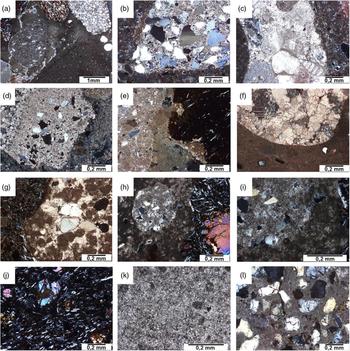
The presented outline of the geology of the area and the description of the formations occurring in the vicinity of Sussita shows the available raw materials. The reflection of the local geological structure can be clearly found in the aggregate (Figure 2). Taking into account the geological setting of the study area, and petrography of both the historical mortars and the rocks used for their production, the mortars could contain, apart from lime and dolomitic binder, also basalt fragments, clay minerals and different kinds of carbonate aggregate, e.g. organogenic limestone, sandy-limestone, sandy-dolomite, marls. The estimations of the binder/carbonaceous aggregate ratio (Table 2) were based on studies of at least 2 thin sections from the same (dated) mortar. The uncertainties of estimation of binder/aggerate ratio for dated mortar were ca. 1%.
Petrography of analyzed mortars and raw material. A–61H with basalt fragments and different carbonaceous aggregate (sandy dolomite, limestone, marly limestone); B, C–carbonaceous aggregate from mortar 76H; B–sandy dolomite as aggregate; C–organogenic limestone; D–151,2H, the layered carbonaceous rock; E–mortar 5H, sandy dolomite and volcanic rock aggregate; F–A1/H with carbonaceous aggregate (marble?); G–14H, with aggregate of carbonaceous rock with singular quartz (siderite); H, I–80H with sandy dolomite aggregate and basalt fragments (H); J–basalt from Sussita hill with visible olivine and iddingsite; K–DGol-dolomite from Sussita Fm; L–SGol-sandy dolomite from Sussita Fm (used for experimental research).

MODELING OF δ13C IN BINDERS AND AGE CORRECTION
Petrographic observations indicate different proportions, size, and type of the aggregate used in mortars and plasters, hence a significant discrepancy of the obtained results for bulk mortars with historical age is observed. The shift in ages varies for different mortars from ca. 1000 (A1/H) up to 6000 (5H) years toward older ages. Moreover, it is expected to see discrepancies between dating results for mortars with different proportion of binder to aggregate (Table 2, Figure 3). As the samples were dated in the bulk form (lime binder with carbonate aggregate), it was necessary to implement the correction for the content of carbonates from the different source that the binder.
Calibration of the results in graphical form of bulk material and after applying the age corrections; 61H–mortar name; tot–bulk material; petro–age correction based on petrographic observation; IRMS–corrections based on measured carbon isotope composition of binder; model–corrections based on modeled δ13C of binder; 61H/tot–bulk material of mortar 61H. The archeological estimations for dated samples are given in Supplement 1 and marked on the figure with shaded bars; orange bar–for air-hardening, open-air samples; blue bars–samples from humid conditions with limited airflow.

An attempt has been made to correct the ages obtained for the samples of mortars dated in bulk form, using the data related to the carbon isotopic composition, which is reflected by the δ13C.
δ13C of the aggregate extracted from the 61H\K and for all the bulk sample have been measured by the isotope ratio mass spectrometer, whereas the indispensable value of δ13C for the binder has been modeled using Microsoft Excel’s solver module. The δ13C of binder has been modeled so that the corrected 14C age of mortar matched the archaeological context. δ13C of the 61H\K aggregate (–5.46‰VPDB) was used when modeling δ13C of the binders. This attempt allows to observe that the ratio of carbonaceous aggregate to binder estimated on the basis on modeled δ13C are similar to those obtained independently from petrographical research. The amounts of binders and aggregate in mortars acquired using the δ13C values, were verified by the estimated percentage of these components (Table 2) resulting from petrographic observations, made with the software AnalySIS (Soft Imaging System).
For the samples where enough material was available, the binder modeled δ13C (Table 2, column 11) was compared to δ13C from measurement (IRMS, Table 2, column 15).
Considering all the necessary procedures required for the 14C age calculation (Stuiver and Polach, Reference Stuiver and Polach1977), the age correction for binder and aggregate was possible using the following calculations:
 $$ \!{{\, {{{{\delta ^{13}}{C_b} - {\delta ^{13}}{C_a}} \over {{\delta ^{13}}{C_{bi}} - {\delta ^{13}}{C_a}}} = {{{m_{bi}}} \over {{m_b}}}} \,}} \right $$(1.1)
 $$ \!{{\, {{\delta ^{13}}{C_b} = {{{\delta ^{13}}{C_a} \times {m_a}} \over {{m_b}}} + {{{\delta ^{13}}{C_{bi}} \times {m_{bi}}} \over {{m_b}}}} \,}} \right $$(1.2)
 $$ \!{{\, {{A_{bi}} = {A_b}{{{m_b}} \over {{m_{bi}}}}} \,}} \right $$(1.3)
 $$ \!{{\, {{A_{bi}} = {A_b}{{{\delta ^{13}}{C_{bi}} - {\delta ^{13}}{C_a}} \over {{\delta ^{13}}{C_b} - {\delta ^{13}}{C_a}}}} \,}} \right $$(1.4)
 $$ \!{{\, {{t_{bi}} = - 8033 \times \ln{{{A_C}{{{m_b}} \over {{m_{bi}}}}} \over {{A_{std}}}}} \,}} \right $$(1.5)
where:
A—specific 14C radioactivity; m—mass; a—aggregate; std—standard, bi—binder, b—bulk.
DISCUSSION OF RESULTS
The correction of conventional ages obtained from measurements made on bulk samples, depends on carbonaceous binder to aggregate ratio, environmental conditions and on local geological formations used as a raw material for mortars and plasters production. The aggregate in the Sussita samples has mainly Miocene age and from the 14C dating point of view the age may be treated as infinite.
The modeled δ13C values for the binder enabled estimation of the carbonate fraction percentages, which were very close to the results obtained using petrographic observations for those components. Moreover, in the all cases where IRMS measurement of binder δ13C was possible, all the results (of binder to aggregate ratio) were consistent or similar with those obtained during modeling (Table 2, Supplement 1). The results of modeling (and measurements) made for different types of mortars (and plasters) show similar δ13C values for each type of carbon bonding mechanism in the sample (Tables 1 and 2 and Supplement 1), e.g. for finishing plaster (Hip10, caption of Table 1) and an open-air mortar (61H) from ca. –8 to –10‰VPDB (Table 1); for mortars covered by another layer of plaster or by mosaic, ca. –15‰VPDB, and for the samples from humid and colder conditions, closer to more negative values: –20, –23‰VPDB (as for Belgium mortars; Van Strydonck et al. Reference Van Strydonck, Dupas, Dauchot-Dehon, Pachiaudi and Marechal1986). That kind of estimation and modeling needs verifications for mortars from different climatic conditions, however it is very promising, especially when taking into account how difficult is to obtain pure binder fraction from archaeological mortar not only for 14C, but also for δ13C measurements. Looking on the Table 2, and Supplement 1, the δ13C gives the information about the mortar type.
The conducted research proved that the isotopic fractionation distinctly differs for mortars from various climatic conditions. Referring to the measurements made by Van Strydonck et al. (Reference Van Strydonck, Dupas, Dauchot-Dehon, Pachiaudi and Marechal1986, Reference Van Strydonck, Dupas and Keppens1989), the fractionation in the mortars from Israel, with a high average temperature, is different than in case of the mortars produced in colder environment. Therefore, the isotopic fractionation and δ13C values published by Van Strydonck et al. (Reference Van Strydonck, Dupas and Keppens1989) differ from those obtained for the historical mortars from Sussita. Such assumptions were also confirmed by the independent δ13C measurements of the experimental binders produced in Polish climate conditions from the raw materials coming from the vicinity of Sussita, Israel (Table 1). The δ13C values for these experimental binders are much more negative (B_DGOL1_k: –22.1‰VPDB; B_SGOL2_k: –25.6‰VPDB) than for the original historical binders formed on the site of Sussita (but similar to Van Strydonck et al. (Reference Van Strydonck, Dupas and Keppens1989) measurements of Belgium samples).
The results of 14C measurements after application of the appropriate petrographic corrections enabled to establish the age, which fell into the time range of the settlement existence (Figure 3). The further discussion focused mainly on the samples for which the age correction based on measured (IRMS, Supplement 1) carbon isotopic composition, was possible (enough material was available from: 61H, A1/H, 14H, 80H). For all samples, the corrected 14C age and the binder-aggregate ratio based on two different assumptions (“petro” and “model”), could be observed in Table 2.
For the mortar 61H, the obtained corrected age of this sample which was measured as bulk material, together with measurements of different portion of suspension from the same mortars revised the previous hypothesis regarding the age of this mortar (Michalska Nawrocka et al. Reference Michalska Nawrocka, Michczyńska, Pazdur and Czernik2007). The real age of mortar 61H obtained by 14C measurement of the second portion of suspension with CO2 collected in the first 5 sec of leaching reaction (61H/sus2/0-5s, Poz-97862, 1470 ± 30 BP; Michalska Reference Michalska2019), together with measurements of thin layer of binder covering basaltic aggregate (61H/>100, Poz-16078, 1490 ± 30 BP; Michalska Nawrocka et al. Reference Michalska Nawrocka, Michczyńska, Pazdur and Czernik2007) were verified (Figure 4) by the results obtained by application of appropriate corrections (61H/tot/petro: 1575 ± 90BP, 61H/tot/IRMS: 1657±90 and 61H/tot/model: 1550 ± 90BP) to the bulk mortar measurement (61H/tot, Gd-12824).
Calibration of 14C results for mortars for which beside modeled, also measured δ13C was applied to obtain corrected ages. To verify the obtained corrected and modeled ages, the reference data are presented and marked with arrows: Poz-16078, Gd-17381, Poz-5088, Michalska Nawrocka et al. 2007, and Poz-97862, Michalska Reference Michalska2019); tot–bulk material; petro–age correction based on petrographic observation; IRMS–corrections based on measured carbon isotope composition of binder; model–corrections based on modeled δ13C of binder; >100–separated basaltic aggregate (>100 μm) covered with film of binder; sus2/0–5s sec portion of suspension, gas collected after first 5 sec of leaching reaction; 45–100–grain fraction 45–100 μm; ch–charcoal. To distinguish the comparative, reference dates, they were additionally described by laboratory numbers and marked with arrows (a color consistent with shaded bars on Figure 3).

Considering plaster A1 from the North-Eastern church, with the composition similar to mortars (Figure 2), the obtained corrected ages (A1/H/tot/petro: 1374±55 BP, A1/H/tot/IRMS: 1268 ± 55 BP and A1/H/tot/model: 1300 ± 55 BP, Figures 3, 4) are within the time interval specified by the relative chronology and are also similar to the previous measurements for this sample (A1/H/45-100/Gd-17381, 1140 ± 130; Michalska Nawrocka et al. Reference Michalska Nawrocka, Michczyńska, Pazdur and Czernik2007)
Comparing obtained corrected ages of mortar 14H (14H/tot/petro: 1946 ± 80 and 14H/tot/model: 1950 ± 80 BP) with previous charcoal dating from the same mortar (14H/ch, Poz-5088, 2025 ± 80 BP; Michalska Nawrocka et al. Reference Michalska Nawrocka, Michczyńska, Pazdur and Czernik2007) the convergence is also visible. The age corrected basing on measured carbon isotopic composition (14H/tot/IRMS: 1520 ± 80 BP) is shifted towards younger ages. Considering the hydraulic character and composition of that sample, the assumption, that collecting of pure binder for IRMS measurements was not possible in this case could be made. The provenance of sample 80H from humid condition, interior of the tomb in small, closed room suggests a similar interpretation. The age obtained after correction based on measured carbon isotopic composition is also (as in 14H mortar) shifted toward younger ages (80H/tot/IRMS: 1000 ± 80 BP). The binder aggregate ratio obtained during correction based on petrography (Table 2, columns 7–8) is the same as the one obtained during modeling the δ13C of binder (Table 2, column 12). However, the carbon mass percentage in the binder obtained during age correction based on measured carbon isotope composition (Table 2, column 16) is about 3–4% lower than the same parameter obtained in petrographic correction for both, 14H and 80H samples.
SUMMARY AND CONCLUSION
The most probable source of the raw material used for production of the studied mortars are the rocks of the Hordos Formation, cropping out all over the surrounding of the Sea of Galilee. However, some content of carbonate rocks belonging to the underlying formations (Sussita Fm. and En Gey Fm.), and cropping out at the slopes of the hill, where the historical Sussita was situated cannot also be excluded.
For samples originated from Israel or Near East in general, isotopic fractionation occurring in CO2 fixation in binder hardening may be different than for samples in Europe. Our data may suggest that environmental conditions (not only the sample composition and type) during binder hardening in buildings construction or decoration influence carbon isotopic fractionation. The hypothesis is supported by both modeled and measured δ13C of binder. Some more systematic research in laboratory controlled environments is needed to check our hypothesis.
Knowing the δ13C of binder and aggregate and having a 14C measurement for the bulk material, it is possible to model the actual age of the mortar. The δ13C for samples of an experimental binder produced in the Polish climate from the fired rocks from the Sussita region give values similar to those defined by Van Strydonck et al. (Reference Van Strydonck, Dupas and Keppens1989). However, δ13C for historic binders formed in Israel varies, depending on the mortar. In majority of cases, the δ13C for binders from air-hardening mortars is close to –15.3 ± 0.2‰VPDB (falls between –15.13‰VPDB for 151, 2H, –15.32‰VPDB for A1/H and –15.54‰VPDB for 76H-modeled ones, and –15.35‰VPDB for the measured one, A1/H).
The shift of δ13C values in reference to atmospheric CO2 in the climatic conditions of Israel is ca. 7–8‰VPDB. The samples originating from humid environment show lower δ13C: –20.61 (80H) to –23.8 (5H) for modeled values and –21.68 (80H) for the measured one, which may be the result of higher isotopic fractionations during CO2 diffusion through mortar material. Plasters and external mortars almost do not display high fractionation. The modeled δ13C for binder in finishing plasters (10H) and for open-air, façade mortars from the outermost layer (61H) are close to –9.3 ± 0.2‰VPDB.
In the environmental conditions similar to inland Israel (with high average annual temperatures and low humidity) it is possible to apply the approximate calculation of the aggregate content relatively to the binder content basing on δ13C analyses.
Separation of the sufficiently clean binder material from the mortar (both, for 14C and δ13C measurements) is rather difficult, that is why we propose following protocol for 14C dating of mortars from similar to presented environmental conditions: DoM/p (dating of mortars/based on petrography) and DoM/i (dating of mortars/based on isotopic composition).
DoM/p:
1. Make determination of 14C concentration for mortar bulk material.
2. Prepare thin sections of bulk material adequately representing the sample.
3. Using appropriate software, analyze the total area occupied by carbon containing minerals on the microscopic images of thin sections.
4. Calculate fraction of mass of carbon in binder and aggregate (considering different chemical composition of other carbon containing minerals).
5. Calculate corrected 14C concentration based on previously estimated in the point 4 fraction and then calculate 14C age of binder.
6. Take into account uncertainties of petrographic correction during calculation of conventional 14C age.
DoM/i:
1. Make sure that environment of your mortar sample is equivalent to the average climatic conditions of Inland Israel.
2. Obtain 14C concentration for bulk mortar material.
3. Extract carbonaceous aggregate material from your samples (or outcrops) and measure δ13C for this material.
4. Measure δ13C for bulk material.
5. Estimate type of the mortar (plaster, air-hardening type of mortar, humidity).
6. Assume that the δ13C for binder in finishing plasters, or outermost fragments of open-air mortars is close to –9.3 ± 0.2‰VPDB, the δ13C for typical air-hardening mortars and multilayer plasters (not finishing one, with composition similar to mortars) is close to –15.3 ± 0.2‰VPDB.
7. Calculate corrected 14C concentration using Eq. (1.4) and then 14C age for the sample.
8. Take into account uncertainties of petrographic or isotopic correction during calculation of conventional 14C age.
We believe that it is possible to adapt the isotopic method also for 14C dating of hydraulic type of mortars, or for mortars from humid conditions, but it is rather complicated and could be a subject for additional research.
ACKNOWLEDGMENTS
The authors gratefully thank all their colleagues from the Department of Physical and Regional Geology in Poznań. Many thanks go to both teams of radiocarbon laboratories in Gliwice and Poznań for the performed measurements. Special thanks to Prof. Anna Pazdur and Prof. Tomasz Goslar for their support and fruitful discussions. The corresponding author sincerely thanks Jędruś and Marysia Wasilewscy, Janka, Małgosia, and Jurek Michalscy for their support and patience.
SUPPLEMENTARY MATERIAL
To view supplementary material for this article, please visit https://doi.org/10.1017/RDC.2019.29.