Introduction
The simple, almost strictly automatic and dichotomous, taxonomic system generalized by Zahlbruckner for lichenized fungi in his classical Catalogue (Zahlbruckner 1921–1940; reprint issued in Reference Zahlbruckner1951) denied any evolutionary concepts. This monumental work has further obliterated several earlier studies on the systematics of many crustose species with tiny ascocarps. Fortunately, it has already been disputed by major contributions such as Santesson (Reference Santesson1952) in his monograph of foliicolous lichens, and Poelt & Vězda (Reference Poelt and Vězda1977, Reference Poelt and Vězda1981) in their keys to many European genera and species. The introduction of much more carefully examined morphological, anatomical and chemical characters, such as in Coppins (Reference Coppins1983) for the genus Micarea, and Lücking (Reference Lücking2008) for the foliicolous representatives of the Bacidiaceae and Ramalinaceae, could provide a more comprehensive description of many genera, and sharpened delimitation of species and distinction of closely related species. A major breakthrough, albeit much disputed immediately after its publication, was the use of hamathecium features, and especially ascus structure, as a radical set of characters to reorganize and delimit the genera and families (Hafellner Reference Hafellner1984).
Production of large datasets of sequences for single or several loci and their processing with modern statistical techniques within a phylogenetic framework led to a thorough reassessement of taxa at all levels, including at the highest level within the Pezizomycotina (Miądlikowska et al. Reference Miądlikowska, Kauff, Hofstetter, Fraker, Grube, Hafellner, Reeb, Hodkinson, Kukwa and Lücking2006). Generic circumscription is also a major issue at stake, including for crustose species producing lecideoid or biatorine apothecia and historically assigned to heterogeneous genera such as Bacidia, Catillaria and Lecidea. Indeed, few studies using molecular data and statistical analysis within an evolutionary framework are dedicated to assignment of such species at generic level: Stenroos et al. (Reference Stenroos, Huhtinen, Lesonen, Palice and Printzen2009) for Lecidea margaritella, now included in the newly described genus Puttea, Sérusiaux et al. (Reference Sérusiaux, Brand, Motiejūnaitė, Orange and Coppins2010) for Lecidea doliiformis now referred to Micarea and Catillaria alba now referred to Biatora, and more recently Schmull et al. (Reference Schmull, Miądlikowska, Pelzer, Stocker-Wörgötter, Hofstetter, Fraker, Hodkinson, Reeb, Kukwa and Lumbsch2011) who examined the phylogenetic position of 25 species of Lecidea s. lat. and 22 putatively allied species. These species were resolved in many and very diverse positions within the Lecanoromycetidae, and outside of it. A new order (Lecideales) could be circumscribed for Lecidea s. str. and species of Porpidia, and a single species was transferred to a more appropriate genus (Lecidea pullata to Frutidella).
The genus Lecania is characterized (Smith et al. Reference Smith, Aptroot, Coppins, Fletcher, Gilbert, James and Wolseley2009) by its sessile, first flat then often becoming convex apothecia, a proper margin usually well developed, a thalline margin usually present, rarely excluded, hamathecium of thick, simple, conglutinated paraphyses, sometimes sub-moniliform, or with 1–2 terminal pigmented cells, with a dark cap, asci of the Bacidia- or Biatora- type, 8- or 16-spored, ascospores simple or with 1–7 septa, mostly being 1-septate, thin-walled, conidiomata frequent with curved conidia. The phylogeny of the genus was investigated by Reese Næsborg et al. (Reference Reese Næsborg, Ekman and Tibell2007) using sequences from mtSSU rDNA, nuITS DNA and RNA polymerase II second large subunit (RPB2); phylogenetic analyses were carried out using Bayesian inference, maximum likelihood and maximum parsimony methods. The genus was clearly demonstrated to be polyphyletic: a clade supported in the Bayesian analysis including the type species [L. fuscella (Schaer.) A. Massal.] was referred to as Lecania s. str. and is nested within a larger one, also supported in the Bayesian analysis, and including other species currently assigned to Lecania (L. furfuracea, L. naegelii), all accessions of Bilimbia (B. lobulata, B. microcarpa and B. sabuletorum) and of Thamnolecania (L. brialmontii, L. gerlachei and L. racovitzae), Bacidia fuscoviridis, as well as several other species currently referred to other genera (Cliostomum tenerum, Catillaria aphana and C. scotinodes). Three species are excluded from the latter clade: Lecania baeomma, a usually sterile species, easily distinguished by its bluish soralia, growing on rocky seashores in Norway and the British Isles, L. glauca, a sorediate species from the Antarctic with a pseudoparenchymatous exciple, and rather large apothecia and ascospores, and finally Lecania chlorotiza. The last species is resolved in a strongly supported clade with Bacidia rosella, Catillaria modesta and Toninia cinereovirens, all representatives of the Bacidiaceae s. str. (Andersen & Ekman Reference Andersen and Ekman2005; Sérusiaux et al. Reference Sérusiaux, Brand, Motiejūnaitė, Orange and Coppins2010).
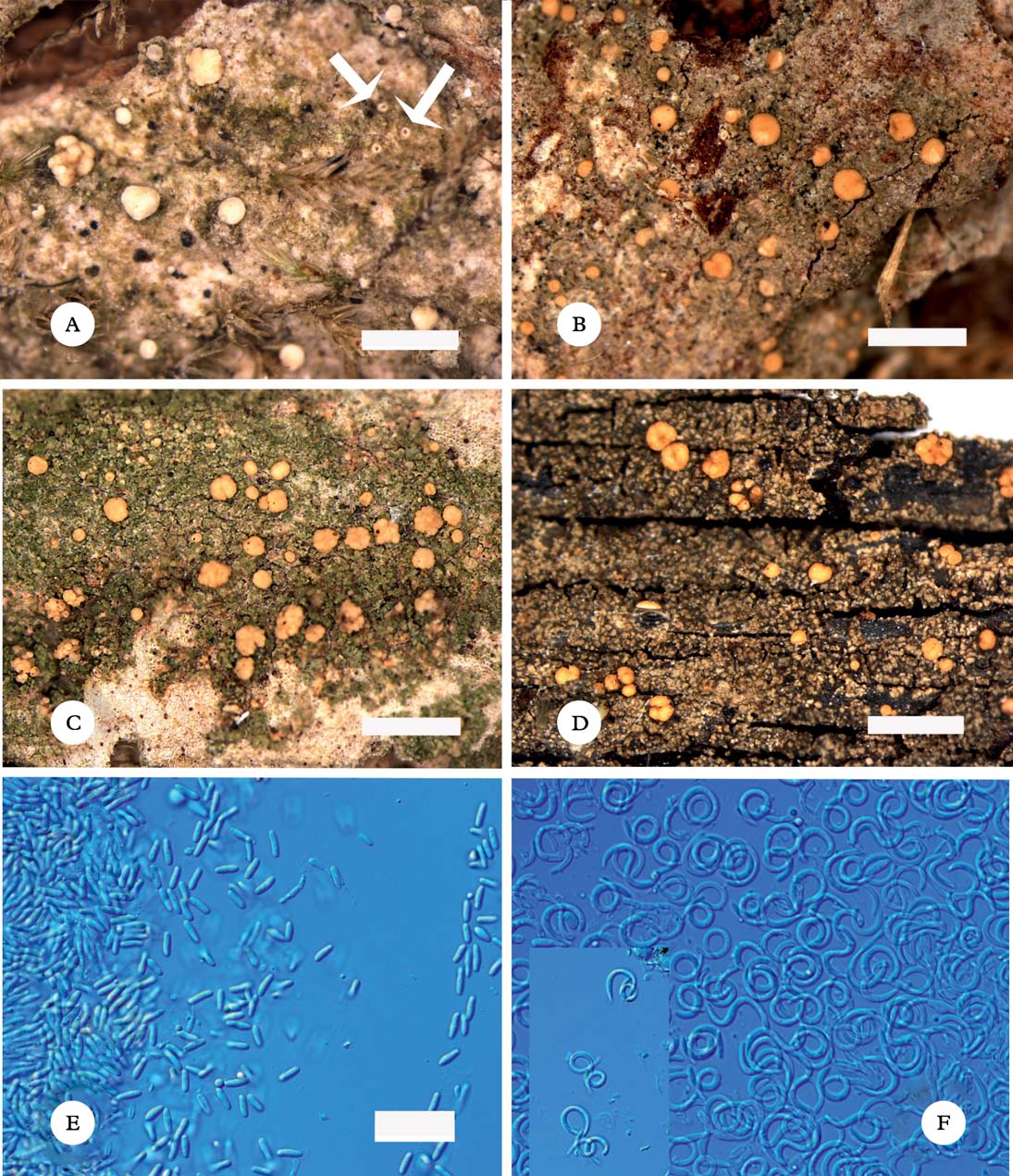
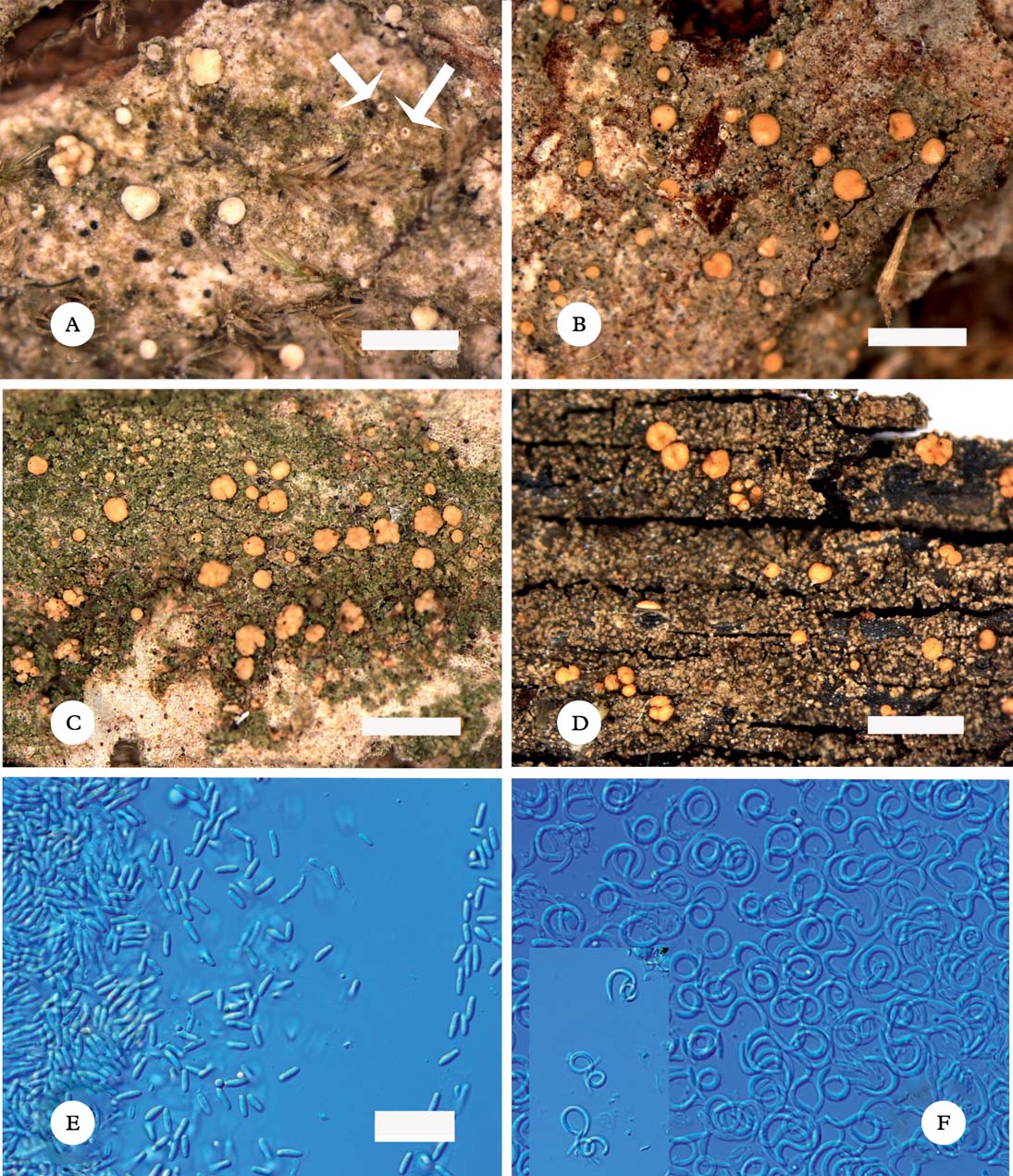
A new species close to Lecania chlorotiza was detected in the material available to us from continental Spain, the Canary Islands and the Azores and is described in this paper (Fig. 1). Its study provides an opportunity to further assess the generic assignment of the rare L. chlorotiza.
Lecania chlorotiza and L. falcata. A–D, thalli with apothecia. A & B, L. chlorotiza; A, B. J. Coppins s.n. (LG) with arrows pointing to two empty pycnidia; B, A. M. Brand 35163 (hb. Brand). C & D, L. falcata; C, P. van den Boom 37919 (LG, isotype); D, A. M. Brand 13600 (hb. Brand). E & F, conidia; E, L. chlorotiza, A. M. Brand 35163 (hb. Brand); F, L. falcata, P. van den Boom 37919 (LG, isotype), insert with strongly curved conidia under unpressed cover slip. Scales: A–D=1 mm; E & F=20 µm.
Material and Methods
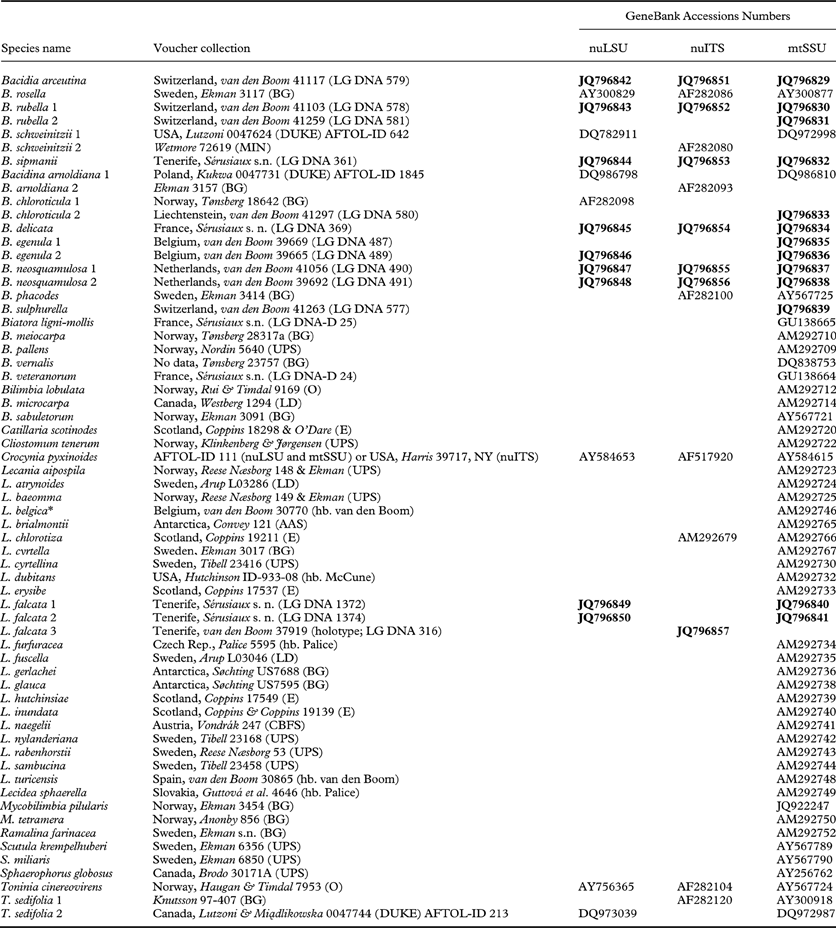
The material assembled for this study primarily consists of all collections available to us of both species targeted here (Lecania chlorotiza and L. falcata sp. nov.). Both species have been collected in the field by the authors and were identified following Smith et al. (Reference Smith, Aptroot, Coppins, Fletcher, Gilbert, James and Wolseley2009). Further detailed studies of material of L. chlorotiza from SW England, where the type specimen comes from, were crucial to understanding the variation of that species. For inclusion in our DNA datasets, we also gathered recent collections in both genera Bacidia and Bacidina (sensu Ekman Reference Ekman1996 and Spribille et al. Reference Spribille, Björk, Ekman, Elix, Goward, Printzen, Tønsberg and Wheeler2009) (Table 1).
Species, specimens and DNA references used in this study, with their respective voucher information. GenBank accessions in bold refer to sequences produced for this study. All others were retrieved from GenBank
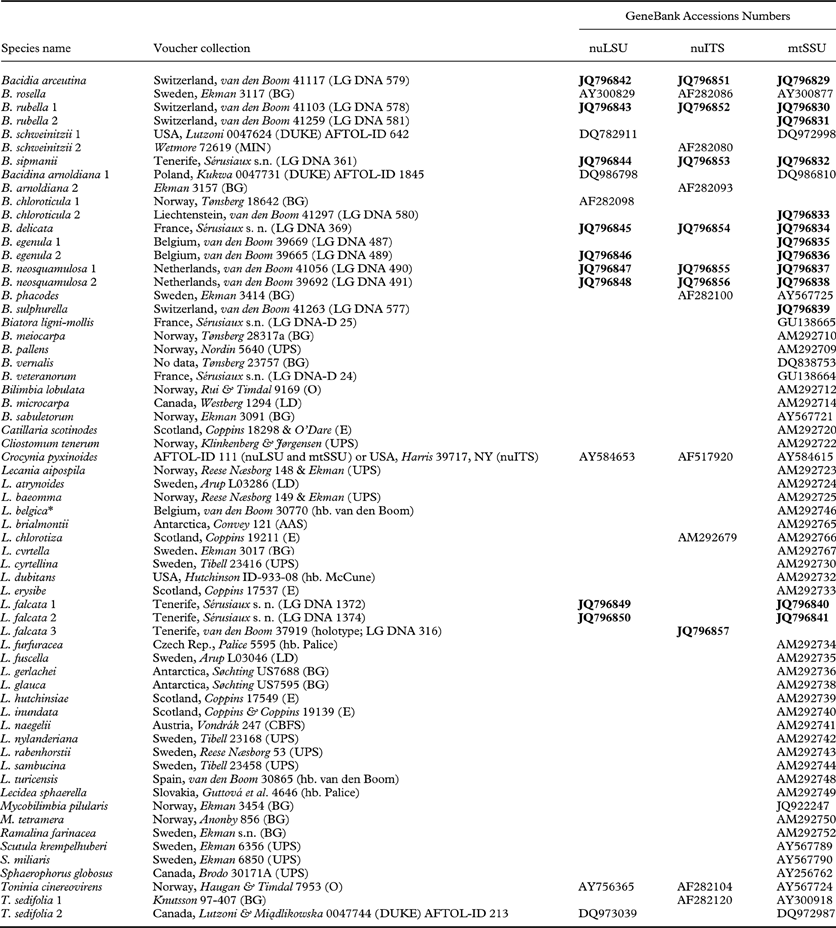
* =sp. 1 in Reese Næsborg et al. (Reference Reese Næsborg, Ekman and Tibell2007); see Reese Næsborg & van den Boom (Reference Reese Næsborg and van den Boom2007)
Well-preserved lichen specimens lacking any visible symptoms of fungal infection were used for DNA isolation. Extraction of DNA and PCR amplification were performed following the protocol of Cubero et al. (Reference Cubero, Crespo, Fathi and Bridge1999). The primers used were the following: ITS1F (Gardes & Bruns Reference Gardes and Bruns1993) and ITS4 (White et al. Reference White, Bruns, Lee, Taylor, Innis, Gelfand, Sninsky and White1990) for nuITS; mtSSU1 and mtSSU3R (Zoller et al. Reference Zoller, Scheidegger and Sperisen1999) for mtSSU; and LR0R, LR3R, LR3, LR5R and LR6 (following the suggestions available on www.lutzonilab.net/primers) for nuLSU. Amplicons were sequenced by Macrogen®. Sequence fragments were assembled with Sequencher version 4.9 (Gene Codes Corporation, Ann Arbor, Michigan). Sequences were subjected to BLAST searches to detect potential contaminations.
We first assembled a matrix with mtSSU sequences of all species of Lecania included in the detailed study of Reese Næsborg et al. (Reference Reese Næsborg, Ekman and Tibell2007), and related species, to test the phylogenetic position of Lecania falcata sp. nov., assumed to be close to L. chlorotiza. Sphaerophorus globosus was chosen as the outgroup following Reese Næsborg et al. (Reference Reese Næsborg, Ekman and Tibell2007). As the position of Lecania falcata in the same clade as L. chlorotiza was confirmed, we assembled a second matrix with nuLSU, nuITS and mtSSU sequences of species resolved as members of that clade, including data retrieved from GenBank as well as sequences produced for this study. Biatora pallens and Ramalina farinacea were chosen as the outgroup as they belong to the basal groups of the clade containing all other species of Lecania (Reese Næsborg et al. Reference Reese Næsborg, Ekman and Tibell2007). Altogether, we generated 29 new sequences, including five for Lecania falcata sp. nov. (Table 1).
For both matrices, the sequences were first aligned using Mafft (online version available at http://mafft.cbrc.jp/alignment/server/), and eventually adjusted manually using MacClade v. 4.05 (Maddison & Maddison Reference Maddison and Maddison2002). Sets of characters to be excluded from phylogenetic analyses were constructed using the online version of GBlocks v 0.91b (Castresana Reference Castresana2000) at http://molevol.cmima.csic.es/castresana/Gblocks.html, allowing for gap positions within the final blocks.
The first matrix included 58 accessions (two for Lecania falcata sp. nov.) and 718 characters representing the loci mtSSU, and is deposited in TreeBASE under the accession number 12482. An unweighted maximum parsimony (MP) analysis was performed in PAUP* 4.0b10 (Swofford Reference Swofford2002). All characters were equally weighted and gaps were treated as missing data. A first heuristic analysis was performed using NNI (Nearest Neighbor Interchange) branch swapping, with 1000 replicates and saving 10 trees at each step, the functions Steepest Descent and MulTrees being in effect. A second analysis was performed with the 10 000 trees saved using TBR (Tree Branch Swapping), with a maximum of 200 trees saved at each step, the function Steepest Descent being inactivated. A 50% consensus tree was produced, and the strength of support for individual branches was estimated using bootstrap values (MPBS) obtained from 500 heuristic bootstrap pseudoreplicates. As four taxa (Bacidina phacodes, both species of Scutula and Toninia cinereovirens) have three identical deletions (20 bp at positions 304–323, 1bp at position 392, 5bp at positions 550–554), a second analysis was performed with gaps treated as a fifth character, all other parameters being identical.
Models of evolution for the maximum likelihood and Bayesian analysis were selected based on the Akaike Information Criterion (Posada & Buckley Reference Posada and Buckley2004) as implemented in Mr. Modeltest v2.3 (Nylander Reference Nylander2004). The selected model corresponds to the GTR model of nucleotide substitution (Rodríguez et al. Reference Rodríguez, Oliver, Marín and Medina1990), including a proportion of invariable sites and a discrete gamma distribution of six rates categories. The maximum likelihood analysis was performed using GARLI (Zwickl Reference Zwickl2006, version 0.951 for OS X) with gaps treated as missing data, and a single most likely tree was produced. Support for the branches was estimated using bootstrap values (MLBS) from 100 pseudoreplicates (all parameters identical to the original ML search).
Bayesian analyses were carried out using the Metropolis-coupled Markov chain Monte Carlo method (MCMCMC) in MrBayes v3.1.2 (Ronquist & Huelsenbeck Reference Ronquist and Huelsenbeck2003; Altekar et al. Reference Altekar, Aittokallio, Huelsenbeck and Ronquist2004). Priors values were set to default and gaps were treated as missing data. Four parallel runs were performed, each using four independent chains (three heated and one cold chain), with a single tree saved every 100th generation for a total of 6 000 000 generations. The incremental heating scheme was set to default. We used TRACER v1.4.1 (Rambaut & Drummond Reference Rambaut and Drummond2007) to plot the log-likelihood values of the sample points against generation time, and determine when stationarity was achieved. Consequently the first 6 000 trees sampled were deleted as the burn-in of the chain. A majority rule consensus tree with average branch lengths was constructed for the remaining trees using the sumt option of MrBayes. Phylogenetic trees were visualized using TreeFig v1.3.1 (Rambaut Reference Rambaut2009).
The second matrix was assembled with nuLSU, nuITS and mtSSU sequences of 17 species belonging to the Bacidiaceae, plus Biatora pallens and Ramalina farinacea as the outgroup. The dataset is incomplete for several taxa: both outgroup species and both species of Scutula are represented only by mtSSU sequences; Bacidina egenula and B. chloroticula lack ITS sequences; finally Bacidina phacodes and Lecania chlorotiza lack LSU sequences. Furthermore, sequences from different origins have been assembled under a single entry for the following species: Bacidia schweinitzii, Bacidina arnoldiana, B. chloroticula and Toninia sedifolia. For this dataset, sequences from two collections of Lecania falcata have been assembled; they were gathered at the very same location (references to LG DNA data: 316 and 1372).
The second matrix included 20 accessions (one for Lecania falcata sp. nov.) and 3690 characters representing the three loci nuLSU, nuITS and mtSSU, and is deposited in TreeBASE under the accession number 12482. The matrix was submitted to the same three analyses, always with gaps treated as missing data. The selected model corresponds to the GTR model of nucleotide substitution (Rodríguez et al. Reference Rodríguez, Oliver, Marín and Medina1990), including a proportion of invariable sites and a discrete gamma distribution of six rates categories. The maximum likelihood analysis performed using GARLI (Zwickl Reference Zwickl2006, version 0.951 for OS X) produced a single most likely tree. Incongruence between single-gene matrices was tested with maximum likelihood analysis using GARLI for each partition. A conflict was considered significant if a clade was supported with bootstrap support >75% in a one-locus analysis and not in the other two. A further test for conflict was performed with ITS and LSU concatenated in a partition versus mtSSU in another. No conflict was detected and therefore the available sequences for the three loci were concatenated.
For analysis of both matrices, branches support were considered as significant when Maximum Parsimony Bootstrap (MPBS)>75%, Maximum Likelihood Bootstrap (MLBS)>75% and Posterior Probabilities (PP)>0·95.
Results
The first matrix included 58 accessions (two for Lecania falcata sp. nov.) and 718 characters representing the loci mtSSU. Fifty-five characters are excluded from the analysis (i.a. an intron of 20 bp at positions 565–584 in L. falcata), 381 are constant, 59 are parsimony non-informative and 223 are potentially parsimony-informative. The single most likely tree has a ln likelihood score of −5375·527542. The second matrix included 20 accessions (one for Lecania falcata sp. nov.) and 3690 characters representing the three loci nuLSU, nuITS and mtSSU. A total of 2090 characters are excluded from the analysis, including the whole ITS1 and almost all ITS2, and the second part of nuLSU for which available sequences were very much incomplete. Of the remaining 1600 characters, 1182 are constant, 151 are parsimony non-informative and 267 are potentially parsimony-informative.
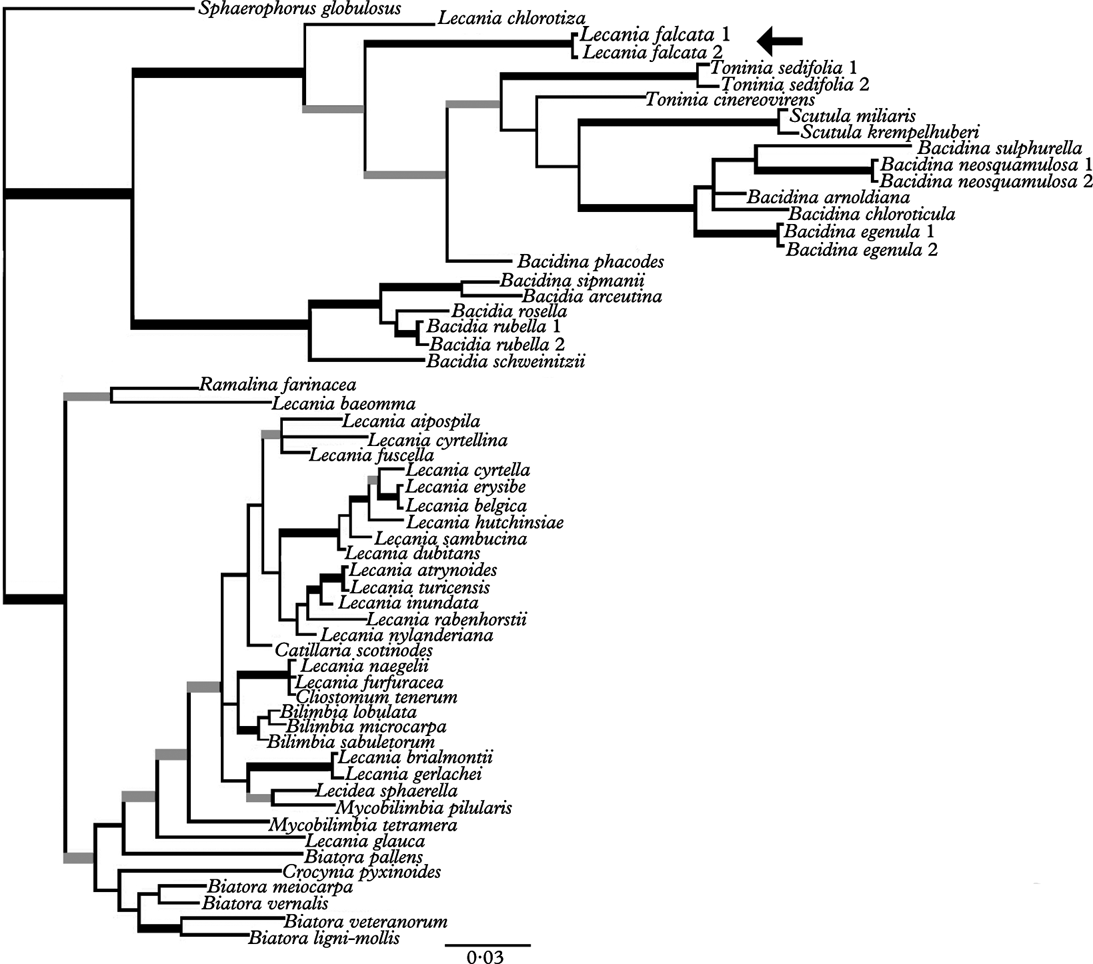
The matrix with mtSSU sequences of all species of Lecania (Reese Næsborg et al. Reference Reese Næsborg, Ekman and Tibell2007) and related species, including Lecania chlorotiza and L. falcata sp. nov., retrieved the topology obtained by those authors with 3 loci (mtSSU, nuITS and RPB2) (Fig. 2): a clade supported only in MrBayes (MPBS and MLBS<70%; PP=1·0) includes most accessions of Lecania (including the type species of the genus, L. fuscella), with L. glauca as sister to all other species, and several species currently assigned to other genera (e.g. species of Bilimbia, Cliostomum tenerum, Lecidea sphaerella, Mycobilimbia pilularis). Two species of Lecania are excluded from that clade: L. baeomma which is resolved as sister to Ramalina farinacea (with strong support only in MrBayes), and L. chlorotiza which is resolved, together with L. falcata sp. nov., into a strongly supported clade (MBPS=98%; MLBS=96%; PP=1·0) representing the Bacidiaceae s. str. The latter is resolved into two strongly supported clades: one with all species referred to Bacidia (MPBS=100%; MLBS=100%; PP=1·0), and the second with all other species (MPBS=97%; MLBS=99%; PP=1·0). The latter clade further provides strong support for two genera: 1) Scutula with two species (MPBS=100%; MLBS=100%; PP=1·0), and 2) Bacidina with five species (MPBS=100%; MLBS=100%; PP=1·0) but excluding its type species, B. phacodes. Toninia, represented here by two species (T. cinereovirens and T. sedifolia), is not resolved as a monophyletic group. Lecania chlorotiza and L. falcata sp. nov. are also not resolved in a monophyletic group.
One locus (mtSSU) 50% majority rule consensus tree produced by the Bayesian analysis and representing the phylogenetic relationships of Lecania chlorotiza and L. falcata sp. nov. (arrow) within the Ramalinaceae sensu lato. Branches supported by MPBS and MLBS>75% and Bayesian posterior probabilities>0·95 are in black; those supported only by Bayesian posterior probabilities>0·95 are in grey.
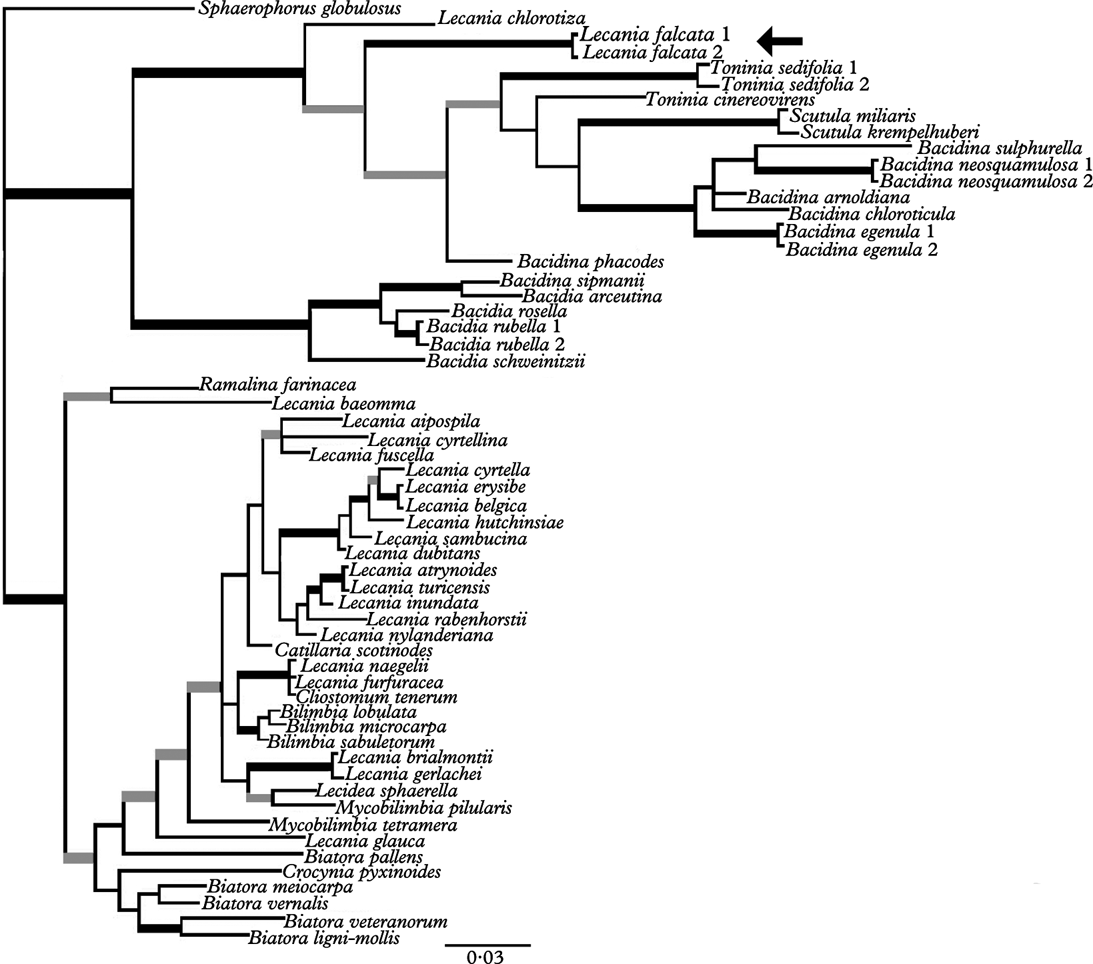
In a second analysis on the same matrix (tree not shown), a maximum parsimony run with gaps scored as a fifth character gave prominence to the three indels autapomorphic of the group formed by Bacidina phacodes, Toninia cinereovirens and both species of Scutula. Indeed, a strongly supported clade (MPBS=100%) comprising only these four species is resolved at an unsupported position within a supported clade (MPBS=75%), including all other accessions of Bacidina and Toninia sedifolia. This clade further provided support (MPBS=70%) to a clade comprising Bacidina phacodes and Toninia cinereovirens. All these branches collapsed in maximum likelihood and MrBayes analysis.
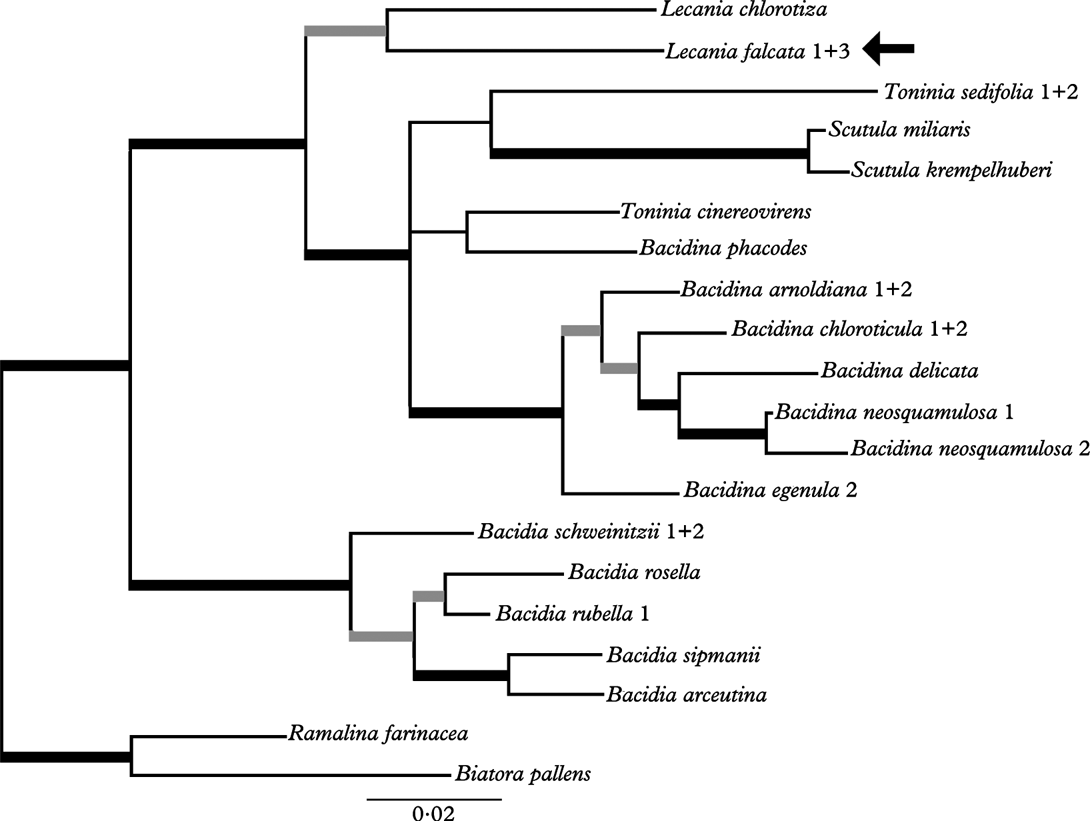
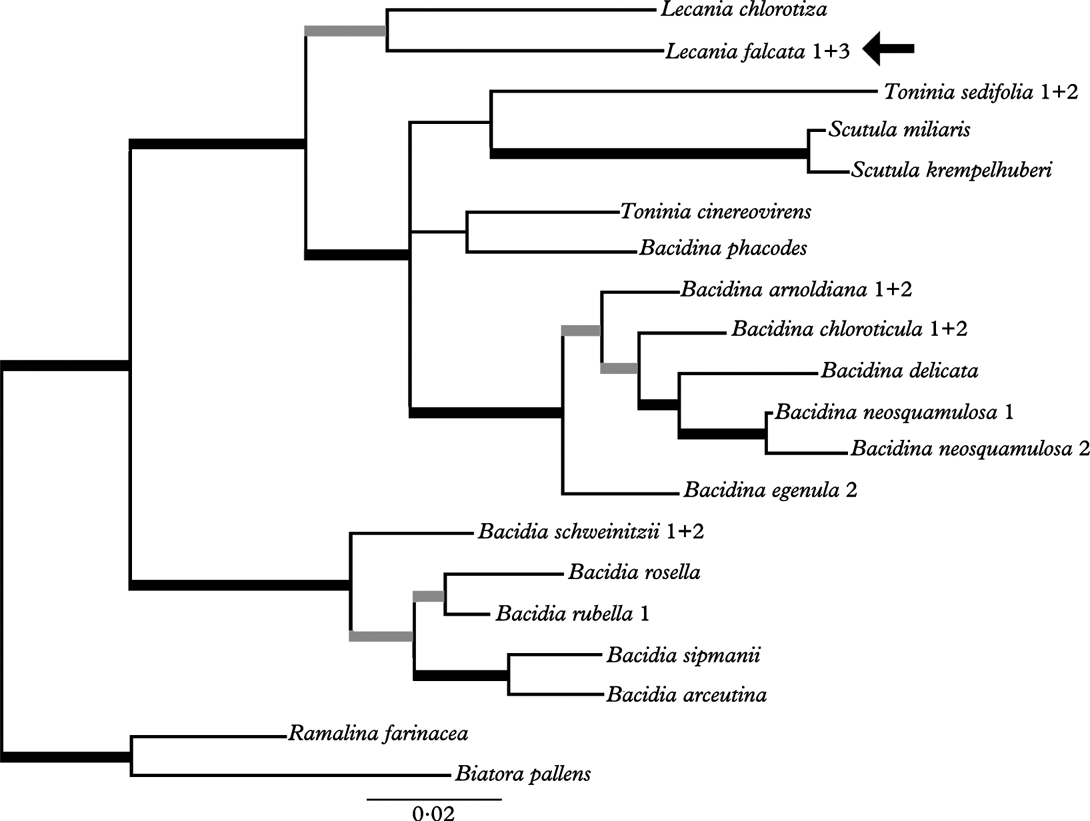
The second matrix assembled species of a clade strongly supported in the first analysis and representing the Bacidiaceae s. str., and thus comprised species of Bacidia, Bacidina, Scutula, Toninia, Lecania chlorotiza and L. falcata sp. nov. Three loci are included here: mtSSU, nuLSU and nuITS (Fig. 3). The Bacidiaceae s. str. is resolved as a strongly supported clade (MPBS=100%; MLBS=100%; PP=1·0). All accessions of Bacidia (B. arceutina, B. rosella, B. rubella, B. sipmanii and B. schweinitzii) are resolved in a strongly supported clade (MPBS=100%; MLBS=100%; PP=1·0), sister to all other accessions, also resolved in a strongly supported clade (MPBS=96%; MLBS=97%; PP=1·0). The 50% majority rule consensus tree produced by the Bayesian analysis resolves the latter clade into two branches: a clade comprising Lecania chlorotiza and L. falcata sp. nov. supported only in MrBayes (PP=0·99), sister to a supported clade (MPBS=87%; MLBS=80%; PP=1·0) comprising other accessions, for example both species of Scutula (clade strongly supported: MPBS=100%; MLBS=100%; PP=1·0), all species of Bacidina, except B. phacodes (clade strongly supported: MPBS=100%; MLBS=100%; PP=1·0), the topological position of others (Bacidina phacodes, T. cinereovirens and T. sedifolia) being unsupported.
Three loci (nuLSU, nuITS and mtSSU) 50% majority rule consensus tree produced by the Bayesian analysis and representing the phylogenetic relationships of Lecania chlorotiza and L. falcata sp. nov. (arrow) within the Bacidiaceae sensu stricto. Branches supported by MPBS and MLBS>75% and Bayesian posterior probabilities>0·95 are in black; those supported only by Bayesian posterior probabilities>0·95 are in grey.
Discussion
In a pioneering molecular study of the Bacidiaceae, Ekman (Reference Ekman2001) pointed out that the relationships between this family and the Ramalinaceae were “definitely in need of scrutiny”. Their close relationship was eventually demonstrated by Andersen & Ekman (Reference Andersen and Ekman2005) and by Reese Næsborg et al. (Reference Reese Næsborg, Ekman and Tibell2007). Currently both families are united under the name Ramalinaceae C. Agardh (=Bacidiaceae W. Watson), which encompasses 38 genera (Lumbsch & Huhndorf Reference Lumbsch and Huhndorf2010). Inclusion of the Crocyniaceae, as proposed by Miądlikowska et al. (Reference Miądlikowska, Kauff, Hofstetter, Fraker, Grube, Hafellner, Reeb, Hodkinson, Kukwa and Lücking2006), and of the Megalariaceae, as proposed by Schmull et al. (Reference Schmull, Miądlikowska, Pelzer, Stocker-Wörgötter, Hofstetter, Fraker, Hodkinson, Reeb, Kukwa and Lumbsch2011), would add four other genera. Most of those genera have never been studied within a molecular phylogenetic context, and further their relationships with the Pilocarpaceae Zahlbr. are not settled. An example is Eugeniella Lücking et al., a recent segregate of corticolous and foliicolous species around the neotropical Bacidia psychotriae (Müll. Arg.) Zahlbr., which was assigned to the Pilocarpaceae (Lücking Reference Lücking2008) and eventually transferred to the Ramalinaceae without new data or analysis (Lumbsch & Huhndorf Reference Lumbsch and Huhndorf2010). The present study does not contradict the concept of the Ramalinaceae as circumscribed by Lumbsch & Huhndorf (Reference Lumbsch and Huhndorf2010), but provides further support for a clade comprising Bacidia, Bacidina, Scutula, Toninia, Lecania chlorotiza and L. falcata sp. nov., thus representing the Bacidiaceae s. str.
The genus Lecania, as currently circumscribed in floras (van den Boom & Ryan Reference van den Boom, Ryan, Nash, Ryan, Diederich, Gries and Bungartz2004; Smith et al. Reference Smith, Aptroot, Coppins, Fletcher, Gilbert, James and Wolseley2009), is again demonstrated as polyphyletic, and the clade referred to Lecania s. str. by Reese Næsborg et al. (Reference Reese Næsborg, Ekman and Tibell2007) is resolved outside of the Bacidiaceae s. str. (Fig. 2). The discovery of an undescribed species, close to Lecania chlorotiza, and the analysis of its phylogenetic position inferred from mtSSU sequences, did not detect a well-supported clade for them within the Bacidiaceae s. str. Indeed, only the two species currently assigned to Scutula, and the species assigned to Bacidia (including the type species B. rosella) are strongly supported, as shown by Ekman (Reference Ekman2001) with a much larger species sampling but on the basis of ITS sequences only. Furthermore, all species representing Bacidina are resolved as a strongly supported group which does not include the type species of the genus (B. phacodes). Our results (Fig. 3), however, do not exclude the possibility that the latter actually belongs to that genus.
The phylogenetic tree inferred from three loci sequences provided some support for the recognition at genus level for L. chlorotiza and L. falcata sp. nov. (Fig. 3). Indeed, the Bayesian analysis could detect strong support for a clade comprising these two taxa. Absence of such support in the other two optimization analyses (maximum parsimony and maximum likelihood) may be due to an incomplete dataset, the latter being very sensitive to missing data (Simmons Reference Simmons2012). With the existing data, no genus name published seems to be available. We refrain from describing a new genus for these two species as most genera currently assigned to the Ramalinaceae by Lumbsch & Huhndorf (Reference Lumbsch and Huhndorf2010) have never been assessed with molecular data and modern statistical optimization methods. Analysis of a much larger sampling throughout the whole family Ramalinaceae (including Bacidiaceae) is therefore needed before such a decision can be taken. A comprehensive and fully supported generic classification of many crustose species with tiny ascocarps remains a long-term goal (see the case of Lecidea rubrocastanea in Spribille & Printzen Reference Spribille and Printzen2007).
The Species
In this section, we refer to Coppins (Reference Coppins1983) and van den Boom & Brand (Reference van den Boom and Brand2008) for the description and terminology of conidia (microconidia, mesoconidia, macroconidia and leptoconidia). In particular, the term macroconidia refers here to slightly to strongly curved, 0–3-septate and 1·0–3·0 µm wide conidia, whereas the term leptoconidia refers to filiform, often curved, non-septate, and 0·6–1·0 µm wide conidia.
Lecania chlorotiza (Nyl.) P. James
in Coppins, James & Hawksworth, Lichenologist 24: 367 (1992). Basionym: Lecidea chlorotiza Nyl., Flora 49: 85 (1866); type: England, “ad corticem ulmi prope Clifton in Anglia (Larbalestier, 1865)” (H-Nyl!)
Thallus never larger than 1–2 cm across, diffuse, mostly developed in fissures of the bark, greenish to greenish brown or grey, thin, rather granulose, made of small granules (50–100 µm diam.), rarely smooth, without cortex, nor prothallus. Photobiont belonging to the Chlorococcaceae, cells 5–9 µm, thin-walled, without visible haustoria but closely surrounded by hyphae.
Apothecia rarely abundant, up to 0·30–0·45 mm diam., and 0·10–0·14 mm high, pale orange, sometimes with the disc more orange than the margin, with constricted base, flat when young and slightly to distinctly convex when mature. Excipulum 30–50 µm thick, chondroid, made up of radiating and connected thin hyphae, with marginal cells slightly but distinctly broadened (up to 3·5–4·5 µm); hymenium 25–32(–35) µm; paraphyses simple, 1·0–1·5 µm thick, with apical cell slightly broadened (up to 2·5 µm); asci 8-spored, 20–28 µm long, clavate, of the Bacidia-type (with rather broad and rounded axial mass, and not a narrow cone as in Bacidia rosella; see Fig. 2 in Hafellner Reference Hafellner1984: 261); ascospores narrowly ellipsoid, 1-septate (rarely simple), 10·3–11·1×1·9–2·4 µm.
Pycnidia of two types: 1) abundant, immersed in thallus or emergent, 60–120 µm diam. and 40–100 µm high; wall 10–20 µm thick, of conglutinated hyphae; conidiogenous cells parietal, closely packed, c. 8·0×1·8 µm; mesoconidia bacilliform, simple, with rounded ends, 4·3–5·1×1·0–1·5 µm; 2) not common, very small (20–25 µm diam.), completely immersed in the thallus; microconidia narrow, curved, 8·4–9·6×0·6 µm.
Chemistry. No crystals or pigment observed (Meyer & Printzen Reference Meyer and Printzen2000); no lichen substances detected by microcrystallizations (Huneck & Yoshimura Reference Huneck and Yoshimura1996).
Ecology and distribution. On shaded and base-rich bark, sometimes inside hollow trunks, or under well-developed aerial roots, reported on Ulmus, Fraxinus, Salix and old Quercus in Smith et al. (Reference Smith, Aptroot, Coppins, Fletcher, Gilbert, James and Wolseley2009). Reported by the same authors from throughout Britain, France, Denmark, Norway and Spain, and also from Portugal by van den Boom (Reference van den Boom2005) and Luxembourg by Ertz et al. (Reference Ertz, Diederich, Brand, van den Boom and Sérusiaux2008). The species thus has an Atlantic distribution in Europe and is not known elsewhere.
Selected specimens examined. Great Britain: England: V.C. 3, South Devon: Dartmoor, 6 km NW of Bovey Tracey, 240 m, old Fraxinus at edge of garden, sheltered, 1996, A. M. Brand 35146 (hb. Brand); ibid., 15 km W of Exeter, Teign Valley, 1 km W of Steps Bridge near foot bridge, 100 m, base of old Quercus, 1996, A. M. Brand 35163 (hb. Brand); ibid., Buckland, valley of River Webburn, 90 m, old Quercus at stream in wooded valley, 1996, A. M. Brand 35358 (hb. Brand). V.C. 4, North Devon: Abbeyford woods, on trunk of Fraxinus, 4 iii 2010, B. J. Coppins s. n. (LG). Scotland: V.C. 104, North Ebudes: Eigg, on Ulmus, 2000, B. J. Coppins 19211 (E).—France: Dépt. Pyrénées Atlantiques: SE of Arthez, 370 m, on Quercus at shore of stream (on limestone), 2003, A. M. Brand 48402 (hb. Brand).—G. D. Luxembourg: Gutland: Vogelsmühle, vallon du Halerbaach, sur Fagus dans une chênaie-hêtraie, 2000, P. Diederich 14028 & J. M. Cepeda (hb. Diederich, LG).—Portugal: Alto Douro: W of Villa Real, Amarante, N-slope with Pinus and Quercus wood, roots of Quercus under overhang, N face, 1999, P. van den Boom 22947 (hb. van den Boom, LG).
Lecania falcata van den Boom, Brand, Coppins, Magain & Sérus. sp. nov.
MycoBank No: MB 564696
Similis speciei Lecania chlorotiza sed cum conidiis majoribus et valde curvatis vel sigmoideis.
Typus: Canary Islands, Tenerife, Puerto de la Cruz, ‘Jardin Botanico’, 100 m, N 28°24·58′W 16°32·15′, 100 m, on Erythrina corallodendron, 14 May 2007, P. & B. van den Boom 37916 (LG—holotypus; E, hb. v.d. Boom—isotypi).
Thallus forming large thalli, covering several dm2 in the type locality, but obviously less exuberant in natural conditions, diffuse, on bark of living trees or on dead standing wood, vividly green when living and moistened, or greyish or yellowish brown, pale green, thin to rather thick (0·2–0·3 mm thick), made of tiny granules (50–150 µm diam.) sometimes aggregated and thus forming tiny scurfy to eroded squamules up to 200–250 µm across, without cortex or prothallus. Photobiont belonging to the Chlorococcaceae, cells 5–10 µm, thin-walled, in rounded aggregates, without visible haustoria but closely surrounded by hyphae.
Apothecia abundant, 0·3–0·5 mm diam., and 0·13–0·20 mm high, pale orange to pale brownish, with constricted base, flat when young and slightly to distinctly convex when mature, sometimes becoming aggregated or tuberculate and thus somewhat deformed, margin slightly prominent in young apothecia, becoming excluded in older ones. Excipulum 40–50 µm thick, chondroid, made of radiating hyphae, with rather large cells (3–4 µm) and marginal cells identical; hymenium 40–45 µm; paraphyses simple, c. 1·5 µm thick, with apical cell slightly broadened (up to 2·5 µm); asci 8-spored, 30–37 µm long, clavate, of the Bacidia-type (with rather broad and rounded axial mass, and not a narrow cone as in Bacidia rosella); ascospores narrowly ellipsoid, 1-septate, 10·3–11·7×2·3–2·5 µm.
Pycnidia of two types: 1) sometimes abundant, immersed in thallus or emergent, rounded, 140–160 µm diam., 40–100 µm high; wall 7–10 µm thick, of conglutinated hyphae; conidiogenous cells parietal, closely packed, 6–8×1·8–2·1 µm; macroconidia rather polymorphic but of a single type, long, strongly and repeatedly curved sigmoid, tapering towards proximal ends, simple or 1(–2)-septate, 12·3–26·4×1·0–1·2 µm; 2) very rare, immersed in the thallus, less than 50 µm diam.; microconidia narrow, curved, 8·5–12·0×0·6–0·8 µm.
Chemistry. No crystals or pigment observed (Meyer & Printzen Reference Meyer and Printzen2000); no lichen substances detected by microcrystallizations (Huneck & Yoshimura Reference Huneck and Yoshimura1996).
Taxonomic notes. Lecania falcata can be distinguished from L. chlorotiza by several characters: 1) bacilliform mesoconidia never produced but long and strongly curved macroconidia always found; 2) excipulum without distinctly swollen outer cells; 3) hymenium slightly higher (40–45 µm vs. 25–35 µm in L. chlorotiza), and asci longer (30–37 µm vs. 20–28 µm in L. chlorotiza). The thallus of Lecania falcata is also better developed and more conspicuous, with granules and minute, ±eroded squamules in optimal conditions.
Ecology and distribution. Lecania falcata is certainly a rare species. It is known from two natural, prestigious sites (NE of La Palma and the Foz de Arbayún in Navarra), and in two botanical gardens (Tenerife in the Canary Islands and San Miguel in the Azores). It is abundant in the botanical garden of Puerto de la Cruz on the northern side of Tenerife but was carefully looked for, in vain, in both large stands of laurisilva on the same island, during further field excursions in 2009 and 2010. Interestingly, it was found in similar ecological conditions in the Azores archipelago, on the island of San Miguel. It further occurs in the most diverse laurisilva in the NW of the rather young island of La Palma in the Canary Islands, an area where many new and rare lichen species have also been detected, such as Byssoloma kalbii, Gyalectidium membranaceum, Porina ocoteae and Strigula brevis (Sérusiaux et al. Reference Sérusiaux, Berger, Brand and van den Boom2007). In continental Spain (Navarra), it occurs in the most famous gorge on the southern flank of the Pyrenees, the Foz de Arbayún, where other interesting species are reported, such as Megalaria grossa, M. laureri, Phaeographina buxi (on twigs on Buxus), Porina rosei, and two species of the mainly foliicolous and tropical genus Gyalectidium, G. setiferum (Sérusiaux Reference Sérusiaux1993) and G. puntilloi (Ferraro et al. Reference Ferraro, Lücking and Sérusiaux2001).
Additonal specimens studied. Portugal: Azores: San Miguel, Ponta Delgada, jardín José do Couto, on trunk, 2007, J. Etayo 24089 & E. Ros (hb. Etayo).— Spain: Canary Islands: Tenerife, Puerto de la Cruz, ‘Jardin Botanico', same locality as the type, also found on other trees such as Chrysophyllum sp. or on the ‘trunk’ of Livistona australis, 14 v 2007 (hb. van den Boom 37917 and 37914); ibid. P & B. van den Boom 37915 (hb. v.d. Boom); same locality as the type, abundant on c. 30 tree boles, v 2010, E. Sérusiaux s. n. (LG, E, hb. Brand, hb. van den Boom); La Palma, 3·5 km WSW of Los Sauces, N-slope of Barranco del Agua, 530 m, on wood of dead Ocotea foetens in laurisilva, 1986, A. M. Brand 13600 (hb. Brand). Navarra: Foz de Arbayún, le long du Rio Salazar, 550 m, fourrés de Buxus et futaie à Quercus rotundifolia sur le flanc gauche des gorges, sur Quercus, 12 vii 1989, E. Sérusiaux s. n., P. W. James, R. Rose & J. Etayo-Salazar (LG); ibid., 500 m, on bark, 1993, J. Etayo & P. van den Boom 16549 (hb. v.d. Boom).
Further notes
Albeit belonging to a different and strongly supported clade in molecular phylogenetic analysis, L. chlorotiza and L. falcata do not feature clear and diagnostic morphological or anatomical differences with Lecania s. str. (sensu Reese Næsborg et al. Reference Reese Næsborg, Ekman and Tibell2007). In most species of Lecania s. str., a thalline margin is clearly visible in young apothecia, but several species (especially L. hutchinsiae and L. sylvestris) have apothecia with an evanescent margin. The latter two species, however, feature characters distinct from those of both L. chlorotiza and L. falcata: thallus smooth or almost so, sometimes with scattered granules, hamathecium with conglutinated paraphyses, sometimes sparingly branched and apical cells enlarged to 2·5–5·0 µm, often pale but sometimes dark brown pigmented, and ascospores wider (3·0–4·5 µm vs. 2·3–2·5 µm in L. chlorotiza and L. falcata). Furthermore, in Lecania s. str. (sensu Reese Næsborg et al. Reference Reese Næsborg, Ekman and Tibell2007), conidia (when produced) most usually belong to the leptoconidia-type (sensu van den Boom & Brand Reference van den Boom and Brand2008): slighty curved, non-septate, c. 10–25×0·8–1·0 µm (van den Boom Reference van den Boom1992; Smith et al. Reference Smith, Aptroot, Coppins, Fletcher, Gilbert, James and Wolseley2009). A remarkable exception is Lecania cyrtellina, a species resolved with strong support in Lecania s. str. and which produces macroconidia crescent-shaped, 0–1-septate, 10–15×1·5–2·0 µm.
We wish to thank very warmly our colleagues and friends J. Etayo and Z. Palice for the loan of precious collections. Finally, we thank both referees for their critical and most helpful notes and suggestions.