Introduction
One in seven people passing through prisons worldwide suffers from a severe mental disorder (Fazel & Seewald, Reference Fazel and Seewald2012). In Australia, the odds of psychiatric illness are 10 times greater in prisoners than the wider population (Butler et al. Reference Butler, Andrews, Allnutt, Sakashita, Smith and Basson2006). After release, former prisoners continue to be at dramatically elevated risk of adverse mental health outcomes (Alan et al. Reference Alan, Burmas, Preen and Pfaff2011; Frank et al. Reference Frank, Andrews, Green, Samuels, Trinh and Friedmann2013) and suicide (Binswanger et al. Reference Binswanger, Stern, Deyo, Heagerty, Cheadle, Elmore, Thomas and Koepsell2007; Spittal et al. Reference Spittal, Forsyth, Pirkis, Alati and Kinner2014). Ex-prisoners with a history of mental disorder are at even greater risk than other ex-prisoners for a host of poor outcomes, including substance misuse, homelessness, unemployment (Cutcher et al. Reference Cutcher, Degenhardt, Alati and Kinner2014), reincarceration (Baillargeon et al. Reference Baillargeon, Binswanger, Penn, Williams and Murray2009) and mortality from drug overdose and suicide (Kariminia et al. Reference Kariminia, Law, Butler, Corben, Levy, Kaldor and Grant2007; Webb et al. Reference Webb, Qin, Stevens, Mortensen, Appleby and Shaw2011).
There have been few prospective studies examining changes in mental health status after release from custody. No previous research has investigated individual-level changes in mental health status among prisoners or ex-prisoners: most existing longitudinal studies report only changes in the mean value of various mental health indicators across the cohort. For example, one study of adult prisoners in Australia found that the mean score on a depression scale declined following release compared with immediately pre-release, although the mean anxiety score remained relatively constant (Shinkfield & Graffam, Reference Shinkfield and Graffam2010) and self-rated psychological health varied (Shinkfield & Graffam, Reference Shinkfield and Graffam2009). In another study of US adult male prisoners the percentage of the cohort reporting a mental illness increased in the first year following release (Visher & Courtney, Reference Visher and Courtney2007).
After release, many ex-prisoners continue to have substantial mental health service needs (Kinner, Reference Kinner2006; Alan et al. Reference Alan, Burmas, Preen and Pfaff2011). However, neither the extent and nature of these needs, nor the degree to which they are currently being met, are well understood (Mears & Cochran, Reference Mears and Cochran2012). Previous research on mental health service utilization among ex-prisoners has focused on the needs of those with a known mental disorder. One study of male ex-prisoners found that about half of those reporting a mental disorder were receiving prescription medication or other mental health treatment 1 year after release (Visher & Courtney, Reference Visher and Courtney2007). In another study of mentally ill male and female ex-prisoners, half the participants accessed community mental health services in the first year after release, but the frequency and duration of service contacts was typically low (Lovell et al. Reference Lovell, Gagliardi and Peterson2002). A third study found that 60% of ex-prisoners with severe mental illness used community mental health services within 90 days of release, but this percentage was higher for those with health insurance (Morrissey et al. Reference Morrissey, Steadman, Dalton, Cuellar, Stiles and Cuddeback2006). To our knowledge, no previous studies have examined mental health service access among general prisoner cohorts, despite the fact that their mental health needs may still be substantial.
While measuring aggregate changes in mental health status can help in assessing the overall extent of mental health service need among ex-prisoners, understanding individual-level changes is essential to the delivery of targeted and individually tailored transitional care. Studying individual trajectories of mental health problems could help identify predictors of ongoing or increasing need for mental health services and reveal at what points before and after prison release this need is most acute. A detailed understanding of the demand for and access to mental health services among former prisoners is critical, given the empirical link between mental illness and a host of poor outcomes following release, and the corresponding potential for mental health services to facilitate successful community re-integration and reduce harmful outcomes (Hammett et al. Reference Hammett, Roberts and Kennedy2001). By comparing mental health trajectories with actual post-release service utilization, it is possible to consider whether current levels of service access are commensurate with need.
In this paper, we apply group-based trajectory modeling (GBTM; Nagin, Reference Nagin2009) to data on psychological distress in a large cohort of adult ex-prisoners in Australia. The aims of the study were to:
-
(1) Describe trajectories of psychological distress after prison release;
-
(2) Characterize individuals following different trajectories according to their pre-release characteristics; and
-
(3) Describe patterns of community mental health service use during the first year post-release, among individuals following different psychological distress trajectories.
Method
Study design
This was a prospective cohort study of sentenced adult prisoners from seven prisons in the state of Queensland, Australia, recruited between August 2008 and July 2010. The original study was a randomized controlled trial of a re-entry intervention, described in greater detail elsewhere (Kinner et al. Reference Kinner, Lennox, Williams, Carroll, Quinn, Boyle and Alati2013; Kinner et al. Reference Kinner, van Dooren, Boyle, Longo and Lennox2014). Eligible participants were within 6 weeks of expected release (full-time or parole) at baseline.
Psychological distress was assessed during a pre-release interview and at three follow-up interviews approximately 1, 3 and 6 months post-release. Baseline (pre-release) interviews were conducted in person. Post-release interviews were conducted via telephone for those residing in the community. Interviews in prison were typically face to face, with a minority conducted by telephone for hard-to-reach subjects. The study employed a range of strategies to minimize attrition (David et al. Reference David, Alati, Ware and Kinner2013; Kinner et al. Reference Kinner, Lennox, Williams, Carroll, Quinn, Boyle and Alati2013).
We investigated mental health service utilization in the first year post-release via linkage with the Consumer Integrated Mental Health Application (CIMHA), a system that records information on contacts with community mental health services in Queensland.
Measures
Psychological distress
Psychological distress at each interview was assessed using the Kessler Psychological Distress Scale (K10), a screening tool designed to assess non-specific psychological distress. The K10 has high accuracy in discriminating between those with and without mental illness according to criteria from the Diagnostic and Statistical Manual of Mental Disorders, fourth edition (DSM-IV) (Kessler et al. Reference Kessler, Andrews, Colpe, Hiripi, Mroczek, Normand, Walters and Zaslavsky2002) and has been used extensively in both general population (e.g. Australian Bureau of Statistics, 2008b ) and prison-based surveys (e.g. Butler & Allnutt, Reference Butler and Allnutt2003; Australian Institute of Health and Welfare, 2013). The 10 items address the frequency of a range of mental health symptoms within the past 4 weeks. Each item is scored from 1 to 5 in ascending order of frequency, for a total score ranging from 10 to 50. Scores on the K10 can be categorized into low (10–15), moderate (16–21), high (22–29) and very high (30–50) psychological distress (Andrews & Slade, Reference Andrews and Slade2001).
Baseline characteristics
We selected a range of demographic, criminal justice, substance use and mental health variables from the baseline survey in order to assess their association with psychological distress trajectories. Demographic variables included age (<25 v. ⩾25 years), gender (female v. male), and indigenous status (Aboriginal and/or Torres Strait Islander v. neither). We defined high-risk illicit drug use in the 3 months prior to incarceration as a score ⩾27 on the Alcohol, Smoking and Substance Involvement Screening Test (Humeniuk et al. Reference Humeniuk, Henry-Edwards, Ali, Poznyka and Moneiro2010) for at least one of cannabis, hallucinogens, ecstasy, methamphetamines, cocaine, benzodiazepines, heroin or other opiates. We defined high-risk drinking in the year prior to incarceration as a score ⩾16 on the Alcohol Use Disorders Identification Test (Babor et al. Reference Babor, Higgins-Biddle, Saunders and Monteiro2001). Current mental illness (schizophrenia, anxiety disorder or mood disorder) was assessed by self-report using questions adapted from Australia's National Health Survey (Australian Bureau of Statistics, 2008a ): participants were asked if they had ever been told by a doctor, psychologist or psychiatrist that they had a mental illness. If yes, they were asked to specify the illness and whether they currently suffered from that illness. History of self-harm, including attempted suicide, was self-reported. Queensland Corrective Services (QCS) provided data on length of incarceration (⩽180 days v. >180 days) and prior incarcerations (any history of incarceration as an adult prior to baseline incarceration v. none).
Mental health service contact
CIMHA captures all state-funded community mental health services in Queensland, including services provided to non-mental health in-patients. Private mental health services are not captured, although financial barriers are likely to exclude most ex-prisoners from private care. We obtained CIMHA data for the first year after prison release, including the date of contact, type of service and length of consultation. Common types of services included therapy, counseling, crisis management, case management, education, intake, assessment (including speech and language assessment), review and administrative activities. We included only records in which the participant had direct contact with a clinician or other employee, in person, by telephone or via videoconference, while in the community (i.e. not during a period of incarceration). In order to ascertain the dates when participants were in the community and therefore able to access community-based services, QCS provided release and re-incarceration dates up to 1 year post-release.
Baseline data were linked to CIMHA by the Queensland Health Data Linkage Unit using LinkageWiz software, followed by a full clerical review of all possible matches. LinkageWiz employs a probabilistic record linkage algorithm that has an estimated positive predictive value of 96% and sensitivity of 79% for identifying true matches (Ferrante & Boyd, Reference Ferrante and Boyd2010). All known aliases of participants (obtained from prison records) were included as matching variables, a process that improves sensitivity without reducing specificity (Larney & Burns, Reference Larney and Burns2011).
Analyses
GBTM is a statistical technique used to characterize longitudinal patterns of change in a population by identifying a fixed number of latent groups whose members follow similar outcome trajectories. The analyst must specify the number of trajectory groups, but the shapes of the trajectories are estimated semi-parametrically from the data (Nagin, Reference Nagin2009). Compared with other trajectory modeling techniques such as growth curve and growth mixture modeling, GBTM constrains treatment of within-group variances (random effects are not considered). However, GBTM can be regarded as a device for approximating a more complex distribution of trajectories, it is well suited to exploratory studies without pre-specified hypotheses regarding the trajectory shapes, its outputs are easier to visualize and interpret, and fewer modeling assumptions are required (Nagin & Odgers, Reference Nagin and Odgers2010).
The outcome in our trajectory analyses was psychological distress, as measured by the K10. Because interviews were conducted within a flexible time window, we excluded any K10 data collected more than 8 weeks prior to prison release or more than 1 year after release. Participants were included in trajectory analyses if they responded to the K10 during at least one interview within this time period. Within each trajectory group, we assumed that the outcome followed a censored normal distribution and modeled the uncensored mean as a function of time since release using a polynomial of cubic or lower order (Nagin & Odgers, Reference Nagin and Odgers2010).
Trajectory model building proceeded in two stages. First, we fitted trajectory models with two to seven latent groups and chose the model that maximized the Bayesian information criterion (BIC) after non-significant (p < 0.05) polynomial coefficients were dropped (Andruff et al. Reference Andruff, Carraro, Thompson, Gaudreau and Louvet2009). Second, to investigate possible associations between baseline characteristics and trajectory group membership, we re-estimated our trajectory model allowing the log odds of group membership (relative to a reference group) to depend linearly on all baseline variables, as in (unordered) multinomial logistic regression (Nagin, Reference Nagin2009). We then assigned participants to trajectory groups according to their maximum posterior probability of group membership and assessed model fit by computing the mean posterior probability of group membership and odds of correct classification (OCC) within each group.
Next, within assigned trajectory groups, we calculated the percentage of mental health service users, defined as those who had at least one community mental health service contact in the first year after prison release, and tested for differences using logistic regression. Among service users, we then computed the median cumulative duration of mental health service contact in the first year post-release. To control for time spent in the community (as opposed to periods of re-incarceration), these analyses were weighted by the proportion of follow-up time spent in the community. Among service users, we computed the median number of days after release until the first service contact.
Sensitivity and attrition analyses
In order to determine whether return to custody during the follow-up period affected our results, in a sensitivity analysis we excluded any data obtained after the date of the participant's first re-admission to prison (if any). We also excluded individuals for whom K10 data were available from only one interview prior to re-incarceration. We repeated all analyses in this reduced sample to check for any substantive changes to our conclusions. In order to investigate the potential impact of missingness in the outcome variable on our results, we examined univariate associations between missing at least one K10 score at follow-up and baseline variables via logistic regression.
All analyses were performed in Stata version 13.1 (USA). GBTM analyses employed the traj package (Jones & Nagin, Reference Jones and Nagin2013).
Ethical standards
All procedures contributing to this work comply with the ethical standards of the relevant national and institutional committees on human experimentation and with the Helsinki Declaration of 1975, as revised in 2008. Ethics approval for this study was granted by the Behavioural and Social Sciences Ethical Review Committee of the University of Queensland and the Queensland Health Human Research Ethics Committee.
Results
Preliminary analyses
Of the 1325 participants recruited to the study, 94.1% responded to the K10 at baseline, 65.1% at the 1-month follow-up, 64.4% at the 3-month follow-up and 67.7% at the 6-month follow-up. The mean K10 scores for respondents were 17.9 (baseline), 17.1 (1-month follow-up), 16.6 (3-month follow-up) and 16.6 (6-month follow-up). Of those who responded to the K10 at each follow-up interview, 5.2% (1-month follow-up), 12.1% (3-month follow-up) and 23.1% (6-month follow-up) had returned to custody and so were interviewed in prison. Online Supplementary Table S1 shows the percentage of participants in each K10 category (low, moderate, high or very high) at each interview and compares prison and community percentages.
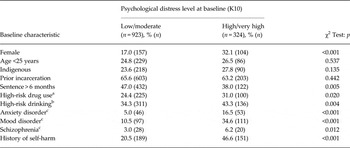
The median age of participants at baseline was 30 years; 21.1% were female and 25.5% identified as indigenous. Table 1 shows the distribution of baseline characteristics for those scoring low/moderate v. those scoring high/very high on the K10 at baseline, with χ2 tests for differences in proportions.
Participant characteristics according to level of psychological distress at baseline (n = 1247)

K10, Kessler Psychological Distress Scale.
a In the 3 months prior to incarceration.
b In the year prior to incarceration.
c Self-reported current diagnosis at baseline interview.
Trajectory modeling results
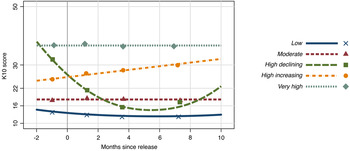
The BIC was maximized by a model with five trajectory groups (see online Supplementary Table S2), and we therefore used a five-group model in all subsequent analyses. Our final trajectory model included baseline predictors of group membership and so was applied to data from the 1216 (92%) participants who responded to the K10 at least once during the study period and had data available for all baseline variables. Fig. 1 shows the mean K10 score as a function of time since release for each trajectory group and online Supplementary Table S3 shows the estimated polynomial coefficients. We refer to these groups as follows: low – mean K10 score consistently within the low psychological distress range (an estimated 51.1% of the cohort); moderate – mean K10 consistently within the moderate distress range (29.8%); high increasing – mean K10 within the high distress range, and increasing slightly (11.6%); high declining – mean K10 in the very high distress range prior to release, then declining to the low to moderate range (5.5%); and very high – mean K10 score consistently within the very high distress range (1.9%). We italicize the trajectory group names throughout this paper to distinguish them from the usual cross-sectional K10 categories. For each group, the mean posterior probability of group membership and OCC, respectively, were 0.86 and 5.75 (low), 0.75 and 7.18 (moderate), 0.81 and 31.89 (high increasing), 0.79 and 65.53 (high declining) and 0.86 and 305.84 (very high), indicating adequate model fit (Nagin, Reference Nagin2009).
Estimated mean Kessler Psychological Distress Scale (K10) trajectories (n = 1216). The plotted curves show the estimated mean K10 score as a function of months since release, where negative months signify the pre-release period, for each psychological distress trajectory group. The plotted points show the mean K10 score and mean interview date weighted by the posterior probability of membership in each trajectory group. The horizontal gridlines were chosen to reflect established (static) categories of psychological distress: low (scores 10–15), moderate (16–21), high (22–29) and very high (30–50) (Andrews & Slade, Reference Andrews and Slade2001). The estimated population percentages in each trajectory group were 51.1% (low), 29.8% (moderate), 11.6% (high increasing), 5.5% (high declining) and 1.9% (very high). For a color figure, see the online version.

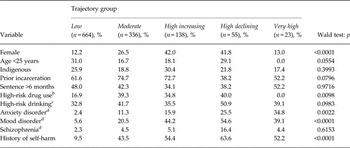
Table 2 shows percentages of baseline characteristics by assigned trajectory group and p values from the multinomial logistic regression model (for full results, see online Supplementary Table S4). In adjusted multinomial analyses, we found strong evidence that being female, a history of high-risk drug use or self-harm, and reporting a mood or anxiety disorder at baseline were risk factors for membership in the moderate, high declining and high increasing K10 trajectory groups compared with the low group. Reporting an anxiety disorder or history of self-harm was significantly associated with membership in the very high group compared with the low group.
Participant baseline characteristics by K10 trajectory group (n = 1216) a

K10, Kessler Psychological Distress Scale.
a The Table shows the raw percentages of participants having baseline characteristics by trajectory group. The rightmost column shows results from a multinomial logistic regression model estimated jointly with the K10 trajectory model, in which the baseline characteristics were included as covariates. The p values are from Wald tests of the null hypothesis that each baseline characteristic has no effect on the probability of trajectory group membership, after adjustment for all other listed characteristics. Full results from the multinomial model are shown in online Supplementary Table S4.
b In the 3 months prior to incarceration.
c In the year prior to incarceration.
d Self-reported current diagnosis at baseline interview.
Post-release mental health service use
A total of 1318 (99.5%) participants were successfully linked to both the CIMHA and QCS data. Of these, 155 (11.8%) had direct contact with public mental health services at least once in the 12 months following release. Those scoring high or very high on the K10 at baseline were significantly (p < 0.001) more likely to access services (19.4%) than those scoring low/moderate (9.1%). Among those who accessed mental health services at least once, the median cumulative duration of contact was 2.7 h [interquartile range (IQR) 1.3–6.4 h] and the median number of days until the first contact was 92 (IQR 10–222).
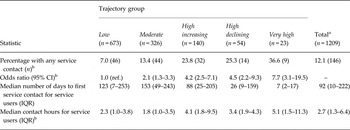
Table 3 shows indicators of mental health service usage by trajectory group for the 1209 participants included in trajectory analyses and for whom CIMHA and QCS data were available. The odds of any contact were significantly greater for all other trajectory groups when compared with the low group. Among service users, the median time until first service contact was longest in the low (123 days) and moderate groups (153 days), somewhat shorter in the high increasing group (88 days), and much shorter in the high declining (26 days) and very high groups (7 days). The median cumulative duration of mental health service visits in the first year post-release was similar for the low (2.3 h) and moderate (1.8 h) groups, and somewhat higher for the high declining (3.4 h), high increasing (4.1 h) and very high groups (5.1 h).
Mental health service use in the first year after prison release by K10 trajectory group (n = 1209)

K10, Kessler Psychological Distress Scale; CI, confidence interval; ref., reference; IQR, interquartile range.
a Among participants included in K10 trajectory analyses.
b Weighted by proportion of first year after release spent in the community.
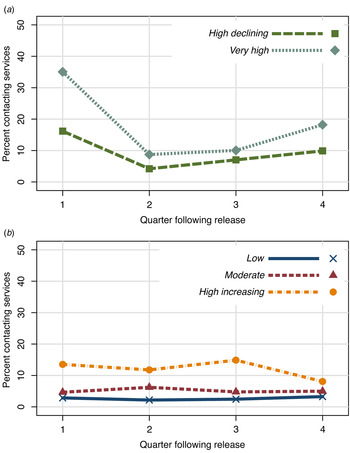
Fig. 2 shows the percentage of participants accessing mental health services at least once in each quarter following prison release, by trajectory group. The rate of service contact in the low, moderate and high increasing groups was largely constant over time. However, in the high declining group and particularly the very high group, the contact rate declined after the first quarter following release (from 35% in the first quarter to 9% in the second quarter for the very high group, and from 16% to 4% for the high declining group) and increased slightly thereafter.
Mental health service contact against time since release by Kessler Psychological Distress Scale (K10) trajectory group (n = 1209): high declining and very high (a); low, moderate and high increasing (b). The figures show the percentage of participants who contacted services in each quarter (a period of approximately 3 months) following prison release, by K10 trajectory group. The calculated percentages are weighted by the proportion of time spent in the community in each quarter. For a color figure, see the online version.

Sensitivity and attrition analyses
The K10 trajectories, probabilities and predictors of group membership and rates of service contact by trajectory group were not substantively altered when we removed data obtained after participants’ first return to custody and participants with only one K10 response (for full results, see online Supplementary Fig. S1 and online Supplementary Tables S5, S6 and S7).
We observed moderate to strong positive associations between missing at least one K10 score at follow-up and being indigenous (odds ratio [OR] 2.52), prior incarcerations (OR 2.42), high-risk drinking (OR 1.58) and high-risk drug use (OR 1.47). Associations between all other baseline variables, including baseline K10 score, and attrition were relatively weak (OR < 1.40 and OR > 1/1.40; see online Supplementary Table S8).
Discussion
We have, for the first time, described individual-level trajectories of psychological distress after prison release. This has allowed us to distinguish between aggregate changes and individual-level patterns of psychological distress over time, and to investigate mental health service utilization among those for whom there is evidence of ongoing need for such services following release. Prior to release, more than half of participants experienced at least moderate psychological distress, compared with less than one-third in the Australian community (Slade et al. Reference Slade, Grove and Burgess2011). The mean K10 score in our cohort declined slightly following release, from 17.9 pre-release to 16.6 about 6 months after release. However, our trajectory model results suggest that nearly 83% of participants (the low, moderate and very high trajectory groups) experienced minimal changes in psychological distress in the first 6 months after release. About one in 10 experienced moderate increases in distress after release from prison (the high increasing group) and about one in 20, who were typically highly distressed in custody, experienced a large decline in distress after release (the high declining group). These findings suggest that, for most individuals who are distressed prior to release, transition into the community is likely to remain a distressing and challenging time.
Two possible interpretations of the high declining trajectory are that: (1) the experience of being imprisoned and near to release was highly distressing, a phenomenon sometimes referred to as ‘gate fever’ (Castellano & Soderstrom, Reference Castellano and Soderstrom1997), and was followed by a natural decline in psychological distress after release; or (2) psychological distress in this group improved following release due to effective transitional management, mental health care or other treatment in the community. Of the high declining group, three-quarters did not contact community mental health services in the first year post-release, and those who did engage with services typically had minimal service contact (for a median of 2.7 h of contact over 1 year), thus favoring the first interpretation. Increased social and emotional support in the community could also contribute to declining distress (Jacoby & Kozie-Peak, Reference Jacoby and Kozie-Peak1997; Naser & La Vigne, Reference Naser and La Vigne2006; Shinkfield & Graffam, Reference Shinkfield and Graffam2010). Our results suggest that the mental health of individuals in the high declining group may be amenable to management outside the public mental health system, while the high increasing and very high groups are more likely to require public mental health services.
Females were over-represented in the moderate, high increasing and high declining trajectory groups in our study. This is consistent with cross-sectional research showing higher psychological distress in female Australian prison entrants and dischargees (Australian Institute of Health and Welfare, 2013), as well as women in the general Australian population (Slade et al. Reference Slade, Grove and Burgess2011). By contrast, men were at higher risk of persistently very high psychological distress. As expected, indicators of mental disorder were strong predictors of the higher distress trajectories, as was a history of high-risk drug use. Participants in the high declining group reported the highest rates of mood disorder (55%), schizophrenia (16%), self-harm (64%), risky drinking (51%) and illicit drug use (40%). This suggests that other characteristics or life experiences, beyond mental illness, drove the difference between reductions in and persistence of high psychological distress after prison release. Further research is required to understand the factors contributing to declining compared with persisting psychological distress during community re-entry.
While the K10 has high predictive accuracy for clinical mental disorder in community samples (Furukawa et al. Reference Furukawa, Kessler, Slade and Andrews2003) and was designed to correlate with symptom severity (Kessler et al. Reference Kessler, Andrews, Colpe, Hiripi, Mroczek, Normand, Walters and Zaslavsky2002), it is not a clinical marker of mental illness. In our study, 47% of individuals in the high increasing, high declining and very high trajectory groups reported no mood disorder, anxiety disorder or schizophrenia diagnosis at the time of baseline interview. It is possible that mental disorder was underdiagnosed in this group, or that self-report is unreliable. Another possibility is that high psychological distress in our cohort was often driven by factors other than mental disorder, including the prison environment, legal concerns, substance withdrawal, concerns about family members, anxiety about prison release or difficulties transitioning back into the community (Castellano & Soderstrom, Reference Castellano and Soderstrom1997; Visher & Courtney, Reference Visher and Courtney2007). To the extent that this is the case, our study suggests the need for a broad range of mental health supports for ex-prisoners, including not only management of major mental disorder but support for securing housing and employment post-release, managing substance misuse and meeting broader cultural and psychosocial needs (Draine & Herman, Reference Draine and Herman2007). In particular, in our study 30% of those in the high increasing, high declining and very high trajectory groups reported a history of risky drug use. The high prevalence of co-occurring substance use and mental disorder in prisoners is well documented, and there is widespread recognition of the benefits of coordinated treatment (Edens et al. Reference Edens, Peters and Hills1997).
In our study, relatively few participants (12%) accessed public mental health services in the first year after release and, among service users, 75% had no more than 6.3 cumulative hours of service contact. While those who followed high increasing and very high distress trajectories initiated mental health service contact more frequently and sooner after release, contact rates were still low, with only 25% using public mental health services and for a median of 4.4 cumulative contact hours. This suggests the presence of significant barriers to public mental health service access for ex-prisoners, even among those who exhibit ongoing mental health need. Notably, while individuals following the very high distress trajectory typically initiated service contact within 3 weeks of release, service access declined sharply after the first 3 months. This suggests that highly distressed prisoners who initiate service contact soon after release may not be retained in care despite the persistence of very high distress. Given the strong associations between distress, mental disorder and poor post-release outcomes (Cutcher et al. Reference Cutcher, Degenhardt, Alati and Kinner2014), it is likely that this group incurs substantial health and criminal justice costs (Social Exclusion Unit, 2002; Alan et al. Reference Alan, Burmas, Preen and Pfaff2011), such that increased investment in holistic transitional support and active follow-up post-release may be both warranted and cost-effective.
Limitations
Loss to follow-up in our study ranged between 32% and 36% across the post-release interviews. Baseline K10 score was weakly associated with missing K10 score(s) at follow-up; if the association between true (possibly missing) K10 score at follow-up and missingness were similarly weak, then attrition would not have caused significant bias in our trajectory analyses (Nagin, Reference Nagin2009). We observed moderate to strong positive associations between several other baseline variables and loss to follow-up. However, all participants with at least one K10 score and all baseline variables available were retained in our multinomial regression model. This was 92% of our cohort. As such, any attrition bias in the observed associations between baseline characteristics and trajectory group membership is likely to be small.
In this study, the outcome was measured at relatively few time points (four), limiting our ability to map trajectories of psychological distress in detail. Furthermore, the sensitivity of the K10 to small or rapid changes in distress levels in response to rapid changes in life circumstances is unknown. However, it is questionable whether changes too small or rapid to be detected by our study would have clinically meaningful implications.
Some of the trajectories identified, particularly the high declining and very high trajectories, represented small proportions of our cohort. The lack of significant baseline predictors of these trajectories most likely reflects a lack of statistical power rather than a lack of true associations. The small number of mental health service users in some trajectory groups also made it difficult to estimate parameters related to service contact hours and time to first service contact with adequate statistical precision.
Finally, trajectory modeling uses a discrete approximation to represent a continuous distribution of trajectories (Nagin & Odgers, Reference Nagin and Odgers2010). While, for the purposes of discussion, it is useful to treat the five trajectories estimated as representing distinct groups that genuinely exist in the population from which the sample was drawn, reality is usually much more complex. Heterogeneity in psychological distress is still present within the groups and group assignment involves uncertainty.
Despite these limitations, our study still represents one of the largest cohorts of ex-prisoners ever studied in the level of detail provided by our surveys and data linkage.
Conclusions
We found that rates of psychological distress in our cohort were elevated compared with community samples. For most participants experiencing high distress prior to release, symptoms persisted during community re-integration, although a minority experienced a sharp decline in distress. Despite this, rates of mental health service contact post-release were low. Further research is needed to better understand the causes of high psychological distress in ex-prisoners, to evince the drivers of persisting versus declining distress post-release and to illuminate the barriers to mental health care access in ex-prisoners.
Supplementary material
For supplementary material accompanying this paper visit http://dx.doi.org/10.1017/S0033291715002123
Acknowledgements
This work was supported by Australian National Health and Medical Research Council (NHMRC) Strategic Award no. 409966, NHMRC Project Grant no. 1002463 and Australian Research Council (ARC) Discovery Project DP140102333. S.A.K. is supported by NHMRC Senior Research Fellowship no. 1078168. The authors wish to thank QCS, the Passports study interview team for assistance with data collection, and the Queensland Health Statistical Analysis and Linkage Unit for assistance with data linkage. The views expressed herein are solely those of the authors, and in no way reflect the views or policies of QCS. We wish to thank the Passports study participants for sharing their stories. Finally, we wish to acknowledge the late Professor Konrad Jamrozik for his invaluable contribution to the conception, development and implementation of the Passports study.
Declaration of Interest
None.