1. Introduction
The inefficiencies, large costs, and distortionary effects of fossil fuel subsidies on international trade and local markets have motivated international organizations, such as the G7, the G20, and the Asia–Pacific Economic Cooperation (APEC), to elicit commitments from various member countries to reduce fossil fuel subsidies. Given the estimated impact of subsidies on trade, the International Centre for Trade and Sustainable Development (ICTSD) and the World Trade Organization (WTO) have targeted effectuating subsidy reform through the use of trade rules.
Energy pricing reform has also gained ground across major oil-exporting economies, as high subsidies were blamed for aggravating the severe fiscal challenges caused by the collapse of the oil price in mid-2014. Nevertheless, barriers to reform persist, and subsidies remain high. According to the International Energy Agency (2018), fossil fuel consumption subsidies increased by 12% in 2017 to reach US$300 billion, more than half of which is accounted for by 11 of the major oil-producing economies.Footnote 1 Barriers to reform have included concerns over inflationary pressures (due to the rising cost of energy sources both as an input and a final good), as well as over the industrial competitiveness of the export-oriented sectors necessary for economic diversification (IMF, 2013).
Importantly, in the literature on oil-exporting economies, while studies on the impact of energy subsidy reform on welfare and the macroeconomy offer inconclusive evidence and have been rising in number (Gahvari and Taheripour, Reference Gahvari and Taheripour2011; Arze Del Granado et al., Reference Arze Del Granado, Coady and Gillingham2012; BuShehri and Wohlgenant, Reference BuShehri and Wohlgenant2012; Lin and Li, Reference Lin and Li2012; Fattouh and Mahadeva; Reference Fattouh and Mahadeva2014; Dennis, Reference Dennis2016; Rentschler, Reference Rentschler2016; Li, Shi, and Su, Reference Li, Shi and Su2017; Shehabi, Reference Shehabi2017; Gelan, Reference Gelan2018), little is known about the impact of energy subsidy reform on the trade and competitiveness of these economies. In general terms, subsidies impact competitiveness and trade via two main mechanisms: first, via prices of final and intermediate goods; and, second, via the real exchange rate, which affects trade flows (both imports and exports). In the context of Nigeria, Bazilian and Onyeji (2012) show that fossil fuel subsidy removal in energy-poor countries reduces competitiveness for businesses impaired by power supply deficiencies. Using a generic general equilibrium model with constant returns to scale, Jensen and Tarr (Reference Jensen and Tarr2003) find that subsidy reform and trade reform achieve large welfare gains, respectively, but the impact of the former on the latter is not examined. Further, Roos and Adams (Reference Roos and Adams2019) utilize a dynamic modelling framework with constant returns to scale to show that energy subsidy reform in Saudi Arabia improves efficiency of resource use and leads to improvement in the net volume of trade that varies across industries.
In the context of highly specialized economies, such as those of the Gulf region, proponents of energy subsidy reform have stipulated that in a low oil price environment it would lead to the expansion of non-oil sectors and their exports. This is the logic of the WTO's use of trade rules to reform subsidies. Sceptics, however, argue that subsidy reform would result in minimal changes to either the economic structure or trade in these economies, due to the dominance of the oil sector in them and, consequently, that the prospects for expansion opportunities in the non-oil sector and its exports are limited.
To examine these two views, and given the gaps in the literature, this article examines the impact of fossil fuel subsidy reform on trade (inflow and outflow) in an oil-exporting, distorted, ‘almost’ small economy, showing illustrations from Kuwait. Specifically, this article asks two primary questions: (i) Do production subsidies offer non-energy Kuwaiti industries an advantage in the international market?; and (ii) What are the linkages between energy subsidy reform and trade if the former is implemented after the decline of the international oil price? Economy-wide models are best suited to offer such insights, because answering these central questions requires capturing the interactions between industries in a second-best environment, which can be only measured by economy-wide CGE models. Yet only a few such models of Kuwait's economy exist. The models of Alsabah (Reference AlSabah1985) and Khorshid (Reference Khorshid1990, Reference Khorshid1991) are dated. The more recent model of Gelan (Reference Gelan2018) uses the International Food Policy Research Institute (IFPRI) standard CGE model (Lofgren, Harris, and Robinson, Reference Lofgren, Harris and Robinson2002). with Kuwaiti data and does not reflect recent economic features or current market conditions. In contrast, Shehabi (Reference Shehabi2017) constructs an economy-wide model in a CGE framework that explicitly incorporates oligopoly behaviour and embodies key economic features of the Kuwaiti economy; however, its representation of subsidies uses a homogeneous subsidy rate across industries, which limits the ability to offer insights relating to economic impacts on specific sectors. Finally, Roos and Adams (Reference Roos and Adams2019) apply an economy-wide model in a dynamic CGE framework to the Saudi Arabian economy, an economy similar to Kuwait, but their assessment is limited by the unrealistic constant returns to scale assumption.
To tackle the aforementioned questions, this article employs a two-region, single country economy-wide, general equilibrium model with oligopolistic behaviour that embodies key features of Kuwait's contemporary economy and extends the model of Shehabi (Reference Shehabi2017) by differentiating consumer- and industry-specific energy subsidy rates. The model embodies key unique features of the Kuwaiti economy which are: high specialization in petroleum sector activity; dominance of the public sector in the economy; dominance of expatriate labour across the economy, particularly in the private sector; large consumption and industrial subsidies; investments into and withdrawals from the sovereign wealth funds; and oligopolistic industrial structures. The key motivation behind extending Shehabi (Reference Shehabi2017) is the importance of oligopolistic behaviour in small economies where industrial output tends to be below minimum efficient scale. A key novel contribution of this article is its incorporation of modelling of oligopolistic behaviour of firms.
This article makes important contributions to the literature by understanding the linkages between trade and subsidy reform in distorted, highly specialized, small open oil economies. Based on available information, this article is the only applied GE study in which trade emerges as a central issue in the context of the Middle East. In the context of current literature on the MENA economies, this model offers new insights on whether subsidy reform offers pro-trade impacts, and it also offers a unique perspective on oligopolistic behaviour and its regulation. Kuwait's economy is the illustrative case as it offers various parallels with distorted oil economies having similar high levels of distortions, and with others having similar economic structures. Not only is the Kuwaiti economy highly specialized – with the oil sector constituting more than 62% of GDP and more than 90% of exports, estimated at US$41 billion in 2016 – it also exhibits one of the highest energy price distortions, estimated at US$41 billion in 2016, with an annual subsidy per capita of US$1,547 in 2015 (the highest globally) (EIA, 2017).
This article undertakes three experiments, all analysed in the long run: (a) a counterfactual decline in energy subsidy rates in a high oil price environment without change in any policy instruments; (b) the first shock in experiment (a) combined with a decline in the oil price (this is similar to the position in Kuwait following the implementation of energy pricing reform in August 2016; and (c) both shocks in experiment (b) combined with a hypothetical microeconomic policy reform.
The results show that the impacts of subsidy reform on trade are driven by existing idiosyncratic economic rigidities and distortions. Simulations clarify the fact that energy production subsidies have minimal effect on the international competitiveness of Kuwaiti non-energy sectors, due to the pervasiveness of oligopolies that sustain large markups and collusive pricing. Therefore, contrary to what the WTO policies suggest, subsidy reform in highly specialized oligopolistic oil economies does not lead to pro-trade expansion due to economic and structural constraints, a result which has direct policy implications. Yet with appropriate incentives, such dynamics could be considerably more effective, leading to potential expansion. The results have great policy implications, including that organizations like the WTO should use benefits other than non-energy expansion to encourage oil economies to reform energy subsidies.
The rest of the article is organized as follows. Section 2 summarizes Kuwait's economy, trade profile, and energy pricing developments. Salient details of the model follow in Section 3. Section 4 summarizes scenarios of empirical applications of the model and their results. The concluding Section 5 reveals various tradeoffs and policy lessons.
2. The Kuwaiti Context
2.1 Economic Structure
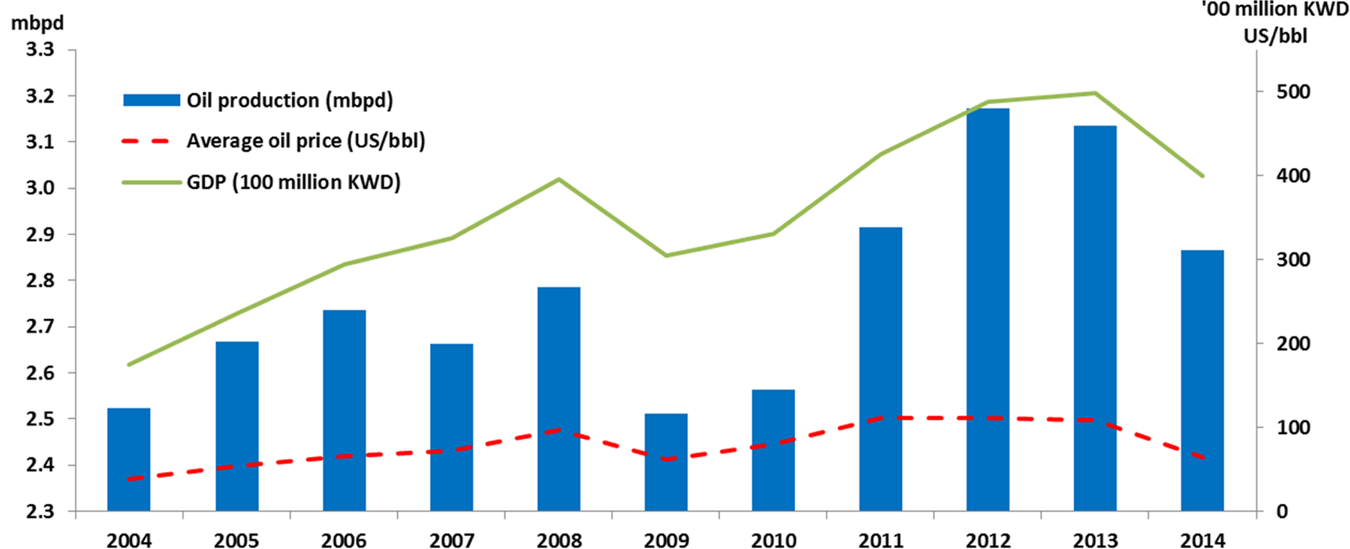
Like many oil-exporting economies, Kuwait's economic development strategy since the 1960s has positioned crude and refined oil products at the forefront of its exports and government revenue. The country's GDP is closely linked to its oil production and oil prices, as Figure 1 illustrates, and, it is therefore, subject to oil price volatility.
Kuwaiti oil production and oil prices 2004–2014

Kuwait's hydrocarbon production is managed through the state-owned Kuwait Petroleum Company (KPC), and oil production is formally determined by OPEC's production allocations, set at 2.7 million barrels per day (mbpd) effective January 2017 (OPEC, 2017). Actual production varies, but hovered around 3.1 mbpd between 2012 and 2017 (BP, 2018). Kuwait follows a seemingly export-led growth policy in a welfare state with high government intervention. The country's primary macroeconomic objective has been the maintenance of low inflation (1.5%), which has been partly achieved through a monetary policy tied to its stable currency, which is pegged to a basket of reserve currencies. It relied on fiscal policies as its main instrument of macroeconomic stabilization, aided by substantial foreign asset accumulation in its sovereign wealth funds (SWFs). The high levels of oil rent to date have seen the country enjoy striking levels of wealth, impressive foreign savings abroad, and enviable redistribution to its citizens via a generous domestic welfare system that includes various mechanisms for transferring petro-rents to nationals, including the use of energy subsidies.
2.2 Energy Subsidies and Energy Pricing Reform
Kuwait has a generous system of welfare and subsidies, covering a wide range of products and services, including energy. The reported consumption subsidies represent approximately 8% of value-added activities, and together with government-reported industry subsidies were US$8,670 million in 2013. Energy subsidies are pervasive and high even when compared to other petrostates. In 2015, Kuwait had the fifth-highest subsidization rate on energy products (when comparing domestic prices with their international shadow prices); it was estimated at 70%.Footnote 2
Up to mid-2016, Kuwaiti electricity prices were less than one twentieth of generation costs and had not changed since 1990 (Shehabi, Reference Shehabi2017). Water, for which the desalination techniques in use are mostly based on local hydrocarbon resources, has been offered at virtually no cost. Kuwait was one of the last countries to reform local energy prices, in August 2016, before which local gasoline prices had been among the lowest in the world. By 2014, Kuwait was the world's sixth-highest per capita energy consumer (World Bank, 2017), with domestic consumption having steadily increased over the previous 25 years. Given the large domestic energy requirements for consumption, reconstruction, private consumption, and desalination, these subsidies countervail attempts to restore fiscal balance.
Despite historic economic advantages, the oil price in mid-2014 caused serious fiscal and economic challenges, bringing accelerated energy subsidy reform to the forefront for the government. In the wake of the rejection of various schemes and failed reform attempts, in March–April 2016 it was proposed that electricity prices for residential use by non-owner occupied residences (who are effectively expatriates) should increase from US$0.007, progressively, to US$0.05/kilowatt hour, and for commercial use from US$0.007 to US$0.082/kilowatt hour. For remaining users, the price stayed at US$0.007, subsidized at a rate of approximately 95%. Reforming gasoline prices uniformly was a more successful endeavour when, in August 2016, the government, circumventing parliament, raised gasoline prices by 41–83% (differentiated by octane levels) to the international shadow price effective September 2016. Kuwait had been the last GCC state to reform its gasoline prices, at which point it had the lowest domestic gasoline prices globally, together with a US$15.3 billion deficit for 2016. Despite widespread opposition, which culminated in the parliament's failed attempt to reverse the price change in court, the government insisted its pricing reform would solve fiscal pressures, economic inefficiencies, and energy over-consumption, and that any subsequent inflation would be muted.
2.3 Trade
Kuwait has very liberal trade policies. The country signed the General Agreement on Tariffs and Trade in 1963 and has been a WTO member since 1995. Its trade balance in 2015 stood at 9.12% of its GDP, while trade in services reached 26.18% of GDP. While Kuwait's imports have been steadily increasing, its exports have been volatile, being subject to world demand fluctuations (for example, due to the global financial crisis in 2008) and volatile oil price movements. During the period 2013–2017, chemicals dominated non-oil exports, followed by machinery and transport equipment. While imports of machinery and transport equipment dominated non-energy imports, followed by manufacturing then chemicals.
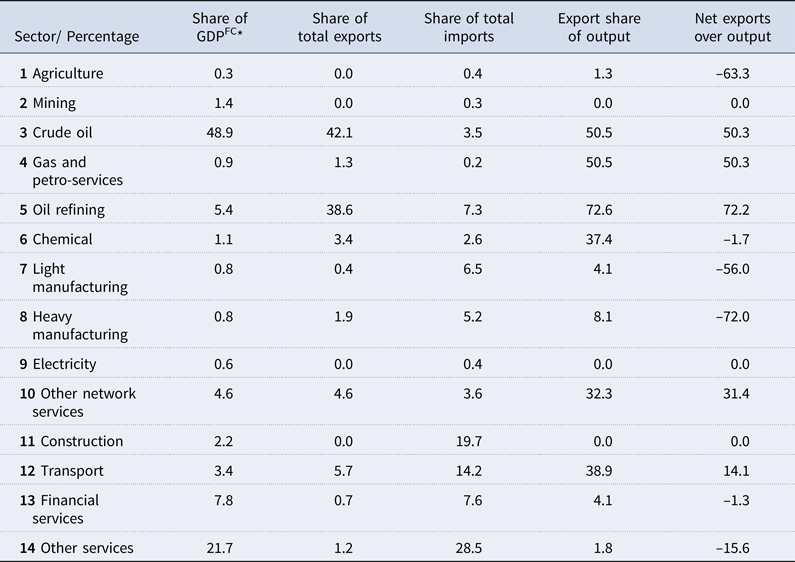
Data on Kuwait's economic structure reveal dynamics pertinent to assessing the impacts of trade and pricing reforms. Key structural elements of the Kuwaiti economy are depicted in Table 1 using the database for 2013 (the most recently available) constructed to calibrate this article's economy-wide model.
Economic structural elements 2013

Note: * GDPFC is GDP at factor cost, which is the sum of value added in each industry.
Source: Model database (social accounting matrix) constructed by author for 2013.
After hydrocarbons (consisting of ‘Crude oil’, ‘Gas and petro-services’, and ‘Oil refining’), ‘Other services’ are the second-highest value-adding industry. The ‘Chemicals’, ‘Other network services’, and ‘Transport’ industries generate 14% of exports, each exporting approximately one-third of its output. Kuwait has some existing expandable non-oil exportation capacity as well as import-competing industries. The data point to the existence of a heavy indirect (rather than direct) effect on the economy generated by imported intermediate inputs (because they form a large part of all intermediates). This structure has two main consequences: first, the economy had a capital surplus, which was funnelled into investments abroad and foreign aid; and, second, most of the consumer and intermediate consumption had to be met through imports.
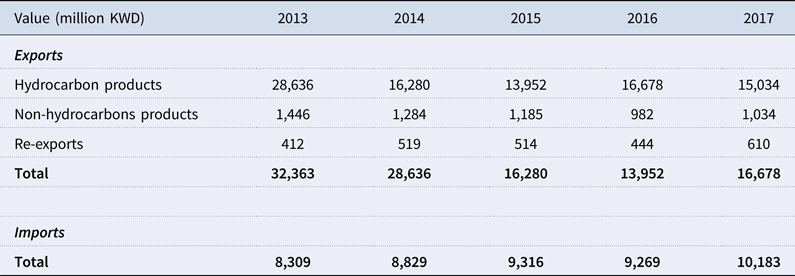
Critical to understanding the potential trade capacity and government policy in Kuwait is the existence of local non-oil import-competing industries, the expansion of which has been a key development target. To that end, the National Assembly approved US$103.4 billion to fund more than 800 projects, with the aim of moving the country towards becoming a banking, trade, and services hub for the GCC and the MENA area by 2030. In March 2013, the government invested KWD2 billion in a fund dedicated to support small and medium enterprises and young entrepreneurs. Moreover, the fiscal savings achieved by the 2016 subsidy reform were proposed as a means of supporting diversification of non-oil exports. Nevertheless, non-oil exports (such as ‘Chemicals’ and ‘Base metals’) have plummeted since key economic shocks (namely the oil price collapse in 2014 and energy pricing reform in 2016, see Table 2), despite depreciation of the real exchange rate. Such declines confirm that these industries’ capacity to expand their exports is constrained by other factors in the economy. Such declines can suggest to opponents of subsidies that energy subsidies had offered an extra advantage to these industries in international trade by lowering their costs – an assumption that will be examined further in this article.
Value and composition of imports and exports 2013–2017

Source: Kuwait Central Statistical Bureau (2017b).
Non-oil productive capacity is limited and hydrocarbons continue to dominate trade.
2.4 Key Economic Features and Structural Rigidities
In addition to high specialization in hydrocarbons (a commodity with a highly volatile price) and their dominance over trade, Kuwait's economy is constrained by other structural rigidities. Chief among these rigidities is public sector dominance; in 2014, this generated over 65% of GDP and has been historically high (compared with the private sector share that has ranged between a minimum of 21% (in 1989) and a maximum of 41% (in 2010). The public sector contributed to two-thirds of total capital formation. It is also the employer of choice for Kuwaiti workers (it employs the majority of them) and they in turn form the majority of public sector employees. Despite privatization efforts, Kuwait has a small private sector, and the public sector continues to dominate the economy in various industries, including petroleum.
These structural rigidities have contributed to fiscal rigidities. Adjusting the fiscal gap between revenue and expenditure is difficult during periods of low oil prices due to the following factors.
• Negligible tax revenue: Negligible rates are applied on labour and corporate income (Shehabi (Reference Shehabi2017) offers details).
• Large current expenditures and wage bill: The government's current expenditure (half of which funds the public sector wage bill) constitutes 80% of total government expenditure. Such large commitments have reduced the scope and flexibility of other public expenditures, especially given the political opposition to any reduction in public transfers.
• Subsidies and welfare transfers:Footnote 3 In 2014, transfers and subsidies to households and firms represented more than half of the government's total spending. As a result, when the oil price collapsed in mid-2014, there were ensuing large fiscal pressures resulting from declining oil (and correspondingly government) revenues, especially as welfare and subsidy expenditures continued to rise.
2.4.1 Expatriate labour
The structure of the labour force in Kuwait is unique. Only 17% of the total labour force is Kuwaiti, the majority of whom are employed in the bloated public sector (Public Authority for Civil Information, 2018). The remaining portion are expatriates, most of whom work in the private sector at lower wages for similar levels of education and technical training (Al-Kaisi, Reference Al-Kaisi1993). Importantly, in the expatriate labour market, labour is mobile between sectors and internationally owing to flexible contracts linked to employers through a strict system of employer-sponsorship of expatriate labour named kafāla. The ensuing exit of the expatriate labour offers large efficiency gains and a way to adjust to oil price shocks (Shehabi, Reference Shehabi2017).
2.4.2 Kuwait Investment Authority (KIA)
The KIA is an important institutional and financial feature of the Kuwaiti economy. It manages two funds of diversified assets, including one fund that acts as an instrument of macro-stabilization. This fund offers fiscal rebalancing through flows to and from the fund, so it can fund high subsidy commitments during deficits. The KIA funds are estimated at US$524 billion (SWF, n.d.), more than three times the size of Kuwait's record high GDP in 2013 and more than five times the country's export revenue in that year.
2.4.3 Oligopoly
Competition has been accepted as a central contributor to economic growth (Segerstrom, Anant, and Dinopoulos, Reference Segerstrom, Anant and Dinopoulos1990), while oligopolies and their collusive behaviour limit innovation-led growth and creative destruction (Schumpeter, Reference Schumpeter1942;Footnote 4 Aghion and Howitt, Reference Aghion and Howitt1992). In Kuwait, the economy is dominated by oligopolistic firms, led by members of the politically influential merchant elite. Shehabi (Reference Shehabi2017) examines firm- and industry-level market capitalization and revenue data, to reveal that oligopolies are pervasive in Kuwait. This pervasiveness is evidenced by the high concentration of industries’ capital and revenue levels within a few companies across all industries. It is not surprising that oligopolies or monopolized industries, particularly in protected services, would emerge as a result of the combination of of the large scale required to achieve minimum efficiency in modern technology, with the small scale of Kuwait (and similar GCC economies). And while it is natural for all economies to have oligopolies, this can be problematic for Kuwait and other small economies with similarly high specialization because oligopolies exhibit distortionary behaviour that is exacerbated by high subsidies. Subsidizing the negatively impacted industries enables them to be profitable at their existing levels of investment and innovation, thus reducing their economic incentives to innovate and expand. Government-dominated industries are, by definition, monopolies and oligopolies in the economy. The government has adopted plans to increase industrial competitiveness and expand the private sector. Yet reform attempts have had limited success, largely due to strong public discontent and parliamentary obstruction.
3. Modelling Subsidies and Trade
This article employs a two region (Kuwait and the Rest of the World), economy-wide model in a CGE framework that embodies the abovementioned unique features and structure of the economy. CGE frameworks, generally considered the most suitable for policy assessment, are economy-wide models that capture the major structural features of an economy and represent the interactions between its industries. The database for Kuwait, prepared in a Social SAM for Kuwait is constructed using the various data sources from the Kuwaiti government, as detailed in Appendix A. Data for the Rest of the World were sourced from the Global Trade Analysis Project (GTAP) database.
The model is comparative static, comparing the economic outcomes of endogenous variables (such as real prices and wages at different equilibrium states) that result from changes in exogenous variables such as oil prices and subsidy rates. It employs different closures to mimic the economy's long-run responses to external or policy shocks. The model represents explicitly external financial flows, domestic fiscal policy, oligopolistic industrial structures, government regulation, labour market composition by skill level and nationality source, and oil prices. All in all, there are 3,820 components representing 247 equation blocks, with 3,606 separate endogenous variables, implemented using the GEMPACK (General Equilibrium Modelling PACKage) software. The following offers an overview of the salient parts of the model, with additional model details confined to Appendix B.
This model builds upon much of the work done in Shehabi (Reference Shehabi2017), which builds on Asano and Tyers (Reference Asano and Tyers2019) which represent oligopoly behaviour and its regulation explicitly.
3.1 Basis
The model incorporates core features common in economy-wide national modelling. The ‘almost small’ characterization of the modelled economy follows Harris (Reference Harris1984) and Dixon et al. (Reference Dixon, Parmenter, Sutton and Vincent1982) and its openness extends to financial markets via endogenous saving and investment and open capital and current accounts. An ‘almost small’ open economy characterization entails an economy that has price-taking behaviour for imports along with constant elasticity downward-sloping foreign demand curves for exports, which are differentiated from competing products (Harris, Reference Harris1984). These assumptions are essential in the case of Kuwait, which has a small economy that is highly dependent on trade (including imports in markets where it is a price taker) and on international financial flows. Beyond the Armington (Reference Armington1969) assumption of national product differentiation (a standard feature in trade policy applications), this model, like that of Balistreri and Markusen (Reference Balistreri and Markusen2009), includes the standard ArmingtonFootnote 5 constant elasticity of substitution (CES) nesting structures at the sub-national (firm) level that imply product differentiation between home and foreign products. Similar differentiation applies between common home products supplied by oligopolistic firms, though elasticities of substitution are larger in this case.
Financial flows and real exchange rate changes are endogenous, while external economic conditions, such as yields on investments abroad and global oil market trends, are exogenous and can be shocked in model simulations. The real exchange rate represents the common currency ratio of the home price of a bundle of (traded and non-traded) goods and services at home relative to that abroad, and is modelled accordingly. Therefore, it is sensitive to both the performance of the traded industries and to that of the non-traded services sector. The model adopts neoclassical features in characterizing consumption preferences and the variable costs of production, including the optimization of representative agent behaviour, full input substitutability, and flexible product and factor prices.
The model, however, breaks away from existing and traditional frameworks through its representation of oligopoly behaviour and in extensions to the model, as detailed in Shehabi (Reference Shehabi2017). Incorporating oligopolies is important, as they distort markets and prices while their sustained rents engender strategic behaviours that detract from growth-enhancing innovation (Grossman and Helpman, Reference Grossman and Helpman2014). Devarajan and Rodrik (Reference Devarajan and Rodrik1991) suggest that pro-competitive forces operating on oligopolistic firms can influence the magnitude of efficiency gains resulting from trade liberalization in Cameroon. Incorporation of oligopoly behaviour by Tyers (Reference Tyers2015) suggests that the full exploitation of oligopoly market power in Australia would cause a reduction of real GDP by as much as a third in the long run. Of course, in advanced economies, this effect is moderated by pricing surveillance and price-cap regulation. Yet in resource exporters, oligopolies play an additional role: their increased rents during booms and their (usually subsidized) losses during busts further impair economic performance. The model of Shehabi (Reference Shehabi2017) was the first to consider the role of oligopoly and the resulting efficiency in the context of economies in Kuwait and the MENA region.
3.2 Model Details
As modelled, the Kuwaiti economy has one representative household that consumes home produced and imported goods, supplies indigenous and expatriate labour and skills, and owns physical capital. The model has macroeconomic elements, including endogenous saving and investment, open capital and current accounts, and a complete system of taxes and subsidies. Financial flows and real exchange rate changes are endogenous and external economic conditions (as represented by bond yields and commodity prices) are readily shocked as part of analytical applications.
3.2.1 Demand Side
On the demand side, firms in 14 industries rent capital and hire workers, supplying products and services to meet five sources of demand: final, intermediate, investment, government, and foreign demands. The model makes conventional assumptions about the consumption of home products in each sector. According to these assumptions, each demand source consumes domestic products that are differentiated by variety via CES nests, which are further differentiated from imported foreign varieties. Critical to the results of this paper, there are no existing estimates of the elasticity of substitution between imports and locally produced goods; nonetheless, the convention adopted in this study assumes low elasticity of substitution for non-energy industries for which limited domestic production exists leading to low substitutability of domestic goods and imports.Footnote 6
As oligopolists or monopolists, firms’ optimal sale price depends on the varietal elasticity of demand they face (εi) via the Lerner formula. This elasticity of collective demand is then a weighted average of the elasticities of demand in the five markets it supplies (see above):
 $$\varepsilon _i = S_i^F \varepsilon _i^F + S_i^G \varepsilon _i^G + S_i^I \varepsilon _i^I + S_i^T \varepsilon _i^T + S_i^X \varepsilon _i^X {\rm \;\;}\;\;\;\;\forall i$$
where ( $\varepsilon _i^X \lt \varepsilon _i^F \lt \varepsilon _i^G \lt \varepsilon _i^I \lt \varepsilon _i^T \lt 0$).
and the following subscripts represent the following demand sources: F represents final, I intermediate, T investment, G government, and X foreign demands; while $\;S_i^j $ denotes the fully endogenous volume share of the home product in market j for each source of demand.
Each of these demand sources has a demand elasticity that depends on component elasticities of substitution, firm numbers, conjectural variation parameters in industry i (μ i) that indicate the extent of collusion in price setting, and further sets of shares.
3.2.2 Supply Side and Oligopolies
The production technology is Cobb–Douglas in variable factors and intermediate inputs, so that Industries can substitute between the variable factors and the intermediates. Intermediate inputs, in turn, are composites (CES nests) of home and imported products and services. The model captures key Kuwaiti oligopolistic (and monopolistic) industries and targeted regulatory surveillance, a key economic feature (Section 2.2).
The model represents oligopoly with behavioural structure from Shehabi (Reference Shehabi2017), based on Asano and Tyers (Reference Asano and Tyers2019), which is based on earlier work by Tyers (Reference Tyers2015), Gunasekera and Tyers (Reference Gunasekera and Tyers1990), Harris (Reference Harris1984), Horridge (Reference Horridge1987), and Tyers (Reference Tyers2005), and is similar to that of Devarajan and Rodrik (Reference Devarajan and Rodrik1991).
Firms in all economic sectors, private and state-owned firms, are oligopolistic, operate in differentiated product markets, and adopt profit-maximizing rules each carrying fixed capital and labour costs that can lead to the potential for unrealized economies of scale and to the occurrence of pure (economic) profits (or losses) at market levels. Pure (economic) profits are those earned for charging a price plus a markup above the average cost. As such, each firm in industry i exploits its monopoly over the supply of its own product variety through selecting the price p i relative to average variable cost v i, therefore its markup m i that maximizes its profit is as follows:
 $$m_i = \displaystyle{{\,p_i} \over {v_i}} = \displaystyle{1 \over {1 + \displaystyle{1 \over {\varepsilon _i}}}}\,\,\,\,\,\,\,\,\,\,\,\forall \,i$$
As the markets (export and domestic) in which each firm sells its products are different, this is the average markup that a firm earns locally, taking into account the total elasticity of demand facing the firm, being the weighted average of elasticities of demand of the five demand sources.
All firms in all economic activities have oligopoly power in product and input markets.Footnote 7 Larger firms are subject to pricing surveillance regulation. Firms in industry i collude on prices to varying extents, and their collusion is parametrized through conjectural variations parameters (μ i). The conjectural variations parameters in each industry indicate the influence of pricing choices by any individual firm k, on the price set by of firm j:  $\mu _i = {{\partial p_{ij}} \over {\partial p_{ik}}}$.
In calibrating these parametrized values, information on oligopolistic industries is used to determine rough estimates of the number of ‘effective’ (strategically interacting) firms in each industry and the corresponding parameters governing competitive behaviour. Appendix B offers details, including the number of effective firms per industry and initial conjectural variation parameters.
These parametrized values are critical because they capture the degree of price-setting collusion that occurs between the firms in a given industry. The value of μ i ranges from 0 in the Nash equilibrium case (where each firm chooses its price, taking the prices of all other firms as given), which is a non-collusive differentiated Bertrand oligopoly, to 1 (unity) when all firms act as a cartel. Parameter values between 0 and 1 represent a collusive Bertrand oligopoly. The conjectural variation parameters also reflect the extent of existing regulatory surveillance; in the model, larger firms are subject to pricing surveillance regulation. These relationships are complex and Shehabi (Reference Shehabi2017) and Tyers (Reference Tyers2015) detail their analytics. Yet relevant to trade, being the central subject of this article, final demand and intermediate demand elasticities are important and are detailed in Appendix B.
3.2.3 Factors of Production and Input Demands
There are seven primary factors of production: physical capital, Kuwaiti unskilled labour, Kuwaiti skilled labour, expatriate unskilled labour, expatriate skilled labour, arable land, and natural resources. Solving the firm's cost minimization problem with Cobb–Douglas technology in variable factors and inputs yields the volumes of each intermediate demand.
Unit input demands are Leontief input–output coefficients, but they are not fixed but depend on product and input prices. Specifically, their values are determined by substitution behaviour (between domestic and imported inputs) in response to product and input prices.
3.2.4 Government and Subsidies
The government is fully represented. Fiscal rigidities are included through a full representation of government accounts and macroeconomic elements, including endogenous saving and investment, open capital and current accounts, and a complete system of expanded consumption subsidies and of taxes – both from direct taxes (on capital, labour income, land, and resource rents) and from indirect taxes (on trade and consumption expenditures). Total government expenditure is the sum of expenditure on goods and services and the expenditure on transfers (pensions).
The government also makes direct transfers to the collective household, which can be set as exogenous in real terms and can be shocked, in which case one other fiscal variable must be made endogenous: the fiscal deficit, one of the tax rates, or government expenditure on goods and services. Therefore, the government transfer variable is exploited beyond the applications by Asano and Tyers (Reference Asano and Tyers2019) by not setting the expenditures on transfers constant relative to the consumer price level.
Subsidies are represented by negative consumption and company taxes. Although Kuwait has negligible income tax rates, with some of these government revenue sources being inactive, the modelling includes them to enable the simulation of alternative tax policy options and the analysis of potential taxation reforms. This model differentiates consumption subsidy by industry. Artificial reductions in local prices below firms’ output prices are captured as consumption subsidies to households.
3.2.5 Financial Flows, Savings, and the KIA
The model represents financial agents who manage portfolios of domestic and foreign assets, impacting the inflow and outflow of financial investments. The model also takes into account Kuwait's external financial flows, primarily flows to and from the KIA. These mimic, to the extent possible, the KIA's role as a source of government funds following oil price shocks.
To complete the external financial accounts, the model represents both foreign direct investments and official foreign reserve accumulations through the KIA. In the long-run version of the model applied in this study, the total capital stock of the economy is endogenous, as is the level of capital used in each industry. The open economy capital market has a market clearing identity that accounts for financial flows, both inward (FIInward) and outward (FIOutward).
 $$I\lpar r^{ce}\comma \;\,r\rpar = S_D\lpar Y_{DH}\comma \;\pi \comma \;G\rpar + FI_{Inward}\,\lpar r\comma \;r\ast \comma \;\hat{e}_R^e \rpar -FI_{Outward}\,\,\lpar r\comma \;r\ast \comma \;\hat{e}_R^e \rpar \comma \;$$
where r ce is the expected average net rate of return on installed capital; r is the home bond yield (representing the real financing rate); SD is total domestic saving applied to the home household disposable income YDH; π is accounting profit; G is total government expenditure; r* is the foreign real post-tax yield on bonds abroad; and  $\hat{e}_R^e $ is the expected proportional change in the real exchange rate. Total domestic saving is the sum of saving by households, corporations, and government. The household savings rate is fixed, and firms retain net earnings at corporate savings rates that are also fixed and industry-specific.Footnote 8 Inward and outward financial flows follow changes in interest rate parity, being the difference between the home and foreign real bond yields and expectations of real exchange rate.
The model allows for reversals of the direction of net flow as a response to shock and capital flows policy changes. Inward flows, which are divided between home and foreign portfolio decisions, have a negative elasticity. Outward flows, by contrast, occur due to portfolio management decisions at home, so have a positive elasticity. These flows are determined by the interest – or financing – rate, rather than the expected rate. Subsequently, the capital market clearing identity determines the home real interest rate and the magnitude of the external financial deficit. This value is equal in magnitude to the current account surplus.
3.2.6 Capital
To allow changes in investment flows in the model, capital representation includes capital used locally, as well as the portion of capital owned by Kuwaiti citizens, calculated after subtracting foreign owned capital from total capital. Capital owned by Kuwaiti citizens does not change total capital use in the economy. Repatriated capital income impacts the real exchange rate and GNP. Capital flows are set at the level where post-tax rates of return at home equal rates internationally, while also allowing firms to generate rents consistent with oligopoly behaviour. Therefore, in the long run, capital use equates post-tax capital rate of return to post-tax “market” returns, net of pure profits. Drops in taxation rates of capital income (or conversely, increases in subsidies) will cause the pre-tax rate of return demanded at home to drop and capital use to, correspondingly, increase.
Capital is mobile across sectors as well as internationally. The capital market closure can be changed to mimic the economy's behaviour in the short run, in which capital is fixed at the industry level, while rates of return vary across industries and are changeable in response to various shocks. The long-run version has prices and interest rates which adjust to ensure that product, factor, and financial markets all clear.
3.3 Closures
Closures represent assumptions relating to which variables are free to change in response to shocks and also to which variables can adjust, reflecting policy targets and market clearance assumptions. While comparatively static, the model employs different closures to represent the responses of the Kuwaiti economy in both the short and long run. These closures have four sub-closures reflecting four elements, namely: the labour market; fiscal closures; the financial capital market; and a market structure (oligopoly) sub-closure.
In this application to Kuwait, closures are one way in which the unique Kuwaiti economic features (detailed in Section 2.2) are captured in the model. They are as follows: the standard labour closure fixes the employment of Kuwaiti labour and enables endogenous movement of both skilled and unskilled expatriates. The real expatriate skilled and unskilled production wage rates (relative to an index of producer prices) are held fixed (to reflect the movement of expatriate labour and the possibility of their exit from the market), while the real Kuwaiti skilled and unskilled production wages are endogenous. This closure is set in this way, first, to represent the inflexibility of the majority of Kuwaiti workers, who are likely to remain employed in the public sector, yet are sectorally mobile. Second, it accounts for the long-run flexibility of expatriate worker contracts, given that the stock of expatriate workers can fall with a decline in labour demand in both the short and long run.
To represent more realistically the changes in either the fiscal deficit and/or transfer payments, the adopted fiscal closure has an endogenous fiscal deficit and transfer (welfare) payments, with exogenous government spending on goods and services, and exogenous consumption subsidy rate and corporate tax rates (both of which are shocked). Notably, it is common to hold the fiscal balance constant in studies on distortions caused by taxes/subsidies (as in the first simulation of Shehabi (Reference Shehabi2017)), thus allowing the lost revenue to be returned to households and enabling the examination of the price effect and not the income effect of the reform policy. Nevertheless, this study adopts a different government closure to mimic to the greatest extent possible the policy reform in Kuwait, where the cost of subsidy reform was borne by the households and not offset by transfer (welfare) payments to households or firms. To that end, the government transfer variable is exploited beyond the applications by Asano and Tyers (Reference Asano and Tyers2019) by not setting the expenditures on transfers constant relative to the consumer price level.
For the capital market closures, in the long run, the capital stock of the entire economy is mobile, so it adjusts (rises or falls) to maintain a fixed rate of return in all industries, with implications for financial flows on the balance of payments. Payments to the KIA, and withdrawals from it, remain endogenous in the model. Finally, the oligopoly sub-closure in the long run allows free entry and exit of firms at a given profitability level.
4. Policy Experiments
The article undertakes three experiments analysed in the long term only with long-term closures, due to the nature of subsidy reform which has long-term rather than transitory effects:
1. The first experiment concerns a decline in the energy subsidy rate in a high oil price environment without change in any policy instruments (Scenario 1).
2. The second experiment combines the first shock in experiment (a) with a decline in the world oil price (this is similar to the position in Kuwait following the implementation of energy pricing reform in August 2016, whereby local energy prices were raised to match the international shadow price) (Scenario 2).
3. The last experiment combines both the shocks in (b) with a hypothetical microeconomic policy reform that includes competition policy and productivity boosts (Scenario 3).
The findings are summarized in the following subsections.
4.1 Scenario 1: Energy Subsidy Reform in a High Oil Price Environment Allowing Adjustments in Fiscal Deficit and Transfer (Welfare) Payments
To examine whether energy subsidies, including production subsidies, offer non-energy Kuwaiti industries an advantage in the international market, this counterfactual simulation examines the impact of reducing oil subsidies by 50% to raise the domestic price to a level that matches the international shadow price of oil during the episodes of high oil prices, without any changes in other policy instruments. The price reform shock is administered through a 50% decrease in the households consumption subsidy rate on crude oil and refined oil products and a 5% decrease in the corporate subsidy (and tax) rate (showing effectively as an increase of 5% in the net corporate tax rate) on non-petroleum industries. This is calculated based on a pro rata basis, based on the share of intermediate (industrial) consumption of crude and petroleum products in consumption of goods and services all other industries. The adopted capital market and market structure closure, summarized in Section 3.4 above, dictate whether the model simulates short- or long-run results. Government expenditures on goods and services are assumed to remain constant, allowing the fiscal balance to adjust.
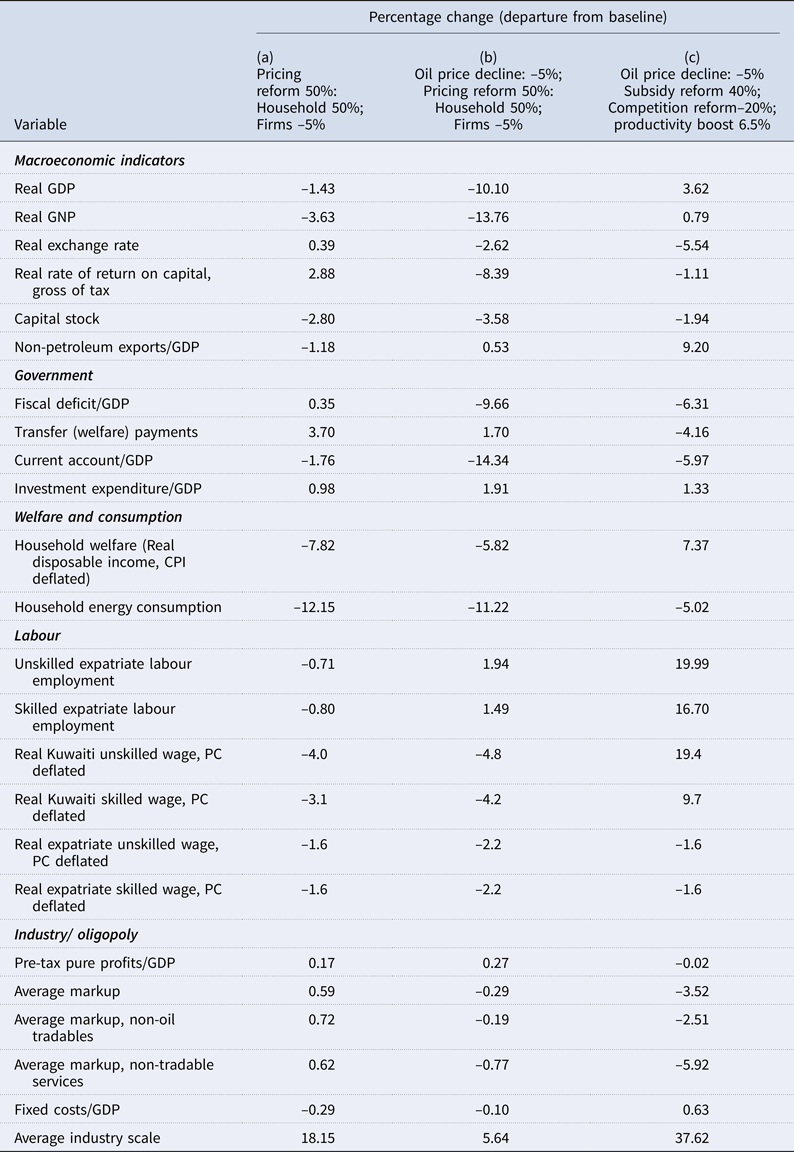
Table 3 column (a) summarizes the results.
Impact of energy subsidy reform shocks on selected economic variables in the long run

Source: Simulation results.
At the macro level, the real GDP and real GNP drops are driven by a loss in capital stock. Both of these values move relative to one another and are affected by movements in the price deflator used to calculate them. In addition, the real GNP decline is further driven by the net income component of the current account and unrequited transfers. The net fiscal effects witness only minor improvements. The increase in government revenue resulting from savings accrued by reducing subsidies improves the government budget. These savings, however, are offset by higher transfer (welfare) payments to Kuwaiti citizens to compensate for inflation and for the decline in household disposable income caused by the decline in the subsidy. Aggregate household welfare, measured in the model by real disposable income deflated by the CPI, drops.
The first important insight from the results is that transmission of energy subsidy reform into trade flows occurs through the two main channels, but with opposing effects: (i) raising the cost of local energy and energy-dependent goods; and (ii) appreciation of the exchange rate, which decreases the relative cost of imports and reduces the competitiveness of non-oil exports abroad. Nevertheless, these effects are very limited due to idiosyncratic factors, namely: (i) the elasticity of substitution between imports and locally produced goods; (ii) the flexibility of expatriate labour contracts; (iii) high share of imports in intermediates; and (iv) oligopolistic structures in non-tradable and tradable sectors. The dynamics are as follows.
The drop of the subsidy by itself does not materially affect Kuwait's net petroleum exports because the subsidy impacts the domestic price only, while exports depend on the international price and importantly the export demand elasticity for oil from Kuwait by the rest of the world. It does, however, raise the cost of domestic energy and energy-dependent goods, as well that of intermediates using local energy as an input. Accordingly, overall household income declines as, consequently, does household demand for energy and other products. As such, both households and industries’ (intermediate) demand for these goods also declines. Further, the rise in domestic energy prices causes the real exchange rate to appreciate, which decreases the competitiveness of non-oil exports as they become relatively more expensive on the international market.
Accordingly, industries adjust their production (downwards) through labour and capital. For labour, the flexibility of expatriate labour contracts allows affected industries to adjust their employment levels, causing similar declines in the employment levels of skilled and unskilled expatriates (while the employment of Kuwaitis is largely unaffected due to their fixed employment in the public sector, while their real wages are reduced). Without employment sponsorship, expatriate labour must exit. As expatriates’ wages are generally lower than those of Kuwaitis, their exit contributes to the above-described production adjustments and to potentially smaller adjustments in consumption. This mechanism is unique to GCC states (with similar labour markets) in which expatriates’ exit acts as a cushion that absorbs the economic shock.
The mobility of capital in the long run, coupled with the decreased competitiveness of non-oil exports (owing to the appreciating real exchange rate), leads to declines in output for the non-energy sectors, which has a net contractionary effect on the overall economy. This effect is similar to that of the ‘Dutch disease’, which occurs following a boom in natural resource exports that leads to a significant appreciation of nominal (and real) exchange rates (or to inflation in countries with fixed exchange rates regimes), adversely affecting non-resource tradable sectors and expanding non-traded service sectors.
At the same time, the appreciating real exchange rate also renders imported goods relatively cheaper. Thus, the declining household demand is moderated with more affordable imports. Similarly, the demand for intermediate goods is inelastic, and the high real exchange rate powered by the strong petroleum exports renders imported intermediate goods relatively cheaper. As such, there are potential expansion opportunities as local industries shift away from local intermediates to more affordable imported intermediates. Nevertheless, low elasticity of substitution between imports and locally produced goods (assumed by author to reflect the low substitutability between the two in the non-energy tradable sectors), coupled with the share of imports in intermediate inputs in the non-energy tradable sectors, means that the expansion in those sectors is small. Overall, the demand for imported intermediate inputs changes, but only marginally. The net effect is a decline in non-energy output and exports, and an increase in overall imports.
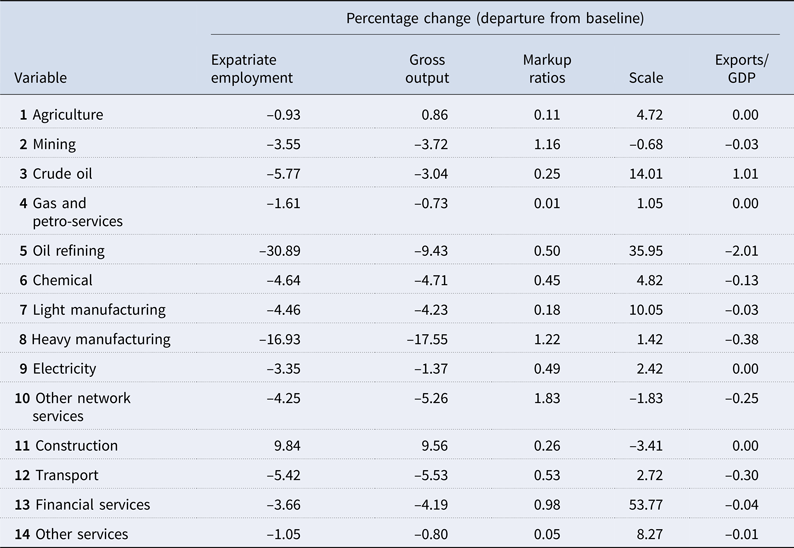
The long-term sectoral results, depicted in Table 4, reveal three important insights into the linkages between subsidy reform and the trade of non-oil tradable industries.
Long-run sectoral effects of subsidy reform

Source: Simulation results.
First, although the shock reduces economic distortions, there is an increase in oligopoly markups across all industries and the overall economy, which is effectively an increase in distortions. This result requires explanation. The contractionary nature of the shock itself initially reduces oligopoly markups. There are, potentially, expansion opportunities as traded industries shift their output away from the international market to the domestic market. Yet demand in the non-petroleum exporting and services industries shifts from exports (with the highest elasticity) to intermediate and investment demand (with the lowest and second-lowest elasticity, respectively), causing the overall elasticity of demand to decrease. Oligopoly markups therefore increase in turn, counterbalancing the negative impact of the shocks. This is a very important result because these markups, and the pure profits in the larger industries, remain especially high, implying that a large part of the economy's inefficiency is captured by distortionary oligopoly rents.
Second, energy subsidy reform in Kuwait has little in the way of pro-competitive industrial effects and produces few efficiency gains. This result is evidenced by small increases in average markups as a share of GDP, including those for non-oil tradable sectors. It is thus unsurprising that the result is contractionary for the overall economy, achieving losses at both the macro and microeconomic levels. The non-traded ‘Construction’ industry appears to be the main winner. Its output increases, despite the decline in capital in the economy, owing to a higher employment of unskilled expatriate employees.
The third insight is that non-oil tradable exports do not gain a significant advantage from energy production subsidies. This is evidenced by the negligible decline in their exports following energy subsidy reform (a total of –1.18%, a value that is not a significant portion of the overall Kuwaiti exports). Further, if subsidy reform offered a noticeable advantage to non-energy exports, then it is reasonable to expect that following the drop of subsidies, their exports (as a share of output) would decrease proportionately by more than their overall output. Yet the results show that this is not the case for the major non-oil exporters (‘Transport’, ‘Other network services’, and ‘Chemicals’), and occurs only for small exporters of ‘Heavy manufacturing’ and ‘Services’.
These results offer a salient conclusion on linkages between subsidies and trade in oligopolistic economies: local energy subsidies do not offer non-energy exporting sectors a significant advantage in international markets, largely due to the oligopolistic nature of the industries and their ability to secure large markups and pure profits locally. These profits are at risk of being eroded in the international market, so non-oil-exporting industries have little incentive to export with or without high energy subsidies at home.
4.2 Scenario 2: Energy Subsidy Reform Following the Decline of the Oil Price
This analysis quantifies the impact of energy pricing reform (of the type implemented by the Kuwaiti government) on current economic conditions. Thus, this scenario simulates the effects of a 5% drop in the oil export price combined with the subsidy reform shock from the earlier simulation,Footnote 9 adopting the same closures. Table 3 column (b) summarizes the results.
At the macroeconomic level, assuming a continually low oil price, energy pricing reform exacerbates the contractionary shock of energy subsidy reform in a high oil price environment in Scenario 1.Footnote 10 Falls in both real GNP and real GDP are greater than in the first simulation, largely driven by a decline in the oil price and a loss in investment. The real exchange rate depreciates, raising the relative cost of intermediate goods. The aggregate household welfare measure drops, as real disposable income falls (while savings remain constant), and households adjust their consumption of energy and other products. In compensation, the government increases transfer (welfare) payments to Kuwaiti citizens, but only by half that of the first scenario because welfare losses are lower than in the first scenario. These payments erode the fiscal improvement obtained through reducing the cost of subsidy payments to households and industries in the long term, necessitating large withdrawals from the KIA funds to finance committed government expenditures.
Importantly, the pro-trade effects of subsidy reform following a decline of the oil price are higher than in the first scenario, driven by the depreciating exchange rate, elasticities of demand, and efficiency improvements through declines in oligopoly markup. The depreciating real exchange rate makes prices of imports increase from the base level, reducing demand for imported final goods and intermediates. The rise in input costs, coupled with the high rise in energy costs, force Kuwaiti non-oil industries to cut costs, especially those of expatriate labour in the short run, limiting their expansion. Capital flows out of the economy (given the declines in returns locally), which further hurts non-petroleum production and reduces demand for imported inputs. Consequently, markups of the non-oil non-tradables (such as Construction) also decline to a greater extent. Markup declines entail increasingly competitive pricing, which generates an overall positive effect on economic activity and real GDP, as well as substantial indirect effects that accumulate economy wide. Conversely, this will have only modest direct effects (on final product markups). The ensuing efficiency improvements partially compensate for the output losses of affected industries.
Non-oil-exporting industries (such as Chemicals), whose input costs also rise, are directed away from (the least elastic) intermediate and investment demand to (the more elastic) export and final demand. Consequently, their markups decline, expanding their scale efficiency, which further enlarges their expansion. Furthermore, they become more competitive owing to the depreciating exchange rate, enabling them to increase their output and exports. To that end, they import more intermediates and benefit from the movement of expatriate labour and capital away from the negatively impacted non-traded sectors. Additional labour demand is met through hiring additional expatriate workers, who are mobile with flexible employment contracts. All in all, the overall employment level of expatriates increases marginally from that in the initial equilibrium, a result that has critical implications for the labour market because it entails continued reliance on expatriate workers (a politically sensitive issue) and its dependence on international labour mobility. Consequently, both non-oil exports and imports increase because of the majority of intermediate inputs (used by the expanding industries) are imported.
This analysis shows that the pro-trade effects of subsidy reform are limited, but that they are higher if reform is implemented following an oil price decline because negative effects are partially offset by efficiency gains and reduction in oligopoly markups. Nevertheless, these effects remain small due to structural constraints in economic, labour, and oligopolistic structures. Increases in non-oil industrial production and exports remain insufficient to counter the contractionary effects caused by the oil price decline and subsidy reform, with only minimal improvement in competitiveness from the initial base level.
The pervasiveness of oligopolies that sustain large markups, together with their collusive pricing in the economy, limits trade expansion and suggests that there is considerable scope for competition reform in Kuwait. This is further confirmed by Kuwait's various Five-Year Development Plans, which have the explicit goal of expanding the private sector, coupled with increasing competition within the overall economy. This scope motivates the final analysis, which explores the possible effects of subsidy reform in combination with other reforms that relax distortions caused by oligopolistic behaviour in the Kuwaiti economy.
4.3 Scenario 3: Competition Reform and Subsidy Reform
This scenario aims to investigate the circumstances in which energy reform could also be accompanied by pro-competitive pro-trade effects. To that end, this scenario seeks to identify possible policy solutions that not only could be implemented in combination with energy pricing reform in a low petroleum price environment (simulated in Scenario 2), but also can relax some of the existing distortions caused by pervasive oligopolistic behaviour. To identify such possible policy solutions that would also be politically viable, consideration was given to policy solutions on oligopolistic behaviour that already exist in Kuwait's policy mandates and laws of Kuwait's Competition Protection Authority. Accordingly, this analysis quantifies the effects of these policy solutions, namely competition reform, in combination with the previous two shocks.
To that end, two hypothetical competition policy reforms are introduced simultaneously along with the shocks implemented in Scenario 2. These two competition policy reforms are: tighter pricing surveillance that reduces collusive behaviour across all non-petroleum industries, simulated through a 20% reduction in the tendency for businesses to collude on prices (represented by the conjectural variations parameters), and improvements in the productivity of both the private and services sectors of 6.5% in the long run. These sectors are private and services companies (namely all industries with the exception of the hydrocarbon and mining sectors, electricity, and agriculture). The results are highly informative about the dynamics of the economy and the possible effects of such reforms even though the costs of reforms are not simulated.Footnote 11Table 3 column (c) summarizes the results.
Competition reform can yield substantial improvements in performance, further confirming conclusions obtained by Shehabi (Reference Shehabi2017), as well as substantial pro-trade effects, as improvements in both imports and non-oil exports can be seen in margins significantly larger than in the previous simulations. Real GDP and real GNP both rise, and output, employment, and aggregate welfare all increase. As in the previous scenario, the transmission of these shocks to households and industries occurs through price and the real exchange rate, whereby initial demand for final and intermediates goods declines, while non-oil exports expand.
Yet in this scenario, competition reform yields noticeable expansion in non-oil output (tradable and non-tradable) as well as in non-oil exports. Non-oil exports as a share of GDP increase by as much as 9.2%, which occurs through five main transmission channels:
1. The real exchange rate, which depreciates substantially (approximately twice the depreciation in the previous scenario), not only because of the drop in the oil price, but also due to increases in efficiency. Consequently, firms can increase production scale gains and reduce overall costs.
2. Limiting collusion slashes the large pure profits captured by oligopolies, offering gains distributed across the economy as a whole.
3. Efficiency gains increase the competitiveness of these industries, enabling expansion that exceeds the loss due to increased costs for these industries.
4. In the long run, improvements in efficiency encourage capital stock enlargement, shown as a rebalancing of Kuwait's asset portfolios away from foreign toward domestic productive assets. Unlike the previous scenario, local rates of return on capital change slightly, driven by changes in market capital returns rather than by pure profits, making this scenario beneficial for both workers and capital owners.
5. The increase in productivity of the private sector and services, which further augments the aforementioned efficiency gains; these gains reduce markups further and increase production scale.
With the exception of energy industries and energy-dependent transportation, industries demand additional labour in the long run, which will mostly be filled by expatriate labour (as Kuwaiti workers are largely locked into the public sector). Capital mobility rebalances real rates of return on capital to a level only slightly lower than that of the base scenario. Kuwaiti labour gains in the long run, and capital owners do not endure significant losses. Reductions in oligopolies’ pure profits as a share of GDP drive increased competitiveness of the overall economy.
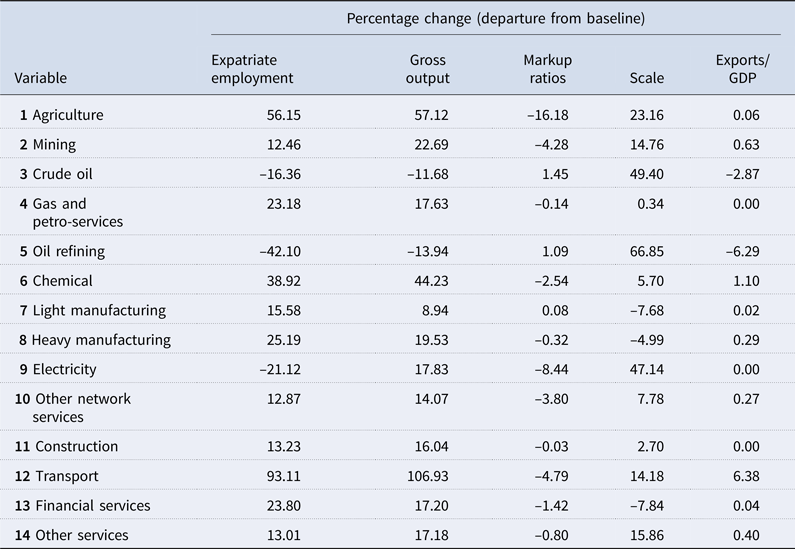
Importantly, in industries where large initial markups exist, such as the construction industry, which also uses energy as an input, more competitive pricing generates significant drops in markup. These drops yield effects on overall economic activity that largely exceed the neoclassical gains in allocative efficiency from removing price distortions due to taxes, subsidies, and regulation. The increase in transportation exports reflects expansion in exports (including re-exports) of this industry.
Table 5 summarizes long-term sectoral results.
Long- run sectoral effects of subsidy and competition reforms following oil price declines

Source: Simulation results.
Imports also increase substantially, driven by expanded employment, improvement in economic performance, and substantial welfare gains. Households with higher incomes demand more local and imported products. In turn, non-traded sectors demand more intermediate goods, including imported goods, to meet local increased demand. Similarly, non-oil-exporting firms consume more imported intermediates to accommodate their expansion in output and exports.
In summary, there are large improvement and output gains achieved by competition reform, as well as an increase in expatriate labour employment to accommodate firms’ expansion that is significantly larger than that in the first experiment. The economy faces larger impairments in the long run, caused by the decline of the oil price on the economy. Nonetheless, expansion due to more competitive pricing is particularly relevant as it achieves reverse Dutch disease dynamics as well as expansions in some non-tradable industries, which may be sufficient to sustain improvements in real GDP and achieve significant pro-trade effects. These effects are not achieved under the previous scenarios.
5. Conclusions
This article examines the linkages between trade and energy subsidy reform in a distorted, small oil-dependent economy, using illustrations from Kuwait. There is little evidence on the linkages between trade and subsidy reform in oil-producing economies. In the case of Kuwait, proponents of energy subsidy reform have argued that, if implemented following a decline in the oil price, such reform would lead to the expansion of non-oil sectors and their exports. This is the logic of the WTO's use of trade rules to reform subsidies. Sceptics, however, predict that there are limited expansion opportunities, with the consequent expectation of minimal changes in the economic structure or in trade as result of subsidy reform. This article addresses this gap in the literature. Based on the available information, this analysis is the first to feature trade as a central theme of energy subsidy reform, especially in the context of MENA.
Four major findings emerge from the simulation results.
First, the results show that the transmission of subsidy reform on trade in a highly specialized and distorted economy is negative and occurs through the two main channels of price and appreciation of the real exchange rate, but the effects are largely limited due to existing idiosyncratic economic rigidities and distortions. Second, in certain circumstances, however, these channels can produce the opposite effect, as follows. By raising the costs of energy and energy-dependent goods, subsidy reform appreciates the real exchange rate, which renders imports relatively more affordable while reducing the international competitiveness of non-oil exports. Third, subsidy reform has higher pro-trade effects if implemented following a decline in the oil price (but, even then, the effects are relatively small) because their negative effects (in the first finding) are partially offset by efficiency gains and reduction in oligopoly markups. Fourth, if subsidy reform is applied following a decline in the oil price (rather than when the oil price is high), it worsens the competitive gains of non-energy exports (which result from the depreciating exchange rate) because they cause energy and imported goods' prices to increase. Yet, contrary to claims by proponents of reforms, these impacts of subsidy reform on trade are largely constrained mainly due to four unique factors: rigid public sector employment, oligopolistic distortions, high dependence on imported intermediate inputs in local production, and the limitations of capital movement (due to its concentration in the capital-intensive nationally owned oil industry and the SWFs).
The results of the last simulation are more optimistic – in that expansion of the non-oil industrial and exports sectors is constrained by institutional, political, economic, and labour constraints and rigidities. Yet they point to an important message that pro-trade effects of subsidy reform will continue to be constrained unless appropriate incentives are introduced. These results have important policy implications. First, in developing oil-exporting economies with pervasive oligopolies, microeconomic reform can be a channel through which to achieve pro-trade effects of energy subsidy reform. Further, benefits beyond export expansion, such as higher economic efficiency, could be better motivators of energy subsidy reform in oil economies.
Acknowledgements
Thanks are due to two anonymous reviewers for very helpful comments. Thanks are also due to Rod Tyers for guidance on modelling conducted for the project on which this article was based. I thank participants of the Trade Impacts of Fossil Fuel Subsidies Workshop 2018, organized by the Graduate Institute Geneva, the International Institute for Sustainable Development, and supported by the World Trade Organization. I thank researchers at the Kuwait Institute for Scientific Research for assistance with data gathering. I gratefully acknowledge funding support from the Kuwait Foundation for the Advancement of Sciences.