INTRODUCTION
The Sparidae family consists of 106 species worldwide, with a peak of diversity in the north-east Atlantic and the Mediterranean, where 24 species have been described. The sharpsnout seabream, Diplodus puntazzo (Cetti, 1777), is a valuable Sparidae species inhabiting rocky bottoms and sea grass beds and is seldom found at depths greater than 50 m (Macpherson, Reference Macpherson1998). As far as its geographical distribution is concerned, D. puntazzo is a common species throughout the Mediterranean Sea and the eastern coasts of the Atlantic Ocean from Gibraltar to Sierra Leone, rare in the Black Sea and in the North Atlantic (Bay of Biscay), and present in the Canaries and the Cape Verde Islands (Bauchot & Hureau, Reference Bauchot, Hureau, Whitehead, Bauchot, Hureau, Nielsen and Tortonese1986). The majority of published studies deal with investigation of its potential for introduction into intensive mariculture (Divanach et al., Reference Divanach, Kentouri, Charalambakis, Pouget, Sterioti, Barnabe and Kestemont1993; Abellan & Garcia-Alcazar, Reference Abellan and Garcia-Alcazar1995; Gatland, Reference Gatland1995), and being reared in aquaculture for more than ten years (Abellan & Basurco, Reference Abellan and Basurco1999; Divanach & Kentouri, Reference Divanach and Kentouri2000). Other data on biological aspects of this species that have been reported concern feeding (Hernandez et al., Reference Hernandez, Egea, Rueda, Aguado, Martinez and Garcia-Garcia2001a; Atienza et al., Reference Atienza, Chatzifotis and Divanach2004), morphology and shape variation (Sara et al., Reference Sara, Favaloro and Mazzola1999; Loy et al., Reference Loy, Busilacchi, Costa, Ferlin and Cataudella2000; Palma & Andrade, Reference Palma and Andrade2002; Favaloro & Mazzola, Reference Favaloro and Mazzola2003a, Reference Favaloro and Mazzolab), settlement and recruitment process (Garcia-Rubies & Macpherson, Reference Garcia-Rubies and Macpherson1995; Vigliola et al., Reference Vigliola, Harmelin-Vivien, Biagi, Galzin, Garcia-Rubies, Harmelin, Jouvenel, Le Direach-Boursier, Macpherson and Tunesi1998; Vigliola & Harmelin-Vivien, Reference Vigliola and Harmelin-Vivien2001), reproductive biology (Faranda et al., Reference Faranda, Cavaliere, Loparo, Manganaro and Mazzola1985; Micale et al., Reference Micale, Perdichizzi and Basciano1996; Pajuelo et al., Reference Pajuelo, Lorenzo and Dominguez-Seoane2008; Papadaki et al., Reference Papadaki, Papadopoulou, Siggelaki and Mylonas2008), age and growth (Domίnguez-Seoane et al., Reference Domínguez-Seoane, Pajuelo, Lorenzo and Ramos2006; Kraljević et al., Reference Kraljević, Matić-Skoko, Dulcić, Pallaoro, Jardas and Glamuzina2007), diseases (Athanassopoulou et al., Reference Athanassopoulou, Prapas and Rodger1999), nutritional quality and sensory evaluation (Orban et al., Reference Orban, Di Lena, Ricelli, Paoletti, Casini, Gambelli and Caproni2000; Hernandez et al., Reference Hernandez, Martinez and Garcia-Garcia2001b), as well as the development of skeletal deformities (Boglione et al., Reference Boglione, Costa, Di Pato, Ferzini, Scardi and Cataudella2003). On Tunisian coasts some research on aspects of the biology of D. puntazzo has been studied (Bradai et al., Reference Bradai, Ghorbel, Jarboui and Bouain1998a; Bradai, Reference Bradai2000; Guerbej et al., Reference Guerbej, Besbes, EL Aouaer and EL Abed2002; Chaouch, Reference Chaouch2006; Mouin et al., Reference Mouin, Chakroun-Marzouk and Ktari2006). With the exception of some data on feeding habits of D. puntazzo in the Gulf of Gabès (Bradai et al., Reference Bradai, Ghorbel, Jarboui and Bouain1998b), little is known about the trophic ecology of this species in Tunisia.
The objectives of this study were to: (1) quantify the diet composition; (2) examine potential diet differences by predator size, sex and season; and (3) qualitatively assess feeding strategy. This study will strengthen our knowledge on the feeding biology of D. puntazzo in Tunisia and in the Mediterranean Sea.
MATERIALS AND METHODS
In the Gulf of Gabès, from the parallel 35°N to the Tunisian–Libyan border (33°10′N), Diplodus puntazzo is caught by different types of artisanal fishing gear (gill-nets and trammel nets). A total of 490 specimens were collected, all year round during 2008 and 2009, ranging in size from 12.6 cm to 26.1 cm total length (TL). In the laboratory the TL of each fish was measured to the nearest 0.1 cm and the fish were weighed to the nearest 0.1 g. Thus fish were dissected, the number of empty stomachs recorded and prey identification carried out to the lowest possible taxonomy level using the manuals of Riedel (Reference Riedel1963) and Fisher et al. (Reference Fischer, Bauchot and Schneider1987a, Reference Fischer, Bauchot and Schneiderb). In order to perform a qualitative and quantitative description of the diet, the following indices were used:
-
• Percentage frequency of occurrence (%F): number of stomachs in which a food item was found, expressed as a percentage of the total number of full stomachs.
-
• Percentage numerical abundance (%Cn): number of each food item expressed as a percentage of the total number of food items in all stomachs.
-
• Percentage gravimetric composition (%Cw): total weight of each food item, expressed as a percentage of the total weight of stomach contents.
-
• Index of relative importance (IRI) (Pinkas et al., Reference Pinkas, Oliphant and Iverson1971) as modified by Hacunda (Reference Hacunda1981), to estimate the contribution of food items in the fish diet:
The index was expressed in percentage as follows: %IRI = (IRI/∑IRI) × 100. $$\hbox{IRI}=\% {\rm F} \times \lpar \% {\rm Cn} +\% {\rm Cw}\rpar$$
-
• In order to evaluate periods of feeding activity, the vacuity index (VI) was calculated as follows: number of empty stomachs divided by total number of stomachs multiplied by 100.

Prey species were sorted in decreasing order according to the IRI. The cumulative %IRI was calculated from the main food categories and compared among different groups according to sex, size and season. To assess for possible changes in diet with respect to size, fish were divided into two size-classes: small (≤16 cm, N = 134) and large (>16 cm, N = 356). Statistical differences (P < 0.05) in the diet composition with respect to size, season and sex were assessed by a χ2 test (Sokal & Rohlf, Reference Sokal and Rohlf1981) of the frequencies of a given prey. The variation of vacuity index was also tested by χ2 test over a contingency table of the number of empty stomachs.
The trophic level (TROPH) was estimated as follows (Pauly et al., Reference Pauly, Froese, Sa-a, Palomares, Christensen and Rius2000):
 $$TROPH_i = 1 + \mathop \sum \limits_{\,j = 1}^G DC_{ij} ^{\ast} TROPH_j$$
where TROPH j is the fractional trophic level of prey (j), DC ij is the fraction of j in the diet of i and G is the total number of prey species. The trophic level permits to express the different positions of the organism in the food spectra that define a large portion in the aquatic ecosystems (Stergiou & Polunin, Reference Stergiou and Polunin2000). The determination of different prey trophic level has been made from the list established by Froese & Pauly (Reference Froese and Pauly2000) and presented among the Trophlab database. We took account into works achieved by Konstantinos & Karpouzi (Reference Konstantinos and Karpouzi2002) and on FishBase data to estimate their trophic level.
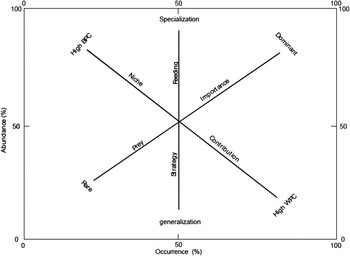
Relative importance of prey items, for interpretation of the feeding strategy, was constructed graphically using a variation of the Costello method (Costello, Reference Costello1990) proposed by Amundsen et al. (Reference Amundsen, Gabler and Staldvik1996). This analysis is based on a graphical representation (Figure 1), making it possible to explore ingested food types and data in relation to feeding strategies, as well as intra- and inter-individual shifts in niche utilization. On this graphic, the first diagonal represents abundance increase along with prey/food importance. The vertical axis represents predator strategy going from generalist to specialist. The second diagonal axis represents resource use changing from BPC (between phenotype component, among individuals of population) to WPC (within phenotype component—tending towards the same resource use). Graph interpretation of fish feeding strategies based on our data follows the Amundsen et al. (Reference Amundsen, Gabler and Staldvik1996) procedure illustrated in Figure 1, where coordinates x and y represent occurrence and abundance of items, respectively.
Schematic representation of species feeding strategies proposed by Costello (Reference Costello1990) and modified by Amundsen et al. (Reference Amundsen, Gabler and Staldvik1996).

RESULTS
Feeding intensity and trophic level
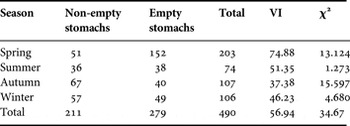
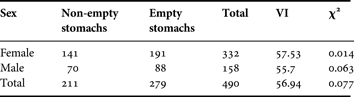
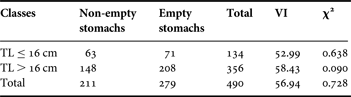
Of the 490 stomachs examined, 279 were empty (VI% = 56.94). This percentage varied significantly by season (χ 2 = 34.67, P < 0.05), with a maximum of 74.88% during the spring and a minimum of 37.38% during the autumn (Table 1). The VI analysis did not show any significant differences between the sexes (χ2 = 0.08, P > 0.05) (Table 2), and among size-classes (χ2 = 0.73, P > 0.05) (Table 3).
Variation in vacuity index (VI) of Diplodus puntazzo in the Gulf of Gabès by season.

Variation in vacuity index (VI) in female and male of Diplodus puntazzo in the Gulf of Gabès.

Variation in vacuity index (VI) of Diplodus puntazzo in the Gulf of Gabès by size-classes.

The calculation of trophic level gave an average of 2.57 ± 0.2 for the whole population of Diplodus puntazzo of the Gulf of Gabès. We notice, according to the classification of Konstantinos & Karpouzi (Reference Konstantinos and Karpouzi2002), that this is an omnivore species with a preference for vegetable material (2.1 < TROPH < 2.9).
The TROPH of this species was 2.45, 2.65, 2.55 and 2.7 in autumn, winter, spring and summer, respectively. This level was 2.62 for females and 2.46 for males, and acrues the same value (2.57) for small size-classes (TL ≤ 16 cm) and for large size-classes (TL > 16 cm).
Diet composition
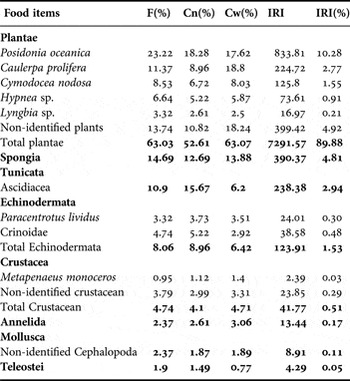
The stomach contents of the sharpsnout seabream consisted of eight major systematic groups: Plantae, Spongia, Tunicata, Echinodermata, Crustacea, Annelida, Mollusca and Teleostei (Table 4). Plantae were the most frequently and important observed food source, constituting 89.88% of the total IRI. Among these plantae, Posidonia oceanica was the most important food source (%IRI = 10.22), followed by Caulerpa prolifera (%IRI = 2.77). Many plants were unidentified (%IRI = 4.92). Comparatively, smaller amounts of sponges were consumed as secondary food source (%IRI = 4.81). The rest of the food items were of minor importance.
Diet composition of Diplodus puntazzo in the Gulf of Gabès.

Diet composition in relation to sex
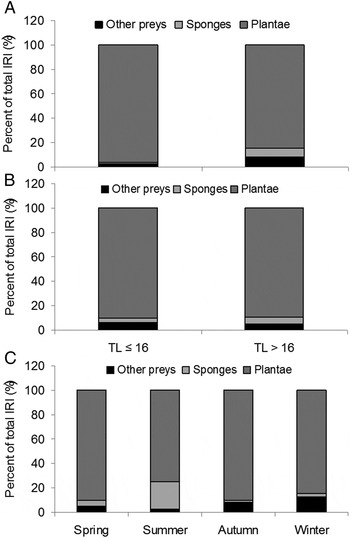
Overall, Plantae were the main food source in both sexes, reaching 96.1% and 84.55% IRI in males and females, respectively. Sponges were the secondary food source, constituted 7.6% and 1.6% in females and males, respectively. There were no dietary differences between sexes (χ2 = 12.75, P > 0.05) (Figure 2A).
Diet composition of Diplodus puntazzo among sex (A), size-classes (B) and season (C), based on percentage index of relative importance (IRI) values of major prey groups in the Gulf of Gabès (April 2008–March 2009).

Diet composition in relation to fish size
Plantae were the most important food source in the diet of both size-classes (90.25% and 89.32% IRI in smaller and larger specimens, respectively). Between smaller individuals, echinoderms (%IRI = 3.17) were relatively important, while sponges (%IRI = 5.42) and tunicates (%IRI = 3.50) were frequently in the diet of larger fish. A Chi-square test revealed no significant differences in the diet among size-classes in any prey category (χ2 = 7.18, P > 0.05) (Figure 2B).
Diet composition in relation to season
The analysis of stomach contents of sharpsnout seabream in the Gulf of Gabès showed that there was some seasonal variation in food habits of the species (Figure 2C). The sharpsnout seabream diet was dominated by plants in all seasons particularly in autumn (%IRI = 90.21). Sponges were present in the stomachs throughout the year, with a peak recorded in summer (%IRI = 22.41). The other taxa, represented by echinoderms, tunicates, crustaceans, annelids, molluscs and teleosts were present in stomach contents in very low quantities, whereas ‘others’ represented 13% of the total IRI in winter. Analysis of the stomach contents of D. puntazzo in the Gulf of Gabès evidenced significant differences in the diet composition of this species among seasons (χ2 = 66.02, P < 0.05).
Feeding strategy
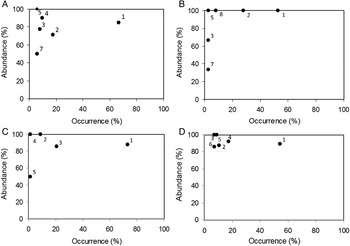
The feeding strategy plots (Figure 3) revealed that D. puntazzo ate eight food items, predominantly plants. We regarded this species as specializing in this food item during all seasons. These plots also position prey types which indicate some individual specialization in some periods, e.g. crustaceans, echinoderms and tunicates in spring; teleosts and sponges in summer; echinoderms and sponges in autumn; tunicates, crustaceans and annelids in winter. The variability in resource breadth between individuals was high (high variation between phenotypes).
Feeding strategy plots for Diplodus puntazzo in (A) spring, (B) summer, (C) autumn and (D) winter. Food sources and prey types are numbered as follows: 1, plants; 2, sponges; 3, tunicates; 4, echinoderms; 5, crustaceans; 6, annelids; 7, molluscs; 8, teleosts.

DISCUSSION
Dietary studies of Diplodus puntazzo in the Gulf of Gabès, show a high proportion of empty stomachs. This is consistent with results from Bradai et al. (Reference Bradai, Ghorbel, Jarboui and Bouain1998b) who estimated annual VI to be 59.3% in the same area. In view of the lack of evidence of stomach reversion at capture, the high percentage of empty stomachs may reflect short periods of feeding followed by periods of rapid digestion. Rapid digestion can complicate dietary analysis, because of the possibility of a reduction in the number of prey species/food sources that may be positively identified.
The present study revealed that the diet of D. puntazzo was diverse, consisted mainly of plants (%F = 63.03) and sponges (%F = 14.69), with an important occurrence of ascidiacea (%F = 10.9). Other prey groups, i.e. echinoderms, crustaceans, annelids, molluscs and teleosts, were less important in the diet of sharpsnout seabream. In the Gulf of Gabès, Bradai et al. (Reference Bradai, Ghorbel, Jarboui and Bouain1998b) found that plants and sponges were preferential food sources, while crustaceans, echinoderms and ascidiacea represented secondary food; remaining prey, such as annelids, molluscs and teleosts, were of minor importance and represented a sort of ‘accessory’ food. In our study, temporal variation of the diet revealed that the sharpsnout seabream diet in all seasons was dominated by plants, while in the summer there was an increase in the consumption of sponges. This species showed a high proportion of empty stomachs in spring. Decrease in feeding rate might be attributed to a lower ingestion of food during this month. According to Wassef & Eisawy (Reference Wassef and Eisawy1985), temperature has a strong effect on the feeding activity of the seabream.
According to the classification of fish in functional groups based on their Troph (Stergiou & Karpouzi, Reference Stergiou and Karpouzi2002), D. puntazzo is an omnivorous fish with a preference for vegetable food source (2.1 < TROPH < 2.9). In addition, we compared its TROPH in other areas of its distribution based on published diet composition data (Table 5).
Feeding habits of Diplodus puntazzo in different areas. Length range (or mean length) of specimens (in cm); TROPH, trophic level; SE, standard error of TROPH.

In our study based on the Amundsen's method, the sharpsnout seabream is a specialist feeding strategy. Plants were the main diet of D. puntazzo during all seasons exhibiting a preference for this item. A dietary analysis is key to the assessment of feeding strategy (Amundsen et al., Reference Amundsen, Gabler and Staldvik1996) and the breadth of a predator's diet (i.e. niche width; Schoener, Reference Schoener1971), which ultimately identify the functional role of a predator in an ecosystem. The main division of feeding strategies is that of generalist or specialist, where predators with a diverse diet or broad dietary niche are described as generalists, and specialists are predators that have low prey diversity or narrow niche width (Bridcut & Giller, Reference Bridcut and Giller1995; Amundsen et al., Reference Amundsen, Gabler and Staldvik1996). Feeding strategies, however, have traditionally been described for populations of predators under the assumption that the individuals within the population share identical strategies (Bolnick et al., Reference Bolnick, Svanback, Fordyce, Yang, Davis, Hulsey and Forister2003).
Data on feeding of sharpsnout seabream from other areas indicate that the diet of the species includes a wide range of prey. Rossechi (Reference Rosecchi1987) showed that these fish have very diverse diets throughout their lives, although there are marked changes in the types of invertebrate prey targeted (amphipods, isopods, and larvae for small fish; decapods, molluscs, echinoderms and polychaetes for larger fish). Bauchot & Hureau (Reference Bauchot, Hureau, Clofeta, Quero, Hureau, Karrer, Post and Saldanha1990) reported that this species feeds on seaweeds, worms, molluscs and shrimps. Sala & Ballesteros (Reference Sala and Ballesteros1997) recorded that sharpsnout seabream is markedly omnivorous, macrophyta being the most important food source, followed by sponges and cnidarians. According to them this species exploited a resource that is apparently not used by any other species of littoral fish in the western Mediterranean, and exploitation of sponges may segregate this species ecologically from other sparid species, thereby helping minimize whatever level of competition for food resources may occur between them. Some other authors also pointed that this species is omnivorous (Bauchot & Hureau, Reference Bauchot, Hureau, Whitehead, Bauchot, Hureau, Nielsen and Tortonese1986; Jardas, Reference Jardas and Draganovi1996). Sala & Ballesteros (Reference Sala and Ballesteros1997) have also noted that even large Diplodus specimens tend to eat algal material. Dulčić et al. (Reference Dulčić, Lipej, Glamuzina and Bartulović2006) used the frequency of occurrence to assess the diet composition of D. puntazzo, finding that the diet of this species consists mainly of macrophyta, followed by bivalves, polychaetes, sponges and ophiuroids. Sala & Ballesteros (Reference Sala and Ballesteros1997) pointed out that sharpsnout seabream have sharp teeth to help it cut algae and molars to grind crustaceans, snails and molluscs. It exhibits morphological differences, having a longer intestine than either of the other species of Diplodus, and thus it appears to be adapted to feeding on ‘low-digestible’ organisms, like algae and sponges. Mena Sellés & García-García (Reference Mena Sellès and García-García2002) noted that sharpsnout seabream, takes advantage of a resource like sponges that apparently goes unused by other coastline fish species, in spite of the fact that these are important sources of prey in other environments, such as for certain reef-dwelling fish species. In general, these finding are similar with the present study, especially regarding plants and sponges. Many of the authors (Rosecchi & Nouaze, Reference Rosecchi and Nouaze1987; Caragitsou & Papaconstantinou, Reference Caragitsou and Papaconstantinou1998; Pallaoro et al., Reference Pallaoro, šantić and Jardas2003) have observed generally analogous feedings habits in other species of Sparidae. Similar indications were also made by authors working on sparid species on the coasts of Tunisia (Ghorbel & Bouaïn, Reference Ghorbel and Bouaïn1991; Bradai et al., Reference Bradai, Ghorbel, Jarboui and Bouain1998b, Reference Bradai, Jarboui, Ghorbel, Bouain and El Abedc, Bradai, Reference Bradai2000; Chemmam-Abderkader Reference Chemmam-Abdelkader2004).
Sharpsnout seabream is an omnivorous sparid of potential interest for Mediterranean aquaculture (Hernandez et al., Reference Hernandez, Martinez and Garcia-Garcia2001b) and being omnivorous, dietary flexibility makes it an interesting model for studying dietary self-selection. Sharpsnout seabream can select a complete diet from two incomplete diets (Vivas et al., Reference Vivas, Madrid, García-García and Sánchez-Vázquez2002) and show an apparent ability to compose a preferred diet when offered diets differing in fat and protein composition (Atienza et al., Reference Atienza, Chatzifotis and Divanach2004). In a study analysing locomotor activity and feeding, sharpsnout seabream displayed a diurnal, albeit quite plastic, locomotor activity pattern, as some fish spontaneously shifted from a diurnal to a nocturnal pattern. By contrast, irrespective of whether or not locomotor activity had switched to nocturnal, feeding activity remained strictly diurnal, pointing to phase independence between locomotor and feeding activity (Vera et al., Reference Vera, Madrid and Sánchez-Vázquez2006). Also, Vivas et al. (Reference Vivas, Rubio, Sánchez-Vázquez, Mena, García-García and Madrid2006) investigated feeding behaviour; dietary self-selection and the capability of sharpsnout seabream demonstrates that this species can select from incomplete diets to compose a balanced diet, and the fish are also able to compensate for a dietary dilution to regulate both energy intake and the relative proportions of macronutrients.
In conclusion, sharpsnout seabream is mainly an omnivorous fish with a specialist feeding strategy, with a preference for vegetable food. But feeding mechanisms that lead to specialization or generalization in the diet are not yet properly defined. This question is broad and has so far barely been addressed. Furthermore, morphological and physiological specialization can also influence fish feeding behaviour, and must be considered. Further research will be focused on feeding ecology of Diplodus puntazzo in order to better understand inter- and intra-specific interactions in the study area and elucidate the impact of climate changes on these interactions.