Introduction
Heritability in schizophrenia is as high as 0.8, and the risk of occurrence is increased approximately 10-fold in first-degree relatives of index patients (Owen et al. Reference Owen, O'Donovan, Gottesman, McGuffin, Owen and Gottesman2002). In addition, relatives of schizophrenia patients show personality traits such as social avoidance, ideas of reference, vagueness, magical thinking, odd speech, illusions and paranoid ideation at increased rates in comparison to relatives of healthy persons (Spitzer et al. Reference Spitzer, Endicott and Gibbon1979). These traits were subsequently incorporated into the DSM-III criteria for schizotypal personality disorder (SPD). Furthermore, there is converging evidence from adoption (Kendler et al. Reference Kendler, Gruenberg and Strauss1981), family (Kendler et al. Reference Kendler, McGuire, Gruenberg, O'Hare, Spellman and Walsh1993) and twin (Torgersen et al. Reference Torgersen, Edvardsen, Oien, Onstad, Skre, Lygren and Kringlen2002) studies indicating that schizotypal traits are in a genetic continuum with schizophrenia. In line with these formal genetic observations, genetic linkage patterns to schizotypy and schizophrenia are reported to be more similar than expected by chance (Fanous et al. Reference Fanous, Neale, Gardner, Webb, Straub, O'Neill, Walsh, Riley and Kendler2007). Molecular genetic studies using positional genetics have identified several candidates including catechol-O-methyltransferase (COMT), dystrobrevin-binding protein 1 (or dysbindin 1; DTNBP1), neuregulin 1 (NRG1), regulator of G-protein signalling 4 (RGS4), G72, proline dehydrogenase (PRODH), disrupted-in-schizophrenia 1 (DISC1) and d-amino acid oxidase (DAAO) (Owen et al. Reference Owen, Williams and O'Donovan2004a; Harrison & Weinberger, Reference Harrison and Weinberger2005; O‘Tuathaigh et al. Reference O'Tuathaigh, Babovic, O'Meara, Clifford, Croke and Waddington2007).
Personality traits that are implemented in the personality inventory proposed by Costa & McCrae (Reference Costa and McCrae1992) have also been associated with schizophrenia and its spectrum. Schizophrenia patients showed higher levels of neuroticism and lower levels of extraversion, openness, agreeableness and conscientiousness than control subjects (Maier et al. Reference Maier, Minges, Lichtermann, Heun and Franke1994; Bagby et al. Reference Bagby, Bindseil, Schuller, Rector, Young, Cooke, Seeman, McCay and Joffe1997; Camisa et al. Reference Camisa, Bockbrader, Lysaker, Rae, Brenner and O'Donnell2005). Other studies on participants with no lifetime evidence of psychotic-like disorders found correlations between higher levels of neuroticism and onset of psychosis after 3 years (Krabbendam et al. Reference Krabbendam, Janssen, Bak, Bijl, de Graaf and van Os2002), and lower levels of extraversion and development of schizophrenia later (Angst & Clayton, Reference Angst and Clayton1986). Personality traits, in general, show substantial heritability coefficients and they remain stable for a long time (Berenbaum & Fujita, Reference Berenbaum and Fujita1994; Jang et al. Reference Jang, Livesley and Vernon1996). In summary, certain personality traits can be viewed as risk factors for schizophrenia and schizotypal features in particular aggregate in families with schizophrenia liability. The same genes that increase the risk for schizophrenia may, according to a continuum model of schizophrenia, also increase the risk for those personality traits.
Little is known about the influence of schizophrenia risk genes on personality traits. Association studies with schizotypal personality and the COMT gene have shown correlations between the high-activity allele Val 158 and high scores on schizotypal personality traits in healthy males (Avramopoulos et al. Reference Avramopoulos, Stefanis, Hantoumi, Smyrnis, Evdokimidis and Stefanis2002; Stefanis et al. Reference Stefanis, Van Os, Avramopoulos, Smyrnis, Evdokimidis, Hantoumi and Stefanis2004; Smyrnis et al. Reference Smyrnis, Avramopoulos, Evdokimidis, Stefanis, Tsekou and Stefanis2007). Other molecular genetic studies have reported associations between NRG1 (Lin et al. Reference Lin, Liu, Liu, Hung, Hwu and Chen2005), DTNBP1 and DAAO (Stefanis et al. Reference Stefanis, Trikalinos, Avramopoulos, Smyrnis, Evdokimidis, Ntzani, Ioannidis and Stefanis2007) genotypes and the schizotypy components.
Schizophrenia patients show a general impairment in cognitive functions. Several studies have indicated a strong influence of susceptibility genes for schizophrenia, such as COMT (Harrison & Weinberger, Reference Harrison and Weinberger2005), DTNBP1 (Burdick et al. Reference Burdick, Lencz, Funke, Finn, Szeszko, Kane, Kucherlapati and Malhotra2006, Reference Burdick, Goldberg, Funke, Bates, Lencz, Kucherlapati and Malhotra2007; Donohoe et al. Reference Donohoe, Morris, Clarke, McGhee, Schwaiger, Nangle, Garavan, Robertson, Gill and Corvin2007; Zinkstok et al. Reference Zinkstok, de Wilde, van Amelsvoort, Tanck, Baas and Linszen2007), NRG1 (Hall et al. Reference Hall, Whalley, Job, Baig, McIntosh, Evans, Thomson, Porteous, Cunningham-Owens, Johnstone and Lawrie2006), DISC1 (Burdick et al. Reference Burdick, Hodgkinson, Szeszko, Lencz, Ekholm, Kane, Goldman and Malhotra2005) and G72 (Goldberg et al. Reference Goldberg, Straub, Callicott, Hariri, Mattay, Bigelow, Coppola, Egan and Weinberger2006), on cognition in healthy subjects and patients with schizophrenia. Of note, intelligence in a healthy sample and cognitive impairment in schizophrenia have been linked to chromosomal region 6p25.3-22, where the DTNBP1 gene is located (Posthuma et al. Reference Posthuma, Luciano, Geus, Wright, Slagboom, Montgomery, Boomsma and Martin2005).
Straub et al. (Reference Straub, Jiang, MacLean, Ma, Webb, Myakishev, Harris-Kerr, Wormley, Sadek, Kadambi, Cesare, Gibberman, Wang, O'Neill, Walsh and Kendler2002) identified in Irish pedigrees an association between schizophrenia and several single nucleotide polymorphisms (SNPs) within the gene encoding the dystrobrevin-binding protein dysbindin 1 (DTNBP1). Since then, a series of studies have reported evidence supporting this association in worldwide populations (Schwab et al. Reference Schwab, Knapp, Mondabon, Hallmayer, Borrmann-Hassenbach, Albus, Lerer, Rietschel, Trixler, Maier and Wildenauer2003; Tang et al. Reference Tang, Zhou, Fan, Li, Shi, Gu, Feng, Xing, Shi and He2003; Van Den Bogaert et al. Reference Van Den Bogaert, Schumacher, Schulze, Otte, Ohlraun, Kovalenko, Becker, Freudenberg, Jonsson, Mattila-Evenden, Sedvall, Czerski, Kapelski, Hauser, Maier, Rietschel, Propping, Nothen and Cichon2003; van den Oord et al. Reference van den Oord, Sullivan, Jiang, Walsh, O'Neill, Kendler and Riley2003; Funke et al. Reference Funke, Finn, Plocik, Lake, DeRosse, Kane, Kucherlapati and Malhotra2004; Kirov et al. Reference Kirov, Ivanov, Williams, Preece, Nikolov, Milev, Koleva, Dimitrova, Toncheva, O'Donovan and Owen2004; Numakawa et al. Reference Numakawa, Yagasaki, Ishimoto, Okada, Suzuki, Iwata, Ozaki, Taguchi, Tatsumi, Kamijima, Straub, Weinberger, Kunugi and Hashimoto2004), although two recent studies do not (Datta et al. Reference Datta, McQuillin, Puri, Choudhury, Thirumalai, Lawrence, Pimm, Bass, Lamb, Moorey, Morgan, Punukollu, Kandasami, Kirwin, Sule, Quested, Curtis and Gurling2007; Li & He, Reference Li and He2007). Nevertheless, two meta-analyses support an association between genetic variations in DTNBP1 and schizophrenia (Owen et al. Reference Owen, Williams and O'Donovan2004b; Williams et al. Reference Williams, O'Donovan and Owen2005). Although the authors reported a large body of supportive evidence implicating DTNBP1 as a schizophrenia-susceptibility gene, they also emphasize differences in the allelic variations reported by the supportive studies and also heterogeneity of their outcomes.
In the brain, dysbindin 1 binds to β-dystrobrevin, a member of the dystrophin protein complex (DPC) that has been implicated in synaptic structure and signalling of the glutamatergic neuronal system (Benson et al. Reference Benson, Newey, Martin-Rendon, Hawkes and Blake2001). The DPC is located at postsynaptic densities throughout diverse regions of the brain (Blake et al. Reference Blake, Hawkes, Benson and Beesley1999) and disruption of its function might result in structural and functional abnormalities in cerebral areas that are involved in schizophrenia (Straub et al. Reference Straub, Jiang, MacLean, Ma, Webb, Myakishev, Harris-Kerr, Wormley, Sadek, Kadambi, Cesare, Gibberman, Wang, O'Neill, Walsh and Kendler2002). A substantial fraction of dysbindin 1 also occurs presynaptically. Talbot et al. (Reference Talbot, Eidem, Tinsley, Benson, Thompson, Smith, Hahn, Siegel, Trojanowski, Gur, Blake and Arnold2004) reported a selective reduction in presynaptic dysbindin 1 expression, and also an inverse correlation of dysbindin 1 levels with VGlut-T-1, the primary vesicular glutamate transporter in hippocampal formation. Further evidence for presynaptic dysbindin involvement comes from Numakawa et al. (Reference Numakawa, Yagasaki, Ishimoto, Okada, Suzuki, Iwata, Ozaki, Taguchi, Tatsumi, Kamijima, Straub, Weinberger, Kunugi and Hashimoto2004), who suggested dysbindin 1 regulation of the expression of the synaptosomal-associated protein, 25 kDa (SNAP25) and synapsin 1 proteins in the presynaptic machinery, which is associated with increased glutamate release. Finally, numerous studies to date have reported decreased dysbindin 1 expression in schizophrenia-related brain regions, such as the dorsolateral prefrontal cortex, hippocampus and midbrain (Numakawa et al. Reference Numakawa, Yagasaki, Ishimoto, Okada, Suzuki, Iwata, Ozaki, Taguchi, Tatsumi, Kamijima, Straub, Weinberger, Kunugi and Hashimoto2004; Talbot et al. Reference Talbot, Eidem, Tinsley, Benson, Thompson, Smith, Hahn, Siegel, Trojanowski, Gur, Blake and Arnold2004; Weickert et al. Reference Weickert, Straub, McClintock, Matsumoto, Hashimoto, Hyde, Herman, Weinberger and Kleinman2004; Coyle, Reference Coyle2006). Thus, glutamatergic synaptic alterations and aberrant neural circuitry are considered to be crucial reasons for functional abnormalities in schizophrenia (Harrison & Weinberger, Reference Harrison and Weinberger2005). However, the specific contribution of a single dysbindin 1 SNP or haplotype on structural and functional abnormalities in the glutamatergic neuronal system is still unclear.
Although a series of linkage and association studies has implicated the dysbindin 1 SNP rs1018381 with genetic susceptibility to schizophrenia (Straub et al. Reference Straub, Jiang, MacLean, Ma, Webb, Myakishev, Harris-Kerr, Wormley, Sadek, Kadambi, Cesare, Gibberman, Wang, O'Neill, Walsh and Kendler2002; Schwab et al. Reference Schwab, Knapp, Mondabon, Hallmayer, Borrmann-Hassenbach, Albus, Lerer, Rietschel, Trixler, Maier and Wildenauer2003; Tang et al. Reference Tang, Zhou, Fan, Li, Shi, Gu, Feng, Xing, Shi and He2003; Van Den Bogaert et al. Reference Van Den Bogaert, Schumacher, Schulze, Otte, Ohlraun, Kovalenko, Becker, Freudenberg, Jonsson, Mattila-Evenden, Sedvall, Czerski, Kapelski, Hauser, Maier, Rietschel, Propping, Nothen and Cichon2003; Funke et al. Reference Funke, Finn, Plocik, Lake, DeRosse, Kane, Kucherlapati and Malhotra2004), there are also studies providing no significant results for this marker (Stefanis et al. Reference Stefanis, Trikalinos, Avramopoulos, Smyrnis, Evdokimidis, Ntzani, Ioannidis and Stefanis2007; Tosato et al. Reference Tosato, Ruggeri, Bonetto, Bertani, Marrella, Lasalvia, Cristofalo, Aprili, Tansella, Dazzan, Diforti, Murray and Collier2007). In three studies the C allele (Straub et al. Reference Straub, Jiang, MacLean, Ma, Webb, Myakishev, Harris-Kerr, Wormley, Sadek, Kadambi, Cesare, Gibberman, Wang, O'Neill, Walsh and Kendler2002; Schwab et al. Reference Schwab, Knapp, Mondabon, Hallmayer, Borrmann-Hassenbach, Albus, Lerer, Rietschel, Trixler, Maier and Wildenauer2003; Tang et al. Reference Tang, Zhou, Fan, Li, Shi, Gu, Feng, Xing, Shi and He2003) and in two others the T allele (Van Den Bogaert et al. Reference Van Den Bogaert, Schumacher, Schulze, Otte, Ohlraun, Kovalenko, Becker, Freudenberg, Jonsson, Mattila-Evenden, Sedvall, Czerski, Kapelski, Hauser, Maier, Rietschel, Propping, Nothen and Cichon2003; Funke et al. Reference Funke, Finn, Plocik, Lake, DeRosse, Kane, Kucherlapati and Malhotra2004) were found to be associated. It is noteworthy that in the study by Funke et al. (Reference Funke, Finn, Plocik, Lake, DeRosse, Kane, Kucherlapati and Malhotra2004), the association with the T allele was found in three independent samples of different ethnic origin (white, Hispanic and African American), whereas the studies of Schwab et al. (Reference Schwab, Knapp, Mondabon, Hallmayer, Borrmann-Hassenbach, Albus, Lerer, Rietschel, Trixler, Maier and Wildenauer2003) and Van Den Bogaert et al. (Reference Van Den Bogaert, Schumacher, Schulze, Otte, Ohlraun, Kovalenko, Becker, Freudenberg, Jonsson, Mattila-Evenden, Sedvall, Czerski, Kapelski, Hauser, Maier, Rietschel, Propping, Nothen and Cichon2003) reported association with opposite (T and C) alleles in samples of similar ethnic origin (white European). Another study by Funke et al.'s group reported strong evidence for association of the T allele (the A allele in the current study, see the section on Genetic Analysis) with cognitive abilities in patients with schizophrenia and healthy volunteers, showing that carriers of this allele perform significantly worse on diverse cognitive tests than non-carriers in both groups (Burdick et al. Reference Burdick, Lencz, Funke, Finn, Szeszko, Kane, Kucherlapati and Malhotra2006). Despite this inconsistency with regard to allelic variation and ethnic origin, the SNP rs1018381 was conceived as a tagging SNP for the risk six-locus haplotype (CTCTAC), which was significantly over-represented in the Caucasian patients when compared with the Caucasian controls. It was the only SNP of the haplotype that showed a significant effect of genotype on cognitive abilities in patients with schizophrenia and healthy volunteers (Burdick et al. Reference Burdick, Lencz, Funke, Finn, Szeszko, Kane, Kucherlapati and Malhotra2006).
Other SNPs of this haplotype have also been related to cognitive impairments. For example, the SNPs rs2619522 and rs760761 were associated with lower sustained attention in healthy volunteers (Stefanis et al. Reference Stefanis, Trikalinos, Avramopoulos, Smyrnis, Evdokimidis, Ntzani, Ioannidis and Stefanis2007) and the SNP rs3213207 was associated with spatial working memory and attentional control deficits in patients with schizophrenia (Donohoe et al. Reference Donohoe, Morris, Clarke, McGhee, Schwaiger, Nangle, Garavan, Robertson, Gill and Corvin2007). Nevertheless, no other SNP of the DTNBP1 polymorphisms in the literature have provided this characteristic with regard to cognitive deficits in both groups. Furthermore, Stefanis et al. (Reference Stefanis, Trikalinos, Avramopoulos, Smyrnis, Evdokimidis, Ntzani, Ioannidis and Stefanis2007) reported that the same allele of this SNP was associated with lower paranoid schizotypal traits and positive psychotic-like experiences in healthy individuals. These results do indicate an influence of this SNP on schizotypal personality traits, but not in a conventional direction.
Thus, on the basis of theoretical background outlined above, we decided to investigate the effect of SNP rs1018381 alleles on cognitive function and personality traits in a sample of healthy volunteers. We hypothesized that healthy carriers of the rare A allele (the T allele in the study by Burdick et al. Reference Burdick, Lencz, Funke, Finn, Szeszko, Kane, Kucherlapati and Malhotra2006) of rs1018381 would perform worse on cognitive tests than healthy non-carriers. Despite the outcomes of Stefanis et al. (Reference Stefanis, Trikalinos, Avramopoulos, Smyrnis, Evdokimidis, Ntzani, Ioannidis and Stefanis2007) concerning the reported lower positive schizotypal personality traits, we hypothesized higher scoring on schizophrenia-related personality traits in the risk-allele carrier group compared to the non-carrier group. This decision was made because (1) we had planned data analysis prior to the publication of Stefanis et al. (Reference Stefanis, Trikalinos, Avramopoulos, Smyrnis, Evdokimidis, Ntzani, Ioannidis and Stefanis2007) and the results were unknown to us at the time and (2) the continuum model of schizophrenia implies that the same genes that increase the risk for schizophrenia may also increase the risk for schizophrenia-related personality traits.
Method
Subjects
A sample of 521 healthy subjects (268 men, 253 women) was recruited from RWTH Aachen University. Request for participants was by word of mouth, by posting flyers in Institutes and canteens, and by an email sent to all students of the University. In this way, about 25 000 students could be reached and therefore the vast majority of our volunteers were students. All subjects gave written informed consent, and the study was approved by the local ethics committee. The tests lasted about 1 hour and all volunteers received 10 euros for their participation. The inclusion criteria were: age 18–50 years and no past or current psychiatric, neurological or chronic medical disorder according to ICD-10. Health status was assessed by a short semi-structured interview conducted by a psychologist. At the end of the testing session, 18 ml of blood was taken from a vein of each subject's arm for genomic DNA analysis. The mean age of the participants was 24.75 (s.d.=5.84) years and the mean duration of education was 15.59 (s.d.=2.65) years. The duration of education of their fathers was 14.89 (s.d.=6.44) years and of their mothers 13.38 (s.d.=4.27) years on average. Overall, 82.2% of all subjects had Western European or Middle European ancestry, 6.3% were of Eastern European and 11.2% non-European ancestry.
Personality questionnaires
Two personality questionnaires were administrated in each subject: the NEO Five-Factor Inventory (NEO-FFI) and the Schizotypal Personality Questionnaire – Brief Version (SPQ-B).
NEO-FFI
The NEO-FFI is a test based on the five-factor model of personality proposed by Costa & McCrae (Reference Costa and McCrae1995; see also Digman, Reference Digman1990). The five personality traits included in this model were found to show substantial heritability coefficients (Jang et al. Reference Jang, Livesley and Vernon1996). These traits are Neuroticism (N), Extraversion (E), Openness to experiences (O), Agreeableness (A) and Conscientiousness (C). The N-scale assesses emotional stability and liability, the E-scale extra- and introversion, the O-scale measures the extend to which people try to gain new experiences, the A-scale interpersonal behaviour, and the C-scale describes the planning, organization and realization of actions (Borkenau & Ostendorf, Reference Borkenau and Ostendorf1993; Bagby et al. Reference Bagby, Bindseil, Schuller, Rector, Young, Cooke, Seeman, McCay and Joffe1997).
SPQ-B
The SPQ-B is a brief, 22-item self-report screening instrument for SPD according to the DSM-IV (Raine & Benishay, Reference Raine and Benishay1995). This questionnaire contains a total scale score and three subscale scores to assess the three main factors of SPD: Cognitive-Perceptual Deficits, Interpersonal Deficits, and Disorganization. The Cognitive-Perceptual Deficits factor is based on magical thinking, ideas of reference, and unusual perceptual experiences. The Interpersonal Deficits factor describes social anxiety, no close friends, blunted affect, and paranoid ideation. The Disorganization factor implicates odd speech and odd behaviour. The higher the score on each factor, the more pronounced is the subject's schizotypal personality trait.
Cognitive tests
All subjects performed the following cognitive tasks: the d2 Test of Attention (Brickenkamp, Reference Brickenkamp2002), the multiple-choice vocabulary intelligence test MWT-B (Lehrl, Reference Lehrl2005), the Letter-Number Span (Gold et al. Reference Gold, Carpenter, Randolph, Goldberg and Weinberger1997), the Trail Making Test Part B (TMT-B; Reitan & Wolfson, Reference Reitan and Wolfson1985), the spatial span of the Wechsler Memory Scale (Wechsler, Reference Wechsler1997; Härting et al. Reference Härting, Markowitsch, Neufeld, Calabrese and Deisinger2002), and a paradigm to test the subjects’ verbal fluency (Daum et al. Reference Daum, Graber, Schugens and Mayes1996). All these tests were completed in order of appearance here.
d2 Test of Attention
The d2 Test of Attention assesses the ability to discriminate between similar stimuli, measured by speed and accuracy of performance (Brickenkamp, Reference Brickenkamp2002). It consists of 14 rows that have to be completed in 20 s per row. Each row consists of 47 letters that are either a ‘d’ or a ‘p’ and have one to four strokes above and/or below them. Subjects have to mark each ‘d’ that has two strokes and not mark any other type of item. The variables assessed were the number of errors made by omitting a correct item (F1), the number of errors made by falsely marking an incorrect item (F2) and the overall level of concentration (number of items marked correctly minus number of items marked incorrectly; KL).
MWT-B
The MWT-B is used as an instrument to screen for verbal intelligence. It consists of 37 rows of five words (Lehrl, Reference Lehrl2005). Only one word in each row is a German word. Subjects have to indicate the right item by marking it. The score recorded with this test is the number of correctly identified words, which is converted to an estimated IQ.
Letter-Number Span
The Letter-Number Span was used to test subjects' auditory working memory. It comprises 24 items, each having letters and numbers in ascending order (Gold et al. Reference Gold, Carpenter, Randolph, Goldberg and Weinberger1997). The items are read aloud and have to be sorted by subjects such that, first, all numbers have to be presented in ascending order, followed by all letters in alphabetical order. The test starts with three letters and numbers, the maximum number per item is seven. The test is terminated as soon as a subject fails to report the numbers and letters in the correct order four times within a given range of items (e.g. four items consisting of three letters and numbers). The number of correctly answered items is recorded.
TMT-B
The TMT is a pencil-and-paper test assessing psychomotor speed, attention and set alternation (Reitan & Wolfson, Reference Reitan and Wolfson1985). In Part B, the subjects have to connect 25 consecutively numbered and lettered circles by alternating between the two sets. The time taken to connect all the circles is measured and recorded in seconds.
Spatial Span
The Spatial Span of the Wechsler Memory Scale was used to identify subjects' visual working memory (Wechsler, Reference Wechsler1997; Härting et al. Reference Härting, Markowitsch, Neufeld, Calabrese and Deisinger2002). The test is administered on a board that has eight blocks on it. In the first trial subjects have to tap on the blocks according to the order they were shown directly before. In the second trial the subjects have to reverse the order of the blocks to tap. The number of correct responses is reported, the sum score is based on 26 items (14 forwards and 12 backwards).
Verbal fluency
The participants' verbal fluency was measured with a widely used test (Daum et al. Reference Daum, Graber, Schugens and Mayes1996). In the first part of the test as many countries as possible were to be named within one minute (this was to test subjects' semantic verbal fluency). The number of correctly named countries was recorded in addition to the number of errors and perseverations. In the second part of the test as many German words as possible beginning with the letter ‘B’ were to be named within one minute (this was to test subjects' lexical verbal fluency). The number of correctly named words was recorded in addition to the number of errors and perseverations.
Genetic analysis
DNA from peripheral lymphocytes was isolated by a simple salting-out procedure. The SNP rs1018381 (P1578 by Straub et al. Reference Straub, Jiang, MacLean, Ma, Webb, Myakishev, Harris-Kerr, Wormley, Sadek, Kadambi, Cesare, Gibberman, Wang, O'Neill, Walsh and Kendler2002) was genotyped using Applied Biosystems 7900HT Fast Real-Time PCR System and TaqMan probes designed by Applied Biosystems (Foster City, CA, USA). Primers and VIC/FAM probe sequences for rs1018381 detection were: forward 5′-GAGTTACAAGTAAATGAAACGTCATGCA-3′; reverse 5′-GCTGAGATCTGCCGGTGATTC-3′; 5′-VIC-ACAGCGTGCGGAAC-3′; 5′-FAM-AACAGCATGCGGAAC. Thus, the common C allele reported in previous studies is equivalent to our G allele and, analogously, the risk T allele (Straub et al. Reference Straub, Jiang, MacLean, Ma, Webb, Myakishev, Harris-Kerr, Wormley, Sadek, Kadambi, Cesare, Gibberman, Wang, O'Neill, Walsh and Kendler2002; Funke et al. Reference Funke, Finn, Plocik, Lake, DeRosse, Kane, Kucherlapati and Malhotra2004; Burdick et al. Reference Burdick, Lencz, Funke, Finn, Szeszko, Kane, Kucherlapati and Malhotra2006) is equivalent to our A allele. For differences between actual and expected frequencies of the SNP rs1018381, we used the Hardy–Weinberg equilibrium (HWE) equation as implemented in the DeFinetti program (Strom & Wienker, Reference Strom and Wienker2005). For SNP rs1018381, the sample did not deviate significantly from HWE (p=0.43). We replicated more than 15% of genotypes with 100% identity. The call rate for genotyping was 96.74%.
Statistical analyses
After exclusion of three homozygous A/A genotype carriers that would not have allowed for meaningful statistical analyses, the final sample for statistical analysis comprised 518 subjects. This group was divided into carriers (n=94; 48 males) of the A allele and non-carriers (n=424; 220 males). One-way analysis of variance (ANOVA) was used to test the genotype effect of DTNBP1 on each of the personality questionnaires and cognitive performance indices. In addition, we used the Bonferroni correction for all variables (personality traits and cognitive abilities: p=0.003). Post hoc, we tested the interaction effect between DTNBP1 genotype and age, gender and ethnicity with a univariate general linear model.
Results
There were no differences between the A/G and G/G groups with regard to years of education [t(df=517)=0.13, p>0.8] but there were significant differences between the A/G (mean=23.89 and s.d.=4.24 years) and G/G (mean=24.96 and s.d.=6.15 years) groups concerning age [t(df=517)=2.02, p=0.044]. We used age as a covariable in the univariate general linear model for every variable. There were, however, no significant effects of age on any of the variables (see below).
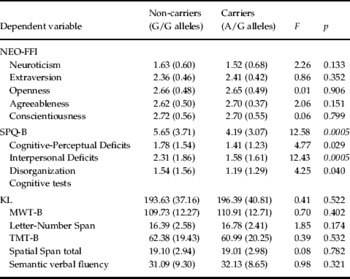
Statistical comparisons of the dependent variables showed a highly significant effect on the total SPQ-B scale score and on the subscale Interpersonal Deficits (see Table 1). Higher ratings for schizotypy were associated with the G/G genotype.
Mean (standard deviation) of the dependent variables of G/G and A/G alleles in the SNP rs1018381 (P1578) of the DTNBP1 gene

SNP, Single nucleotide polymorphism; DTNBP1, dystrobrevin-binding protein 1 gene; NEO-FFI, the NEO Five-Factor Inventory; SPQ-B, Schizotypal Personality Questionnaire – Brief Version; KL, number of correctly marked items in the attention task; MWT-B, verbal intelligence screening (MWT-B values constitute estimated IQ scores); TMT-B, Trail Making Test Part B.
F and p values accrued from the ANOVA.
Bonferroni-corrected significant p values (p=0.003) are shown in italics.
There was no significant correlation between estimated IQ (measured by the MWT-B) and SPQ-B scores (r=−0.068, p=0.124) and no interaction between them in relation to the DTNBP1 genotype. No significant effects were observed on the factors of the NEO-FFI and on all cognitive tests.
In post-hoc tests, there was no significant DTNBP1 genotype interaction effect by gender and by ethnicity in any of the variables. The results of the personality questionnaires and cognitive tests are presented in Table 1.
Discussion
We investigated the influence of the SNP rs1018381 of the DTNBP1 gene on personality traits and cognitive abilities in healthy individuals. Subjects carrying the minor A allele scored lower on the SPQ-B sum and the Interpersonal Deficits subscore. An association in healthy male subjects of the same allele of the SNP rs1018381 and lower paranoid schizotypal traits and positive psychotic-like experiences, but not with Disorganization and Cognitive-Perceptual Deficits traits, was found in a study by Stefanis et al. (Reference Stefanis, Trikalinos, Avramopoulos, Smyrnis, Evdokimidis, Ntzani, Ioannidis and Stefanis2007). In line with our study, they did not find an association between this allele and any cognitive deficits. A possible interpretation of our results may be a relationship between schizotypy and cognition. Hallmayer et al. (Reference Hallmayer, Kalaydjieva, Badcock, Dragovic, Howell, Michie, Rock, Vile, Williams, Corder, Hollingsworth and Jablensky2005) reported in their study of the linkage of schizophrenia to chromosome 6p25-24 that cognitively impaired patients had lower positive schizotypal scores than cognitively spared patients. This leads to the suggestion that the DTNBP1 gene, located at the same region, influences cognitive impairment (Burdick et al. Reference Burdick, Lencz, Funke, Finn, Szeszko, Kane, Kucherlapati and Malhotra2006), which in turn could affect the elaboration of complex psychic experiences (e.g. hallucination, delusion, magical thinking, etc.) and therefore risk-gene carriers may under-report them and as result reveal lower schizotypy. This might be related to previous findings of the association between the DTNBP1 gene and negative rather than positive psychotic symptoms (Fanous et al. Reference Fanous, van den Oord, Riley, Aggen, Neale, O'Neill, Walsh and Kendler2005; DeRosse et al. Reference DeRosse, Funke, Burdick, Lencz, Ekholm, Kane, Kucherlapati and Malhotra2006). Thus, the risk-allele of the SNP rs1018381 might show strong correlation with cognitive deficits only when combined with the other SNPs of the previous reported high-risk haplotype CTCTAC (Funke et al. Reference Funke, Finn, Plocik, Lake, DeRosse, Kane, Kucherlapati and Malhotra2004; Burdick et al. Reference Burdick, Lencz, Funke, Finn, Szeszko, Kane, Kucherlapati and Malhotra2006). Furthermore, the presumed SNP may influence schizotypal personality traits because of cognitive ability to elaborate on psychic experiences.
Our findings thus support evidence that the SNP rs1018381 is a genetic marker for vulnerability to schizophrenia. However, because of the observed ‘flip-flop’ phenomenon of this marker across the different studies, it is clear that the marker per se cannot be the vulnerability-causing allele. This argument is supported by the identification of risk haplotypes that carry opposite alleles for the SNP rs1018381 within the same population (Schwab et al. Reference Schwab, Knapp, Mondabon, Hallmayer, Borrmann-Hassenbach, Albus, Lerer, Rietschel, Trixler, Maier and Wildenauer2003; Van Den Bogaert et al. Reference Van Den Bogaert, Schumacher, Schulze, Otte, Ohlraun, Kovalenko, Becker, Freudenberg, Jonsson, Mattila-Evenden, Sedvall, Czerski, Kapelski, Hauser, Maier, Rietschel, Propping, Nothen and Cichon2003; van den Oord et al. Reference van den Oord, Sullivan, Jiang, Walsh, O'Neill, Kendler and Riley2003). Consequently, the minor allele of the SNP rs1018381 could show either a 'susceptive' or a ‘protective’ effect depending on the different haplotypes. Mutsuddi et al. (Reference Mutsuddi, Morris, Waggoner, Daly, Scolnick and Sklar2006) have shown that DTNBP1 haplotype frequencies are very similar across European countries, arguing against an allele stratification effect to explain these discrepancies. They have provided a dense genetic map for DTNBP1 that might be used in future studies to resolve the proposed associations with different markers.
Several limitations of the current study should be noted. First, although we had a fairly large sample, the group of homozygous risk allele carriers was very small (n=3) so we could not maximize the contrast of the genotype effect by two groups of homozygote carriers. Second, we considered only one SNP of the DTNBP1 polymorphisms. We did not implement the exploration of more SNPs and haplotypes that are not reported to be associated with general cognitive abilities and schizotypal personality traits in patients with schizophrenia, and even healthy volunteers, because this would require further correction of multiple testing and could thus drastically minimize the statistical power and lead to false-negative results. Third, our sample consisted mainly of students. Although the sample is fairly homogeneous in terms of socio-economic status and relatively high IQ, it is not completely representative of the general population. About a fifth of the age-equivalent general German population goes to university. It might thus be that potential genotype effects on cognitive abilities did not emerge because of the selection process. However, in line with our results, an effect on cognition of the SNP rs1018381 was also not present in the Stefanis et al. (Reference Stefanis, Trikalinos, Avramopoulos, Smyrnis, Evdokimidis, Ntzani, Ioannidis and Stefanis2007) population sample (military recruits). In summary, the present data support previous evidence that the marker rs1018381 within the DTNBP1 gene is associated with schizotypal personality traits in healthy subjects, although it does not support its influence on cognitive ability. To unravel its exact relationship to schizophrenia within a more complex haplotype will require further work. This will involve investigation of susceptibility allelic variants of DTNBP1 and the precise process of their influence on the aetiology of schizophrenia.
Acknowledgements
This work was supported by the Federal Ministry of Education and Research (Brain Imaging Centre West, 01GO0204).
Declaration of Interest
None.