




No CrossRef data available.
SOCIAL DIMENSIONS IN CERAMIC ANALYSIS: A case study from peripheral Tikal
Published online by Cambridge University Press: 11 July 2003
Abstract
This paper examines the evidence for status and wealth differentiation within the peripheral areas of Tikal, Guatemala, and intersite areas north and south of Tikal. Frequency counts of differing major shape classes show that large groups had significantly higher frequency of serving forms and more associated pottery. The technique of multidimensional scaling is used to see whether there are any qualitative differences in pottery reflecting higher status or wealth. Results of the analysis indicate that qualitative differences are present only for Ik Complex vases. There are also indications of a special relationship between central Tikal and the minor center of Navahuelal located beyond the edges of the Tikal settlement zone.
Information
- Type
- Research Article
- Information
- Copyright
- © 2003 Cambridge University Press
In this paper I discuss new approaches to the investigation of wealth and social rank using ceramic data. In doing so, I must acknowledge my debt to Pat Culbert, who has always encouraged research that pushes the boundaries of ceramic analysis. When I began working with ceramic analysis in Maya ceramics under his supervision, the type-variety system was just becoming solidly established in Maya ceramic studies (Gifford 1960, 1976; Willey et al. 1967). The focus of ceramic research was on cultural affiliation and chronology. The type-variety system was critical in standardizing typologies and allowing for pan-regional comparisons. It also emphasized cultural factors in interpreting differences among types and wares. Although he was a key player in the adoption of the type-variety system by Maya ceramicists, Culbert had a much broader vision of the role of ceramic analysis in sociocultural studies. For him, type-variety was only one tool to be used with other systems of analysis. Among his contributions were systemic use of shape classes (see Kosakowsky 2003) and paste classes. Although Jim Gifford (personal communication 1968; Gifford 1976) and others stressed the need for concurrent modal analyses pragmatically, these often were not completed or were subordinated to type-variety classification.
Perhaps the most important lesson I learned under Culbert's tutelage was an awareness of people involved in ceramic production and consumption. Emphasizing formal classification and concentrating on attributes, modes, and quantitative approaches can lead to a disembodied view of ceramic processes. Culbert has always made one aware of the people who manufactured, acquired, and used pottery. Groups of potters developed normative traditions, while the preferences of consumers shaped these ongoing ceramic traditions. Culbert also has been very aware of the nature of production traditions. One of the traditional big problems in type-variety analysis was a tendency to create new types for each sequent ceramic complex. Culbert has emphasized continuity within ceramic tradition, including continuity in types and varieties across complex boundaries. This has brought a healthy realism to the type-variety system.
Culbert has always been interested in deriving information on social groups from ceramic data. There are many perspectives that can be called up by the term “social dimensions” in ceramic studies. There is, of course, the social dimension in pottery production. What was the place of pottery production in systems of production? How did potters fit into the division of labor? Were they part-time or full-time specialists? What were their roles and social positions within their local and regional stratification systems? We can look at the social aspects of production–distribution systems. What were the modes of exchange involving pottery? Were they entirely embedded in social relations or circulated by more market-like mechanisms? In state-level societies did the state interfere in that portion of the economy involving ceramics or abstain from interference (Blanton et al. 1982; Feinman 1984)?
Then there is the aspect of ceramic studies dealing with reconstructing systems of social interaction and social stratification using ceramic data. In what ways can we reconstruct patterns of social interaction within household, community, or regional systems using ceramic data? One of the primary approaches has been to document difference in social rank of local residence or household. Various measures have been proposed, from simple counts of types to frequencies of vessels (Fry 1969, 2003; LeCount 1996, 1997) to production-step approaches (Feinman et al. 1981; Heredia and Fry 2003).
On a larger scale, there is the area of the meaning of social interaction on a regional scale. Here the type of research using the traditional type-variety systems appears to be its most culturally meaningful. Recent research has shown that changes in political systems involving external conquests and political incorporation are often correlated with the spread of diagnostic types creating a distinctive ceramic sphere. At a minimum, such political changes involve the introduction of new classes of serving vessels. If the changes involve very different populations, the changes may also involve new functional categories of vessels. For example, comales used to prepare tortillas and chile graters make their first major appearance in the Maya Lowlands during the politically turbulent Terminal Classic period.
SOCIAL VARIATION IN PERIPHERAL TIKAL
The ceramic research at Tikal has been the central portion of Culbert's research career. His interests run the gamut from typological studies and chronological concerns to the issues of social markers of status and systems of production and distribution. He has done important work in identifying the location of differing production centers using X-ray fluorescence analysis (Culbert and Schwalbe 1987). My research at Tikal began by investigating the ceramics in peripheral areas of the site and intersite areas (Fry 1969, 2003). In setting up a test-pitting program for structures in peripheral Tikal, I used the knowledge about the structure and location of occupation debris deposits developed by Culbert, Bill Haviland, and Dennis Puleston in their studies of households and structures at some remove from the larger ritual centers and palaces. A major innovation of this research was the use of post-hole sampling in locating productive middens (Fry 1972). When preliminary testing in the peripheral Tikal households indicated a paucity of datable ceramics in structure fills, I decided to concentrate on recovering associated middens along platform edges. In that way I could both date the latest occupation of the structures and get information on occupation activities not possible with fill ceramics. My initial idea was to concentrate on residential rules, but it quickly became clear that studies such as James Deetz's Arikara research (Deetz 1965) and William Longacre's at Carter Ranch (Longacre 1970) were not feasible, given the evidence for specialist production of pottery and the high degree of standardization in Classic pottery. I turned then to studies of systems of production and distribution and social differences among households in peripheral Tikal as reflected in pottery-consumption patterns. In my previous publications, I have emphasized ceramic production and distribution, confirming the presence of a marketing system at Tikal and defining boundaries of interaction between greater Tikal and other regional centers (Fry 1979, 1980; Fry and Cox 1974).
This study will examine the evidence for wealth and status differences within peripheral Tikal and intersite areas dominated by Tikal using ceramic data. One basic source of information on household wealth or status was structure and group size. In peripheral Tikal and intersite areas there was a great degree of variability in platform height and number of courtyards per group (Puleston 1973, 1983). Most of the excavations in peripheral Tikal were small test pits in areas of denser occupation debris associated with structures. Only a small number of groups were more intensively studied, so that the number of structures with features such as masonry architecture or presence of vaulted or beam-and-mortar roofs could not be reliably estimated. There was a clear-cut distinction between the very large groups with multiple courtyards and a number of structures of more than 2 m elevation and smaller groups. The former showed longer occupation histories, and the latter had occupations confined to one or at most two ceramic complexes. A simplified classification of structure groups based on mound elevation was chosen to represent wealth or status. Minor centers were aggregates of pyramids and range-type structures on raised platforms. Large groups had several to many structures with elevations higher than 1.5–2 m in their present state of preservation, usually placed on a raised platform. Medium-size groups had structures between 1 m and 2 m in elevation and usually had a lower platform. Small groups had mounds under 1 m in elevation and often had a fairly low or no observable platform.
Examination of the frequencies of differing shape classes of pottery for each group shows that there were significant differences in proportions of serving forms in occupation deposits (Table 1). Large groups tended to have much higher frequency of serving forms. Such high frequency can be explained by a higher frequency of feasting events and the economic possibility of having multiple sets of serving dishes. Medium-size and small groups both tended to have much lower frequencies of serving forms. Poorer households may have had fewer feasting events and could afford only a smaller repertoire of serving vessels. They may also have substituted perishable containers for everyday use, saving the finest serving wares for special events. Small centers tended to have more large monochrome bowls and basins and fewer coarseware storage jars. This could be due to the higher rate of consumption activities, but not of food preparation and storage, at the centers. In addition, large groups tended to have more voluminous occupational debris deposits. Middens in smaller households tended to be small and concentrated in one or two loci behind or beside the structure platform, while middens behind many of the larger structures were almost continuous along the backs and sides of platforms. Activities such as feasting by higher-rank individuals could have led to a much higher frequency of all classes of pottery vessels. Qualitative assessments of ceramics, especially dichromes and polychromes, were difficult to make because of the generally poor preservation of the Late and Terminal Classic deposits. The small Early Classic samples, with their much better preservation, indicate that many of the serving-class vessels—such as basal flange bowls, which had polychrome decoration in central Tikal—were slipped monochromes in the peripheries.
Shape classes for different-size Late Classic house-mound groups in peripheral Tikal

Over the years, I have investigated other means of assessing differences in household wealth and status. One approach is the production-step method to assess resemblances. This technique has been used with some success elsewhere in Mesoamerica (Feinman et al. 1981) and in the Maya area (Heredia 1998; Heredia and Fry 2003; LeCount 1997). One major drawback in using this approach on peripheral Tikal ceramics was the scarcity of well-preserved surfaces on the pottery. I decided to see, as a proxy, whether high-quality ceramics could be recognized using paste attributes and firing characteristics. Studies by Joseph Ball and others have indicated that surface characteristics and paste types are often correlated and can be used to distinguish groups or schools of potters (Ball 1993). To extract information on wealth and status differences from both central and peripheral Tikal, I turned to multidimensional scaling analysis of attributes reflecting vessel quality. All ceramics from excavations chosen by a stratified random-sampling research design along the north and south survey strips were included (Fry 1969). In addition, I included ceramics from the non-random excavations in the small centers of Bobal and Navajuelal (Green 1970) located within the Tikal National Park as well as the oversampled large groups from the north survey strip. I also included ceramics from non-random excavations at Jimbal. For central Tikal, I used sherds from excavations off the East Plaza, which probably came from the marketplace located there as well as from an adjacent portion of the Central Acropolis (Jones 1996). I also used ceramics from excavations by Haviland (1985) in the northeastern quadrant of central Tikal. The locations of the sampled areas are shown in Figure 1. Only sherds representing separate vessels were used in the analysis. Ceramics were coded using a standardized format. Nine attributes were selected from the original database, which would be considered evidence of vessel quality. These included such variables as size and frequency of temper, evidence of fire-clouding and irregular firing, and presence of significant visible inclusions. These sherds were also categorized using the Tikal shape-classification system. No type-variety attributes were coded, because only a few of the vessel fragments had enough slip preserved to allow assignation to defined types.

Map of the Tikal zone showing the location of grouped collections in peripheral and central Tikal used in the analysis.
Each major shape class was analyzed separately so that differences in frequencies of these classes would not skew the results. For example, a collection dominated by coarseware jars in which there may not have been much interest in vessel quantity could override differences in quality seen in the rarer vase category. Separate analyses were run for six major shape classes of pottery; two for vases of differing time periods; and one each for serving plates, large bowls and basins, and narrow-mouth and wide-mouth jars. My previous research and Raymond Thompson's ethnoarchaeological studies of Yucatecan Maya pottery (Thompson 1958) had shown that serving or fiesta wares and high-quality water-carrying jars were often highly prized and ranked in terms of preferences. I originally planned to compare assemblages of ceramics from individual structures—or, at least, household clusters—as the minimal unit of analysis. However, the small number of vessels represented from many of the collections precluded any statistically valid comparison and would have severely limited the number of cases, making multidimensional scaling uninformative. Instead, I combined the ceramic samples from all of the structures classified as one of the structure types for each of the sampling universes in peripheral Tikal and from the central Tikal samples. Thus, one unit of analysis would be all the Ik Complex vases recovered from the sampling universe running from 1.8 km north of central Tikal to the Tikal earthworks on the north survey strip. I also included a separate ceremonial category for the public architecture of the small centers such as Bobal and Navahuelal. Nineteen technological, functional, and stylistic variables had originally been recorded for each sherd representing a separate vessel. From these, nine technological variables that could be considered to represent vessel quality were selected for this analysis. They included such variables as paste texture and temper frequency, as well as firing characteristics. It was assumed that higher-quality pastes would tend to have smaller and less tempering and show better control of firing.
Multidimensional scaling is an analytic technique that places units or items compared by a measure of similarity or difference in a multidimensional space. Items that are very similar are placed in close proximity, while those that are significantly different are placed farther apart. One can interpret either the clusters or groupings of units or the axes on which they are arrayed. Solutions can be many dimensions down to a single dimension. Usually two- and three-dimensional solutions provide the optimal interpretability. The measure of distance used in this study and a more complete description of this technique may be found in an earlier article (Fry and Cox 1974). Each solution can be seen as a model of the data in multidimensional space. The difference between the actual measures of distance and the models—that is, the goodness of fit—is indicated by a measure called stress. The better the fit, the lower the stress. No magic number indicates an optimal stress value. For the number of cases represented here, a measure of stress of less than .1 is considered acceptable.
POTTERY AND WEALTH IN PERIPHERAL TIKAL
If pottery does communicate wealth or status differences, one would expect larger and more substantial households to have higher-quality items. Although assemblages should be influenced by proximity to pottery sources, the highest-quality items should gravitate to the wealthiest or higher-status households. Thus, higher-rank households should be drawn closer together in a solution than would normally be expected by geography. Or there should be a definable axis within the solution in which groups would be roughly arranged by social rank. Another predictable axis would be proximity to a major source. In previous publications, I have emphasized that the central market at Tikal was marked by extremely high-quality, well-fired pottery (Fry 1979). Proximity and access to the market should affect the position of even lower-rank households in the central portion of the site.
Because serving vessels are most often studied in looking at wealth and rank distinctions, I will begin by looking at examples from this critical class of vessels. Perhaps the most clear-cut status-linked items are vases, which were used for drinks, including various chocolate-based concoctions. The multidimensional scaling solution for the Ik Complex barrel-shaped vases is presented in Figure 2 with a low stress of .0864. There is an axis representing higher social rank. Higher-rank groups are all in the upper-left and lower-right quadrants of the solution, along one axis of variability. The lower-right quadrant groupings are within the 16 km2 site map of central and epicentral Tikal, plus the distant center of Navahuelal. The slightly more inclusive right-hand grouping also includes the area of the Bobal ridge, an old and long-term settlement area some 5 km south of the Main Plaza. As predicted, the smaller structures near the central Tikal market also are very close to the larger groupings in the same area. There appears to be a greater qualitative difference in the collections from the north survey strip seen on the left-hand portion of the figure. The multidimensional scaling solution for Imix Complex cylindrical vases seen in Figure 3 does not show such a clear discrimination of wealth or rank. Stress was even better at .038 for the two-dimensional solution. There are two broad groupings, with proximity rather than rank being important. Even here, Navahuelal is still tightly tied to central Tikal. This pattern supports my observation that the few whole serving vessels from burials at Navahuelal are almost identical in slip and paint characteristics and paste to those from central Tikal. The solution for Imix Complex plates and shallow dishes (Figure 4) very closely mirrors the solution for Imix Complex vases with an excellent stress of .0268. It is unfortunate that not enough Ik Complex plates were recovered to be useful for this study. My studies of pastes of these vessels indicate an even closer resemblance to the pastes from central Tikal than in the Imix Complex examples.

Two-dimensional multidimensional scaling solution for Ik Complex vases. Stress is .086.

Two-dimensional multidimensional scaling solution for Imix Complex vases. Stress is .038.

Two-dimensional multidimensional scaling solution for Imix Complex plates. Stress is .027.
In turning to the solutions for more utilitarian pottery, we would predict a quality factor for narrow-mouth water-carrying jars. These jars often had greater prestige value than other utilitarian wares, being widely traded in colonial and modern Yucatan. These were often the most highly decorated of utilitarian vessels (Thompson 1958). However, large open-mouth unslipped coarseware jars were quite bulky. These were produced by differing workshops than the slipped vessels and show a highly localized supply-zone pattern of distribution (Fry 1980).
The solution for large slipped bowls and basins presented in Figure 5 indicates that there is no obvious prestige value to these items. Again Navahuelal clusters with the epicentral and central Tikal assemblages. Surprisingly, as Figure 6 shows, slipped narrow-mouth jars (stress of .0329) also show no clear-cut qualitative factor. It is possible that with more ubiquitous water sources, the prestige value of water-carrying jars was not as great as in northern Yucatan. The presence of limited water sources in northern Yucatan made the water source a larger-scale public domain and would have encouraged the use of higher-quality vessels as status or wealth markers. My research in Quintana Roo and northern Belize also shows that water-carrying jars make up a lower proportion of the total ceramic assemblage than in the Tikal region. Here again, Navahuelal is linked with the central Tikal collections. A highly localized distribution is indicated for wide-mouthed coarseware storage jars, with no marked qualitative differences (Figure 7; stress of .0628).

Two-dimensional multidimensional scaling solution for Late Classic-period large slipped bowls. Stress is .047.

Two-dimensional multidimensional scaling solution for slipped narrow-mouth jars. Stress is .033.

Two-dimensional multidimensional scaling solution for Late Classic-period unslipped wide-mouth jars. Stress is .063.
CONCLUSIONS
In terms of ceramics, social rank and wealth are mostly visible at Tikal in consumption patterns of small and medium-size serving wares but probably not water-carrying jars. Scale of consumption is probably a better indicator of wealth than other qualitative approaches. Qualitative differences are most clear-cut for slipped and painted vases. It is likely that, at a major political and cultural center such as Tikal, most ceramic vessels did not figure prominently as status or wealth markers. It is possible that, at smaller and more peripheral sites, at least some classes, including utilitarian pottery, did. A high rate of consumption may be associated with intense activities at successful socially heterogeneous household clusters (McAnany 1993). In peripheral Tikal, only a few non-ceramic status-marking artifacts are preserved in middens, including pyrite mosaic mirrors and shell-handled fans. These rare items are uniformly associated with large structure groupings. The present exercise does illustrate one promising method in extracting information on social rank or wealth from ceramic data. Certainly with a more complete data set, and especially with better preservation, more reliable information can be gathered.
Este trabajo utiliza cerámica como medio para investigar diferencias en la riqueza y el estatus social en la periferia del sitio de Tikal en Guatemala. Para el análisis, se utilizaron colecciones de material arqueológico encontrados en una variedad de estructuras. La cuantificación de tipos de formas de las distintas clases de estructuras indica que grupos de estructuras grandes poseen una mayor frecuencia de formas que se utilizaban para servir, así como también un volumen mayor de desecho cerámico. La cerámica se analizó utilizando atributos o características que califican la calidad de la vasija. Análisis multidimensionales de escala fueron realizados en cada una de las principales formas cerámicas por separado. Los análisis indican que la riqueza y las diferencias sociales son más evidentes en vasijas estilo barril del complejo cerámico Ik (el cual pertenece a la porción temprana del clásico tardío). Durante el complejo Imix (perteneciente a la porción tardía del clásico tardío), los resultados son menos significativos. No se encontraron diferencias en riqueza o estatus social en los análisis realizados en platos, cuencos grandes, ollas de boca estrecha u ollas de barro burdo. Las diferencias entre las recolecciones reflejan sistemas de producción y consumo local principalmente.
ACKNOWLEDGMENTS
Ceramics from peripheral Tikal were gathered while the author was ceramics specialist for the Tikal Sustaining Area Project, William A. Haviland, Director. The project was supported by National Science Foundation Grant GS 1409 and the University Museum of the University of Pennsylvania. I am grateful to T. Patrick Culbert and William A. Haviland for access to data from excavations in the East Plaza at Tikal and excavations in structures in the northeastern quadrant of central Tikal. Coding and analysis for data from peripheral Tikal was facilitated by a Graduate Fellowship from the University of Arizona. Coding and analysis of data from central Tikal and the multidimensional scaling analysis was facilitated by Grant 5796, Penrose Fund, American Philosophical Society. Assistance in computer programming and analysis was provided by Scott C. Cox and Steven Durand.
Critical commentary by Lisa LeCount and an anonymous reviewer significantly improved the manuscript.
References
REFERENCES
Ball, Joseph W.
1993
Pottery, Potters, Palaces and Polities: Some Socioeconomic and
Political Implications of Late Classic Maya Ceramic Industries. In
Lowland Maya Civilization in the Eighth Century a.d., edited by
Jeremy A. Sabloff and
John S. Henderson, pp.
243–272.
Dumbarton Oaks Research Library and Collection,
Washington, DC.
Blanton, Richard E.,
Stephen Kowaleski,
Gary Feinman, and
Jill Appel
1982
Monte Alban's Hinterland. Part 1: Prehispanic Settlement
Patterns in of the Central and Southern Parts of the Valley of Oaxaca,
Mexico. In
Prehistory and Human Ecology of the Valley of Oaxaca, vol. 7,
edited by
Kent V. Flannery and
Richard E. Blanton.
Memoirs of the University of Michigan, No. 15.
Museum of Anthropology,
Ann Arbor.
Culbert, T. Patrick, and
L.A. Schwalbe
1987
Analytic Measures of Variability and Group Differences in X-Ray
Fluorescence Data.
Journal of Archaeological Science
15:669–681.Google Scholar
Deetz, James
1965
The Dynamics of Stylistic Change in Arikara Ceramics.
Studies in Anthropology No. 4.
University of Illinois Press,
Chicago.
Feinman, Gary
1984
Modeling Ceramic Production and Organizational Change in the
Pre-Hispanic Valley of Oaxaca, Mexico. In
The Many Dimensions of Pottery: Ceramics in Archaeology and
Anthropology, edited by
S.E. Van der Leeuw and
A. Prichard, pp.
295–338.
Cingvla VII. University of Amsterdam.
Feinman, Gary,
Stedman Upham, and
Kent Lightfoot
1981
The Production Step Measure: An Ordinal Index of Labor Input in
Ceramic Manufacture.
American Antiquity
46:871–884.Google Scholar
Fry, Robert E.
1969
Ceramics and Settlement of the Peripheries of Tikal, Guatemala. Unpublished Ph.D. dissertation,
Department of Anthropology, University of Arizona,
Tucson.
Fry, Robert E.
1972
Manually Operated Post-Hole Diggers as Sampling Instruments.
American Antiquity
37:259–261.Google Scholar
Fry, Robert E.
1979
The Economics of Pottery at Tikal, Guatemala: Models of Exchange
for Serving Vessels.
American Antiquity
44:494–512.Google Scholar
Fry, Robert E.
1980
Models of Exchange for Major Shape Classes of Lowland Maya
Pottery. In
Models and Methods in Regional Exchange, edited by
Robert Fry, pp.
3–18.
SAA Papers No. 1.
Society for American Archaeology,
Washington, DC.
Fry, Robert E.
2003
Peoples of Tikal. In
Tikal: Dynasties, Foreigners, and Affairs of State, edited by
Jeremy Sabloff, pp.
143–170.
School of American Research Press,
Albuquerque.
Fry, Robert E., and
Scott C. Cox
1974
The Structure of Ceramic Exchange at Tikal, Guatemala.
World Archaeology
6:209–225.Google Scholar
Gifford, James C.
1960
The Type-Variety Method of Ceramic Classification as an Indicator
of Cultural Phenomena.
American Antiquity
25:341–347.Google Scholar
Gifford, James C.
1976
Prehistoric Pottery Analysis and the Ceramics of Barton Ramie in
the Belize River Valley.
Papers of the Peabody Museum of Archaeology and Ethnology, Vol. 18.
Harvard University,
Cambridge, MA.
Green, Ernestene
1970
The Archaeology of Navajuelal, Tikal, Guatemala and Test of
Interpretive Method.
Unpublished Ph.D. dissertation,
Department of Anthropology, University of Pennsylvania,
Philadelphia.
Haviland, William A.
1985
Excavations in Small Residential Groups of Tikal: Groups 4F-1 and
4F-2.
Tikal Report No. 19. University Museum Monographs 58.
University Museum, University of Pennsylvania,
Philadelphia.
Heredia, Verenice
1998
Material Possessions as Communicators of Wealth Status in a Rural
Lowland Maya Community.
Unpublished M.S. thesis,
Department of Sociology and Anthropology, Purdue University,
West Lafayette, IN.
Heredia, Verenice, and
Robert E. Fry
2003
Material Possessions as Communicators of Wealth Status in a Rural
Lowland Maya Community. In
New Horizons for Ancient Maya Ceramics, edited by
Heather McKillop and
Shirley Boteler-Mock.
University of Florida Press,
Gainesville.
In press.
Kosakowsky, Laura H.
2003
Shaping Ceramic Research at the Maya Site of Cuello, Belize.
Ancient Mesoamerica
14:61–66.Google Scholar
Jones, Christopher
1996
Excavations in the East Plaza of Tikal.
Tikal Report No. 15. University Museum Monograph 92.
University Museum, University of Pennsylvania,
Philadelphia.
LeCount, Lisa J.
1996
Pottery and Power: Feasting, Gifting and Displaying Wealth among
the Late and Terminal Classic Lowland Maya.
Unpublished Ph.D. dissertation,
Department of Anthropology, University of California,
Los Angeles.
LeCount, Lisa J.
1997
Polychrome Pottery, Primitive Wealth and Social Power in Late and Terminal Classic Lowland Maya Society.
Paper presented at the 62nd Annual Meeting of the Society for
Archaeology,
Nashville, TN.
Longacre, William A.
1970
Archaeology as Anthropology: A Case Study.
Anthropological Papers No. 17.
University of Arizona,
Tucson.
McAnany, Patricia A.
1993
The Economics of Social Power and Wealth among Eighth-Century Maya
Households. In
Lowland Maya Civilization in the Eighth Century a.d., edited by
Jeremy A. Sabloff and
John S. Henderson, pp.
65–89.
Research Library and Collection,
Dumbarton Oaks, Washington, DC.
Puleston, Dennis E.
1973
Ancient Maya Settlement Patterns and Environment at Tikal,
Guatemala: Implications for Subsistence Models.
Unpublished Ph.D. dissertation,
Department of Anthropology, University of Pennsylvania,
Philadelphia.
Puleston, Dennis E.
1983
The Settlement Survey of Tikal.
Tikal Report No. 13. University Museum Monograph 48.
University Museum, University of Pennsylvania,
Philadelphia.
Thompson, Raymond H.
1958
Modern Yucatecan Maya Pottery Making.
Memoirs of the Society for American Archaeology, No. 15.
Salt Lake City,
UT.
Willey, Gordon R.,
T. Patrick Culbert, and
Richard E.W. Adams
1967
Maya Lowland Ceramics: A Report from the 1965 Guatemala City
Conference.
American Antiquity
32:289–315.Google Scholar
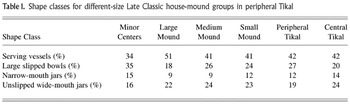
Shape classes for different-size Late Classic house-mound groups in peripheral Tikal
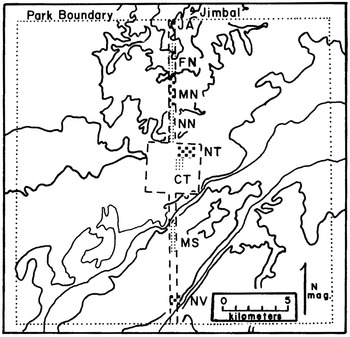
Map of the Tikal zone showing the location of grouped collections in peripheral and central Tikal used in the analysis.
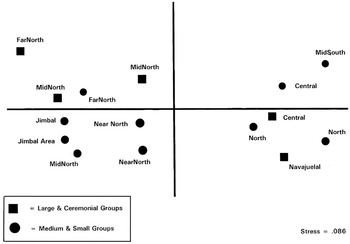
Two-dimensional multidimensional scaling solution for Ik Complex vases. Stress is .086.
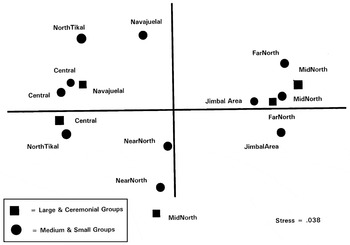
Two-dimensional multidimensional scaling solution for Imix Complex vases. Stress is .038.
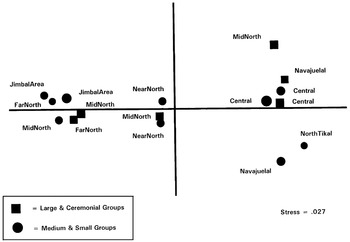
Two-dimensional multidimensional scaling solution for Imix Complex plates. Stress is .027.
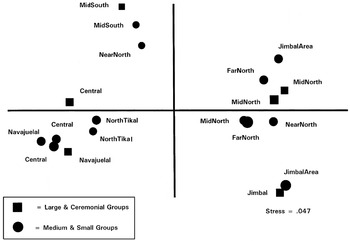
Two-dimensional multidimensional scaling solution for Late Classic-period large slipped bowls. Stress is .047.
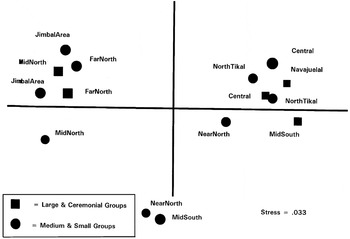
Two-dimensional multidimensional scaling solution for slipped narrow-mouth jars. Stress is .033.
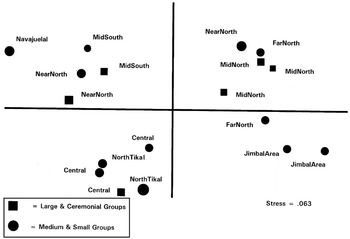
Two-dimensional multidimensional scaling solution for Late Classic-period unslipped wide-mouth jars. Stress is .063.
 You have
Access
- 11
- Cited by