Introduction
Word learning deficits and late acquisition of the first fifty words are hallmark characteristics of children with specific language impairment (SLI; Leonard, Reference Leonard1998). While theoretical bases and language symptomatology for SLI often focus on morphosyntactic deficits, difficulties in word learning are a substantial component of the linguistic impairment associated with SLI, and speech production, spoken language, and reading comprehension may suffer secondary to semantic deficits (Gathercole, Reference Gathercole1993). In contrast, typically developing children learn words rapidly and easily during the toddler and preschool years. Differences in underlying processes for learning new words may account for these deficits: perhaps children with SLI do not utilize lexical constraints, such as mutual exclusivity (Markman, Reference Markman and Dromi1993). Mutual exclusivity, the assumption that each object can have only one label and that each label applies to only one object, aids word learning by reducing potential referents for new words. Mutual exclusivity has been described as a specific lexical constraint, but similar processes could arise from a more general cognitive inference or as an outgrowth of social knowledge and theory of mind skills (Bloom, Reference Bloom2000; Clark, Reference Clark1990).
Disambiguation tasks are psycholinguistic experimental tasks that test mutual exclusivity by imposing selections among familiar and unfamiliar objects or pictures when presented with novel words. Merriman and Bowman (Reference Merriman and Bowman1989) found that typically developing children showed a tendency to decide that the novel word referred to the unfamiliar object and termed this phenomenon the disambiguation effect. Across studies, a strong disambiguation effect has been shown by typically developing children between the ages of 2;6 and 6;0 (Jarvis, Merriman, Barnett, Hanba & Van Haitsma, Reference Jarvis, Merriman, Barnett, Hanba and Van Haitsma2004; Merriman & Bowman, Reference Merriman and Bowman1989; Merriman, Marazita & Jarvis, Reference Merriman, Marazita, Jarvis, Tomasello and Merriman1995; Merriman & Schuster, Reference Merriman and Schuster1991).
In early language development, a tendency toward mutually exclusivity would assist young children in mapping words to referents, but older children must flexibly define and label categories that overlap, allowing for synonyms, speaker differences, and morphological inflections. Consistent with this, stimulus factors, such as phonological similarity of nonwords presented, phonological priming prior to introduction of nonwords, typicality of target objects, and novelty of target objects, have been shown to impact disambiguation (e.g. Merriman & Marazita, Reference Merriman and Marazita1995; Merriman & Schuster, Reference Merriman and Schuster1991). Merriman and Schuster (Reference Merriman and Schuster1991) found that typically developing two- and four-year-olds selected the unfamiliar object significantly more often when presented with phonologically distinct words (PD), words that did not sound like the conventional object name (e.g. lote), compared to phonologically similar words (PS; e.g. cardle with a car) or a no word (NW) condition (e.g. I want you to pick one. Do you know which one I want you to pick?). The mean selection of the unfamiliar objects by children tested in the PS word condition was not significantly different from chance, suggesting that phonological similarity to the familiar object label disrupted children's disambiguation. Merriman and Marazita (Reference Merriman and Marazita1995) found that phonological priming (e.g. sat, hat, lazy, and large to prime novel word lat) strengthened disambiguation for young two-year-old children, indicating that phonological working memory plays an important role in children's acquisition of new words.
Disambiguation tasks are conducted in experimental settings, but children encounter ambiguous word learning opportunities incidentally. Carey and Bartlett (Reference Carey and Bartlett1978) proposed that children utilize a fast mapping strategy to acquire new words, deriving a quick, partial understanding of a word's meaning from the linguistic and non-linguistic context during initial encounters with a word. Studies of fast mapping in children with SLI vary, but suggest weaknesses (Alt, Plante & Creusere, Reference Alt, Plante and Creusere2004; Dollaghan, Reference Dollaghan1987; Gray, Reference Gray2003; Rice, Buhr & Nemeth, Reference Rice, Buhr and Nemeth1990; Rice, Oetting, Marquis, Bode & Pae, Reference Rice, Oetting, Marquis, Bode and Pae1994). Consideration of the role of phonological processing in word-to-object mapping is particularly pertinent for understanding the nature of word learning deficits in children with SLI, who have known phonological representation differences (Gathercole & Baddeley, Reference Gathercole and Baddeley1990; Gathercole, Willis, Emslie & Baddeley, Reference Gathercole, Willis, Emslie and Baddeley1992). Alt et al. (Reference Alt, Plante and Creusere2004) found that children with SLI, aged four to six, showed poorer fast mapping of labels to referents and mapped significantly fewer semantic features (e.g. color, pattern, animacy, sound) than typically developing age-matched peers. Although deficits were not accounted for by receptive vocabulary or phonological skills, investigators found that children with SLI did not differentiate real words from either phonologically related foils or phonologically unrelated foils in a receptive labeling task, suggesting weak phonological representations. Two additional studies (Alt & Plante, Reference Alt and Plante2006; Maillart, Schelstraete & Hupet, Reference Maillart, Schelstraete and Hupet2004) found that children with SLI had trouble rejecting phonologically related foils as lexical labels.
While deficiencies processing semantic and phonological information during fast mapping and word learning have been shown for children with SLI, the utilization of underlying constraints, like mutual exclusivity, remains unclear for this population. To test this, Beverly and Estis (Reference Beverly and Estis2003) employed a within-subjects design based on Merriman and Schuster's (Reference Merriman and Schuster1991) phonologically distinct (PD) and phonologically similar (PS) word conditions and found that children with SLI had significantly weaker disambiguation for PD words compared to chronologically age-matched and younger, language-matched typically developing children. Second, the children with SLI given PS words consistently selected familiar objects, unlike the two typically developing groups who had chance-level selections with PS words. These authors concluded that children with SLI presented deficits in word-to-object mapping that were not simply commensurate with their lexical deficits. One six-year-old who showed consistent disambiguation was the only participant in school, completing her second year of kindergarten, suggesting that children with SLI might undergo changes in disambiguation over time or with increased meta-phonological instruction consistent with kindergarten.
To further explore the preliminary findings of Beverly and Estis (Reference Beverly and Estis2003), the current study investigated disambiguation in preschool and school-age children with SLI. Preschool children with SLI were compared to school-age children with SLI and age-matched groups of typically developing children to investigate whether there is a point in development when children with SLI would perform similarly to typically developing children. Phonological similarity was explored as a factor to test the flexibility of disambiguation and challenge strong versions of constraints like mutual exclusivity.
The following research questions were posed:
1. Are there differences in selections of unfamiliar objects during a disambiguation task among preschool children with SLI, school-age children with SLI, preschool typically developing children, and school-age typically developing children?
2. Do the groups of children demonstrate differences in selections of unfamiliar objects in a disambiguation task given three word conditions: phonologically distinct (PD), phonologically similar (PS), and no word (NW)?
Method
Participants
Participants were sixteen children with SLI and sixteen typically developing (TD) children. Eight preschoolers with SLI, two girls and six boys aged 3;7 and 4;11, were assigned to the ‘younger’ SLI or YSLI group, and one girl and seven boys aged 6;0 to 8;1, were assigned to the ‘older’ SLI or OSLI group. The TD children were matched with SLI participants for age (±2 months), gender, and ethnicity to form younger (YTD) and older (OTD) groups. Overall, participants were fourteen African-American and eighteen White children. Although not a criterion for participation, maternal education in years was reported for twenty-nine of the thirty-two participants. Group means (standard deviations) were: YSLI (n = 7) M = 12·71 (1·89); OSLI (n = 7) M = 13·00 (1·73); YTD (n = 8) M = 17·25 (2·55); and OTD (n = 7) M = 15·72 (1·38).
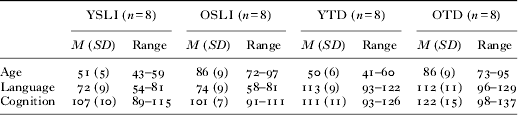
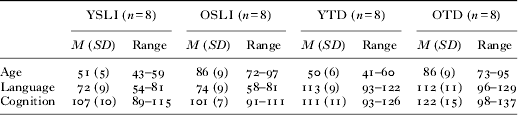
Following informed consent, parents completed a history questionnaire to rule out frank neurological or social-emotional concerns. Participants passed a pure-tone, play-based audiometric screening and were given an omnibus, standardized language assessment (e.g. Preschool Language Scale-4 [PLS-4; Zimmerman, Steiner & Pond, Reference Zimmerman, Steiner and Pond2002], Clinical Evaluation of Language Fundamentals-Preschool [CELF-P2; Wiig, Secord & Semel, Reference Wiig, Secord and Semel2004], Clinical Evaluation of Language Fundamentals-4 [CELF-4; Semel, Wiig & Secord, Reference Semel, Wiig and Secord2003]). Children with SLI demonstrated standard scores of ⩽81 (Table 1). All participants demonstrated non-verbal cognitive abilities ⩾85 on the Brief IQ Screener of the Leiter International Performance Scale-Revised (Leiter-R; Roid & Miller, Reference Roid and Miller1997). Eligible participants came from native English-speaking homes and passed the PLS-4 Articulation Screener (Zimmerman et al., Reference Zimmerman, Steiner and Pond2002). Preschoolers in the YSLI and YTD groups had no kindergarten or reading curriculum experience, but children in the OSLI and OTD groups had at least six months of kindergarten or reading curriculum experience.
Participant group means (standard deviations) for age (months), language standard scores, and non-verbal cognitive standard scores
Object stimuli
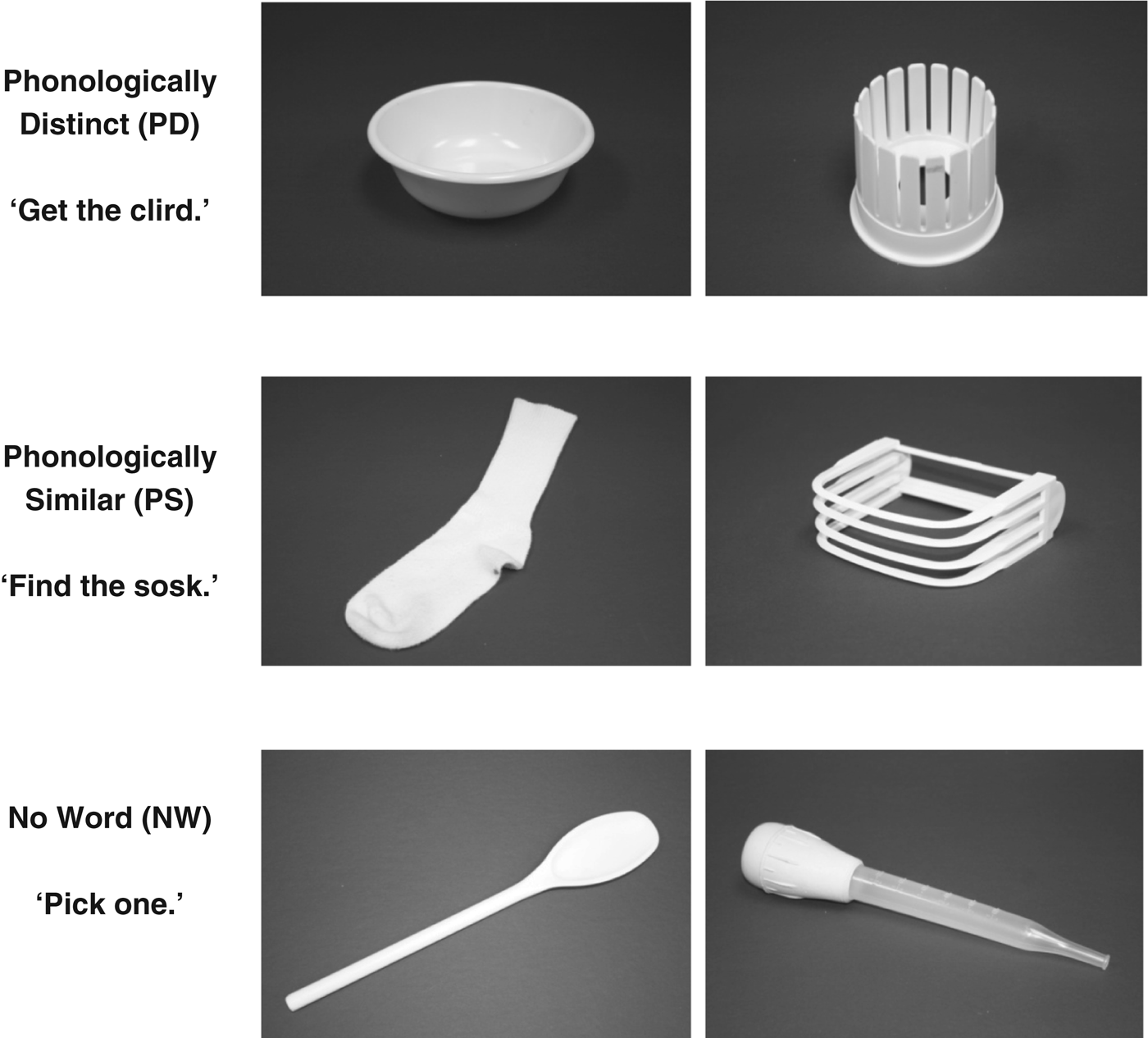
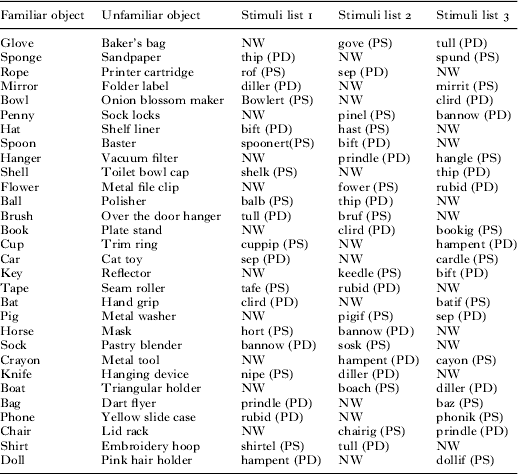
Object stimuli consisted of sixty objects: thirty familiar objects (e.g. flower, pig) paired with thirty unfamiliar objects (e.g. metal file clip, hand grip exerciser; see Table 2). Unfamiliar objects, although possibly familiar to adults, were unnamable by young children (Beverly & Estis, Reference Beverly and Estis2003). Object pairings were created to balance size and interest factors (Figure 1). Although participants received the same object pairings, three word conditions (PD, PS, and NW) were systematically varied across three stimuli lists such that each object pair occurred in each of the three word conditions counterbalanced across participants. For example, the object pair (e.g. glove, baker's bag) was presented with ‘Pick one’, the NW condition, in List 1; ‘Pick the gove’, a PS word, in List 2; and ‘Get the tull’, a PD word, in List 3. This eliminated object pair effects as explanations for condition differences. Participants were randomly assigned to lists at enrollment.
Examples of familiar/unfamiliar object pairs in three word conditions, phonologically distinct, phonologically similar, and no word.

Familiar objects, unfamiliar objects, and three stimuli lists varying the three word conditions: phonologically distinct (PD), phonologically similar (PS), and no word (NW)
Auditory stimuli
Nonwords created for this investigation were either phonologically distinct (PD) or phonologically similar (PS). PD words (e.g. bannow, tull) were one and two syllable nonwords used by Gathercole et al. (Reference Gathercole, Willis, Emslie and Baddeley1992). PD words did not sound similar to the names of the familiar objects or to any possible names for the unfamiliar objects (e.g. thip presented with a ball and a polisher).
PS words sounded similar to the familiar object names (e.g. spund with a sponge). Twenty of the thirty PS words were used previously by Beverly and Estis (Reference Beverly and Estis2003). We created PS words that children might construe as mispronunciations, alternate forms of the object name, or morphological endings – variations that may impact word-to-referent mapping in natural contexts. Specifically, fourteen of the thirty PS words simulated articulation errors by substituting the final consonant of a monosyllabic word (e.g. tafe with tape), by substituting the final syllable of a bisyllabic word (e.g. hangle with a hanger), or by omitting a consonant in the onset cluster (e.g. fower for flower). Sixteen PS words simulated the addition of a morpheme: twelve had an unstressed syllable added to a monosyllabic word (e.g. keedle with a key) and four had an added phoneme at the coda (e.g. hast with a hat). (See also Jarvis et al.,'s [Reference Jarvis, Merriman, Barnett, Hanba and Van Haitsma2004] study of disambiguation with differing PS words.) PS words did not overlap with phonological characteristics of the participants' regional dialects, Southern White English and Southern African-American English. Initial position cluster reductions and final position sound and syllable additions are not characteristic of these Southern dialects. Substitutions for ‘th’ or ‘v’ and derhotacization of vocalic ‘er’ were avoided.
The first author recorded forty-one sentences: ten PD and thirty PS words preceded by carrier phrases, and one sentence, Pick one, for the ‘no word’ (NW) condition. Five different carrier phrases were used to facilitate participant attention to task (i.e. Get the, Point to the, Show me the, Pick the, and Find the). The Computerized Speech Lab (CSL, Kay Elemetrics Corporation) was used to monitor amplitude and duration of stimuli sentences during recording in a sound-treated booth at a sampling rate of 44100 Hz. The stimuli sentences were saved as digital files, converted to .wav files, and edited with Cool Edit Pro Version 2.0 (Syntrillium Software Corporation, 2002). To ensure comparable loudness across stimuli, peak amplitudes were adjusted such that all sentences were within 2 dB. Stimuli sentences were arranged as needed for the three stimuli lists and recorded onto a compact disk with a 3 s silence between sentences.
Procedure
Each participant attended two sessions in a sound-treated booth, with the exception of two participants whose sessions were held in isolated, quiet speech therapy rooms at local schools after school hours. Pre-experimental testing and an object exposure task were conducted in one session. The object exposure task, sorting the objects by the attributes ‘big’ and ‘little’, decreased the novelty for the sixty experimental objects. Participants handled each object, but no objects were named or used in typical functions. The second session consisted of three tasks: the experimental disambiguation task, the object identification task, and the speech perception task.
For the experimental task, the child and investigator were seated across from one another at a child-sized table. Object pairs were placed on the table in front of the child, with left and right presentation of familiar and unfamiliar objects varied randomly. Auditory stimuli were presented in sound field via a compact disc player and an external speaker. Each child heard each stimulus sentence one time after the object pair was placed on the table. Neutral verbal and tangible reinforcement were administered after every response regardless of the child's choice. Results were recorded on a response form during administration, in addition to videotaping the procedure for re-scoring.
Following the experimental task, an identification task was administered to ensure that participants knew the familiar object names. Pictures of the thirty familiar objects were presented in arrays of four: three familiar objects and one distracter picture per page. Children were asked: ‘Point to the (familiar object)’. Last, a speech perception task was administered to determine if participants simply misperceived the PS word as the familiar object name. Inclusion of the speech perception task was important for ruling out a breakdown at the point of perception of the phonologically similar word. A modified version of Locke's (Reference Locke1980) speech production–perception task was created for each stimuli list. Participants were introduced to a puppet and told that sometimes the puppet does not talk quite right. They were instructed to point to a happy face if the puppet produced the word correctly and to point to a sad face if the puppet produced the word incorrectly. Following four practice trials, each child was shown ten familiar objects, one at a time. For each familiar object, the puppet randomly produced the correct name for the object three times (e.g. ball) and the corresponding PS word three times (e.g. balb), with the child selecting a sad face or happy face for each trial.
Results
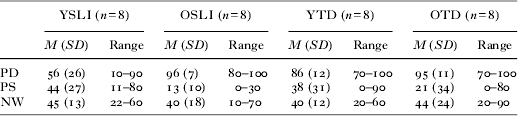
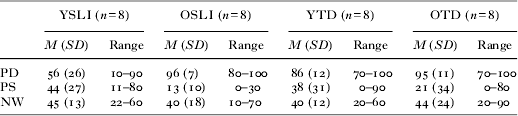
The dependent variable was the percentage of selections of unfamiliar objects (number of unfamiliar selections/number of trials in each condition). For thirty of the thirty-two participants, this percentage was based on ten trials per condition, because they identified familiar objects with 100% accuracy in the object identification task. Two YSLI participants did not identify all thirty familiar objects, scoring 28 or 29 correct. These object trials were excluded from the data. Group descriptive statistics are reported in Table 3 for percentages of selections of unfamiliar objects in each word condition.
Means (standard deviations) for selection of unfamiliar objects given phonologically distinct words (PD), phonologically similar words (PS), and a no word condition (NW) for young children with SLI (YSLI), older children with SLI (OSLI), young typically developing children (YTD), and older typically developing children (OTD)
A mixed model analysis of variance (ANOVA), 4 Groups × 3 Word Conditions, with repeated measures on the Word Condition term was conducted. Mauchly's Test of Sphericity was significant (p = ·01); therefore, Huynh-Feldt results (ε = ·902) were reported. A significant interaction between Group and Word Condition was revealed (F(5·410,50·491) = 6·013, p < ·001, partial η 2 = 0·504). There was a significant main effect of Word Condition (F(1·803,50·4951) = 6·013, p < ·001, η 2 = 0·993). The main effect of Group was non-significant (F(3,28) = 0·372, p = ·774, η 2 = 0·038).
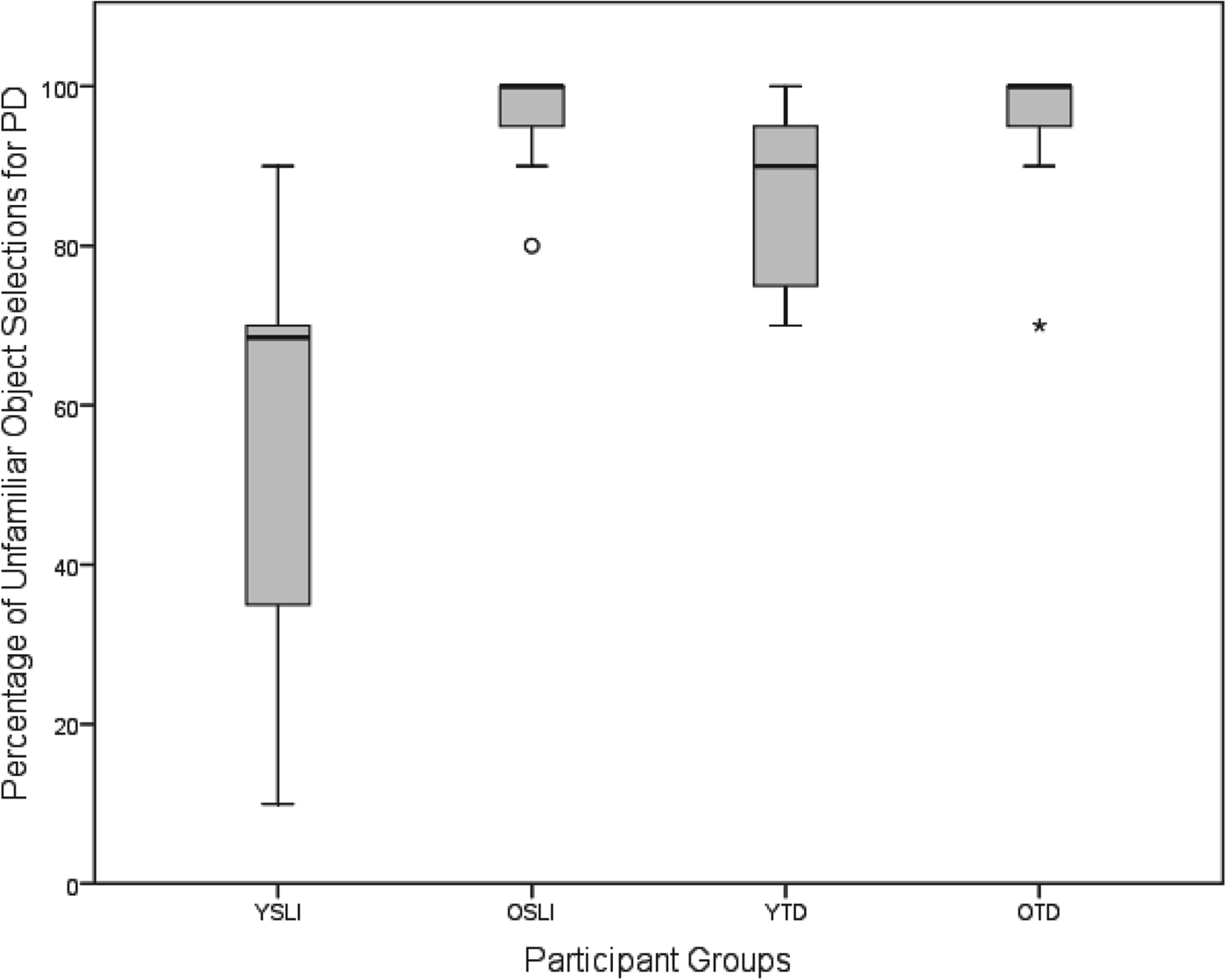
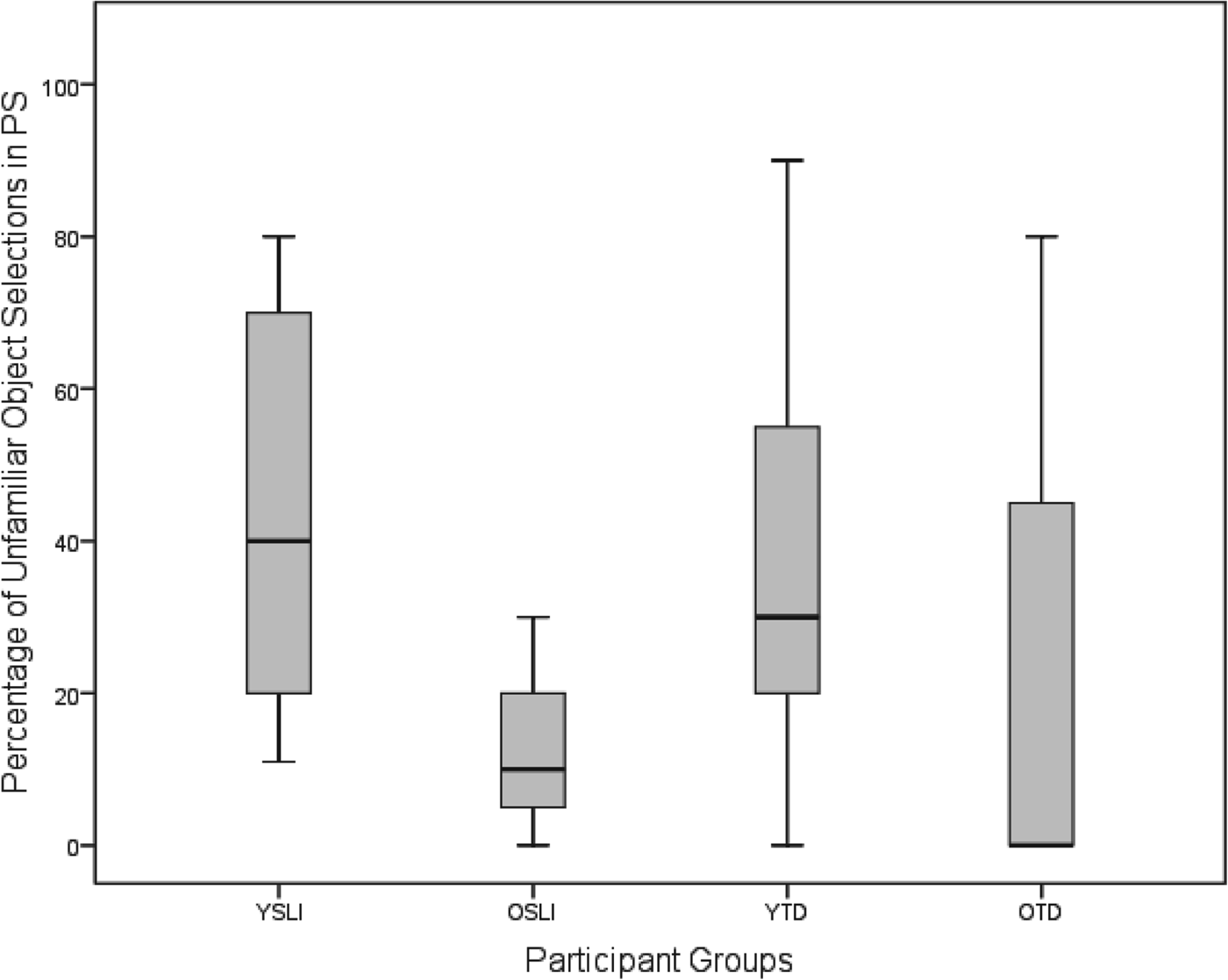
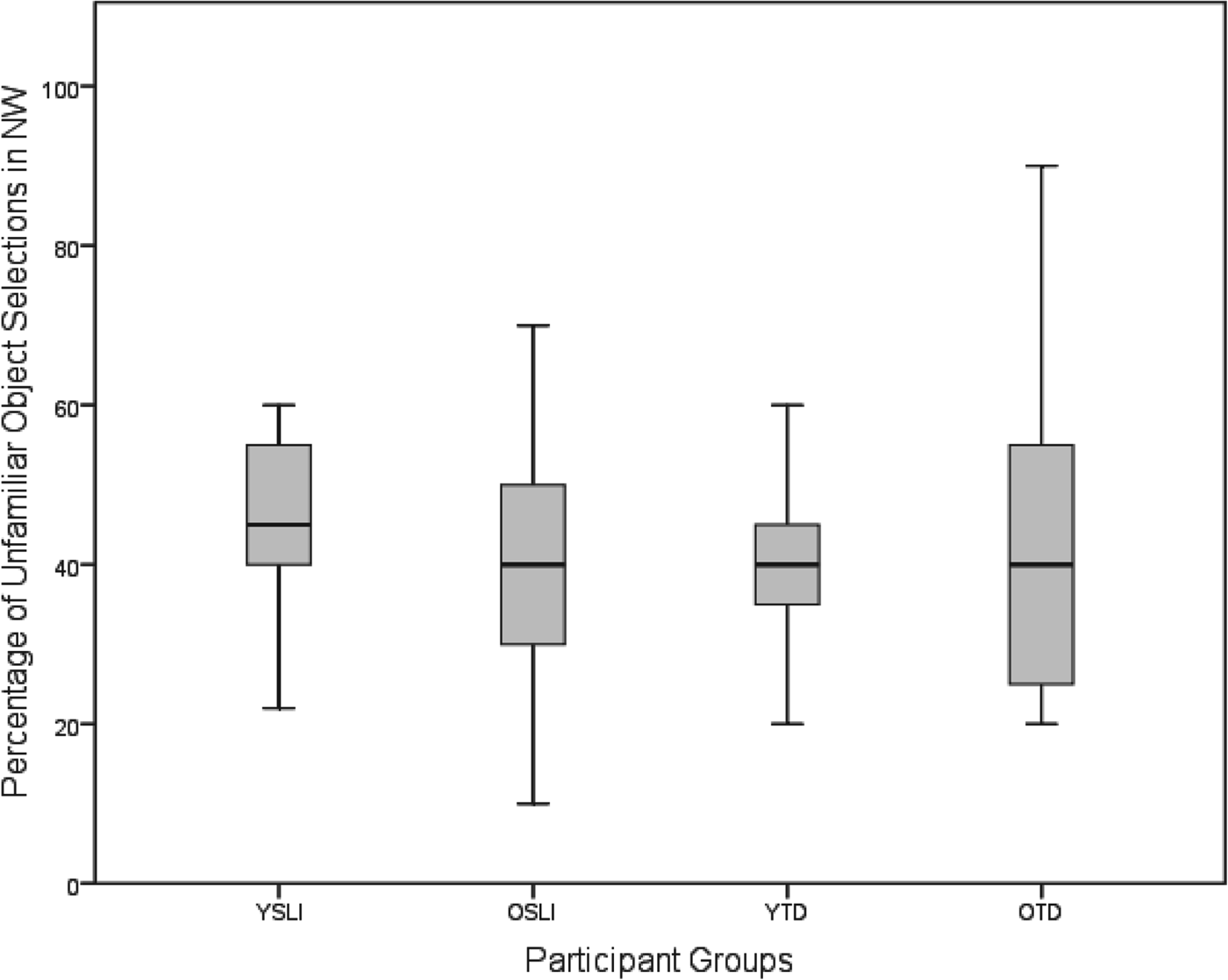
Given the significant interaction effect, univariate ANOVAs for each Word Condition were conducted to assess Group differences (see boxplots depicted in Figures 2, 3, and 4). In the PD condition, a significant Group difference was revealed (F(3,28) = 11·224, p < ·001, partial η 2 = 0·546). Tukey HSD comparisons revealed that the YSLI group selected unfamiliar objects significantly less often than other groups. The other participant groups, the OSLI group and both typically developing groups, YTD and OTD, performed similarly, demonstrating disambiguation with high percentages of unfamiliar object selections in the PD condition. Group differences were non-significant for both the PS and NW Conditions.
Boxplots depicting the median percentage of unfamiliar object selections, the lower and upper quartiles, and the minimum and maximum scores for the four participant groups (YSLI = young, preschool children with SLI, OSLI = older, early-elementary age children with SLI, YTD = young, typically developing preschoolers, OTD = older, early-elementary age typically developing children) in the phonologically distinct (PD) condition. Note that there were two participants who were statistical outliers for their groups.
Boxplots depicting the median percentage of unfamiliar object selections, upper and lower quartiles, and the minimum and maximum scores for the four participant groups (YSLI = young, preschool children with SLI, OSLI = older, early-elementary age children with SLI, YTD = young, typically developing preschoolers, OTD = older, early-elementary age typically developing children) in the phonologically similar (PS) condition.
Boxplots depicting the median percentage of unfamiliar object selections, upper and lower quartiles, and the minimum and maximum scores for the four participant groups (YSLI = young, preschool children with SLI, OSLI = older, early-elementary age children with SLI, YTD = young, typically developing preschoolers, OTD = older, early-elementary age typically developing children) in the no word (NW) condition.
Additional univariate ANOVAs to test differences among Word Conditions within each Group were conducted. For three of the four groups, OSLI, YTD, and OTD, significant differences among Word Conditions were revealed. For the OSLI group, pairwise comparisons revealed significant differences for all Word Conditions (p = ·005). Children in the OSLI group showed disambiguation in PD (M [SD] = 96·3 [7·4]), random selections for NW (M [SD] = 40·0 [17·7]), and an almost complete reversal of disambiguation in PS (M [SD] = 12·5 [10·4]). That is, they tended to select familiar objects given phonologically similar words. Pairwise comparisons revealed a different pattern for the YTD and OTD groups. For these typically developing groups, performances in the PD condition were significantly different from the PS condition and the NW condition (p = ·003), but differences between the PS condition and the NW condition were non-significant. Although both the YTD and OTD groups demonstrated disambiguation in the PD Condition, as evidenced by high percentages of unfamiliar object selections, neither group showed a strong reversal to the familiar object in the PS Condition.
Comparisons with chance
Because the experimental task involved a forced choice paradigm, results were compared to the probability of obtaining a chance level response. Twelve one-sample t-tests were conducted to test for significant differences between group means in each word condition and the constant of 50%, which is the chance level response or no difference in selecting the familiar versus the unfamiliar objects (Bonferonni correction, α = ·004). For the YSLI group, the mean percentages of unfamiliar selections (i.e. 56%, 44%, and 45% in the PD, PS, and NW conditions, respectively) were not significantly different from chance in any word condition. Performance by the OSLI group (see Figures 2, 3, and 4), however, differed significantly from chance (p values < ·001) in both the PD and PS conditions (Ms of 96% and 13%, respectively), but not the NW condition (M = 40%). The YTD and OTD performed similarly with means that were significantly different from chance in the PD condition (i.e. 86% for YTD and 95% for OTD; p < ·001), but non-significant in the other two conditions, PS and NW (see Table 3).
Speech perception task
Descriptive and statistical analyses were used to describe each group's performance on the post-experimental speech perception task. The dependent variable was the percentage of correct responses. The OSLI, YTD, and OTD groups showed highly accurate performance on this task (i.e. Ms of 97·7%, 90·5%, and 99·8%, respectively). In contrast, only 7 of the 8 YSLI children completed this task. The group mean and 95% confidence interval overlapped with chance level performance (M = 58%, 95% CI = 48–69%). A univariate ANOVA revealed significant between-group differences on the speech perception task (F(3,27) = 63·821 p < ·001, η 2 = 0·876). Equal variances were not assumed based on Levene's test (p = ·001); therefore, Dunnett T3 post-hoc comparisons were used to explore differences among groups. The YSLI group performed significantly poorer than the other groups (p < ·001). Children in the YSLI group showed difficulty completing the speech perception task. Thus, between-group differences in performance on this task may not adequately reflect differences in speech perception abilities.
Discussion
As predicted, there were significant differences in disambiguation between groups when phonologically distinct words were presented. Both typically developing groups showed consistent disambiguation, replicating findings of previous disambiguation studies (Beverly & Estis, Reference Beverly and Estis2003; Jarvis et al., Reference Jarvis, Merriman, Barnett, Hanba and Van Haitsma2004; Merriman & Bowman, Reference Merriman and Bowman1989; Merriman & Schuster, Reference Merriman and Schuster1991; Merriman & Stevenson, Reference Merriman and Stevenson1997; Merriman et al., Reference Merriman, Marazita, Jarvis, Tomasello and Merriman1995). Early elementary-age children with SLI also showed a strong tendency to disambiguate in the phonologically distinct word condition. However, preschool children with SLI did not demonstrate consistent disambiguation, replicating findings of Beverly and Estis (Reference Beverly and Estis2003).
Solving problems of ambiguity in word learning appears particularly difficult for preschoolers with SLI, but questions remain regarding the nature of these object-to-word mappings. One conclusion is that children with SLI do not consistently infer mutual exclusivity, which would explain their fast mapping deficits. Alternatively, differences in social-pragmatic reasoning may lead to inconsistent disambiguation. Instead of inferring that the speaker would have produced the familiar label if that was the intended referent, preschoolers with SLI invoke a more basic probable event strategy, selecting the familiar object, an established referent that is shared with the speaker in the experimental context, more often than typically developing children.
A third possibility is that reduced disambiguation in preschoolers with SLI is explained by generalized cognitive limitations. The disambiguation task required concurrent cognitive processing as the children perceived visual and auditory stimuli, accessed lexical and phonological information, compared the visual and auditory input to stored information, and determined which object corresponded to the nonsense word (Storkel & Morrisette, Reference Storkel and Morrisette2002). It is possible that the demands of the task, not the lack of a specific constraint such as mutual exclusivity, led to weaker disambiguation by preschoolers with SLI, due to limited processing capacity. Others have proposed a resource limitation explanation for lexical tasks: Jarvis et al. (Reference Jarvis, Merriman, Barnett, Hanba and Van Haitsma2004) noted that resource limitations could explain disambiguation decisions by typically developing two-year-olds in disambiguation paradigms, and Mainela-Arnold, Evans, and Coady (Reference Mainela-Arnold, Evans and Coady2008) invoked limited capacity models based on attention and inhibition processes when interpreting the less stable word identification in a gated lexical task for eight- to twelve-year-old children with SLI compared to typically developing peers.
As observed by Merriman and Schuster (Reference Merriman and Schuster1991) and Beverly and Estis (Reference Beverly and Estis2003), phonological similarity disrupted disambiguation. At first glance, the performance of preschoolers with SLI appears to mirror the typically developing groups' performance, because group means were not significantly different from chance. However, individual performances for typically developing children were polarized, while preschoolers with SLI showed chance level performance as they did in all conditions. No typically developing child displayed selections of the unfamiliar objects between 30% and 70%. Some children decided that phonological mismatch signaled a change in the lexical boundary and disambiguated, yielding a high percentage. Others accepted the phonological mismatch as a label for the familiar object, yielding a low percentage, perhaps concluding that the mismatch was an articulation error or morphological variation. Elementary-age children with SLI showed a different pattern of performance compared to the other three participant groups, consistently choosing familiar objects in the phonologically similar word condition, with percentages of selections of unfamiliar objects ranging from only 0% to 30%. Chance level responding by this group in the no word condition indicated that the selection of familiar objects in the phonologically similar condition was related to the phonologically similar words, not a general bias toward the familiar objects. Also, the post-experimental speech perception task provided evidence that the tendency to select familiar objects was not based on a phonological misperception.
What underlying processes or mechanisms lead early elementary school-age children with SLI, unlike typically developing children, to familiar objects when presented with phonologically similar words? Given ambiguity, lexical activation for the familiar object should have occurred (i.e. recognition of the object, key), but lexical activation for the unfamiliar object, which is not known, would be limited. For typically developing children, the phonological representation for the familiar object label would also be activated (e.g. /ki/), but children with SLI may have less specific phonological (and lexical representations) for familiar objects. The context of high competition of phonological activation given the similarity between the word presented and the label for the familiar object may yield a different pattern of activation and inhibition for SLI children. Children with SLI may be particularly vulnerable to such increased competition (Coady, Reference Coady2013). Lexical activation may have superseded phonological activation. For the children with SLI, the familiar object was lexically activated when they saw the familiar object and enhanced when they heard the similar sounding word (e.g. cardle). If early elementary-age children with SLI utilize lexical representations more than phonological representations during disambiguation, difficulties with word learning may stem from limited use of phonological information to support word learning.