Introduction
The Eurasian wild boar Sus scrofa Linnaeus, 1758 is one of the most widely distributed terrestrial mammals (Luccini et al., Reference Luccini, Meijaard, Diong, Groves and Randi2005) and over the past two decades it has become one of the most intensively managed game species in Bulgaria, with an estimated population size of approximately 40,000 individuals (Nikolov et al., Reference Nikolov, Gum, Markov and Kuehn2009). In parallel, a rise of prevalence and incidence rates of certain parasitic diseases in Bulgaria during the past two decades has led to an increased awareness of their public health importance (Kurdova, Reference Kurdova2001). Although the source of human trichinellosis in Bulgaria has been increasingly attributed to the domestic pig over the past 20 years (Kurdova, Reference Kurdova2001; Kurdova et al., Reference Kurdova, Jordanova, Vutchev, Filippov, Rainova, Charizanov, Dimitrov, Ivanova and Marinova2003), other emerging and re-emerging parasitic zoonoses transmitted by feral pigs can cause lasting negative effects on consumers' health.
The trematode Alaria alata is an intestinal parasite of carnivores in the middle latitudes in Central Europe and Asia. The mesocercarial stage of this parasite can infect almost all terrestrial and semi-aquatic vertebrate species, and, in particular, omnivore species such as wild boars or feral pigs serve as paratenic or transportation hosts for the mesocercariae. Alaria spp. can cause severe damage in its paratenic hosts and cases of human alariosis associated with dermal and ocular infection, respiratory disorders and generalized disease have been recorded with regard to American Alaria species (Shea et al., Reference Shea, Maberley, Walters, Freeman and Fallis1973; Byers & Kimura, Reference Byers and Kimura1974; Fernandes et al., Reference Fernandes, Cooper, Cullen, Freeman, Ritchie, Scott and Stuart1976; Freeman et al., Reference Freeman, Stuart, Cullen, Ritchie, Mildon, Fernandes and Bonin1976; Beaver et al., Reference Beaver, Little, Tucker and Reed1977; McDonald et al., Reference McDonald, Kazacos, Schatz and Johnson1994; Kramer et al., Reference Kramer, Eberhard and Blankenberg1996). Although no cases of human alariosis associated with A. alata have been reported yet, the German Federal Institute for Risk Assessment (BfR), in its opinion No. 027/2007, 1 July 2007 (Anonymous, 2007), emphasized the pathogenic potential of this parasite. The BfR follows, in this case, the assessment of the Swiss Agency for the Environment, Forests and Landscape (SAEFL) which classified Alara alata as a zoonotic parasite in 2003 (Anonymous, 2003).
The parasite is widely distributed in Europe and findings of adult and mesocercarial stages of A. alata have been documented, for example, in Ireland, Germany, France, Poland, Hungary, Serbia, Greece, Turkey and Croatia (Papadopoulos et al., Reference Papadopoulos, Himonas, Papazahariadou and Antoniadou-Sotiriadou1997; Pavlović & Kulišić, Reference Pavlović and Kulišić2001; Rajković-Janje et al., Reference Rajković-Janje, Marinculić, Bosnić, Benić, Vinković and Mihaljević2002; Széll et al., Reference Széll, Sréter and Varga2004; Große & Wüste Reference Große and Wüste2006; Popiołek et al., Reference Popiołek, Szczesna, Nowaka and Mysłajeka2007; Gicik et al., Reference Gicik, Kara, Sari, Kiliç and Arslan2009; Murphy et al., Reference Murphy, O'Connell, Berzano, Dold, Keegan, McCann, Murphy and Holden2012; Portier et al., Reference Portier, Jouet, Vallée and Ferté2012). Adult A. alata have also been documented once in foxes from three regions of north-western Bulgaria (Jančev & Ridjakov, Reference Jančev and Ridjakov1977) but there are no reports about the occurrence of A. alata mesocercariae in paratenic hosts in Bulgaria.
So, for the first time we present the isolation and subsequent molecular identification of A. alata mesocercariae from two wild boars in Bulgaria.
Materials and methods
Sample material originated from two wild boars: an approximately 2-year-old female with a body weight of 80 kg and an approximately 3.5-year-old male with a body weight of 80 kg. Both animals originated from the south-eastern part of Bulgaria. The sow was shot near the village of Kokalyane (latitude 42.583°N; longitude 23.417°E). The boar was shot in Kladnica village (latitude 42.56,667°N; longitude 23.18,333°E). Both hunting grounds are located in the direct vicinity of the capital Sofia.
Samples for official Trichinella examination were taken from the pillar of the diaphragm immediately after hunting and in accordance with Annex III; letter (a) of the EC Regulation (No.) 2075/2005. The A. alata mesocercariae migration technique (AMT), as described by Riehn et al. (Reference Riehn, Hamedy, Große, Zeitler and Lücker2010), was used to examine a 15-g sample of this tissue. This technique exploits the tendency of the mesocercariae to migrate from the infested tissue into a surrounding liquid of similar concentration as the nematode larvae by the Baermann technique.
The mesocercariae were washed extensively in physiological saline and shifted into 90–95% ethyl alcohol for preservation. Genomic DNA extraction from the isolate was performed using DNeasy® Blood and Tissue Kit (Qiagen, Hilden, Germany). Extracted DNA was eluted in 20 μl of Tris/EDTA (TE) buffer (Roth, Karlsruhe, Germany) and stored at 4°C until analysed. After genomic DNA was purified from the fluke, the molecular identification was carried out by polymerase chain reaction (PCR) analysis according to the protocol described by Riehn et al. (Reference Riehn, Hamedy, Alter and Lücker2011). As positive control, an A. alata specimen which had been previously identified by the German Federal Institute of Risk Assessment was used. For negative controls we used a non-template control (NTC).
PCR amplicons were separated electrophoretically in 1.5–2% agarose gel (Peqlab, Erlangen, Germany) and visualized on a Multi Image® Light Cabinet UV transilluminator (Alpha Innotech, distribution by Biozym Scientific, Hessisch Oldendorf, Germany). Detection of a single band at approximately 300 bp allowed identification of A. alata mesocercariae as the specific oligonucleotide primers DME-F and DME-R deliver a band of 303 bp.
Results and discussion
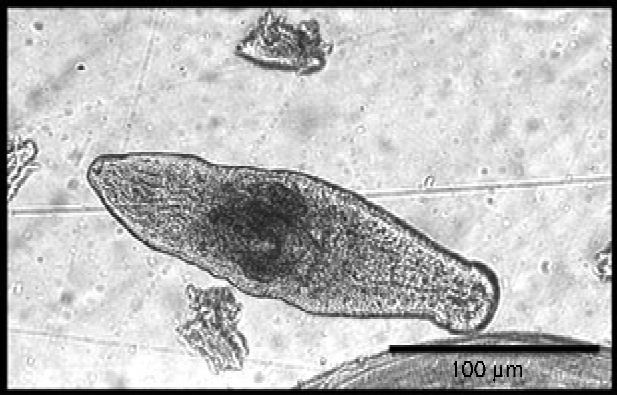
Examination of the minced sample material with the AMT produced in both cases one vital fluke. The flukes were identified by light microscope as Alaria spp. mesocercariae due to their morphology (Odening, Reference Odening1961; Freeman et al., Reference Freeman, Stuart, Cullen, Ritchie, Mildon, Fernandes and Bonin1976) and by means of their characteristic movement patterns (Riehn et al., Reference Riehn, Hamedy, Alter and Lücker2011). Figure 1 shows a light optical microscope image of one fluke within the surrounding examination liquid.
Mesocercaria of Alaria alata from a female wild boar.

The subsequent PCR analysis of the extracted genomic DNA successfully amplified a region of approximately 300 bp in both field isolates. The positive controls, two specimens previously validated by the National Reference Laboratory for Trichinella (German Federal Institute for Risk Assessment) as A. alata, also produced a sharp, single band in the same region. Thus, the amplicon size of both the field samples and the positive controls were entirely consistent with the length predicted from sequence analysis to select primers (303 bp). Negative controls produced no bands.
Facultative mammalian scavengers such as wild boars play an important role in enhancing the dissemination of Alaria spp. in the environment and contributing to the maintenance of their infection cycles. Moreover, due to its use as food, the wild boar represents an important link from the primary sylvatic infection cycles of this parasite, which include mainly small to medium-sized predators, amphibians and gastropods, to possible human infections. A prerequisite for generating an informed assessment of the possible risk posed by this parasite is, among others, the collection of valid and accurate data about the prevalence of Alaria spp. mesocercariae in stocks of wild boars.
However, the detection of A. alata mesocercariae in wild and feral pigs was hitherto limited to random findings because a specific detection method was lacking. It was not until the introduction of the A. alata mesocercariae migration technique that the specific examination of game meat for Alaria spp. mesocercariae was possible.
On the basis of this new method, it was possible to establish vital A. alata mesocercariae from two Bulgarian wild boars for the first time. Furthermore, we have succeeded in unequivocal identification of the isolated flukes by means of PCR analysis.
These first findings of A. alata mesocercariae in a Bulgarian wild boar, however, are just a beginning and need to be followed up by pursuing actions at national level to determine the parasite's actual prevalence in its hosts. Another continuing possibility of interest is the molecular biological analysis of different European and American Alaria spp. isolates with regard to their degree of relationship.
Acknowledgements
This work was supported financially by the German Federal Ministry of Food, Agriculture and Consumer Protection (BMELV) through the Federal Office for Agriculture and Food (BLE), grant number 2810HS017. None of the authors of this manuscript has declared any conflict of interest within the past 3 years which may arise from being named as an author on the manuscript.