Introduction
Epidemiological studies consistently demonstrate high rates of co-morbidity between anxiety and depressive disorders (Broekman et al. Reference Broekman, Chan, Chong, Kwek, Cohen, Haley, Chen, Chee, Rifkin-Graboi, Gluckman, Meaney and Saw2014; Falah-Hassani et al. Reference Falah-Hassani, Shiri and Dennis2016). In a cohort study conducted in the Netherlands among those with a depressive disorder, 67% had a current co-morbid anxiety disorder (Lamers et al. Reference Lamers, van Oppen, Comijs, Smit, Spinhoven, van Balkom, Nolen, Zitman, Beekman and Penninx2011). Of those with a current anxiety disorder, 63% had a current depressive disorder. Further, in 57% of co-morbid cases, anxiety preceded depression, and in 18% depression preceded anxiety. Data from the US-based National Comorbidity Survey of more than 8000 community-living persons confirm that co-morbid anxiety disorders often predate depressive disorders (Kessler et al. Reference Kessler, Nelson, McGonagle, Liu, Swartz and Blazer1996).
Co-morbid anxiety and depression have been associated with sociodemographic factors such as female gender, not having a partner, lower socio-economic status and lower educational level (de Graaf et al. Reference de Graaf, Bijl, Smit, Vollebergh and Spijker2002; Alonso et al. Reference Alonso, Angermeyer, Bernert, Bruffaerts, Brugha, Bryson, de Girolamo, Graaf, Demyttenaere, Gasquet, Haro, Katz, Kessler, Kovess, Lepine, Ormel, Polidori, Russo, Vilagut, Almansa, Arbabzadeh-Bouchez, Autonell, Bernal, Buist-Bouwman, Codony, Domingo-Salvany, Ferrer, Joo, Martinez-Alonso, Matschinger, Mazzi, Morgan, Morosini, Palacin, Romera, Taub and Vollebergh2004; Fichter et al. Reference Fichter, Quadflieg, Fischer and Kohlboeck2010), and with vulnerability factors such as parental psychiatric history, childhood trauma, negative life events and neuroticism (de Graaf et al. Reference de Graaf, Bijl, Smit, Vollebergh and Spijker2002). They are further associated with important clinical factors including earlier age at onset of first disorder, more severe and persistent symptomatology (Lamers et al. Reference Lamers, van Oppen, Comijs, Smit, Spinhoven, van Balkom, Nolen, Zitman, Beekman and Penninx2011), increased disability and impaired functioning (Kessler & Frank, Reference Kessler and Frank1997; Fichter et al. Reference Fichter, Quadflieg, Fischer and Kohlboeck2010), higher health care utilization (Kessler et al. Reference Kessler, McGonagle, Zhao, Nelson, Hughes, Eshleman, Wittchen and Kendler1994), poorer response to treatment (Merikangas et al. Reference Merikangas, Zhang, Avenevoli, Acharyya, Neuenschwander, Angst and Zurich Cohort2003; Rush et al. Reference Rush, Zimmerman, Wisniewski, Fava, Hollon, Warden, Biggs, Shores-Wilson, Shelton, Luther, Thomas and Trivedi2005) and increased risk to commit suicide (Tavares et al. Reference Tavares, Quevedo, Jansen, Souza, Pinheiro and Silva2012). Individuals experiencing co-morbidity also have fewer social interactions and demonstrate greater social dysfunction (Nakayama et al. Reference Nakayama, Koyanagi, Stickley, Kondo, Gilmour, Arenliu and Shibuya2014).
Despite high rates of co-morbidity between anxiety and depressive disorders and women's increased vulnerability to experience these conditions during the perinatal period, the precise prevalence of this comorbidity is not well known. Estimates of the prevalence of co-morbid perinatal anxiety and depression have varied across studies. Previous studies have reported the prevalence of co-morbid anxiety and depression to be between 4 and 8% in pregnancy (Fisher et al. Reference Fisher, Tran, La, Kriitmaa, Rosenthal and Tran2010; Grant et al. Reference Grant, Bautovich, McMahon, Reilly, Leader and Austin2012) and between 2% and 13% in the first 6 months postpartum (Reck et al. Reference Reck, Struben, Backenstrass, Stefenelli, Reinig, Fuchs, Sohn and Mundt2008; Austin et al. Reference Austin, Hadzi-Pavlovic, Priest, Reilly, Wilhelm, Saint and Parker2010; Tavares et al. Reference Tavares, Quevedo, Jansen, Souza, Pinheiro and Silva2012). The identification and management of co-morbid anxiety and depression in the perinatal period are important given the well-documented adverse effects of anxiety and depression on maternal and child outcomes. Primary care practitioners and those providing care across the perinatal period have an opportunity to assess maternal mental health. However, little is known about their ability to recognize and manage perinatal anxiety (Ford et al. Reference Ford, Shakespeare, Elias and Ayers2017). For non-perinatal anxiety in primary care settings, health care providers fail to diagnose anxiety disorders in half of cases (Olariu et al. Reference Olariu, Forero, Castro-Rodriguez, Rodrigo-Calvo, Alvarez, Martin-Lopez, Sanchez-Toto, Adroher, Blasco-Cubedo, Vilagut, Fullana and Alonso2015). Moreover, only a small proportion of obstetricians and midwives screen for anxiety during pregnancy (Coleman et al. Reference Coleman, Carter, Morgan and Schulkin2008). The aim of this systematic review and meta-analysis was to estimate the prevalence of co-morbid anxiety and depression in the antenatal and postnatal periods.
Method
Search strategy and study eligibility
The protocol and reporting of the results of this systematic review and meta-analysis were based on the Preferred Reporting Items for Systematic Reviews and Meta-Analyses (PRISMA) statement (Moher et al. Reference Moher, Liberati, Tetzlaff and Altman2009). Comprehensive literature searches were conducted in PubMed, Embase, PsycINFO, Web of Science, Scopus, ResearchGate and Google Scholar from their inception until January 2016 using predefined search terms (online Supplementary Table S1). We used Medical Subject Headings (MeSH) terms and text words in PubMed, and Emtree terms and text words in Embase. The titles and abstracts of all identified citations were screened for relevance and the full texts of potentially relevant articles were obtained and assessed for eligibility. In addition, the reference lists of relevant articles were hand-searched.
Studies were eligible for inclusion if they: (a) assessed antenatal or postnatal anxiety and depressive symptoms using a validated diagnostic or self-report instrument; (b) reported the results of peer-reviewed research based on cross-sectional or cohort studies; and (c) reported the results for co-morbid anxiety and depressive symptoms or the authors provided the reviewers with the requested data in order to estimate the prevalence of co-morbid anxiety and depressive symptoms. Studies were excluded if they: (a) were conducted among self-selected volunteers; (b) over-sampled psychiatric patients; (c) recruited women experiencing a medically high-risk pregnancy; (d) reported results only for a subsample of a study population; (e) reported results only for a subgroup of anxiety disorders, e.g. panic disorder, except generalized anxiety disorder; (f) reported mean data only; (g) reported combined prevalence of either anxiety or depression; or (h) did not report a cut-off point for anxiety or depressive symptoms. Study authors were contacted by email for additional information, particularly those who reported only mean data, not cut-off data, or had missing information. We made efforts to ensure that all of the studies included in the meta-analyses used relatively representative samples. Volunteers are generally healthier than the general population. The generalizability of the results of self-selected volunteers to childbearing women is limited (Leung et al. Reference Leung, McDonald, Kaplan, Giesbrecht and Tough2013).
Data extraction and quality assessment
We extracted individual details of the included studies such as year of publication, country, study population, recruitment method, sample size, measure of anxiety and depression, cut-off points and timing of measurement, and prevalence of co-morbid anxiety and depression. The risk of bias in the included studies was independently rated by two reviewers (K.F.-H. and R.S.) using criteria adapted from the Effective Public Health Practice Project Quality Assessment Tool (Armijo-Olivo et al. Reference Armijo-Olivo, Stiles, Hagen, Biondo and Cummings2012). Three domains were assessed: selection bias, detection bias and attrition bias (online Supplementary Table S2). Any disagreements in quality ratings were resolved by discussion (K.F.-H. and R.S.), and if necessary with the involvement of another author (C.-L.D.).
Data synthesis and meta-analysis
Many studies reported an estimate for the prevalence of antenatal or postnatal co-morbid anxiety and depressive symptoms for more than one time point for the same participants. In order to include each study only once in a meta-analysis, an overall prevalence of antenatal or postnatal co-morbid anxiety and depressive symptoms was estimated using an average sample size and an average number of events. The prospective cohort studies included in the current meta-analysis determined the prevalence of co-morbid anxiety and depressive symptoms rather than the incidence. We therefore combined both cross-sectional and cohort studies in a single analysis. Anxiety and depression were measured using diverse scales and cut-off scores and at differing antenatal or postnatal time periods. We performed subgroup analyses for studies on self-reported depressive symptoms and clinically diagnosed depression. We also performed subgroup analyses for studies on self-reported mild to severe depressive symptoms and self-reported moderate to severe depressive symptoms. Following published recommended cut-off points, mild to severe depressive symptoms were defined as Edinburgh Postnatal Depression Scale (EPDS) >9, Center for Epidemiologic Studies Depression Scale (CES-D) >16, Hospital Anxiety and Depression Scale (HADS) >8, Depression Anxiety and Stress Scale (DASS) >10, Hopkins Symptom Checklist-25 (HSCL-25) >1.75, or Self-Rating Scale for Depression (SRDS) >40. Moderate to severe depressive symptoms were defined as EPDS >12, CES-D >20, HADS >11, DASS >14, or Beck Depression Inventory (BDI) >20. Furthermore, we performed subgroup analyses for studies on trait anxiety, self-report anxiety symptoms, any clinically diagnosed anxiety disorder, and generalized anxiety disorder.
We used a random-effects meta-analysis to combine the estimates of different studies (Higgins & Green, Reference Higgins and Green2009). The presence of heterogeneity across the studies was assessed by the I 2 statistic (Higgins & Thompson, Reference Higgins and Thompson2002). An I 2 statistic less than 25% indicates small inconsistency and more than 50% indicates large inconsistency (Higgins & Thompson, Reference Higgins and Thompson2002). We used meta-regression to assess the differences between subgroups (Higgins & Green, Reference Higgins and Green2009). We performed subgroup analyses according to year of publication, country of study, pregnancy trimester, postpartum time period, selection bias and attrition bias. Stata, version 13 (StataCorp LLC, USA) was used for the meta-analyses.
Results
Study characteristics
The study selection process is presented in online Supplementary Fig. S1. The literature search yielded 23 464 references, of which 22 685 were excluded following title and abstract screening by the first author (K.F.-H.). Overall, 779 full papers were retrieved and assessed by two reviewers. Of these, 77 studies were relevant following full-text screening. From these 77 studies, a further 11 were excluded from the meta-analyses: five studies were conducted among self-selected volunteers (Wenzel et al. Reference Wenzel, Haugen, Jackson and Brendle2005; Moss et al. Reference Moss, Skouteris, Wertheim, Paxton and Milgrom2009; McFarland et al. Reference McFarland, Salisbury, Battle, Hawes, Halloran and Lester2011; McPhie et al. Reference McPhie, Skouteris, Fuller-Tyszkiewicz, Hill, Jacka and O'Neil2015; Sockol & Battle, Reference Sockol and Battle2015), two used non-validated tools to assess anxiety or depressive symptoms (Milgrom et al. Reference Milgrom, Gemmill, Bilszta, Hayes, Barnett, Brooks, Ericksen, Ellwood and Buist2008; Farr et al. Reference Farr, Dietz, O'Hara, Burley and Ko2014), one reported mean anxiety and depressive symptoms scores (van Bussel et al. Reference van Bussel, Spitz and Demyttenaere2009), one estimated prevalence of co-morbid postpartum anxiety and depressive symptoms after the first year of postpartum (Nguyen et al. Reference Nguyen, Tran, Tran, La, Nguyen and Fisher2015), one recruited women who already sought psychiatric treatment (Swanson et al. Reference Swanson, Pickett, Flynn and Armitage2011), and finally one study measured both anxiety and depression with a single scale but did not give separate scores for anxiety and depression (Karmaliani et al. Reference Karmaliani, Asad, Bann, Moss, McClure, Pasha, Wright and Goldenberg2009).
In total, 66 studies (n = 162 120 women) on antenatal or postnatal co-morbid anxiety and depressive symptoms were included in the meta-analyses. Forty-two authors provided via email additional information to determine co-morbidity and enable study inclusion. Characteristics of the included studies are provided in online Supplementary Tables S3–S5. There were 44 studies that provided data on the prevalence of antenatal co-morbid anxiety and depressive symptoms and 36 studies that provided postnatal data. Three studies reported an estimate for the prevalence of co-morbid anxiety and depressive symptoms either at pregnancy or postpartum (online Supplementary Table S5). The included studies were conducted in 30 different countries spanning six continents. The countries with the largest number of included studies were the USA (n = 13), Australia (n = 8), Brazil (n = 4), Canada (n = 4) and the Netherlands (n = 4). There were two studies from France, Germany, Greece, Italy, New Zealand, Norway, Portugal, Singapore, Tanzania, UK and Vietnam, and one study from Bangladesh, Croatia, Ghana, Hong Kong, Hungary, Ireland, Israel, Japan, Nigeria, Poland, Romania, Saudi Arabia, Switzerland and Turkey.
Prevalence of antenatal co-morbid anxiety and depression
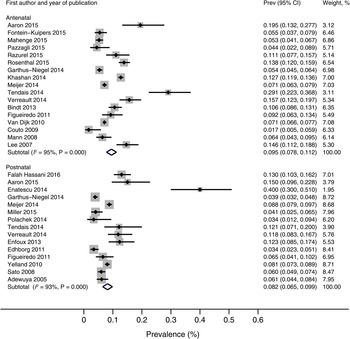
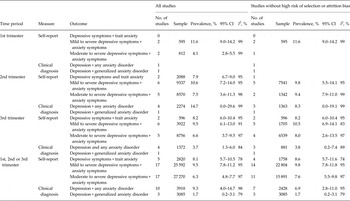
Table 1 presents the prevalence of co-morbid anxiety and depression in the 1st, 2nd and 3rd trimesters of pregnancy. Meta-analytic pooling of the estimates yielded the prevalence of co-morbid anxiety symptoms and mild to severe depressive symptoms to be 11.6% [95% confidence interval (CI) 9.0–14.2, two studies, n = 595] for the 1st trimester, 10.6% (95% CI 7.2–14.0, six studies, n = 9337) for the 2nd trimester, and 9.5% (95% CI 6.1–13.0, six studies, n = 3922) for the 3rd trimester (Table 1). The overall pooled prevalence for co-morbid anxiety symptoms and mild to severe depressive symptoms across the three trimesters was 9.5% (95% CI 7.8–11.2, 17 studies, n = 25 592, Fig. 1). The prevalence of co-morbid anxiety symptoms and moderate to severe depressive symptoms was 4.1% (95% CI 2.8–5.5, two studies, n = 812) for the 1st trimester, 7.5% (95% CI 3.6–11.3, five studies, n = 8570) for the 2nd trimester, and 6.6% (95% CI 3.7–9.5, five studies, n = 8756) for the 3rd trimester (Table 1). The overall pooled prevalence for co-morbid anxiety symptoms and moderate to severe depressive symptoms across the three trimesters was 6.3% (95% CI 4.8–7.7, 17 studies, n = 27 270, Table 1 and online Supplementary Fig. S2). The overall prevalence for co-morbid self-reported trait anxiety and depressive symptoms across the three trimesters was 8.1% (95% CI 5.7–10.5, five studies, n = 2820). The overall prevalence for a clinically diagnosed co-morbid anxiety and depression disorder across the three trimesters was 9.3% (95% CI 4.0–14.7, 10 studies, n = 3918, Table 1 and online Supplementary Fig. S3) and co-morbid generalized anxiety disorder and depression was 1.7% (95% CI 0.2–3.1, three studies, n = 3085).
Prevalence (Prev) of antenatal and postnatal (1–24 weeks) co-morbid mild to severe depressive and anxiety symptoms. CI, Confidence interval.

Prevalence of antenatal co-morbid anxiety and depression

CI, Confidence interval.
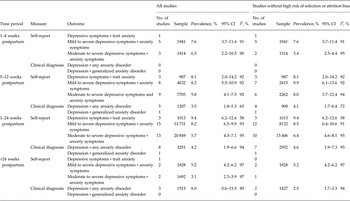
Prevalence of postnatal co-morbid anxiety and depression
Table 2 shows the prevalence of co-morbid anxiety and depression at 1–4 weeks, 5–12 weeks, 1–24 weeks, and >24 weeks postpartum. The prevalence of postnatal (1–24 weeks postpartum) co-morbid trait anxiety and depressive symptoms was 9.4% (95% CI 6.2–12.6, three studies, n = 1013). Meta-analytic pooling of the estimates yielded the prevalence of co-morbid anxiety symptoms and mild to severe depressive symptoms to be 7.6% (95% CI 3.7–11.4, 5 studies, n = 1941) for 1–4 weeks postpartum, 8.2% (95% CI 5.5–10.9, eight studies, n = 4632) for 5–12 weeks postpartum, and 8.2% (95% CI 6.5–9.9, 15 studies, n = 14 731, Table 2 and Fig. 1) for 1–24 weeks postpartum. The prevalence of co-morbid anxiety symptoms and moderate to severe depressive symptoms was 6.3% (95% CI 2.2–10.5, three studies, n = 1814) for 1–4 weeks postpartum, 5.8% (95% CI 4.1–7.5, nine studies, n = 7705) for 5–12 weeks postpartum, and 5.7% (95% CI 4.3–7.1, 13 studies, n = 20 849, Table 2 and online Supplementary Fig. S2) for 1–24 weeks postpartum. The prevalence of a clinically diagnosed co-morbid anxiety and depression disorder was 3.5% (95% CI 1.8–5.3, five studies, n = 1207) for 5–12 weeks postpartum and 4.2% (95% CI 1.9–6.6, eight studies, n = 3251, Table 2 and online Supplementary Fig. S3) for 1–24 weeks postpartum.
Prevalence of postnatal co-morbid anxiety and depression

CI, Confidence interval.
Prevalence of antenatal or postnatal co-morbid depression and anxiety
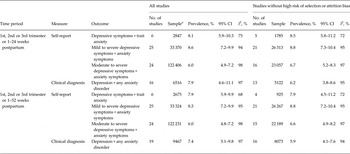
The prevalence rates of co-morbid depression and anxiety at 1st, 2nd or 3rd trimester of pregnancy, or 1–24 weeks postpartum as well as at 1st, 2nd or 3rd trimester of pregnancy, or 1–52 weeks postpartum are presented in Table 3. The prevalence of antenatal (1st, 2nd or 3rd trimester) or postnatal (1–24 weeks postpartum) co-morbid trait anxiety and depressive symptoms was 8.1% (95% CI 5.9–10.3, six studies, n = 2847, Table 3), co-morbid anxiety symptoms and mild to severe depressive symptoms was 8.6% (95% CI 7.2–9.9, 25 studies, n = 33 370), co-morbid anxiety symptoms and moderate to severe depressive symptoms was 6.0% (95% CI 4.9–7.2, 24 studies, n = 122 406), and clinically diagnosed co-morbid anxiety and depression disorder was 7.9% (95% CI 4.6–11.1, 16 studies, n = 6516).
Prevalence of antenatal or postnatal co-morbid anxiety and depression

CI, Confidence interval.
a We used an average sample sizes for the studies that reported two or more time points. Because of attrition, sample sizes were smaller for longer follow-ups.
Sensitivity analysis
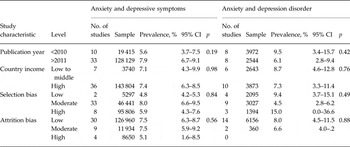
Excluding studies with high risk of selection or attrition bias did not change significantly the prevalence estimates for self-reported co-morbid anxiety and depressive symptoms or a clinically diagnosed anxiety and depression disorder (Tables 1–3). Further, the prevalence of co-morbid anxiety and depressive symptoms or a clinically diagnosed anxiety and depression disorder did not differ with regard to year of publication (⩾2011 v. ⩽2010), country income, selection bias and attrition bias (Table 4).
Prevalence of antenatal (1st, 2nd or 3rd trimester) or postnatal (1–24 weeks) anxiety and depressive symptoms and that of anxiety and depression disorder according to year of publication, country income, and methodological quality of included studies

CI, Confidence interval.
Discussion
This is the first systematic review and meta-analysis to estimate the prevalence of co-morbid anxiety and depression in the perinatal period. Included were 66 studies involving 162 120 women from 30 different countries. Overall, the prevalence rate for self-report anxiety and mild to severe depressive symptoms in the 1st trimester was 11.6%, decreasing slightly as the pregnancy progressed to 9.5% in the 3rd trimester. The prevalence of co-morbid symptoms across the three trimesters was 9.5%. Postnatally, 7.6% of women experienced anxiety and mild to severe depressive symptoms in the first 4 weeks following childbirth, with rates stabilizing at approximately 8.2% at 24 weeks. Similar patterns at lower rates were found for anxiety and moderate to severe depressive symptoms both antenatally and postnatally. When diagnostic interviews were employed, the prevalence rate for a co-morbid anxiety and depression disorder during the 2nd trimester was 14.7%, decreasing significantly to approximately 3.7% in the 3rd trimester for an overall 9.3% rate across the pregnancy. The prevalence for a co-morbid anxiety and depression disorder continued to decrease postnatally and ranged from 3.5% to 4.2% in the first 24 weeks and then increased to 8.0% after 24 weeks postpartum. Very few studies provided data for co-morbid generalized anxiety disorder and depression either antenatally or postnatally. Overall, our findings demonstrate co-morbid anxiety and depression affects approximately one in 10 women during their pregnancy and one in 12 women postnatally. Given the well-documented negative effects of perinatal anxiety and depression on child cognitive, behavioral and emotional development, co-morbid anxiety and depression are an important public health issue that warrant further attention.
In understanding the results, it is important to note that the majority of studies assessed anxiety and depression using self-report instruments that measured symptoms rather than ‘gold standard’ diagnostic clinical interviews. While the sensitivity and specificity of these self-report instruments vary substantially, the most frequently used measures in this review were the State-Trait Anxiety Inventory (STAI) (Grant et al. Reference Grant, McMahon and Austin2008) for anxiety and the EPDS (Bergink et al. Reference Bergink, Kooistra, Lambregtse-van den Berg, Wijnen, Bunevicius, van Baar and Pop2011) for depression. Self-report measures do have limitations, such as potentially inflated prevalence estimates, but they also have high clinical utility. Health professionals in obstetrics, midwifery, public health and primary care practices often have limited clinical expertise and time for diagnostic interviews. Since research clearly suggesting informal surveillance misses at least 50% of cases (Gavin et al. Reference Gavin, Gaynes, Lohr, Meltzer-Brody, Gartlehner and Swinson2005), self-report measures are crucial for systematic identification. The varying prevalence rates between the included studies may further be attributed to diverse recruitment strategies, inclusion and exclusion criteria, data collection methods, and follow-up time periods. Language or translation complexities and variations in conveying psychiatric symptoms are other potential methodological issues (Bandelow & Michaelis, Reference Bandelow and Michaelis2015). While our results are not consistent with another systematic review that found rates of perinatal anxiety among World Bank-categorized low- and middle-income countries to be significantly greater than those reported in high-income countries (Dennis et al. Reference Dennis, Falah-Hassani and Shiri2017), in our review there were very few studies included from low- to middle-income countries. Additional research addressing perinatal mental health in low- and middle-income countries is required.
It is noteworthy that many of the studies included in this review presented perinatal anxiety and depression data separately for each condition. To ensure comprehensiveness of the meta-analysis, 44 study authors provided additional, unpublished information to enable us to calculate the prevalence rate of co-morbidity and permit study inclusion. Of the few studies that specifically published results for co-morbid anxiety and depression, a similar relationship between anxiety and depression was found in comparison with non-postpartum samples. An Australian study found that a third of pregnant and postpartum women with major depression had co-morbid anxiety (Austin et al. Reference Austin, Hadzi-Pavlovic, Priest, Reilly, Wilhelm, Saint and Parker2010). Similarly, in a Canadian population-based study, 18% of women reported depressive symptoms at 8 weeks postpartum of which 52% also experienced co-morbid anxiety (Falah-Hassani et al. Reference Falah-Hassani, Shiri and Dennis2016). In a US population-based study incorporating 4451 postpartum women, 18.0% reported anxiety symptoms, of which 35% also reported depressive symptoms (Farr et al. Reference Farr, Dietz, O'Hara, Burley and Ko2014). These results confirm a significant amount of overlap between anxiety and depressive symptoms.
Because co-morbid anxiety and depression are associated with higher symptom severity, suicidality, chronicity and treatment resistance, identifying risk factors is an important first step in developing prevention interventions. Co-morbidity has many origins. The genetic factors contributing to anxiety and depression are shared (Taporoski et al. Reference Taporoski, Negrão, Horimoto, Duarte, Alvim, de Oliveira, Krieger, Schantz, Vallada and Pereira2015). Environmental experiences, such as stressful life events and a lack of social support, also contribute to both (Norhayati et al. Reference Norhayati, Hazlina, Asrenee and Emilin2015; Biaggi et al. Reference Biaggi, Conroy, Pawlby and Pariante2016). The factors leading to co-morbid anxiety and depression v. a single disorder seem multifactorial (Moscati et al. Reference Moscati, Flint and Kendler2016). Previous studies have found that, in comparison with individuals with a single disorder, those with co-morbid anxiety and depression were more likely to be lower educated, not married and younger. Further, they were more likely to have neuroticism, a positive parental psychiatric history and a history of childhood trauma (Blazer et al. Reference Blazer, Kessler, McGonagle and Swartz1994; de Graaf et al. Reference de Graaf, Bijl, Smit, Vollebergh and Spijker2002).
To date, very few studies have examined co-morbidity risk factors in the perinatal population. In an Australian population-based survey of 4366 women, symptoms of co-morbid anxiety and depression were associated with young maternal age, not being married, not having completed secondary school, having a health care card, and experiencing one or more social health issues (Yelland et al. Reference Yelland, Sutherland and Brown2010). In another population-based study involving a sample of 522 Canadian women (Falah-Hassani et al. Reference Falah-Hassani, Shiri and Dennis2016), immigration within past 5 years, maternal vulnerable personality, childcare stress and perceived stress predicted a higher risk of co-morbidity. Conversely, high breastfeeding self-efficacy, maternal self-esteem and partner support were associated with a lower risk of developing co-morbidity (Falah-Hassani et al. Reference Falah-Hassani, Shiri and Dennis2016). These two perinatal studies provide beginning evidence that some risk factors may be similar to non-postpartum populations but they also highlight unique factors that require further exploration to assist in preventive strategies. When examining co-morbidity risk factors it is important to note that there is growing evidence to suggest anxiety disorders often precede depressive disorders. Because a reversed pattern – depressive disorders preceding anxiety disorders – may represent a different etiologic pathway, it is also essential to evaluate whether risk factors of co-morbidity with preceding anxiety are different from co-morbidity with preceding depression. A large study conducted in the Netherlands found that a pattern of depressive disorder preceding anxiety disorder was more likely among those who were female, were higher educated, experienced childhood parental divorce and suffered childhood emotional neglect (de Graaf et al. Reference de Graaf, Bijl, Spijker, Beekman and Vollebergh2003).
While the US Preventive Services Task Force now endorses screening for perinatal depression (Siu et al. Reference Siu, Bibbins-Domingo, Grossman, Baumann, Davidson, Ebell, Garcia, Gillman, Herzstein, Kemper, Krist, Kurth, Owens, Phillips, Phipps and Pignone2016), not identifying anxiety symptoms as well underestimates the prevalence of mental health disorders and the need for perinatal mental health services. Matthey et al. (Reference Matthey, Barnett, Howie and Kavanagh2003) suggest that there is a ‘hierarchical diagnostic custom’ where depression takes precedence in clinical practice even when anxiety symptoms are a prominent feature resulting in cases of anxiety being untreated. Given the possible adverse effects of co-morbid perinatal anxiety and depression on maternal and infant outcomes, primary care practitioners, obstetricians and midwives should screen pregnant women and those who are in the postpartum period for depression as well as for anxiety, and facilitate treatment of both conditions.
Conclusions
The prevalence of maternal co-morbid anxiety and depression in the antenatal and postnatal periods was estimated among 162 120 women from 30 countries. Results suggest that co-morbidity across the perinatal period is prevalent and merits clinical attention similar to that given to perinatal depression. Research to develop evidence-based interventions to prevent co-morbid anxiety and depression in the perinatal period is warranted in order to promote healthy child development.
Supplementary material
The supplementary material for this article can be found at https://doi.org/10.1017/S0033291717000617
Acknowledgements
We thank the following authors for providing us the additional results: Dr Mostafa Amr, Dr Kim Betts, Dr Marte Helene Bjørk, Ms Alexa Bonacquisti, Dr Marie-Jo Brion, Ms Elena Buliga, Dr Tamás Bödecs, Associate Professor Huibert Burger, Dr Robert Courtois, Dr Shayna Cunningham, Dr Egle Couto, Associate Professor Deborah Da Costa, Professor Janet DiPietro, Dr Virgil Radu Enatescu, Dr Alexandre Faisal-Cury, Ms Dayana Rodrigues Farias, Dr Yvonne Fontein-Kuipers, Dr Susan Garthus-Niegel, Ms Kate Gilstad-Hayden, Dr Ali Khashan, Dr Yann Le Strat, Professor Joshua R. Mann, Professor Carlo Marchesi, Professor Julia Martini, Dr Sheila W McDonald, Dr Judith L. Meijer, Dr Emily Stinnett Miller, Dr Sandra Nakić Radoš, Dr Chiara Pazzagli, Dr Inbal Shlomi Polachek, Associate Professor Shahirose S. Premji, Professor Chantal Razurel, Mr Eric Schaefer, Dr Heidi Stöckl, Associate Professor Jan Taylor, Ms Iva Tendais, Associate Professor Faruk Uğuz, Dr Lisa Underwood, Dr Tamara van Batenburg-Eddes, Dr Judith van der Waerden, Professor Hélène Verdoux, Dr Tanja G.M. Vrijkotte, Professor Kimberly Ann Yonkers and Dr Karen Wynter. K.F.H. and R.S. developed the review protocol, conducted the literature searches, rated the quality of included studies and performed meta-analyses, and were involved in the interpretation of the results, and writing of the paper. C.L.D. was involved in the interpretation of the results and writing of the paper.
Declaration of Interest
None.