Background
Executive functions consist of the following core competencies: (1) working memory, the ability to hold and manipulate complex information in the mind (Baddeley, Reference Baddeley1998; Smith & Jonides, Reference Smith and Jonides1997); (2) inhibition (or inhibitory control), the ability to delay a well-learned prepotent response for the purposes of a more appropriate response (Barkley, Reference Barkley2001); and (3) cognitive flexibility, the capacity to adapt behavior quickly and flexibly to changing situations (Davidson, Amso, Anderson, & Diamond, Reference Davidson, Amso, Anderson and Diamond2006; Diamond, Reference Diamond2006). Executive functions have increasingly been recognized as relevant to self-regulation. Theoretical and empirical frameworks have emerged linking the two (Barkley, Reference Barkley2001; Karoly, Reference Karoly1993; McCabe, Cunnington, & Brooks-Gunn, Reference McCabe, Cunnington and Brooks-Gunn2004; Rueda, Posner, & Rothbart, Reference Rueda, Posner and Rothbart2005; Sarsour, Reference Sarsour2007). Insufficient acquisition of executive functioning capacity during early childhood has been associated with developmental psychopathology (Pennington & Ozonoff, Reference Pennington and Ozonoff1996), physical aggression (Seguin & Zelazo, Reference Seguin and Zelazo2005), cortisol reactivity (Blair, Granger, & Peters Razza, Reference Blair, Granger and Peters Razza2005), and lack of school readiness and success (Blair, Reference Blair2002; Diamond, Reference Diamond2007). At the neurobiological level, the prefrontal cortex (PFC) and its extensive connections with other brain regions are considered to be the neural substrate of executive functions (Fuster, Reference Fuster1997) through which the PFC integrates and processes environmental stimuli (Shimamura, Reference Shimamura2000). The PFC has a prolonged period of postnatal development and maturation, as indexed by synaptogenesis, pruning, and myelination (Davidson et al., Reference Davidson, Amso, Anderson and Diamond2006; Diamond, Reference Diamond2002, Reference Diamond2006), rendering the PFC especially sensitive to environmental input. Executive functions are thought to develop as a result of a dynamic interaction between the child’s PFC and the external environment (Calkins & Fox, Reference Calkins and Fox2002; Diamond, Reference Diamond2009; Diamond, Barnett, Thomas, & Munro, Reference Diamond, Barnett, Thomas and Munro2007; McCabe et al., Reference McCabe, Cunnington and Brooks-Gunn2004). Much of the development of the PFC is believed to occur during the transition from childhood to adolescence, known as middle childhood and generally defined as ages 6–12 (Andersen, Reference Andersen2003). Middle childhood also is the period that witnesses the development of increased independence, peer relationships and intellectual challenges, making this developmental period especially interesting for the study of environmental influences on the development of executive skills. Environmental influences may be conceptualized at multiple levels of analysis including the microenvironments (i.e., the family setting, nonparental care settings, peer group); and the macro-environments (i.e., neighborhoods, culture and social policy) (Baumeister & Vohs, Reference Baumeister and Vohs2004; Forgas, Baumeister, & Tice, Reference Forgas, Baumeister and Tice2009; Hertzman & Boyce, Reference Hertzman and Boyce2010).
Family Socioeconomic Status And Child Health And Development
Associations between socioeconomic status (SES) and health are so pervasive that some have designated SES as a fundamental cause of health and illness (Link & Phelan, Reference Link and Phelan1995, Reference Link and Phelan1996; Rose, Reference Rose1985). A fundamental cause is defined as a distal cause that determines access to important resources, which in turn influence the extent to which people are able to avoid risk and develop competence (Link & Phelan, Reference Link and Phelan1995). Associations between family SES and child outcomes have been documented in multiple disciplines and research traditions. Chen and colleagues concluded that family SES is associated with multiple physical health outcomes, as well as risk factors for adult morbidities (Chen, Matthews, & Boyce, Reference Chen, Matthews and Boyce2002). Brooks-Gunn and Duncan (Reference Brooks-Gunn and Duncan1997) found that childhood poverty influence s a broad diversity of child outcomes, classified into physical health, cognitive, school achievement, emotional, and behavioral domains. Other studies have similarly found that lower SES is associated with poor school achievement (Currie, Reference Currie2005; Malecki & Demaray, Reference Malecki and Demaray2006; Marks, Reference Marks2006; Toutkoushian & Curtis, Reference Toutkoushian and Curtis2005; Walker, Greenwood, Hart, & Carta, Reference Walker, Greenwood, Hart and Carta1994) and more specifically with poor math (Case, Griffin, & Kelly, Reference Case, Griffin and Kelly1999) and language skills (Hoff, Reference Hoff2003; Raviv, Kessenich, & Morrison, Reference Raviv, Kessenich and Morrison2004), as well as increased child psychopathology and mental illness (Boyce, Reference Boyce2004; Essex et al., Reference Essex, Kraemer, Armstrong, Boyce, Goldsmith, Klein and Kupfer2006; Tuvblad, Grann, & Lichtenstein, Reference Tuvblad, Grann and Lichtenstein2006), and poor physical health (Boyce et al., Reference Boyce, Essex, Woodward, Measelle, Ablow and Kupfer2002; Chen et al., Reference Chen, Matthews and Boyce2002). Recent findings have further demonstrated that childhood socioeconomic conditions affect distal adult health endpoints, such as physical and cognitive functions (Evans & Schamberg, Reference Evans and Schamberg2009; Guralnik, Butterworth, Wadsworth, & Kuh, Reference Guralnik, Butterworth, Wadsworth and Kuh2006; Kaplan et al., Reference Kaplan, Turrell, Lynch, Everson, Helkala and Salonen2001).
Until recently, many studies documenting associations between family SES and child cognitive functions have focused principally on child IQ (Brooks-Gunn, Klebanov, & Duncan, Reference Brooks-Gunn, Klebanov and Duncan1996; Harden, Turkheimer, & Loehlin, Reference Harden, Turkheimer and Loehlin2006; McLoyd, Reference McLoyd1998; Mercy & Steelman, Reference Mercy and Steelman1982; Turkheimer, Haley, Waldron, D’Onofrio, & Gottesman, Reference Turkheimer, Haley, Waldron, D’Onofrio and Gottesman2003). The study of IQ, however, is limited by its global nature, its principal focus on the memory of previously learned facts, and its inability to differentiate the contributions of distinctive neurocognitive systems. Recent advances in neuroscience have broadened the scope of studies examining SES and cognitive function to include executive functions—for a review from the point of view of cognitive neuroscience, see Hackman & Farah (Reference Hackman and Farah2009) and Hackman, Farah, & Meaney (Reference Hackman, Farah and Meaney2010). Mezzacappa found an association between family SES and children’s alerting, orienting, and executive attention scores on Posner’s Attention Network Test (Reference Mezzacappa2004). In another sample of children from Colombia and Mexico, Ardila, Rosselli, Matute, and Guajardo found that years of parental education were associated with child executive functions, with the strongest relation found for semantic verbal fluency (Reference Ardila, Rosselli, Matute and Guajardo2005). In a series of papers, Noble, Farah, and colleagues conducted a more in-depth study of family SES and child neurocognitive executive functions (Farah et al., Reference Farah, Shera, Savage, Betancourt, Giannetta, Brodsky and Hurt2006; Noble, Farah, & McCandliss, Reference Noble, Farah and McCandliss2006; Noble, McCandliss, & Farah, Reference Noble, McCandliss and Farah2007; Noble, Norman, & Farah, Reference Noble, Norman and Farah2005; Noble, Wolmetz, Ochs, Farah, & McCandliss, Reference Noble, Wolmetz, Ochs, Farah and McCandliss2006) demonstrating that (a) these associations exist for specific neurocognitive systems, with the strongest being found for the language and prefrontal executive systems; (b) within the prefrontal system, family SES is associated with children’s working memory and cognitive control, defined as the ability to inhibit a prepotent response; (c) child language skills may mediate the association between family SES and child executive functions; and (d) these associations resemble a dose-response gradient that exists across kindergartners, first graders, and 10–13 year olds. More recently, studies have begun to elucidate the neural mechanisms of SES-mediated disparities. For example, prefrontal-dependent electrophysiological measures of attention were found to be reduced in children from low SES backgrounds compared with children from high SES backgrounds (Kishiyama, Boyce, Jimenez, Perry, & Knight, Reference Kishiyama, Boyce, Jimenez, Perry and Knight2008; Stevens, Lauinger, & Neville, Reference Stevens, Lauinger and Neville2009).
Single Parenthood
Growing up in a single-parent household has also been associated with adverse child outcomes (East, Jackson, & O’Brien, Reference East, Jackson and O’Brien2006; McLanahan & Sandefur, Reference McLanahan and Sandefur1994), albeit inconsistently across investigations. In fact, family SES and single parenthood often covary, complicating efforts to disentangle the correlates of poverty versus single parenting. For example, in a nationally representative sample, Allison and Furstenburg found growing up in a single-parent household to be associated with problem behaviors, psychological distress, and poor academic performance (Reference Allison and Furstenberg1989). On the contrary, in the National Longitudinal Study of Youth (NLSY), Ricciuti and colleagues found that there was little evidence of negative effects on children from being reared in a single-parent home (Ricciuti, Reference Ricciuti2004). Other studies have found that the adverse effects of growing up with one parent may be exacerbated by the presence of further adversity such as financial constraints and low SES (Barber & Eccles, Reference Barber and Eccles1992). Studies of family SES associations with child executive functions, on the other hand, have not considered the role of single parenthood, a problematic oversight given the need to disentangle socioeconomic and parenting contributions to the development of executive functions.
The Role of Language
Developmental theories suggest that the effects of social interactions on cognitive and behavioral development may be mediated by language and symbols. It is purported that executive functioning is developed through language internalization (Vygotsky & Kozulin, Reference Vygotsky and Kozulin1986; Zivin, Reference Zivin1979) and that internal language is the active vehicle for thinking, reflection, analysis, and learning from experience (Barkley, Reference Barkley2001; Winsler, Diaz, Atencio, McCarthy, & Chabay, Reference Winsler, Diaz, Atencio, McCarthy and Chabay2000). Child language skills may thus mediate the linkage between family SES and child executive function (Noble et al., Reference Noble, Norman and Farah2005, Reference Noble, McCandliss and Farah2007). Past studies examining the possible mediating role of language skills have largely used standard psychometric tests that do not distinguish between expressive and receptive language abilities. No studies have yet examined the possible role of expressive language skills, ascertained through the coding of spontaneous speech, in mediating the family SES—child executive functions association. The present investigation begins to address this gap in existing literature.
The Home Environment as a Mediator
Home environments of developing children comprise both material and psychosocial dimensions. SES may affect the extent to which parents use family resources to enrich developmental experiences with hobbies, recreation, museums, libraries, travel, etc. Moreover, family SES may affect parenting dimensions including the emotional and verbal responsiveness of the parents, such as offering reinforcement for desired behavior and providing scaffolding to encourage the development of executive skills—for a full review, see Bradley and Corwyn (Reference Bradley and Corwyn2002). The family environments of children from low SES backgrounds are often characterized by organizational chaos, lack of structure and routine, exposure to multiple stressors (Evans & English, Reference Evans and English2002), and excess background noise and crowding (Evans, Reference Evans2006; Evans, Gonnella, Marcynyszyn, Gentile, & Salpekar, Reference Evans, Gonnella, Marcynyszyn, Gentile and Salpekar2005). Longitudinal data from the NLSY, demonstrated that the home environment of poor children was of significantly lower quality as measured by parenting variables (e.g., responsivity, emotional climate) and material resources (physical environment, learning materials, enrichment) (Bradley, Corwyn, McAdoo, & Coll, Reference Bradley, Corwyn, McAdoo and Coll2001). The same investigation also demonstrated that the association between poverty and child development was mediated by the home environment (Bornstein & Bradley, Reference Bornstein and Bradley2003; Bradley, Corwyn, Burchinal, McAdoo, & Coll, Reference Bradley, Corwyn, Burchinal, McAdoo and Coll2001). The present work examined whether specific domains of the home environment mediated an association between SES and executive functions.
Hypotheses
Our aim was to investigate the independent and interactive contributions of family SES and single-parent status to children’s level of executive functioning. Specifically, we examined the constructs of inhibitory control, cognitive flexibility, and working memory, as measured by standard age-appropriate neuropsychological tests. We hypothesized that family SES would independently contribute to child performance on neurocognitive tests, such that higher family SES would be associated with improved performance on tests of children’s executive functions. We further hypothesized that single-parent status would contribute to diminished performance on the child neurocognitive tests over and above the independent influence of low SES. We also sought to replicate the finding that child language abilities mediate the association between family SES and children’s neurocognitive abilities using a measure of language derived from children’s spontaneous speech within a natural family context. Finally, we assessed whether the quality of the home environment mediates the association between family SES and child neurocognitive abilities.
Method
Sample and Method
A community sample of 60 families (from a wide spectrum of socioeconomic backgrounds) was recruited from the San Francisco Bay Area through advertisements at local parenting organizations, elementary schools, health clinics, and community centers. The research protocol for this study was approved by the Committee for the Protection of Human Subjects of the University of California, Berkeley. Families participating in the study were offered a small monetary compensation for their time and effort.
Families were eligible for the study if they had a child who was 8–12 years old and spoke English in the home more than 50% of the time. Families were excluded from study when the target child had a serious handicap or chronic neurological disorder (e.g., epilepsy, cerebral palsy, or mental retardation), if the child had a psychiatric disorder (such as ADHD or depression), or if the child regularly took a psychotropic medication (such as stimulants or SSRIs). Data were collected through two home visits and a set of questionnaires completed by the primary caregiver (95% of the time, the mother). Neuropsychological evaluations of the child were conducted in a quiet room during the home visit. Children within the study sample were 43% African American, 32% White, and 25% other race/ethnicity (18% two or more racial backgrounds, 5% Hispanic, and 2% Asian). One-third of families were living under or near the poverty line, while 28% reported an annual family income greater than $100,000. Twenty seven percent of the sample’s primary caregivers reported having some postgraduate education, and 15% reported having a high school education or less.
Measures
Sociodemographic variables
The MacArthur Research Network on SES and Health Questionnaire was used to ascertain family SES (2000). Self-reported family income was converted to a family-income-to-needs ratio per established formulas (Dearing, McCartney, & Taylor, Reference Dearing, McCartney and Taylor2001). Occupational prestige of parent(s) was assigned based on categories of the Hollingshead Index of Occupation Status (Hollingshead, Reference Hollingshead1975) matched as closely as possible to modern occupations. Family wealth was measured by asking: “Suppose you needed money quickly, and you cashed in all of your (and your spouse’s) checking and savings accounts, and any stocks and bonds. If you added up what you would get, about how much would this amount to?” A family SES composite index was created by standardizing and averaging the income-to-needs ratio, family wealth, the Hollingshead occupational status rank, and the maternal education level.
Home environment
The Middle Childhood Home Observation for the Measurement of the Environment inventory (HOME) was used as a measure of the quality of the home environment. The HOME is designed to measure the quality and quantity of stimulation and support available to a child in the home environment. It contains 59 binary items clustered into 8 domains: physical environment, enrichment activities, parental responsivity, encouragement of maturity, emotional climate/acceptance, learning materials and opportunities, family companionship, and family integration (Bradley & Caldwell, Reference Bradley and Caldwell1977; Caldwell & Bradley, Reference Caldwell and Bradley2005). The HOME was administered via a semistructured interview at the family home by trained research assistants.
Child neurocognitive abilities
Based on the taxonomy presented earlier, we divided executive self-regulatory functions into three constructs—working memory, inhibitory control, and cognitive flexibility—and selected appropriate tasks to assess them: Digit Span for working memory, the Stroop test for inhibitory control, and the Trail Making Test for cognitive flexibility (Alvarez & Emory, Reference Alvarez and Emory2006; Anderson, Anderson, Northam, Jacobs, & Catroppa, Reference Anderson, Anderson, Northam, Jacobs and Catroppa2001; Brocki & Bohlin, Reference Brocki and Bohlin2004; Davidson et al., Reference Davidson, Amso, Anderson and Diamond2006; Diamond et al., Reference Diamond, Barnett, Thomas and Munro2007; Lamm, Zelazo, & Lewis, Reference Lamm, Zelazo and Lewis2006). Each of the three tasks consisted of two subtests (Digits Forward and Digits Backward, Stroop rapid color naming test and Stroop color word interference test, and Trails A and Trails B). In each case, the first of the two subtests is a test of lower order cognitive skills (basic nonexecutive function), while the second is a more complex executive function task. Our hypothesis was that lower SES would be associated with worse performance on the second task in each set (the one requiring higher order executive skills) even after you adjust away any SES associations with lower order cognitive skills. By “adjusting away” the basic skills involved in the tasks, we were able to explicitly test the SES associations with the executive function sub-components alone. Details of the three tests are presented below.
Working memory
The Digit span subtest from the Wechsler Intelligence Scale for Children (Wechsler, Reference Wechsler1994) was used as a test of working memory. The child was verbally presented with progressively longer strings of numbers and was asked to repeat the sequence, in identical order for the Digits Forward (DF) test and in reverse order for Digits Backward (DB). Both tests require verbal information to be held in memory across a delay interval. DF is not considered a measure of executive function per se, but rather of auditory attention or span (Anderson et al., Reference Anderson, Anderson, Northam, Jacobs and Catroppa2001). DB is considered a measure of working memory (Baron, Reference Baron2004) as it requires information to be cognitively manipulated during the delay period. The child was given a point for each trial completed correctly, and the test was terminated when the child failed to recall two consecutive strings of numbers. The final score was the sum of points earned.
Cognitive flexibility
The Trail Making Test (Trails A and B) is a timed, paper-and-pencil test consisting of two parts (Kortte, Horner, & Windham, Reference Kortte, Horner and Windham2002). Trail A requires the child to connect numbered circles in sequence scattered across the page, much like classic connect-the-dots games. Trail B requires the child to draw a line between points, alternating between numbers and letters in sequence (e.g., 1, A, 2, B, 3…). The Trails tests were administered following a six-item practice session for each part to ensure that the child understood the instructions. If an error was made, the line was crossed out by the experimenter to indicate the error. Trail A measured the construct of visual-spatial attention (a nonexecutive cognitive skill), while Trail B measured the constructs of set shifting and cognitive flexibility, given that it requires a cognitive shift between two sets of information while avoiding their mutual interference. The time in seconds taken to complete the task correctly was used in analyses.
Inhibitory control
The Stroop Test was used as a measure of children’s inhibitory control (Golden, Reference Golden1978; MacLeod, Reference MacLeod1991). This test requires the inhibition of a prepotent verbal response. The child is presented with colored words (red, green, blue) printed with a mismatching color and is asked to inhibit the well-learned reading response and to produce instead a color-naming response. The test consists of three sets of items. The first two are tests of nonexecutive cognitive skills, while the third is the executive test of interest. The child is asked to read color words printed in black ink, to do color naming in a randomized three-color sequence (blue, green, red), and finally name colors when the words are printed in nonmatching ink (e.g., the word green printed in red). Scoring consisted of the number of items successfully completed during 45 s.
Child expressive language abilities
Using the naturalistic setting of a family dinner time conversation, child-spoken words were video recorded and transcribed. We used the variable of child’s mean length of utterance in morphemes (MLUm) (Dethorne, Johnson, & Loeb, Reference Dethorne, Johnson and Loeb2005; Parker, Reference Parker2005) as a measure of expressive language complexity in a naturalistic setting. A morpheme is defined as the smallest unit of language that carries meaning and has a grammatical function (e.g., books has two morphemes one signifying the meaning of the word and the other designating plurality). MLUm was calculated by dividing the total number of child morphemes in the first 30 min of family dinner by the total number of child utterances in the same time period. An utterance is defined as a complete unit of speech such as a statement or a question.
Analysis
Frequency distributions, skewness, and normality were examined for each independent and outcome variable. Regression diagnostics were used to ensure that standard assumptions were met. Nonparametric robust standard errors were used to calculate p values. Whenever there was evidence of heteroskedasticity, standard errors obtained through the robust bias correction suggested by Long and Ervin (Reference Long and Ervin2000) were compared with default robust standard errors to ensure consistency. Multicollinearity diagnostics were conducted as outlined by Cohen and Cohen (Reference Cohen and Cohen2003). All executive function task scores were converted to standardized z-scores before regression analysis in order for task performance to be represented on a common scale. All independent variables were centered at their means, and regression equations were computed to assess the independent and interactive contributions of family SES and single-parent status to the three measures of executive functioning. Mediation analyses were conducted controlling for children’s age and nonexecutive cognitive skills. Using the approaches of Baron and Kenny (Reference Baron and Kenny1986) and Kraemer, Stice, Kazdin, Offord, and Kupfer (Reference Kraemer, Stice, Kazdin, Offord and Kupfer2001), we tested whether the association between family SES and child executive functions was mediated through child language abilities or by the individual disaggregated domains of the HOME inventory. All data analyses were conducted using STATA 9.1 (StataCorp, College Station, Texas 2007).
Results
Descriptive Statistics and Univariate Associations
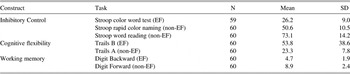
Complete descriptive characteristics of the sample are presented in Table 1. Means and standard deviations for each of the executive function tasks are presented in Table 2. Task means for this study sample were comparable to published norms of typically developing children of similar age (Baron, Reference Baron2004; Strauss, Sherman, Spreen, & Spreen, Reference Strauss, Sherman and Spreen2006; Vakil, Blachstein, Sheinman, & Greenstein, Reference Vakil, Blachstein, Sheinman and Greenstein2009). Of all the neurocognitive tasks, only one individual score fell more than three standard deviations below the mean. Excluding this outlier from the analysis did not significantly alter the results and thus all the analyses presented here include this one outlier.
Descriptive characteristics of sample

Mean and standard deviations of study cognitive tasks

EF = Executive Function.
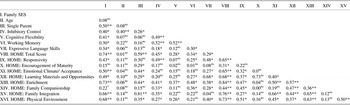
Univariate Pearson correlation coefficients (Table 3) among the three dependent variables ranged from 0.49 (inhibitory control and cognitive flexibility) to 0.52 (inhibitory control and working memory). Family SES was associated with all three dependent measures. Child word reading abilities were associated with age (r = 0.443; p < .001) but not with family SES (r = 0.124; p = ns). Family SES was independent of the sex and age of the study child. The target child’s age was associated with inhibitory control but not cognitive flexibility or working memory. Single parenthood was associated with inhibitory control but not with cognitive flexibility or working memory. Additionally, single parenthood was associated with the home environment (r = 0.59; p < .005). Expressive language skills of the target child were significantly associated with family SES (r = 0.34, p < .05) and home environment (r = 0.29; p < .05) and with inhibitory control and working memory. The total score of the HOME inventory was significantly associated with the three dependent variables of child’s inhibition, working memory, and cognitive flexibility. All eight domains of the HOME inventory were associated with family SES except for encouragement of maturity. The HOME domain of ‘enrichment’ was associated with all three dependent variables, ‘encouragement of maturity’ and ‘emotional climate’ were not associated with any of the three dependent variables, and the remaining five domains were associated with at least one of the three dependent variables. Complete univariate correlations are presented in Table 3.
Univariate associations correlations matrix

*P < 0.05, **P < 0.005, nsNot Significant.
Multivariate Associations
At the multivariate level, we began by investigating whether family SES was independently associated with the three dependent variables after controlling for their respective lower-order nonexecutive cognitive skills (e.g., Trails A, Stroop color and word naming, and DF tests; model 1, Table 4). The associations of SES with cognitive flexibility and inhibition persisted after controlling for nonexecutive cognitive skills. After controlling for the nonexecutive cognitive skills measured by color naming and word reading tests, family SES explained an additional 7% of the variance in the EF construct of inhibitory control (SES β = 0.28, p < .05). Similarly, after controlling for the nonexecutive skills measured by Trail A, family SES explained an additional 5% of the variance in cognitive flexibility (SES β = −0.25, p < .05). We did not conduct the single parent by SES interaction analysis while controlling for Trails A and Stroop color naming due to increased multicolinearity (variance inflation factor >15.0).
Multivariate results

†Model Adjusts for child’s age; All models adjust for Child’s race; *P < 0.05; 1Stroop Color Word Interference Test, 2Trails B, 3Digit Backward.
In model 2 (Table 4), we controlled for single-parent status. Controlling for child age and single-parent status, there were modest associations between family SES and the three dependent variables of cognitive flexibility, inhibition, and working memory. After controlling for age and single-parent status, family SES explained 24% of the variance in cognitive flexibility, 9% of unique variance in working memory, and 8% of variance in inhibition skills. An increase by one standard deviation in family SES was associated with an average decrease of 23 seconds (95% confidence interval [CI] [9, 37 s]) in the time a child took to complete Trails B. Similarly, a one standard deviation increase in family SES was associated with an average increase of three color words on the Stroop (95% CI [1.4, 5.0 words]). Adjusted for SES and age, single parenthood was not associated with cognitive flexibility, inhibitory control, or working memory.
Single-Parent Status as Potential Moderator
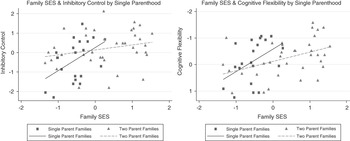
In model 3 (Table 4), we explored whether single-parent status moderated the relation of family SES and executive functions. That is, we tested whether associations between SES and executive functions systematically differed between single-parent and two-parent families by including a single-parent status × SES interaction term. Single-parent status modified the association between SES and inhibitory control and cognitive flexibility but not working memory for children living with single parents. A sensitivity analysis was conducted to test whether the apparent interaction effect was spurious due to the association, in this sample, between SES and single parent (r = 0.52, p < .0001). The interaction analysis was repeated after excluding families from upper middle to high SES (n = 19) thus statistically removing the association between SES and single parent (r = 0.19, p = .22). The interaction results remained highly significant (single parent × SES β = 0.58, p < .05 and single parent × SES β = −0.44, p < .05 for cognitive flexibility and inhibitory control, respectively) confirming that children from low socioeconomic status who came from single parent families scored lowest on tests of inhibitory control and cognitive flexibility skills (Figure 1).
Single parent status interacts with family socioeconomic status (SES) in the association with inhibitory control and cognitive flexibility. Children from single parent families performed worse at lower strata of SES compared with single parent children from higher SES.

Potential Mediators: Child Language and Family Home Environment
Four conditions must be met to demonstrate mediation (Baron & Kenny, Reference Baron and Kenny1986; Eaker & Walters, Reference Eaker and Walters2002; Holmbeck, Reference Holmbeck1997; Kraemer et al., Reference Kraemer, Stice, Kazdin, Offord and Kupfer2001): (a) The independent variable (family SES) must be significantly associated with the criterion measures of interest (i.e., inhibition, cognitive flexibility and working memory), (b) the hypothesized mediator must be significantly associated with the criterion of interest, (c) the independent variable must be significantly associated with the hypothesized mediator, and (d) the association between independent variable and outcome must be reduced once the hypothesized mediator is controlled.
In light of the above criteria, HOME total scores partially mediated association between SES and inhibitory control but not cognitive flexibility or working memory (model II, Table 5). There was no evidence for our measure of child expressive language mediating the association between family SES and the three dependent variables (model III, Table 5). In the models testing mediation by individual domains of the HOME, responsivity (model IV, Table 5) and family companionship (model VIII) partially mediated association between SES and inhibitory control, enrichment (model VII) and family companionship (model VIII) mediated the association between SES and working memory. None of the HOME domains mediated the association between SES and cognitive flexibility. Complete mediation results are presented in Table 5. In a post hoc analysis we also tested if the HOME domains mediated the SES × single parent interaction. There was no evidence that the observed interaction is mediated by any of the HOME domains (data not shown).
Mediation results

§All models adjust for child’s age; *P < 0.05, nsP not significant.
Discussion
This study adds to a growing literature seeking to understand the link between family SES and child neurocognitive development. We found clear evidence of an association between SES and three important neurocognitive criterion measures. Additionally, to our knowledge, this is the first study to report a statistical interaction between single parenthood and low family SES in the prediction of children’s inhibitory control and cognitive flexibility, such that children from single parent families performed less well on these cognitive tests compared with children from two-parent families of similar low socioeconomic backgrounds. Importantly, using a well-validated measure, we found that specific domains of the home environment partially mediated the association between family SES and child inhibitory control and working memory but not cognitive flexibility. Our findings regarding mediation by child’s expressive language ability were inconclusive.
This study also found that SES disparities in neurocognitive development represented disparities in higher order executive functions rather than simply reflecting differences in less-complex, basic reading abilities and attentional skills which were accounted for in the analysis. These higher order executive functions, including the ability to block irrelevant or distracting information while simultaneously focusing on the relevant features of the environment (inhibitory control) and the ability to adapt cognitive processing to new and unexpected conditions in the environment (cognitive flexibility), are capacities important for everyday functioning in school, at home, in employment, and in other critical social settings.
Why did children in poor, single-parent families perform less well on executive cognitive tasks compared with similarly poor children who live with two parents? The answer is multifactorial and is likely due to processes operating at many levels. These levels could include the family environment—for example, parenting, material resources (Kroenke, Reference Kroenke2008), larger scale social contexts—for example, social policies impacting low SES and single parent families, (Navarro, Reference Navarro2007) and physiological—for example, individual variability in processing and embedding biologically stressful environments via the stress response system (Blair et al., Reference Blair, Granger and Peters Razza2005; Evans & Schamberg, Reference Evans and Schamberg2009; Hertzman & Boyce, Reference Hertzman and Boyce2010). This study, however, was not able to ascertain conclusively whether children from single-parent, high SES families are less adversely affected by single-parent status because very few high SES families in this sample were also single-parent families. Future studies should examine this question within a representative sample including a higher proportion of high SES, single-parent families. Furthermore, future studies should consider the links between variables of multiple levels that influence the interplay between family SES, single parenthood and the development of executive functions.
Specific domains of the child’s home environment—namely responsivity—a measure of parental emotional and verbal sensitivity to the child; enrichment, a measure of the extent to which parents use family and community resources to enrich the development of the child; and family companionship, a measure of parental involvement in child activities providing companionship and mutual enjoyment—mediated the association between family SES and inhibitory control and working memory. These domains comprised both parenting variables (i.e., responsivity and family companionship) and material resources variables (i.e., enrichment). These findings highlight the significance of psychosocial/parenting variables and material resource dimensions to the mechanism linking SES and executive functions. That the HOME domains of learning materials and physical environment were not significant mediators in this sample may be attributable to lack of adequate variability in these two measures. Future research should continue to elucidate the specific domains of the home environment that mediate socially partitioned disparities in the development of child executive skills. Moreover, future studies should explore the interplay between single-parenthood, family environment, and family SES. It is conceivable that the children of poor, single parents are at double jeopardy because single-parent families from low SES backgrounds are not capable of providing the material resources necessary for enriching developmental experiences, and they are also not capable of devoting the time to provide verbal and emotional responsivity to their children.
We did not find that child expressive language mediated family SES associations with the three executive function tasks. This finding differs from that reported by Noble and colleagues (Noble et al., Reference Noble, Norman and Farah2005, Reference Noble, McCandliss and Farah2007), who produced evidence for language mediation of cognitive control (a construct related to inhibitory control). This discrepancy may be due to the different ways that children’s language skills were ascertained across studies. Further investigation is required to assess the validity of using spontaneous child utterances during family meals as a measure of child expressive language skills. Clarifying the possible linkage between language exposure and development of executive skills remains an important focus of future research, especially given that low family SES is adversely associated with child home language exposure (Hart & Risley, Reference Hart and Risley1995) and language skills (Hoff, Reference Hoff2003).
The findings of this study should be interpreted in light of several limitations. First, each of the three executive constructs was measured using a single task. Future studies should consider using multiple tasks that appear superficially different to the target child yet tap the same executive construct to minimize measurement error introduced through the particular mode of administration. Second, executive neuropsychological measures are indirect assessments of the activity of the prefrontal cortex. Studies that seek to understand how low SES affects the developing prefrontal cortex should consider using new technologies such as functional MRI. Using novel investigative methodologies will allow for generating and testing nuanced hypotheses about the neural specificity of SES associations with executive functions (Kane & Engle, Reference Kane and Engle2002; Miller & Cohen, Reference Miller and Cohen2001). Third, the cross-sectional nature of the study prevented ascertainment of the temporal ordering of variables. Future studies should consider the longitudinal link between family SES in early childhood and executive functions in middle childhood. Fourth, although children with neurological and psychiatric disease were excluded, participants were not screened based on learning disabilities or language disorders. As a result, a bias may be present because these issues are likely over-represented among children from lower SES. Finally, the current design of the study does not rule out confounding by genetic factors. That is, this study is not capable of ascertaining the extent (if any) of underlying genetic commonalities that may contribute to parental SES and child executive function. Suggesting a role of genes does not necessarily suggest genetic destiny (Rutter, Reference Rutter2006). For example, evidence from animal models reveals that the environment affects and often regulates gene expression (Francis, Champagne, Liu, & Meaney, Reference Francis, Champagne, Liu and Meaney1999). Additionally, Turkheimer demonstrated that family SES modifies how much genetics play a role in the heritability of child IQ: Family SES accounted for 60% of the variance in child IQ at low SES strata but nearly none of the variance at high SES (Turkheimer et al., Reference Turkheimer, Haley, Waldron, D’Onofrio and Gottesman2003). Future studies should examine the complex interplay among genetics, biology, and adverse social environments and how such interactions affect the rise and reproduction of child health disparities.
Despite these limitations, this study demonstrated that family SES inequalities are associated with inequalities in home environments and with inequalities in the development of executive functions in typically developing children. The unfolding of this socioeconomic disparity as a cumulative, longitudinal narrative in children’s lives may constitute a significant psychobiological process by which SES differences in developmental health and achievement arise across the life-course.
Acknowledgment
Support for this work was provided by NIH R21MH70950-01 and the Berkeley Consortium on Population Health and Human Development. This work was conducted in partial fulfillment of the requirements for a doctoral dissertation in the graduate program in Epidemiology in the School of Public Health at the University of California, Berkeley. Special thanks to Christina Wells, Hana Nielsen-Kneisler, Annabelle Morrison, and Irena Stijacic for leading the data collection effort; and to all the families enrolled in the Wellness in Kids project who made this study possible.