INTRODUCTION
The loggerhead sea turtle (Caretta caretta) is the only sea turtle species that nests predominantly outside tropical latitudes (Ehrhart et al., Reference Ehrhart, Bagley, Redfoot, Bolten and Witherington2003), although some important nesting areas are located inside the tropics. This species occurs throughout the Mediterranean Sea, although regular nesting has been confined almost exclusively to the eastern basin, in warmer months (May–September), with little nesting in the central basin (Broderick et al., Reference Broderick, Glen, Godley and Hays2002). Until 2001, no evidence of recent nesting activity had been reported from westernmost countries of the north-west Mediterranean basin: France (including Corsica; Laurent, Reference Laurent1991) and Spain, with an exception of a developed loggerhead embryo found in the Delta of the Ebro River (north-east Spain; Llorente et al., Reference Llorente, Carretero, Pascual and Pérez1993). The species is classified as ‘non-nesting or occasional’ on the Spanish Mediterranean coast (Margaritoulis et al., Reference Margaritoulis, Argano, Baran, Bentivegna, Bradai, Camiñas, Casale, De Metrio, Demetropoulos, Gerosa, Godley, Haddoud, Houghton, Laurent, Lazar, Bolten and Witherinton2003; Margaritoulis, Reference Margaritoulis2005). However, Salvador (Reference Salvador1974) provides information of one nesting activity in the 19th Century in Murcia province (south-east Spain). Additionally, despite the lack of scientific reports, interviews with coastal inhabitants indicate that some nesting activity of sea turtles still occurred in the 20th Century on the Spanish Mediterranean coasts (Pascual, Reference Pascual1985; Filella-Subira & Esteban-Guinea, Reference Filella-Subira and Esteban-Guinea1992). This fact was confirmed when a loggerhead turtle was observed nesting on a beach of Vera, Almería (south-east Spain) in July 2001 (Tomás et al., Reference Tomás, Mons, Martín, Bellido and Castillo2002). Close monitoring of this nest allowed elucidation of various nest parameters, including an incubation period of 58 days; a clutch size of 97 eggs, and a hatchling emergence success of 41.2% (Tomás et al., Reference Tomás, Mons, Martín, Bellido and Castillo2002). After this event, systematic beach surveys were undertaken in Almeria province from 2001 to 2005 (Bellido et al., Reference Bellido, Martín, Castillo and Mons2006), but no more nesting events were recorded there. Subsequently, a series of nesting occurrences have been reported elsewhere in the western Mediterranean (Delaugerre & Cesarini, Reference Delaugerre and Cesarini2004; Bentivegna et al., Reference Bentivegna, Treglia and Hochscheid2005). Here we present additional nesting records on the Spanish Mediterranean coast from the summer of 2006.
REPORTS OF NESTING EVENTS
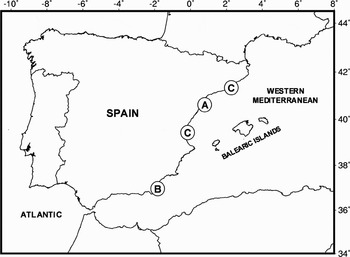
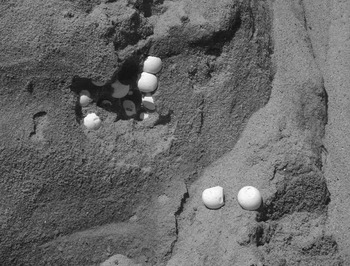
On 11 August 2006, a loggerhead turtle nest was reported on a tourist and renewed beach in Puzol (39°36′24″N/0°15′54″W; Valencia, east Spain; Figure 1). The chamber had been partially opened by waves after a storm (Figure 2) and contained 78 eggs, although it is possible that the original clutch size had been larger. A total of 76 eggs of the clutch were relocated to a 40 m wide beach closed to the public in El Saler Natural Park (39°36′24″ N/0°15′54″W; Valencia, east Spain) and thus protected. At the time of relocations the eggs were completely calcified, thus nesting date was at minimum 10–12 days before the date of discovery, the minimum period for complete calcification after laying (Demetropoulos & Hadjichristophourou, Reference Demetropoulos and Hadjichristophorou1995). This fact was confirmed when, on 20 September, 40 days after translocation, a total of 25 hatchlings (mean straight carapace length [SCL] = 42.4 mm±1.8 SD; mean weight = 14.6 g±1.3 SD; N = 15) emerged from the nest. On 25 September, 48 dead eggs, one dead hatchling and two more live hatchlings were found during the excavation of the nest, although one of the hatchlings died in the following hours. Overall, the relocated clutch had 36.8% hatching success and 34.2% emergence success.
Map with location of sea turtle nesting events reported from the Spanish Mediterranean coast in the last decades. (A) 1991 (Llorente et al., Reference Llorente, Carretero, Pascual and Pérez1993); (B) 2001 (Tomás et al., Reference Tomás, Mons, Martín, Bellido and Castillo2002); (C) 2006 (present study).

Picture of the clutch found in Puzol (Valencia, east Spain) in August 2006. Note that the two eggs found out of the chamber were discarded for relocation.

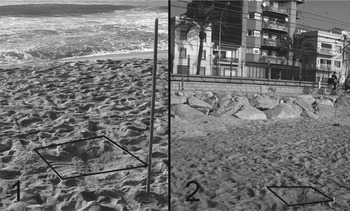
On 27 October 2006, at 8:30 pm, a total of 14 loggerhead turtle hatchlings were observed heading to the sea at ‘Pla de l'Os’ beach, in the town of Premià de Mar (Barcelona, north-east Spain, 41°29′19″N/02°21′27″E; Figure 1). This is a narrow sandy beach oriented east-south-east and approximately 18 m wide, limited on the land-side by a railway line. This beach is frequently visited by tourists. Staff from the Rehabilitation Centre for Marine Animals (CRAM Foundation) were alerted by passers-by that hatchlings were crawling on the beach. Since there was no information on the exact emergence location, CRAM staff conducted an overnight operation but were unable to detect new hatchling emergences or locate the nest chamber. No more emergences were reported that night. The nest chamber was found the next day at 7.3 m from the waterline, in an area with high risk of inundation (Figure 3), on a crowded beach and where sand-smoothing operations are conducted daily using mechanical rollers. Nest excavation revealed a clutch of 82 eggs with 52 hatched eggs, 25 eggs with dead embryos, and 5 eggs with live embryos. CRAM staff removed dead eggs and reburied the 5 eggs with live embryos. During the night 2 of these 5 eggs hatched naturally and the other 3 were moved to the facilities of the Rehabilitation Centre for observation, from which two hatched and one failed to pip. Overall, hatchling success of the clutch was 68.3%. The nest chamber was 21 cm wide and 51 cm deep. A total of 10 live hatchlings from this nest were measured: mean SCL = 42.9 mm±2.13 SD; mean weight =17.6 g±0.83 SD.
Picture showing the unsafe location where the clutch of Premià de Mar (Barcelona) was found in autumn 2007. Black square shows the clutch location close to the water edge (1) and its proximity to the railway and main road (2).

Again, incubation period was impossible to determine in this second nest, since no nesting date was recorded. A female loggerhead was seen on the same beach by a passer-by on 5 August. However, if that was the laying date, the resultant incubation period of 84 days is outside the range reported for Mediterranean loggerhead nests (47–62.3 days; Margaritoulis et al., Reference Margaritoulis, Argano, Baran, Bentivegna, Bradai, Camiñas, Casale, De Metrio, Demetropoulos, Gerosa, Godley, Haddoud, Houghton, Laurent, Lazar, Bolten and Witherinton2003). The turtle seen in August could have been detected in an earlier nesting event or, rather unlikely, be another female. Together with the report from Corsica in 2002 (Delaugerre & Cesarini, Reference Delaugerre and Cesarini2004), the clutch found in Premià is the northernmost nesting event reported for loggerhead turtle nesting in the Mediterranean.
Despite differences in sample size, we found that hatchlings of both nests reported in 2006 were similar in size to other Mediterranean (e.g. Adam et al., Reference Adam, Tur, Rees and Tomás2007) and Atlantic populations (e.g. Abella et al., Reference Abella, Marco and Lopez-Jurado2007), although the hatchlings of the northern nest were more similar in weight to the Atlantic ones (range: 17.1–18.2 g; Abella et al., Reference Abella, Marco and Lopez-Jurado2007).
DISCUSSION
Beach surveys were carried out in summer months (June–September) of 2007 in different regions such as Andalusia (south), Catalonia (north-east) and Valencia Community (east Spain), including training of people in charge of sand smoothing and beach cleaning, to detect further possible nesting events, but to our knowledge no nests were detected, not unlike what occurred in 2001–2005 in Andalucia (south Spain; Tomás et al., Reference Tomás, Mons, Martín, Bellido and Castillo2002). Nonetheless, sea turtle nesting season in the Mediterranean coincides with the tourist high season in the summer months (June–September; Margaritoulis et al., Reference Margaritoulis, Argano, Baran, Bentivegna, Bradai, Camiñas, Casale, De Metrio, Demetropoulos, Gerosa, Godley, Haddoud, Houghton, Laurent, Lazar, Bolten and Witherinton2003). Tourism is massive in these months throughout the Spanish Mediterranean coast, when the human population increases considerably. Thus, there is apparently a conflict between turtles and people who want to use the beaches in the summer months. Also, the pressure of tourism creates challenges for turtle monitoring efforts. For instance, the daily cleaning of many beaches for tourists, by raking and smoothing the sand surface with heavy machines, eliminates the tracks of nesting events, making it practically impossible to detect freshly laid nests (Tomás et al., Reference Tomás, Mons, Martín, Bellido and Castillo2002). In addition, the beach cleaning activity may produce sand compaction, possibly affecting nest construction and hatchling emergences.
Given the general lack of reports of nesting activity along the Spanish Mediterranean coast, the recent increase of nests reported deserves explanation. First, it is possible that there has always been a low level of undetected nesting in Spain, and the recent records reflected heightened awareness, both public and scientific, in the species. Unfortunately, as there is scarce historical information about loggerhead nesting along the Spanish coast, it is impossible to ascertain whether or not there was regular nesting in the past. Second, these new nests could be the consequence of lost or non-philopatric turtles or perhaps reflect colonization from other nesting populations elsewhere. Occasional nesting of loggerhead turtles out of their normal range has been previously reported (e.g. Soto et al., Reference Soto, Beheregaray, Rebello and De1997). Climate warming could produce migration of nesting females off their range. In marine turtles, sex is determined by incubation temperature with female offspring produced at higher temperatures and males at lower temperatures within a thermal tolerance range of 25–35°C (Ackerman, Reference Ackerman, Lutz and Musick1997). Thus, in a warming scenario, sea turtles could prevent effects on the sex-ratio by, for instance, altering nesting spatially. However, as loggerhead turtles usually maintain a considerable degree of nest site fidelity, and climate warming would be expected to occur over a large (regional) scale, the different scales over which change could occur could prevent adaptation by turtles shifting nesting location en masse, making other adaptation strategies more likely (Hawkes et al., Reference Hawkes, Broderick, Godfrey and Godley2007 and references therein). Nonetheless, no potential explanation can be confirmed until the origin of the Spanish nesting females will be determined.
Eastern Mediterranean and Atlantic loggerhead populations are genetically distinct (Carreras et al., in press, and references therein). Since Atlantic loggerhead turtles can enter into the Mediterranean through the Gibraltar Strait (Revelles et al., Reference Revelles, Carreras, Cardona, Marco, Bentivegna, Castillo, de Martino, Mons, Smith, Rico, Pascual and Aguilar2007) and, even more, being dominant in the south-western basin of this sea (Carreras et al., Reference Carreras, Pont, Maffucci, Pascual, Barceló, Bentivegna, Cardona, Alegre, San Félix, Fernández and Aguilar2006), genetic studies are in progress to determine the original populations of all the nesting loggerhead turtles found along the Spanish coast over the last decade.
Further research and beach surveys should be conducted in order to explore potential changes in breeding areas and nesting behaviour of loggerhead sea turtle on the western Mediterranean coasts.
ACKNOWLEDGEMENTS
This study is supported by the Departament de Medi Ambient i Habitatge de la Generalitat de Catalunya and the Conselleria de Medio Ambiente, Urbanismo y Vivienda de la Generalitat Valenciana. The study would have not been possible without the collaboration of the staff of the Marine Animal Rehabilitation Centre of CRAM and the personnel of the Centro de Recuperación de fauna ‘La Granja’ de El Saler, GV. We especially thank Juan Eymar for his collaboration in the study and for the coordination of the monitoring of the relocated clutch in Valencia. Thanks are also given to the whole staff of the Marine Zoology Unit of the Cavanilles Research Institute of the University of Valencia. We would like to thank Brendan Godley for constructive criticism that improved the manuscript. Jesús Tomás is supported by a Marie Curie Postdoctoral Fellowship.