INTRODUCTION
One crucial property of many inflectional processes is that they generalize to novel or unusual words. Adults make use of this to incorporate words from foreign languages, as for example in I schlepped a shopping bag around Manhattan or Es ist verboten während der Arbeitszeit zu bloggen ‘It is prohibited to blog during working hours’. By applying inflectional processes a new word can easily be accommodated into another language; in the first case by applying -ed to a Yiddish/German word (schleppen ‘to drag’) and in the second case by applying the German -en to an English word. Children make use of the generalization properties of inflectional processes in over-regularization errors such as *beated and *drawed (Marcus, Pinker, Ullman, Hollander, Rosen & Xu, Reference Marcus, Pinker, Ullman, Hollander, Rosen and Xu1992: 148), in which -ed forms are applied to verbs that have irregular past tense forms (beat, drew). These kinds of error have been extensively studied and have been taken as an indication that children do not just memorize and repeat forms found in the input but also make use of abstract rules of grammar in producing inflected word forms (see e.g. Brown & Bellugi, Reference Brown and Bellugi1964; McNeill, Reference McNeill, Smith and Miller1966).
Whilst the capacity for linguistic generalizations seems to be a core element of human knowledge of language, the mechanisms underlying generalization of inflectional processes are still subject to some controversy. The dual-mechanism model (see Clahsen, Reference Clahsen and Brown2006, for a review) distinguishes between two complementary systems for inflection: a rule-based system that is based on combinatorial grammatical rules (e.g. add -ed for the English past tense) and an associative system that extracts probabilistic contingencies between inflected word forms from the input, e.g. the similarity clusters among irregular past tense forms in English (sing–sang, ring–rang, etc.). This model distinguishes between associative and rule-based generalization processes. The latter are based on grammatical properties, e.g. rules that are sensitive to the syntactic category of a novel word and treat all members of a given category (e.g. V(erb)) equally irrespective of their similarity to existing forms. Rule-based generalizations apply to unusual novel words, e.g. to words that are phonologically dissimilar to existing words, as long as the novel word can be assigned to the grammatical category that is targeted by the rule, such as when, for example, given the unusual sounding verb to ploamph, native speakers of English will apply -ed suffixation to form the past tense. Thus, rule-based generalizations apply under default circumstances, i.e. when analogies to existing words fail. Associative generalizations, on the other hand, are based on the similarity of a novel word to existing ones stored in lexical memory. The novel verb to spling, for example, may elicit splang or splung as a past tense form on analogy with existing irregular verbs (sing–sang, cling–clung).
An alternative view to the dual-mechanism model is represented by different kinds of single-mechanism accounts according to which all word forms (including morphologically complex ones) are stored in an associative network in memory (Bybee, Reference Bybee1995; Elman, Bates, Johnson, Karmiloff-Smith, Parisi & Plunkett, Reference Elman, Bates, Johnson, Karmiloff-Smith, Parisi and Plunkett1996; Langacker, Reference Langacker2000; among others). Bybee (Reference Bybee, Huebner and Ferguson1991: 87) describes the alternative model of the acquisition of inflection as follows: ‘All types of morphological patterns can be acquired by the same process – the storage of items, the creation of connections among them, and the formation of patterns that range over sets of connections. The differences among them are due largely to the number of distinct lexical items involved – a big class is more productive and forms a stronger schema than a small class.’ One important issue in the controversy between dual- and single-mechanism accounts concerns the nature of children's overgeneralization errors. In the former, past tense errors such as *bring-ed are interpreted in terms of overapplication of a regular -ed affixation rule (Pinker & Ullman, Reference Pinker and Ullman2002), whereas in single-mechanism models these kinds of error are taken to reflect a generalization of a high-frequency pattern (McClelland & Patterson, Reference McClelland and Patterson2002). In child language acquisition research over the past fifteen years, these models have been tested against different sets of data. However, much of this research has focused on just one inflectional system, the English past tense, and it remains to be seen whether contrasts between regular and irregular morphology in children's generalization errors that were found for the English past tense also hold cross-linguistically. It is true that acquisition researchers have begun to examine children's overgeneralizations in languages other than English, but the results are still scarce and mixed, and the controversy surrounding the nature of these generalization processes is far from settled. Some acquisition studies have provided support for a dual-mechanism account reporting dissociations between rule-based and associatively based generalization in children's inflectional errors (see e.g. Clahsen & Rothweiler, Reference Clahsen and Rothweiler1993, for German; Say & Clahsen, Reference Say, Clahsen, Nooteboom, Weerman and Wijnen2002, for Italian; Clahsen, Aveledo & Roca, Reference Clahsen, Aveledo and Roca2002, for Spanish; Royle, Reference Royle2007, for French). Other researchers have not found such dissociations and claimed that children's inflectional errors can better be interpreted in terms of single-mechanism accounts (see e.g. Orsolini, Fanari & Bowles, Reference Orsolini, Fanari and Bowles1998, for Italian; Laaha Ravid, Krecky-Kröll, Laaha & Dressler, Reference Lahha, Ravid, Korecky-Kröll, Laaha and Dressler2006, for German; Dabrowska & Szczerbinski, Reference Dabrowska and Szczerbinski2006, for Polish; Ragnarsdottir, Simonsen & Plunkett, Reference Ragnarsdottir, Simonsen and Plunkett1999, for Icelandic and Norwegian; Marchman, Plunkett & Goodman, Reference Marchman, Plunkett and Goodman1997, for English). Clearly, more research is needed to determine the nature of generalization processes in children's inflectional errors from a cross-linguistic perspective.
The present study contributes new data and analyses to these issues by investigating the perfective past tense in Greek child language. Our main purpose is to describe the kinds of generalization processes Greek children employ in producing and judging perfective past tense forms and how these generalization processes change with age. To this end, we collected and analyzed an extensive data set. A total of 189 native speakers of Greek in different age groups were examined, using two experimental tasks (acceptability judgment and elicited production), and testing perfective past tense forms of both existing and novel verbs. The results from these data provide a detailed picture of the development of the perfective past tense in Greek child language, which will be interpreted from the perspective of a dual-mechanism account.
Linguistic background: The perfective past tense in Greek
Modern Greek marks present, past and future tense in the indicative mood (Holton, Mackridge & Phillipaki-Warburton, Reference Holton, Mackridge and Phillipaki-Warburton1997). Tense marking is closely linked to the distinction between perfective and imperfective aspect. The former is used when an action or an event is seen as completed while the latter is used when it is seen as in progress, habitual or repeated (Holton et al., Reference Holton, Mackridge and Phillipaki-Warburton1997; Triandafillidis, Reference Triandafillidis1941). Consequently, Greek distinguishes between a perfective and an imperfective past tense. Both types of past tense form have antepenultimate stress and are prefixed by a stressed augment e- when the verb stem is monosyllabic and starts with a consonant; compare, for example, the two perfective past-tense forms efaga ‘I ate’ and halasa ‘I destroyed’, of which only the former contains the augment e- (Holton et al., Reference Holton, Mackridge and Phillipaki-Warburton1997; Triandafillidis, Reference Triandafillidis1941).
One important distinction amongst perfective past tense forms is between sigmatic and non-sigmatic ones, the former contains an -s- perfective affix (‘sigma’ in the Greek alphabet) and the latter are without -s-. Sigmatic past tense forms have been considered to be ‘regular’ in the sense that they involve a segmentable affix (-s-) paired with phonologically predictable stem changes; non-sigmatic past tense forms, by contrast, exhibit properties typical of ‘irregular’ inflection in that they involve unsystematic and even suppletive stem changes and no segmentable (perfective past tense) affix (for discussion see, e.g., Ralli, Reference Ralli1988, Reference Ralli2003; Terzi, Papapetropoulos & Kouvelas, Reference Terzi, Papapetropoulos and Kouvelas2005; Tsapkini, Jarema & Kehayia, Reference Tsapkini, Jarema and Kehayia2001, Reference Tsapkini, Jarema and Kehayia2002a, Reference Tsapkini, Jarema, Kehayia and Fava2002b). Consider the following examples.
- (1)
a. graf-o, e-grap-s-a ‘I write, I wrote’
b. lin-o, e-li-s-a ‘I untie, I untied’
- (2)
a. plen-o, e-plin-a ‘I wash, I washed’
b. zesten-o, zestan-a ‘I warm, I warmed’
c. tro-o, efag-a ‘I eat, I ate’
(3) kouval-o, kouvali-s-a ‘I carry, I carried’
The first two cases illustrated in (1) involve -s- affixation and predictable stem changes (Holton et al., Reference Holton, Mackridge and Phillipaki-Warburton1997). If, for example, the unmarked (=present tense or imperfective) stem ends in a labial consonant, then the sigmatic perfective past tense form changes to p-s- (1 a). If the unmarked stem ends in a vowel followed by /n/, the stem-final consonant is deleted in the sigmatic perfective past tense form (1b). The examples shown in (2) are forms without a segmentable perfective affix and idiosyncratic stems. Examples (2a) and (2b) illustrate unpredictable stem-vowel changes and example (2c) has a completely suppletive stem. The verb form in (3) is an example of a case in which an idiosyncratic perfective stem is combined with the perfective past tense affx -s-.
To determine frequency differences between the sigmatic and the non-sigmatic past tense, we performed a count of a relevant subset of the verb lemmas represented in a large corpus of 100,000,000 Greek words collected from the web (Neurosoft Language Tools; http://www.neurosoft.gr/). We excluded verbs that appeared in the passive voice, because sigmatic and non-sigmatic verbs do not have distinct perfective past tense forms in the passive. We also excluded verbs that do not have distinct forms for the imperfective and the perfective past tense, and verbs with very low token frequencies (of <40). This resulted in a total of 2,266 verb lemmas extracted from the Neurosoft corpus, with token frequencies ranging from 40 to 121,760. We found that 2,119 of these take sigmatic and only 147 non-sigmatic past tense forms. Thus, in terms of type frequencies, the sigmatic past tense clearly outnumbers the non-sigmatic one.
Summarizing, the sigmatic perfective past tense is more frequent and, due to the -s- affix and systematic stem allomorphy, more transparent than non-sigmatic perfective past tense forms which do not have a segmentable perfective past tense affix and are partly idiosyncratic. The -s- affix in sigmatic past tense forms is likely to be a case of regular inflection, whereas non-sigmatic verb forms are characteristic of irregular inflection, i.e. inflected forms stored in associative networks in memory. From the perspective of a dual-mechanism model, one would therefore expect differences between sigmatic and non-sigmatic perfective past tense forms in their generalization properties. Sigmatic forms should be employed for rule-based generalizations. They should widely generalize to novel verbs irrespective of their similarity to existing verbs, and in children's inflectional errors, sigmatic forms should overgeneralize to existing non-sigmatic verbs (in cases in which children fail to retrieve them from memory), whereas generalizations of non-sigmatic forms in cases in which sigmatic ones are required should be rare or non-existent. Moreover, the likelihood of children's over-regularization errors has been shown to be dependent upon the frequency of irregular forms (Marcus et al., Reference Marcus, Pinker, Ullman, Hollander, Rosen and Xu1992, among others). Consequently, we would expect that -s- over-regularizations should be more likely for low-frequency non-sigmatic forms than for high-frequency forms. Overapplications of non-sigmatic forms, on the other hand, should be subject to associative generalizations, i.e. neighbourhood or gang effects, depending on the degree of similarity of a novel form to existing ones. Thus, non-sigmatic forms are more likely to generalize to novel verbs that are similar to existing non-sigmatic verbs than to those that are dissimilar to existing ones. The purpose of our study was to test these predictions.
Previous studies on the Greek perfective past tense
Stephany (Reference Stephany and Slobin1997), examining spontaneous speech data from four children aged 1 ; 10 to 2 ; 10, found that aspect marking emerges earlier than tense marking. Whilst the grammatical categories of perfective and imperfective aspect emerge by 1 ; 10, ‘the category of tense is implied rather than formally distinguished’ (Stephany, Reference Stephany and Slobin1997: 245) at 1 ; 10. In particular, children use the indicative perfective verb forms to express the past tense in adult Greek and the imperfective indicative verb forms to express the present tense in adult Greek. The imperfective past tense is acquired late and only emerges at 2 ; 4 in child speech, a finding which confirms previous findings on late emergence of the imperfective past tense (Katis, Reference Katis1984: 197). More recent studies of Greek child language have examined the interaction of aspect, tense and telicity (Stephany & Voeikova, Reference Stephany and Voeikova2003; Delidaki & Varlokosta, Reference Delidaki and Varlokosta2003). We are aware of just one study (Mastropavlou, Reference Mastropavlou, Agathopoulou, Dimitrakopoulou and Papadopoulou2007) that examined past tense formation in Greek-speaking children, ten children with Specifically Language Impairment (SLI) and twenty typically developing children (age range 3 ; 0 to 6 ; 7). This study, however, was not designed to examine sigmatic and non-sigmatic past tense formation. Instead, Mastropavlou studied morphophonological properties of past tense forms. She found that all participant groups performed better on suppletive than on other (sigmatic and non-sigmatic) past tense forms. However, apart from this observation, the development of sigmatic and non-sigmatic past tense in Greek child language has not yet been studied.
Similarities and differences between sigmatic and non-sigmatic past tense forms have been examined in several neurolinguistic studies with aphasic and Parkinson's disease (PD) patients. Kehayia & Jarema (Reference Kehayia and Jarema1991) reported that the two non-fluent aphasic patients they tested showed lower performance on highly irregular past tense forms, such as troo, efaga ‘I eat, I ate’, than on the sigmatic past tense, e.g. grafo, egrapsa ‘I write, I wrote’. In addition, Tsapkini and colleagues presented several studies examining the performance of non-fluent patients on the Greek past tense (Tsapkini et al., Reference Tsapkini, Jarema and Kehayia2001, Reference Tsapkini, Jarema and Kehayia2002a, Reference Tsapkini, Jarema, Kehayia and Fava2002b). Tsapkini et al. (Reference Tsapkini, Jarema and Kehayia2002a) found that the non-fluent patient they studied had more problems with the production of non-sigmatic perfective past tense forms such as pleno–eplina ‘I wash–I washed’ than with sigmatic forms involving -s- suffixation. Tsapkini et al. (Reference Tsapkini, Jarema and Kehayia2001) reported that their non-fluent patient was impaired in producing perfective past tense forms that required both a stem change and -s- suffixation. Tsapkini et al. (Reference Tsapkini, Jarema, Kehayia and Fava2002b) presented data from on-line experiments with two aphasic patients and eleven control subjects. Whilst the controls showed priming effects for all verb types tested, one aphasic patient failed to show any priming effects for regular sigmatic forms such as grafo–egrapsa ‘I write–I wrote’, but showed priming effects for non-sigmatic forms and for semi-regular forms such as milo–milisa ‘I speak–I spoke’. By contrast, the second patient did not show any priming effect for sigmatic forms but a priming effect for highly irregular suppletive forms (pleno–eplina).
Terzi et al. (Reference Terzi, Papapetropoulos and Kouvelas2005) tested twenty-five patients with PD and twenty-five normal controls on the production of sigmatic and non-sigmatic perfective past tense forms. In the data from the control participants, there were only six (out of 540) errors, one for a sigmatic and five for non-sigmatic verbs. The PD patients performed worse than controls on both sigmatic and non-sigmatic forms, and they produced more errors on verbs requiring non-sigmatic (n=40/270) than sigmatic forms (n=28/270). Moreover, there were substantial individual differences. For example, patient TA performed at chance on sigmatic forms whereas patients ED, ZS and KT were at chance on non-sigmatic ones. Further investigation is required to determine whether these differences are correlated with the patients' cognitive profile.
Although the results from the studies mentioned above are not completely coherent (which might be due to individual differences between patients), several studies yielded distinct patterns of impairment for sigmatic and non-sigmatic perfective past tense formation in aphasia and PD. As pointed out above, however, nothing is known about the development of the perfective past tense in Greek child language and the kinds of inflectional errors Greek children produce. The present study is meant to fill this gap.
METHOD
We examined the sigmatic and non-sigmatic perfective past tense in Greek child language and a control group of adult native speakers testing both existing and novel verbs. The same set of materials was used for an elicited production task and (with an altered procedure) as an acceptability judgment task.
Participants
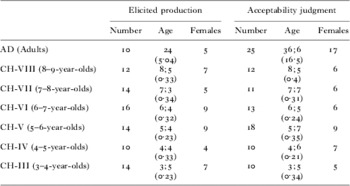
Thirty-five adults and 154 typically developing children of different age groups participated in one of the two tasks, none of whom took part in both the elicited production and the acceptability judgment task; see Table 1 for further participant information. All participants were native speakers of Greek living in urban and rural areas of northern Greece (Ioannina and Thessaloniki and the rural areas around these places). All adult participants had been exposed to three to eighteen years of education, except for one adult participant who was illiterate. All children attended Greek day nursery and primary schools at the time of testing. The experiments were performed by properly trained third- and fourth-year undergraduate students of the Department of Speech and Language Therapy, Technological Educational Institute of Epirus (Ioannina) under the supervision of the first author.
Number of participants, mean age (standard deviations) and number of female participants

Materials
A total of fifty verbs were tested, twenty existing verbs, twenty rhyming novel verbs and ten non-rhymes (see Appendix A for a complete set of experimental items). The existing verbs were divided into two conditions with ten items each, a sigmatic and non-sigmatic one, depending on the required past tense form. The sigmatic condition included three subclasses (Holton et al., Reference Holton, Mackridge and Phillipaki-Warburton1997; Ralli, Reference Ralli1988): three verbs in which (in addition to the affix -s-) the past tense form comprises a consonantal change in the coda of the stem, e.g. graf-o, e-grap-s-a ‘I write, I wrote’; four verbs in which (in addition to the perfective affix -s-) one or two stem-final consonants are deleted in the past tense, e.g. lin-o, e-li-s-a ‘I untie, I untied’; and three verbs in which a marked perfective stem is combined with the affix -s-, e.g. kouval-o, kouvali-s-a ‘I carry, I carried’, where kouvali- is the perfective stem of kouval-. The non-sigmatic condition also included three subclasses (Holton et al., Reference Holton, Mackridge and Phillipaki-Warburton1997; Ralli, Reference Ralli1988): three verbs with a suppletive perfective past-tense form, e.g. tro-o, e-fag-a ‘I eat, I ate’; four verbs with stem-internal changes and the augment e-, e.g. plen-o, e-plin-a ‘I wash, I washed’; and three verbs with stem-internal changes but without the augment e-, e.g. zesten-o, zestan-a ‘I warm, I warmed’.
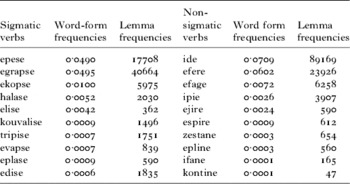
Frequency information for the existing verbs in the sigmatic and the non-sigmatic condition is shown in Appendix B. The lemma frequencies were taken from the Neurosoft Language Tools and represent frequencies calculated as proportions of a total of 100,000,000 words. The (perfective past tense) word-form frequencies were taken from the Institute of Speech and Language Processing (ISLP) corpus (http://hnc.ilsp.gr/en/) and represent proportions out of the total number of word forms included in ISLP in‰ (per thousand). The items in the sigmatic and non-sigmatic condition were matched both in terms of their mean word-form frequencies (Z=0·682, p=0·495) and their mean lemma frequencies (Z=0·718, p=0·473). Moreover, we attempted to match the items in the two conditions pairwise as closely as possible.
Rhyming novel verbs differ from the existing ones in their onsets. For the existing verb graf-i, for example, we constructed the novel one draf-i. There were twenty novel rhymes in total, ten verbs that rhymed with existing sigmatic verbs and ten that rhymed with existing non-sigmatic verbs. Non-rhyming novel verbs (n=10) were constructed so as not to rhyme with any existing verb in the language but to be phonotactically legal words in Greek. An additional ten filler items were included.
Procedure
The linguistic materials described above were used for two experimental tasks, elicited productions and acceptability judgments. All participants were tested individually. Both tasks were preceded by a training session aiming to familiarize participants with the two tasks. Participants were told that they were going to see pictures showing people who live on earth and some other pictures showing people who live on a different planet and speak a strange language. The training session contained eight pictures (four used to introduce novel verbs and four for existing verbs). In the production and judgment experiments, participants were presented with pairs of two pictures each on one sheet of paper. The first picture (shown in the top half) depicted an ongoing activity (e.g. a child eating a cake), whereas the second picture (shown in the bottom half) showed that the activity presented in the first picture had been completed, e.g. an empty plate. There were sixty picture pairs, fifty for the experimental items and ten fillers, all presented in a pseudo-randomized order. An example of a picture pair is shown in Appendix C.
Instructions given to participants differed between the two experimental tasks. In the elicited production task, the experimenter pointed to the first picture saying, for example, ‘Here the child is eating a cake’, and then she/he pointed to the second picture saying ‘and what did the child do here?’ Participants' responses were written down and tape-recorded for verification. Calculation of accuracy scores excluded 211 cases which were: (i) exact repetitions of one of the experimental verbs; or (ii) an existing verb produced instead of one of the targeted novel ones.
In the judgment task, the experimenter pointed to the first picture and described the picture in the same way as in the production task. Two puppets, a boy and a girl called ‘Giannis’ and ‘Maria’ respectively, manipulated by the experimenter then provided one simple sentence each to describe the second picture. These two sentences contained different past tense forms of the target verb but were otherwise identical. Participants were asked to choose between the two puppets' descriptions and encouraged to provide a third, alternative past tense form if they did not find either of the past tense forms provided acceptable. For existing verbs, one of the puppets provided the perfective past tense of the target verb while the other one gave a corresponding imperfective past tense form of the same verb. For novel verbs, one puppet provided a sigmatic and the other a non-sigmatic perfective past tense form; see the example in Appendix C. The order in which these forms were given was pseudo-randomized to ensure that existing, novel and filler items appeared in a random order and that the order in which the puppets presented sigmatic and non-sigmatic forms was not predictable. The examiners recorded the children's preferences by ticking off the participants' chosen response on a prepared answer sheet.
RESULTS
Elicited productions
Existing verbs
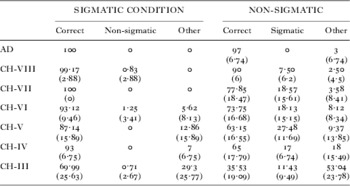
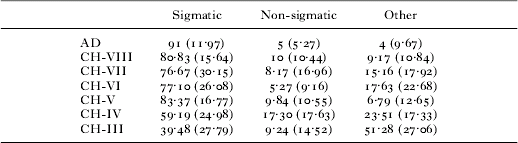
Table 2 shows mean percentages (and standard deviations) of the participants' responses in the two conditions. The three columns on the left refer to verbs that require sigmatic perfective past tense forms in Greek, the three columns on the right to verbs that require non-sigmatic perfective past tense forms. For each of these two conditions, Table 2 provides percentages of correct and incorrect elicited productions. Of the incorrect responses, we distinguish between overapplications of non-sigmatic forms in the sigmatic condition, overapplications of sigmatic forms in the non-sigmatic condition and ‘other’ errors. All incorrect productions were subject to a separate error analysis (see below).
Mean percentages (and standard deviations) of the production of correct and incorrect (sigmatic/non-sigmatic or other) forms of existing verbs in the sigmatic and the non-sigmatic condition

Consider first the accuracy scores (see the columns headed ‘Correct’ in Table 2). Whilst the adult group had high correctness scores for both the sigmatic and the non-sigmatic condition, the children's scores for the non-sigmatic condition were lower than those for the sigmatic ones. The younger the children, the stronger was this contrast.
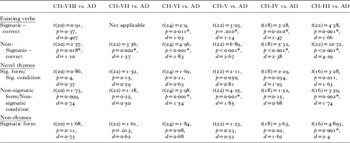
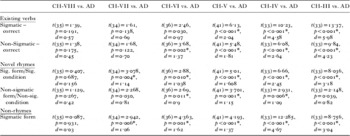
To analyze the data statistically, we performed a two-way analysis of variance (ANOVA) with two variables: (i) condition, with two levels (sigmatic, non-sigmatic) and (ii) group, with seven levels for the various participant groups. Additionally, a series of planned comparisons using t-tests were performed to determine whether the six child groups differed from the adult group on these measures (see Table 3). Given that multiple comparisons were made following the ANOVA, we adjusted the alpha level of all pairwise comparisons using the (sequentially rejective) Bonferroni correction procedure (Holm, Reference Holm1979; Shaffer, Reference Shaffer1986). The ANOVA revealed significant effects of group (F(6, 83)=19·73, p<0·001) and condition F(1, 83)=153·04, p<0·001), and an interaction between group and condition (F(6, 83)=5·91, p<0·001). The planned comparisons (see Table 3) indicate that the two oldest child groups (CH-VII, CH-VIII) achieved adult-like correctness scores for the sigmatic condition, whilst the younger child groups had significantly lower accuracy scores for the sigmatic past tense than the adult group. Moreover, for the non-sigmatic condition children of all age groups performed significantly worse than the adult group, a contrast that is also evident from the large effect sizes in this condition. Taken together, these results indicate that for existing verbs, sigmatic perfective past tense forms are acquired earlier than non-sigmatic ones.
Planned comparisons of child to adult groups for the production data (* indicates significant differences after α-level adjustment)

Error analysis
The label ‘Other' in Table 2 comprises the following kinds of error:
(4) imperfective past tense instead of the targeted perfective form:
… ekove (target: ekopse; present tense: kovo)
… cut-imperfective-aspect-past-3rd sg.
(5) perfective past tense of a different verb:
… teliose (target: egrapse; present tense: grafo)
… finish-perfective-past-3rd sg.
(6) incorrect stem of a sigmatic form
… plathise (target: eplase; present tense: plathi)
… made-3rd sg. (by hand)
(7) incorrect stem of a non-sigmatic form
… esprothe (target: espire; present tense: sperni)
… seeded-3rd sg.
Table 2 shows that errors of these kinds were mostly found in the child group CH-III. Stem errors such as those illustrated in (6) and (7) were rare. There were only eight cases such as (6) and five cases such as (7) in the whole dataset, all of which came from the youngest children. As can be seen from Table 2, most of the ‘other’ errors occurred for verbs that required non-sigmatic forms. There were also three such errors in the adult group; all of these were imperfective past tense forms. In cases in which a participant selected a different verb (which was often semantically related to the target verb, as in (5)), the corresponding past tense form was correctly inflected. Hence, these cases do not represent morphological errors.
Table 2 also shows that the children (but not the adults) produced overapplications of sigmatic and non-sigmatic perfective past tense forms. Consider the examples in (8) and (9):
(8) Overapplication of the sigmatic perfective past tense:
(a) … ejerse (target: ejire; present tense: jern-i)
… bent-3rd sg.
(b) … kontese (target: kontine, present tense: konten-i)
… shortened-3rd sg.
(c) … eplise (target: epline, present tense plen-i)
… washed-3rd sg.
(d) … esprise (target: espire, present tense: sperni
… seeded-3rd sg.
(9) Overapplication of the non-sigmatic perfective past tense
… eplan-e (target: eplas-e, present tense: plath-i)
… made-3rd sg. (by hand)
Three observations can be made about the distribution of overapplications. First, there was a clear contrast between sigmatic and non-sigmatic forms. Whilst sigmatic forms were often overapplied to existing non-sigmatic verbs, with percentages ranging from 7·5% to more than 27·5%, non-sigmatic forms were hardly ever overapplied to existing sigmatic verbs. The mean overapplication rate for the sigmatic past tense was 20%, forty times higher than the one for the non-sigmatic past tense (=0·005%)Footnote 1. Second, low-frequency verbs were more vulnerable to over-regularizations than high-frequency ones. The numbers of overapplications of sigmatic forms for non-sigmatic verbs were as follows: ide: 0, efere: 2, efage: 0, ipie: 1, ejire: 34, espire: 23, zestane: 3, epline: 6, ifane: 42, kontine: 24. Comparison with the verb frequencies in Appendix B shows that verbs with high lemma and word-form frequencies were less likely to be overgeneralized than low-frequency verbs. There were only three over-regularizations for the four verbs with the highest frequencies (=ide, efere, efage, ipie). By contrast, the two verbs with the lowest frequencies (=ifane, kontine) produced most over-regularizations (=66/135). Third, overapplications of the sigmatic form sometimes co-occurred with stem errors. In most of these (96 out of a total of 135 cases), the -s- affix of the perfective past tense was combined with the unmarked (present tense) stem of the verb, as for example in (8 a) and (8 b). In 21 cases, -s- was attached to a different marked stem of a given verb, as in (8c), and in 18 cases, the sigmatic suffix -s- was combined with a non-existing stem (8d).
Novel rhymes
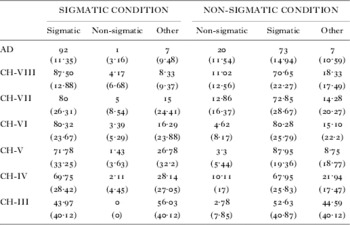
Table 4 shows mean percentages (and standard deviations) of the participants' responses for rhyming novel verbs. The three columns on the left refer to verbs that rhyme with existing verbs that require sigmatic past tense forms, the three columns on the right to verbs that rhyme with existing verbs that require non-sigmatic past tense forms. For each of these two conditions, Table 4 provides a breakdown of the past tense forms produced by the participants. ‘Other’ responses were imperfective past tense forms instead of the target perfective ones.
Mean percentages (and standard deviations) of the production of sigmatic, non-sigmatic or other forms for novel verbs rhyming with existing sigmatic or non-sigmatic verbs

In all participant groups, the most common responses were sigmatic past tense forms, even for nonce verbs that rhyme with existing verbs taking non-sigmatic past-tense formsFootnote 2. Thus, the sigmatic past tense generalizes outside its own similarity domain. For non-sigmatic forms, however, we can see an effect of rhyme similarity. Non-sigmatic forms are hardly ever used for verbs that rhyme with existing verbs taking sigmatic past tense forms (range: 0% to 5%). Instead, non-sigmatic forms are largely confined to the non-sigmatic condition, i.e. to novel verbs that rhyme with existing non-sigmatic ones.
Table 4 shows developmental changes. The percentages of sigmatic past tense responses gradually increase with age. For the two oldest child groups (CH-VIII & CH-VII) as well as for the adult group, the percentages of sigmatic forms are higher in the sigmatic than in the non-sigmatic condition, whereas for the other child groups there is no such difference. The percentages of non-sigmatic forms in the non-sigmatic condition also increase with age from 2·78% in the youngest children to 20% in the adult group.
The same statistical analyses as for existing verbs were performed on the data in Table 4, a two-way ANOVA with the variables group and condition on the percentages of expected responses (i.e. sigmatic form/SIGMATIC CONDITION, non-sigmatic form/NON-SIGMATIC CONDITION) followed by a series of planned comparisons to examine differences between the various child groups and the adult group. The ANOVA revealed significant effects of group (F(6, 77)=6·48, p<0·001) and condition F(1, 77)=326·83, p<0·001), but no interaction between group and condition (F(6, 77)=1·33, p=0·26). The main effect of group reflects the fact that the younger the children, the smaller the number of expected responses. The main effect of condition is due to the fact that all participant groups produced more sigmatic forms and less non-sigmatic ones than would be expected on the basis of rhyme similarity. According to the planned comparisons in Table 3, none of the child groups differed from the adult group with respect to the production of sigmatic past tense forms. It should be noted, however, that the comparisons between the younger child groups (particularly CH-IV and CH-III) and the adult group exhibited large effect sizes (d>1), reflecting considerably lower percentages of sigmatic forms in these child groups than in the adult group. Table 3 also shows that three- to six-year-old children produced significantly fewer non-sigmatic forms (for novel non-sigmatic verbs) than the adult group, a contrast that is also confirmed by large effect sizes (d>1). An exception to this is child group CH-IV, but even this group only produced half as many non-sigmatic forms for novel rhymes as the adult group (10·11% vs. 20%, see Table 4). These results indicate that sigmatic past tense forms generalize to novel verbs early on, whereas three- to six-year-old children rely less on non-sigmatic processes to inflect novel verbs than adults.
Non-rhymes
Table 5 presents mean percentages (and standard deviations) of the participants' responses for novel verbs that did not rhyme with any existing verb. ‘Other’ responses were imperfective past tense forms used instead of the targeted perfective ones.
Mean percentages (and standard deviations) of the production of sigmatic, non-sigmatic or other forms for non-rhyming verbs

In all participant groups, sigmatic past tense forms were more commonly used for non-rhyming novel verbs than for non-sigmatic onesFootnote 3. Table 5 shows that the use of sigmatic forms for non-rhymes increases with age. A one-way ANOVA on the percentages of sigmatic forms shown in Table 5 revealed a significant effect of group (F(6, 77)=5·24, p<0·001), and planned comparisons (see Table 3) showed that the two youngest child groups differed most clearly from the adult group, with large effect sizes (d>1) for both the CH-III vs. AD and the CH-IV vs. AD comparisons. These differences reflect the fact that these two groups of children produced considerably fewer sigmatic forms for non-rhymes than the adult group.
Summarizing the results of the elicited production task, we found some striking asymmetries between sigmatic and non-sigmatic perfective past tense forms in both children and adults. Whereas the children overgeneralized the sigmatic form to existing verbs that required non-sigmatic forms, non-sigmatic forms were (with a few exceptions) not extended to cases in which sigmatic forms were required. Moreover, the sigmatic past tense was the most common response for novel verbs, even for those that were similar to existing verbs taking non-sigmatic past tense forms. The sigmatic past tense was also clearly preferred for non-rhymes, i.e. in cases in which similarity-based generalizations were not possible. These results indicate that the sigmatic perfective past tense generalizes beyond similarity and is used in cases in which access to exceptional (non-sigmatic) forms fails. By contrast, non-sigmatic forms did not generalize outside their own similarity domain. Non-sigmatic forms of novel verbs were largely confined to those novel verbs that rhyme with existing non-sigmatic ones. Thus, the use of non-sigmatic past tense forms is sensitive to (rhyme) similarity.
We also observed developmental changes from child to adult. The development of the non-sigmatic past tense was found to lag behind that of the sigmatic one. For existing verbs, children showed lower accuracy scores for non-sigmatic than for sigmatic ones. Children were also found to generalize sigmatic forms to rhyming and non-rhyming novel verbs, with scores of over 70% from the age of five onwards, whereas they underused non-sigmatic forms for novel verbs relative to adults.
Acceptability judgments
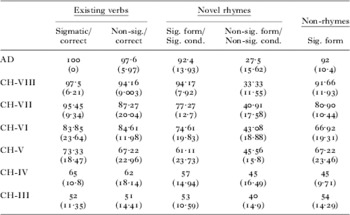
Recall that for this experiment the same materials were used as for the elicited production task, but that for each item participants were confronted with two past tense forms from which they had to choose which one sounded better. Mean percentages (and standard deviations) for existing verbs, novel rhymes and non-rhymes are shown in Table 6. These data were statistically analyzed in the same way as the production data, with ANOVAs followed by planned comparisons (using t-tests) to determine differences between the scores of the various child groups and those of the adult group (Table 7). The alpha levels of all paiwise comparisons were adjusted using the same (Bonferrorni) correction procedure as for the production data.
Mean percentages (and standard deviations) of forms chosen in the judgment task: (i) correct responses for existing sigmatic and non-sigmatic verbs; (ii) sigmatic forms for novel sigmatic and non-sigmatic forms for novel non-sigmatic verbs; (iii) sigmatic forms for non-rhyming verbs

Planned comparisons for the judgment data (* indicates significant differences after α-level adjustment)

Existing verbs
The two columns for existing verbs in Table 6 display correct responses for existing sigmatic and non-sigmatic verbs. A correct response is one in which the participant selected the sigmatic form for the sigmatic condition and the non-sigmatic one for the non-sigmatic condition. Although participants were told that they may provide a response different from one of the two offered, they never made use of this option. Consequently, the scores shown in Table 6 for existing verbs subtracted from 100% will yield the percentages of incorrect choices.
The accuracy scores increase with age and are slightly higher for the sigmatic condition than for the non-sigmatic condition. These observations were confirmed by a two-way ANOVA which revealed main effects of group (F(6, 92)=26·44, p<0·001) and condition F(1, 92)=5·95, p=0·017), but no interaction between group and condition (F(6, 92)=0·695, p=0·654). The main effect of group is due to the fact that the accuracy scores for both conditions increase with age. The main effect of condition reflects the fact that all participant groups (except CH-VI) had higher accuracy scores for sigmatic than for non-sigmatic forms. The planned comparisons in Table 7 indicate that the two oldest child groups (CH-VII, CH-VIII) achieved adult-like correctness scores in both conditions. The younger child groups had lower accuracy scores in both conditions.
Novel rhymes
The two columns for novel rhymes in Table 6 present percentages of choices of a sigmatic form in the sigmatic condition and of a non-sigmatic form in the non-sigmatic condition. There were no ‘other’ responses. Thus, the percentages for the corresponding alternative choices (i.e. a non-sigmatic form in the sigmatic condition and a sigmatic form in the non-sigmatic one) can be determined by subtracting the percentages given for each condition and participant group from 100%.
Table 6 shows that in all participant groups, the scores for the sigmatic past tense form were higher than those for the non-sigmatic one, even in the non-sigmatic condition. This preference increased with age. Moreover, for novel verbs that rhymed with existing non-sigmatic ones, a non-sigmatic form was more likely to be chosen than for novel verbs that rhymed with existing sigmatic ones. Thus, whilst sigmatic past tense forms were widely preferred for novel verbs, the choice of non-sigmatic forms was affected by rhyme similarity.
A two-way ANOVA on the percentages shown in Table 6 revealed main effects of group (F(6, 92)=4·70, p<0·001) and condition F(1, 92)=148·84, p<0·001) and a significant interaction between group and condition (F(6, 92)=11·58, p<0·001). Table 7 shows that only the oldest child group (CH-VIII) performed adult-like in both conditions. The difference to the adult group is particularly striking for the younger child groups (CH-III-V), which can also be seen from the large effect sizes (d>1). Additional analyses revealed that for child groups CH-V, CH-IV and CH-III, the percentages of expected choices were at chance level for the sigmatic condition, whereas for the adult group and the older children they were different from chanceFootnote 4. For the non-sigmatic condition, only the performance of the AD and the CH-VIII groups was above chance level.
These results show that adults and older children prefer sigmatic forms for nonce verbs, even for those that rhyme with existing non-sigmatic ones, whereas non-sigmatic forms rarely generalize outside their own similarity domain. In contrast to that, three- to six-year-old children do not yet have a clear preference for either past tense form.
Non-rhymes
The column for non-rhymes in Table 6 displays mean percentages (and standard deviations) of sigmatic choices for novel verbs that did not rhyme with any existing verb. In all remaining responses participants chose the non-sigmatic form. There were no ‘other’ responses.
The data in Table 6 show that adults and older children (CH-V and above) preferred sigmatic forms for novel non-rhyming verbs and that the percentages of sigmatic choices gradually increased from child group CH-V to the adult group. By contrast, the two youngest child groups (CH-III, CH-IV) did not seem to have a clear preference. A one-way ANOVA revealed a main effect of group, confirming that the groups' mean scores for sigmatic past tense forms of non-rhyming nonce verbs were significantly different (F(6, 92)=18·47, p<0·001). According to the planned comparisons in Table 7, all child groups (except CH-VIII) performed below adult level. Additional analyses revealed that the scores for sigmatic forms of non-rhymes in Table 6 were significantly above chance level in the adult group as well as in child groups CH-V and above (AD: t(24)=20·17, p<0·001; CH-VIII: t(11)=12·09, p<0·001; CH-VII: t(10)=9·82, p<0·001; CH-VI: t(12)=3·16, p=0·008; CH-V: t(17)=3·11, p <0·006), whereas the younger children's scores did not significantly differ from chance level (CH-IV: t(9)=1·62, p=0·14; CH-III: t(9)=0·89, p=0·40).
Summarizing the results of the judgment task, we found that sigmatic perfective past tense forms were preferred for novel verbs including non-rhymes and novel verbs that rhymed with existing non-sigmatic verbs. Non-sigmatic forms, on the other hand, were more common for novel verbs that rhymed with existing non-sigmatic verbs than for those that were similar to existing sigmatic ones. These contrasts confirm the different generalization properties of the two perfective past tense forms seen in the elicited production task, suggesting that whilst generalizations of non-sigmatic forms are similarity based, the sigmatic perfective past tense generalizes widely even outside its own similarity domain. We also found developmental changes in the acceptability judgments with the children's scores gradually approaching those of the adult group. Only the two youngest child groups did not seem to have a clear preference in this task.
DISCUSSION
The most important findings of the present study are the contrasts in how sigmatic and non-sigmatic perfective past tense forms generalize to novel verbs. In the following, we will first discuss the nature of these generalization processes and then the developmental changes from child to adult.
The generalization properties of the perfective past tense in Greek
Our main findings can be summarized in four points:
- (10)
a. Sigmatic forms were preferred for non-rhyming novel verbs.
b. Sigmatic forms were preferred for novel verbs that rhyme with existing non-sigmatic verbs.
c. Children often overapplied sigmatic forms to existing non-sigmatic verbs, whereas overapplications of non-sigmatic forms to existing sigmatic verbs were extremely rare.
d. Generalizations of non-sigmatic forms were most common for novel verbs that were similar to existing non-sigmatic verbs.
The form that is used for non-rhymes may be regarded as a default which applies when analogical (similarity based) generalizations to existing items fail. Finding (10a) shows that the sigmatic perfective past tense has this function in Greek. For novel verbs that did not rhyme with existing Greek verbs, all participant groups preferred sigmatic forms over non-sigmatic ones in the elicited production task. In the judgment task, this was the case for the adult group and for children from the age of five onwards.
Sigmatic forms were also preferred for novel verbs that belong to a different similarity cluster (10b). This preference was seen in the production task for all age groups, and in the judgment task for the adult group and for children from the age of five onwards. Notice that the opposite pattern does not hold, that is, non-sigmatic forms were rarely chosen for novel verbs that are similar to existing sigmatic verbs. This contrast confirms the default function of the sigmatic perfective past tense in Greek.
In contrast to the adult participants, children of all age groups produced overapplication errors on existing verbs, and the distribution of these errors showed the asymmetry mentioned in (10c). These data show that in cases in which children fail to retrieve the correct non-sigmatic perfective past tense they produce a sigmatic form, another finding that supports the default nature of the sigmatic perfective past tense.
As mentioned in (10d), non-sigmatic forms also generalized to novel verbs, albeit under different circumstances than sigmatic forms. In the production task, both children and adults were most likely to use a non-sigmatic form for novel items that were similar to existing non-sigmatic verbs. In the judgment task, non-sigmatic choices were more common for novel non-sigmatic than for novel sigmatic rhymes in adults and in children (except for the two youngest child groups). These results show that generalizations of non-sigmatic forms are more restricted than those of sigmatic forms and sensitive to a novel verb's similarity to existing forms.
From the perspective of dual-mechanism morphology, one may account for the findings in (10) by assuming that the grammar of Greek contains a general rule that attaches -s- to a verbal stem to form the sigmatic perfective past tense and that non-sigmatic perfective past tense forms are listed in memory. The different generalization properties of sigmatic and non-sigmatic forms can be explained in terms of this simple distinction. If sigmatic forms are based on a general rule (=add -s-), then this rule may generalize freely to any verbal stem (unless it is blocked by a lexical entry containing a non-sigmatic form). Consequently, the sigmatic perfective past tense functions as a default form in generalization processes, i.e. as a form which is used when access to stored perfective past tense forms is not possible (10a) or fails (10b). Children's overapplication errors (10c) can also be explained in these terms. Overapplications such as ejerse (see (8a)) are attributable to the child applying the -s- perfective past tense rule in cases in which access to the lexical entry for the non-sigmatic word form (ejir-e ‘bent-3rd sg.’) fails, and they disappear once the child can reliably retrieve the correct exceptional form. Consequently, -s- overapplication errors decrease with age. Generalizations of non-sigmatic forms, on the other hand, were found to be similarity based (10d). This finding is consistent with the idea that non-sigmatic perfective past tense forms are stored in lexical memory, hence allowing for analogical generalizations. In this way, dual-mechanism morphology provides a straightforward account for the different generalization properties of sigmatic and non-sigmatic forms in Greek.
Alternatively, one may try and explain the findings in (10) from the perspective of associative single-mechanism models such as the kinds of connectionist models proposed for the English past tense and other inflectional systems (see McClelland & Patterson, Reference McClelland and Patterson2002, for review). These models do not posit any kind of morphological operations or rules for inflected word forms but, instead, claim that all inflected word forms are represented in the same way as uninflected word forms, in terms of associative links between phonological and semantic codes. Sigmatic forms are more frequent in Greek than non-sigmatic ones. Thus, in a connectionist network of this system, the link weights to the phonological and semantic features defining sigmatic forms would probably be stronger than those to non-sigmatic forms. This may lead the network to output sigmatic forms for novel items that are dissimilar to any stored form (10a) and to even overwhelm the relatively weaker weights to existing non-sigmatic forms, as in the case of novel rhymes (10b) and in children's overapplication errors (10c). From this perspective, the generalization properties of the sigmatic perfective past tense would essentially be a consequence of its higher type frequency relative to the number of verbs that take non-sigmatic forms.
On the other hand, it is hard to see how a model of this kind could at the same time account for the similarity based generalizations that were found for non-sigmatic forms (10d), because a single-mechanism model that normally applies the most frequent pattern to novel verbs will always do so and will not suddenly rely on a less frequent pattern for a particular subclass of novel verbs. It seems then that a single-mechanism account only provides a partial account for our findings. To be sure, however, the generalization properties of sigmatic and non-sigmatic forms need to be simulated in an implemented connectionist model of the Greek perfective past tense, a model that is currently not available.
Developmental aspects
Developmental changes were found for existing and for novel verbs. For existing verbs, all children had lower correctness scores for non-sigmatic than sigmatic verbs in both the production and the judgment task. For sigmatic verbs, the two oldest child groups (CH-VII, CH-VIII) achieved adult-level scores in both tasks. For non-sigmatic verbs, children of all age groups performed worse than adults in the production task, and in the judgment task only the two oldest child groups (CH-VII, CH-VIII) achieved adult-level scores. These results show that the development of the non-sigmatic past tense lags behind that of the sigmatic one, probably because non-sigmatic forms have to be learned on an item-by-item basis over an extended period of time.
The present study also provides a rich source of data on how inflectional generalization processes emerge over time. Consider the following summary of the results for the novel verb conditions:
- (11)
a. The two youngest child groups (CH-III, CH-IV)showed lower levels of generalization of both sigmatic and non-sigmatic forms than adults.
b. The intermediate age groups of children (CH-V, CH-VI) showed high scores for generalizations of sigmatic but reduced scores for generalizations of non-sigmatic forms.
c. The two oldest child groups (CH-VII, CH-VIII) showed adult-like levels of generalization of both sigmatic and non-sigmatic forms.
In the production task, the two youngest child groups had considerably lower scores than the adult group for generalizations of both sigmatic and non-sigmatic forms in all novel verb conditions, and in the judgment task they performed at chance level on novel verbs. The two intermediate age groups achieved high scores in the production task, and the CH-VI group above chance-level performance in the judgment task, but only for generalizations of sigmatic forms. For generalizations of non-sigmatic forms, the CH-V and CH-VI group performed significantly below adult levels in both tasks. In the production task, the two oldest child groups, and in the judgment task, only the CH-VIII group, achieved adult-level scores in generalizing sigmatic and non-sigmatic forms to novel verbs.
These findings are perhaps surprising in that it seems to take a long time until adult-level performance is reached, especially in the judgment task. Could this mean that productive inflectional processes of the adult language are unproductive in young children and only become productive in late childhood? We argue that this is not case, for the following three reasons. First, the production data show that even the youngest children prefer to use sigmatic forms for rhyming and non-rhyming novel verbs. It is true that the scores are lower than for adults, but the pattern is the same as for adults, with sigmatic forms of novel verbs clearly outnumbering non-sigmatic ones. Thus, even the youngest children we tested were able to use the sigmatic perfective past tense productively to create word forms that are not attested in the input. Second, the finding that the two youngest child groups (CH-III, CH-IV) performed at chance level in most conditions in the judgment task is likely to be due to the specific demands of the judgment task, and not to a lack of grammatical knowledge. For existing sigmatic verbs, for example, the CH-III group performed at chance level in the judgment task, even though they were able to correctly produce the sigmatic perfective past tense form of the same verbs with a mean accuracy score of almost 70% (see Table 2). The judgment task involves two very similar verb forms to be stored in working memory and to subsequently match them to a picture target. This task requires metalinguistic abilities, which are known to develop late in childhood and beyond (Gombert, Reference Gombert1992; Edwards & Kirkpatrick, Reference Edwards and Kirkpatrick1999), and it incurs working memory demands. Chance performance in this task could result from children focusing on whether the picture contents fitted with the verb's semantics rather than with its inflectional form. Third, overapplication errors of the sigmatic -s- to verbs that require non-sigmatic forms were found in all age groups of children, even for the youngest ones. Such errors represented 11·43% (for CH-III) and 17% (for CH-IV) of the total responses to existing non-sigmatic verbs, rates that are in line with children's overapplication rates of regular inflections in elicited speech reported in the literature (Clahsen et al., Reference Clahsen, Aveledo and Roca2002: 606). These types of error were found for different types of non-sigmatic verbs and were not restricted to particular lexical items. Whilst most of the -s- overapplication errors were with the unmarked (present tense) stem of the verb, there was also a considerable number of cases in which -s- was attached to a different marked stem of a given verb (n=21) and cases in which -s-was combined with a non-existing stem form (n=18); see examples in (8) above. Instances of these different kinds of overapplication errors were found in three- to four-year-olds, indicating that at this age children are already capable of manipulating stems and inflectional endings separately. Taken together, these findings suggest that even the younger children's linguistic knowledge in this domain includes productive inflectional processes and goes beyond an inventory of lexically based forms.
CONCLUSION
We presented a detailed and large-scale investigation of the development of the perfective past tense in Greek. Our focus was on how children and adults generalize different kinds of inflected forms to novel verbs and how these generalization processes change over time. The data came from acceptability judgments and elicited productions testing 35 adult native speakers of Greek and 154 Greek-speaking children in six age groups on both existing and novel verbs.
Our main finding was a dissociation between sigmatic and non-sigmatic forms in both the adult and the child data. Sigmatic forms showed generalization properties that are characteristic of regular defaults. They were preferred for non-rhymes and for novel verbs in general, even for those that are similar to existing non-sigmatic ones. Children produced overapplication errors using sigmatic forms. Non-sigmatic forms, on the other hand, exhibited analogical generalization properties and were only extended to novel verbs that were similar to existing non-sigmatic verbs. The data also provided a detailed picture of the development of perfective past tense formation. In particular, we found that whilst children's accuracy scores for existing non-sigmatic verbs were lower than for sigmatic ones, the contrast between the generalization properties of the two kinds of perfective past tense inflection was basically the same for children and adults. We proposed a dual-mechanism account for these findings, arguing that the sigmatic perfective past tense involves a morphological rule and that non-sigmatic forms are stored in lexical memory.
APPENDIX A: EXPERIMENTAL ITEMS
EXISTING VERBS
First subclass – Sigmatic past tense
grafo–egrapsa (I write–I wrote), kovo–ekopsa (I cut–I cut), vafo–evapsa (I paint–I painted)
Second subclass – Sigmatic past tense
lino–elisa (I untie–I untied), pefto–epesa (I fall–I fell), dino–edisa (I dress–I dressed), platho–eplasa (I make by hand–I made by hand)
Third subclass – Sigmatic past tense
tripo–tripisa (I bore–I bored), kouvalo–kouvalisa (I carry–I carried), halo–halasa (I spoil–I spoiled)
First subclass – Non-sigmatic past tense
troo–efaga (I eat–I ate), pino–ipia (I drink–I drank), vlepo–ida (I see–I saw)
Second subclass – Non-sigmatic past tense
pleno–eplina (I wash–I washed), sperno–espira (I seed–I seeded), ferno–efera (I bring–I brought), jerno–ejira (I bend–I bent)
Third subclass – Non-sigmatic past tense
zesteno–zestana (I warm–I warmed), ifeno–ifana (I weave–I wove), konteno–kontina (I shorten–I shortened)
NOVEL VERBS

Appendix B
Word-form frequenciesa (out of the 1000 most frequent word forms) and lemma frequencies (out of 100,000,000 words) for existing verbs

a The word-form frequencies in the ISLP corpus are regularly updated, and the ones shown here were taken on 24 March, 2007.
Appendix C
Example picture stimulus set (the complete set can be made available upon request)

To koritsi bini to luludi'
The-girl-nom novel verb the-flower-acc
Maria: To koritsi ebane to luludi Giannis: To koritsi ebise to luludi
The-girl-ebane-non-sigmatic-the-flower The-girl-ebise-sigmatic-the-flower