


INTRODUCTION
Forty-two percent of the world’s population live in countries where political imprisonment or brutality is common.Footnote 1 Citizens in these repressive regimes must make difficult decisions about whether or not to express their dissent—decisions that are difficult not only because the stakes are high, but also because informational signals are infrequent and ambiguous, and decisions must be made in stressful, emotional environments. Coercive violence is analyzed by political scientists as an informational signal of the cost of dissent, but it is often perpetrated in a way that seems designed to maximize fear through graphic torture, public spectacle, or violation of norms. Does the emotion of fear play an important role in shaping citizens’ willingness to dissent in autocracy, and if so, how?
This study tests a theory that emotions influence dissent by shaping how citizens perceive and process information about its risks. I present a simple decision framework that is a function of the strength of citizen preferences for an alternative regime, the repressiveness of the regime, and the number of other people who are expressing dissent. I argue that dissent decisions are affected in systematic ways by citizens’ emotional states. Specifically, fear makes citizens more pessimistic in their perceptions of the risk of repression and the likelihood that other opposition supporters will mobilize alongside them, and less accepting of risk. Through these parameters, the emotion of fear reduces dissent.
I test these predictions with a lab-in-the-field experiment carried out in Zimbabwe in the final years of the repressive regime of Robert Mugabe. Identifying the causal effect of fear in observational data is difficult because the emotion of fear is usually induced by a contextual factor such as new information about a threat. When fear is induced by new information about a threat, it is impossible to separate out the effect of the information, which would be expected in a Bayesian framework, from the effect of the emotions induced by that information. To identify the effect of emotions, I induce fear without providing any new information using a technique from experimental psychology called an autobiographical emotional memory task (AEMT). I then measure beliefs about the risk of repression, beliefs about the behavior of other opposition supporters, risk attitudes, and propensity to dissent using self-reported and behavioral measures.
The evidence shows that fear has a strong negative effect on dissent that may work through pessimism and risk aversion, particularly pessimism about the likelihood that other opposition supporters will also engage in dissent. The fear treatments significantly reduced both the hypothetical and behavioral measures of participation in dissent. The treatments reduced dissent on a low-risk behavioral measure by 14–23% as well as the self-reported likelihood that participants would engage in six hypothetical acts of higher-risk dissent. These reductions in dissent may be driven by shifts in perceptions and fundamental preferences: the fear treatments caused significant increases in the perceived risk of repression, decreases in the perceived likelihood that other opposition supporters would also participate in dissent, and increases in risk aversion on an incentivized lottery. Mediation analysis suggests that pessimism about the proportion of other opposition supporters who will also engage in dissent may be the most important psychological channel through which fear reduces dissent.
These results are substantively important for several reasons. First, they provide a rigorous empirical test of one of the core debates in the literature on protest. Rational choice models of protest in autocracy have assumed away emotions and emphasized the role of informational signals that citizens use to consistently update their beliefs about the regime’s strength or the preferences of other citizens (Angeletos, Hellwig, and Pavan Reference Angeletos, Hellwig and Pavan2007; Kuran Reference Kuran1991; Lohmann Reference Lohmann1994; Shadmehr and Bernhardt Reference Shadmehr and Bernhardt2011). On the other hand, many qualitative scholars put emotions at the center of protest (Goodwin, Jasper, and Polletta Reference Goodwin, Jasper and Polletta2009; Gurr Reference Gurr1970; Pearlman Reference Pearlman2013). Although there is rich case study evidence documenting the strong emotions felt during moments of protest, I am not aware of another study that addresses this debate by causally identifying the effects of an emotion on dissent in a repressive environment and testing for multiple perception- and preference-based mechanisms. The results of this experiment show that fear causes decreases in the perceived proportion of other opposition supporters who will engage in dissent. Mediation analysis suggests that these perceptions of others’ behavior may be the key factor driving down participation in dissent. This provides an important link between individual-level theories of emotions in protest and the game theoretic literature that has emphasized the importance of others’ dissent as a strategic complement or substitute for one’s own dissent. The results also imply that when people perceive that others are more likely to protest, they are more likely themselves to participate. Thus, at least in this environment, participation is characterized by the strategic complements of a coordination game rather than the substitution logic of a basic collective action model.
Second, incorporating emotions into models of citizen dissent has implications for understanding how autocracies persist. Recent research has focused on how citizens are persuaded rather than coerced into supporting autocratic regimes. Some of this work has argued that repression is an undesirable tool for autocrats because building institutions to repress citizens increases the threat of a coup (Svolik Reference Svolik2012). A recent review article argues that “although violence has historically been an important instrument of authoritarian governance, modern dictators rule by ‘velvet fist,’ relying on manipulation of the media and other sources of information to remain in power and pursue policy goals” (Gehlbach, Sonin, and Svolik Reference Gehlbach, Sonin and Svolik2016, 578). The empirical results presented here imply that repression can have a powerful effect on citizen beliefs and behavior, even if the threat is not entirely credible, as long as it induces fear. They also suggest that the growing literature on autocratic propaganda may be overly focused on the credibility and precision of informational signals (see, for example, Egorov, Guriev, and Sonin Reference Egorov, Guriev and Sonin2009; Gehlbach and Sonin Reference Gehlbach and Sonin2014; Gehlbach, Sonin, and Svolik Reference Gehlbach, Sonin and Svolik2016; Shadmehr and Bernhardt Reference Shadmehr and Bernhardt2015). The results presented here suggest that autocrats may even be able to repress dissent by highlighting frightening topics unrelated to state repression such as foreign threats or crime in the media. Ultimately, it may be easier for autocrats to influence citizens through the more emotional channels of propaganda, including fear of repression or fear of a foreign enemy or domestic out-group, than by persuading them to believe false facts.
Finally, this study contributes to a long debate on the implications of emotions for citizenship and accountability. Research in American politics has questioned the common belief that emotions reduce the quality of decision making. A number of studies in the US have argued that anxiety actually makes people better citizens by increasing information seeking, openness to new ideas, knowledge, and ultimately participation (Brader Reference Brader2005; MacKuen et al. Reference MacKuen, Wolak, Keele and Marcus2010; Marcus and MacKuen Reference Marcus and MacKuen1993; Marcus, Neuman, and MacKuen Reference Marcus, Neuman and MacKuen2000; Valentino et al. Reference Valentino, Hutchings, Banks and Davis2008). This study suggests that this optimistic view of anxiety does not extend to settings where repression weighs heavily in participation decisions. Although the effects of fear may make people safer at an individual level in the short term, their welfare effects are decidedly negative as they trap citizens in predatory authoritarian institutions.
A PSYCHOLOGICAL THEORY OF DISSENT IN AUTOCRACY
Citizens living under a repressive regime must assess a number of parameters that shape the costs and benefits of dissent, including how many other citizens will join them and the likelihood that they will face repression if they engage in a specific act of dissent. The expected utility of dissent involves weighing the expressive and instrumental benefits of dissent against the costs, including the expected disutility of being repressed, which is a function of the severity and probability of the violence that an individual might face. If the regime has a limited capacity to repress, an individual’s personal risk of repression also depends on the number of other people who are expressing dissent. These terms—the expressive benefits, perceived potential for change, and potential repression—must be weighed against each other. At this point citizens’ risk attitudes can also influence their decision. Citizens who are risk averse will need the potential benefits of dissent to outweigh the potential costs to compensate for the risk that they are taking on relative to the status quo.
Estimating the risk of repression in an autocracy is not a trivial task. Informational signals such as past repression events, propaganda, threats, and rumors can serve as inputs. For example, a citizen may assess the riskiness of attending a particular protest based on what she knows happened to past protest attendees and what she has heard state agents say about this particular protest. Many of these informational signals, particularly repression events, also induce fear. As a result, citizens must update their beliefs about the costs and benefits of dissent in highly stressful environments based on rare, noisy, and potentially biased signals (Stern and Hassid Reference Stern and Hassid2012; Stern and O’Brien Reference Stern and O’Brien2012).
This type of low-information social environment is exactly where one would expect cognition to be influenced by emotions. Emotions are specific patterns of chemical and electrochemical processes triggered by the brain in response to a stimulus (Damasio Reference Damasio1994). Fear is a process in which a threatening stimuli causes the amygdala region of the brain to set off the release of adrenal steroids, which causes changes in bodily functions such as heart rate and binds to receptors in many brain regions (LeDoux Reference LeDoux1996, 240–41). Past research in psychology and neuroscience has shown that emotions are associated with significant changes in how the body and brain function. These include physiological changes that affect the autonomous nervous system including breathing patterns and heart rate, and the central nervous system. Emotions also cause changes in cognitive function including attention (Eysenck Reference Eysenck1982), the distribution of cognitive capacity (Eysenck and Calvo Reference Eysenck and Calvo1992), the use of heuristics (Park and Banaji Reference Park and Banaji2000), appraisals of uncertainty (Lerner and Keltner Reference Lerner and Keltner2001), and evaluations of risks (Johnson and Tversky Reference Johnson and Tversky1983).
Fear is believed to be associated with a bundle of cognitive changes that evolved to help an organism survive an imminent threat. Fear causes people to pay more attention and dedicate more cognitive capacity to the threatening stimuli (Eysenck and Calvo Reference Eysenck and Calvo1992; Gray Reference Gray1987). A number of studies in American political psychology have found that fear increases information-seeking and vigilance (Brader Reference Brader2005; Valentino et al. Reference Valentino, Hutchings, Banks and Davis2008). Most importantly for this study, fear leads to more pessimistic perceptions of risks (Johnson and Tversky Reference Johnson and Tversky1983; Lerner et al. Reference Lerner, Gonzalez, Small and Fischhoff2003; Lerner and Keltner Reference Lerner and Keltner2001) and risk aversion (Cohn et al. Reference Cohn, Engelmann, Fehr and Maréchal2015; Druckman and McDermott Reference Druckman and McDermott2008; Guiso, Sapienza, and Zingales Reference Guiso, Sapienza and Zingales2013).
Qualitative interviews that my research team performed in Zimbabwe in 2015 and 2016 with opposition activists and supporters provide examples of how the cognitive processes described in this psychological theory actually influence repression risk assessments and ultimately dissent behavior in an autocracy. First, the interviews illustrate how decisions about dissent in repressive contexts themselves induce fear, making memories of particularly extreme violence easy to recall. One youth opposition organizer recounted that he assesses the risk of repression at protests based primarily on past repression events, particularly the most violent period in Zimbabwe’s recent history, the 2008 election. In his words, “that one [2008] was a very terrible experience, which always sort of like comes to mind whenever you try to go against the government” (interview, Harare, July 7, 2016). Another organizer similarly reported that “it [the risk of violence] just comes into your mind” (interview, Harare, July 27, 2016). Whereas a Bayesian model would suggest that all past experiences—violent and non-violent—should be used to assess the present risk of repression, these quotes suggest that extreme violent events are much more available to potential participants in dissent, driven by and reinforcing fear at the time of the decision.
Second, the interviews illustrate how many opposition supporters and organizers view dissent decisions as intuitive rather than analytical processes. Although there is certainly evidence that organizers carefully analyze signals of the risk of repression such as whether a protest receives police permission and whether similar events have recently been targeted with repression, the way this information is interpreted in the moment is described as instinctual. One organizer said that “you need to feel it when you’re at a dangerous place and move away” (interview, Harare, July 27, 2016). Similarly, a former opposition candidate described the importance of using “defensive instincts” when threatened with violence (interview, Harare, July 7, 2016). These interviews suggest that dissent decisions do involve cost–benefit analysis, but this analysis is heavily influenced in the moment by emotional inputs. Finally, some interviewees suggested that fear actually reduces the quality of decisions about dissent. An opposition activist in a high-density area of Harare put it this way: “to be brave makes you mature and get some better tactics to fight” (opposition activist, Harare, September 28, 2015). Another activist argued that “fear is vague” and that it makes dissidents overestimate the effectiveness of the security forces: in his words, “after World War II they realized that the Gestapo were nowhere near as effective as they thought it was” (interview, Harare, July 9, 2016). This idea has also been recognized by some previous political scientists studying dissent. According to Scott (Reference Scott1990), “…estimating the intentions and power of the dominant is a social process of interpretation highly infused with desires and fears… the evidence is never entirely unambiguous and that the subjectivity of subordinate groups is not irrelevant to its reading” (220).
I form specific hypotheses to test quantitatively by applying this view of emotions and cognition to the study of dissent decisions in autocracy. The hypotheses were pre-registered with the EGAP experimental registry:Footnote 2
1. People in a state of fear will express less dissent.
2. People in a state of fear will be more pessimistic about the risk of repression.
3. People in a state of fear will be more pessimistic in their expectations of whether other opposition supporters will dissent.
4. People in a state of fear will be more risk averse.
The first hypothesis lays out the overall behavioral prediction that fear will cause reductions in dissent. The second and third hypotheses are logically linked by the fact that an individual’s own probability of facing repression is a function of the number of other opposition supporters engaged in a particular dissent behavior. The final hypothesis posits that fear will cause increases in general risk aversion.
FEAR AND REPRESSION IN ZIMBABWE
This study was carried out in a political context that is characterized by a long history of repressive violence designed to reduce the political participation of opposition supporters. However, when the study was carried out, active violence against opposition supporters was very low. This created a unique opportunity to study how people living under a repressive regime make decisions about dissent without exposing participants to unjustifiable risks.
Since gaining independence in 1980, Zimbabwe has held regular contested elections, but these have not resulted in any peaceful transitions of power between parties, in part because of the ruling party’s use of repression. There are two major periods of repression in Zimbabwe’s history, each directed at a potential threat to ZANU-PF’s power. First, shortly after independence in the 1980s, ZANU-PF used its armed forces to brutally quash a potential insurgent and electoral challenge from the Ndebele minority group living in Matabeleland. As many as 20,000 citizens were killed by the government during this period (Catholic Commission for Justice and Peace in Zimbabwe (CCJPZ) 1997). Second, in 1999 an opposition party called the Movement for Democratic Change (MDC) grew out of the country’s major trade union and gained significant public support. Shortly after the unexpected defeat of ZANU-PF’s proposed constitution in a referendum, a new wave of violence against these opposition supporters and organizers began. In addition, the government began tacitly encouraging independence war veterans to invade white commercial farms and stopped protecting the farmers, who had been an important source of funding and mobilization for the opposition during the referendum (LeBas Reference LeBas2006).
Violent repression reached a peak during the 2008 elections, which took place in a context of hyperinflation, deindustrialization, and the collapse of public services. Before the first round, violence began to escalate and was consistently viewed as a strategy of inducing fear and signaling the cost of opposition to the broader mass of opposition supporters. Opposition supporters described one early act of violence as “…aimed at sending ‘a message to all … and there was both fear and revulsion,’ ‘a warning to others’ and ‘a lesson that authorities can humiliate anybody’” (Sachikonye Reference Sachikonye2011, 89). One civil society leader explained that this type of violence was designed to affect election outcomes by intimidating opposition supporters. In his words, violence “is a tool of intimidation. By beating up people like Tsvangirai they are sending the message that no one is safe. And when word gets out into the rural areas that you are not safe, this will have enormous impact” (civil society leader Reginald Matchaba-Hove, quoted in OSISA, 2007, 8).
As the votes in the March 2008 election came in, it became clear that ZANU-PF had lost its parliamentary majority and the office of the presidency. At this point, “the party-state launched a terror campaign of a scope and intensity never before seen in Zimbabwe” (Bratton and Masunungure Reference Bratton and Masunungure2008, 51). This campaign was centrally controlled under the leadership of the former defense minister (and current president) Emmerson Mnangagwa (HRW 2008). Violence during this period was marked by public assault and killings, and the increasing use of graphic forms of torture. Sachikonye describes the “widespread but calculated use of torture as an instrument to punish the opposition and cause fear amongst its ranks” by the police, military, and militias (Reference Sachikonye2011, 88).
The violence in 2008 set off a chain of events that ultimately resulted in ZANU-PF winning the 2013 election through a mix of popularity, vote buying, and manipulation of electoral rules (Bratton, Dulani, and Masunungure Reference Bratton, Dulani and Masunungure2016). After the violent first round of the election, MDC presidential candidate Morgan Tsvangirai pulled out of the run-off. Negotiations brokered by the international community led to the formation of a coalition government with Mugabe remaining as president and Tsvangirai serving as prime minister. Entry into government in 2009 was the beginning of the MDC’s loss of popular support (Booysen Reference Booysen2012; Bratton and Masunungure Reference Bratton and Masunungure2012). The MDC focused on skirmishes over parliamentary procedures and largely dismissive of polls showing that they had lost support, ran an anemic campaign in 2013 (Zamchiya Reference Zamchiya2013). By contrast, the ZANU-PF 2013 campaign was “slick, well-funded, united and peaceful” (Tendi Reference Blessing-Miles2013). ZANU-PF won by large margins at the presidential and parliamentary levels in 2013.
This study was carried out in the aftermath of the 2013 election, approximately two years before Robert Mugabe was removed from office by his former vice president in a coup. Between 2013 and 2015, both MDC and ZANU-PF were focused on internal battles to decide who would succeed the aging Mugabe and weakened Tsvangirai, who by this point had lost three presidential elections. As both parties purged members, a series of by-elections were held in 2015 that were generally peaceful and handily won by the ruling party (Freedom House 2015). It is in this context of ruling party popularity and low violence against opposition supporters that this study was carried out.
RESEARCH DESIGN: IDENTIFYING THE EFFECT OF FEAR
Testing the causal proposition that emotions affect dissent requires isolating the effect of emotions from two primary threats to identification. First, the effect of emotions must be isolated from the characteristics of individuals who make them more likely to feel certain emotions. For example, activists who face a higher risk of repression because of their political activities may report lower levels of fear, leading to a spurious positive correlation between fear and activism. Second, the effect of emotions must be isolated from the effect of new information. In the real world, people are likely to feel fear after receiving new information about a threat, making it difficult to disentangle the effects of fear from the effects of the actual threat in observational data.
The research design in this article addresses these two threats to identification by randomly assigning opposition supporters and activists in Zimbabwe to a procedure that induces a mild state of fear during the course of an interview. I use a common emotion induction from experimental psychology in which participants are asked to recall in detail a situation that has made them feel a targeted emotion (Lerner and Keltner Reference Lerner and Keltner2001; Myers and Tingley Reference Myers and Tingley2016; Strack, Schwarz, and Gschneidinger Reference Strack, Schwarz and Gschneidinger1985). To deal with the first threat to identification, I randomly assign participants into the fear treatment so that the treatment is orthogonal to any individual characteristics. To deal with the second threat, I use an emotion induction technique in which participants receive no new information and simply reflect on information that they already have. Therefore, any differences between the treatment and control groups can be attributed to the effect of the fear treatment itself and not to differences in information about the risk of repression.
Treatment: Inducing Emotions
The treatment in this study is commonly used in psychology to induce specific emotions, often called an affective emotional memory task (AEMT). Participants were asked by the enumerator to describe a situation that makes her relaxed (control), or afraid (treatment),Footnote 3 in detail and in a way that would also make another person feel the emotion.Footnote 4 Compared to other methods of inducing emotions, including videos or situations such as interactions with confederates, AEMTs are one of the best ways to induce a specific emotion in a wide range of people. This method is strong enough to cause changes in physical measures of emotional arousal based on cardiovascular, respiratory, or electrodermal response (Kriebing Reference Kriebing2010). It has been used in a wide range of contexts, including with violence-affected populations in Afghanistan (Callen et al. Reference Callen, Isaqzadeh, Long and Sprenger2014) and Colombia (Bogliacino et al. Reference Bogliacino, Grimalda, Ortoleva and Ring2017).
Half of the treatment participants were directed to describe fears around politics and elections, whereas the other half were asked to describe general fears and directed away from experiences related to politics and elections. In the general fear condition, participants reflected on things like snakes, witchcraft, and walking in the dark that have nothing to do with the decision about political risk that they were then asked to make. In the political fear condition, participants reflected on frightening things related to the dissent decision.Footnote 5 Although in neither treatment condition are participants receiving any new information, the estimates of the effect of fear based on the general fear treatment are a cleaner test of the effect of fear because in this condition participants are not even reflecting on information about repression that they already have. However, the political fear condition more closely approximates the way that fear may be induced in practice in repressive environments, through memories or stories of brutal violence.
The interview was conducted in private. The surveyor read a list of examples that a similar sample pool had reported made them afraid or relaxed before asking the participant to describe the situation in a way that might make the enumerator herself afraid or relaxed as well. Surveyors were given a list of probes to follow up on the response and were instructed to keep the participant focused on what makes him or her afraid until the surveyor was satisfied that the participant had reflected on a real, relevant fear and to redirect the participant if she went off topic. The text of the instructions for the emotion induction is given in Appendix C.
Recounting the response to a surveyor is advantageous for several reasons. First, it enables the inclusion of low-literacy participants. Second, enumerators could use several permitted probes to direct the participant in an interactive way to reflect precisely on the ideas or feelings that trigger the specific emotion, enabling a more potent and directed treatment. Third, it reduced the risk that participants’ responses could be traced back to them through a written record.
Although the AEMT is one of the best existing ways to induce a specific targeted emotion, in practice it tends to induce a bundle of positive or negative emotions. Studies that have carried out manipulation checks on multiple emotions in large samples have typically found that the emotional memory tasks targeting one negative emotion such as fear in many cases also increase other negative emotions such as anger (Banks and Valentino Reference Banks and Valentino2012; Myers and Tingley Reference Myers and Tingley2016; Valentino et al. Reference Valentino, Brader, Groenendyk, Gregorowicz and Hutchings2011).Footnote 6 For this reason, some have recommended that emotion inductions should be primarily analyzed using mediation analysis (Albertson and Gadarian Reference Albertson and Gadarian2016; Myers and Tingley Reference Myers and Tingley2016), although this relies on strong assumptions of no post-treatment confounding. Ultimately, the most conservative interpretation of the results presented here is that any treatment effects are caused by a bundle of negative emotions induced by thinking about frightening things. This interpretation is based purely on the randomized design. However, to help interpret this result, I use mediation analysis to test whether fear rather than five other post-treatment emotions seem to mediate the differences in the substantive outcomes. If the reader accepts the assumptions required for the mediation analysis, then passing this test enables these results to be interpreted as the effects of fear itself.
Measurement
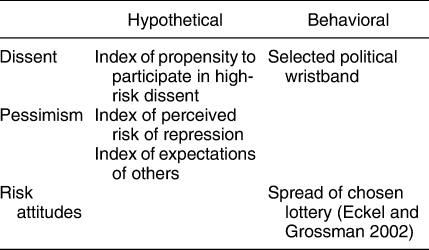
After the emotion induction, participants went through a series of modules to measure outcomes.Footnote 7 Five main outcomes were measured. Table 1 breaks these down by whether they measure dissent or the posited psychological mechanisms and by whether they are behavioral or hypothetical measures.
Hypothetical and Behavioral Outcome Variables

I measured propensity to dissent using both hypothetical and behavioral measures. Whereas hypothetical measures are the only way to measure high-risk acts of dissent without putting participants at unjustifiable risk, including one behavioral measure of a low-risk act of dissent increases confidence that fear has an effect on actual behavior, and not only the way that participants answer survey questions. The main hypothetical measure of dissent is based on an index of twelve questions. I asked participants to assess their propensity to participate in six acts of dissent: wearing an opposition party t-shirt, sharing a funny joke about the president, going to an opposition rally, refusing to go to a rally for the ruling party, telling a state security agent that she supports the opposition, and testifying in court against a perpetrator of violence. They were asked about these six items both for the current (non-election) period and for the period around the next election, when risks are heightened. The items were selected to be contextually relevant and to span a range of risk levels.
For the behavioral measure of dissent, I measured whether participants chose to take a plastic wristband with a pro-democracy slogan on it over an otherwise similar plain wristband as a thank you gift for participating in the study. Although the message was subtle and the band was not affiliated with any particular opposition group, participants were told by the enumerator that the pro-democracy wristband will “show your political beliefs” and read the written text on the band, then shown that the other wristband has no political message. Because the wristbands are otherwise similar in appearance and value, choosing the political wristband can be interpreted as participation in a low-risk act of dissent.
Pessimism about the risk of repression and about the participation of other opposition supporters in dissent were also measured using twelve-question indices. To measure perceptions of repression risks, participants were asked about six types of repression in two periods: threats, assault, destruction of property, sexual abuse, abduction, and murder. To measure perceptions of other opposition supporters, participants were asked about the proportion of other opposition supporters that would engage in the same six acts of dissent.
Finally, I measured risk attitudes in a financial domain using an incentivized game developed by Eckel and Grossman (Reference Eckel and Grossman2002). In the game, participants play four 50–50 lotteries by choosing from five different bets with increasing spreads, or level of risk. Across the four lotteries, there are two standard conditions, one condition with ambiguity, and one with losses. From these I constructed several measures: risk aversion, ambiguity aversion, and loss aversion. Due to its reliance on 50–50 coin flips, this measure is effective with a participant pool that includes low-numeracy individuals. One of the four rounds was randomly selected to be paid out for a value between 0 and $1.10.
As a manipulation check, participants’ current emotional states were measured on a four-point scale after the last outcome measure. I included this manipulation check after the substantive measures because there is evidence that asking participants to report their emotional states can reduce the extent to which they actually feel the targeted emotion (Kassam and Mendes Reference Kassam and Mendes2013; Keltner, Locke, and Audrain Reference Keltner, Locke and Audrain1993). Measuring emotions after the substantive outcomes also tests whether the emotions were induced throughout the course of all the outcome modules.
The outcome variables used in the main hypothesis tests are mean effects indices based on all of the subindicators for the hypothetical measures (Kling, Liebman, and Katz Reference Kling, Liebman and Katz2007). Within each hypothetical outcome module, the order of the questions was randomly assigned.
Implementation and Ethics
The safety of participants and the research team was a first-order concern in the design and implementation of this study. This section provides a brief overview of the ethical principles that guided the project, and the procedures that I put in place to try to adhere to them. A more complete description of the ethical considerations and procedures that I used is included in Appendix D.
The experiment was carried out by the Zimbabwean NGO Voice for Democracy (VfD), which conducts research and organizes communities to prevent and respond to political violence. VfD’s existing networks and local knowledge were crucial to safely carry out this study as the research team could leverage existing social ties to recruit participants and establish trust. Their local reputation also helped reduce the risk of biased data.
Importantly, the threat of violence during this period was low. The ruling party had a comfortable cushion of popularity and was preoccupied with its own internal politics. Political violence in September 2015 and the preceding months was infrequent and entailed largely low-level acts of intimidation or harassment, much of it perpetrated against ZANU-PF members (Zimbabwe Peace Project 2015). Nevertheless, I took a number of steps to protect participants and the survey team from the risks of retribution and re-traumatization.
The primary ethical concern was that participants might be subject to retribution for participating in the study or for their responses through a breach of confidentiality. To minimize this risk, interviews were carried out in private homes. No identifying information was collected, and consent was obtained verbally so that a written consent document would not link participants to their data. Data were collected on password-protected tablets, and immediately after each interview the data were sent to a server and deleted from the tablet. To prevent participation from being tracked, interviewees were recruited by VfD’s community-based mobilizers and the VfD team spent no more than a few non-consecutive days at each site. VfD also used its network to monitor whether there was any retribution after their team left, including attempts to track possession of the orange wristbands. We received no reports of breaches of confidentiality, retribution, or attempts to track participation.
A second concern was that participants could become retraumatized. I judged this risk to be sufficiently low given that the AEMT has been used in numerous studies, including some with participants exposed to political violence in Afghanistan and Colombia (Bogliacino et al. Reference Bogliacino, Grimalda, Ortoleva and Ring2017; Callen et al. Reference Callen, Isaqzadeh, Long and Sprenger2014) and is similar to established therapeutic practices for anxiety and PTSD (Rothbaum and Schwartz Reference Rothbaum and Schwartz2002; Steinman, Wootton, and Tolin Reference Steinman, Wootton, Tolin and Friedman2016). Nevertheless, I set up systems to monitor, prevent, and address retraumatization. The first way I minimized this risk was by selecting a survey team that had past experience working with survivors of violence and pursued a mission to prevent and mitigate violence. Second, during surveyor training, we developed specific, contextually appropriate guidelines for how to recognize and respond to trauma by pausing or stopping the interview and how to conduct a postinterview debrief to bring participants back to a neutral emotional state. These practices were evaluated and reinforced during surveyor debriefing sessions at the end of each day. Third, surveyors assessed whether or not each participant needed professional counseling as a result of the interview and the team had a plan to refer traumatized participants to a well-respected counseling center. Ultimately, the surveyors did not identify any participants who were so upset during the interview that they needed referral to counseling.
These steps minimized but did not eliminate the risk to participants. To this end, the recruitment and consent processes clearly stated that the interview would cover sensitive political topics that could upset participants, while carrying no direct benefits.
The third set of ethical concerns was around the safety of the research team, which was not explicitly considered during the review by my university’s Institutional Review Board. Moving quickly between communities and using local mobilizers to recruit participants also reduced risks to the surveyors. The local mobilizers also assessed the security situation in each community before the surveyors arrived. Finally, the questionnaire asked participants about their party identification early on to identify regime supporters who had mistakenly been recruited into the study. In these cases, surveyors were trained to skip all sensitive questions. Out of the target of 700, three recruited participants ended up being regime supporters, and in all cases the surveyors followed the protocol appropriately.
In addition to these ethics considerations, another implementation challenge in this authoritarian environment was the risk of biased responses. I believe that VfD’s local reputation reduced the under-reporting of sensitive opinions and behaviors.Footnote 8 However, only bias that differentially affects the responses of the treatment and control groups could bias the estimates of the effect of fear reported here. To minimize bias that could be correlated with the emotion induction treatments, I kept the surveyors and team leader blind to my hypotheses, although it was necessary that they understood that the emotion induction was designed to affect participants’ behavior. When asked what patterns I expected, they reported that they had no expectations. Keeping participants and surveyors blind to the hypotheses reduced the risk that their behavior could be shaped by desirability bias.
Participant Recruitment and Randomization
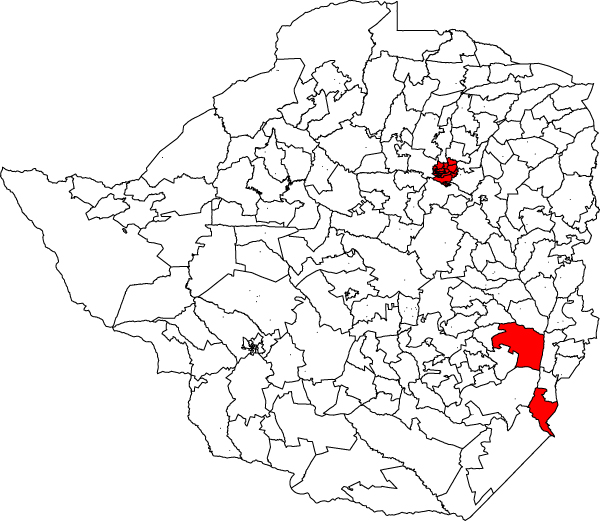
I recruited 671 participants from six communities in Zimbabwe where VfD has a network of mobilizers and informants and which have also been affected by state-sponsored violence since 2000. Half of the participants were recruited in the southern suburbs of the capital city Harare, and half from rural areas in Masvingo and Manicaland provinces in southern and eastern Zimbabwe. Figure 1 displays a map of the study constituencies.
Map of Constituencies Included in the Study

All of Harare is highlighted for display purposes.
The recruitment strategy produced a mix of opposition activists and sympathizers. The surveyors started by interviewing the activists who were working as VfD mobilizers so that they understood the sensitive content of the study, and then asked them to recruit opposition supporters, including those who were afraid to openly participate in opposition politics. Ultimately, 15% of the sample reported that they have not attended an opposition rally, and 41% reported that they have not volunteered for an opposition party, suggesting that the participant pool has a mix of activists and sympathizers.Footnote 9
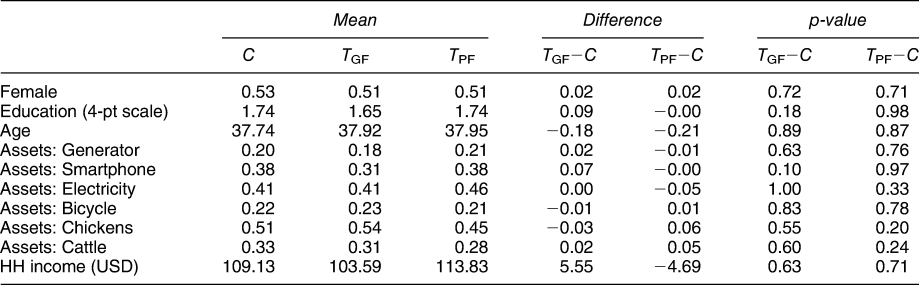
Table 2 presents summary statistics and tests of whether treatment assignment was balanced across important covariates. Just more than half of study participants are female. The median respondent has a high school degree and is 35 years old. There is significant variation in asset ownership: around one in five participants owns a generator, more than one in three owns a smartphone, 43% have electricity in their home, almost one-third own cattle, and around 50% own chickens. The median monthly household income is $55.
Summary Statistics and Balance on Baseline Covariates

C refers to the control group, T GF refers to the general fear treatment, and T PF refers to the political fear treatment.
Treatment assignment was blocked by surveyor, day, and participant gender. Participants were randomly assigned into one of the three treatment groups using “survey dictionaries”, or sheets that indicated which treatment assignment the surveyor should enter into the tablet for the n-th participant of k gender on a given day of surveying. Balance tests do not indicate any failures in the randomization procedure.
The average respondent has experienced significant past repression. Since the year 2000, 83% of the control group reported that, in the context of political violence, they had experienced verbal abuse or threats, 63% withholding of benefits such as food or goods, 32% torture, 38% destruction of property, 38% assault, 14% abduction, 17% arbitrary arrest or detention, 3% sexual violence, and 2% murder. Surveyors defined “experience” for the respondent as something that happened to you or someone in your household. Because these variables were measured post-treatment, I only report statistics for the control group. These numbers suggest an extremely high level of victimization, but evidence suggests that this may not be far from the average experience in Zimbabwe. A nationally representative study carried out in 2009 found similar levels of victimization, including that 70% of Zimbabwean opposition supporters had experienced threats or intimidation, 39% had experienced personal injury, and 44% had experienced property damage (author’s own analysis of data in Bratton Reference Bratton2011).Footnote 10
RESULTS
The Effect of Fear on Dissent
This section presents tests of whether the fear treatment reduces participation in dissent. I test this prediction using both the hypothetical index based on how likely participants say it is that they would take action and the behavioral wristband measure.Footnote 11
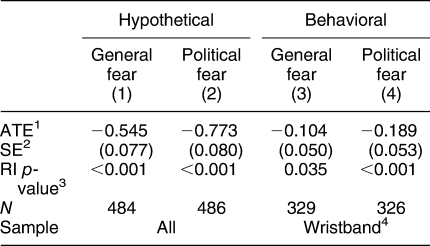
Table 3 presents the results. In Columns 1 and 2, I present the estimated average treatment effect (ATE) and measures of uncertainty for the general and political fear treatments, respectively, on the hypothetical index of propensity to dissent. Columns 3 and 4 present the same for the behavioral measure based on whether a participant took the political wristband. The first row presents the ATE and the second presents estimated standard errors from linear regression. The third row presents p-values calculated using randomization inference. Assuming that there is no treatment effect for any unit, randomization inference uses the actual distribution of the outcome in the data to calculate a test statistic rather than an assumption that the outcome follows a particular distribution (Fisher Reference Fisher1935). Although randomization inference may not always be preferable to methods that rely on the assumption of a particular distribution, in this case because most of the outcomes that I investigate are not normally distributed, it is particularly appropriate (Gerber and Green Reference Gerber and Green2012).
The Fear Treatments Reduce Dissent

1 The first row presents the estimated average treatment effects (ATEs) of the general and political fear treatments on the hypothetical measure of propensity to dissent in columns 1 and 2, and the behavioral measure in columns 3 and 4. ATEs are calculated based on assignment to treatment and weighted by inverse propensity scores by block.
2 Robust standard errors (SEs) from linear regression analysis.
3 The p-value is based on a two-tailed test using randomization inference.
4 The estimate of the treatment effect on the wristband measure comes from the subset of the sample respondents who were offered a choice between two real wristbands. Results are similar for the full sample.
Table 3 shows that participants who receive the fear treatment report a lower likelihood of expressing dissent, and are less likely to take the wristband with a pro-democracy slogan. These effects are substantively large and statistically significant.Footnote 12 The general and political fear treatments reduced how likely participants said they were to take action on the hypothetical measure by 0.55 and 0.77 standard deviations, respectively. The fear treatments reduced the proportion of respondents who took the political wristband by 10 percentage points in the case of the general fear treatment and 19 percentage points in the case of the political fear treatment.Footnote 13 The effect of fear is consistent across the 12 subindicators that make up the hypothetical dissent index.Footnote 14
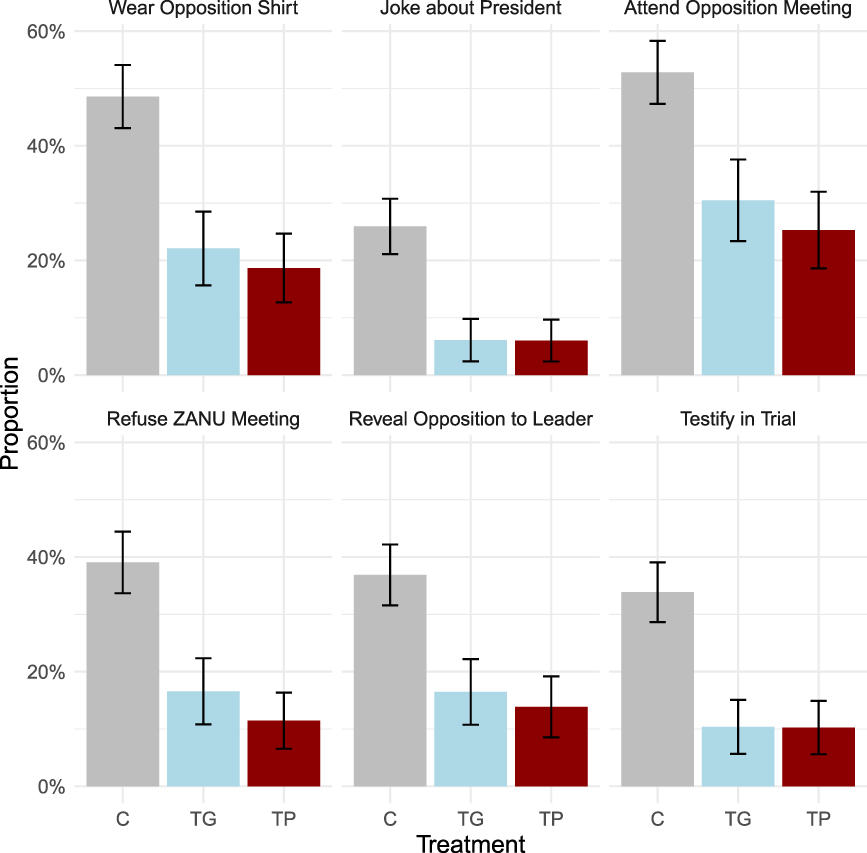
These reductions in dissent are substantively important. To illustrate the substantive changes, Figure 2 shows that the proportion of participants who say that they are “very likely” or “sure” to take the hypothetical political actions during an election period drops by substantively large amounts for participants assigned to the fear condition.
The Fear Treatments Cause Substantively Large Increases in the Proportion of Respondents Who Are Very Likely or Sure to Dissent During an Election Period

Figure 2 shows that the fear treatment causes large decreases across all six hypothetical measures. For example, although 28% of people in the control group said they were very likely or sure to share a joke about the president during an election period, just 7–8% of respondents in the fear treatment groups reported the same high propensity to dissent by sharing a joke.Footnote 15 This represents a 70–77% reduction in the proportion of respondents who say they are likely to take that action.
The Effect of Fear on Pessimism and Risk Aversion
The first results provide strong support for the prediction that the fear treatment has a causal effect on participation in pro-democracy political action. In this section, I test whether the treatment affects the variables that I posited as mechanisms—namely, that fear increases pessimism around the cost of expressing dissent and risk aversion. I test the effect of the fear inductions on three outcomes: the index of expectations about how many other opposition supporters will take pro-democracy action, the index of the perceived risk of repression associated with attending a protest, and the amount of risk that the participant chose to take on the monetary lottery in exchange for a higher expected payoff.Footnote 16
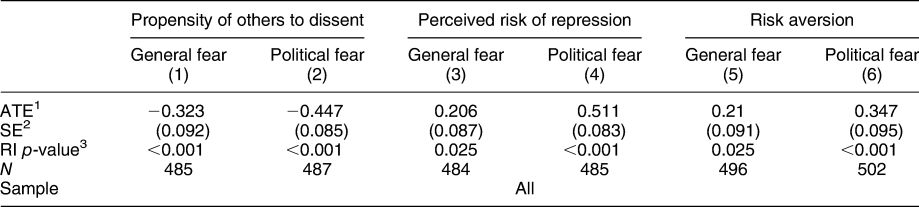
Table 4 shows that fear causes increases in pessimism and risk aversion. In Columns 1 and 2, I present the estimated average treatment effect (ATE) and measures of uncertainty for the general and political fear treatments, respectively, on the perceived proportion of other opposition supporters who will express dissent. Columns 3 and 4 present the results for the perceived likelihood of repression, and Columns 5 and 6 present the effects on risk attitudes.
The Fear Treatments Increase Pessimism and Risk Aversion

1 The first row presents the estimated average treatment effects (ATEs) of the general and political fear treatments on beliefs about the likelihood that other opposition supporters will engage in dissent in columns 1 and 2, on the perceived likelihood of repression in columns 3 and 4, and on risk aversion in columns 5 and 6. ATEs are calculated based on assignment to treatment and weighted by inverse propensity scores by block.
2 Robust standard errors (SEs) from linear regression analysis.
3 The p-value is based on a two-tailed test using randomization inference.
Table 4 shows that both the political and general fear treatments cause participants to become more pessimistic in their estimation of parameters in the expected cost of expressing dissent, and more risk averse. Columns 1 and 2 show that the general fear treatment reduced the perceived propensity of other opposition supporters to engage in dissent by 0.32 standard deviations, whereas the political fear index reduced expectations of others by 0.45 standard deviations. In real terms, whereas 39% of participants in the control group believe that most or all other opposition supporters in their communities would attend an opposition rally, in the general fear treatment group just 30% believe this and in the political fear condition just 20% do.
These treatment effects are larger for assessments of others’ actions during election periods and for more contentious actions, although the differences between the treatment effects are not statistically significant. Tables with these results on individual measures are presented in Appendix G.2.
Columns 3 and 4 in Table 4 show that both political and general fear also increase expectations that participants will personally be the victims of repressive violence if they attend an opposition rally. The general fear treatment increased the perceived risk of repression by 0.21 standard deviations, and the political fear treatment increased perceived risk by 0.51 standard deviations. In real terms, 68% of participants in the control group think that it is very likely or sure that they would be beaten up if they attended an opposition rally during an election period compared to 74 and 90% in the treatment groups. These treatment effects are again larger during election periods and generally slightly larger for acts of repression that people judged to be more probable at an opposition rally, such as threats, assault, and destruction of property. They were lowest for sexual violence, which respondents generally judged unlikely.
Finally, Columns 5 and 6 show that participants in the treatment groups exhibited more risk aversion than participants in the control group, meaning that they chose lotteries with lower level of risk and a lower expected payout. The general and political fear treatments caused increases of 0.21 and 0.35 standard deviations compared to control in the estimated risk aversion of the treatment participants based on the spread of the lottery that respondents chose to play in a 50–50 draw. One in four (26%) respondents in the control group seem to have no aversion to risk, indicated by the fact that they chose the riskiest lottery with a spread of $1.10 despite the fact that its expected payout ($0.55) was equal to that of the second riskiest lottery with a spread of $0.90. In the general and political fear treatment arms, however, 17% of respondents chose the lottery with the highest spread, and much larger proportions of respondents chose lotteries with lower expected utilities in exchange for higher sure payouts.Footnote 17 If individuals’ attitudes toward risk are stable across domains, these results indicate that fearful citizens making decisions about whether or not to participate in dissent would need to perceive that the potential gains of participation actually outweigh the potential losses by a larger amount than citizens not experiencing fear.
Interpretation: Substantive Mediation Analysis
The results presented so far based on assignment to the experimental treatment show that the fear treatment caused reductions in dissent and increases in the proposed psychological mechanisms of pessimism and risk aversion. Are the proposed psychological mechanisms actually mediating the relationship between the treatments and dissent? Do some of the psychological mechanisms seem to play a larger role than others? A simple experimental research design with a single treatment does not allow me to conduct a causally identified test of this mediation effect. However, in this section, I use a method developed by Imai and Yamamoto (Reference Imai and Yamamoto2013) to estimate the average causal mediation effect (ACME) of each of the psychological outcomes conditional on other potential observed mediators.
The Imai and Yamamoto (Reference Imai and Yamamoto2013) method enables estimation of the ACME if we accept two identifying assumptions. First, the “sequential ignorability” assumption requires that the treatment, mediator of interest, and alternative mediators are conditionally exogenous. However, the mediator of interest is only assumed to be exogenous after conditioning on the alternative mediators, treatment, and pretreatment confounders. In addition, we must either assume no interaction between the treatment and mediator or set the correlation between the mediator and the interaction of the mediator and treatment as well as its standard deviation, by assumption. This mediation analysis was not pre-registered, although the causal logic that changes in dissent should be mediated by changes in risk perceptions and risk aversion was and so should also be interpreted as more exploratory than the design-based analyses presented in the previous sections.
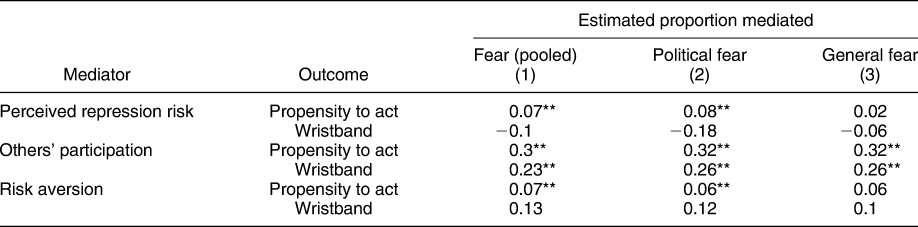
With these caveats, Table 5 presents the proportion of the effect on the two dissent outcomes—propensity to act and wristband—that is estimated to be mediated by the three psychological outcomes. The first column of the table presents the estimated proportion mediated for the pooled version of the fear treatment, whereas the second and third columns present the estimated proportion mediated for the political fear and general fear versions of the treatment separately. A full table with the estimated coefficients for all ACMEs and average direct effects (ADEs) is presented in Appendix E.
Pessimism and Risk Aversion Mediate the Effects on Dissent

** Indicates that 95% confidence intervals for the ACME do not include zero.
The estimated proportion of the effect mediated is presented in the table.
The first column presents the results from a mediation analysis where the treatment variable indicates that the participant received either fear treatment. The second column presents the results of a mediation analysis on the general fear treatment compared to control, and the last two columns present the same for the political fear treatment.
Table 5 presents suggestive evidence that all three psychological outcomes mediate the changes in dissent. Each of the individual mediation effects is found to mediate between 0 and 32% of the total effect of the treatment. In the pooled version of the treatment, 23% of the variation in the wristband measure and 44% of the variation in the hypothetical index can be explained by the proposed mechanisms.Footnote 18 The fact that not all of the effect of the treatments on dissent is mediated by these perceptions and risk aversion could suggest that the treatments are affecting dissent in ways that are precognitive (what Frijda (Reference Frijda1986) would call “action tendencies”) or that they are triggering shifts in values or other perceptions or preferences that I did not measure. The full table of results, including the estimated ACMEs with confidence intervals, are available in Appendix E.
This analysis suggests that the strongest mediator for both general and political fear is pessimism about how many other opposition supporters will engage in dissent. This effect is in line with findings in the theoretical literature that suggest that small changes in the propensity of some individuals’ dissent behavior can have large effects on the level of dissent in the population when participation has strategic complementarities (Kuran Reference Kuran1991; Little Reference Little2017). Risk aversion is also a significant mediator of the effect of the political fear treatment on both measures of dissent and is estimated to mediate a similar proportion of the general fear treatment on the dissent outcomes although these mediation effects are not statistically significant. Interestingly, the perceived risk of repression is found to be the weakest mediator in this analysis, holding constant perceptions of other opposition supporters’ propensities to participate in dissent and risk aversion. If participants view the risk of repression as the state’s propensity to repress averaged over the number of dissenters, this may suggest that the observed increases in the perceived risk of repression are largely driven by pessimism about how many other opposition supporters will coordinate on dissent.
This interpretation should be tested in the subsequent research. As stated above, to the extent that there are unmeasured alternative mediators that are correlated with the treatment, mediators, and outcomes, this analysis does not provide a consistent estimate of the ACME. Nevertheless, the consistency with the theoretical literature highlighting strategic complementarities is worth noting. Subsequent empirical studies should further unpack how secondary beliefs about others’ participation affects the perceived risk that an individual will face repression.
Manipulation Check
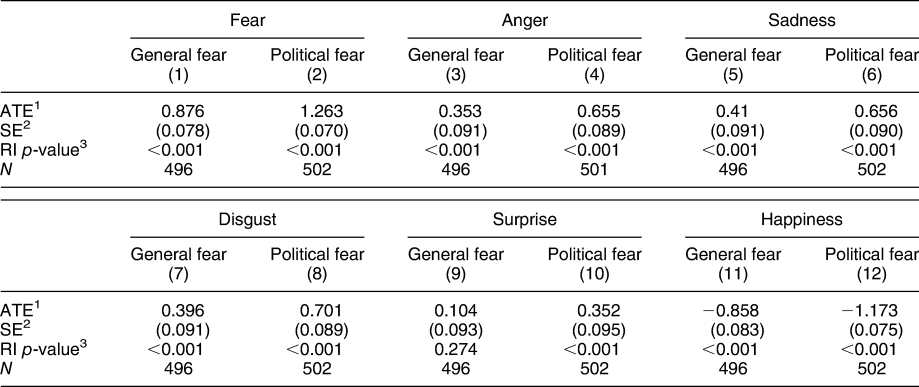
The procedures that I used to induce emotions asked treatment participants to reflect on a situation in which they felt afraid. However, in practice, emotion inductions often induce multiple emotions of a similar valence. This section presents a manipulation check that tests the extent to which the reflection tasks induced fear and five other primary emotions. Table 6 shows that the treatments induced high levels of fear and to a lesser extent increased other negative emotions and decreased happiness.
The Fear Treatments Increase Fear by More Than Other Negative Emotions

1 The odd columns present the estimated average treatment effects (ATEs) of the general fear treatment, and the even columns present that of the political fear treatment. Columns 1 and 2 present the results for the outcome of Fear, 3 and 4 for Anger, 5 and 6 for Sadness, 7 and 8 for Disgust, 9 and 10 for Surprise, and 11 and 12 for Happiness. ATEs are calculated based on assignment to treatment and weighted by inverse propensity scores by block.
2 Robust standard errors (SEs) from linear regression analysis.
3 The p-values are based on a two-tailed test using randomization inference.
Because the manipulation checks show that the fear treatments increased not only fear but also other negative emotions, and decreased happiness, the treatment should be interpreted as a bundle of negative emotions, of which fear is the strongest. This finding that emotions in general matter for high-risk political participation is in itself important given the focus of much of the current rational choice literature and lack of previous empirical tests. In addition, the effect of a bundle of negative emotions induced by reflecting on something frightening is a very close approximation of the way that fear is actually induced in authoritarian regimes. As a result, these effects are substantively interesting even if we cannot precisely attribute them to fear rather than anger, sadness, or other emotions.
Nevertheless, it is substantively interesting to assess the extent to which fear specifically is driving the observed effects. To provide a suggestive test of whether the emotion of fear is driving the observed changes in dissent and psychological parameters relevant to the dissent decision, I again use the Imai and Yamamoto (Reference Imai and Yamamoto2013) methodology. This method depends on the assumption that all other potential mediators are measured and included in the analysis. Although this assumption is generally quite strong, in this case, considering that the research design has eliminated the possible effects of new information or selection into emotions based on personal characteristics, it may be plausible that the only potential alternative mediators are the five other primary emotions that I measure and include as conditioning variables in my estimation of the ACME of fear.
Assuming there are no unmeasured alternative mediators, the analysis finds that fear mediates between 52 and 76% of the relationship between the pooled treatment assignment and the beliefs, preferences, and behaviors of interest. In the case of the political fear treatment, this analysis finds that fear is a statistically significant mediator of all of the changes in the substantive outcomes besides risk aversion. In the case of the general fear treatment, this analysis finds that fear is a statistically significant mediator of only the effects on the hypothetical dissent measure and risk aversion. However, even when the ACME of fear is not statistically significant, the proportion of the treatment effect that it is estimated to mediate is still quite large, varying from 43 to 83% of the ATE.
By contrast, tests of whether other emotions mediate the relationship between the treatment and the outcomes of interest largely fail to find significant or substantively large effects. There is some evidence that sadness may mediate the effect of the treatment on dissent, but it is found to explain 15% of the total effect in comparison to 75% for fear and does not seem to mediate the effects on the psychological outcomes. There is no evidence that anger, disgust, surprise, or happiness can explain the observed effects, and in a few cases may even work against the observed relationships. Overall, these results strongly suggest that fear induced by the treatments is responsible for a large majority of the treatment effects and that other emotions explain very little or none of the effects. Full results of this analysis are presented in Appendix F.
This manipulation check also helps interpret the differences between the general and political fear treatments. The estimated effects of the political fear treatment are consistently larger than those of the general fear treatment, although this difference is only significant for two out of five substantive outcomes (full results presented in Appendix G). It is possible that the political fear treatment is activating pre-existing memories of past trauma that affect the outcomes through a more cognitive channel. However, the results of the manipulation check suggest that the political fear treatment may have a stronger effect on the outcomes simply because it is inducing more fear.
CONCLUSION
Qualitative scholars have long argued that emotions play a critical causal role in dissent through a number of different channels. However, most of the theoretical work that currently dominates the study of participation in protest and other forms of dissent assumes that citizens rationally update their beliefs about the costs and benefits of protest based on informational signals. This is, to my knowledge, the first identified empirical test of the causal effects of emotions on high-risk dissent and on psychological mechanisms that might mediate the relationship between emotions and dissent. The results suggest that emotions do play an important causal role. However, emotions do not seem to overwhelm strategic considerations in dissent decisions, in contrast to common perceptions. Instead, they change behavior by affecting the parameters that enter into cost–benefit decisions about dissent, including the perceived risk of repression, risk aversion, and strategic considerations such as beliefs about the number of other opposition supporters who will engage in dissent. These findings imply that theories of dissent based on emotions and strategic considerations are complements rather than exclusive alternatives. In addition, they suggest that in highly repressive environments, participation in dissent is characterized by strategic complementarities: the more other citizens participate in dissent, the more likely an individual is to decide that the potential costs are outweighed by the potential benefits.
A handful of existing models provide promising ways forward and suggest that incorporating emotions and other psychological dynamics into protest models does in fact change the equilibrium predictions. Little (Reference Little2017) shows that the existence of just a small number of non-strategic citizens can have large equilibrium effects in a coordination game between citizens and a regime. In a 2009 model, Lupia and Menning (Reference Lupia and Menning2009) show that modeling fear as temporarily making citizens non-strategic has implications for the type of issues and contexts in which citizens can be manipulated into supporting a regime that they otherwise would oppose. Finally, in related work I explore how the three psychological mechanisms identified in this experiment can be added into a global game (Aldama, Vasquez, and Young Reference Aldama, Vasquez and Young2018). These models begin to bridge the gap between individual-level psychological explanations for citizen behavior in autocracy and equilibrium models where citizen dissent is a strategic complement or substitute. They show that incorporating more realistic assumptions about cognition into formal models can have important implications for understanding when mass dissent will emerge.
This research also has implications for the study of autocratic persistence. A growing strand of the autocracy literature argues that autocrats persuade citizens to offer genuine support rather than coerce them to falsify their preferences (Gehlbach, Sonin, and Svolik Reference Gehlbach, Sonin and Svolik2016). A formal literature that explicitly focuses on the role of propaganda and censorship as tools of persuasion largely focuses on how Bayesian citizens update their beliefs based on potentially biased information (Egorov, Guriev, and Sonin Reference Egorov, Guriev and Sonin2009; Gehlbach and Sonin Reference Gehlbach and Sonin2014; Shadmehr and Bernhardt Reference Shadmehr and Bernhardt2015). The evidence presented here that even non-political forms of fear can reduce dissent suggests that the emotional valence of the media rather than the informational content might be an important active ingredient in an autocrat’s media strategy. A recent empirical literature provides some corroborating evidence that the way that events are covered in the media in autocratic regimes may play an important role in autocratic media manipulation. These studies focus not only on information but on the valence of language or causal attributions with which events are discussed as mechanisms through which autocratic media might affect citizen dissent (Carter and Carter Reference Carter and Carter2016; Rozenas and Stukal Reference Rozenas and Stukal2017). Additional research should consider how foreign or internal threats are covered in authoritarian media as well as on the symbolic politics emphasized in some of the qualitative literature on autocracy (Arendt Reference Arendt1951; Wedeen Reference Wedeen1998).
Finally, these findings have implications for the study of repression itself. Much of the existing literature on the effects of repression has aggregated forms of violence that vary widely in their severity and targeting into a single independent variable, often based on the frequency or severity of violent events in a particular period (Carey Reference Carey2006; Francisco Reference Francisco1995; Moore Reference Moore1998). However, it is likely that some forms of violence induce more fear than others. Extremely brutal, public, or counter-normative forms of repression may be more likely to induce fear than imprisonment or lower-level violence. Indiscriminate violence may induce more fear than targeted forms, which may help explain why violence against civilians is used despite its apparently low value as a deterrent. Studies that have disaggregated repression into discriminate versus indiscriminate forms, or by levels of severity (Khawaja Reference Khawaja1993; Rasler Reference Rasler1996; Young Reference Young2017), to examine whether repression with different characteristics might have different effects on dissent, suggest a promising way forward. Finally, given the significant variation in beliefs about the risk of repression that this project measures, more empirical work should be carried out that actually measures the effect of repressive threats on citizen beliefs about the cost of dissent.
SUPPLEMENTARY MATERIAL
To view supplementary material for this article, please visit https://doi.org/10.1017/S000305541800076X.
Replication materials can be found on Dataverse at: https://doi.org/10.7910/DVN/OOMI57.




Comments
No Comments have been published for this article.