INTRODUCTION
Ovine toxoplasmosis, caused by the obligatory intracellular protozoan parasite Toxoplasma gondii, was first described in New Zealand by Hartley et al. (Reference Hartley, Jebson and McFarlane1954) as a significant cause of abortion in sheep, and thereafter was recognized in many other countries (Buxton et al. Reference Buxton, Maley, Wright, Rodger, Bartley and Innes2007). While T. gondii does not appear to cause any significant clinical disease in sheep, congenital infection can cause reproduction disorders such as early embryonic death, fetal resorption, mummification, abortion, stillbirth, neonatal and fetal death in sheep (Blewett and Watson Reference Blewett and Watson1983; Johnston,Reference Johnston1988; Buxton, Reference Buxton, Martin, and Aitken1991; Givens and Marley, Reference Givens and Marley2008) and evidence suggests that this route of transmission may be much more significant than previously assumed (Duncanson et al. Reference Duncanson, Terry, Smith and Hide2001; Williams et al. Reference Williams, Morley, Hughes, Duncanson, Terry, Smith and Hide2005; Hide et al. Reference Hide, Morley, Hughes, Gerwash, Elmahaishi, Elmahaishi, Thomasson, Wright, Williams, Murphy and Smith2009). Further, more recent molecular studies in England showed that repeated ovine transmission of T. gondii may be more common than previously believed (Morley et al. Reference Morley, Williams, Hughes, Terry, Duncanson, Smith and Hide2005, Reference Morley, Williams, Hughes, Thomasson, Terry, Duncanson, Smith and Hide2007; Hide et al. Reference Hide, Morley, Hughes, Gerwash, Elmahaishi, Elmahaishi, Thomasson, Wright, Williams, Murphy and Smith2009; Innes et al. Reference Innes, Barley, Buxton and Katzer2009; Dubey, Reference Dubey2009). Consumption of infected meat from sheep is considered as a source of T. gondii infection in humans and carnivores (Dubey, Reference Dubey2009).
Different techniques have been used to detect the infection in aborted fetuses. One of the most widely used diagnostic tests is the PCR assay on fetal brains of infected animals (Ortega-Morta et al. Reference Ortega-Morta, Gottstein, Conraths and Buxton2007; Dubey, Reference Dubey2009). Comparison of different conventional PCR methods has shown that Nested-PCR amplification of the B1 gene of the organism is one of the most sensitive and specific (Burg et al. Reference Burg, Grover, Pouletty and Boothroyd1989; Jones et al. Reference Jones, Okhravi, Adamson, Tasker and Lightman2000; Mason et al. Reference Mason, Quinnell and Smith2010). Detection of anti-Toxoplasma gondii antibodies in ewe's serum is also a very useful method for comparison of the data achieved for fetuses (Hurtado et al. Reference Hurtado, Aduriz, Moreno, Barandika and García-Pérez2001). However, detection of anti-Toxoplasma gondii antibodies in maternal serum may not be interpreted as an indicator of cause and effect phenomenon for the abortion associated with this pathogen. In contrast, identification of the genome of the organism in the brain, achieved by molecular approaches, definitely confirms an active infection process.
The aims of this study were 3-fold. (1) To set up an easy, rapid and economical conventional molecular technique for the detection of Toxoplasma-induced abortion in laboratories around the world, more specifically in developing countries which can not afford to use more modern molecular assays, such as Real-time PCR. (2) To track the involvement of T. gondii in ovine abortion in Khorasan Razavi Province, Iran. (3) To assess the correlation of data achieved by molecular methods with the serological response of infected ewes.
MATERIALS AND METHODS
Samples and tissue collection
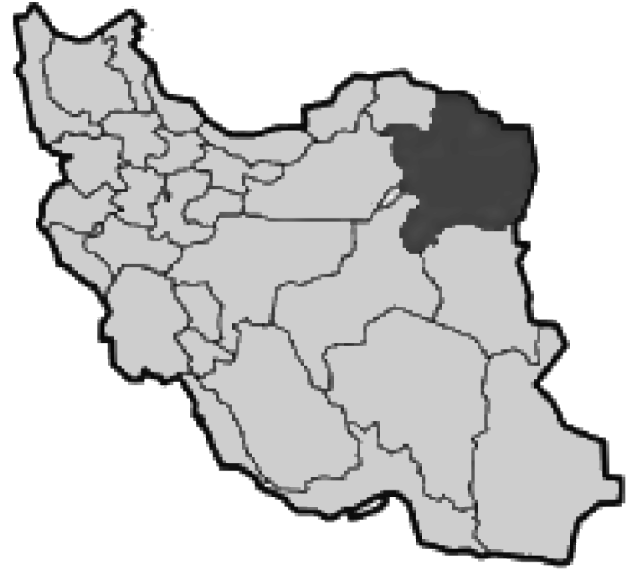
This investigation was conducted on samples collected from 200 aborted ovine fetuses all across the Khorasan Razavi Province, north-east of Iran (Fig. 1). These samples were submitted to the Center of Excellence in Ruminant Abortion and Neonatal Mortality, School of Veterinary Medicine, Ferdowsi University of Mashhad, Iran, from 2006 to 2010. The general status of each fetus such as freshness, autolysis, mummification and presence of macroscopic lesions in the fetus and fetal membranes was examined and recorded. To estimate the conception age of the fetuses, crown-rump length was measured (Evans and Sack, Reference Evans and Sack1973). One-half of fetuses’ brains were collected in such a way that no cross-contamination occurred, which was followed by storage at −20°C for PCR analysis. Furthermore, maternal serum samples of these 200 aborted fetuses were collected and stored at −20°C to be assayed by the indirect fluorescent antibody test (IFAT).
Map of the Khorasan Rasavi Province, in north-east Iran.

IFAT on maternal sera
The presence of Toxoplasma antibodies in maternal serum was assessed by IFAT, as previously described by Razmi and Rahbari (Reference Razmi and Rahbari2001). The IFAT was run on 10-well glass slides, with each well covered with in vitro-produced tachyzoites of the RH strain of T. gondii (Bio gene®, Iran). Sera were diluted 1:20 in PBS, then 5 μl of a positive-control, 5 μl of a negative-control and 5 μl of diluted test samples were added to the wells. The slides were then incubated for 30 min in a humid chamber at room temperature. After washing the slides 3 times for 10 min in PBS, 5 μl of rabbit-anti-sheep IgG conjugated to FITC (Sigma®, St Louis, Missouri) were added (conjugate dilution was 1:500 in 0·2% filtered Evan's blue dye in PBS). Incubation with the secondary antibody was carried out for 30 min at room temperature in a humid chamber. The slides were subsequently washed again 3 times in PBS for 10 min. For fluorescence microscopy, buffered glycerol was added to the slides and they were then covered by cover-slips.
DNA extraction and nested-PCR assay
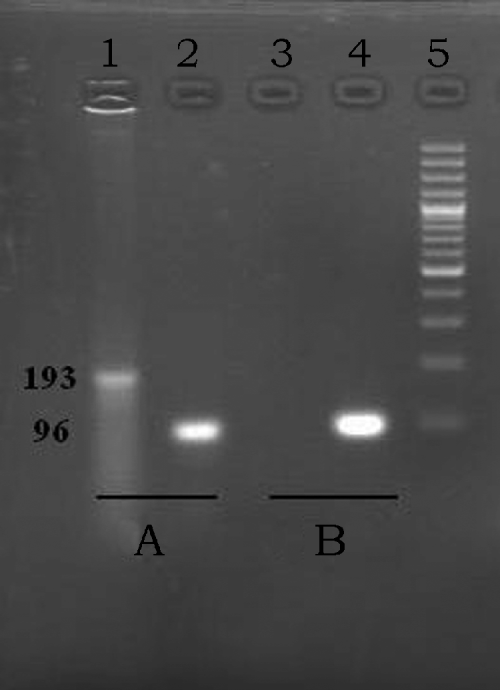
Frozen fetal brain tissues were homogenized by mortar and pestle in Tris-HCl (pH 8·0) followed by treatment with proteinase K (Fermentas®, Lithuania) at a final concentration of 200 μg/ml. DNA was extracted by use of the phenol-chloroform and ethanol precipitation method. The purified DNA samples were resuspended in 20 ml of TE (10 mm Tris and 1 mm EDTA, pH 8·0) and stored at −20°C. DNA extracted from 106 particles of the RH strain of T. gondii (kindly provided by The School of Public Health and Institute of Public Health Research, Tehran University of Medical Sciences, Tehran, Iran) were used as a source of positive control sample. DNA samples were tested by Nested-PCR based on the amplification of high copy number B1 target gene (35 copies per parasite) using 2 sets of oligonucleotide primers as described by Burg et al. (Reference Burg, Grover, Pouletty and Boothroyd1989), as presented in Table 1. Amplification was conducted in 20 μl reaction volumes (Accupower PCR premix kit, Bioneer®, South Korea) with a final concentration of each dNTP of 250 μ m in 10 mm Tris-HCl pH 9·0, 30 mm KCl and 1·5 mm MgCl2, 1 U Taq DNA polymerase and 10 pmol of each PCR primer (Takapouzist Co. Iran). Then 1 μl of DNA template (250–500 ng) was added to each reaction and the remaining 20 μl reaction volume was filled with sterile distilled water. Slight modifications including the PCR conditions and elimination of the gelatin were employed. The reactions were subjected to the following cycling conditions using a Bio-Rad thermocycler: 94°C for 3 min, 40 cycles of 94°C for 1 min, 50°C for 1 min and 72°C for 1 min, followed by a final extension at 72°C for 7 min. The PCR products were electrophoresed through a 2% agarose gel to assess the presence of a 193 bp band (if any) in the first round. All PCR products, regardless of the presence or absence of a visible band were subjected to a second round of PCR. The Nested-PCR reaction condition was the same as the first round, except for the annealing temperature which was 52°C, the number of cycles was 30. The template for the nested PCR was a 1:10 dilution of first PCR products. The Nested-PCR products were also electrophoresed through a 2% agarose gel to assess the presence of a 96 bp band. A 100 bp molecular marker was used for size evaluation (Fermentas®, Lithuania).
Oligo-nucleotide primers specific for B1 gene used in the experiments

Analysis of data
Serological samples that showed fluorescence in at least 50% of coated RH tachyzoites were considered positive, and those that showed less than 50% fluorescence in coated RH tachyzoites were considered negative. In PCR, the positivity and negativity was based on detection of special visible bands (193 bp for the first run and 96 bp for the second run) on 2% agarose gel. Both samples– with the193 bp visible band and without– were tested for the second run of PCR to detect the 96 bp band. Both samples, either with 2 bands visible and or just one 96 bp band visible, were recorded as positive. Negative samples displayed neither of the 2 special bands.
The minimum and maximum range of ovine abortion prevalence and occurrence of congenital transmission were calculated with 95% confidence interval (+/−) and the level of agreement (kappa statistics, SPSS 16) was measured to analyse any association between congenital infection by T. gondii and between the 2 different diagnostic techniques used (Fleiss et al. Reference Fleiss, Levin and Paik2003). The Chi-square test was used (SPSS 16) to analyse the association between congenital infection and gestational age.
RESULTS
Age and macroscopic lesions
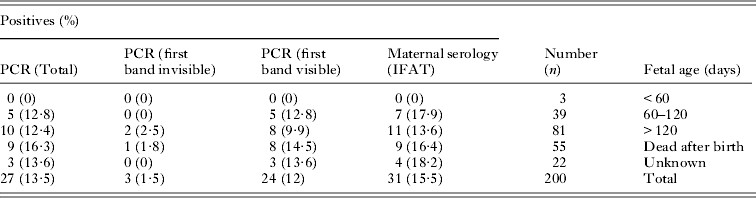
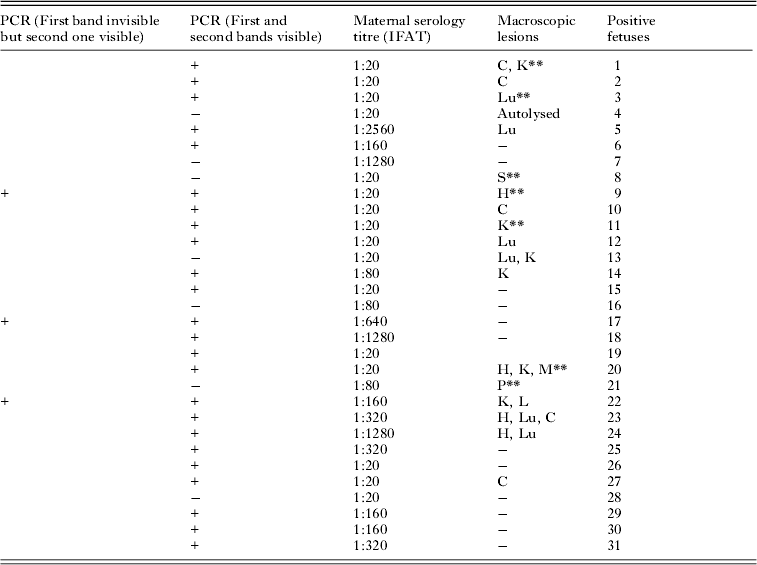
The age of aborted fetuses had been recorded in all cases except 4 (Tables 2 and 3). Macroscopic lesions were recorded in 122 out of 200 cases (61%). In 18 out of 31 positive cases, a swollen and congested placenta was recorded in 1 sample, central nervous system (CNS) lesions were recorded as hydrocephalus, encephalomalachia and small cerebelli (4 cases). Cardiac lesions included congestion, haemorrhage and necrosis (4 cases). Thoracic lesions consisted of hydrothorax, pulmonary congestion and haemorrhage, (6 cases). There was necrosis and haemorrhage in the liver, (1 case). Kidneys showed swelling, necrosis, hypoplasia, congestion and haemorrhage (5 cases). Skeletal muscle necrosis was recorded in 1 case (Tables 2 and 3). Not one sample was typical for toxoplasmosis (i.e. necrotic placenta).
Infection by Toxoplasma gondii in ovine fetuses aborted at different times of gestation by different diagnostic techniques

Distribution of different IFAT titres, macroscopic lesions and PCR results in positive samples

* DB, Dead after birth; UKn, Unknown;
** C, CNS; H, Heart; L, Liver; K, Kidney; Lu, Lung; P, Placenta; S, Small-sized fetus; M, Muscles.
Serology
Indirect fluorescent antibody test (IFAT) showed positive titres ⩾1:20 in 31 (15·5%) out of 200 examined maternal sera. Titration was 1:20 (16 samples), 1:80 (3 samples), 1:160 (4 samples), 1:320 (3 samples), 1:640 (1 sample), 1:1280 (3 samples), 1:2560 (1 sample).
PCR
Toxoplasma infection was diagnosed in 27 out of 200 (13·5%) ovine fetuses’ brain samples based on PCR. In 24 of the positive samples both the 193 bp and the 96 bp bands were detectable (Fig. 2), but in 3 positive specimens, just the 96 bp band was detected in Nested-PCR (Fig. 2). Four maternal sera were positive in IFAT but not in the PCR attempted on the reported fetal brains. (Tables 2 and 3).
PCR products electrophoresed on a 2% agarose gel.

Correlation between age and infection
No significant association was found between the infection and 3 different fetal age categories (60–120, >120 and DB) (χ2 value=0·439 for the serological test and χ2 value=0·481 for PCR test; P>0·05, Table 2).
Prevalence and agreement
Maternal seroprevalence was 10·6% to 20·4% (95% confidence interval) and the estimated ovine abortion prevalence associated with T. gondii, based on PCR, was calculated as being from 8·8% to 18·2% with 95% confidence interval. These results show that the congenital levels of transmission constitute a high percentage of lambing, 27/31(87%) with an excellent logical agreement between the 2 different tests (ĸ=0·9) (Fleiss et al. Reference Fleiss, Levin and Paik2003).
DISCUSSION
In the course of this study a slightly modified Nested-PCR assay based on previously described primers was set up and employed for molecular detection of Toxoplama gondii in brain tissues of ovine aborted fetuses. Brain, skeletal muscle, cardiac muscle, liver, spleen, lung and placenta are valuable tissues for T. gondii detection but the brain is a preferred tissue for diagnosis of Toxoplasma-induced ovine abortion because it is the most frequently infected tissue compared with the others (Esteban-Redondo and Innes, Reference Esteban-Redondo and Innes1998; Hurtado et al. Reference Hurtado, Aduriz, Moreno, Barandika and García-Pérez2001; Pereira-Bueno, Reference Pereira-Bueno, Quintanilla-Gozalo, Pérez-Pérez, Álvarez-García, Collantes-Fernández and Ortega-Mora2004; Dubey, Reference Dubey2009). On the other hand, Gutierrez et al. (Reference Gutierrez, O'Donovan, Williams, Proctor, Brady, Marques, Worrall, Nally, McElroy, Bassett, Sammin, Buxton, Maley and Markey2010) discussed the fact that placenta and fetal lung could also be good tissues and they detected the infection from these organs approximately as well as from the brain. However, Duncanson et al. (Reference Duncanson, Terry, Smith and Hide2001) and Sreekumar et al. (Reference Sreekumar, Rao, Mishra, Ray, Joshi and Singh2004) failed to detect the parasite in lung.
Furthermore, the maternal serology of reported cases was tested by IFAT to assess the agreement between the maternal serological response and detection of the parasite genome in the reported fetal brain tissue. Overall, in this survey a reasonable number of ovine abortions were examined to assess the role of T. gondii as the causative agent in economical losses and potential public health threats in sheep herds in Khorasan Razavi Province, Iran. According to the result of this study, about 13·5% (8·8%–18·2% with a 95% confidence interval) of ovine abortions and fetal losses were associated with this organism, although the involvement of other pathogens could not be ruled-out. According to our findings the rate of ovine Toxoplasma-induced abortion in the province was similar to rates found previously using various techniques, including surveys based on serology in different countries such as Australia, 10% (Plant et al. Reference Plant, Beh and Acland1972), UK, 14% (Linklater, Reference Linklater1979), USA, 15·4%–16·7% (Sheryl, Reference Sheryl, Clyde, Kirkbride and Dubey1989), Oregon, USA, 14–18%, (Dubey et al. Reference Dubey, Sonn, Hedstorm, Snyder and Lassen1990; Dubey and Kirkbride, Reference Dubey and Kirkbride1990), South Dakota, USA 10·7% (Clyde and Kirkbride, Reference Clyde and Kirkbride1993), New Zealand, 14–32% (Charleston, Reference Charleston1994), Italy, 28·4% by serology and 11·1% by Nested-PCR on ITS1 gene amplification (Masala et al. Reference Masala, Porch, Madau, Tanda, Ibba, Satta and Tola2003) and in Spain, 15% in a pathological study (Oporto et al. Reference Oporto, Barandika, Hurtado, Aduriz, Moreno and Garcia-Perez2006). In evaluation by different diagnostic techniques such as histopathology, serology and Nested-PCR on B1 gene amplification, a rate of 23·1% was obtained by at least 1 of the diagnostic techniques used (Pereira-Bueno et al. Reference Pereira-Bueno, Quintanilla-Gozalo, Pérez-Pérez, Álvarez-García, Collantes-Fernández and Ortega-Mora2004). Prevalence in a pathological study in Hungary was 5·2% (Szeredi et al. Reference Szeredi, Jánosi, Tenk, Tekes, Bozsó, Deim and Molnár2006) and in Egypt was, 4 (50%) of 8, as meausured by Nested-PCR on B1 gene amplification and histopathology (Ahmed et al. Reference Ahmed, Sokkar, Desouky and Soror2008).
In Iran, little is known about the relative prevalence of Toxoplasma-induced abortion in sheep and most of the data are based on serology, including a report describing a rate of 72·6% seropositivity by ELISA and MAT (modified agglutination test) in a single sheep herd with a history of severe abortion (Hamidinejat et al. Reference Hamidinejat, Goraninejad, Ghorbanpoor, Nabavi and Akbarnejad2008) and 5·2% seropositivity by IFAT in 325 aborted ovine fetuses in the Mashhad area (Razmi et al. Reference Razmi, Ghezi, Mahouti and Naseri2010).
In this present study, macroscopic lesions were seen in 18 of 31 maternal IFAT-positive cases and none of them was typical for toxoplasmosis (i.e. necrotic placental lesions were not observed in any of the placenta) but it was interesting that most of the lesions were observed in those organs that were most frequently used for detection of the parasite such as CNS, lungs, liver, kidneys (Table 3).
There were 7, 11 and 9 cases in the different age groups (60–120, >120 days and the ones that died shortly after birth), respectively that showed no significant difference amongst them (P>0·05). No case was recorded in the age group <60 days after gestation because fetal resorption was the most frequent event at this time (Buxton, Reference Buxton, Martin, and Aitken1991; Johnston, Reference Johnston1988; Blewett and Watson, Reference Blewett and Watson1983; Givens and Marley, Reference Givens and Marley2008). A second reason might be that if fewer cases of aborted fetus and placenta are observed by the owners, then fewer cases will be referred to the Center of Excellence in Ruminant Abortion and Neonatal Mortality.
In Toxoplasma-induced abortion, a combination of diagnostic techniques is necessary for accurate diagnosis. Among them is the Nested-PCR assay, based on the B1 target gene having 35 copies per parasite, which is one of the most sensitive and specific tests (Jones et al. Reference Jones, Okhravi, Adamson, Tasker and Lightman2000; Mason et al. Reference Mason, Quinnell and Smith2010). Although there are some new quantitative tests for Toxoplasma detection (Jauregui et al. Reference Jauregui, Higgins, Zarlenga, Dubey and Lunney2001; Wu et al. Reference Wu, Chen, Jiang and Cao2009), the one recently used by Gutierrez et al. (Reference Gutierrez, O'Donovan, Williams, Proctor, Brady, Marques, Worrall, Nally, McElroy, Bassett, Sammin, Buxton, Maley and Markey2010) as a specific and sensitive test for detection of the infection in ovine maternal and fetal tissues was unfortunately not cost-effective for our study and we conclude that it is better to consider all advantages and disadvantages of a test before making a decision.
To prevent cross-contamination during sample collection and processing, efforts were made to prevent carry-over contamination during amplification steps in both rounds of PCR. The use of pre-prepared reagents, such as Accupower PCR premix kit (Bioneer®, South Korea) reduced the extent of manipulation and the time needed for the assays. Negative controls, included in each PCR experiment ensured us that no contamination had occurred during the experiment. Increasing annealing temperature and decreasing the number of cycles in the second PCR gave a sharp and intense band. As previously described, there were 3 positive specimens that yielded only the 96 bp band in Nested-PCR. Consequently, we conclude that because there may be a very low copy number in these samples, the importance of the Nested-PCR is greatly increased as a more specific test compared with single PCR.
As previously discussed, the prevalence of congenital toxoplasmosis is somewhat higher than previously supposed, i.e. 61% (Duncanson et al. 2001), 69% (Williams et al. Reference Williams, Morley, Hughes, Duncanson, Terry, Smith and Hide2005) and 66% (Hide et al. Reference Hide, Morley, Hughes, Gerwash, Elmahaishi, Elmahaishi, Thomasson, Wright, Williams, Murphy and Smith2009) and in our study it was estimated at 87% (82% to 91% with 95% confidence interval) with an excellent agreement between the 2 different tests (ĸ=0·9) (Fleiss et al. Reference Fleiss, Levin and Paik2003) These findings increase the necessity for further work to clarify the precise mechanisms of this route of transmission and its occurrence from generation to generation following a primary infection as described by Morley et al. (Reference Morley, Williams, Hughes, Terry, Duncanson, Smith and Hide2005, Reference Morley, Williams, Hughes, Thomasson, Terry, Duncanson, Smith and Hide2007), Hide et al. (Reference Hide, Morley, Hughes, Gerwash, Elmahaishi, Elmahaishi, Thomasson, Wright, Williams, Murphy and Smith2009) and Innes et al. (Reference Innes, Barley, Buxton and Katzer2009). These latter studies also suggest the need for further investigation of the processes that provide life-long immunity to ewe and offspring after an initial infection.
According to the results of this study, it is concluded that T. gondii can be considered a common cause of abortion in Khorasan Razavi Province, north-east of Iran and that the level of congenital transmission is sufficiently high that it necessitates further research. It can also be concluded that the slightly modified Nested-PCR assay used in this study might be considered as a rapid, sensitive, specific and highly affordable conventional assay for molecular diagnosis of T. gondii worldwide.