Infection with coronavirus disease 2019 (COVID-19) has become a severe public health issue worldwide. COVID-19 is caused by severe acute respiratory syndrome coronavirus 2 (SARS-CoV-2), a novel coronavirus that recently emerged from China. In March 2020, the World Health Organization (WHO) declared that COVID-19 can be characterized as a pandemic. Therefore, it is of utmost importance to prevent the further spread of the pandemic in public and healthcare settings. Reference Giustini, Ali and Fraser1,Reference Velasco, Agheneza and Denecke2 Social distancing, checking any suspicious case, staying at home, avoiding social events, treating patients, and touch tracing are common techniques and recommendations. While countries are taking increasingly stringent steps to combat the pandemic, such as lockdowns and mass assessments, the pandemic has risen worldwide. 3,Reference Chan4
In Ethiopia, hundreds of thousands of people were affected by the pandemic, more than 2000 have died, and most of the public health measures still hold promise to slow and ultimately contain the spread of COVID-19. In response to COVID-19, the Government of Ethiopia has been taking a series of policy actions beyond public health initiatives alone; these include closing schools, restricting the use of public transportation, banning large meetings, and suspending sporting and religious gatherings. 5–7
Public awareness and prevention of COVID-19 infection play important roles in disease control; a lack of reasonable information on infectious diseases leads to low detection rates. 3,Reference Wilder-Smith and Freedman8 Therefore, to stop the spread of COVID-19 infection in Ethiopia, the Ethiopian Ministry of Health launched specific national disease control measures, using several media campaigns, posters, and advertisements on television and print media along with other methods to improve awareness of this pandemic among the general population. The assessment of government websites and social media platforms for public awareness is important; because it helps determine the impact of governmental prevention efforts and measures and gauges the need for intervention. Reference Mohammed, Oljira and Roba6,7,Reference Allgaier and Svalastog9
Scholars have reported that evidence of the impact of social media platforms (e.g., Facebook, YouTube, Telegram, Instagram, and Twitter) on health knowledge, behaviors, and outcomes shows that these tools can be effective in meeting individual and population health needs, increasing public consciousness. Reference Mohammed, Oljira and Roba6,7,Reference Korda and Itani10–Reference Motta Zanin, Gentile and Parisi14
The public perceptions of risks are shaped depending on how information is communicated across social media platforms. As a result, the WHO has called for proactive and effective use of social media platforms to disseminate information on health issues, explicitly on emerging infectious diseases, to unspecialized persons and the general public. Reference Benetoli, Chen and Aslani15 Therefore, this study aimed to assess the influence of using social media on COVID-19–related awareness and preventive practices of COVID-19 during the pandemic in Ethiopia.
Methods
This study used an anonymous Internet-based online cross-sectional survey by using Google Forms to collect the data from the respondents from May 15 to June 17, 2020, in Ethiopia. Since the first cases of the COVID-19 were confirmed in Ethiopia on March 13, 2020, the government declared the state lockdown on April 5, 2020. This lockdown made it difficult to conduct the community- or institutional-based survey. Because of this, the link of the questionnaire was posted by the authors on social media, such as Facebook, Instagram, Twitter, Telegram, and YouTube. To select the respondents from the population, a snowball sampling technique was used through the author’s network with residents on popular social media. The questionnaire focused on the respondents’ socio-demographic characteristics, risk perception of COVID-19, using social media to get information about COVID-19 and COVID-19 preventive practice. The inclusion criteria of the participants used in this study were the ability to read and understand the English language, have Ethiopian nationality, and be ≥ 18 y of age. Before proceeding to fulfil the questionnaire, respondents were briefed on the objective of the study, the informed consent of participation, the declaration of anonymity, and confidentiality of their response.
The questionnaire was developed in English and then translated into Amharic. Local experts performed face validation on the content of the questionnaire. The online questionnaire was subsequently pilot tested for readability and clarity of items on 30 participants from the general public. A minor revision was made based on the results of the pilot study. The revised questionnaire was further pretested before distribution. Participants in the survey received no incentives. A survey link was distributed to respondents, and 395 individuals responded. After excluding participants who provided incomplete data, for instance, people who started the survey but did not finish it, we used a total sample of 372 for the analysis. The average age of the participants was 38.07 y (standard deviation [SD] = 10.33), and there were 164 female participants and 208 male participants.
Instruments and Measurements
Social Media Use to Get Information About COVID-19
We included the following question to assess the participants’ exposure to COVID-19–related risk information by means of social media during the COVID-19 pandemic, using a 7-point Likert scale (1 = not at all, to 7 = to a great extent): “How much have you seen the information about COVID-19 on social media such as Instagram, Facebook, Twitter, YouTube, and Telegram?” Higher scores indicated greater exposure to COVID-19–related risk information by means of social media (M = 3.94; SD = 1.47). Level of social media use was categorized based on the median score because the cumulative score is not normally distributed. Those who scored less than the median points were classified as poor use, and those who scored a median point and above were classified as good use.
Personal-Level Risk Perception of COVID-19
We measured personal-level risk perception of COVID-19 by using the following 4 items on a 5-point Likert scale ranging from 1 = strongly disagree to 5 = strongly agree: “(1) The problem of COVID-19 is serious to me; (2) I am worried that I would be affected by COVID-19; (3) I would likely be affected by COVID-19; (4) I have felt that COVID-19 is dangerous.” The responses were averaged to construct an index of personal-level risk perception of COVID-19, and higher scores indicated greater personal-level risk perception of COVID-19 (M = 4.58; SD = 1.40; Cranach’s α = 0.92). The level of perception was categorized based on the median score because the score is not normally distributed. Those who scored less than the median points were measured as they have a low-level risk perception, and those who scored a median point and above were considered as high-level risk perception.
COVID-19 Preventive Practice
We assessed COVID-19 preventive practices on a 5-point Likert scale ranging from 1 (strongly disagree) to 5 (strongly agree) in which respondents were asked how frequently they engaged in the following COVID-19 preventive practices since the first COVID-19 patient was confirmed: “(1) I have worn a mask to reduce the risk of COVID-19 infection; (2) I have not been going to crowded places; (3) I avoid touching the eye, nose, mouth before washing hands; and (4) I have tried to wash my hands or used hand sanitizer more often to prevent the risk of COVID-19 infections.” We averaged the 4 items to create an index of COVID-19 preventive practices (M = 4.47; SD = 1.47; Cronbach’s α = .82). The preventive practice was categorized based on the median score because the score is not normally distributed. Those who scored less than the median points were measured as they have a poor practice of COVID-19 prevention measure, and those who scored a median point and above were considered as a good practice.
Statistical Analysis
The collected data were checked manually for completeness. The data were coded and edited in the Epi - Info version 3.5.1 and exported to SPSS version 21 for further statistical data analysis. Descriptive statistics were used to summarize the data of this study. Multivariable logistic regression was used to assess the relationship between social media use as a predictor and COVID-19 preventive practice, after adjusting for socio-demographic and risk perception of COVID-19 variables. Adjusted odds ratios (AORs) were used to interpret variables in the final model of COVID-19 preventive practices. Variables with P < 0.25 in bivariate analysis were entered into a multivariate logistic regression model to adjust the effects of cofounders on the outcome variable. Multivariable logistic regression analyses were performed on all variables found to have a statistical significant association (2-tailed, P < 0.05) in the bivariate analyses. Odds ratios (ORs), 95% CIs, and P-values were calculated for each independent variable. The level of significance was set at P < 0.05. And the final model was checked using the Hosmer-Lemeshow goodness of fit test; interaction, and multi-colinearity were checked to minimize bias.
Ethical Considerations
Ethical approval was obtained from the Wachemo University College of Medicine and Health Science Institutional Review Board, and the research was conducted following the prevailing ethical principles. The participants responding to a “yes” or “no” question obtained voluntary on-line consent to express their willingness to attend the study by means of Google Forms.
Results
Socio-demographic Characteristics of the Respondents
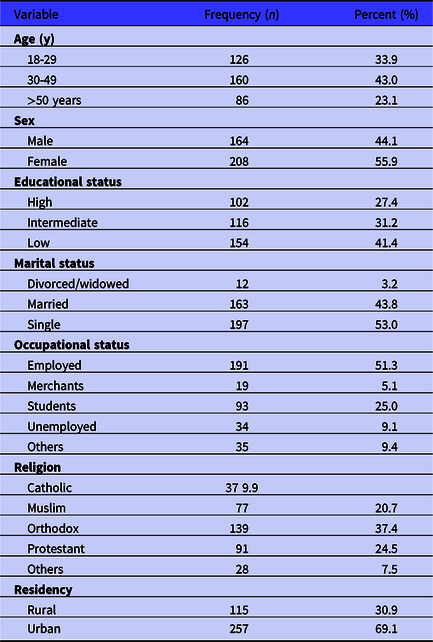
A total sample of 372 respondents has participated. From 372, a total of 208 (55.9%) respondents in this study were male. The respondents’ mean age was 30.6 ± 5.07 y; 102 (27.4%), 116(31.2%), and 154 (41.4%) have high, medium, and low educational status, respectively. A higher proportion of respondents were single (53%), employed (51.3%), and urban residents (69.1%) (Table 1).
Socio-demographic characteristics of the study participants, Ethiopia, June 2020 (n = 372)

Description of the Level of Risk Perception of COVID-19
Among the 4 items of risk perception, 73.1% of respondents believe that the problem of COVID-19 is serious, 54.6% of respondents strongly agreed that they would be affected by COVID-19. The mean risk perception of COVID-19 score of all participants is 17.94 and the SD is 2.14. These results show that 47.8% respondents have a high-risk perception of COVID-19. This classification was based on cumulative median score. Participants who scored less than the median points were classified as they have a low-level risk perception, and those who scored a median point and above were considered as high-level risk perception (Table 2).
Risk perception of COVID-19 scores during the pandemic in Ethiopia, June 2020 (n = 372)

Social Media Use for COVID-19–Related Information
The mean of the utility of social media for COVID-19 information is 24.4, and the SD is 6.78. Facebook was used to get COVID-19–related information for the majority of respondents during the pandemic. The overall level of use was classified as poor or good, based on the median cumulative score. Those who scored less than the median points were classified as poor use, and those who scored a median point and above were classified as good use. Therefore, in this study, 48.7% of participants have good social media use (Table 3).
Social media use for COVID-19–related information during the pandemic in Ethiopia, June 2020 (n = 372)

COVID-19 Preventive Practices
The mean of COVID-19 preventive practice is 17.4 and the SD is 2.6. Over the last few days, respondents were predominantly engaged in the frequent use of face masks to reduce the risk of COVID-19 infection (64.8%). Overall level of preventive practice was categorized into poor and a good level of practice. Those who scored less than the median points were measured as they have a poor practice of COVID-19 prevention measure, and those who scored a median point and above were considered as they have a good practice. In this study, 52.7% of the participants had a good COVID-19 preventive practice (Table 4).
COVID-19 preventive practices during the pandemic in Ethiopia, June 2020 (n = 372)

Predictors of COVID-19 Preventive Practices
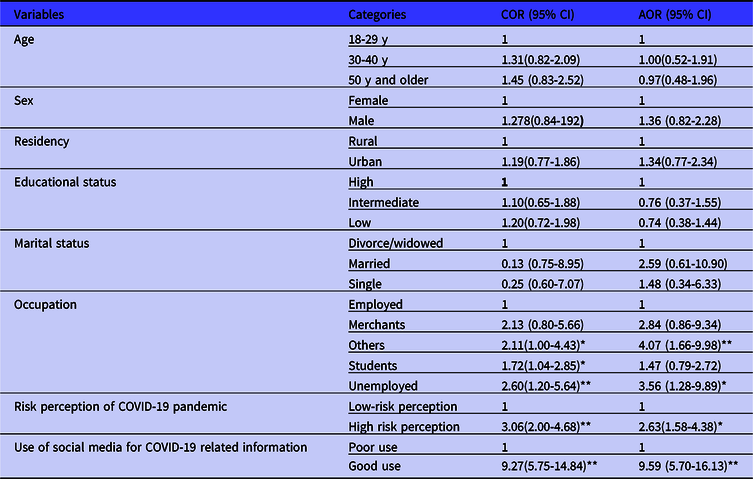
Study participants who had good use of social media to get COVID-19–related information were 9.5 times engaged in COVID-19 preventive practices compared with study participants who had poor use of social media to get COVID-19–related information (AOR = 9.59; 95% CI: 5.70-16.13). Also, study participants who had a high-risk perception of COVID-19 were 2.6 times engaged in COVID-19 practices compared with study participants who had a low-risk perception of COVID-19 (AOR = 2.63; 95% CI: 1.58-4.38). Study participants who were students at the time of this study were 4 times more likely to show adequate COVID-19 preventive practice scores compared with those who had another occupational status (AOR = 4.07; 95% CI: 1.66-9.98) (Table 5).
Predictors of COVID-19 preventive practices during the pandemic in Ethiopia, June 2020 (n = 372)

**P < 0.01.
*P = 0.01-0.05.
Discussion
In this study, we aimed to assess the impact of using social media for COVID-19–related information on the preventive practice of COVID-19 during the pandemic in Ethiopia. The potential benefits of using social media platforms in public health protection against pandemic diseases include dissemination of public health interventions, enhanced public awareness, promotion of healthy behavior, improved health outcomes, and provision of health information to the community. Reference Al-Surimi, Khalifa and Bahkali16–Reference Ahmad and Murad19 The analysis provides empirical evidence regarding the impact of using social media platforms for COVID-19–related information against COVID-19. Numerous research studies have explored the relationship between the use of social media platforms and public health. Reference Chan4,Reference Pagoto, Waring and Xu18,Reference Ahmad and Murad19
In recent years, social media have become an increasingly important information source of risk and crisis communication, particularly during infectious disease outbreaks. Reference Benetoli, Chen and Aslani15 In this study, the mean of the utility of social media for COVID-19 information is 24.4. This high mean total exposure score suggests that study participants have high exposure to social media during the COVID-19 pandemic. This study showed that 48.7% of participants have good social media use. This finding replicates evidence from previous research, indicating high use of online media (particularly social media) by the younger generation and specifically university students. Reference Kitazawa, Yoshimura and Hitokoto23,Reference Apuke and Iyendo24
It is worth noting that, in this analysis, getting information about COVID-19 on social media significantly influences its preventive practices. The present study found a significant association between COVID-19 preventive practices and the perceived high-risk of COVID-19 among respondents after adjusting for other cofounders. Study participants who were students at the time of this study were 4 times more likely to show adequate COVID-19 preventive practice scores compared with those who had another occupational status. Consistent findings were reported from other previous similar studies. Reference Srichan, Apidechkul and Tamornpark12,Reference Ahmad and Murad19,Reference Al-Dmour, Masa’deh and Salman25
Our result showed a higher mean of COVID-19 preventive practice (17.4). This study depicted that 52.7% of participants had good COVID-19 preventive practice, which was lower than the study conducted in Iran, 71%, Reference Erfani, Shahriarirad and Ranjbar11 but much higher than the study conducted in Thailand, 17%, Reference Srichan, Apidechkul and Tamornpark12 The socio-demographic characteristics of the study participants, study differences in methodology, study time, and area of the study could explain the differences.
In this study, 47.8% of participants have higher risk perception. There are some studies on the risk perception of COVID-19 in other countries. Nearly half of the participants in a study of India felt panic by reports of COVID-19. Reference Roy, Tripathy and Kar13 A study in Iran showed that study participants had a medium risk perception of COVID-19. Reference Taghrir, Borazjani and Shiraly26 In a study in Italy, most participants felt uncertainty, fear, and sadness. Reference Motta Zanin, Gentile and Parisi14 The participants of our survey are social media users throughout the country, which to a large extent reflects the risk perception of COVID-19. Although the results show that most study participants have a higher risk perception of COVID-19, 6.7% disagreed with the statement that “I would likely be affected by COVID-19.” Underestimation of this risk characteristic may lead to risky behaviors and neglect of early symptoms of COVID-19. Most study participants strongly agreed with the statement “problem of COVID-19 is serious to me,” which, to some extent reflects the public’s attention to COVID-19.
Limitations
The major limitation of this study was the data collected by an online distribution of the survey through social media and the only individual with access to social media and the Internet can participate in the study and this study cannot represent the overall population of the country. In addition, because the study was cross-sectional, the findings may not indicate a cause and effect relationship. Because the dynamics of the pandemic have led to many changes in the society behavior and practices, the findings may be updated by future studies.
Conclusions
Overall, this study validated the use of social media for COVID-19–related information during a COVID-19 pandemic. Therefore, we conclude that higher exposure to COVID-19–related information on social media increased preventive practices of a COVID-19 pandemic. Risk perception of COVID-19 enhanced dominant COVID-19 preventive practices. Therefore, risk communication, social media communication, and community engagement efforts to combat COVID-19 should emphasize addressing key preventive methods. Social media campaigns should be used to inform the public about pandemics so that behavior changes can result. In terms of practical implications, our findings suggest that public health communicators and policy-makers should pay more attention to the roles of social media during pandemic diseases.
Data Availability
All relevant data are within the paper.
Acknowledgments
We express our heartfelt thanks to Wachemo University and respondents.
Author Contributions
All authors made substantial contributions to the conception and design, acquisition of data, analysis, and interpretation of data, took part in revising the article, gave final approval of the version to be published, and agreed to be accountable for all parts of the work.
Funding
Not funded by any organization.
Declaration of Conflicting Interests
The authors declare that they have no conflicts of interest.