Introduction
Obstructive sleep apnoea (OSA) is a common chronic sleep disorder characterised by repetitive, complete or partial, collapse of the upper airway during sleep.Reference Greenstone and Hack1 This results in decreased airflow, and transient hypercapnia and hypoxaemia. Sympathetic activation leads to increased tone in the upper airway, but this increases arousal and disrupts normal sleep patterns.Reference Eckert and Malhotra2 Patients with OSA often report daytime sleepiness, and other symptoms including waking up at night, poor sleep and snoring.
Polysomnography is considered the ‘gold standard’ method for objectively measuring OSA severity, using a multi-channel recording of cardiac, respiratory and sleep parameters. However, given the limited availability of polysomnography, other methods such as oximetry3 and respiratory multi-channel recording are also used with adequate effect.
Commonly used measures of OSA severity are the apnoea/hypopnoea index, the respiratory disturbance index and the flow limitation index. The apnoea/hypopnoea index records the number of obstructive events per hour. An apnoea is typically classed as a cessation of airflow for at least 10 seconds, whilst a hypopnoea refers to a reduction in airflow for at least 10 seconds.4 The respiratory disturbance index is defined as the average number of respiratory disturbances (apnoeas, hypopnoeas and respiratory event related arousals) per hour. Flow limitation is a partial obstruction of the airway as detected by a change in the shape of the flow signal to a non-rounded inspiratory flow shape. The flow limitation index is calculated by the total number of flow limitation events per night divided by the hours of therapeutic device use, and can be used for diagnosis as well as continuous positive airway pressure (CPAP) titration. No consensus has been reached at present on whether the apnoea/hypopnoea index or respiratory disturbance index should be used as the standard index.
An apnoea/hypopnoea index or respiratory disturbance index above 5 events per hour is commonly used to diagnose OSA, with mild disease scoring 5–14 events per hour, moderate disease scoring 15–29 events per hour and severe disease scoring greater than 30 events per hour.Reference Greenstone and Hack1 This disease can be further classified as obstructive sleep apnoea syndrome (OSAS), in which the patient has an apnoea/hypopnoea index of more than 5 events per hour and co-existing symptoms of daytime sleepiness.Reference Eckert and Malhotra2
A North American study reported the prevalence of OSA in middle-aged adults as 24 per cent in men and 9 per cent in women, and the prevalence of OSAS was estimated to be 4 per cent and 2 per cent respectively.Reference Young, Palta, Dempsey, Skatrud, Weber and Badr5
Treatment of this condition is important. There are the direct effects of daytime somnolence on the patient, such as patient's mood, productivity and an increased risk of road accidents.Reference Antonopoulos, Sergentanis, Daskalopoulou and Petridou6 There are also many long-term conditions that have now been linked to OSA. Untreated OSA has been shown to cause systemic hypertension.Reference Parati, Lombardi, Hedner, Bonsignore, Grote and Tkacova7, Reference Montesi, Edwards, Malhotra and Bakker8 Other studies have investigated hypothesised links between OSA and cardiovascular events, such as myocardial infarction, stroke and congestive cardiac failure.Reference Barbé, Durán-Cantolla, Sánchez-de-la-Torre, Martínez-Alonso, Carmona and Barceló9, Reference Gottlieb, Yenokyan, Newman, O'Connor, Punjabi and Quan10
Non-surgical treatments include simple lifestyle advice, oral appliances and CPAP. Continuous positive airway pressure, first described by Sullivan et al. in 1981,Reference Sullivan, Issa, Berthon-Jones and Eves11 remains the gold standard in adult OSA treatment. It has been shown to improve symptoms of tiredness and objective polysomnography measures.Reference Gay, Weaver, Loube and Iber12 There is also evidence that CPAP treatment can reduce blood pressure in patients with OSA.Reference Montesi, Edwards, Malhotra and Bakker8 In accordance with National Institute for Health and Care Excellence guidelines, CPAP has a role in the treatment of moderate and severe OSA, and can be used judiciously for mild OSA.Reference Epstein, Kristi, Strollo, Friedman, Malhotra and Patil13
There are compliancy issues associated with CPAP. Many patients do not use the mask as much as they should, for a variety of reasons (which can include physical side-effects, equipment-related issues and psychological factors), whilst others cannot tolerate it at all.Reference Weaver and Grunstein14 Oral appliances to advance the mandible and tongue, and therefore prevent upper airway collapse, have also been shown to be efficacious in reducing the apnoea/hypopnoea index.Reference Takaesu, Tsuiki, Kobayashi, Komada, Nakayama and Inoue15 For those who have OSA refractory to CPAP, or who are unable to tolerate it or oral appliances, there is the option of upper airway surgery.
The role of surgery has been widely explored over the past few decades. The principle is to identify the area of airway collapse during sleep and tailor the surgery accordingly. Surgical procedures have traditionally included uvulopalatopharyngoplasty, maxillomandibular advancement, adenotonsillectomy and radiofrequency ablation of the palate.
The nasal airway forms a significant proportion of the upper airway, and hence obstruction at this level has been thought to contribute to OSA. There are a number of mechanisms to explain this. According to the Starling resistor model, it can be explained by seeing the upper airway as a hollow tube. A narrowing upstream (in the nose) can produce a negative pressure and therefore collapse further downstream in the oropharynx.Reference Smith and Guyette16, Reference Park17 If this nasal obstruction is more marked, then it follows that the oropharyngeal collapse may also be more severe. If nasal obstruction is severe, then a switch to oral breathing may occur. Mouth breathing at night is associated with higher total respiratory resistance and increased upper airway collapse.Reference Meurice, Marc, Carrier and Sériès18
Nasal receptors play an important role in breathing. Activation of these receptors has a direct positive effect on spontaneous ventilation. Nocturnal mouth breathers bypass these receptors and this can negatively affect their nocturnal ventilation, as shown in experiments involving anaesthesia of the nasal mucosa.Reference Berry, Kouchi, Bower and Light19
Nitric oxide produced by the nasal mucosa is known to act as a lung vasodilator and improve blood oxygenation. It also has a hypothesised role in pharyngeal muscle tone. However, currently, the exact role of nitric oxide in breathing and its effect in OSA is not fully understood.Reference Haight and Djupesland20
It has been shown that complete induced nasal obstruction in healthy volunteers can lead to an increased number of apnoeas and hypopnoeas.Reference Suratt, Turner and Wilhoit21 Nasal obstruction can occur for a variety of reasons, such as rhinitis (with or without nasal polyps), or with a structural abnormality like septal deviation or turbinate hypertrophy. Therefore, relieving the source of obstruction may help to improve OSA.
Nasal obstruction resulting from chronic rhinitis can be managed medically. Nasal blockage has an estimated prevalence of 30 per cent in Europe, which is caused predominantly by allergic rhinitis and chronic rhinosinusitis.Reference Fokkens, Lund, Mullol, Bachert, Alobid and Baroody22 In the context of OSA, studies have investigated the use of nasal steroids in its management in rhinitic patients. Subjective improvement in nasal patency and daytime somnolence have been described, but any objective improvement has yet to be shown.Reference Georgegalas23
Functional septorhinoplasty for the treatment of nasal blockage has also been shown to improve sleep disturbance, night-time awakenings and daytime fatigue, as demonstrated by the Sino-Nasal Outcome Test 22 (SNOT-22), which is a sinonasal disease specific quality of life (QoL) patient-reported outcome measure.Reference Poirrier, Ahluwalia, Goodson, Ellis, Bentley and Andrews24 Functional septorhinoplasty also improves objective nasal airway measurements such as nasal inspiratory peak flow, but, interestingly, we have not found an objective measurement in septorhinoplasty surgery that correlates with improved subjective measurements.Reference Andrews, Choudhury, Takhar, Poirrier, Jacques and Randhawa25
Nasal surgery is undertaken to improve the structural abnormalities within the nose, or to remove obstructing lesions and improve nasal resistance. The surgical procedures most commonly performed are functional endoscopic sinus surgery (FESS), septorhinoplasty, septoplasty, nasal valve surgery and inferior turbinate reduction, or any combination of these operations.
Functional endoscopic sinus surgery has been shown to improve QoL symptoms, including improving sleep following surgery for the management of chronic rhinosinusitis.Reference Hopkins, Gillet, Slack, Lund and Browne26 As well as improved QoL symptoms in chronic rhinosinusitis patients following FESS, there are also improvements in patients’ sleep and perceived nasal airway as measured by the Nasal Obstruction Symptom Evaluation scale,Reference Andrews, Poirrier, Lund and Choi27 which correlates significantly with improved nasal inspiratory peak flow.Reference Whitcroft, Andrews and Randhawa28
This study aimed to systematically review the current literature to determine the role of rhinological surgical interventions in the management of OSA, in terms of both objective polysomnographic measures and patient-related outcome measures.
Materials and methods
Data sources and literature search
The authors performed a systematic search, with a focus on identifying randomised controlled trials or quasi-randomised trials where possible. The authors individually carried out an independent systematic literature search of all records in the Cochrane Library, Ovid Medline, Ovid Embase and ClinicalTrials.gov databases, from inception until December 2016. Searches of free-text and Medical Subject Heading terms were completed, using variations of the keywords ‘sleep apnoea’ and ‘surgery’, and in combination using Boolean operators. Only English-language articles were considered. The archives of major ENT and sleep medicine journals were hand-searched for recent or in-press articles that may have been missed by electronic searching. Each author's search results were merged, and duplicate citations were discarded.
Study selection
Titles and abstracts were screened, and studies unrelated to the research objective were discarded. The full text of the relevant papers was retrieved and examined by each author independently for consideration of inclusion or exclusion. The final lists of the included studies were compared and discussed between all authors. The reference lists of the included papers and previous reviews were examined to ensure relevant studies had been considered. Any disparities regarding the inclusion of articles were discussed between the authors, and a joint decision was made based on the inclusion criteria.
Data extraction
Data were extracted by the lead author and then checked by the other authors separately. The published data from included studies were scrutinised in terms of the reporting of outcomes. If relevant data were not available for extraction, the authors of the study were contacted by e-mail with a specific data request. If there was no reply, a reminder e-mail was sent after a week and a final further e-mail sent if no response after another week. If we still received no response, the study was excluded and the authors were notified.
Data items relating to the following were extracted from each study: (1) study characteristics, including study design, study duration and data analysis method; (2) participants, including population demographics, participant numbers and diagnostic criteria; and (3) intervention types, including medical or surgical treatment, follow up, outcomes, and data summary for each intervention group.
Inclusion and exclusion criteria
Studies were included if they involved comparison of a non-surgical and/or non-rhinological surgical intervention with a rhinological surgical intervention for OSA treatment. The rhinological surgery may have been the sole procedure, or performed in combination with palatal or tonsillar surgery. Study participants had to be adult patients (aged over 18 years) with a diagnosis of OSA.
Outcomes assessed
Studies were selected if the outcomes assessed included: objective changes in the apnoea/hypopnoea index or the respiratory disturbance index, or subjective changes on the Epworth Sleepiness Scale.
Statistical analysis
We performed simple descriptive analysis on the pooled data from the included studies (using means and standard deviations) where possible. Formal statistical meta-analysis was not possible because of inter-study heterogeneity; namely, considerable variation in study designs, interventions studied and outcomes reported.
Results
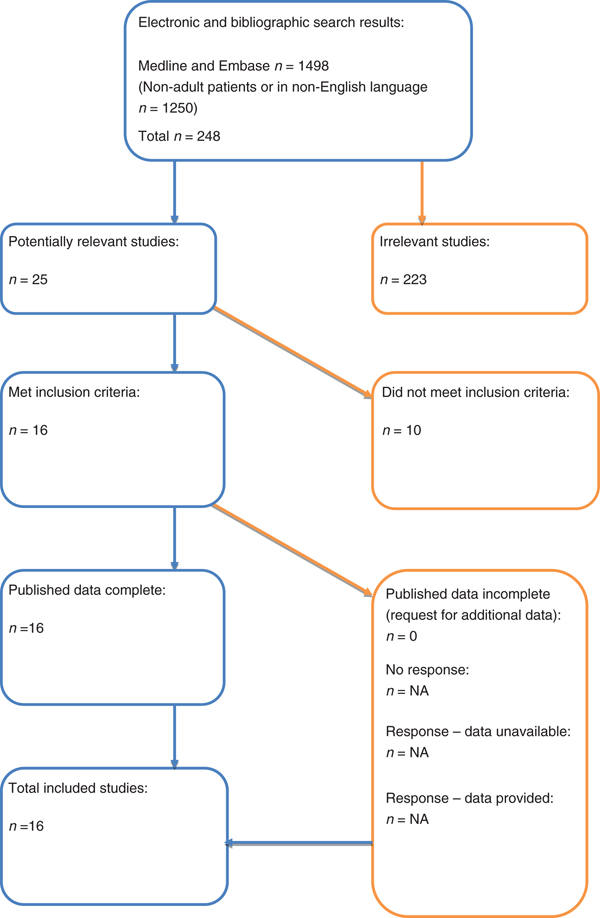
A total of 248 citations were identified by the search; 16 of these studies met the selection criteria and were included in this review.Reference Bican, Kahraman, Bora, Kahveci and Hakyemez29–Reference Virkkula, Bachour, Hytönen, Salmi, Malmberg and Hurmerinta44 The process of study inclusion and exclusion according to our criteria is displayed in a study attrition chart, in accordance with the Preferred Reporting Items for Systematic Reviews and Meta-Analyses (‘PRISMA’) statement (Figure 1). Descriptions of the included studies are summarised in Table 1. These studies exhibited levels of II–IV evidence.
Preferred Reporting Items for Systematic Reviews and Meta-Analyses (‘PRISMA’) flow chart of study attrition. NA = not applicable

Characteristics of included studies

AHI = apnoea/hypopnoea index; ESS = Epworth Sleepiness Scale; OSAS = obstructive sleep apnoea syndrome; BMI = body mass index; UPPP = uvulopalatopharyngoplasty; OSA = obstructive sleep apnoea; FESS = functional endoscopic sinus surgery; SMR = submucosal resection; RDI = respiratory disturbance index; CPAP = continuous positive airway pressure; ANOVA = analysis of variance; post-op = post-operative
The sample size of patients undergoing nasal surgery per study varied across the trials, ranging from 12 to 66 patients. A total of 499 patients underwent a rhinological procedure to improve their OSA symptoms. Of the patients, 487 solely underwent nasal surgery, whilst 12 patients received nasal surgery in combination with multi-level surgery; 3 studies were controlled, comprising a total of 84 control participants.
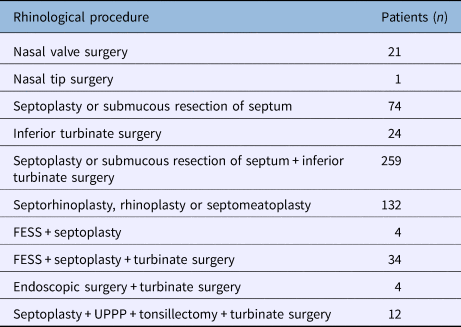
The nasal operative interventions consisted of submucous resection of the septum or septoplasty, septorhinoplasty or rhinoplasty, varying methods of turbinate reduction, FESS, and nasal valve and nasal tip surgery (Table 2).
Nasal operative interventions

FESS = functional endoscopic sinus surgery; UPPP = uvulopalatopharyngoplasty
Apnoea/hypopnoea index
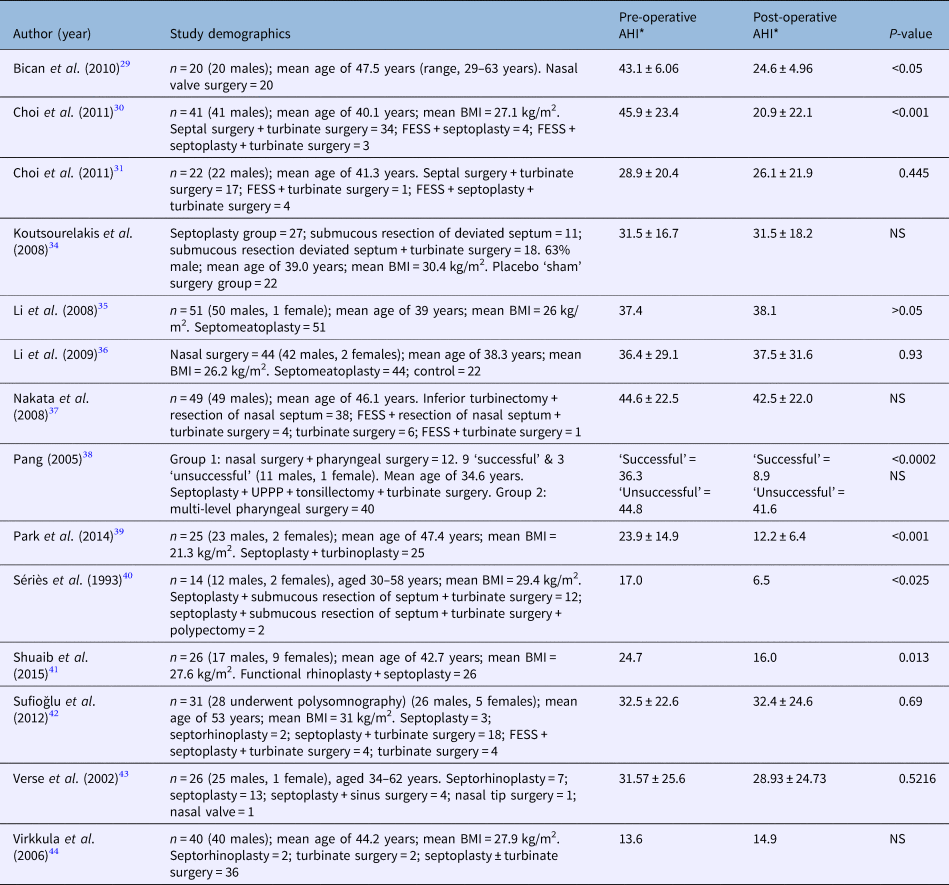
Data addressing the apnoea/hypopnoea index changes were available from 14 studies. Table 3 shows the pre- and post-operative apnoea/hypopnoea index results. Pooled descriptive analysis showed a reduction of 10.6 points on the apnoea/hypopnoea index following surgical intervention.
Pre- and post-operative apnoea/hypopnoea index results

Statistical significance, p < 0.05. *Data represent mean (± standard deviation). AHI = apnoea/hypopnoea index; BMI = body mass index; FESS = functional endoscopic sinus surgery; NS = not significant; UPPP = uvulopalatopharyngoplasty
Respiratory disturbance index
The respiratory disturbance index was described in three studies (including one study which measured both the apnoea/hypopnoea index and the respiratory disturbance indexReference Park, Hong, Lee, Lee, Cho and Lim39); the results are shown in Table 4. The findings were significant for two of the studies. Park et al. found a significant improvement in both the apnoea/hypopnoea index and the respiratory disturbance index following septoplasty plus turbinoplasty at two months post-operation.Reference Park, Hong, Lee, Lee, Cho and Lim39 Pooled descriptive analysis showed a reduction of 4.6 points on the respiratory disturbance index following surgical intervention.
Pre- and post-operative respiratory disturbance index results

Statistical significance, p < 0.05. *Data represent mean (± standard deviation). RDI = respiratory disturbance index; FESS = functional endoscopic sinus surgery; NS = not significant; BMI = body mass index
Epworth Sleepiness Scale
The Epworth Sleepiness Scale score was reported in 12 papers. The results are shown in Table 5. Pooled descriptive analysis showed a reduction of 3.9 points on the Epworth Sleepiness Scale following surgical intervention.
Pre- and post-operative Epworth Sleepiness Scale results

Statistical significance, p < 0.05. *Data represent mean (± standard deviation). ESS = Epworth Sleepiness Scale; NS = not significant
Discussion
The pooled data from this systematic review of the current evidence suggest that, overall, there is a reduction of 10.6 events per hour in the objective polysomnographic measure of apnoea/hypopnoea index following nasal surgery. The respiratory disturbance index results were found to be significant in two out of the three studies,Reference Kim, Choi, Jeon, Cha, Kim and Chung33, Reference Park, Hong, Lee, Lee, Cho and Lim39 and the pooled data suggest a reduction in respiratory disturbances of 4.6 events per hour. Both findings suggest an overall improvement following surgical intervention. However, the data from the current body of studies are too heterogeneous for a meta-analysis to be conducted without exposing the results to bias. Hence, the significance of intervention cannot be statistically determined. Nevertheless, as some studies report improvements in the apnoea/hypopnoea index and the respiratory disturbance index following surgery, there may be a subset of patients who are more likely to benefit from nasal surgery.
Koutsourelakis et al. produced the only randomised controlled trial on this specific topic.Reference Koutsourelakis, Georgoulopoulos, Perraki, Vagiakis, Roussos and Zakynthinos34 Their findings generally agreed with the cumulative results, in that there was no significant difference in the apnoea/hypopnoea index of the surgery and placebo sham surgery groups. They did, however, note that the patients who responded to surgery (apnoea/hypopnoea index of less than 15 events per hour post-operatively, with a 50 per cent decrease from baseline) had significantly lower baseline periods of nasal breathing compared to non-responders. They reported that increased nasal breathing periods are inversely related to apnoea/hypopnoea index change, and therefore hypothesised that patients with particularly poor nasal breathing at night may respond better to nasal surgery.
A number of anatomical and physiological factors that contribute to OSA will vary from patient to patient. Sériès et al. used cephalometric assessment as a tool to predict the effect of nasal surgery.Reference Sériès, St Pierre and Carrier40 They found surgical intervention to be more effective in patients without craniomandibular abnormalities. Friedman et al. found that the respiratory disturbance index was only significant for patients with mild OSA.Reference Friedman, Tanyeri, Lim, Landsberg, Vaidyanathan and Caldarelli32 These variations could also explain why the severity of underlying OSA may affect the success of nasal surgery.
The current review demonstrated a significant improvement in the subjective patient-related outcome measure that is the Epworth Sleepiness Score in all but one study.Reference Pang38 This improvement suggests that improving nasal patency provides symptomatic relief for patients, which can improve their QoL, even if they are still classed as suffering from OSA on the basis of apnoea/hypopnoea index or respiratory disturbance index scores.
Relieving nasal obstruction could be an adjunct in the management of OSA. Nasal obstruction can cause discomfort for patients using CPAP in light of the structural obstruction.Reference Hoffstein, Viner, Mateika and Conway45 The CPAP itself can also cause rebound nasal congestion and CPAP-induced rhinitis.Reference Bican, Kahraman, Bora, Kahveci and Hakyemez29
Studies conducted by Bican et al.Reference Bican, Kahraman, Bora, Kahveci and Hakyemez29 and Friedman et al.Reference Friedman, Tanyeri, Lim, Landsberg, Vaidyanathan and Caldarelli32 measured effects on CPAP users before and after nasal surgery. Bican et al. found that CPAP users reported a greater subjective improvement in symptoms, with a lower Epworth Sleepiness Scale, following nasal valve surgery and CPAP titration, compared to CPAP non-users.Reference Bican, Kahraman, Bora, Kahveci and Hakyemez29 Friedman et al. found that all their patients, regardless of OSA severity, required significantly lower CPAP titration levels following nasal surgery (p < 0.01).Reference Friedman, Tanyeri, Lim, Landsberg, Vaidyanathan and Caldarelli32 A subset analysis of the severe OSA group revealed a significant reduction in CPAP levels (p < 0.01), despite no significant improvement in the respiratory disturbance index.Reference Friedman, Tanyeri, Lim, Landsberg, Vaidyanathan and Caldarelli32
The CPAP treatment pressures have been shown to strongly correlate with apnoea/hypopnoea index.Reference Camacho, Zaghi, Tran, Song, Chang and Certal46 Nasal surgery could increase CPAP compliance because the lower pressures may improve ease of use and improve patients’ tolerance of CPAP.Reference Sériès, St Pierre and Carrier47 Camacho et al. performed a systematic review and meta-analysis of the effect of nasal surgery on CPAP use, and found that it reduced the required therapeutic pressures, and in some patients it suggested an increase in CPAP use.Reference Camacho, Riaz, Capasso, Ruoff, Guilleminault and Kushida48
There are limitations to this review. The studies reviewed all relate to patients who have symptomatic and physical evidence of existing nasal obstruction; therefore, the conclusions reached should only be applied to this subset of patients. The studies were fairly matched in terms of demographics; nevertheless, there was variability in the type of nasal operation being undertaken and the surgical techniques described. Subset analysis would be useful in assessing the effects of each of these surgical procedures on the outcomes; however, this was not undertaken in any of the studies, and therefore the data could not be extracted and analysed in our review. There was also heterogeneity across the outcome measures: some studies measured apnoea/hypopnoea index changes overall, whilst others defined a specific reduction in apnoea/hypopnoea index or an endpoint apnoea/hypopnoea index score for the outcome to be considered significant.
It would be beneficial for future studies if a consistent outcome measure for apnoea/hypopnoea index was agreed; the Sher criteria for the success of surgical management of OSA is a possible measure.Reference Sher, Schechtman and Piccirillo49 This criteria defines successful treatment in terms of a reduction of apnoea/hypopnoea index by 50 per cent and an apnoea/hypopnoea index of less than 20 events per hour.
The study designs ranged from level II to level IV evidence, and included only one randomised control trial; however, this is currently the best level of evidence available on this topic.
Conclusion
Nasal surgery may have limited benefit for patients based on current evidence. It seems illogical to suggest that one type of surgery could be beneficial to every patient with OSA. Similarly, not every patient with OSA and nasal obstruction may benefit from surgery. Perhaps only a subset of patients within this category will benefit; for example, those who show particularly poor nasal breathing during sleep or those with mild OSA. Obstructive sleep apnoea can exhibit multi-level phenomenon; drug-induced sleep endoscopy may be useful to confirm the multi-level features within a patient to identify the anatomical segment predominantly causing the obstruction, and tailoring surgical intervention accordingly. Nasal surgery could be used as an adjunct to improve compliance with CPAP or to reduce the burden of symptoms associated with OSA.
The inconsistency of outcomes reported across the studies could be addressed by developing standardised core surgical and patient-related outcome measures for future trials, potentially through the application of a Delphi survey, as has been achieved in other areas.Reference Bruce, Harman, Williamson, Tierney, Callery and Mohiuddin50 However, assessing and validating tools to measure these outcomes may continue to be a challenge. It is an area in which more research must be carried out if we are to further delineate whether certain subsets of patients do indeed consistently respond to surgery.
Competing interests
Author JCRW is a National Institute for Health Research Academic Clinical Fellow, and this research is indirectly supported by the National Institute for Health Research infrastructure at the Nuffield Department of Orthopaedics, Rheumatology and Musculoskeletal Sciences, University of Oxford. The views expressed are those of the author(s), and not necessarily those of the National Health Service, the National Institute for Health Research or the Department of Health.