Introduction
According to the World Health Organization, based on 2020 data, over 55 million people suffer symptoms of dementia globally (https://www.who.int/news-room/fact-sheets/detail/dementia), with the number of patients with dementia in Ireland expected to rise from 55,000 (data from 2018) to approximately 141,200 by 2050 (https://dementia.ie/lessons/irelands-dementia-statistics). Dementia encompasses a diverse group of conditions characterised by significant cognitive decline impacting memory, communication skills and daily functioning and is associated with a complex and multifaceted aetiology resulting in neuronal loss and brain atrophy (Chouliaras & O’Brien, Reference Chouliaras and O.’Brien2023).
More than 90% of individuals diagnosed with dementia experience one or more of the behavioural and psychological symptoms of dementia (BPSD) over the course of their illness (Lee et al. Reference Lee, Gill, Freedman, Bronskill, Hillmer and Rochon2004; Cerejeira et al. Reference Cerejeira, Lagarto and Mukaetova-Ladinska2012; Van Der Linde et al. Reference Van Der Linde, Dening, Matthews and Brayne2014). Approximately 50% of individuals with BPSD will experience significant behavioural difficulties including agitation and will act in an aggressive fashion (Gilmore et al. Reference Gilmore, Stebbins, Argüelles-Borge, Trinidad and Golden2020). Psychotic symptoms affect 34–63% of individuals and can incorporate both delusions and hallucinations (Atchison et al. Reference Atchison, Wu, Watt, Seitz, Ismail and Goodarzi2024), with 10–20% of individuals experiencing depression, apathy and sleep disturbance (Kolanowski et al. Reference Kolanowski, Boltz, Galik, Gitlin, Kales, Resnick, Van Haitsma, Knehans, Sutterlin, Sefcik, Liu, Petrovsky, Massimo, Gilmore-Bykovskyi, MacAndrew, Brewster, Nalls, Jao, Duffort and Scerpella2017; Tible et al. Reference Tible, Riese, Savaskan and Von Gunten2017; Koren et al. Reference Koren, Fisher, Webster, Livingston and Rapaport2023).
Both the UK’s National Institute for Health and Care Excellence and the Irish Health Service Executive’s National Clinical Guideline (NCG) on appropriate prescribing of psychotropic medication for non-cognitive symptoms in people with dementia (NCG No. 21) suggest that non-pharmacological interventions such as cognitive stimulation training, exercise, music therapy, light therapy and aromatherapy, should be instituted prior to the introduction of pharmacological strategies for BPSD Dyer et al. Reference Dyer, Crotty, Laver, Pond, Cumming, Whitehead and Crotty2016; Náisiúnta & Othar, Reference Náisiúnta and Othar2019; National Institute for Health and Care Excellence [NICE], 2023). Despite these guidelines, pharmacological treatments are frequently employed (including as a first-line intervention) and include medications of differing pharmacological properties including antipsychotics, antidepressants, anxiolytics, cognitive enhancers, mood stabilisers and benzodiazepines (Kales et al. Kales et al. Reference Kales, Gitlin and Lyketsos2014; Náisiúnta & Othar, Reference Náisiúnta and Othar2019)
Antipsychotic medications are frequently prescribed (20–50% of cases) to treat BPSD (Lee et al. Reference Lee, Gill, Freedman, Bronskill, Hillmer and Rochon2004; Brimelow et al. Reference Brimelow, Wollin, Byrne and Dissanayaka2019; Ohno et al. Reference Ohno, Kunisawa and Shimizu2019; Fashaw et al. Reference Fashaw, Chisholm, Mor, Meyers, Liu, Gammonley and Thomas2020), with second-generation antipsychotics (i.e. aripiprazole, olanzapine, quetiapine and risperidone) more frequently prescribed compared to first-generation antipsychotics (i.e. chlorpromazine, haloperidol) (Rogowska et al. Reference Rogowska, Thornton, Creese, Velayudhan, Aarsland, Ballard, Tsamakis, Stewart and Mueller2023). However, the utilisation of antipsychotic medications is associated with adverse sequelae, particularly in this population cohort. Of most concern is the potential for antipsychotics to mask the presence of delirium and increase the risk of cerebrovascular accidents, consequently increasing mortality rates (Schuetz, Reference Schuetz2008; Bailey et al. Reference Bailey, Oliveri and Levin2013; Kwak et al. Reference Kwak, Yang and Jang2015). Additionally, individuals with dementia have a higher incidence of developing extrapyramidal side-effects (i.e. bradykinesia, akathesia, tremor and muscle rigidity) and of falling with associated increased risk of hip fractures, particularly where first-generation antipsychotic medications are prescribed (Ali et al. Reference Ali, Sisay, Tariku, Mekuria, Desalew and Gonda2021; Article, 2022).
Given the challenges of providing non-pharmacological approaches for the management of BPSD (i.e. lack of expertise, lack of resources, training and staff shortages), it has been previously reported that doctors (psychiatrists and general practitioners) feel they have no option but to prescribe antipsychotic medications for symptom management (Wood-Mitchell et al. Reference Wood-Mitchell, James, Waterworth, Swann and Ballard2008). Nursing staff have an integral role in managing the care of persons with BPSD in nursing homes. Their regular assessments and observations with patients provide valuable collateral information to prescribers, which inform treatment plans and prescribing decisions (Sawan et al. Reference Sawan, Jeon, Fois and Chen2017; Raza et al. Reference Raza, Piekarz, Jawad, Langran and Donyai2023). We believe that understanding the perspectives of nursing staff regarding the use of antipsychotic medications may help our understanding of wider prescribing patterns for this patient cohort. Consequently, obtaining nurses’ perspectives regarding the use of antipsychotic medications could help understand prescribing patterns for antipsychotic medications for this patient cohort. It is important to take into account the perspective of patients and their families, as well as patient outcomes and evidence-based research, in order to develop well-rounded and effective policies. This study, utilising both quantitative and qualitative methods, evaluates the knowledge, experience and attitudes of nurses working in nursing homes in relation to the administration of antipsychotic medications to individuals diagnosed with BPSD.
Methods
Participants
Nursing staff working in 24 nursing homes in a rural geographical catchment area were invited to participate (n = 120). All nursing staff who participated were required to be actively providing direct care to residents diagnosed with BPSD. All responses were anonymised, and all data were stored securely and handled in accordance with the Data Protection Act 2018. Ethical approval was attained prior to study commencement from the Galway University Hospitals Research Ethics Committee (C.A. 3119), and written informed consent was provided by all participants prior to study engagement.
Procedure
The study questionnaire was developed by a community psychiatry of later-life multi-disciplinary team (including doctors, community mental health nurses, psychologist, social worker and occupational therapist) with any disputes regarding specific questionnaire items resolved via consensus. The final disseminated questionnaire included 17 items, pertaining to staff members’ experience, knowledge of BPSD, antipsychotic medications and NCG (NCG No. 21) pertaining to treatment strategies for BPSD and staff members’ level of confidence in managing BPSD. Questionnaires composed of 17 questions, 16 of which were quantitative, of which 6 contained a prompt for qualitative responses and 1 open-text response question for further comments, were distributed to 120 nurses. Data were collected from 1 January 2024 to 31 March 2024.
Statistical analysis
Statistical analysis was performed using the Statistical Package for Social Sciences (SPSS) 27.0 for Windows (SPSS Inc., IBM, and New York, USA). Descriptive analyses (frequencies, percentages, means and standard deviations) on key demographic and questionnaire were performed for both categorical and continuous variables, as appropriate, with nurses’ experience of working in a nursing home setting categorised as <1 year, 1–5 years and >5 years’ experience. We utilised independent t-tests, or analysis of variance for continuous data, and the chi-square (χ 2) test or Fisher’s exact test to compare data between groups (years of nursing experience) as appropriate. Free-text data were examined and were open-coded based on the framework of the questionnaire and on any other themes unrelated to these questions that emerged. These data were grouped into themes by consensus of the researchers (AT, BH and JMCL).
Results
Of the 120 nurses invited to participate, 70 (58.3%) consented to engage in all study procedures. Sixty-one (87.1%) participants were female, and 59 (84.3%) participants had at least 1 year’ experience working in a nursing home.
Data pertaining to nurses’ knowledge and perceptions of antipsychotic treatment for BPSD symptoms are displayed in Table 1. Sixty-eight participants (97.1%) were comfortable in their knowledge of managing BPSD symptoms with antipsychotic medications. Most nurses stated their beliefs that antipsychotic medications were associated with a noticeable improvement in BPSD symptoms (n = 49, 70.0%), with appropriate dosing regimens utilised by clinicians (n = 52, 82.9%), that treatment was mostly commenced at an appropriate stage of the patients illness (n = 47, 67.1%) and that they were actively involved in decision-making regarding the utilisation of antipsychotic medications for their patient(s) (n = 58, 82.8%). Although not statistically significant, nursing staff with <1 year experience were less aware if alternative therapies were helpful for BPSD (helpful [n = 4, 36.4%], unhelpful [n = 1, 9.1%], unsure [n = 6, 54.5%]) compared with those with either 1–5 years’ experience (helpful [n = 20, 64.5%], unhelpful [n = 5. 16.1%], unsure [n = 6, 19.4%]) and those with greater than 5 years’ experience (helpful [n = 18, 64.3%], unhelpful [n = 3, 10.7%], unsure [n = 7, 25.0%], χ 2 = 5.48, Fisher’s exact p = 0.28). Nurses with more >5 years’ experience stated more frequently that nursing homes were not well equipped to provide alternate therapies (n = 15, 57.1%) compared to nurses with <1 year’ experience (n = 4, 36.4%) or with 1–5 years’ experience (n = 8, 25.8%), (χ 2 = 8.62, Fisher’s exact p = 0.059). Gender was not associated with any significant differences on any items of the questionnaire.
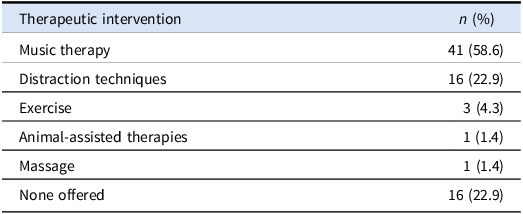
Table 2 details the alternate therapies participants noted utilised in their nursing home for BPSD, with music therapy the most frequently utilised alternate therapy (n = 41, 58.6%). Some potential therapeutic strategies were not offered to any patients (i.e. life-story books, film therapy, aroma therapy, cognitive stimulation therapy).
Nursing staff perspectives on antipsychotic medications for BPSD

BPSD, behavioural and psychological symptoms of dementia; CVA, cerebrovascular accident.
EPSE, extra-pyramidal side effects; NCG, National Clinical Guideline; NH, nursing home.
Therapeutic interventions used in nursing home

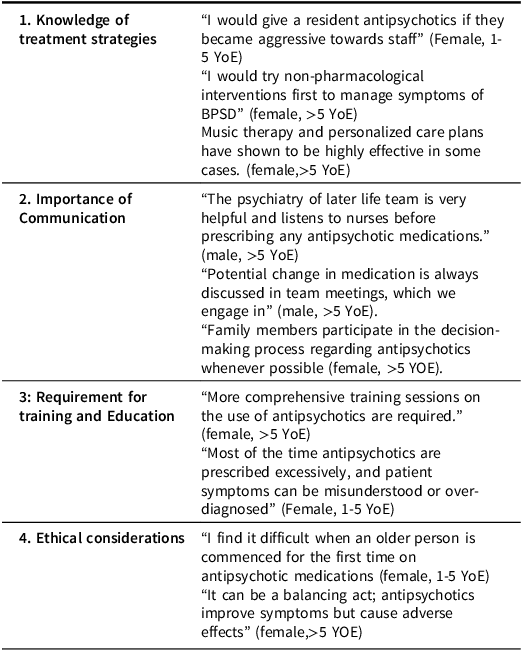
Fifteen distinct comments were provided by participants, revealing four distinct themes (Box 1). The most common theme related to nurses’ knowledge regarding antipsychotic medications and treatment guidelines for the management of BPSD (n = 10). Other themes related to the importance of communication between nursing staff, health professionals and family members (n = 9), the ongoing requirement for training on antipsychotic prescribing in BPSD (n = 8) and ethical considerations in prescribing to this patient cohort (n = 2).
Free-Text Data Themes

Patients with BPSD referred as residents by participants
POLL= psychiatry of later life, YoE = Years of Experience
Discussion
In this study, nurses’ self-reported knowledge and attitudes regarding antipsychotic medication (AP) use for managing BPSD symptoms in nursing homes were examined using both quantitative and qualitative methods.
Almost 97% of the nursing staff interviewed reported good familiarity with BPSD management strategies, with over half (58%) stating a good awareness of the NCG No. 21 for appropriate prescribing of psychotropic medication for non-cognitive symptoms in people with dementia. This likely illustrates the educational benefits of agencies such as the Health Information and Quality Authority (HIQA) and the National Dementia Office and their respective standards and training supports. A key role played by HIQA is to improve nursing home standards and ensure accountability. This regulatory oversight promotes a more humane and person-centred approach to care, ultimately reducing the likely need for antipsychotic medications. The Irish National Dementia Strategy, published in 2014, led to the development of NCG No. 21 (published in 2019), under the guidance of the National Dementia Office. These guidelines suggest that the use of antipsychotic medication should be limited to cases of (1) aggression, (2) agitation or (3) psychosis that cause a likelihood of harm to the individual or others or that cause severe distress. This encourages non-pharmacological interventions and reduces reliance on antipsychotic medications and provides a useful guide for clinicians regarding appropriate use of such agents and a requirement for regular review of side effects, benefits and the need for ongoing use. Training programmes for nursing staff organised by HIQA and the National Dementia Office educates staff with the skills needed to provide compassionate and effective care (https://www.hiqa.ie/learning-hub).
Regarding non-pharmacological or alternative therapies, nurses with a minimum of 5 years’ experience (64 %) demonstrated a high level of awareness of the effectiveness of alternative (non-pharmacological) therapies in managing patients with BPSD. Those with less experience had less awareness of such therapies (however, this was not a statistically significant finding, likely due to the relatively low numbers of staff with <1 year experience [n = 11]). Consequently, targeting training programmes to nurses with less experience would lead to a potential reduction in antipsychotic prescribing for individuals with BPSD. However, a lack of availability of non-pharmacological strategies in some sites (reported by 40% of nursing staff), despite the NCG being published 5 years ago, impedes the potential for the further utilisation of such strategies. Nursing staff note an amelioration of BPSD symptoms when available. Indeed, there is an increasing evidence base for a large array of such strategies (i.e. music therapy, aromatherapy, aroma-acupressure, art therapy, behavioural therapy, reality orientation) (Chen et al. Reference Chen, Liu, Lin, Peng, Chen, Liu and Chen2014; Yang et al. Reference Yang, Lin, Wu, Chiu, Wang and Lin2015; Li et al. Reference Li, Yin, Zhang, Chen, Xia, Ji and Liang2022).
A wide range of behavioural and psychological symptoms associated with dementia (BPSD), particularly psychosis and behavioural disturbances, can be managed with antipsychotic drugs. Results of our study indicate that improvements with antipsychotic in BPSD was noted by 94% of respondents, indicating a high regard for the use of antipsychotic medications and that observable improvements in symptoms are evident; findings consistent with a number of previous reports, including in nursing home settings Walsh et al. Reference Walsh, Sinnott, Fleming, Mc Sharry, Byrne, Browne and Timmons2018; Kelleher et al. Reference Kelleher, Weedle and Donovan2021. However, antipsychotic medications are associated with an array of adverse sequelae as previously stated, with some nurses concerned additionally regarding this risk and the potential overuse of antipsychotics as evidenced from qualitative comments.
Implementing non-pharmacological treatments for BPSD presents several challenges. These include a lack of availability of such strategies, a lack of other resources (i.e. time and staffing numbers to effectively carry out individualised interventions), and a potential resistance from some staff members to implement such interventions given their knowledge of the benefits of antipsychotic medications. Qualitative data note the collaborative approach to managing BPSD and that the opinion of nursing staff was valued in the decision-making process. Consequently, nurse-led non-pharmacological intervention strategies where appropriate for BPSD are likely to be supported and liked by patients, family members and other clinicians.
Limitations to this study include the relatively low number of participants with less than 1 year’ nursing experience and non-inclusion of other disciplines (patients, family members and other clinicians), which will likely be the focus of future study initiatives. Additionally, although this study captures the perspectives of nursing staff regarding antipsychotic medication use, a qualitative analysis of the processes at play in individual clinical interactions (such as Critical Incident Technique) would provide a greater understanding of the driving forces in the demand for and utilisation of antipsychotic medications. This study assessed the subjective responses of nursing staff, of their experiences and recollections, without analysis of clinical records and quantification of actual use of antipsychotics in the respective nursing homes. This may potentially lead to biased results and limit study reliability.
Future studies may also focus in greater detail on potential barriers and facilitators for successful utilisation of non-pharmacological methods of managing BPSD.
Conclusion
Nurses working in nursing home settings demonstrated confidence in their knowledge of treatment strategies (including antipsychotic medications and non-pharmacological strategies) and had a good awareness of NCG for the management of BPSD. The provision of a wider array of therapeutic strategies for the management of BPSD, with ongoing training, particularly for nurses with limited experience in nursing home settings, is suggested to more optimally provide individualised care programmes for people with dementia experiencing BPSD.
Acknowledgements
The authors would like to extend their sincere appreciation to participants who completed the questionnaire and took an interest in this study.
Author contribution
All authors participated in the design of the study, data attainment and critical review of the manuscript.
Disclosure statement
All authors have seen and approved the final version of the manuscript and believe that the manuscript represents work completed.
Financial support
This research received no specific grant from any funding agency, commercial or not-for-profit sector.
Competing interests
The authors have no competing interests to disclose.
Ethical standard
Ethical approval was attained from the Galway University Hospital Clinical Research Ethics Committee (C.A. 3119). The authors assert that all procedures contributing to this work comply with the ethical standards of the relevant national and institutional committee on human experimentation with the Helsinki Declaration of 1975, as revised in 2008.