Introduction
Primary care medical or general practitioners (GPs) are the professionals first consulted by the majority of patients with a mental health problem in Australia (Thompson et al., Reference Thompson, Hunt and Issakidis2004).
Concerns about unmet need for mental health assessment in primary care (Harris and Penrose-Wall, Reference Harris and Penrose-Wall2001) highlight the importance of mental health literacy – knowledge and beliefs about mental disorders and their appropriate treatments (Jorm et al., Reference Jorm, Korten, Jacomb, Christensen, Rodgers and Pollitt1997a) – among GPs. A previous survey reported a high rate of recognition of a depression vignette presenting in a young adult by Australian GPs who tended to view themselves, clinical psychologists and psychiatrists as professionals who could help, with antidepressants, counseling and physical activity considered helpful treatments (Jorm et al., Reference Jorm, Korten, Jacomb, Rodgers and Pollitt1997b).
Australians aged 55 years and over have been identified as having lower access to primary mental health care and to specialist outpatient care (Issakidis and Andrews, Reference Issakidis and Andrews2006). In order to determine if GPs' knowledge of mental disorders in older people, particularly dementia, was a contributory factor, Brodaty et al. (Reference Brodaty, Howarth, Mant and Kurrle1994) conducted a postal questionnaire of 1473 Australian GPs. This showed that doctors were able to correctly identify relevant clinical features, although some 20% reported inadequate knowledge about dementia, and 10% described hopelessness about treatment (the study was conducted in the pre-cholinesterase inhibitor era). A more recent study of Italian GPs found limited overall knowledge of dementia (Pucci et al., Reference Pucci2004).
A U.K. study reported that GPs tended to view late life depression as part of a spectrum which includes social isolation, loneliness and impaired function, rather than as an objective diagnostic category (Burroughs et al., Reference Burroughs, Lovell, Morley, Baldwin, Burns and Chew-Graham2006). This group of GPs also expressed limitations regarding their skills in managing, and a sense of therapeutic nihilism about, late life depression.
Negative views about prognosis may lead to the use or recommendation of treatments without an adequate evidence base. For instance, of GPs asked to respond to a vignette of depression in a young adult, three-quarters deemed meditation or yoga to be helpful and one-quarter thought the same of hypnosis (Jorm et al., Reference Jorm, Korten, Jacomb, Rodgers and Pollitt1997b).
The aims of this paper were to determine (a) Australian GPs' recognition of older patients with common mental disorders of late life, their intentions with regard to investigation, specialist referral, initial treatment, and beliefs about prognosis; and (b) their likelihood of recommending complementary and self-help treatments, for which there may be limited or no formal evidence about effectiveness.
We hypothesized that (a) there would be a high rate of recognition of all disorders, (b) GPs would tend not to investigate depression as thoroughly as dementia or a physical disorder, (c) complementary and self-help treatments such as vitamins and exercise would be recommended similarly irrespective of diagnosis, and (d) treatments without an adequate evidence base would be recommended alongside more proven treatments.
Method
GPs who attended a pharmaceutical company sponsored workshop entitled Emergencies in General Practice in 2007 were asked to complete a four page questionnaire within four weeks of the seminar. The return of the questionnaires was a condition of obtaining Continuing Professional Development (CPD) Points for the activity, registration in the CPD program being a requisite for maintaining membership of the Royal Australasian College of General Practitioners. A reply paid envelope was provided. The study was approved by the Medical and Community Human Research Ethics Advisory Panel of the University of New South Wales.
The questionnaires contained four vignettes of an older male suffering from conditions encountered commonly in old age psychiatry and another with coronary heart disease (CHD), which was used as a control vignette. All participants received identical vignettes in the same order of presentation.
The depression vignette: “John is a 70-year-old widower who lives alone. For one month he has had trouble sleeping and eating. He is so tired that he cannot keep up with the housework and grocery shopping. He no longer enjoys watching football on TV, and has stopped going to the local club to meet his friends. You have been unable to detect any major physical problems after taking blood tests and X-rays. His daughter is worried that John barely talks when she visits with the grandchildren, and he has told her that he might as well be dead.”
The CHD vignette: “Ken is a 72-year-old who retired from a stressful job as a company manager four years ago. You have treated him for high blood pressure for many years. Recently, you asked him to lose weight, to stop eating fatty food, and to stop smoking because his cholesterol and blood sugar levels were high. Two weeks ago, he started to get chest pain and to become short of breath whenever he walked too fast or up stairs. The chest pain is now coming on even when he is resting.”
The dementia vignette: “Bill is a 75-year-old retired clerk. His wife has noticed that he is forgetful about recent events, though he recalls things from earlier in their marriage quite well. He repeats questions which she has already answered, misplaces personal items and occasionally loses the track of their conversations. He has become lost once or twice whilst driving to their son's home, and has written some checks for the wrong amount when paying bills. When she points out these problems to Bill, he loses his temper. He does not think he has a problem.”
A delirium vignette was also included but is not the subject of analysis in this paper.
For each vignette, participants were first asked one open-ended question about diagnosis. This was followed by four closed questions about assessments or investigations that would be conducted, specialists to whom referral would be considered, actions that the patient would be advised to take, and medicines that would be prescribed. Possible responses to these questions were no, maybe and yes. Question number six asked about the utility of non-medical professionals and other people who might assist each patient, with possible responses being harmful, neither and helpful. In the final question, respondents were asked about likely prognosis, with three possible responses, full recovery, partial recovery, or institutional placement.
SPSS GENLIN (SPSS, 2008), which incorporates generalized linear models, was chosen to compare multiple responses by the same participants across differing diagnoses. SPSS GENLIN analyses were used to model the odds of responding yes versus no for one diagnosis versus another diagnosis, with the category no derived from combining maybe and no responses. An exception was the one question in which the response helpful was compared with the response harmful, and the other possible answer unsure was ignored.
Results
Responses were received from 436 GPs out of 556 who attended the workshop (total response rate of 79%), distributed across the six Australian states as follows: New South Wales 81 (18.6% of sample; response rate 75%); Victoria 107 (24.5%; 82%); Queensland 82 (18.8%; 67%); South Australia 46 (10.6%; 86%); Western Australia 71 (16.3%; 93%); and Tasmania 49 (11.2%; 95%).
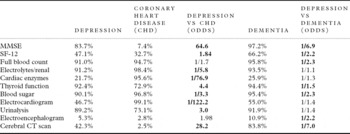
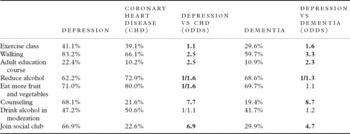
The results in Tables 1–4 simply show the odds of a yes response relative to a no response, as opposed to the likelihood of responding yes. For instance, the odds of ordering a cerebral CT scan for someone with depression are some 28 times greater than for someone with CHD (Table 1). In contrast, the odds of this for someone with depression are 1/7.03 or nearly 7 times smaller than for someone with dementia. The odds in bold are those which are significant after making a Bonferroni adjustment for comparisons within each question. The analyses take into account the fact that the responses on the vignettes are repeated measures and thus correlated. Some odds were not calculated if the number answering yes was too small (typically less than 1% of responses); these are indicated with a dash (-).
Investigations that would be conducted, by vignette

For each investigation, the % figure is the proportion of participants who answered yes (the rest answered maybe or no).
MMSE = Mini-mental State Examination; SF-12 = Short Form 12-item health questionnaire; CT = computerized tomography.
Medical specialists to whom referral would be considered, by vignette

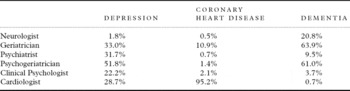
For each specialist, the % figure is the proportion of participants who answered yes (the rest answered maybe or no). The columns do not add up to 100% given multiple answers were possible.
Other sources that would be helpful, by vignette

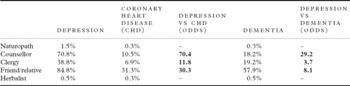
For each response, the % figure is the proportion of participants who answered helpful (the rest answered unsure or harmful). The columns do not add up to 100% given multiple answers were possible.
Medicines that would be prescribed, by vignette
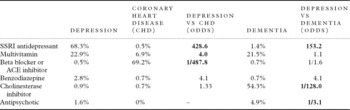
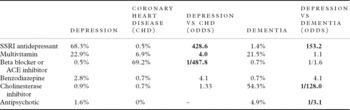
For each medicine, the % figure is the proportion of participants who answered yes (the rest answered maybe or no).
SSRI = selective serotonin reuptake inhibitor; ACE = angiotensin converting enzyme.
Actions that would be recommended, by vignette

For each action, the % figure is the proportion of participants who answered yes (the rest answered maybe or no).
Diagnostic recognition
The rate of recognition for the depression vignette was 93.4%, the remaining responses being “depression and/or dementia” or “depression and/or delirium.” The rate of recognition for the dementia vignette, including responses of “Alzheimer's disease” or “cognitive impairment,” was 97.5%. There was almost universal recognition (99.1%) of the CHD vignette.
Assessments/investigations considered
There was a high rate of endorsement of systemic investigations, such as thyroid and renal function, in all three conditions. The use of organ specific assessments varied. The Mini-mental State Examination (MMSE) of cognition (Folstein et al., Reference Folstein, Folstein and McHugh1975), cerebral CT scan and electroencepahalogram (EEG) were most likely to be used in dementia, although only 84% of respondents considered a CT scan and 11% an EEG in this diagnosis. Both the short form-12 item (SF-12) health questionnaire (Ware et al., Reference Ware, Kosinski and Keller1996) and cerebral CT scan were considered by less than half of respondents for the depression vignette, and CT scan was seven times less likely to be ordered in this vignette compared to the dementia vignette. In contrast, electrocardiogram (ECG) and cardiac enzymes were considered by 96–99% in the CHD vignette.
Referral intentions
When GPs were asked about which specialists would be considered, a cardiologist (95.2%) was the most common choice in CHD, whereas several specialists were considered appropriate in the other two conditions. For dementia, a geriatrician (aged care physician) or a psychogeriatrician (aged care psychiatrist) were considered equally frequently. For depression, a number of specialties were considered, although a geriatrician referral was considered almost universally in conjunction with referral to a mental health professional (10.8% psychiatrist, 10.6% psychogeriatrician, 10.3% clinical psychologist).
Other sources of help considered
There was little endorsement of naturopathy or herbal medicine as being helpful for any of the vignettes. GPs were far more likely to recommend a number of formal or informal sources of talking/listening for the depression vignette, ranging from a friend or relative, a counselor or a member of the clergy, than in the CHD or dementia vignettes.
Medication prescription intentions
Whilst approximately two-thirds of the respective groups would be prescribed an antidepressant or a cardiac medication, only half of dementia patients would be prescribed a cholinesterase inhibitor. Antipsychotics would be rarely prescribed – three times less likely in depression than dementia – and benzodiazepines even less so. Multivitamins would be recommended equally for depression and dementia.
Actions recommended
When non-drug treatments were considered for each disorder, receiving counseling and joining a social club were far more likely to be recommended for depression over the other two disorders. This was also the case for walking and mental stimulation, although to a lesser degree. Despite some statistically significant differences, an exercise class, dietary changes and advice about alcohol consumption were all recommended similarly across vignettes.
Prognosis
GPs viewed dementia as a degenerative condition with little prospect of full recovery (0.7%) and which is far more likely to require institutional placement (70.1%). In contrast, depression was viewed more optimistically as a condition that recovers partially (33.1%) or fully (58.2%). The prognosis for CHD was rated similarly, with full recovery endorsed by 53.8% and partial recovery by 45.8%.
Discussion
There was a very high rate of recognition for all three disorders, including depression and dementia, supporting our first hypothesis. In contrast, actual detection of these disorders in primary care patients tends to be considerably lower (Hickie et al., Reference Hickie, Davenport, Scott, Hadzi-Pavlovic, Naismith and Koschera2001; Iliffe et al., Reference Iliffe, Walters and Rait2000). This lack of translation into everyday clinical practice may be due to the descriptions used here being “textbook” in style; diagnosis in clinical settings is confounded by a number of patient and doctor factors such as time available for consultations, the use of an informant, the presence of co-morbid physical disorders, and the willingness of patients to disclose more sensitive mood and cognitive symptoms. For example, psychological symptoms were clearly described in the depression vignette, whereas depression may be more likely to present with somatic symptoms which is a specific reason for under-detection in primary care (Hickie et al., Reference Hickie, Davenport, Scott, Hadzi-Pavlovic, Naismith and Koschera2001).
One way by which the diagnoses of depression and dementia may be improved is the use of GP-initiated screening instruments (Harris and Penrose-Wall, Reference Harris and Penrose-Wall2001; Brodaty et al., Reference Brodaty2002). We included two such instruments in the survey, chosen on the basis of potential high recognition by Australian GPs. Whilst the MMSE was almost universally and appropriately applied in the dementia vignette, less than half of GPs endorsed the SF-12 in the depression vignette. Although the SF-12 is a general questionnaire about health and disability, it does contain five items pertaining to social function and psychological distress which may be used as prompts for formal clinical assessment. That GPs were far more likely to use the MMSE than the SF-12 in the depression vignette highlights uncertainty about a screening questionnaire relevant to depression. This may in turn reflect local factors; Medicare, the Australian system of universal health insurance, requires GPs to complete Mental Health Care Plans prior to specialist referral, but the SF-12 is only listed in some electronic outcome assessment packages (Australian General Practice Network Ltd, 2007).
More than 90% of GPs advocated thorough investigation for associated systemic physical abnormalities in the dementia and depression vignettes. The rate of neuroimaging was somewhat lower than might have been expected in the dementia vignette which described a patient with relatively early or mild dementia, and especially so in the depression vignette. This suggests that GPs tend to underestimate the significance of central nervous system correlates of late life depression, especially the notion of “vascular depression,” a late-onset sub-type of depression associated with vascular risk factors, overt cerebrovascular disease and relative treatment resistance (Alexopoulos et al., Reference Alexopoulos, Meyers, Young, Campbell, Silbersweig and Charlson1997).
GPs were equally likely to consider referral to two main medical specialists in dementia, an aged care physician (geriatrician) or an aged care psychiatrist (psychogeriatrician), although the vignette did not specifically mention behavioral complications which may have favored the later. In contrast, there was heterogeneity of specialist choice in depression, with both general and aged care psychiatrists named. That one-third of GPs advocated referral to an aged care physician for the depression vignette, mainly in conjunction with a referral to a mental health professional, is suggestive of an approach which considers both physical and psychological etiologies.
As with detection, specialist referral may occur less frequently in practice. A U.K. study found that 90% of patients identified as suffering depression were managed in primary care alone, with suicidal ideation and treatment failure being the main reasons for referral (Dearman et al., Reference Dearman, Waheed, Nathoo and Baldwin2006). This tendency to refer later or in situations of relative crisis was also noted by an Australian study which found that dementia patients were more likely to be referred to community aged care assessment teams when behavioral problems or carer stress were detected (Bruce et al., Reference Bruce, Paley, Underwood, Roberts and Steed2002). An analysis of Medicare billings showed that, per capita, younger adults received approximately 2.5 times the number of psychiatric services as people aged over 64 years and 3.5 times that of people aged over 74 years (Draper and Koschera, Reference Draper and Koschera2001). This compares with combined rates of affective and anxiety disorders being approximately two times less common in old age in Australia (Trollor et al., Reference Trollor, Anderson, Sachdev, Brodaty and Andrews2007).
Our hypothesis that complementary and self-help treatments would be recommended irrespective of actual diagnoses was partly supported. There was little difference in the rate at which multivitamin tablets, joining an exercise group, participating in an adult education course, walking and modifying diet and alcohol use were recommended in the depression and dementia vignettes. These results are similar to previous findings in a community sample about favored interventions for mental disorders being consistent with pre-existing general belief systems which are applicable to any health problem, rather than a lack of knowledge about treatments (Jorm et al., Reference Jorm, Mackinnon, Christensen and Griffiths2005). One important difference with this professional sample is that the lay public tended to rate medical interventions between harmful and neutral.
Our hypothesis about GPs' tendency to recommend evidence and non-evidence-based treatments equally was supported. (There is most evidence for the effectiveness of exercise in depression (Jorm et al., Reference Jorm, Christensen, Griffiths and Rodgers2002), although most studies have been conducted in group settings). In depression, an antidepressant would be recommended less frequently by respondents than advice on walking and dietary change, whilst counseling, reducing alcohol, and joining a social group were only just less likely to be recommended than an antidepressant. The current survey specifically asked about the intention to use a selective serotonin reuptake inhibitor (SSRI) antidepressant because of its greater tolerability in the elderly. It is possible that GPs hold some reservations about the efficacy of this class, given that a qualitative audit of GPs' practice in late life depression found that the tricyclic class was prescribed in half of patients receiving an antidepressant (Dearman et al., Reference Dearman, Waheed, Nathoo and Baldwin2006).
The tendency to recommend counseling much more frequently than a referral to a clinical psychologist underlines a tendency to non-specific treatment. Clinical psychology is a profession expert in cognitive behavior therapy (CBT) which has proven benefit in depression, whereas the term counseling incorporates a variety of psychological techniques for which there is less evidence (Jorm et al., Reference Jorm, Christensen, Griffiths and Rodgers2002). This conclusion is limited by the survey's failure to ask specifically about CBT and may reflect the relative paucity of clinical psychologists in parts of Australia. It is noted that the survey was conducted only six months after Medicare introduced partial reimbursement for services provided by registered clinical psychologists.
In dementia, a cholinesterase inhibitor drug was endorsed less frequently than advice about walking, reducing alcohol or dietary changes. This sample's gloomy views about prognosis may have led to a sense of inevitability and reluctance to prescribe active medication. Although only 5% advocated the use of an antipsychotic in the dementia vignette, this is of concern given that no behavioral changes such as agitation, aggression or psychosis were described, and the benefits of this psychotropic class may be outweighed by adverse effects (Schneider et al., Reference Schneider2006).
A final example of a practice intention with the potential to be “lost in translation” is benzodiazepine use. Although very few respondents recommended benzodiazepines for the depression vignette, 16–20% of an elderly community sample from Sydney was prescribed this class of medication, with psychological disorders being a correlate of usage (Jorm et al., Reference Jorm, Grayson, Creasey, Waite and Broe2000).
There are a number of limitations in the sample that may mean the results are not generalizable. The GPs were recruited at an educational meeting organized by a pharmaceutical company, although not at a seminar specific to psychiatry or aged care medicine. The implications for evaluating practice are limited by our reporting answers to structured questions about hypothetical patients rather than a practice audit. The literature review has been largely confined to Australian studies and results should be seen in the context of the Australian health system, in which GPs play a significant role in providing treatment or as gatekeepers to consultation with mental health specialists.
Despite the high response rate, the distribution by state is not consistent with the proportions of GPs practicing within each state; for instance, NSW has the highest number and proportion of GPs in Australia but provided only the third largest number of respondents. Although there are no data available on the demographics of respondents, previous meetings in this CPD series have attracted over 40% of participants from rural and remote areas.
Conflict of interest declaration
This study was supported by an educational grant from Merck, Sharp and Dohme (MSD), Australia. MSD had no input into the design of the study or interpretation of results.
Description of authors' roles
CW designed the study including writing vignettes and survey, and wrote the paper. PH supervised data collection and contributed to writing of paper.
Acknowledgments
Van Thi Thuy Nguyen coded and entered the data and conducted initial analysis for this study. Dusan Hadzi-Pavlovic compiled the statistics which required the use of SPSS GENLIN software. Brian Draper commented on an earlier version of the paper.