





Introduction
This article focuses on how the widely covered ‘Ditrău incident’Footnote 1 triggered Romania’s first immigration debate. Locally, this event involved the mobilisation of a group of residents from the rural Transylvanian Hungarian-majority town of Ditró against two Sri Lankan employees upon their arrival in January 2020. At the national and international levels, however, the story took on a different shape. We argue that it was made subject to a debate instrumental in reaffirming Romania’s Western-centric neoliberal hegemony and establishing a utilitarian discourse on immigration. This posture stands in sharp opposition to that of many Central and Eastern European (CEE) states, where anti-immigration perspectives became hegemonic, particularly following the European ‘migrant crisis’ of 2015. Over the course of the events, mainstream commentators argued in favour of immigration in connection to economic and demographic development, while absolving the ethnic Romanian majority of any responsibility for xenophobia or racism. In this process, they rhetorically attached both xenophobia and racism specifically to Transylvanian Hungarians and turned third-country labour immigrants (from outside the European Union [EU] and the European Economic Area [EEA]), mostly South Asian, into diligent migrant workers.
The ‘Ditrău incident’ in the reproduction of the hegemonic order
The events that triggered Romania’s immigration debate started in mid-January 2020, when, upon the arrival of two Sri Lankan nationals, the private Facebook group Migránsmentes Ditrót akarunk (Hungarian for ‘We want Ditrău without immigrants’) was established. At times reaching up to 2,000 members, the group functioned briefly as a forum for discussion of immigration, identity politics, and labour issues. More controversially, as screenshots collected at the time demonstrate, the group also spread anti-immigrant hate speech (Gergely Reference Gergely2020). It was the latter that brought the incident to the attention of the Hungarian-language regional press and subsequently to that of the Romanian-language national mass media and international journalism, which ultimately particularised the ‘Ditrău incident’ as the epitome of racism and xenophobia. Since that time, actions carried out by locals, including the organisation of public fora, the drafting of a petition concerning labour issues at a local level, the relocation of the foreigners to nearby towns, and the boycotting of the related bread factory products, have been interpreted by mainstream actors through the language of xenophobia. Over the course of the debate, the local community’s alleged collective refusal to buy and eat ‘white bread’ now kneaded by ‘black hands’ (see Ștefănescu Reference Ștefănescu2020) became a central metaphor, and the mass media portrayed residents of Ditró as a collective indivisibly associated with right-wing extremism. As for the two Sri Lankans, although they were rightly depicted as the principal injured parties, mainstream media deemed them defendable inasmuch as their ‘diligence’ as ‘migrant workers’ could be upheld.
Our article does not focus on the events in situ (see Kiss and Escobedo Reference Kiss and Escobedo2026 for the local analysis of the case). It examines how the ‘Ditrău incident’ was utilised by Romania’s societal and cultural core to reaffirm the hegemony of Western-centric neoliberalism. In line with this claim, we pay attention to how, through this articulation, the cultural core also attempted to expand its control over the country’s political community in matters related to, for example, the integration of Global South immigrants. For this purpose, we conducted social media content analysis, followed by visual and semiotic analysis, to advance three interlinked sets of arguments.
First, we try to understand why mainstream actors (journalists, opinion leaders, politicians) have been so preoccupied with an event that happened in a peripheral Hungarian-speaking location that affected two foreign nationals. We argue that the ‘Ditrău incident’ was instrumental in reproducing the hegemonic order in four interlinked ways. (1) Through the incident, Romania’s mainstream actors were able to present themselves as jointly rational, efficient, and welcoming. In this sense, they embraced a position typically associated with ‘Western’ societies, which, in the Romanian public sphere, are still perceived as archetypes for social, economic, and moral development and as handbooks for ‘Europeanisation’ and ‘Westernisation’ (Thornton, Yount, Young-DeMarco et al. Reference Thornton, Yount, Young-DeMarco, Moaddel, Moaddel and Gelfand2017). (2) They also reproduced a social order that has thus far relied on the hegemony of neoliberalism, according to which the interests of capital are represented as the national interest and the common good (Ban Reference Ban2016). This order has also relied on the idea of the ‘middle class’ as an ideology (Weiss Reference Weiss2019), which dictates the unrecognition of a division among classes with opposing group interests in preference for singling out a ‘middle class’ category as the moral core and role model of society (Crăciun Reference Crăciun and Vainovski‑Mihai2022). (3) Mainstream actors also used ‘the incident’ to absolve themselves of any responsibility for xenophobia or racism (see Kalmar Reference Kalmar2022), partly by attributing these phenomena to particular ‘white subjects’ in a nondominant or subordinate position (see Hunter and van der Westhuizen Reference Hunter, van der Westhuizen, Hunter and van der Westhuizen2022: 6–10), whether individually or collectively. Primarily, rural dwellers, or țărani (literally, Romanian for ‘peasants’, but often used pejoratively and for [self-]orientalising purposes), and the Transylvanian Hungarian minority were put under the spotlight in this pursuit. This reinforced the longstanding perception of ambivalence and in-betweenness attributed to the latter, especially as a group not entirely belonging to the political community, and one additionally influenced by Viktor Orbán, the Hungarian Prime Minister, an external geopolitical actor. Hence, the recurring argument is that racism was rather external to the Romanian political community. (4) Mainstream actors articulated the ‘Ditrău incident’ as a xenophobic one to strengthen the construction of the mostly South Asian third-country labour immigrants as ‘diligent migrant workers’, hence their integration as merely parts of the workforce, regardless of their cultural characteristics and origin.
Second, we focus on the characteristics of the ‘New Romania’ (Noua Românie), meaning the political community envisioned by the country’s dominant core (Borțun and Cheregi Reference Borțun, Cheregi, Adi and Lilleker2017) and on how non-dominant classes and minorities are represented within it. We argue that hegemonic neoliberalism does not only erode class-based social ontology through the disguise of exploitation and expropriation (Yılmaz Reference Yılmaz2016), but it also silences, individualises, and invisibilises working-class voices. Additionally, during the debate, the narratives that portrayed Ditró as a ‘racist Hungarian town’ proved to be highly significant in the particularisation of Transylvanian Hungarians as racists and extremists – the town functioning as a synecdoche for the whole minority, rather than acknowledging the protesters also as workers. To add more layers of complexity, Hungarian minority members were, however, conditionally accepted and validated as part of the core group whenever they displayed (enough) proficiency in Romanian, exhibited signs of ‘adequate’ social status, and conformed to the hegemonic discourse. This assimilatory dynamic was also present whenever narratives that welded ‘diligence’ to ‘labour migration’ were articulated vis-à-vis existing cultural classificatory schemes, often used pejoratively to refer to the Roma, Romania’s second-largest ethnic minority. Although textual references to the Roma were notably absent, the vocalisation of the said schemes (for example, the allusion to a welfare-dependent, ‘unworthy’ underclass) was used to deter third-country labour migrants from escaping their categorisation as ‘good migrant workers’ (Cremers Reference Cremers2022).
Third, we focus more narrowly on what the ‘Ditrău incident’ reveals about Romania’s approach to Global South immigration, particularly about the role played by race and racialisation in immigrant integration. This is especially relevant in the context of the broadening literature on race and racialisation in CEE, which focuses, on the one hand, on the racialisation of Central and Eastern Europeans in a ‘Western’ context (Krivonos Reference Krivonos2023; Lewicki Reference Lewicki2024), and, on the other hand, on the radicalisation of racism in CEE under the illiberal hegemony (Kalmar Reference Kalmar2022). Although the inclusion of non-European (non-white) ‘immigrants’ into the envisioned political community and the open condemnation of racism allowed Romanian national actors to brand their country as open, tolerant, and humane, we argue that under Romania’s allegedly progressive neoliberalism, these self-celebratory discourses in fact effectively window-dress the commodification and overexploitation of foreign labour. In line with this, we claim that these discourses also conceal other forms of racialisation, such as the dichotomous representation of race relations that are aimed at keeping immigrant labour in ‘its place’ – typically, in a precarious and partially unfree position.
Analytical frames and research methods
In our case study, we employ historically and structurally situated content-, discursive- and semiotic analyses inspired largely by Wodak’s (Reference Wodak2015) discursive-historical approach. On the one hand, we engage with the institutional, political, and historical framing of ‘the incident’, as well as with the broader historical and political economic context of Romania’s immigration debate. On the other hand, we employ critical discourse analysis and cultural semiotics, focusing on both texts and audiovisual media, to decode and understand the political processes and dominant discourses that enable the (re)production of social hierarchies and inequalities. Similar to Wodak (Reference Wodak2015: 5), we focus on both the role that content (ideologies, beliefs, proposals, imaginaries) and form (rhetoric, argumentation schemes, debating style) play in making meaning.
Beginning with the broader structural and historical context, we first depict how Romania was affected by the ‘migration turn’ (Melegh Reference Melegh2023) – the process that transformed it first into Western Europe’s labour frontier and then into a receiving country for third-country labour immigration. We argue that, in spite of the polarisation between the pro-and anti-immigration blocs and the rise of illiberalism in other CEE countries, in Romania, utilitarian discourses about immigration became dominant as part of a persisting Western-centric neoliberal hegemony. Next, we engage with meaning-making processes, drawing upon Lotman’s (Reference Lotman1990) cultural semiotics. His ‘semiosphere’ constitutes a tool for a fine-grained analysis of the system of representation, its organisation along centre-periphery relations, and the social and linguistic structuring practices of its normative core. This allows us to present the debate around the ‘Ditrău incident’ as a national spectacle of ‘self-description’, where the country’s cultural and societal core reproduces the hegemony of neoliberalism, makes sense of immigration in relation to development, and attributes anti-immigration to particular subjects understood as belonging to the semiotic and cultural periphery.
Aligned with our empirical methodology, we began by constructing a Romanian mainstream social media universe based on Facebook posts and their associated content. This was followed by quantitative trend analysis, semi-qualitative textual content analysis, and qualitative semiotic and discourse analyses, with a primary focus on audiovisual media. The first step involved using CrowdTangle, a public insights tool, to explore publicly available social media content. This tool allowed us to construct a mainstream Romanian Facebook universe based on a selection of 2,341 public sites and groups, including those of political parties (county-and local-level branches), politicians (members of the parliament, party leaders, mayors of larger municipalities), opinion leaders (public intellectuals, journalists, political commentators), media outlets (national and the most important local TV and radio stations, print and online newspapers), and politically engaged public Facebook groups. In addition to Romanian-language sites, we also included the most important Hungarian-language sites in Romania.
The second step involved conducting quantitative trend analysis of immigration-related posts and interactions for the 2013–2023 period. Employing a set of keywords in Romanian and Hungarian – among them, ‘immigrant’, ‘immigrants’, ‘immigration’, ‘foreign worker’, ‘foreign labourer’, ‘guest worker’, ‘residence permit’, ‘work permit’, ‘General Inspectorate for Immigration’ – we searched for immigration-related edited content (Facebook posts) in our already established universe. Based on this, we identified 10,840 immigration related posts, of which 1,950 (18 per cent) were published in January–February 2020, most of them related to the ‘Ditrău incident’.
As CrowdTangle databases allow for the analysis of interactions (comments, shares, likes, and other reactions) generated by edited content, in a third step, we selected the most popular posts (defined as generating more than 100 interactions) referring to the ‘Ditrău incident’ and conducted a content analysis of a total of 405 of them. The aim of this phase was to map the themes, topics, and frames used by those arguing for or against immigration. Drawing on Yılmaz (Reference Yılmaz2016: 27), we treated each post as a unit of analysis and classified the perspective from which it was written using our own codes. In most cases, we identified more than one perspective (theme, topic, frame); hence, we used more than one code per post, with a maximum of four. This allowed us to quantify the strength of association among themes using the odds ratio (OR) (Figure 4). We identified 29 themes in total and grouped them into major thematic categories (Figure 4).
The final (fourth) step consisted of qualitative semiotic analyses. In accordance with our Lotmanian framework, our goal at this point was to show how the semiotic and cultural core reaffirms itself and constructs its periphery, and, by this means, how it maintains the uniformity of the semiotic space. We selected 35 news items from the 405 posts previously coded, including online news articles, social media posts, internet memes, and other related parodic, satiric, and humorous cultural items; televised news, reports, and interviews; radio discussions and blogs; and embedded screenshots. Their selection reflects that these items offer more substantial and creative content than the average reporting of the case; come from diverse media channels and outlets; represent a variety of genres of storytelling, journalism, reporting, and content creation; are written by opinion leaders with various professional and personal backgrounds; and provide fictional and non-fictional accounts of the case. To complete the textual content analysis, this time we focused more on the audiovisual material (photographs, voices, sounds, music, internet memes, embedded screenshots of social media posts).
Romania’s immigration debate
From labour frontier to destination country: the political-economic context
To understand the historical-structural and discursive context within which immigration has suddenly become a politically striking issue, we turn to the concept of the ‘migration turn’ (Melegh Reference Melegh2023). At the structural-historical level, the migration turn denotes the substantial increase in immigration during the post-1980 phase of capitalist accumulation, characterised by declining profit rates, market saturation, and intensified market competition. Characteristics of this period include capital liquidity, the relocation of industrial production to lower-wage regions of the world (Arrighi Reference Arrighi1994; Arrighi and Silver Reference Arrighi and Silver1999), and increasing reliance on ‘immigrant’, meaning more precarious and partially unfree, labour in higher-wage regions (Silver Reference Silver2003: 169).
Romania was affected by these processes in two consecutive phases. First, particularly since 2000, the country has become a ‘labour frontier’ (Skeldon Reference Skeldon1997) for Western Europe. Along other guest workers arriving from Eastern Europe, Romanian labour was instrumental in enforcing higher levels of flexibility of employment in the Western European core (McCollum and Findlay Reference McCollum and Findlay2018). Internally, the mass emigration of Romanian citizens was prompted by the context of massive deindustrialisation (Murgescu Reference Murgescu2010: 469) and re-ruralisation (Horváth and Kiss Reference Horváth and Kiss2015) that followed regime change. Second, following Romania’s EU accession and its recovery from the financial crisis, massive economic restructuring and reindustrialisation improved the country’s position in the Western European value chain (Ban and Buciu Reference Ban, Buciu, Vincze, Ban, Gog and Friberg2024), setting Romania on the path to becoming a destination country more recently. Benefitting from extra-territorial citizenship, Moldovans were among the first to arrive. Since around 2017, however, a large number of work permits have been issued to South Asian workers, primarily from Sri Lanka, Nepal, and the Philippines.
Romania’s turn into a destination country was thus demand-driven. In line with Brass (Reference Brass2017: 251), we identify the presence of two types of economic rationalities arguing in favour of open immigration policy. One logic is utilitarian and argues that immigrants are needed to ‘supplement’ the existing labour force due to shortages connected to the ‘unavailability’ or ‘unwillingness’ of the local workers. Employers usually rely on this rationality, as do political actors, who, in support of the former, encourage policies that can unfavourably impact the wages and bargaining capacities of the existing labour force. During the debate around the Ditró incident, opinion leaders, including competent authorities, repeatedly emphasised Romania’s need for foreign workers to counter the domestic labour shortage caused by emigration (see Anastasiu Reference Anastasiu2020; Cornea Reference Cornea2020; Sirbu and Bolocan Reference Sirbu and Bolocan2020).
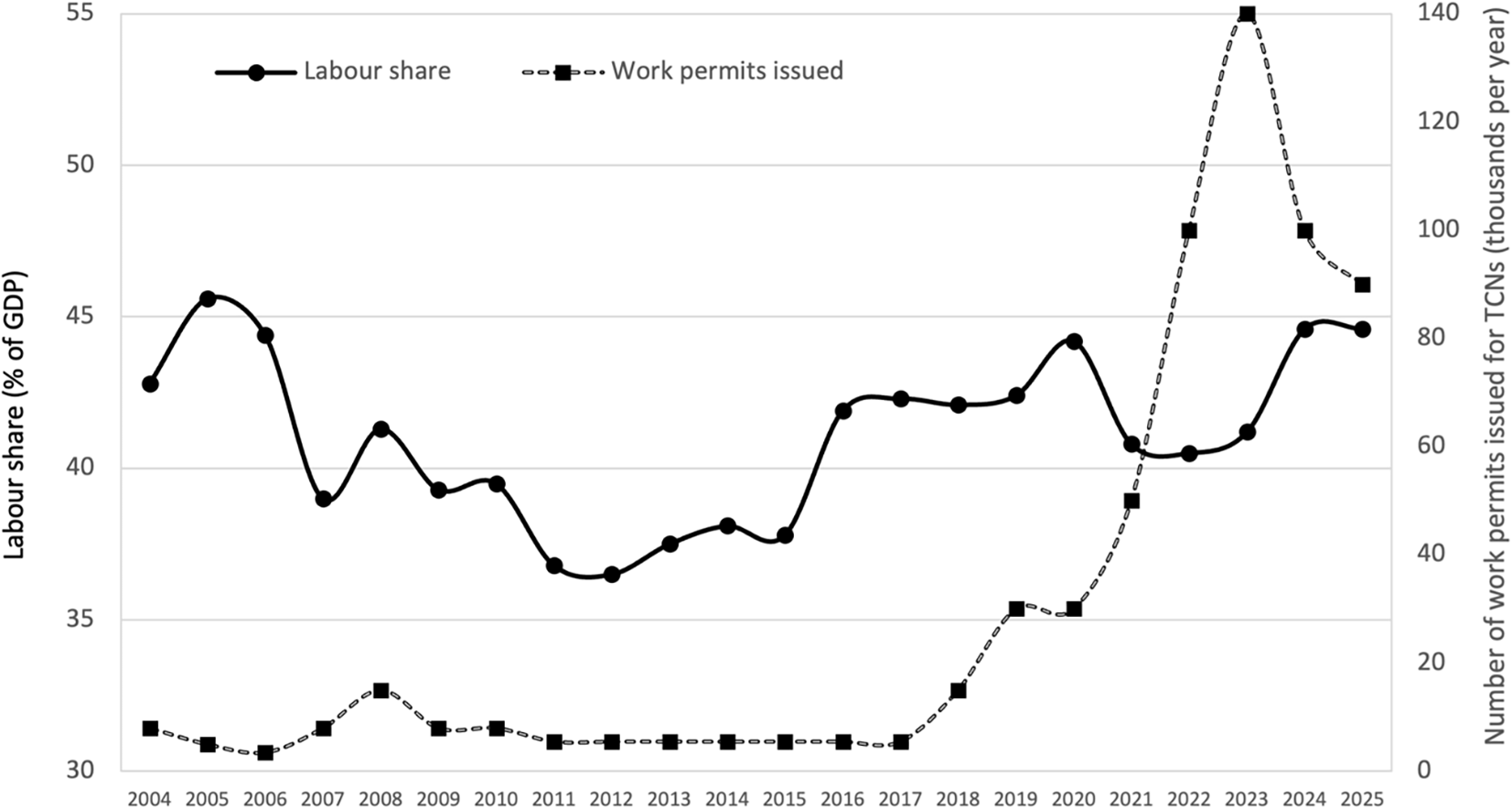
The other logic is one well described by Marx’s concept of ‘industrial reserve army’ (see Brass Reference Brass2017), which explains foreign labour as serving not merely as a supplement, but more so as a ‘replacement’ for, or a threat thereof, the existing local workforce. For Brass (Reference Brass2017: 245), this is driven by the pursuit of capital to increase profitability at the expense of labour. For the private sector, the rapid increase of real wages after 2016 was a severe economic concern (Ban and Buciu Reference Ban, Buciu, Vincze, Ban, Gog and Friberg2024), as this had led to an increase of the labour share (see Figure 1). This change was perceived by entrepreneurs as endangering capital accumulation and the very existence of especially the small-and medium-sized businesses oriented towards the internal market and less embedded in transnational value chains. A perfect example of the latter is the Ditró bread factory, which was intended to serve the local and regional market. In this context, employing foreign workers became imperative not only because of labour shortages but also due to the increasing labour costs.
Labour income share as a percentage of GDP and the number of work permits issued for third-country nationals (TCNs) in Romania, 2006–2023.Footnote 2

Thus, immigration should be seen as increasingly interlinked with capital accumulation. In line with this, increasing profits through migrant labour requires welcoming immigration policies and a certain degree of societal tolerance. Profit accumulation through immigration, however, also entails that ‘immigrants’ are kept in ‘their place’ – that is, in a precarious and partially unfree position. This results in continuous oscillation between a ‘progressive’ discourse around cultural diversity and the application of exclusionary mechanisms of control, including the militarisation of policing and the securitisation of national borders (Kundnani Reference Kundnani2023: 215). This dilemma inherent to the capital accumulation–immigration nexus is, however, hidden by the increasing political polarisation between hegemonic pro-immigration and counterhegemonic anti-immigration blocs, a process that leaves little room for the political articulation of any critical perspective that focuses on the systemic features that produce the so-called ‘immigration problem’ (Melegh Reference Melegh2023: 352).
Utilitarian developmentalism constitutes the main pillar of open-border discourses articulated by multinational corporations and by parts of the local capital, in alliance with experts and stakeholders, including economists, sociologists, demographers, and policy specialists (Melegh Reference Melegh2023). In view of the agenda of advancing a global labour market, international organisations (IOs) such as the World Bank, the Organisation for Economic Co-Operation and Development (OECD), and the EU have reinforced a discursive link between migration and development (Melegh Reference Melegh2023: 268–277). This nexus has also become evident among mainstream experts and stakeholders in Western core societies (Nyberg–Sørensen, Van Hear and Engberg-Pedersen Reference Nyberg–Sørensen, Van Hear and Engberg-Pedersen2002), leading to the embrace of theories of migratory transition (Zelinsky Reference Zelinsky1971) and migration cycles (Fassmann and Reeger Reference Fassmann, Reeger and Okólski2012; Okólski Reference Okólski2012). These national-level variants of immigration-centred pro-market developmentalism argue that with low fertility rates, negative population growth, and ageing, a country cannot progress demographically to counter labour shortages and thus cannot advance economically without ‘immigrants’. From this developmental-idealist perspective, migration becomes a ‘natural’ element of development, a ‘market-building tool’, the opposition to which generates social conflict (Melegh Reference Melegh2023: 43). Hence, demographic and economic progress requires institutional and cultural adaptation: an increase in the permissiveness of immigration policy and the public acceptance of large numbers of immigrants. To achieve this, both global and national variants of pro-immigration developmentalism commodify immigrants as ‘a general and abstract category detached from social relations’ (Melegh Reference Melegh2023: 274), making them available for capitalisation in market calculus or as a population supply. Commodification, however, does not only take place at the discursive level. The detachment of employment from direct contact between employee and employer and the weakening of its embeddedness in local social relations transforms ‘people’ into ‘numbers’. Furthermore, the appearance of a wide range of intermediary actors in the process of labour recruitment exempts employers of their responsibilities vis-à-vis ‘their’ workers (Cremers Reference Cremers2022) and transforms the bodies of immigrant workers into market commodities reflecting the desires of foreign employers (Findlay, McCollum, Shubin et al. Reference Findlay, McCollum, Shubin, Apsite and Krisjane2013: 164).
Seemingly progressive utilitarian developmentalism, skilfully articulating narratives of open borders and the celebration of diversity, is backed by the globally connected upper, urban middle, and professional classes (Friedman and Friedman Reference Friedman and Friedman2008), who also tend to be more resilient to illiberalism (Kalmar Reference Kalmar2022). Thus, liberal anti-racism in immigration policy can easily turn into ‘neoliberal nationalism’ (Joppke Reference Joppke2021; Reference Joppke2024), a process also identified as ‘middle-class nation building’ (Winter Reference Winter2024). Here ‘merit’ becomes the main distinguishing criterion, which in the immigrant selection process transforms into their ‘economic usefulness’. Utilitarian developmentalism coupled with liberal anti-racism opposes direct forms of racial or ethnic-based discrimination, while allowing for indirect forms of discrimination, structural racism, and the overexploitation of certain social groups (Hall Reference Hall and Morley1980; Kundnani Reference Kundnani2023; see Petrovici, Raț, Simionca et al. Reference Petrovici, Raț, Simionca, Vincze, Vincze, Petrovici, Raț and Picker2019 for Romania), while simultaneously strengthening an infrastructure of repression designed to control subordinate, precarious, and vulnerable segments of the population (Wacquant Reference Wacquant2009). In the present European context, the legal distinction between intra-EU mobility and employment of third-country nationals (TCNs) is of central importance. Intensified intra-EU mobility following the Eastern enlargement was conducive to an increase in non-standard employment and the decline in labour rights and collective agreements in Western core-countries (Cremers Reference Cremers2022). Nevertheless, intra-EU mobility is governed by the principle of free movement of persons and regulated at EU level. On the contrary, the labour migration of TCNs falls under immigration law that is almost entirely in the competence of EU member states leading to highly divergent schemes and increasingly repressive regulation (Cremers Reference Cremers2025: 77; Rasnača and Bogoeski Reference Rasnača and Bogoeski2023). In many cases, employers embrace with enthusiasm the employment of TCNs and praise migrant workers for their ‘dedication’ and flexibility in performing physically and psychically demanding work. The main discursive function of the myth of the ‘good immigrant worker’ is, however, to hide overexploitation and to mask the very fact that certain segments of the labour work, at least partially, under unfree conditions (Cremers Reference Cremers2022: 288–289).
At the discursive and political levels, the ‘migration turn’ leads to the increasing polarisation between the hegemonic pro-immigration and counter-hegemonic anti-immigration blocs (Melegh Reference Melegh2023). This latter bloc might gain a dominant position under illiberalism (Kalmar Reference Kalmar2022) and authoritarian versions of neoliberalism (Fabry Reference Fabry2019; Scheiring Reference Scheiring2020a, Reference Scheiring2020b). In this regime type there is an explicit emphasis on repressive mechanisms against immigrants, such as erecting fences (Lamour and Varga Reference Lamour and Varga2020) and a discriminatory and explicitly racist rhetoric to reconstruct the political community while hiding the fact that economically (and demographically) illiberalism also relies just as much on migrant labour (for the Hungarian case see Chen Reference Chen2025; Reményi, Glied and Pap Reference Reményi, Glied and Pap2023).
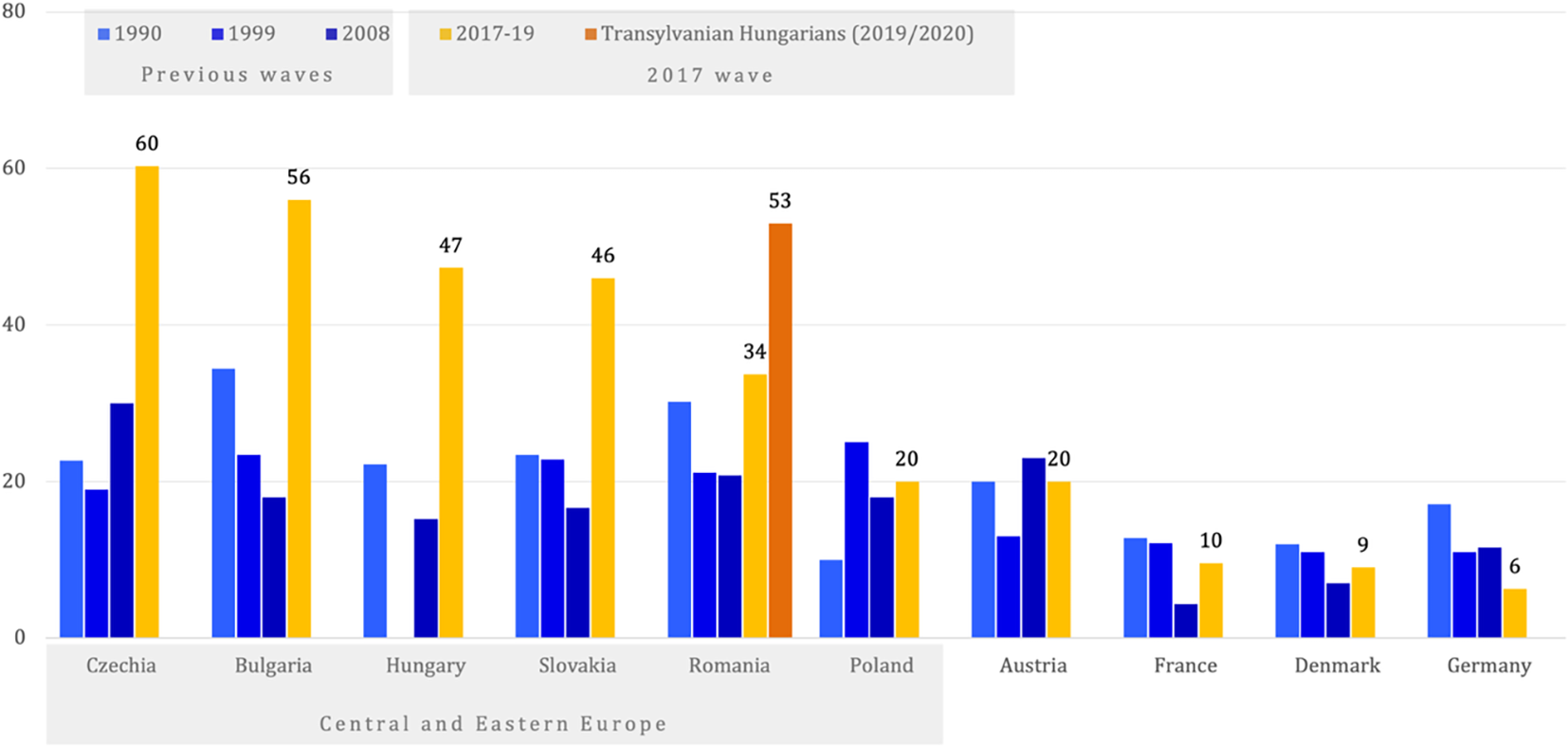
More recently, countries such as the United States have experienced an eruption in political forces representing illiberal or authoritarian versions of neoliberalism, although in part of the CEE, most notably Orbán’s Hungary, these forces were successful in establishing a new hegemony (Éber, Gagyi, Gerőcs et al. Reference Éber, Gagyi, Gerőcs and Jelinek2019). The semi-peripheral version of illiberalism gaining ground in the CEE countries emerges as a critique of the unequal exchange and symbolic asymmetries observed in globalist and Euro-centric versions of neoliberal capitalism (Melegh Reference Melegh2016). It benefits from the alliance between autochthonous capitalists interested in state-sponsored accumulation and the working and lower-middle classes that have been excluded by the very processes that simultaneously made multinational capital successful through export-oriented forms of industrial production (Scheiring Reference Scheiring2020a, Reference Scheiring2020b). The inclination towards explicit racism among the locally rooted (semi-)peripheries (Friedman and Friedman Reference Friedman and Friedman2008) can be understood at the intersection of class and race. From a class perspective, Marx’s concept of the ‘reserve army of labour’ highlights that, alongside (or instead of) mitigating the insufficiencies of a labour force, employers threaten existing workers with replacement, or in fact replace them with ‘immigrants’ to maintain or increase their profitability (Brass Reference Brass2017). From a race perspective, this situation tends to mobilise (semi-)peripheral social groups to protect what they perceive as their endangered ‘white privileges’ – for example, a relatively favourable labour market and welfare position. In the CEE context, however, practices of racial categorisation, or racialisation, within the framework of the polarised migration debate add an additional layer of complexity: The significant increase in anti-immigration attitudes (Figure 2) is occurring in a semi-peripheral region where locals are privileged over Global South migrant workers, yet at the same time are perceived as inferior, ‘dirty white’ (Böröcz Reference Böröcz2021), or ‘not quite white’ (Kalmar Reference Kalmar2022) Europeans, hence are racialised (Lewicki Reference Lewicki2023; Pârvulescu Reference Pârvulescu2019) vis-à-vis the West.
Rejection of ‘immigrants’ as neighbours (%).Footnote 3

Existing literature on race and racialisation in CEE focuses mostly on how anti-immigration and openly racist sentiments nurture illiberal discourses and regimes (Kalmar Reference Kalmar2022; Melegh Reference Melegh2023). Unlike in Western Europe, in some of the CEE, notably Czechia, Bulgaria, Hungary, and Slovakia, anti-immigration attitudes have grown considerably following the 2015 ‘migrant crisis’ (Figure 2). This was, however, not the case of Romania, where, in January–February 2020, when the ‘Ditrău incident’ became a focus of public debate, the hegemony of Western centred neoliberalism was still intact; hence, the mainstream actors that amplified it could wield significant influence over the interpretation of ‘the incident’. This remains the case in Romania even today, despite the substantial electoral gains of the extreme-right Alliance for the Unity of Romanians (Alianța pentru Unirea Românilor – AUR) in the 2020 and 2024 parliamentary elections and the 2025 presidential election. However, the differences between Romania and other CEE countries lie primarily on the supply side rather than in voter behaviour. According to Lambing (Reference Lambing2026), in Romania, there is little support for illiberalism among a significant fraction of the autochthonous capital. Furthermore, anti-immigration rhetoric that targets people from the Global South is articulated only occasionally in public debate and does not constitute a building block of Romania’s extreme-right discourse (Doiciar and Crețan Reference Doiciar and Crețan2021), thereby reinforcing a utilitarian perspective on immigration policy.
Within this context, it is important to understand the situation of Romania’s Hungarian minority. As Figure 2 shows, anti-immigration attitudes and rather explicit manifestations of racism at an individual level are more widespread among minority group members than in Romania in general. In a parallel article, we study the local frameworks of interpretation of the Ditró incident. In it, we explain this tendency through the exploration of two interlinked aspects. First, we argue that ‘essentialist developmentalism’, a hierarchical classificatory scheme that, like racism, relies on immutable categories, is more widespread among Transylvanian Hungarians than among majoritarian Romanians. Second, we also claim that Transylvanian Hungarians, unlike Romanians living under the hegemony of Western-centric neoliberalism, experience a ‘semiotic borderland’ condition. The latter concept is worth bringing into the present article.
The idea of a ‘semiotic borderland’ combines insights from the kinstate policy literature (Brubaker Reference Brubaker1996; Csergő and Goldgeier Reference Csergő and Goldgeier2001; Waterbury Reference Waterbury2010) with Lotman’s (Reference Lotman2005) cultural semiotics. According to scholars focusing on kinstate policy, national minorities that have an ‘external homeland’ (Brubaker Reference Brubaker1996) might be described as ‘caught between states’ (Csergő, Kallas and Kiss Reference Csergő, Kallas and Kiss2025). Transylvanian Hungarians are thus simultaneously affected by Romania’s nationalising project and Hungary’s extraterritorial or ‘virtual’ nation building (Csergő and Goldgeier Reference Csergő and Goldgeier2001). Through the articulation of Lotman’s idea of ‘semiotic borderland’ in our research, we intend to add a new layer to the kinstate policy literature and argue that kin minorities might be caught not only between rival national projects, but also between opposing societal and political hegemonies and diverging perspectives of development. Hungarians in Romania, for instance, are caught between normative expectations about Romania’s Western centric neoliberalism and Hungary’s illiberalism. Hungary’s political, institutional, and ideological penetration among Transylvanian Hungarians has been particularly salient since 2010, the year when Orbán rose to power. The Law on Citizenship was then modified to allow Hungarian minorities abroad to acquire citizenship without residing in Hungary. Since 2011, extra-territorial citizens have been awarded voting rights, and political campaigns carried out in Hungary have affected them directly (as with the 2016 Hungarian migrant quota referendum), with a dehumanising effect (Szalai and Kopper Reference Szalai and Kopper2020) and making them participants in the consolidation of the hegemony of the anti-immigration bloc in Hungary (Melegh Reference Melegh2023). This has fostered divergent attitudes towards immigration among Transylvanian Hungarians, making them rather emblematic of the anti-immigration pole in a Romanian public sphere dominated by pro-immigration utilitarianism.
Moreover, their non-dominant and marginal position within the Romanian community is connected to (their non-dominant) ethnicity, a situation that can also be conceived of as a form of exclusion (Weber Reference Weber1978), thus making structural disadvantage an inherent condition of belonging to a minority in this country (Csergő, Kiss and Talal Reference Csergő, Kiss and Talal2023). This is, however, less connected to the logic of capital accommodation and more to the institutional functioning of the nation-state. The latter aspect, in majoritarian democracies, is perceived as ‘owned’ by the titular majority (Wimmer Reference Wimmer2002) and as designed to maintain the majority’s societal culture and advance its demographic reproduction and economic predominance. In Romania, the primary instrument of this form of ownership is linguistic sovereignty (Csergő Reference Csergő2007), meaning the dominance of the Romanian language in the public sphere. Consequently, although Transylvanian Hungarians are among the most institutionally bonded and politically organised minorities in CEE, they still lack any form of constitutionally guaranteed ethnic power-sharing (Kiss and Kiss Reference Kiss, Kiss, Kiss, Székely, Toró, Bárdi and Horváth2018). As such, they rely on a dense network of meso-level minority institutions: a robust ethnic party; Hungarian-language schools, churches, cultural, charitable, and societal organisations; and Hungarian-language mass media, among other elements (2018). In this way, they can reproduce ethnic boundaries vis-à-vis the Romanian majority and maintain their own public sphere, but they are still perceived as marginal and external from the perspective of Romania’s societal core.
Representation of the national Self in Romania’s neoliberal hegemony
In what follows, we show how Romania’s dominant core represents itself and the national or societal Self (‘what we are’) vis-à-vis how it interprets Others (‘what we are not’). Similarly, symbols, signs, language, meaning, knowledge, and memory are constructed and articulated to reproduce the hegemonic neoliberal discourse. To understand how the ‘Ditrău incident’ was employed for this purpose, we also draw upon Lotman’s cultural semiotics, especially his concepts of ‘semiosphere’ and ‘auto-communication’ or ‘self-description’. These concepts are useful for describing collective identity-building under hegemonic conditions – that is, when a cultural and semiotic core imposes a normative system of representation on its peripheries while overshadowing alternative meaning-making systems (Makarychev and Yatsyk Reference Makarychev and Yatsyk2017: 44).
In Lotman’s terms, the semiosphere is the normative system of representation and the medium of human thought and understanding; the semiotic space from which information is generated and exchanged (Lotman Reference Lotman1990: 127; Reference Lotman2005: 208–225; Mladenova Reference Mladenova2022: 12). It has a ‘cultural’, or ‘semiotic centre’, which structures the communication of meaning and sign processes, keeping the semiotic space together, uniformed, and devoid of textual diversity. The semiosphere, however, also has its semiotic peripheries, which function as the cultural centre’s ‘repository’ of languages, meanings, signs, symbols, and verbalisations, conceived, from a dominant position, as ‘partial and semi-developed’, and as useful merely for ‘certain cultural functions’ (Mladenova Reference Mladenova2022: 13). Thus, in the semiosphere, centre–periphery relations are mutually and hierarchically constitutive. To understand the hegemony of Romania’s pro-immigration approach in Lotmanian terms, in the following sections, we delineate what we mean by the semiotic centre and periphery.
As a first defining feature, Romania’s cultural and semiotic centre deeply interiorises the superiority of Western countries while ranking its own society, and other (semi-)peripheral transnational and domestic actors according to their proximity to the idealised ‘West’, ultimately setting Romania off in the direction of non-negotiable change westwards (Melegh Reference Melegh2006: 133). ‘The West’ is, however, reinterpreted by Romania’s own core, meaning that the discourses associated with the Western core are not necessarily perfectly emulated, but often modified and reinvented (see Makarychev and Yatsyk Reference Makarychev and Yatsyk2017: 26). For example, Ban (Reference Ban2016) has described how Romanian economists embraced market-fundamentalist measures otherwise seen as extreme from a Western perspective. Beyond the nuances, ‘the West’ is nonetheless perceived as a unitary model by Romania’s dominant elites, a perception epitomised in slogans such as ‘vrem o țară ca afară!’, Romanian for ‘we want a country like those found abroad!’, popularised during the 2017–2019 anti-corruption protests (Gubernat and Rammelt Reference Gubernat and Rammelt2021), where ‘abroad’ functions as a taken-for-granted metonymy for ‘the highest income economies of the “West”’. This quasi-consensus around an imagined ‘West’ is due to the compatibility between the everyday developmental perceptions of Romanians and the cultural model of ‘developmental idealism’ produced by global elites and IOs (Kiss Reference Kiss2017; Melegh, Kiss, Csánóová et al. Reference Melegh, Kiss, Csánóová, Young-DeMarco and Thornton2016). According to this model, (semi-)peripheral countries may join the core after adapting their institutional structures and accepting the values underpinning social and economic modernisation, encompassing not only technology and resource allocation but also morality (Thornton, Yount, Young-DeMarco et al. Reference Thornton, Yount, Young-DeMarco, Moaddel, Moaddel and Gelfand2017). In this framework, failure to ‘catch up’ is not explained as resulting from unequal centre–periphery exchanges, but from attachments to ‘atavistic’ institutional structures and social values – most importantly, corruption, clientelism, and approaches considered as non-meritocratic, as well as intolerance, xenophobia, racism, and other phenomena perceived as indicators of the backwardness of the peripheries.
Second, Romania’s semiotic core is dominated by what Ban calls ‘disembedded neoliberalism’. This kind of neoliberalism distinguishes itself from its ‘embedded’ version, in which public policy shields the broader society and compensates it for dislocations (2016: 3–4, 15). The ideas and associated policies that constitute disembedded neoliberalism, instead, seek to maximise, ‘set free’, and radicalise markets, their role, and their effects while deliberately lessening social protection (ibid.: 4). ‘Folk theories of neoliberalism’ (ibid.: 172), a commonsense form of market fundamentalism that is media-friendly, ideologically charged, and detached from formal economic neoliberalism (see also Harvey Reference Harvey2005), have consistently permeated Romania’s mainstream media discourse. ‘Folk neoliberalism’ has radically advanced the idea that disembedded neoliberalism is the country’s only policy alternative; its spokespersons routinely discuss social processes in purely utilitarian terms, equating the common good to the interests of capital accumulation and silencing employee and working-class interests. Although there has never been a universal societal consensus on neoliberal ideals (Bădescu, Gog and Tufiș Reference Bădescu, Gog and Tufiș2022), the influence of neoliberalism has extended far beyond economic circles, ultimately shaping mainstream public opinion.
Third, Romania’s core is also defined by what Weiss (Reference Weiss2019) describes as the ideology of the middle class. In this understanding, the term ‘middle class’ in fact calls social classes into question (Boltanski and Chiapello Reference Boltanski and Chiapello2005), ultimately provoking the dissolution of class-based social ontology (Yılmaz Reference Yılmaz2016). The latter not only represents society as divided into classes but also recognises the antagonistic relations among them and the opposing interests between capital and labour. Under the concept of ‘middle-class ideology’, there is ‘no [other] class to which the middle class stands in opposition’ (Weiss Reference Weiss2019: 22), but society is represented as a set of concentric circles with the middle class at its core, standing for morality and functioning as a role model (Crăciun Reference Crăciun and Vainovski‑Mihai2022). As such, these discourses commonly advance a divide between the members of the middle-class, conceived of as those able ‘to stand on their own feet’, and ‘others’ – mostly the ‘welfare-dependent’ underclasses and marginal populations (Weiss Reference Weiss2019: 23). The middle class, as an ideology, thus dissolves well-defined and bounded group identities, on the premise that everyone can join its ranks through diligence and the sacrifice of immediate consumption in favour of investing in the future.
In Lotmanian terms, the media debate around the ‘Ditrău incident’ can be perceived as auto-communication or a collective spectacle of self-description. Through its articulation, the semiotic centre can reaffirm itself in a context of change, in this case, the beginning of what is perceived as a mass influx of Global South migrant labour. Lotman (Reference Lotman1990: 128–133) perceives self-description as a process of unification, individualisation, and cleansing of the semiotic space, thereby making it coherent yet resilient to external or peripheral identity discourses. In this way, internal differences are suppressed, and the elements that are unfit for the dominant discourse are ruled out, deprived of meaning, relevance, and rationality (Makarychev and Yatsyk Reference Makarychev and Yatsyk2017: 65). Self-description often operates in the hands of the dominant core through nationwide collective ‘performances’. In Romania, we consider to be among these performances the public recognition of Saxon cultural heritage as ‘empowering Transylvania with a European identity’, as reflected in the inclusion of two so considered ‘Saxon’ sites among the seven Romanian cultural sites that are part of the United Nations Educational, Scientific and Cultural Organisation (UNESCO) World Heritage (Cercel Reference Cercel2021: 199). This is further consistent with the election of Klaus Iohannis, an ethnic German politician, as president (Ibid.: 9–13). Other performances of self-description include the 2017–2019 #rezist protests and other anti-corruption collective actions (Gubernat and Rammelt Reference Gubernat and Rammelt2021; Kiss and Székely Reference Kiss and Székely2022), the discourses on ‘responsible’ behaviour during the COVID-19 pandemic (Crăciun Reference Crăciun and Vainovski‑Mihai2022: 22), and the ‘Ditrău incident’, as we show in this article. The political struggle that characterised Romania’s 2024 presidential election, which led to its annulment citing alleged Russian meddling in favour of first-round winner Călin Georgescu, a far-right and ultranationalist candidate, and to its rescheduling to May 2025, showed that a more solid counterhegemony was on the rise. Nevertheless, extraordinary mobilisation and the ultimate success of Nicușor Dan, a ‘pro-West’ independent candidate, made the presidential elections yet another occasion for self-description, this time under the actual threat posed by AUR and its presidential candidate(s).
Performances of self-description, however, do not only reaffirm the core but also define the semiotic peripheries and extra-semiotic (or other semiotic) spaces, dividing the world into ‘us versus them’, ‘our’ organised inner space versus ‘their’ chaotic outer space (Lotman Reference Lotman1990: 131–140). In our case, Ditró’s peripheral position was constructed along multiple axes of ethnic Otherness, coupled with Orbán’s external (and other cultural and semiotic) influence and ‘meta-geographic’ (Lewis and Wigen Reference Lewis and Wigen1997) marginality.
Reaffirming the core, making the periphery: a social media analysis
To better visualise how the core reaffirms itself while defining its semiotic periphery, we constructed a Romanian mainstream social media universe by employing mixed methods. This involved mapping the most relevant themes from the debate and decoding the visual language articulated to reproduce the hierarchical relations between centre and periphery.
Trends and themes
Our quantitative trend analysis of immigration-related posts confirmed that, unlike in most CEE countries, Europe’s ‘migrant crisis’ of 2015 went relatively unnoticed in Romania (see Figure 3). This made space for the media debate around the ‘Ditrău incident’ to become the most important immigration-related media event of the past decade.
Immigration-related posts and interactions by month (2013–2023).Footnote 5

The amount of immigration-related content generated during the 2013–2023 period was not substantial. Nor did it constitute a subject of intense public debate or political contestation. In relation to the party system, it was the neoliberal and market fundamentalist Save Romania Union (Uniunea Salvați România – USR) and the National Liberal Party (Partidul Național Liberal – PNL) that addressed immigration the most, far more than the meagre 50 posts from the extreme-right AUR. In extreme-right public groups, the number of posts was higher (1,057), whereas interactions were relatively limited. Hence, we conclude that ‘immigration’ was not central for the Romanian extreme-right in the period covered by our analysis.
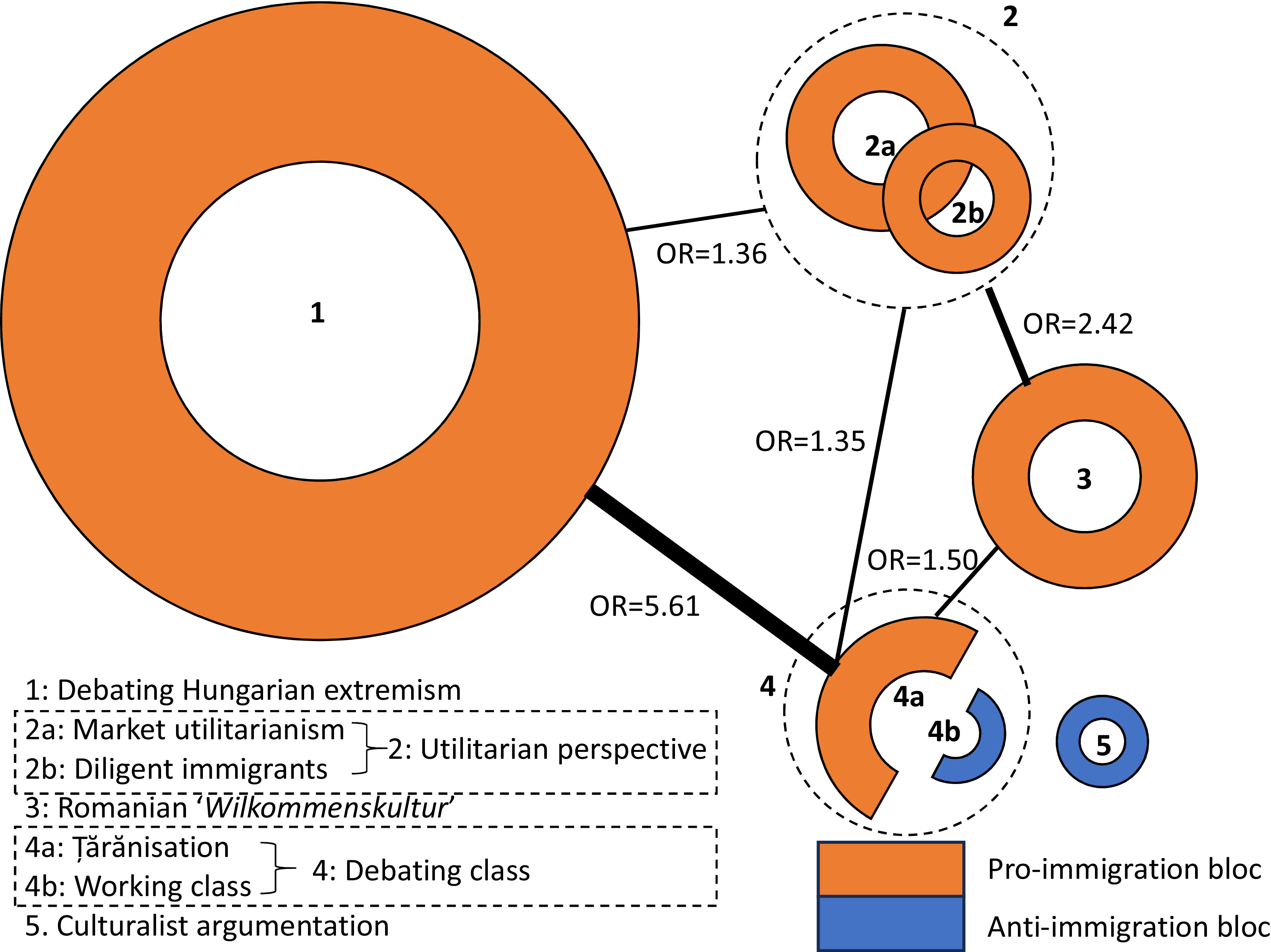
Our semi-quantitative content analysis focusing on the most popular posts related to the ‘Ditrău incident’ was designed to map the themes, interpretative frameworks, and perspectives articulated by the mainstream Romanian actors in the narration of ‘the incident’. Individual coding and subsequent discussions identified 29 themes that we ultimately regrouped into five to seven major thematic categories, namely ‘debating Hungarian extremism’, ‘utilitarian perspective’, ‘Romanian “Wilkommenskultur”’, ‘debating class positions’ (of the demonstrators), and ‘culturalist argumentation’. The ‘utilitarian perspective’ is made up of two strongly interlinked thematic categories, namely ‘market utilitarianism’ and ‘diligent migrant workers’, while ‘debating class positions’ can be divided into two opposing perspectives, one belonging to those who acknowledge the working-class position of the protesters and those perceiving them as ‘backward peasants’ (țărani). Figure 4 shows that there is a close association between the four most frequent thematic categories associated with the pro-immigration bloc, especially between ‘debating Hungarian extremism’ and ‘țărănisation’Footnote 4 on the one hand (OR = 5.61) and ‘utilitarian perspective’ and ‘Romanian “Wilkommenskultur”’ on the other hand (OR = 2.42). The two remaining thematic categories, one that acknowledges the ‘working-class’ perspective of the participants and the other that advances a ‘culturalist argumentation’, not only appear less frequently but are also isolated from the other themes.
Association among relevant themes in the debate.Footnote 6

Our ‘map’ shows the hegemony of the pro-immigration bloc vis-à-vis the non-hegemonic position of anti-immigration discourses. Although mainstream media showcased from the beginning the ‘Ditrău incident’ as the embodiment of rising anti-immigration sentiment among Transylvanian Hungarians, our research reinterprets it as the near consensus among mainstream actors of Romania as a welcoming destination for ‘diligent migrant workers’ in the pursuit of economic development. In this vein, opposition to the normalcy and rationality of this developmental project is attributed to ‘Hungarian extremists’ walled in their ‘ethnic parallelism’, and a backward peasantry still living in the ‘Middle Ages’. Only a few posts did not fit with this rough consensus. On the one hand, culturalist voices advocated recruiting Romanian-speaking foreigners rather than South Asians to mitigate the labour shortage, as evidenced by the relatively isolated posts written by AUR politician Mihail Neamțu and by a few representatives of the centre-right People’s Movement Party (Partidul Mișcarea Populară – PMP). On the other hand, local Hungarian-language opinion leaders acknowledged the working-class position of the Ditró protesters, arguing that ‘the incident’ should have been, at least partially, reframed as a labour conflict involving former and present bread factory workers revolting against precarious working conditions and their replacement with foreign workers (Bartha Reference Bartha2020; Borbély Reference Borbély2020). The latter interpretation was not dominant among Hungarian-speaking audiences and much less penetrated Romania’s mainstream public sphere. The working-class position was hence effectively transformed into what Lotman (Reference Lotman1990) has called a ‘semiotic blind spot’, or ‘zone of silencing’.
At this point, we regroup the different themes. Through the articulation of narratives around ‘Romanian “Wilkommenskultur”’ and the ‘utilitarian perspective’, mainstream actors idealised and reaffirmed the position of the core group as rational and ‘naturally’ tolerant. They simultaneously created, undervalued, and peripheralised the social categories they considered ‘threatening’ to their overvalued self-attributed ‘identity’ through a reporting that is categorisable into the narratives we have classified as ‘debating Hungarian extremism’ and ‘țărănization’. Other categories also played an auxiliary role, mainly that of ‘diligent migrant workers’, signifying a conditional upgrading of the trope ‘noble savages’, albeit the latter’s conditional acceptance based on their ‘worth’, one largely determined by their distance from the culturalist classificatory schemes that have historically and structurally been attributed to the social category of ‘Gypsy’.
The self-perception of mainstream actors
According to our analysis, the main narrators of the ‘Ditrău incident’ make up a cluster of journalists, other opinion leaders, and singled-out observers who (re)produced mainstream news items while performing an identity ‘naturally’, in plain sight. They guide the conversations, ask the questions, and are highly articulate in Romanian. They enjoy the limelight: their posts are often accompanied by well-lit close-up profile photos of their faces, with subjects frequently looking into or posing for the camera. Some preparation is implied: Their hair is groomed; their hairstyles (and facial hair), like their clothing, are gendered. Those coded as ‘men’ are often middle-aged, wearing buttoned-up (usually white) shirts, and often suits, blazers, ties, and spectacles. The ‘women’ wear makeup and often blouses and blazers. This aesthetics spearheads their semiotic centrality, alongside the fact that their stories consistently enjoy (the right of) universal visibility (see Mladenova Reference Mladenova2022: 95). In this way, they establish the development–migration link; they make ‘immigration’ abstract; they cement the narrative of a hospitable, multicultural, and human-rights-oriented Romania; and they construct the new political community.
Furthermore, the aesthetics associated with the ‘Ditrău incident’ also reveal that belongingness to the core group is not exclusive to members of the ethnic Romanian majority. Romania’s minority policy regime not only tolerates but also facilitates ethnic party formation, grants minorities the possibility to choose how they want to be represented and confers them bargaining power vis-à-vis their majority counterparts. This is the case with the Democratic Alliance of Hungarians in Romania (Uniunea Democratică a Maghiarilor din România – UDMR), which ultimately shares the market fundamentalism of USR and PNL (Kiss and Toró Reference Kiss and Toró2023), hence becoming part of Romania’s Western-centred neoliberal core.Footnote 7 One of the emblematic characters enjoying centrality in the debate was UDMR’s former president, Béla Markó, whose textual interpretation of ‘the incident’ aligned with the mainstream perspective. He also validated and represented the neoliberal viewpoint within the Hungarian minority public by agreeing with the reductionist interpretation disseminated by the Romanian mainstream media, and by strongly orientalising the protesters (see Grigorescu Reference Grigorescu2020).
The case of Magor Csibi is even more telling. His career path is unusual among Hungarian elites; during his university years, rather than being incorporated into the UDMR, he joined PNL’s youth organisation, an important fact given that the party is, from a Hungarian minority perspective, a ‘Romanian’ party. He then served as a member of the European Parliament between 2007 and 2009 and developed a profile as a non-governmental organisation (NGO) activist and entrepreneur, well embedded within Romania’s mainstream public sphere. However, during a televised interview on the ‘Ditrău incident’, he was introduced as a representative of the local perspective, allegedly because he had spent his childhood in the town (see Csibi Reference Csibi2020). Although he attempted to draw a more complex picture of the social relations of Ditró in the context of it having been publicly framed as ‘racist’, his performance as an ‘insider’ was rather laborious. As the pace of the interview settled, Csibi’s eloquence, authority, proficient Romanian, entrepreneurial profile, and clothing did more to dissociate him from the rurality that had widely and despicably been attributed to Ditró than support his alleged intention to restore (epistemic) justice for it. The picture was completed by his (and the interviewer’s) vindication of the mainstream interpretation, which ultimately sent the message that Ditró locals need to be (re-)educated by ‘us’ to overcome xenophobia. Although a televised interview may have strengthened Csibi’s individuality and earned him an uninterrupted spotlight – note the close-up of his face, association with the interviewer and an academic guest, and the (class) contrast with ‘ordinary’ Ditró people – it also framed him as a curiosity, an exception, not an exceptional human, but an exceptional ‘Hungarian extremist’ drawn to the semiotic centre.
The chaotic periphery: ‘Țărani’, ‘Hungarian extremists’, ‘diligent migrant workers’, and ‘(undeserving) Gypsies’
All the same, ‘ordinary’ Hungarians, unlike those publicly subscribed to hegemonic neoliberalism, continue to be depicted by the mainstream media as racist, xenophobic, irredentist, and intolerant not only towards South Asian migrant workers but also towards Romanian language and culture. As the words of journalist Dragoș Pătraru reveal, their actions are still presented as emotional and irrational ‘I thought that ethnic Hungarians [wouldn’t] give you any bread if you ask[ed] in [the] Romanian language, but it seems like they [wouldn’t] even let you bake it in a different language’ (see Popa Reference Popa2020). Hungarians are mostly depicted by the camera lens in groups or crowds, walking along the roadside, and shaded from the sun. Their town is rural; its Catholic churches are landmarks. A sense of ageing, obsolescence, and carelessness (for example, in the way they dress) is visually suggested. A meme shows the town’s priest displaying a baseball bat and the KKK (Ku Klux Klan) sign. Moreover, in the dominant semiotic space, and especially in the context of the debate around the ‘Ditrău incident’, simply speaking Hungarian or Romanian with an accent contributes to the portrayal of Hungarians as ‘extremists’. Additionally, ‘Hungarian extremists’ is also a category operating interchangeably with ‘țărani’ (Figure 4). This is exposed, once again, through the voice of Pătraru: ‘it is incredible how some who have arrived with a job contract find themselves chased by villagers with pitchforks and axes’ (see Popa Reference Popa2020).
Besides the categories described above, the constructs ‘diligent migrant workers’, ‘noble savages’, and ‘Gypsies’ are also auxiliary to the reaffirmation of the cultural centre. In the utilitarian reporting of ‘the incident’, the bodies of Sri Lankan fellows Welgamage Don Prasanna Piumal and Amarasinghe Arachchilage Mahinda feature as a synecdoche for all ‘diligent migrant workers’ in Romania: hardworking, legal, work-and remittance-focused, indifferent towards their traumatic experiences, and unconditionally loyal to Romania and Romanians. ‘The two Sri Lankans continue to speak nicely about Romania and Romanians’, reads a banner (Libertatea 2020). They are generally represented in their green-and-white bread factory uniforms and in movement, working at the factory, kneading the dough or handling a work utensil (mixing bowls, bread shovels, trays), holding their heads down, and looking down (hardly ever into the camera lens) while shading their eyes with their caps. Often, they work side by side and smile. This portrayal is, however, based on the concept of the ‘good worker’, which, while glorifying the alleged ‘work ethic’, dedication, and flexibility of migrant labour, enables a high control over labour, the mis-or un-representation of migrant workers, and the invisibilisation of their precarious working and living conditions (Ruhs and Anderson Reference Ruhs and Anderson2010). In his study of CEE labour migration to the Netherlands, Cremers (Reference Cremers2022: 286) documents that while praising foreign workers, local entrepreneurs acknowledge that labour migration offers them ‘an excellent price/quality ratio’ (self-sacrificial availability, cheapness, physical hard work) in the purchase of labour for low-valued and low-paid ‘3-D’ (dirty, dangerous, demanding) occupations.
The construction of ‘diligent migrant workers’ supports a temporary and conditional acceptance based on economic utility. It also compels migrant workers to sustain a façade of industriousness that masks and postpones their racialisation as flawed, immoral, primitive, and undeveloped non-European, non-white people. Transnationally, this portrayal supports the trope of the ‘otherwise cannibalistic’ ‘noble savage’, distinguished through the cultural centre’s aspiration to a national image and brand of hospitality, multiculturalism, democracy, and human rights. The analysed media items often typecast non-European, non-white people in alignment with this aspiration, showing them in anonymity, in ‘their’ ‘natural’ poverty-stricken environments, and engaged in ‘their’ usages, as stereotyped versions of themselves, a ‘human show’, or a ‘collection of human curiosities’, to borrow from Mladenova (Reference Mladenova2022: 141). They often lack facial visibility, yet their physical ‘non-whiteness’ is highlighted. Domestically, the concept ‘diligent migrant workers’ disputes the ‘Gypsy’ construct characterised in pre-existing classificatory schemes as ‘dirty’, ‘work-shy’, ‘lazy’, ‘unreliable’, and ‘welfare dependent’ (see Mladenova Reference Mladenova2022: 34–35; Petrovici, Raț, Simionca et al. Reference Petrovici, Raț, Simionca, Vincze, Vincze, Petrovici, Raț and Picker2019: 13). This representation assists the dominant core in stating out loud ‘what it is not’. For example, a fictional-satirical meme allegedly representing ‘unemployed’ Hungarians and Sri Lankans drinking together, pairs the ‘Hungarian extremist’ ‘țărani’ and the formerly ‘diligent’, now discardable, unemployed South Asian, clearly alluding to the construction of degraded ‘Gypsies’ (Figure 5).
A mainstream fictional-satirical portrayal of the chaotic semiotic periphery.Footnote 8

Summary and conclusion
Due to financialisation, market saturation, and increasing global competition, higher-wage areas increasingly rely on the immigration of precarious, over-exploitable labour (Silver Reference Silver2003). This migration turn (Melegh Reference Melegh2023) has driven the emigration of more than four million Romanians to become labour migrants in countries of the Western core, and the ongoing arrival of thousands of labour immigrants from the Global South in Romania. Maintaining or increasing capital accumulation through the acquisition of foreign labour, however, requires a combination of permissive immigration policy and welcoming public opinion (Fassmann and Reeger Reference Fassmann, Reeger and Okólski2012), on the one hand, and of a state infrastructure that keeps foreign labour exploitable, vulnerable, and partially unfree (Kundnani Reference Kundnani2023), on the other hand. This seemingly contradictory alliance characterises putatively progressive neoliberal capitalism, giving the states and societies that internalise it the possibility to absolve themselves of any responsibility for xenophobia or racism, while incriminating those adopting authoritarian or illiberal versions of neoliberal capitalism that ultimately still needs and accepts immigration.
The literature on the migration turn in CEE has mainly covered illiberalism or authoritarian neoliberalism, with a focus on the evolution of immigration policy (see Chen Reference Chen2025; Reményi, Glied and Pap Reference Reményi, Glied and Pap2023), the use of immigration discourse in the formation of an electoral majority of extreme-right actors (Bíró-Nagy Reference Bíró-Nagy2022), and the role of race and racialisation in this process (Kalmar Reference Kalmar2022). However, we know less about how, in the semi-peripheral condition of CEE, progressive versions of neoliberalism address the growing labour immigration from the Global South. Our single-case study revisits and advances a new critical interpretation of the ‘Ditrău incident’, which we consider the first and most important debate on immigration in progressive neoliberal Romania.
Our Lotmanian framework and our textual and visual analyses have shown how Romania’s societal and cultural core reaffirmed its hegemonic neoliberalism relying on Western centrism (Thornton, Yount, Young-DeMarco et al. Reference Thornton, Yount, Young-DeMarco, Moaddel, Moaddel and Gelfand2017), market fundamentalism (Ban Reference Ban2016), and the middle-class ideology (Weiss Reference Weiss2019), as well as on linguistic sovereignism (Csergő Reference Csergő2007), and titular ownership over public institutions (Wimmer Reference Wimmer2002). We interpreted the Ditrău media event as a collective performance of self-description that reorganised the political community along the centre–periphery axis.
Our semiotic analysis has shown that the centrality and peripherality of certain categories are constructed textually as well as visually. In this way, we have supported our argument that the political community envisioned by Romania’s core, although seemingly tolerant and welcoming, is in fact hierarchical and exclusionary. Besides, it is clearer now how the dominant group can exploit ethnicity in the definition of an internal enemy of immigration and further disseminate anti-Hungarian representations. Moreover, the classist nature of the mainstream story is now more readily visualised. This is despite the attempt to obliterate class-based ontology from mainstream vocabulary and prioritise a hierarchy between ‘developed’ categories (represented by the West, urban centres, and the ‘worthy’ and ‘deserving’ ‘middle classes’, for whom the presence of immigrants is said to be a daily taken-for-granted experience), and the allegedly ‘remote’, ‘mediaeval’, ‘barbaric’, and ‘intolerant’ peripheries and ‘unworthy’ and ‘undeserving’ lower strata made up of ‘țărani’.
Our analysis of signs and symbols has also exposed that unequal representation is permeated by epistemic injustice. In the reporting of the 2020 ‘Ditrău incident’, Romania’s cultural centre attributed to itself what Fricker (Reference Fricker2007: 17) has called ‘credibility excess’. Mainstream journalists, politicians, academics, businesspeople, and related opinion leaders have not only endorsed utilitarian developmentalism in immigration policy but also served as role models for a ‘more European future’. The opinion leaders were mostly male, almost always Romanian, with an appearance conventionally associated with upper-or middle-classness and, as we also claim, ‘whiteness’. At the same time, they used their positional, symbolic, and financial power to ‘hijack’ the representation of the peripheral categories by attributing to them what Fricker (Reference Fricker2007: 9–29) has called ‘identity-prejudicial credibility deficit’, coercing them to fit into certain roles, and shaping them as superficial categories. Thus, the Ditró people and, by extension, Transylvanian Hungarians and the (rural) working class, did not participate adequately in the interpretation of ‘the incident’ as it is presently remembered in the public sphere. In the face of their portrayal as ‘Hungarian extremists’ and ‘țărani’, they were unable to verbalise their position according to the standards of the mainstream, lacking ‘proper’ knowledge of the Romanian language and the required political vocabulary.
Furthermore, at a textual level, openness and tolerance were repeatedly emphasised, and the political community was ready to integrate ‘diligent migrant workers’ even if reifying and reducing them merely to the status of the labour force. The utilitarian discourse and self-congratulatory descriptions of hospitability, however, effectively concealed the realities of racialisation and militarised policing. This explains why, although the press had presented itself as an advocate of Piumal and Mahinda during the Ditrău events, it was absent during Piumal’s deportation following his arrest at the Cenad border checkpoint in 2022, an episode the Romanian Border Police then flaunted online (never finding out who this person was or what they had gone through; see Poliția de Frontieră Română 2022). Added to this, the core group finally leveraged race in the representation of ‘newcomers’ in conformity with its ‘self-descriptive’ pro-migration developmentalism, tactically and tacitly combining people from low-income countries and the Roma.
Finally, Ditrău remains the first and most important public debate on immigration in Romania, underscoring the need to make this case a reference point. In addressing our research goals, we hope to raise and tackle important questions concerning the social ontology upon which Romania’s political community is (re)constructed amid the oscillating situation for the country and CEE in the international arena: On the one hand, increasing ‘Global South’ immigration and Schengen accession for Romania and Bulgaria, and, on the other hand, the first signs that anti-immigration as a building block of the Romanian extreme right is no longer an impossibility.
Data availability statement
There are no access restrictions on the data; all research data related to this project will be made openly available upon request. Please contact either of the co-authors to access the data.
Acknowledgements
The authors would like to express their gratitude to Terrell Carver, Maria-Luiza Lucescu, Daniel Bochsler, and our reviewers and editors for their invaluable support and guidance in the development of this article.
Author contributions
Luis Escobedo: Conceptualisation-Equal, Formal analysis-Equal, Funding acquisition-Equal, Investigation-Equal, Methodology-Equal, Project administration-Equal, Writing – original draft-Equal, Writing – review editing-Equal; Tamás Kiss: Conceptualisation-Equal, Formal analysis-Equal, Funding acquisition-Equal, Investigation-Equal, Methodology-Equal, Project administration-Equal, Software-Lead, Writing – original draft-Equal, Writing – review editing-Equal.
Disclosure statement
The authors declare that the research was mainly funded by their collaboration, through the sharing of financial and in-kind resources, and partly by funds granted by the Romanian Society for Intercultural and Migration Studies (SoSIM) and the Romanian Institute for Research on National Minorities (ISPMN). Besides that, there is no commercial or financial relationship that could be construed as a potential conflict of interest.
Declaration of generative AI and AI-assisted technologies
During the preparation of the final version of this work, the authors did not use AI or AI-assisted technologies.



 Open access

