Introduction
Government statistical agencies face several major constraints. Most notably, citizens expect that agencies will follow procedures judged to be technically sound by a larger community of experts. Furthermore, they typically demand that agencies also produce quantitative knowledge deemed to be value neutral, or at least not overtly affected by partisan politics (cf. Porter Reference Porter1995; Stapleford Reference Stapleford2009). These first two constraints, though not identical, nonetheless seem compatible; indeed meeting the first (approval by a group of experts) is often taken as evidence of meeting the second (value neutrality). Unfortunately, as many scholars have argued, this logic is flawed. Expert approval can not guarantee value-neutral calculation; in fact, such a goal is impossible since political values are actually essential to creating official government statistics (e.g., Alonso and Starr Reference Alonso and Starr1987; Anderson Reference Anderson1988; Desrosières Reference Desrosières1998). Not only are such values required to make judgments about the topics which agencies pursue, but they also necessarily pervade the assumptions and methods used in a project and, in general, the “rules of inquiry” (Longino Reference Longino1990) within a field. Even on a strictly pragmatic basis, no government bureau can long survive (at least with its budget intact) without powerful political allies. Statistical agencies thus find themselves in a delicate position: balancing the necessity of making judgments that (properly speaking) belong to the political sphere while meeting demands for expert consensus and value-neutrality. The precarious nature of this balance is evidenced by the controversies that periodically (but invariably) envelop government agencies and their statistical products, such as the repeated debates about the methodology of the U.S. Census (e.g., Anderson and Feinberg Reference Anderson and Feinberg1999).
In seeking to negotiate these tensions, statistical agencies – like other government agencies dealing with science – have regularly cultivated relationships with relevant groups who can advise the agencies and provide crucial support (tacitly or explicitly) for their decisions. Of course, there are a myriad of ways in which such advice can be ascertained, channeled, and represented. In fact, that very variety has made critical analyses of “science advising” a fruitful component of science studies (e.g., Jasanoff Reference Jasanoff1990; Barker and Peters Reference Barker and Peters1993; Bocking Reference Bocking2004). Advising processes are the most basic ways in which agencies can (in practice) garner the support of important allies and (symbolically) evince that support to the public. The study of these processes is thus the study of how agencies manage the often-conflicting demands placed upon them.
This essay examines the consulting relationships (both formal and informal) of the U.S. Bureau of Labor Statistics (BLS) during the twentieth century. To date, statistics have not been part of the formal literature on science advising, but beyond expanding such studies to a new domain, I also shift the focus: whereas most treatments of science advising tend to emphasize roughly synchronic comparisons between countries or agencies,Footnote 1 I concentrate on major shifts in advising relationships over the course of the twentieth century. This diachronic analysis allows us to recognize how specific shifts in the function, institutional context, and political context of labor statistics have led to related changes in the BLS's strategies for maintaining public confidence and support for its work. In particular, we are able to see how the bureau has generally sustained a reputation for non-partisan data production even while its statistics have served many high-stakes political functions.
The BLS is a valuable site for thinking about how context has affected advising processes in a politically-salient environment. Created in 1884, the agency has a history that stretches across more than a century of tumultuous political, economic, and demographic changes.Footnote 2 Best known today for publication of major macroeconomic data on inflation, unemployment, productivity, and wages, the bureau has also played a central role in American industrial relations. BLS statistics have been intertwined with major debates about the structure (and inequities) of American capitalism, about labor-capital conflict, about the administration of the welfare state, and about federal economic policy. Given the salience of labor statistics in American political life, understanding the transformation of BLS advising processes can not only illuminate the dynamics of science advising in the abstract, it can also enrich our understanding of the history of American political economy itself.
Several themes emerge from this study. First, the formal advising processes of the BLS emerged and expanded in close conjunction with the expansion of federal management of the economy, a goal in which labor statistics played important roles. This expansion occurred temporarily during the First World War, reappeared on a firmer foundation during the Great Depression, and was permanently established in the wake of the Second World War. Federal management of the economy elevated the importance of labor statistics but also changed their form, driving a shift away from one-time investigations (linked to regulation and labor reform legislation) and towards regular data collection on select topics (more closely tied to bureaucratic management and oversight). The growing importance of BLS statistics plus the regularity of its work gave organized groups a greater incentive to invest time and energy in establishing formal advisory committees that could help to shape the bureau's routine data collection. These committees first appeared in the 1920s, found growing success during the New Deal, and proliferated in the second half of the twentieth century.
The bureau's advisory processes can be divided into two main categories: those that (formally speaking) address only the technical quality of its work, and those that implicitly or explicitly provide space for consultation about the political ramifications of BLS decisions. This classification does not imply that the “technical” advisory committees actually avoided what were, properly speaking, political judgments; on the contrary, given how deeply political values are intertwined with statistical calculation, it would be nearly impossible to make any substantive, complex methodological recommendation devoid of such judgments. Rather, the formal designation of these committees as technical, apolitical bodies ensured that political values entered only covertly or unconsciously. Tracking the balance of “technical” and explicitly “political” advisory processes thus provides an important guide to the potential for the BLS and its advisers to have overt political discussions about methodological choices. The second theme of my study is the dangerous lack of such political advisory forums for the BLS that developed in the late twentieth century, a situation that has arguably left the bureau with less overt political guidance than ever before.
Turning to the bureau's “technical” advising, its reputation for statistical acumen has rested primarily on its support from academic economists and statisticians. Nonetheless, the relationship between the bureau and academic scholars has taken a variety of forms, and the transformation in this relationship forms the third theme of my analysis. Prior to the 1920s, the bureau's top staff generally lacked graduate training in economics or statistics, and the ties between the bureau and academic scholars were largely personal and informal. During the New Deal, the situation changed dramatically as economists took leadership roles within the bureau and looked readily towards formal committees of academic colleagues for guidance. By the last third of the twentieth century, though, the bureau had regained some of its earlier autonomy, not because the agency had distanced itself from the academic community but (ironically enough) because the boundaries between the two had become more porous. Key members of the bureau's staff knew the research literature very well, had forged close ties with top scholars, and had become experts in their own right. In turn, BLS staff could defend their methodological choices with great skill and were accordingly less beholden to the conclusions of any given external advisory committee.
The fourth theme of my study is the close link between the extent of explicitly political advising processes and the history of the U.S. labor movement. For the first fifty years after the founding of the BLS in 1884, labor statistics were largely an instrument of moderate labor reformers who aimed to alleviate labor-capital conflict through education and targeted regulation; as one early commissioner put it, a major priority of the bureau was collecting data pertinent “to remedial legislation and to the improvement of working conditions in the United States” (O'Neill Reference O'Neill1913, 53, in Records of the Department of Labor). In contrast to middle- and upper-class Americans who formed the bulk of the labor reform movement, labor unions themselves made much less use of the bureau's data and (in their generally weak state) were ill-positioned to devote time or energy to arguing about statistics. That indifference began to change rapidly in the late 1930s with the rise of powerful industrial unions, however, and by the late 1940s, repeated challenges from unions (including a bitter wartime controversy) had pushed the BLS to establish a union advisory committee to improve relations. Business associations soon followed suit with their own parallel group, and for the next thirty years these two quasi-corporatist committees became important voices in the construction of U.S. labor statistics, which had simultaneously become deeply embedded in the structure of industrial relations within unionized industries. Alongside the waning of union power in the last decades of the twentieth century, however, the influence of both committees began to fade, and in 2007 they were disbanded altogether, eliminating the only overtly political advisory mechanism for the BLS.
The fading of industrial relations from the forefront of American political economy has not lessened the political salience of labor statistics, however. Instead, the links between labor statistics and federal economic policy (a tie first built during the New Deal) have grown over time, while labor statistics have also developed new roles in the administration of the welfare state. However, lacking pressure from a single, powerful constituent (a role once played by industrial unions) and in fact hindered by the diversity of possible interest groups tied to the new functions of labor statistics (where, unlike in industrial relations, one cannot balance two opposed groups against each other), the bureau has yet to develop any new advisory mechanisms for explicit political consultation. Indeed, the bureau's strong reputation among academic scholars has left it seemingly indifferent to the need for overt political discussion. As my final theme, therefore, I link the history of the bureau's “technical” advising processes to that of its “political” advising processes to explain the current deficit in explicit political discussion about labor statistics, and in the conclusion, I give some suggestions for how this problem might be mitigated.
External advising at the BLS before 1933
Prior to the New Deal, the Bureau of Labor Statistics’ technical consultation with non-staff members was largely informal and personal. In one sense this is surprising: by 1900, the three major non-governmental groups that would affect the bureau's work in subsequent years already existed: labor unions, professional societies, and business associations. Yet a variety of factors combined to make these groups either uninterested in establishing formal advisory relationships or unable to make such efforts function effectively. In this respect, the first three decades of the twentieth century provide a useful background to the subsequent flourishing of formal external advising after 1933.
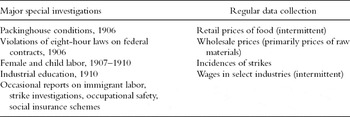
Unions and labor activists had been instrumental in urging the creation of the BLS in the late nineteenth century, but they had also hoped the agency would serve as a gateway for union interests to enter the cabinet. When that possibility faded, so too did intense working-class interest in the project. By the early twentieth century, the bureau was largely an investigative tool of middle-class progressives who sought to improve workplace safety and hygiene, regulate child and female labor, and facilitate industrial peace by promoting conciliation between workers and management (Leiby Reference Leiby1960; Furner Reference Furner, Furner and Supple1990). The most prominent BLS activities were one-time, special investigations of particular topics (see Table 1) and the mediation of labor disputes. Regular data collection was limited and (with the exception of wholesale prices) had far less relevance to major political debates.
Selected BLS Projects, 1904–1913. Many of the special investigations had close ties to politically salient topics. The investigation of packinghouse conditions, for example, began in the wake of public outcry over the abuses revealed in Upton Sinclair's The Jungle and led to new regulations, while the report on female and child labor emerged from the burgeoning anti-child-labor campaign in the U.S. Congress. By contrast, the bureau's regular data collection had no direct connection to regulatory legislation or government policy in general. Not surprisingly, the bureau devoted less effort to these projects. For example, the data series on retail prices and the series on wages were actually suspended in 1908 (in part to concentrate on the female study of female and child labor) and restarted on much more limited bases in 1912 and 1913, respectively.

These functions governed the relationship between the bureau and the American Federation of Labor (AFL), which had become the dominant face of the American labor movement by the turn of the century. Under the leadership of Samuel Gompers, the AFL focused on organizing skilled, male, white workers and protecting their rights to strike and to bargain collectively free from business or government interference. AFL unions typically portrayed contract negotiations as private contests of economic power in which workers acted to secure better working conditions and higher wages by threatening to strike (and thereby demonstrating the real value of their labor). In these contests, unions based their wage demands on existing pay scales (as recorded by the union) and what officials thought employers might accept (Ulman Reference Ulman1966, 425–535; Reed [Reference Reed1930] 1966). Since disputes would not be resolved by union rhetoric but only by an employer's judgment about the relative costs of a strike versus a pay increase, unions had little use for large-scale, government surveys of prices, wages, and so forth in their collective bargaining efforts. Accordingly, Gompers supported bureau investigations that shed light on the living and working conditions of American laborers (which might provide useful propaganda), but such projects were not a primary concern for the AFL. Most union interest in the agency focused on the growing role of the BLS commissioner in labor arbitration, mediation (primarily in coal and railroads), and strike investigations. By contrast, unions had neither the incentive nor the technical staff to probe the details of the bureau's regular data collection (Goldberg and Moye Reference Goldberg and Moye1982).
Not unexpectedly, given the ties between the BLS and the regulatory program of the middle-class progressive movement, the bureau did collaborate more closely with academic social scientists. Yet here, too, the relationships were largely informal and personal. The first commissioner of the BLS, Carroll D. Wright, served as president of both the American Social Science Association (a nineteenth-century organization devoted to the investigation of social problems that was superseded by more specialized professional societies [Haskell Reference Haskell1977]) and the American Statistical Association (ASA, the primary professional society for American statisticians). Wright envisioned government statistical agencies as the major sources of empirical facts that could confirm or dispel theoretical speculation in the social sciences, a role that required relatively close interaction and mutual understanding with other social scientists. But he recognized that this harmonious relationship had yet to develop: American universities gave more attention to “theory” than to “practical statistics” (the intelligent collection and presentation of survey data), and thus had less appreciation for the intricacies and tribulations of data collection than Wright desired; as one of his colleagues put it, American academics appeared “to teach the manner of criticizing the work done by others, rather than a way of doing the work” (Pidgin Reference Pidgin1888, 180; Wright Reference Wright1888).
While hoping that American universities would adopt more favorable curricula, Wright opened his agency to those who wished to gain firsthand experience in statistical research. Numerous economists (including well-known figures like John R. Commons and Thomas S. Adams) worked as field agents or higher-level staff in the BLS; after Wright's death, the statistician Simon Newton Dexter North declared that the agency had “been a university for the education of experts in statistics, in sociology, in economics, and in industrial studies” (North Reference North1909, 461; Grossman Reference Grossman1974, 23–72). But the low pay and lack of research freedom that characterized federal statistical operations kept these interactions briefer and less common than Wright would have liked: on the eve of the First World War, the economist Wesley C. Mitchell could still lament the split between “practical” and “mathematical” statisticians, the latter of whom failed to grasp the difficulties of field work (Mitchell Reference Mitchell1915, 27, 80–81); a similar dynamic existed at the Census Bureau (Anderson Reference Anderson1988, 124–126). Moreover, only a handful of established social scientists were overly concerned with the details of government statistical calculations: the third commissioner of the BLS, former Princeton economist Royal Meeker, chided his colleagues in the American Economics Association in 1915 for taking his “S.O.S. call for help” in revising the agency's price statistics and “carefully depositing it in your waste basket” (Meeker Reference Meeker1915, 433).
The prominence of one-time, special investigations within the bureau's work provided an additional disincentive to developing more formal advisory relationships. These studies sometimes proved controversial – a 1907–1909 study of female workers and child labor led to intense congressional complaints (Goldberg and Moye Reference Goldberg and Moye1985, 62–69, 75–78) – but the singular nature of the projects meant that most criticism was directed towards dissecting project results rather than improving future iterations. Likewise, staff members’ conviction that academic theory could not aid the most prominent and time-consuming aspects of their own work (large-scale data collection) further contributed to their ad hoc approach to external consultation. The bureau did contract with university-trained economists and sociologists to analyze data, provide methodological guidance, or conduct field work, but these ties were temporary and established informally.Footnote 3
The First World War precipitated broader changes that would eventually shift the agency's relationships to outsiders. First, the logistical demands of war mobilization brought a host of empirically-minded social scientists to Washington, where they forged new connections with each other, gained (or deepened) first-hand experience with large-scale data collection and analysis, and tried to use freely-flowing wartime funding to reshape the federal statistical system. The shining example of the latter was the Central Bureau of Planning and Statistics (under the leadership of Edwin Gay, former dean of the Harvard Business School), which was filled with current or former academics and was intended to standardize, centralize, and improve federal statistics (Mitchell Reference Mitchell1919; Heaton Reference Heaton1952).
When fiscal conservatives dismantled wartime administrative structures (including the Central Bureau) in 1919, many of the social scientists who had left government service sought new institutional forums in the private sector through which they might continue to advance empirical social science. Yet since only the state had the resources to conduct regular, large-scale surveys, the empiricists necessarily remained committed to expanding and (to some extent) controlling government statistics. These efforts were manifest within the new think-tanks and research organizations established during and after the war, such as the National Bureau of Economic Research (NBER, co-founded by Gay and Wesley Mitchell), the Social Science Research Council (SSRC, organized by political scientist Charles Merriam), and the Brookings Institution (which included numerous economists who had worked in wartime statistical agencies). Each of these organizations became involved with federal statistics: the NBER collaborated closely with Herbert Hoover's Department of Commerce; the SSRC devised numerous proposals and conferences intended to develop and improve federal statistical programs; while the Brookings Institution trained and employed a cluster of economists and statisticians who served in federal agencies during the 1920s and 1930s, such as Mordecai Ezekiel, Morris Copeland, and Winfield Riefler (Karl Reference Karl1974; Alchon Reference Alchon1985; Critchlow Reference Critchlow1985; Rutherford Reference Rutherford2003). But the growing interest in federal statistics was also evident in the committees that sprouted within professional societies to offer (sometimes unsolicited) advice to federal agencies, including, for example, a joint Census Advisory Committee created by the ASA and the American Economics Association (Anderson Reference Anderson1988, 128–129).
The success of these ventures rested less on the enthusiasm of academic social scientists than on a new appreciation for the potential value of quantitative data that grew during the 1920s among many businessmen and key federal officials. The attention to economic statistics in particular derived from both the success of wartime mobilization (heavily dependent on statistics for production planning and distribution) and the sharp recession of 1920–1921 (which leading government officials such as Herbert Hoover and major corporate figures such as General Motors’ Alfred P. Sloan blamed partly on inadequate market information). The result was a proliferation of public and private forms of quantitative economic analysis: individual companies initiated and expanded market research programs (Wells Reference Wells1999); both the Department of Commerce and the Department of Agriculture enhanced the output and sophistication of their respective statistical divisions (Hawley Reference Hawley, Furner and Supple1990); and philanthropic organizations such as the Russell Sage Foundation, the Rockefeller Foundation, and the Carnegie Corporation readily provided funding for analysis and methodological research, especially when these promised to find applications in public policy (Alchon Reference Alchon1985; Critchlow Reference Critchlow1985). Moreover, the managerial objectives of 1920s technocrats (seeking to mitigate swings in the business cycle and forecast economic behavior) led them to value regular data series rather than one-time, singular studies, thereby providing a more fertile context for establishing long-term advisory relationships. This constellation of interests supplied both the funds and incentive for social scientists to influence federal statistical programs – whether from the inside, as in the Department of Agriculture, or as external consultants, as with the Department of Commerce.
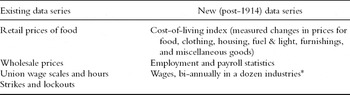
Still, at least in the case of government statistics, the quantitative renaissance of the 1920s was bounded by the pro-business hegemony that characterized much of the decade's politics: projects that had (or could be given) connections to market-friendly strategies for promoting economic prosperity would enjoy broad support; others, such as labor statistics (which were indelibly linked to unions and the labor movement), would find the going more difficult. War mobilization had provided the impetus and funding to expand regular data collection in the BLS, strengthening existing data series and adding new topics (see Table 2), but funding reductions during the 1920s forced the bureau to reduce the scope or frequency of many surveys. The funding limits and emphasis on business-related data likewise shaped the efforts of external social scientists to intervene in federal labor statistics. For example, the ASA's Committee on Governmental Labor Statistics (CGLS, established in 1922 and intermittently funded by the Russell Sage Foundation) focused largely on employment statistics, which were a basic component of business-cycle research. Indeed, the committee grew from research promoted by Hoover and the NBER (Kleeck Reference Kleeck1923). Even here the group encountered obstacles, producing numerous guidelines (e.g., Hurlin and Berridge Reference Hurlin and Berridge1926) but having less success getting the BLS or many state agencies to adopt new methods.
Major BLS Data Series, 1920s. The numerical comparison of pre- and post-1914 data series does not quite do justice to the transformation wrought during the First World War. The three series in the right-hand column became the foundation for three of the five major macroeconomic statistics published currently by the BLS: consumer price indexes, employment and unemployment data, wages, producer price indexes, and productivity measures. Only one of these (producer price indexes) existed prior to 1913 (as “wholesale prices”), and the fifth (productivity) would not be established on a permanent basis until after the Second World War.

*Begun in 1913 for nine industries; later expanded
In large part, the limited financial resources of the targeted bureaus provided the greatest barriers to the efforts of academics to reform government labor statistics. Although the Republican-controlled Congress readily funded major expansions within the Department of Commerce, neither the Department of Labor nor the BLS enjoyed such beneficence, making it hard to even sustain existing programs, much less undertake expensive alterations (Goldberg and Moye Reference Goldberg and Moye1985, 135–138; Leach Reference Leach1993, 359). But limited funding also had indirect consequences through its effects on personnel: it was impossible to attract ambitious, young economists to work in a stagnating agency. Accordingly, the BLS remained in the hands of an older generation of civil service staff who (despite being members of the CGLS) were unsympathetic to some of the social scientists’ priorities. Thus, though BLS commissioner Ethelbert Stewart shared the goal of expanding BLS employment statistics, he had less interest in standardizing methods or in adopting innovative but complex statistical techniques (Kleeck Reference Kleeck1929, 267; Wickens Reference Wickens1982, 30, oral history). Generally speaking, CGLS was hobbled by its lack of official status: it had no formal authority, no ties to sympathetic and powerful supervising administrators who could assume the role that Hoover had taken in the Department of Commerce, and no close support from the Republican majority in Congress. Similar dynamics governed other external attempts to reshape or expand BLS statistical programs through the late 1920s, including the studies of family expenditures and price statistics promoted by the SSRC and the Brookings Institution (Burgess, Copeland et al. Reference Burgess and Copeland1932; Stapleford Reference Stapleford2007, 424–425).
If the BLS was thereby excluded from the broader expansion and refinement of federal economic statistics in the 1920s (linked to a closer relationship between federal officials, external social scientists, and business and philanthropic support), some of its programs actually faced an actively hostile environment. Like the upsurge of interest in business-cycle statistics, this hostility also had its roots in the First World War, this time in labor policy rather than logistics or general economic planning. From 1917–1919, the combination of a tight wartime labor market and urgent production demands led the federal government to intervene broadly in industrial relations, typically through voluntary or compulsory labor arbitration. The quasi-legal setting of arbitration – with its premise of an impartial judgment based upon the facts of a specific case – made “trustworthy statistics” on topics like wages, prices, and family expenditures an essential component of most hearings (Stockett Reference Stockett1918, 97; Feis Reference Feis1924, 8). In turn, several major arbitration boards asked (and supplied the funding for) the BLS to undertake studies of working-class family expenditures and retail price statistics in order to establish “adequate” family budgets and measure changes in the “cost of living” (Goldberg and Moye Reference Goldberg and Moye1985, 102–107).
As is common when scientific expertise is used within litigation (cf. Jasanoff Reference Jasanoff1990), the confrontational framework fostered the deconstruction of statistical facts, albeit a deconstruction shaped by the distribution of political and economic power. For example, after the war, labor arbitrators often agreed that wages should be adjusted both to meet minimum standards of adequacy (typically assessed through BLS surveys of prices and family expenditures) and to match changes in prices over time (typically measured via the BLS cost-of-living index). For these hearings, unions occasionally gathered their own data or critiqued methods used by the BLS (e.g., Soule Reference Soule1928, 10, 36, 75–77). However, these efforts were costly and required the services of external consultants. Such aggressive tactics were increasingly rare after the 1920–21 recession left the labor movement weak and facing a rejuvenated management community (Montgomery Reference Montgomery1987). Instead, union efforts shifted to defending BLS statistics against conservative criticism and against the competing measures produced by companies and business associations, notably the cost-of-living index and standard budgets created by the National Industrial Conference Board (e.g., National Industrial Conference Board 1921; Carr Reference Carr1924).
By the late 1920s, therefore, the context for the production of federal economic statistics had been transformed, but in ways that had yet to fully affect labor statistics. War mobilization and the subsequent recession had prompted a closer public-private collaboration between the federal government, businessmen, and academic social scientists intended to improve managerial control over the economy through expanded analysis of data series. This collaboration was mediated by professional organizations such as the ASA or the NBER (which provided forums for gathering interested representatives from business, government, and academia) and was supported by targeted grants from philanthropic foundations and by congressional appropriations for building commercial and trade statistics. A lack of congressional support for the BLS, however, rendered that agency incapable of fulfilling many external recommendations while also preventing an infusion of younger staff members who might have shared the proclivities of the new generation of social scientists. Meanwhile, the weak labor movement, confronting its own serious problems, remained unprepared to invest time and effort into the details of statistical methodology (especially as conservatives rolled back labor arbitration), and the business community and its political allies remained largely indifferent or hostile to the bureau's work. In no case was there sufficient motivation or resources to permit the operation of a formal external advisory system for the BLS.
The New Deal and the Second World War
The onset of the Great Depression and subsequent resurgence of the Democratic Party in national politics combined to elevate labor statistics and the BLS into prominence. The process began with organic links to the 1920s: the stock market crash of 1929 and subsequent depression intensified interest in employment statistics, which in turn revealed the failure of 1920s efforts to bring order and technical consensus to this domain. Three federal agencies – the BLS, the U.S. Employment Service, and the Census Bureau – issued conflicting estimates of unemployment trends, each grounded in different methodologies. The Hoover administration repeatedly cited more optimistic estimates, while increasingly vocal critics on the progressive left (some of whom were former Hoover allies) criticized the selected figures as inadequate. Despite a rash of committees and often conflicting reform proposals from 1928 to 1932, the controversy remained unresolved. During the debates, however, a core group of reform-oriented CGLS members based in New York had made common cause with the state's Democratic establishment, including Senator Robert F. Wagner, then-governor Franklin D. Roosevelt, and the New York State Industrial Commissioner, Frances Perkins (Kleeck Reference Kleeck1929, 268–269; Stewart Reference Stewart1931, 276–277; Goldberg and Moye Reference Goldberg and Moye1985, 128–132; Anderson Reference Anderson1988, 164–169).Footnote 4 After Roosevelt's election as president, he appointed Perkins as Secretary of Labor, and she quickly requested that the ASA help reform federal labor statistics. The resulting Advisory Committee to the Secretary of Labor (ACSL) had strong ties to CGLS and effectively resolved the crisis by embedding the CGLS viewpoint (i.e., that Hoover's methods understated unemployment) within the BLS (Anderson Reference Anderson1988, 170–171; Kleeck Reference Kleeck1933, in Records of the U.S. Office of Management and Budget [OMB]; Rice Reference Rice1933, in ibid.).Footnote 5
ACSL's work stretched beyond employment statistics to encompass the full range of BLS activities; moreover, it became the inspiration for a much larger consultation project, the Committee on Government Statistics and Information Services (COGSIS), which was formed at the request of multiple cabinet members, funded by the Rockefeller Foundation, and given a broad scope for action. Like ACSL, its membership was comprised of quantitatively-oriented social scientists from academia, philanthropies, and the business community, many of whom had unsuccessfully pressed for changes to the federal statistical system during the 1920s. COGSIS had three major results: it improved the technical sophistication of federal statistics (especially in sampling and data analysis); it partially standardized methods across federal agencies and implemented a limited form of centralized oversight (through the creation of the Central Statistical Board, whose functions were subsequently assumed by the Division of Statistical Standards in the Bureau of the Budget); and it brought a new generation of statisticians and economists sympathetic to the New Deal into federal agencies (almost half of the participants in ACSL and COGSIS would enter government service). Accordingly, ACSL and COGSIS effectively institutionalized a group of statisticians and reform proposals that had been generated through the numerous extra-governmental committees and organizations of the 1920s but which had not yet been implemented (Duncan and Shelton Reference Duncan and Shelton1978, 26–31; Anderson Reference Anderson1988, 170–175).
Unlike in the 1920s, the BLS was included in this reform movement; indeed, the shift to a Democratic administration almost inverted the previous federal hierarchy. Roosevelt undercut the influence of the Department of Commerce (a Republican stronghold) in favor of the Department of Labor, and likewise elevated the Bureau of Labor Statistics over the rival Bureau of Foreign and Domestic Commerce, making the BLS a premier source for federal economic data and an important player in planning New Deal programs. Not only had most of the agency's top staff been replaced by a younger generation of economists sympathetic to (indeed, often advocates of) proposed reforms, but the bureau now had the requisite funding to put many proposals into action: between 1933 and 1939, the agency's total funding more than quadrupled, and (like other federal statistical agencies) it also exploited funding from the Works Progress Administration to hire field agents and tabulate data for large-scale surveys. As a result, the BLS expanded its regular data series on prices, wages, hours, and employment, while also creating numerous special reports on topics such as family expenditures, productivity, labor market projections, and labor practices (Freidel Reference Freidel1973, 238–239, 249–252; Hinrichs Reference Hinrichs1978, 4–5, 7, 33, oral history; Goldberg Reference Goldberg1980).
These studies found a wide range of applications in New Deal programs, including the National Recovery Administration, various labor reform proposals, and larger efforts at economic planning such as the work of the National Resources Committee. The tighter ties that developed between BLS statistics and government policy during the New Deal were not accidental. Though BLS itself remained a fact-gathering agency and staff members strenuously sought to protect the integrity of their data, BLS leaders also developed important policy roles within the Roosevelt administration. For example, BLS commissioner Isador Lubin (who had previously advised powerful, pro-labor Democratic congressional leaders such as Senators Robert LaFollette and Robert F. Wagner) served alongside other influential New Deal policymakers on the Industrial Committee of the National Resources Committee, the major economic planning body during the later years of the New Deal. In 1940, Lubin took a multi-year leave of absence from the BLS to become a direct adviser to President Roosevelt. Meanwhile, his replacement, Ford Hinrichs, continued Lubin's practice of providing unofficial policy advice to Secretary of Labor Frances Perkins.Footnote 6
By the mid-1930s, therefore, pro-labor moderates and left-wing members of the social science community had gained substantial influence over the BLS through formal advisory committees such as ACSL and through the direct movement of personnel into the bureau. For both the business community and unions themselves, the situation was more ambiguous. BLS staff recognized that data on topics such as wages or employment could be improved by consulting people who understood the nuances of job classifications and compensation practices. Furthermore, the agency had a mandate (reinforced by the political leanings of the staff) to gather information useful for unions and a pragmatic need to maintain the support of companies (who were a major audience for bureau studies and a crucial source of raw data). Yet, the BLS also had a long-established and cherished self-conception as a non-partisan, fact-gathering agency (cf. Wright Reference Wright1908, 11–14), a conception reinforced by political considerations and the academic ideals of objective research (cf. Lubin Reference Lubin1934; Lubin Reference Lubin1937). Accordingly, rather than establishing official advisory groups for unions and companies or bringing their respective representatives directly into the bureau, BLS staff members tried to balance their desires for consultation and autonomy by improving communications with each group. During the 1930s, staff members held informal luncheons with union representatives, corresponded frequently with individual companies, described bureau work at commercially-oriented professional meetings (such as that of the American Marketing Association), and gathered union economists and statisticians together for joint conferences.Footnote 7
These strategies appear to have worked well through most of the 1930s, keeping the BLS free from serious public challenge despite occasional conflicts with conservative business associations who resented the use of BLS statistics to promote statist or pro-labor New Deal programs (Goldberg Reference Goldberg1980, 27–28). Yet the context for that success was beginning to dissipate, thanks (ironically enough) to the growing strength of the labor movement. As we have seen, through the early 1930s most unions had neither the resources nor the motivation to present a serious challenge to BLS authority. The AFL had historically distrusted intellectuals, and thus many unions lacked staff economists while those who did employ social scientists typically kept them in a marginal place in the organization hierarchy (Hinrichs Reference Hinrichs1945b, 6, 10–12, in Records of the BLS). But by the late 1930s, the American labor movement was in the midst of a major transition. The National Labor Relations Act of 1935 increased federal oversight of industrial relations while also protecting union organizing and collective bargaining. As a consequence, it substantially boosted union membership (a shift that solidified during the war), prompted the expansion of labor organization into the core of the mass-production industry, and precipitated the formation of the Congress of Industrial Organizations (CIO), which split acrimoniously from the AFL in 1936 (Dubofsky Reference Dubofsky1994, 128–142).
The CIO was not only more militant and more centralized than the AFL, but also had a more favorable attitude towards professional experts. In part this attitude derived from the educational background of CIO leaders, many of whom had studied under left-leaning economists and other social scientists at Brookwood Labor College and had spent time in New Deal agencies. In part it derived from pragmatic requirements: The new unions were heavily involved in proceedings before the National Labor Relations Board (established by the National Labor Relations Act) and typically represented workers in industrial sectors (steel, auto, electrical) which were dominated by large, modern corporations who utilized economists and statisticians to formulate wage arguments and construct complex contracts. Necessarily, then, the expansion of the CIO also expanded the ranks of union research staff – as BLS Chief Economist and subsequent Acting Commissioner Ford Hinrichs put it, some CIO unions were liable to “set up a research department before they even have any members” (Hinrichs Reference Hinrichs1945a, 3, in Records of the BLS). The BLS reacted to the rise in union researchers by strengthening its existing strategies: increasing the channels of communication by introducing annual research conferences in 1940 and creating a smaller committee of union staff based in Washington, D.C. who could meet more frequently as needed (Hinrichs Reference Hinrichs1944, in Perkins papers). But these efforts would soon prove insufficient.
Once again, war became a catalyst for change. Just as in the First World War, the demands of national mobilization led the federal government to assume greater control over industrial relations, this time through the National War Labor Board (NWLB). Like its predecessors, the NWLB relied heavily on economic statistics (especially wage and price statistics) to define policies and issue rulings, and again the litigious environment of labor arbitration encouraged the deconstruction of economic data. But in contrast to the late 1910s and early 1920s, the most aggressive critiques of government statistics now came from the newly-empowered labor movement, especially the unions of CIO. The brackets and classifications used to standardize wages formed one area of contention, but the most dramatic conflicts occurred over the bureau's cost-of-living index, which had been used by the NWLB to limit wage increases as an anti-inflation policy. Union criticism of the BLS index escalated until 1944, when the CIO and AFL published an alternative estimate that showed an increase roughly twice that of BLS statistics (Meany and Thomas Reference Meany and Thomas1944). The CIO-AFL statistics sparked a heated, nine-month controversy that produced conflicting assessments from unions, the National Industrial Conference Board, two committees of academic economists, and a fractured President's Committee on the Cost of Living appointed by Roosevelt and drawn from the NWLB (Mills, Bakke et al. Reference Mills and Bakke1943; Murray and Thomas Reference Murray and Thomas1944; Davis Reference Davis1945; Arnow Reference Arnow1951). Union officials grew increasingly angry that an agency in the Department of Labor would resist what they believed were reasonable demands, and the controversy led to widespread distrust of the bureau within the labor movement. After the war, national labor leaders took revenge by helping to block the promotion of Acting Commissioner Ford Hinrichs, effectively forcing his resignation (Tolles Reference Tolles1969, 1217–1218; Goldberg and Moye Reference Goldberg and Moye1985, 175–176).
By 1946, therefore, the bureau's relationship with external groups was once more in turmoil. In the early New Deal, the Democratic administration had turned to sympathetic social scientists for help in reforming and standardizing federal economic statistics in order to justify and guide federal intervention into the economy. By the end of the decade, however, the growing strength of the labor movement had produced a new institutional network able to challenge BLS statistics: union research staff. The potential conflict posed by union researchers was only actualized after BLS statistics became a central part of labor arbitration during the war. In that combative environment, independent academic support for the BLS proved insufficient: both wartime committees of academic economists supplied strongly positive reviews of the bureau and its cost-of-living index,Footnote 8 but these judgments did not resolve the agency's political difficulties with organized labor. The wartime dispute thus left the bureau searching for a more effective means to manage its relationship with the revitalized labor movement.
Origin and early years of the corporatist Advisory Councils, 1945–1955
One important consequence of the wartime controversies was to end the role of BLS staff in policy discussions. The death of Roosevelt and the resignation of Frances Perkins severed the tight ties between top BLS staff members and policymakers in the executive branch that had been created during the New Deal, and neither President Truman nor his successive secretaries of labor tried to forge new connections. The bitter, public debates over BLS statistics during the war – during which union leaders accused the bureau of having “prostituted its research functions” in order to support government policies that harmed union workers – reinforced the apparent wisdom of keeping stronger institutional walls between policymakers and fact-gathering agencies as a public sign of the agency's autonomy.Footnote 9 With a few temporary exceptions, subsequent administrators returned to an earlier tradition in which BLS officials had no direct role in policy decisions or policy advising for the Secretary of Labor (Hinrichs Reference Hinrichs1978, 4–7, 33–34, oral history).
Still, this subtle if important shift did not directly address the hostility that the BLS now faced from many unions. By the tail end of the controversy over the federal cost-of-living index, both union researchers and top BLS staff were convinced that preventing similarly bitter struggles in the future would require creating more formal relationships between unions and the agency. Nevertheless, the two sides had competing ideas about the objective of these proposed connections. The CIO, while adamant that it would not support “anything inconsistent with accuracy or sound analysis,” wanted greater influence over the topics of BLS research, the agency's methodology, and its presentation of results. CIO representatives argued that the bureau “should help the rest of the community understand the unions’ point of view,” that “every precaution should be taken to avoid unfairness to labor,” and that “in case of doubt, a government labor research organization should give the break to labor.” To that end, the CIO proposed both the appointment of former union officials within the BLS and the creation of a “Policy Committee” comprised of representatives from the AFL, the CIO, and the Railroad Brotherhoods who would review the bureau's plans for major studies and its results prior to publication (Ellickson Reference Ellickson1944, 5–10, in Ellickson papers).
The bureau's leadership took a different perspective. Staff felt that the agency's wartime problems had been intensified primarily by inadequate communication: on the BLS side, interaction with unions was too decentralized and uncoordinated (with individual departments taking initiative and often failing to grasp union perspectives); on the labor side, the bureau had difficulty reaching local unions and found that national officials ignored labor statistics until the numbers were used against them (when it was too late to take alternative action). BLS Acting Commissioner Ford Hinrichs (who wrestled with these problems from the spring of 1944 until the end of his tenure in July 1946) felt that creating formal committees would both “insure that consultation takes place” (by channeling communication through specific forums) and “insure that unions accept some responsibility for consultation” (by placing the onus for appropriate foresight on the committees, rather than on the bureau) (Hinrichs Reference Hinrichs1945b, 10–13, in Records of the BLS).
In the BLS view, however, the recommendations of these committees would not be binding on the bureau, nor did the agency favor expanding direct union influence over its work. Ford Hinrichs rejected requests to appoint union representatives to the bureau and refused to grant the proposed “Policy Committee” the rights to review BLS work before publication, to direct the bureau's research agenda, or to determine its methodology. For Hinrichs, preserving the bureau's autonomy from the labor movement was akin to distinguishing between “research and propaganda” (Hinrichs Reference Hinrichs1944, esp. 3, in Perkins papers; Hinrichs Reference Hinrichs1945b, in Records of the BLS). In the short term, even minimal action was blocked by Frances Perkins, who had been infuriated by the virulent comments of some union leaders during the wartime controversy; instead, the matter was left for her successor, Lewis Schwellenbach, and his choice for BLS commissioner, Ewan Clague (a labor economist and former member of ACSL). In February 1947, the BLS finally established a Joint Labor Research Advisory Council (LRAC, composed of eight representatives from the CIO, eight from the AFL, and four from the railroads). The choice to designate the group an “Advisory Council” rather than a “Policy Committee” indicates how the committee's final form reflected Hinrichs’ recommendations (Saposs Reference Saposs1947, in Records of BLS; LRAC 1947a, ibid.).Footnote 10
On one level, the struggle to define the formal structures for these advising committees falls into a familiar category: debates about the role of normative values in the production of knowledge. Labor unions wanted the bureau to self-consciously promote working-class welfare (as defined by unions); the bureau sought to preserve its autonomy and differentiate “research” from “propaganda.” Yet in other respects this categorization is misleading, for most BLS staff genuinely did want to aid the labor movement. The disagreement was less about ends than about means, and indeed less about epistemology than about political symbolism, for in the end the participants tacitly recognized that the structure of the advisory system was also an important symbolic statement about the respective roles of unions, businessmen, and civil servants in political economy more generally.
First, conflicting views about the status and function of LRAC mirrored similar arguments about the Department of Labor. CIO officials routinely complained that the department did not act as an advocate of unions, a complaint that they extended to the BLS. Consider, for example, the reaction of union researchers after BLS commissioner Ewan Clague announced the formation of a parallel Business Research Advisory Committee (BRAC) in the fall of 1947 (with members nominated by the conservative National Association of Manufacturers and the more moderate U.S. Chamber of Commerce). Many LRAC members, especially those from the CIO, were predictably indignant and questioned why a business organization had been placed on equal footing with unions when advising an agency within the Department of Labor (LRAC 1947b, 9–11, in Records of the BLS). This episode touched a longstanding sore point: during the war, CIO officials had complained that whereas “the Department of Agriculture has long made service to farmers its prime function” and “the Department of Commerce is staffed by businessmen and aims to serve business,” the Department of Labor “gives no inkling of a feeling that it has greater obligations and responsibilities in regard to unions than in regard to business” (Ellickson Reference Ellickson1944, 4–5, in Ellickson papers). The CIO voiced a similar, albeit less bitter, frustration about the bureau's continued deference to external professional experts after the creation of the advisory council system, “as though [an American Statistical Association committee] could be considered an impartial technical committee with a higher status than our own” (Ellickson Reference Ellickson1951, in Ellickson papers). Embedded in this complaint was a double critique: a challenge to the alleged “impartiality” of professional societies and a rebuke to the BLS for privileging experts appointed by the American Statistical Association over those selected by unions. In general, the CIO insisted that the Department of Labor existed to help workers and that (accordingly) its statistical agency should adopt advising procedures commensurate to that goal.
In fact, many department officials had a similar attitude about the overall function of the department, but questioned the wisdom of the CIO's particular tactics. For example, Frances Perkins had intended both the department and the BLS to be “aggressive in serving the interests of working people in the same way that the Department of Agriculture served the interest of the farmer” (ACSL 1933, 7–8, in Records of the OMB). Yet she was aware that the long-term survival and efficacy of the department – like that of the New Deal itself – depended upon the tacit support from at least some members of the business community. Moreover, both she and top BLS staff (like many New Deal social scientists) believed that successful democratic governance required balancing the demands of organized constituents with a broader and more ambiguous “national interest” – a role which required a fair amount of autonomy.Footnote 11
Precisely what political beliefs would govern the department's (or the BLS's) use of such administrative autonomy was left unspecified. Perkins, as a presidential appointee, at least had clear guidelines: under her leadership, the department would serve to advance Roosevelt's vision for labor-capital relations. For BLS staff members, all of whom (except the commissioner) fell under civil service regulations and were not presidential appointees, the situation was more troubling: if their realm for autonomous decision-making encompassed issues clearly belonging to the political sphere, on what basis could they (with no direct connection to democratic elections) make a legitimate political decision? Necessarily, BLS officials were pressed to treat their autonomous realm as encompassing strictly apolitical, technical decisions. Controversies over BLS methodological choices (such as the wartime debates about BLS wage and cost-of-living statistics) demonstrated that this position was untenable, or at least that unions did not agree with how the BLS had drawn the requisite boundaries. Faced with the need to collaborate with powerful, obviously partisan constituents, the bureau decided that the best solution was not to completely deny the relevance of politics to statistical calculation (else why have union or business advisory committees at all?) but to avoid an appearance of bias. Thus, by balancing LRAC with BRAC and continuing to solicit advice from professional organizations (such as committees from the ASA), the BLS was making both an epistemological judgment and a political statement: the bureau was not subservient to either business or labor demands (though it would consult with both groups).
The eventual structure of the advisory council system also reflected a second broader political debate that had become salient during the 1930s and 1940s: the extent to which American political economy would be governed through a corporatist framework. Having de facto accepted the bureau's ongoing commitment to both BRAC and technical advisors from the ASA, the CIO turned to a new tactic in 1951, proposing that the BLS convene a tripartite Executive Advisory Committee with representatives from business, labor, and “the public” (with the latter including “the academic profession”). The proposal had obvious parallels to tripartite labor arbitration boards from the war (such as the NWLB), and indeed to the CIO's larger campaigns to establish tripartite governance both within the wartime economy and within particular industries after the war. Many New Dealers were sympathetic to this effort, and tellingly, neither the 1950s BLS commissioner (Ewan Clague) nor Roosevelt's commissioner (Isador Lubin) objected to the tripartite format. Members of the AFL (which continued to resist extensive entanglement with the government) preferred a slightly weaker version of the tripartite proposal, but BRAC representatives objected strenuously, with Stephen DuBrul of General Motors reporting that to “set up one of these so-called tripartite organizations” would imply “that the group was bargaining with the BLS.” Indeed, BRAC members insisted that they served on the committee solely as individuals, not representatives of their respective organizations. That attitude was met with incredulity by some LRAC members, but it was entirely consistent with the position taken by most businessmen who had served within war mobilization agencies: an emphasis on their relevant experience or knowledge, a deliberate denial of any class-based interest, and a decided resistance to any attempt to institutionalize corporatist governance (which appeared both to set capital and labor on equal terms and to reify class conflict). In the end, the tripartite advisory proposal collapsed in the face of business resistance, just as the CIO's larger push for tripartite, corporatist control over the economy had failed during and after the war.Footnote 12
The CIO thus lost its larger struggle over the structure of the advisory system, and, though union economists had some success influencing BLS work, they had much less control than they would have liked. Nevertheless, major unions remained committed to the formal advising process since key BLS statistics had become fundamental components of the mainstream labor movement's approach to industrial relations and political economy more generally. Behind this shift from the voluntarist perspective held by the AFL in the early twentieth century (in which statistical data had played in minimal role in contract negotiations) was a broader “rationalization” of American industrial relations in postwar unionized industries, in which management-employee interactions became encased in an increasingly dense web of rules, bureaucratic regulations, and grievance procedures – all detailed in lengthy contracts and overseen by the National Labor Relations Board.
Deriving from the legal framework created by New Deal labor legislations, rationalization represented a compromise in which laborite liberals gained legal protection for labor organization in return for voluntarily or forcibly constraining union action and eschewing Marxist notions of class-conflict (Jacoby Reference Jacoby1985; Tomlins Reference Tomlins1985; Lichtenstein Reference Lichtenstein, Fraser and Gerstle1989). Economic statistics fit neatly into this framework because data on prices, wages, and productivity could be construed as offering a neutral, scientific means of adjusting wage rates. A widely-heralded, five-year contract signed by General Motors and the United Auto Workers in 1950 exemplified this view, adjusting wages over the life of the contract based upon changes in the BLS Consumer Price Index (the descendant of its cost-of-living index) alongside an “annual improvement factor” intended to represent productivity gains. The contract (and especially its cost-of-living provisions) produced a host of imitators, and led many observers to suggest that American labor relations had entered a new era. As Fortune proclaimed, here was an agreement “that explicitly accepts objective economic facts – cost of living and productivity – as determining wages, thus throwing overboard all theories of wages determined by political power, and of profit as ‘surplus value’.”Footnote 13
Of course, rationalization did not end labor-capital conflict. But it did constrain it and created a discourse for industrial relations that was suffused with quantitative, economic data used to justify contract demands. Moreover, many unions carried the same perspective into their broader political activities, portraying the labor movement as an ally of working- and middle-class Americans that strove both to promote economic prosperity and to distribute its fruits more justly. As Nat Weinberg, research director for the United Auto Workers, explained to the ASA in 1947, unions had once been “completely indifferent to economic statistics.” However, the rapid expansion of industrial unions and their attempt to become partners in the management of American political economy had changed that attitude. “Statistics are regarded as instruments for the measurement of the social performance of our economic machine,” Weinberg reported. “Labor watches the gauges to discover those parts of the machine which need overhauling and then brings its economic and political strength to bear to secure correction of the defects which it discovers” (Weinberg Reference Weinberg1947, 1–2, in Records of the United Auto Workers – Washington Office).
To succeed, the rationalization project required unions and companies to agree upon a set of numbers – the facts – to embed within contracts and public propaganda. Neither union- nor business-produced figures would be acceptable, hence the increasing reliance on government economic statistics. Of course, both sides struggled mightily to influence the bureau's methodology through mechanisms like LRAC and BRAC. But in the end, they would support the bureau's reputation for non-partisan, technical calculation and would continue to rely on BLS statistics, for to abandon either would be to subvert the rationalization project. Tellingly (and in contrast to the Second World War), the only union which vociferously lambasted the BLS during the Korean War and repeated earlier accusations of political manipulation – the United Electrical Workers (United Electrical 1951) – had been expelled from the CIO due to its perceived connections to the Communist Party (Levenstein Reference Levenstein1981). Likewise, when conservatives in 1951 charged that planned alterations to the Consumer Price Index were “the result of behind-the-scenes collusion between big labor and the Bureau,” BRAC members leapt to the defense of the agency (Smith 1950, in Records of the BLS). By the mid-1950s, conducting a virulent political attack on the BLS and its statistics was akin to assaulting the very framework for rationalized collective bargaining in a liberal capitalist society; in that context, there were strong reasons for supporting a formal, mildly corporatist, statistical advisory system.
The success of the bureau's corporatist advisory system, therefore, rested in no small part on crucial features that served to counteract what was otherwise a remarkable (for the U.S.) official acknowledgement of the role which partisan interest groups could play in the construction of government statistics. LRAC and BRAC were merely advisory committees; there was not (as the CIO had hoped) a tripartite policy board which could directly control BLS statistics. The union committee was offset by a business equivalent, giving at least the appearance of symmetrical consultation in which competing partisan groups would balance each other out. Finally, both unions and businessmen, for their own purposes, touted the non-partisan nature of BLS statistics even as they privately battled to shape those calculations. In short, the overtly political dimension to the corporatist advising system was acceptable only insofar as it could be portrayed as being tightly constrained.
Towards pluralism: reconfiguring BLS advising
Through the early 1950s, the BLS remained an agency devoted primarily to analyzing the labor market, to studying the working and living conditions of urban workers, and to facilitating industrial relations. The bureau's corporatist advising system (whatever its merits or lack thereof) was at least a logical fit for such functions, providing an official venue for both unions and companies to critique BLS methods and priorities. Yet the policy context for the bureau's work was changing rapidly. Building on trends begun in the 1930s, federal officials repeatedly turned to BLS statistics as the government expanded and solidified the welfare state: administrators consulted expenditure, wage, and price surveys to set guidelines for minimum wages and compensation for federal employees; cabinet officials pushed for studies of the urban poor to aid President Lyndon Johnson's “war on poverty”; and, by the latter third of the century, the government began using the Consumer Price Index to adjust parameters and funding for everything from entitlement payments (notably social security benefits) to the official poverty thresholds (Goldberg and Moye Reference Goldberg and Moye1985, 158–159, 185–186, 200–201, 214–215, 243–244).
Meanwhile, BLS statistics also became central guides for economic policy, especially after the Employment Act of 1946 officially sanctioned the federal government's role in economic planning by committing it to pursuing “maximum production, maximum employment, and maximum purchasing power.” Postwar macroeconomic theory focused on the trade-off between unemployment and inflation while assigning long-term growth in living standards (reflected in growing real wages) to improved productivity. The BLS began regular productivity indexes in 1955 and gained responsibility for unemployment measures in 1959, giving it a monopoly on these four crucial macroeconomic variables: unemployment, inflation, wages, and productivity.
Not surprisingly, as federal officials became more dependent on BLS data, they also became more attentive to the bureau's methods, and the fragmented and decentralized nature of the American political system offered numerous forums for critiques or reviews. The Office of Statistical Standards in the Bureau of the Budget (a product of COGSIS reforms from the 1930s, later known as the Statistical Policy Division) had a mandate to coordinate and monitor federal statistical research; numerous congressional committees – such as the Senate Finance Committee, the House Budget Committee, or the Joint Economic Committee – could claim a stake in the bureau's work; and executive authority allowed the creation of many organizations in the executive office, such as the Council of Economic Advisers or the Council on Wage and Price Stability, which subsequently sought to review and reform BLS methodology. Moreover, the political salience of economic statistics as tools for monitoring the success or failure of current administration policies tended to invite criticism of bureau methods, even at the presidential level: a 1961 article in Readers’ Digest prompted President John F. Kennedy to form a presidential commission to investigate BLS unemployment statistics; President Jimmy Carter repeatedly complained that the Consumer Price Index overestimated inflation; while President Ronald Reagan told audiences that the bureau's seasonal adjustment of unemployment figures amounted to “funny ways of counting.” The result was a torrent of congressional hearings, external commissions, and internal reviews that appeared regularly from the 1960s onwards (ibid., 186–257).
In the abstract, one might have expected this political salience and abundant oversight (combined with the two standing committees, BRAC and LRAC) to have paralyzed the BLS or left its work highly subject to shifts in political power. Yet quite the opposite occurred: the bureau gained relatively greater autonomy and greater insulation from political or economic interest groups such as unions and business associations. Instead, the bureau has tightened its ties to economists in universities or think-tanks, relying on its strong professional reputation for support when making controversial decisions. In this respect, the bureau's attitude shares much with its stance during the 1930s. However, unlike that era – when the main influences on the bureau came from economists focused on industrial relations and with left-wing or moderate goals for labor reform – the agency is now more closely allied with macroeconomic analysts.
Several factors combined to produce this shift. First, as union power waned and the primacy of industrial relations faded behind other applications for BLS statistics, the relevance of LRAC and BRAC declined. LRAC continued to help shape BLS statistics through the 1970s, when public protests from unions forced the BLS to alter several planned changes to the Consumer Price Index (ibid., 227–233). Moreover, outside of LRAC per se, union representatives served on several major commissions that examined BLS statistics and regularly appeared at congressional hearings on labor statistics. Nonetheless, union influence was already fading, and it eroded rapidly during the 1980s and 1990s. As a percentage of total wage and salary workers, union membership had fallen from a high of 35 per cent of all workers in the mid-1940s to about 22 per cent by 1980; currently, it stands at roughly 12 per cent (Adams Reference Adams1985, 26; U.S. Bureau of Labor Statistics 2007b). This collapse weakened the labor movement's political influence but also reduced the resources the officials were prepared to devote to contesting statistical methodology. Thus, in contrast to the prominence of union economists during three decades following the Second World War, union experts have played no substantive role in the major methodological debates during the last quarter-century. Broader business attention to methodological details also declined as labor statistics became less crucial for managing industrial relations. Although specific companies and industries have worked closely with the bureau on particular problems (notably the valuation of quality improvements in the information technology sector), BRAC appears to have followed LRAC's retreat. Finally, in October 2007, the BLS announced that it was disbanding BRAC and LRAC in favor of an as-of-yet undisclosed replacement structure intended to “include the broad range of [BLS] constituents” (Swisher Reference Swisher2007).
As union power waned and the salience of industrial relations faded, there were no obvious candidates or structures to craft a new corporatist advising system with representatives from specific social or economic groups. For example, BLS statistics had substantial direct and indirect effects on the welfare state, from the indexation of benefits and eligibility parameters by the Consumer Price Index to the assignment of federal grants based on local unemployment statistics. But those most affected by the welfare state, namely poor Americans, lacked an institutional base from which to press for representation. Moreover, even when powerful advocacy groups existed, such as the American Association of Retired Persons (AARP), they were often not sufficiently invested in “labor statistics” as a whole to invest substantial time and effort creating formal advisory committees; the AARP, for example, intervened in debates about the Consumer Price Index and its effects on Social Security payments only through occasional papers and congressional testimony (e.g., U.S. Senate. Committee on Finance 1995).
Nor did the extensive use of BLS statistics in macroeconomic analysis prompt the creation of an alternative corporatist system. Outside of economists themselves (considered as a professional community), the organized entity with the greatest stake in macroeconomic statistics was the federal government. But since government policies and actions are judged by these very same statistics, direct intervention is a politically-hazardous task. For example, when President Nixon tried to reorganize the BLS and its reporting procedures because he was unhappy with how it was presenting unemployment data, he faced a sharp backlash from both the national media and the American Statistical Association, which cited concerns about the “politicization” of government statistics (Goldberg and Moye Reference Goldberg and Moye1985, 222–226). Typically, government bodies (whether Congress or the executive branch) have turned to external commissions to gather support for methodological changes. From the 1950s through the 1970s, these commissions sometimes had a corporatist slant, including business and union representatives, but economists from universities or think-tanks were more common and clearly dominant as the century ran to a close.
The increased reliance on academic economists suited the BLS well, since the bureau had strengthened its ties to the academic community over the intervening decades. Beginning in the 1960s, the BLS established internal “research divisions” that created a semi-academic environment in which staff could conduct long-term theoretical and empirical research on methods and data. (Currently, the bureau has four such divisions, dedicated to employment, prices, compensation, and survey methodology, respectively.) Research division staff members publish papers in major journals and interact extensively with academic colleagues at professional conferences and BLS-sponsored seminars, thereby fostering a community of scholarship that bridges academic/government divides.
The resulting integration is readily exemplified by BLS participation in the Conference on Research in Income and Wealth (CRIW). Founded in 1936 by the National Bureau of Economic Research, the CRIW quickly established itself as the leading forum for the quantitative study of the aggregate economy, with a strong emphasis on the assessment of growth, output, productivity, and national income. By the mid-1960s, the growing importance of BLS data for macroeconomic analysis plus the formation of the research divisions began to draw the bureau and the CRIW into a closer alliance. Since the 1970s, BLS staff members have been regular participants in CRIW meetings; several current or former research division members have helped to organize CRIW conferences and to edit the subsequent proceedings; research division staff members have been selected to the CRIW executive committee; and the BLS (along with other government agencies) has become a regular financial supporter of the organization.Footnote 14
These ties have paid valuable dividends (especially with the decline of LRAC and BRAC) as the bureau's reputation for non-partisan objectivity and accuracy has come to rest largely on reviews by external professionals. Of course, academic economists rarely reach a full consensus on complex topics such as statistical methodology. Instead of handing the bureau a fully-determined approach, extensive contact with external scholars has helped the agency to defend its choices as reasonable and within the scope of existing professional discretion. Work within the research divisions and feedback through forums such as the CRIW have encouraged earlier negotiation and reform of BLS methods (since staff economists regularly encounter critics), have permitted the agency and individual researchers to establish solid reputations and cultivate allies in the larger professional community, and have kept staff members well-informed about their fields. Indeed, because research division members are often better-informed about the details of BLS methodology than are external economists and have easy access to unpublished data, they are frequently more knowledgeable about potential problems and very well equipped to deflect unwelcome criticism. Accordingly, recent external reviews are more likely to serve as opportunities for research division staff to promote desired reforms than as sources of radical, unanticipated changes (for example, see Greenlees Reference Greenlees2006).
The research divisions have thereby facilitated the independence of the agency vis-à-vis any given external review, and that autonomy has been further strengthened by other factors. For example, unlike during the 1930s – when COGSIS allowed a select group of experts to exercise substantial long-term influence over the federal statistical system – the ad hoc reviews of the second half of the twentieth century have been more fragmented. Although there have been some attempts to create a more centralized, authoritative structure for professional reviews of federal statistics (notably the Committee on National Statistics, CNSTAT, established by the National Academy of Sciences in 1972), these have generally failed to exercise the same powerful effects as COGSIS. Instead, external commissions have been organized by different bodies (Congress, the president, or semi-independent agencies such as the Office of Statistical Standards), have included a more diverse range of participants, and have occasionally produced conflicting recommendations. Accordingly, a more democratic structure for reviews has tended to hinder the production of a clear consensus and has thereby allowed the bureau greater freedom of action. For example, during a particularly contentious debate over housing costs in the Consumer Price Index that arose in the late 1970s, BLS Commissioner Janet Norwood was able to note the conflicting advice provided by different groups and then pursue her own solution (Goldberg and Moye Reference Goldberg and Moye1985, 232).
The bureau's autonomy has been further enhanced by the reduced cost of analysis and tabulation made possible through computer technology. During the 1970s, the BLS began compiling and publishing multiple versions of key statistics; thus the bureau currently publishes three conceptually and methodologically distinct versions of the Consumer Price Index and six distinct measures of national unemployment (Bregger and Haugen Reference Bregger and Haugen1995; U.S. Bureau of Labor Statistics 2007a). Besides creating alternative versions (which can appease critics and place the onus of choosing a particular calculation on other groups), the bureau has been able to create “experimental” statistics that test new techniques and ease the introduction of new methods (a tactic used during the debate about housing costs in the late 1970s).
The combination of these factors – the demise of LRAC and BRAC, the bureau's tighter ties to academic economists, a more democratic structure for reviews, and the flexibility provided by computing technology – have all increased the autonomy of the bureau. No overtly political or economic interest group has a strong tie to the agency or a clear, official forum for engaging in close consultation. Academic economists have pervasive, albeit diffuse, connections to the bureau, but there is sufficient diversity in the academic community to allow the agency a fair amount of discretion in its choices.
Contemporary BLS advising in perspective
Perhaps the best characterization of current advising practices at the BLS is “depoliticized.” That does not mean, of course, that BLS statistics are free from political values, but rather that the agency's advising structures and processes leave no formal space for the expression of political judgments or recommendations. To a certain degree, this has always been true: recall the constraints placed upon the corporatist advisory system and its public image. Nonetheless, through much of the twentieth century, there has been at least a tacit and pragmatic role for overt political direction to the bureau's work. For at least the first fifty years of its existence, the BLS was quite clearly an agent of moderate labor reform, taking cues for its work from the directives of progressives in Congress or the executive branch. Those connections, of course, explain why the agency was ignored or criticized by many businessmen and why Republican administrations left it to wither during the 1920s. Though the New Deal reforms brought an influx of academic economists and statisticians, it did not alter this fundamental orientation, especially since many of the leading figures (such as Commissioner Isador Lubin) had been associated with Democratic labor reform projects since 1920s. The bureau would be, as Secretary of Labor Frances Perkins confessed in private, “aggressive in serving the interests of the working people” (ACSL 1933, 7–8, in Records of the OMB). In this context, the revolt of the unions against the bureau during the Second World War was in part a class struggle within the political left wing, as union leaders rejected the authority of left-wing professionals in constructing knowledge about workers’ economic conditions. The corporatist advising system reflected a partial compromise, giving unions an official role in shaping labor statistics while balancing that position against a similarly positioned business community and the ultimate control of BLS staff.
As union power waned and industrial relations slipped below macroeconomic analysis and the welfare state in the hierarchy of American political economy, the mid-century corporatist compromise became less relevant and ultimately unnecessary. With the labor movement occupying a far less visible place in American politics and economic structure, the need to balance union and business views (symbolically, if not in actuality) disappeared, leaving a vacuum of authority that was filled by economists in academia and think-tanks. Unlike during the 1920s and 1930s, the particular subset of economists most concerned with BLS data has had no strong ties to labor reform; instead, the greatest interest has come from macroeconomists focused on the empirical analysis of economic growth (notably members of the CRIW). This trend was exemplified in 2000 with the formation of the Federal Economic Statistics Advisory Committee (FESAC), which jointly advises the BLS, the Bureau of Economic Analysis in the Department of Commerce, and the Census Bureau. With the demise of LRAC and BRAC, FESAC remains the only standing advisory committee to the BLS. In stark contrast to the corporatist model of advising, FESAC is comprised entirely of academic scholars plus one member of the Brookings Institution and one private, corporate consultant. Of the nine economists, only two study labor economics or the labor market while six are members of the CRIW. The majority focus their research on topics related to growth, technological change, and productivity.Footnote 15
As I argued above, the bureau's reliance on academic economists for validating its work has left it significant autonomy since no full community consensus exists on many methodological issues. But this raises a troubling question: if professional opinions leave a range of possible alternatives, what factors guide the bureau's selection of any given option? Moreover, what happens when certain social or economic groups contest the priorities or assumptions that predominate within the community of academic economists (as, for example, union officials did during the Second World War)? Conceivably, of course, there may be no political ramifications to BLS methodological choices, rendering the lack of political guidance unproblematic. But that seems unlikely, and runs counter to a long list of analyses from philosophers, sociologists, and historians of science. My work on price statistics has argued that translating fundamental but ambiguous concepts such as a “standard of living” into operational terms requires extensive value-laden judgments which are properly the subject of political choice. The bureau's close ties to macroeconomic analysts have allowed it to minimize this problem by emphasizing a framework (the deflation of aggregate data on output) in which the value judgments are less controversial, but this solution has made the statistics less suitable for their extensive roles in welfare and entitlement programs (Stapleford Reference Stapleford2009). Other scholars have argued that BLS productivity and compensation statistics are structured in ways that are not beneficial to the labor movement, however useful they may be for other purposes (Block and Burns Reference Block and Burns1986; Linder Reference Linder1994). On a mundane but equally important level, defining the proper objectives for existing data series, recognizing the need for new statistical programs, and selecting the best uses of the bureau's limited resources are all tasks in which those who use and are affected by BLS statistics clearly have a strong stake.
How to solve this problem is less obvious. The bureau's previous strategies for political consultation rested on earlier economic and political conditions, and were not self-evidently ideal anyway. Turning top BLS staff positions into political appointments (as de facto happened during the transition to the New Deal) would tend to promote instability in BLS statistics by creating the potential for major policy and operational shifts with every presidential election. Moreover, such overlap would hinder the ability of official government statistics to provide a semi-independent evaluation of the effects of a ruling party's economic policies. The relatively tighter ties between bureau and policymakers that existed during the New Deal succeeded only because of Roosevelt's extended tenure as president, and those ties were already causing political problems for the agency during the controversies of the Second World War.
Likewise, the quasi-corporatist advising system of LRAC and BRAC worked reasonably well when the bureau's primary function was regulating and monitoring industrial relations in unionized sectors. Leaving aside the rhetoric of rationalization and the asymmetry of influence (which of course reflected a deeper asymmetry of underlying political and economic power), LRAC and BRAC did at least offer major constituents a formal venue for communicating with BLS staff. Yet it is unclear how to expand a corporatist model to the analysis of statistics used to administer the welfare state or to guide macroeconomic policy, since these functions affect a much larger set of groups, many of whom lack clear organizations that can represent their interests.
A more radical solution might entail handing responsibility for the creation of an advisory committee to existing democratic bodies that are responsible for federal economic policies. For example, an overarching advisory committee with members appointed by the White House and by the Republican and Democratic members of the Joint Economic Committee might avoid the pitfalls of both the New Deal model and 1950s corporatist system. Such explicit recognition of the role that political judgments play in the creation and operation of statistical programs would be a radical departure from past practices, where even the advice of obviously partisan committees such as LRAC or BRAC was rhetorically described as “technical” consultation. Still, major shifts in BLS advising processes have always accompanied broad economic and political transformations. Now, after a wide-ranging financial crisis has forced federal officials to reconceive the federal government's role in the economy, might also be an opportune time to restructure the systems that produce basic economic data.