

Introduction
The Andean Condor Vultur gryphus is an obligate avian scavenger distributed along the Andes from Venezuela to Argentina (Ferguson-Lees and Christie Reference Ferguson-Lees and Christie2001). Like other vulture species, it plays a critical role in maintaining ecological balance, public health, and sustainable development (Grilli et al. Reference Grilli, Bildstein and Lambertucci2019; Ogada et al. Reference Ogada, Torchin, Kinnaird and Ezenwa2012; Santangeli et al. Reference Santangeli, Lambertucci, Margalida, Cancellario, Carucci and Botha2024). Furthermore, it is a species of great cultural significance and is considered a unique symbol of the Andes (Ibarra et al. Reference Ibarra, Barreau, Massardo and Rozzi2012; Santangeli et al. Reference Santangeli, Lambertucci, Margalida, Cancellario, Carucci and Botha2024). The global Andean Condor population is probably below 6,700 mature individuals, with an alarming decline reported across its entire distribution (BirdLife International 2023). This decline has been primarily due to anthropogenic pressures, mainly carcass poisoning but also shooting, illegal capture, electrocution, and lead contamination (Plaza and Lambertucci Reference Plaza and Lambertucci2020; Restrepo-Cardona et al. Reference Restrepo-Cardona, Parrado, Vargas, Kohn, Sáenz-Jiménez and Potaufeu2022). As a result, the species is currently listed as globally “Vulnerable” (BirdLife International 2023).
Andean Condor populations are particularly low in the northern Andes, with an apparent decline in population size from south to north (Méndez et al. Reference Méndez, Marsden and Lloyd2019; Wallace et al. Reference Wallace, Reinaga, Piland, Piana, Vargas and Zegarra2022). The species has been almost eradicated in Venezuela, and there is no information regarding its local natural history or breeding biology (Aguilar Reference Aguilar2000; Sharpe et al. Reference Sharpe, Torres, Rojas-Suárez, Rodríguez, García-Rawlins and Rojas-Suárez2015). Its population in Ecuador is less than 150 and probably less than 190 in Colombia, where the species is listed as “Endangered” and “Critically Endangered”, respectively (Arango-Caro et al. Reference Arango-Caro, Arenas, Zuluaga, Sáenz-Jiménez, Renjifo, Amaya-Villarreal, Burbano-Girón and Velásquez-Tibatá2016; Freile et al. Reference Freile, Santander, Jiménez-Uzcátegui, Cisneros-Heredia, Guevara and Sánchez-Nivicela2019; Naveda-Rodríguez et al. Reference Naveda-Rodríguez, Vargas, Kohn and Zapata-Ríos2016; Renjifo et al. Reference Renjifo, Amaya-Villareal, Burbano-Girón and Velásquez-Tibatá2016; Vargas et al. Reference Vargas, Narváez, Naveda-Rodríguez, Carrasco, Kohn and Utreras2018), in contrast to larger population estimates for the central (1,388 individuals) and southern Andes (2,000 individuals) (Méndez et al. Reference Méndez, Marsden and Lloyd2019; World Wildlife Fund for Nature (WWF) and Fundación Bioandina 2000). Furthermore, analysis of the genetic variability of populations in the equatorial Andes suggests a significant differentiation compared with the more southern populations, indicating a disruption in the spatial connectivity between these populations and a possible extinction vortex in the region due to population collapse (Padró et al. Reference Padró, Vargas, Lambertucci, Perrig, Pauli and Ortega2023). Despite its worrying conservation status, the size of the Andean Condor population in Colombia is currently unknown.
Estimates of the Andean Condor population in Colombia have varied over time. In 2002, it was estimated that no more than 60 individuals remained in the country (Rodríguez and Orozco Reference Rodríguez, Orozco, Renjifo, Franco-Amaya, Amaya-Espinel, Kattan and López-Lanus2002). In 2006, the population was estimated to be fewer than 200 individuals, including the released condors (Rodríguez et al. Reference Rodríguez, Barrera-Rodríguez and Ciri-León2006), and by 2016 the estimate ranged between 135 and 190 individuals (Arango-Caro et al. Reference Arango-Caro, Arenas, Zuluaga, Sáenz-Jiménez, Renjifo, Amaya-Villarreal, Burbano-Girón and Velásquez-Tibatá2016). However, these estimates are probably biased and are not supported by reliable quantitative field survey data (Restrepo-Cardona et al. Reference Restrepo-Cardona, Parrado, Vargas, Kohn, Sáenz-Jiménez and Potaufeu2022).
Its historical distribution in Colombia covered most of the three Andean cordilleras, the Serranía del Perijá, and the Sierra Nevada de Santa Marta. By the end of the 1980s, the population was small, and its distribution was restricted to the two extremes of its original geographical range (Rodríguez et al. Reference Rodríguez, Barrera-Rodríguez and Ciri-León2006). A population reinforcement process was carried out in different parts of the Colombian Andes from 1989 to 2013 to restore the population, with the release of 71 condors (38 males and 33 females) (Lieberman et al. Reference Lieberman, Rodriguez, Paez and Wiley1993; Restrepo-Cardona and Hull Reference Restrepo-Cardona and Hull2023; Rodríguez et al. Reference Rodríguez, Barrera-Rodríguez and Ciri-León2006; Sáenz-Jiménez Reference Sáenz-Jiménez2020). This reintroduction scheme involved the release of solely captive-bred birds and was only regional in scope (Rodríguez et al. Reference Rodríguez, Barrera-Rodríguez and Ciri-León2006).
However, little is known about the outcomes of these releases due to the lack of systematic post-release monitoring. Furthermore, the reintroduction programme appears not to have considered the origins of the released individuals and the associated implications for the genetic composition of the host population and was not accompanied by measures to identify and mitigate detrimental anthropogenic pressures (Restrepo-Cardona and Hull Reference Restrepo-Cardona and Hull2023). Anthropogenic threats have continued to affect wild-born and released condors, and between 2007 and 2021, poisoning and shooting together caused an alarming loss of up to 21% of the estimated Colombian condor population (Restrepo-Cardona et al. Reference Restrepo-Cardona, Parrado, Vargas, Kohn, Sáenz-Jiménez and Potaufeu2022).
Evidence regarding the success of the repopulation programme, the survival rates of released or wild-born condors or the species’ probability of local extinction remains quite limited (Renjifo et al. Reference Renjifo, Amaya-Villareal, Burbano-Girón and Velásquez-Tibatá2016; Restrepo-Cardona et al. Reference Restrepo-Cardona, Sáenz-Jiménez, Echeverry-Galvis, Betancur, Quintero and López2018, Reference Restrepo-Cardona, Parrado, Vargas, Kohn, Sáenz-Jiménez and Potaufeu2022; Sáenz-Jiménez Reference Sáenz-Jiménez2020; Zuluaga and Ospina-Herrera Reference Zuluaga and Ospina-Herrera2020). These knowledge gaps are mainly due to the absence of nationwide systematic population monitoring (Restrepo-Cardona and Hull Reference Restrepo-Cardona and Hull2023). To fill these gaps, we conducted the first national Andean Condor count in 2021, using a citizen science approach, which has proved to be a valuable tool for obtaining up-to-date information on the population status of threatened species elsewhere and allows the participation of volunteers with little or no experience in scientific data collection (Brown and Williams Reference Brown and Williams2019). Here, we present this participative approach’s methodology, the count’s results, and the related population analyses to guide future conservation and research efforts for this species at the northern edge of its geographical range.
Methods
Study area
The count covered the principal localities comprising the current distribution of the species in Colombia. According to Wallace et al. (Reference Wallace, Reinaga, Piland, Piana, Vargas and Zegarra2022), Colombia has eight Andean Condor Priority Conservation Units (UCCA), extending from north to south as follows: the Sierra Nevada de Santa Marta (on the Atlantic coast) (UCCA-CO-01), the Serranía del Perijá (on the border with Venezuela) (UCCA-CO-02), the north-eastern paramos (Santurbán, Almorzadero, Cocuy National Park) (UCCA-CO-03), the Guantiva-La Rusia-Iguaque paramos corridor (UCCA-CO-04), the Los Nevados National Park (UCCA-CO-05), the Chingaza National Park (UCCA-CO-06), the Puracé National Park (UCCACO-07), and the Chiles Indigenous Reserve to the south (on the border with Ecuador) (UCCA-CO-08). Observation points were established in these conservation units (Figure 1).
Distribution of the 84 observation points established for Colombia’s first national Andean Condor count and the number of condor records at each point.

Formation of volunteer observer groups
Thanks to the cooperation of more than 30 public, private, and community organisations (Supplementary material Appendix S1), we made a public call for applications through various social networks (e.g. Facebook, Instagram, Twitter) and the web pages of prominent conservation organisations, e.g. Parques Nacionales Naturales de Colombia, Wildlife Conservation Society (WCS) Colombia, WWF Colombia, and Fundación Neotropical, between August and December 2020. We aimed to register everyone interested in volunteering for Colombia’s first national Andean Condor count.
After the call for volunteers and considering the restrictions due to the COVID-19 pandemic, we set up regional working groups to develop virtual training workshops to strengthen the technical capabilities of the volunteer participants. The workshops addressed the methodology to be used during the count, how to record observations using field forms, and the criteria for differentiating between Andean Condor sex and age classes and between condors and other raptor species such as the American Black Vulture Coragyps atratus, Turkey Vulture Cathartes aura, Black-chested Buzzard-eagle Geranoaetus melanoleucus, King Vulture Sarcoramphus papa, and Carunculated Caracara Phalcoboenus carunculatus.
An illustrated guide was developed to enable differentiation between Andean Condors and other raptors in the field to reduce biases and increase data quality (Brown and Williams Reference Brown and Williams2019). In addition, we appointed five regional coordinators with experience in Andean Condor monitoring to supervise the development of the fieldwork, data collection, distribution, and return of field forms, and to ensure that the data collected by the volunteers met the minimum conditions for analysis. The regional coordinators took responsibility for the Caribbean, north-eastern Andes, central, Los Nevados National Natural Park, and southern regions (Foster-Smith and Evans Reference Foster-Smith and Evans2003). The groups of observers comprised at least two participants per observation point, at least one of whom had previous birding experience, to ensure the quality of the data.
Field data collection
Observations were made between 06h00 and 18h00 (solar time) at 84 points distributed throughout the Andean region and the Sierra Nevada de Santa Marta, beginning on 13 February at 10h00 and ending on 15 February 2021 at 14h00, with a total of 28 hours of observation at each point. Sites were selected according to previously confirmed field records of Andean Condors, and in some cases at condor nests (Restrepo-Cardona et al. Reference Restrepo-Cardona, Sáenz-Jiménez, Echeverry-Galvis, Betancur, Quintero and López2018; Sáenz-Jiménez et al. Reference Sáenz-Jiménez, Parrado-Vargas, Pérez-Torres, Sheppard and Ciri2016), roosting and feeding sites, and from the roost location and flight area monitoring records of two rescued condors that were tagged with satellite transmitters and released in 2018 (Parrado-Vargas Reference Parrado-Vargas2023). It is important to note that only four observation points were established in the Sierra Nevada de Santa Marta and its surrounding areas of influence (UCCA-CO-01). This was because most of the area is located within an indigenous reservation, and the indigenous community did not authorise access for condor observers.
To avoid recounting individual condors and to increase the independence of the observations between points, we took into account two approaches in the methodology. (1) The observations were made simultaneously, at 15-minute intervals (each interval being considered as a replicate count), for a total of 114 intervals (Naveda-Rodríguez et al. Reference Naveda-Rodríguez, Vargas, Kohn and Zapata-Ríos2016; Perrig et al. Reference Perrig, Lambertucci, Donadio, Padró and Pauli2019; Vargas et al. Reference Vargas, Narváez, Naveda-Rodríguez, Carrasco, Kohn and Utreras2018). We used the 15-minute interval in which the maximum number of condors from the entire count was recorded simultaneously to make the final population estimate. (2) The observation points were separated by an average distance of 361 km (mean = 360 km, mode = 81 km, range = 10–1,276 km). We considered this distance sufficient to avoid recounts during each 15-minute interval since empirical data show that condors can fly a maximum distance of 118 km/hour (Guido et al. Reference Guido, Cecchetto, Plaza, Donázar and Lambertucci2023). Observations were made using 10 × 42 binoculars, 20–60 × 80 telescopes, and long-range (50 × or higher) photographic cameras within a 1 km radius. This distance was established based on previous research that suggests it is suitable for monitoring populations of Andean Condors and other vulture species (Lambertucci Reference Lambertucci2010; Margalida et al. Reference Margalida, Oro, Cortés-Avizanda, Heredia and Donázar2011; Naveda-Rodríguez et al. Reference Naveda-Rodríguez, Vargas, Kohn and Zapata-Ríos2016; Ríos-Uzeda and Wallace Reference Ríos-Uzeda and Wallace2007). In addition, when weather conditions allowed, plumage characteristics and patterns (including plumage moulting) were noted to identify individuals, preventing repetitions between nearby observation points.
The number of individuals was recorded by age and sex using the following categories, based on plumage characteristics: juvenile female, juvenile male, subadult female, subadult male, adult female, adult male, juvenile unsexed, adult unsexed, and condors of undetermined age and sex (Méndez et al. Reference Méndez, Soria-Auza, Vargas and Herzog2015; Ríos-Uzeda and Wallace Reference Ríos-Uzeda and Wallace2007). We also documented the prevailing weather conditions throughout each observation interval using four variables: visibility, rain, mist, and cloudiness. Each variable was assigned a numerical value from 1 to 3 based on its degree. The observations were recorded as follows: visibility (1 = low, 2 = medium, 3 = high); rain (1 = heavy, 2 = moderate, 3 = no rain); mist (1 = high, 2 = moderate, 3 = no mist); cloudiness (1 = 100% cloudy, 2 = 50% cloudy, 3 = no clouds) (Vargas et al. Reference Vargas, Narváez, Naveda-Rodríguez, Carrasco, Kohn and Utreras2018). We used these variables to evaluate the effect of climatic conditions on Andean Condor detections and to make subsequent population size estimates.
Data analysis
We estimated the population structure, expressed as the ratio of males to females and adults to immatures, excluding records of individuals for which identification of age and/or sex was impossible (Naveda-Rodríguez et al. Reference Naveda-Rodríguez, Vargas, Kohn and Zapata-Ríos2016; Vargas et al. Reference Vargas, Narváez, Naveda-Rodríguez, Carrasco, Kohn and Utreras2018). Population pyramids were constructed from the sex and age ratio data using the R pyramid package (Nakazawa Reference Nakazawa2019). We used χ2 independence tests to assess significant differences between the sex and age ratios.
We employed a hierarchical N-mixture model to estimate Andean Condor abundance, considering the 15-minute intervals as independent observation events. This model considers replicated counts in space and time, considering imperfect detections (Kéry et al. Reference Kéry, Dorazio, Soldaat, van Strien, Zuiderwijk and Royle2009; Kidwai et al. Reference Kidwai, Jiménez, Louw, Nel and Marshal2019; Royle Reference Royle2004). We made two assumptions in calculating the estimated population: (1) assuming a closed population (i.e. the population at each site does not experience births, deaths or immigration/emigration, and so remains constant throughout the entire study) according to Royle (Reference Royle2004) and using the “pcount” function of the unmarked package (a maximum likelihood framework) with three possible distribution models: Poisson, Negative Binomial (NB), and Zero-inflated Poisson (ZIP) (Fiske and Chandler Reference Fiske and Chandler2011); (2) also assuming a closed population, but using the “stan_pcount” function from the ubms package (a Bayesian framework), which by default uses the Poisson model for data distribution and allows the inclusion of possible random effects due to the data being collected by many different observers at nested survey sites (Kellner et al. Reference Kellner, Fowler, Petroelje, Kautz, Beyer and Belant2022).
Even though recent data suggest that the Andean Condor population in Ecuador is better represented as a closed population (Padró et al. Reference Padró, Vargas, Lambertucci, Perrig, Pauli and Ortega2023), several studies have shown that open population models help to estimate species populations with high mobility and large home ranges (e.g. Amstrup et al. Reference Amstrup, McDonald and Stirling2001; Mendez et al 2019; O’Brien and Whitehead Reference O’Brien and Whitehead2013). We present the results obtained using the closed population assumption due to the lack of data regarding the recruitment rate, population growth rate or individual survival probability needed to fit an open population model (Dail and Madsen Reference Dail and Madsen2011).
The climatic variables (visibility, rain, mist, and cloudiness) recorded for each interval during the observations were used as model covariates for the two methodological approaches. Akaike’s information criterion (AIC) (Akaike Reference Akaike1974) was used to select the best models based on the maximum likelihood approach. Models were ranked according to the AIC differences (ΔAIC), and we estimated the detectability and abundance, along with their confidence intervals, for models with an ΔAIC <2 and considered them as equally plausible competing models using the “predict” function of the unmarked package. For the models fitted using the Bayesian approach, we used the leave-one-out cross-validation (LOOCV) and the expected log predictive density differences (Δelpd), considering models with an Δelpd <4 as plausible models (Vehtari et al. Reference Vehtari, Gelman and Gabry2017). All statistical analyses were performed using the R software (R Core Team 2023).
Results
As a result of the call for volunteers, 300 people registered to participate, of whom 207 finally participated in the field observations. The participants came from a variety of different social groups, including members of birdwatching groups (21%), NGO staff (11%), peasant communities (9.6%), indigenous communities (3%), university students (20%), and National Natural Parks (NNP) and environmental agencies staff (16%) (Appendix S1).
Of the 84 points selected for the count, 44 (52.4%) recorded Andean Condors. The largest number of condors was observed in the north-eastern Andes, especially in the Almorzadero paramo, where 20 condors were observed simultaneously from a single point (Figure 1). The number of individual Andean Condors recorded simultaneously at all observation points was 63. Of these, only nine (14.3%) were confirmed records of individuals released in the reintroduction programme. The regions with the highest number of simultaneously recorded individuals were the north-eastern Andes (UCCA-CO-03) with 34 condors, followed by the Caribbean region with 17 (UCCA-CO-01, UCCA-CO-02), and the Los Nevados NNP with seven condors (UCCA-CO-05) (Figure 2).
Number of Andean Condors observed by category during Colombia’s first national Andean Condor count. Condor Priority Conservation Units (UCCAs) without condor observations are not shown. Ad = Adult; Imm = Immature; NI = Not Identified.

Of the maximum number of simultaneously recorded condors, 30 were not fully identified by age and/or sex, and these were not included in the population structure analysis (Figure 2; see raw counts in Appendix S2). Of the 33 fully identified condors, 23 were adults (13 males and 10 females), and 10 were immatures (Figure 2). The estimated male:female sex ratio was 1.13:1, not significantly different from parity (χ21 = 0.13; P = 0.724), while the adult:immature ratio was 1:0.43, with a significant skew in favour of adults (χ21 = 5.12; P = 0.023). Regarding the sex ratios according to age, the adult male:adult female ratio of 1.3:1 (χ21 = 0.39; P = 0.532) was not significantly different from parity, and neither was the immature male:immature female ratio of 0.8:1 (χ21 = 0.11; P = 0.74) (Figure 3).
Population pyramids of the numbers of Andean Condors recorded simultaneously in the first national Andean Condor count in Colombia, according to sex (male:female) and age (adult:immature). Juv: Juvenile; Sub: Subadult; Adu: Adult. (Condor silhouettes: Michael English - Instagram Science.Skink.Art)

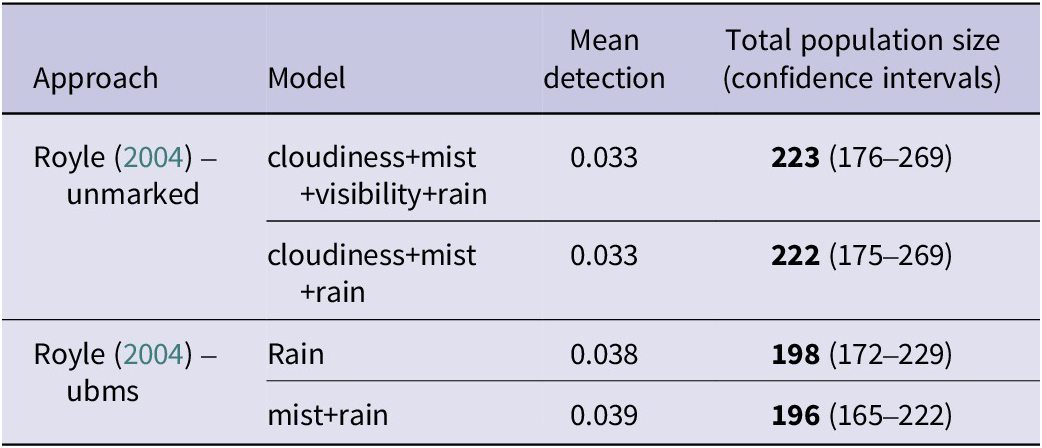
For each of the assumptions addressed, 16 models were generated (including the null model) using all possible variable combinations (Appendix S3). According to the closed population assumption in the maximum likelihood framework, two models with a negative binomial distribution showed the best convergence (ΔAIC <2): one with all four climatic variables and the other including only cloudiness, mist, and rain (Table 1). Both models gave similar results, with an estimated population size of 223 individuals (176–269) and a mean detection rate of 0.033 (Table 2).
Abundance estimation models for the Andean Condor in Colombia. AIC = Akaike’s information criterion; NB = Negative Binomial; ZIP = Zero-inflated Poisson. The best models are highlighted in bold

Andean Condor population estimates for Colombia according to the selected models. Confidence intervals are shown in parentheses

For the closed population assumption in the Bayesian framework, the model with mist and rain as variables and the model with rain as the only variable showed the best convergence (Δelpd <4) (Table 1). The population estimates varied from 196 (165–222) individuals for the mist and rain model to 198 (172–229) individuals with the rain model, with mean detection rates of 0.038–0.039 (Table 2).
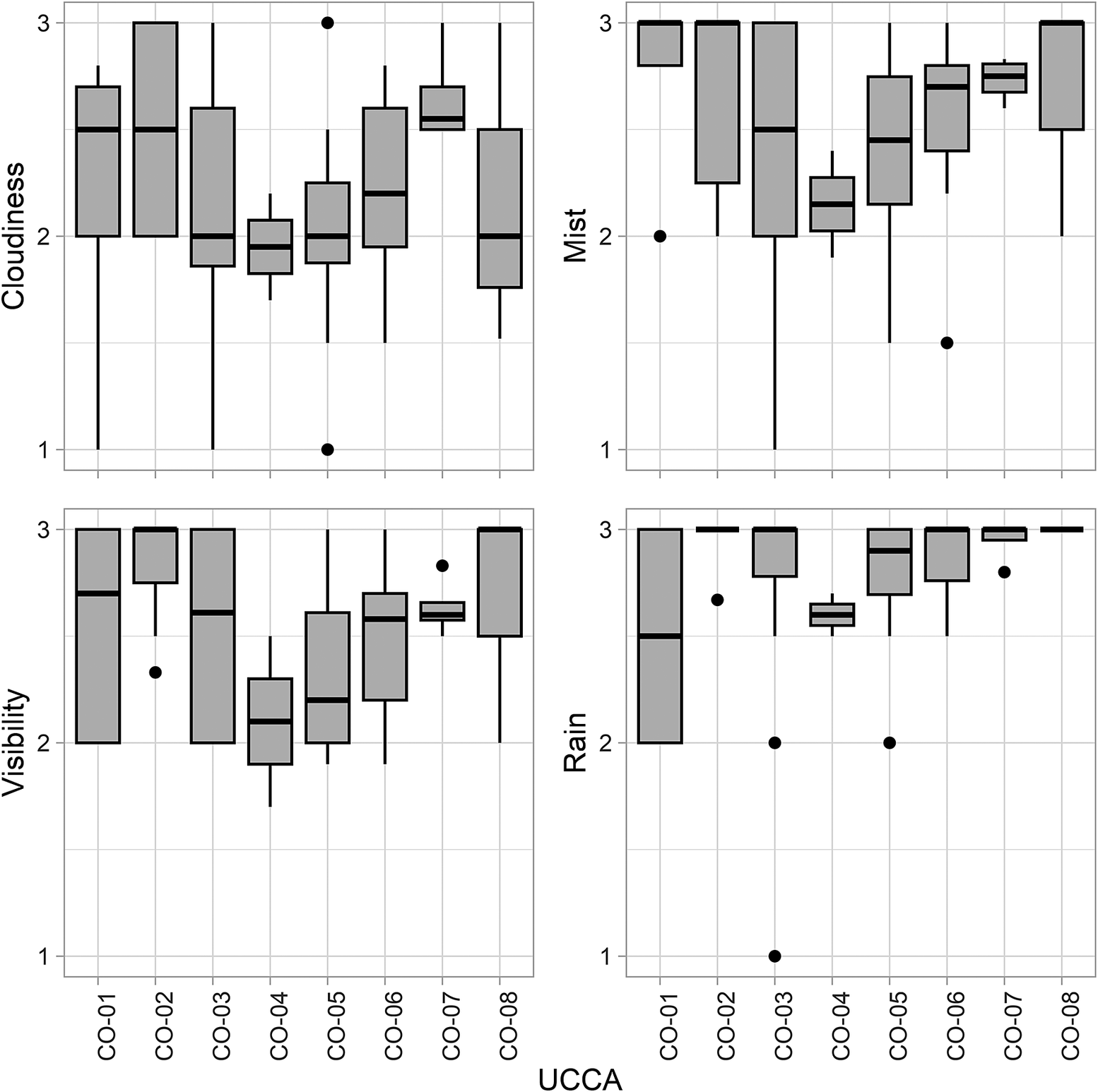
Variation in the climatic conditions among the different UCCAs was found during the count. Even though the average climatic conditions were favourable for observations in most of these units, some UCCAs, such as CO-03 and CO-04, presented climatic conditions that could have affected the records during the count (Figure 4).
Variation in climatic conditions recorded for each Andean Condor Priority Conservation unit (UCCAs) during the first national Andean Condor count in Colombia.

Discussion
Using a citizen science-based approach, this study provides the first empirical quantitative field survey data regarding the status of the Colombian Andean Condor population. Our findings suggest that the estimated Colombian Andean Condor population does not exceed 223 individuals, higher than the 135–190 proposed by Arango-Caro et al. (Reference Arango-Caro, Arenas, Zuluaga, Sáenz-Jiménez, Renjifo, Amaya-Villarreal, Burbano-Girón and Velásquez-Tibatá2016). Considering the estimated 31,492 km2 of the combined Colombian Andean Condor conservation units described by Wallace et al. (Reference Wallace, Reinaga, Piland, Piana, Vargas and Zegarra2022), the condor population density would be 0.5 condors/100 km2 This is much lower than that for Argentina (3.9 condors/100 km2) (Lambertucci Reference Lambertucci2010), but similar to Bolivia (0.6 condors/100 km2) (Méndez et al. Reference Méndez, Soria-Auza, Vargas and Herzog2015), and higher than in Ecuador (0.18 condors/100 km2) (Naveda-Rodríguez et al. Reference Naveda-Rodríguez, Vargas, Kohn and Zapata-Ríos2016).
We found a significant bias in favour of adults over immatures (1:0.43) (Figure 3), consistent with findings from Andean Condor populations in Ecuador (1:0.5) (Naveda-Rodríguez et al. Reference Naveda-Rodríguez, Vargas, Kohn and Zapata-Ríos2016), Peru (1:0.35) (Wallace and Temple Reference Wallace and Temple1982), and Argentina (1:0.46) (Lambertucci Reference Lambertucci2010). Even though the low percentage of immature condors seems to be a common issue throughout the range of the species, it is of most concern in the northern Andes because of its small population size, low reproductive rate, and the severe human threats affecting Andean Condors in this region (Naveda-Rodríguez et al. Reference Naveda-Rodríguez, Vargas, Kohn and Zapata-Ríos2016; Restrepo-Cardona et al. Reference Restrepo-Cardona, Parrado, Vargas, Kohn, Sáenz-Jiménez and Potaufeu2022, Reference Restrepo-Cardona, Kohn, Narváez, Pineida and Vargas2024; Vargas et al. Reference Vargas, Narváez, Naveda-Rodríguez, Carrasco, Kohn and Utreras2018). However, these trends should be verified through future counts, especially given the high number of records for individuals whose sex or age could not be determined.
The sex ratio of immature individuals was slightly biased toward females (0.8:1), similar to the results obtained for Andean Condors in Argentina (Lambertucci et al. Reference Lambertucci, Carrete, Donázar and Hiraldo2012) and Bolivia (Méndez et al. Reference Méndez, Soria-Auza, Vargas and Herzog2015). Regarding the adults, the ratio was biased in favour of males (1.3:1) (Figure 2). Age-dependent differences could be due to a higher mortality rate of adult female condors due to the marked hierarchy imposed by dominant males, which forces females to forage in potentially more disturbed habitats where the risk of mortality is higher (Donázar and Feijóo Reference Donázar and Feijóo2002; Lambertucci et al. Reference Lambertucci, Carrete, Donázar and Hiraldo2012).
Only 13% of the 71 condors released in Colombia between 1989 and 2013 were recorded during the count. Observations in the reintroduction areas revealed that the core area of the Los Nevados NNP had the largest population, with seven condors reported simultaneously (six released individuals and one wild-born condor). This finding aligns with the local condor records between 2016 and 2020 (Arango-Caro et al. Reference Arango-Caro, Arenas, Zuluaga, Sáenz-Jiménez, Renjifo, Amaya-Villarreal, Burbano-Girón and Velásquez-Tibatá2016; Restrepo-Cardona and Hull Reference Restrepo-Cardona and Hull2023; Zuluaga and Ospina-Herrera Reference Zuluaga and Ospina-Herrera2020). Even though previous reports suggested the presence of 11 and 6 condors in the repopulation cores in the Puracé NNP and the Resguardo Indígena de Chiles, respectively (Arango-Caro et al. Reference Arango-Caro, Arenas, Zuluaga, Sáenz-Jiménez, Renjifo, Amaya-Villarreal, Burbano-Girón and Velásquez-Tibatá2016), we recorded only three individuals at each of these localities. Furthermore, no condors were recorded in the Siscunsí paramo and the Chingaza NNP release areas, contrasting with historical records that reported 8 and 11 individuals, respectively (Arango-Caro et al. Reference Arango-Caro, Arenas, Zuluaga, Sáenz-Jiménez, Renjifo, Amaya-Villarreal, Burbano-Girón and Velásquez-Tibatá2016).
The low number of released Andean Condors recorded during the count may be explained by several factors: (1) the death of individuals, since at least 7% of the condors released in Colombia were either poisoned, shot or electrocuted when colliding with powerlines (Restrepo-Cardona et al. Reference Restrepo-Cardona, Parrado, Vargas, Kohn, Sáenz-Jiménez and Potaufeu2022); (2) the migration of condors to other localities outside the core reintroduction areas, due to their high mobility and long-distance explorations (Guido et al. Reference Guido, Cecchetto, Plaza, Donázar and Lambertucci2023; Lambertucci et al. Reference Lambertucci, Navarro, Sánchez-Zapata, Hobson, Alarcón and Wiemeyer2018); (3) the loss of wing bands in reintroduced condors which may prevent distinguishing released individuals from wild-born birds (Arango-Caro et al Reference Arango-Caro, Arenas, Zuluaga, Sáenz-Jiménez, Renjifo, Amaya-Villarreal, Burbano-Girón and Velásquez-Tibatá2016; Rodríguez et al. Reference Rodríguez, Barrera-Rodríguez and Ciri-León2006). The lack of post-release monitoring programmes results in information gaps that constrain implementing management actions to guarantee the long-term persistence of condors (Coz and Young Reference Coz and Young2020; Restrepo-Cardona and Hull Reference Restrepo-Cardona and Hull2023). Systematic monitoring and population assessments of the Andean Condor based on both counts and genetic analysis (see Padró et al. Reference Padró, Vargas, Lambertucci, Perrig, Pauli and Ortega2023; Perrig et al. Reference Perrig, Lambertucci, Donadio, Padró and Pauli2019) may provide relevant data to examine the state of released and wild-born condors and evaluate the conservation success of the species repopulation programme in Colombia.
There is little information on the movement and dispersal patterns of Andean Condors in Colombia, and we only had data on the movement of two rescued wild-born condors that had been monitored with satellite trackers for two years after release, and two released individuals monitored for only eight months (see Parrado-Vargas Reference Parrado-Vargas2023; Sáenz-Jiménez Reference Sáenz-Jiménez2020). The lack of data on the possible flow of condors between subpopulations made it impossible to determine if the current Colombian condor population corresponds to an open or closed population. As a result of this, the population estimates presented here require corroboration through new counts and a better understanding of the spatial ecology of the species. Furthermore, the relatively small number of observation points in the Sierra Nevada de Santa Marta, which is part of an indigenous reservation with restricted access, could have resulted in our underestimating the national condor population. As Rodríguez et al. (Reference Rodríguez, Barrera-Rodríguez and Ciri-León2006) suggested, a considerable percentage of Colombia’s condor population probably inhabits this region. Despite the limitations of our study, this is the first systematic effort to assess the population status of the Andean Condor at the Colombian national level, and its results should provide a relatively sound baseline for comparison with future condor counts.
During the Andean Condor count, expert birders and volunteers from indigenous, rural, and urban communities participated together in the systematic count following virtual training sessions. The technical skills of participants were strengthened in identifying the morphological differences between raptor species, in differentiating condor age and sex classes, and in understanding their natural history, ecology, and the threats that they face, as well as in systematic data collection and recording protocols (Steven et al. Reference Steven, Barnes, Garnett, Garrard, O’Connor and Oliver2019). This approach helped to reduce observer bias by combining the volunteers’ skills with up-to-date scientific practice (Brown and Williams Reference Brown and Williams2019; Tulloch et al Reference Tulloch, Possingham, Joseph, Szabo and Martin2013).
Well-designed and implemented citizen science projects are practical tools for obtaining reliable data regarding the demography of threatened species over wide geographical ranges (Donnelly et al. Reference Donnelly, Crowe, Regan, Begley and Caffarra2014; Greenwood Reference Greenwood2007), information that is critical for developing evidence-based management measures to prevent a species’ local extinction, especially for scarce obligate scavengers such as the Andean Condor, which can be challenging to detect and which require current population data for effective conservation planning (Brown and Williams Reference Brown and Williams2019; Greenwood Reference Greenwood2007; Steven et al. Reference Steven, Barnes, Garnett, Garrard, O’Connor and Oliver2019). In addition, bringing city-dwellers to the remote areas where condors are found provided them with a wilderness nature experience and an understanding of the cultural and ecosystem services that condors provide (García-Jiménez et al. Reference García-Jiménez, Pérez-García, Margalida and Morales-Reyes2022; Moleón et al. Reference Moleón, Sánchez-Zapata, Margalida, Carrete, Owen-Smith and Donázar2014; Santangeli et al. Reference Santangeli, Lambertucci, Margalida, Cancellario, Carucci and Botha2024), and could improve the local economies of rural areas suffering socio-economic difficulties (Chakraborty and Maity Reference Chakraborty and Maity2020), such as those caused by the isolation measures imposed by the COVID-19 pandemic.
The information gathered in this study is fundamental to improving condor management and guiding conservation strategies and actions to mitigate the demographic collapse of the Andean Condor in the northern Andes (Margalida et al. Reference Margalida, Jiménez, Martínez, Sesé, García-Ferré and Llamas2020; Padró et al. Reference Padró, Vargas, Lambertucci, Perrig, Pauli and Ortega2023; Ryan et al. Reference Ryan, Nicholson, Eames, Gray, Loveridge and Mahood2019), especially considering that over the past 33 years, Colombia has invested extensive technical and financial resources in the conservation of the species, such as the implemented reintroduction project (Lieberman et al. Reference Lieberman, Rodriguez, Paez and Wiley1993; Restrepo-Cardona and Hull Reference Restrepo-Cardona and Hull2023; Rodriguez et al. 2006). However, of the entire Andean Condor distribution, Colombia seems to have the greatest information gaps regarding the ecological and demographic aspects of released and wild-born condors (Wallace et al. Reference Wallace, Reinaga, Piland, Piana, Vargas and Zegarra2022).
Estimating the population size of the Andean Condor in the northern Andes is a priority for their conservation (Buechley et al. Reference Buechley, Santangeli, Girardello, Neate-Clegg, Oleyar and McClure2019; Santangeli et al. Reference Santangeli, Buechley, Mammola and Lambertucci2022). However, this is a challenging task considering the species’ highly mobile behaviour, low population density, low reproductive rate, and severe human threats that require monitoring efforts across large-scale landscapes (Lambertucci et al. Reference Lambertucci, Navarro, Sánchez-Zapata, Hobson, Alarcón and Wiemeyer2018, Padró et al. Reference Padró, Vargas, Lambertucci, Perrig, Pauli and Ortega2023; Perrig et al. Reference Perrig, Lambertucci, Donadio, Padró and Pauli2019; Restrepo-Cardona et al. Reference Restrepo-Cardona, Parrado, Vargas, Kohn, Sáenz-Jiménez and Potaufeu2022, Reference Restrepo-Cardona, Kohn, Narváez, Pineida and Vargas2024), as well as the remote habitats that they frequent, especially in Colombia where the means of access to certain areas are restricted, thus increasing the cost of species monitoring. These factors highlight the importance of our citizen science-based approach and the need to carry out new systematic counts in the future to evaluate the population dynamics of the Andean Condor and guide the implementation of effective management and conservation actions.
Supplementary material
The supplementary material for this article can be found at http://doi.org/10.1017/S0959270925000061.
Acknowledgements
We thank all the organisations that supported the development of the count, especially Fundación Neotropical, the Parques Nacionales Naturales de Colombia, WWF Colombia, the WCS Colombia, CORPOCALDAS, and USAID–Riqueza Natural, which provided part of the logistic and economic resources for the development of the count. We also thank the volunteer observers for their field assistance during the simultaneous survey and the participants in the training workshops held before the count. The comments of two anonymous reviewers and José Jiménez improved a previous version of this paper.