The Jewish pilgrim to Jerusalem in the late Second Temple period would have confronted a city in transformation. Its urbanized area was growing significantly, expanding well northward of the Old City walls of today. Sumptuous new residences were being erected in the wealthy quarter on the southwestern hill. And the sacred complex on the Temple Mount was being entirely rebuilt, from the ground up, and turned into one of the grandest sanctuaries anywhere in the world. Beginning in the late 20s BCE, Herod the Great spearheaded and funded the project, utilizing, no doubt, revenues from his newly expanded territories, with their taxable roads, ports, and areas for agricultural development. He had just received the territories of Trachonitis, Batanea, and Auranitis from Augustus in 23 BCE, and in the subsequent year founded Caesarea and Sebaste anew as quintessential Greek cities—the only examples of new urban foundations in the Near East in the reign of Augustus.Footnote 1
The construction of Greco-Roman types of monumental architecture in these urban spaces was a new phenomenon for the region, signaling a cultural shift toward the West. Yet in terms of size and scale, nothing could compare to the expanded Temple complex, with its new sanctuary and enlarged esplanade (temenos), most of which was open to non-Jewish visitors (figure 1). Rubbing elbows with non-Jews within the esplanade, the Jewish pilgrim would have been reminded of the new Roman political order in which they were now entrenched, but also of how much of an international attraction the Temple had become. Pliny the Elder famously called Jerusalem “by far the most illustrious city of the East” (Natural History 5.70), surely owing in large part to the sanctuary that presided over it.Footnote 2
Jerusalem of the first century CE continues to captivate the imagination. This image is a screenshot from Jerusalem: The Movie, which was produced for IMAX and distributed by National Geographic Entertainment, 2014. Copyright: Jerusalem3D US LLP.

Though some non-Jews made their way to Jerusalem as tourists, the vast majority of the international visitors to the Temple would have been Jewish pilgrims from the Diaspora.Footnote 3 Martin Goodman has argued that Herod had precisely this population in mind when erecting this great new sanctuary.Footnote 4 The boon of attracting more pilgrims to the Temple would have been felt not only within the holy institution itself, whose coffers would have benefitted by an increase in sacrifices, offerings, and general euergetism, but also within the larger city, whose markets and hostels would have profited from the throngs of visitors. Ports and way stations along the main travel routes into Jerusalem stood to gain. Josephus tried to give a sense of the scale of the pilgrimage event during the peak season of Passover when he noted that 2,700,000 male pilgrims came to Jerusalem in 66 CE (War 6.425).
Regardless of how exaggerated that number might be, the mass international pilgrimage of late Second Temple Jerusalem was without parallel in the Roman Empire. The Temple of Asclepius at Pergamon or Artemis at Perge drew large crowds, as did major festival events at Olympus and Delphi; people also journeyed to seek cures at healing sanctuaries, to visit oracles, or to participate in mystery cults.Footnote 5 But mass international pilgrimage was the exception rather than the rule. According to Goodman's thesis, this feature of late Second Temple Judaism was the result of Herod's particular vision and business acumen, where the Temple-expansion project was in effect a capital investment. That investment appears to have paid off marvelously—that is, until the outbreak of the war with Rome.
This paper seeks to develop Goodman's thesis in two ways. First, it situates Herod's transformation of Jerusalem into an international pilgrimage site against the backdrop of Mediterranean leisure travel and sightseeing, which reaches far back into classical antiquity but became particularly popular in the Augustan age.Footnote 6 Literary works from the Jewish canon that reflect this expanding interest include the Jerusalem excursus in the Letter of Aristeas and the Jerusalem Temple descriptions of Philo and Josephus. Second, this paper considers ways in which the Jerusalem experience could have changed as a result of foreign pilgrimage and tourism to the city, particularly with regard to festival entertainment. The fragmentary play text Exagoge (Exodus), for example, may represent a larger body of dramatic works put on in the Jerusalem stage during Jewish festivals. Indeed, the blurring of boundaries between pilgrimage and tourism in the modern context has impacted our understanding of the ancient pilgrim's experience.Footnote 7 For the Holy Land, “touristification” of traditional pilgrimage sites may indeed have accelerated in the modern context, but the process as such cannot be limited to modernity.Footnote 8
The Periegetic Temple Description
The earliest ethnographies and travel writing of the Greeks contained elements that can be referred to as periegetic, after the Greek term periegesis, “leading around.” Periegetic accounts and travelogues could inform the future traveler of what there is to be seen in any given destination, or simply entertain by creating a vicarious travel experience. The classic of the genre is Pausanias's tour through Greece (Hellados periegesis, second century CE), but literature of this sort dates back to the writings of Herodotus.Footnote 9 Temples, as mentioned above, were sought-after destinations and the regular subjects of such descriptions.Footnote 10 Actual guidebooks were probably uncommon, because of the unwieldiness of the scroll form and its impracticality as a medium for use while sightseeing.Footnote 11
The Jerusalem Temple has been described in a few periegetic or “walking-tour” accounts. The earliest derives from the prophetic imagination in the wake of the destruction of the First Temple in Jerusalem in 586 BCE. In the Temple Vision of the book of Ezekiel (chapters 40–48), dated to some point in the mid- to late sixth century BCE, the prophet envisions a fully functioning temple after it has been rebuilt in an idyllic age.Footnote 12 He is led through the space by a male guide with a bronze aura, who holds a linen cord and a measuring rod, which he uses to take line measurements of the spaces they walk through (Ezekiel 40:3–4). Ezekiel records those measurements and describes the various things he sees. It may have seemed natural to the author or authors of the Vision to have the prophet guided through the unfamiliar space rather than wandering through on his own. Perhaps the scenario was modeled after experiences with temple guides in real life. Jacob Milgrom and Daniel Block have posited that the author of Ezekiel's Temple Vision was familiar with the Temple of Apollo at Delphi; Yitzhak Magen has noted the similarity in appearance between the Persian-period sanctuary at Mt. Gerizim and that described in the Vision, demonstrating familiarity in the latter with architectural vernacular of the day.Footnote 13
In Ezekiel's Temple Vision, the periegetic style helps recreate for its audience the sensation of being in sacred space. When Ezekiel finished his tour of the inner precinct of the Temple, for example, he felt the glory of God enter the space. He sensed it was coming from the east, a “sound like the sound of mighty waters” (43:2). The ground lit up. The prophet was swept up by a great wind; he was flung into the inner court. And then he heard God's voice, while his guide stood alongside him (43:4–6). Compare this approach with that of Exodus 25:1–31:11, for example, which describes how to construct the tabernacle for God in the camp of the Israelites in the wilderness. This is a kind of equivalent text to Ezekiel's Temple Vision because of its interest in setting standards for the appearance of God's abode; it also derives from priestly circles. However, it is more overtly prescriptive in its framework than the Temple Vision, relying heavily on thick description to impress the reader with how visually stunning the tabernacle was, but not addressing directly the experience of confronting it or walking along its face. That kind of emotional response is more in keeping with the periegetic.
Another example of a Jewish periegetic account of a Temple visit appears in the Letter of Aristeas, a second-century BCE work from Alexandria that includes, among other things, a legendary tale on how the Hebrew Bible was translated into Greek.Footnote 14 The work is in fact a fine pastiche of Hellenistic literary genres, including the travelogue. In one section of the tale (§§83–120), Ptolemy II sends an embassy led by Aristeas to Jerusalem and visits the high priest there, then invites seventy-two translators back to Alexandria to render the Bible into Greek. Aristeas describes his experience of Jerusalem and its hinterland in a narrative that styles the city after the Aristotelian ideal of a polis rather than on fact and experience.Footnote 15 It also uses hallmark features of the travelogue, such as the first-person narrative, the walking-tour approach, and the attention to visual detail, all to convey a sense of the thrill of laying eyes on spectacular architectural craft and design. Aristeas begins with the famous curtain that hung at the entrance to the sanctuary, which he calls a thing of spectacular beauty and a perfect match for the door in which it is fitted (85–86). The curtain waves and flutters as if caught in a gentle breeze. Such a sight, claims Aristeas, “was hard to tear oneself from.”Footnote 16 The water supply to the sacred precinct is extolled, as well, as are the Temple drains, of all things, which Aristeas notes work so effectively that the sacrificial blood is washed out of view “in the twinkling of an eye” (90). Even the sewage technology of the Temple is state of the art.Footnote 17
The idealized representation continues in the Letter's description of the priestly service at the altar. The priests are said to have presided over a sacrificial operation of impressive magnitude and to have done so with upmost competence. “In its exhibition of strength and in its orderly and silent performance,” notes Aristeas, “the ministration of the priests could in no way be surpassed” (92). One gets the impression of a well-choreographed routine. With deft strength the priests are said to have hoisted bovine limbs weighing upwards of two talents (175 lbs.) and “throw[n] them with each hand in a wonderful way on to the high place [of the altar] and never miss placing them on the proper spot” (93). This would have been physically demanding work. The author of the Letter makes special note of how the priests spontaneously and without instruction rose up from the rest area and, in the manner of a tag team, offered relief to their comrades (94). Most stunning of all, to those who witnessed the ministration, was the priests’ ability to carry it out in silence. “The most complete silence reigns,” reads the Letter, “so that one might imagine that there was not a single person present, though there are actually seven hundred men engaged in the work, besides the vast number of those who are occupied in bringing up the sacrifices. Everything is carried out with reverence and in a way worthy of the great God” (95).Footnote 18 The excitement of viewing the sacrificial act—a ritual effecting spiritual transformation in its ability to atone, to appease, and to satiate the divine—may have been heightened by individual concerns over whether it was being properly executed. The Letter appeases any such concern by describing a display of extreme religious discipline.
The objective is to demonstrate the respectability of Judaism, its philosophical underpinnings, and its fine center of worship in Jerusalem by cultivating an emotional connection to the place.Footnote 19 Just as Ezekiel's Temple Vision contrasts with the tabernacle instructions of the book of Exodus, so does the approach of the Letter of Aristeas contrast with another key source on the Jerusalem Temple roughly of its era—the Temple Scroll from Qumran (second to first century BCE).Footnote 20 Here, too, we see a clash between the periegetic and the prescriptive, with the Temple Scroll updating Scripture by giving new instructions on how the sanctuary and its altar were to be constructed, and how the Temple cult was to be officiated. As idealized portrayals of the Temple, both works are largely products of the imagination. But the Letter of Aristeas is interested not only in matters of the integrity of the Temple as a place of worship and a house of God, but also in the emotional response of gazing at its marvels. The virtual visit it provided would have served for many as a necessary substitute for the authentic, for others as inspiration to make the journey.
Festival Spectacle and International Travel
The excursus on the Temple visit in the Letter of Aristeas reflects an expanding interest in travel in the Hellenistic world. Travel infrastructure between East and West improved in the wake of Alexander's conquests, connecting populations through trade, tourism, and immigration. According to Erich Gruen, this resulted in fruitful engagement among foreigners and foreign cultures and promoted a kind of collective self-consciousness.Footnote 21 Concomitant with this development was the rise of a new aesthetic outlook, particularly with regard to the built environment.Footnote 22 Indeed, it was in this period that the Seven Wonders of the Ancient World emerged as a definitive list and concept.Footnote 23 The late second-century BCE poet Antipater of Sidon (Lebanon) claimed to have traveled to all of them and provides us with our earliest full list. He writes, “I have set eyes on the wall of lofty Babylon … the statue of Zeus … the hanging gardens … the Colossus of the Sun … the huge labor of the pyramids … the vast tomb of Mausolus; but when I saw the sacred house of Artemis that towers to the clouds, the others lost their brilliancy” (Greek Anthology 9.58).
That the Temple to Artemis at Ephesus surpassed the other wonders speaks to the ability of sacred architecture to captivate the imagination. Temples in the ancient world served social functions extending far beyond the cultic or religious in a strict sense—as abodes of the divine and sites of spiritual intermediation between the heavenly and earthly realms. They were also tourist destinations and focal points for cultural mediation. Their complexes often contained monuments, war spoils, tapestries, sculpture, paintings, and inscriptions of special cultural significance.Footnote 24 Festivals were opportunities for visitors to take in these marvels firsthand. Jews in the Diaspora would have been familiar with the norms of typical Greco-Roman religious festivals, if not occasional participants in them.Footnote 25 Merrymaking and spectacle were vital components of the gathering, as a kind of thanks offering to the deity. They could include theatrical performances, concerts, horse and chariot races, athletic contests, and gladiatorial fights.Footnote 26
Festivals could also serve as displays of power for rulers and aristocrats, as was the case with the games Herod inaugurated in Jerusalem in 28 BCE in honor of Augustus. Those games are said to have featured the leading sportsmen and performers from the Mediterranean world—the purse for each contest having been exceptionally large—and to have included athletics, two- and four-horse chariot racing, gladiatorial contests, musical performances, and something called thymelikoi, which may refer to acting contests.Footnote 27 It is not known how many times the Jerusalem games were offered. According to Josephus, they were staged on a quadrennial basis (Ant. 15.268–71).Footnote 28 The assumption has been that local resistance to them would have brought about their quick end once their principal benefactor Herod died in 4 BCE, if not at some point before his death.Footnote 29
The theater and amphitheater that Josephus notes were built for the Jerusalem games (Ant. 15.268) would have been new architectural forms for the region. He mentions that “the use of such buildings and the exhibition of such spectacles have not been traditional” (Ant. 15.268). Neither building has been located. A few stone seats found incorporated in secondary use into an Umayyad-era structure near the Temple Mount may belong to the theater.Footnote 30 However, that identification has been cast into doubt, for the extant theater seats are more typical of a second-century structure than a first-century one; neither structure is mentioned in Josephus's tour of the city later; and it was common in Herod's day for structures of this sort to be built of wood and dismantled after the festival.Footnote 31 As for the amphitheater, a recent proposal has it in the Valley of Hinnom, just outside the southern flank of the city wall.Footnote 32
Herod's efforts to spearhead Roman-style festivals in Jerusalem, as well as at Caesarea, whose first festival games were staged in 10 BCE, prompted a broader cultural shift in leisure activities in the region, a process explored fully in a recent volume by Zeev Weiss.Footnote 33 The inaugural Jerusalem games likely demonstrated to Herod and other authorities the benefits of drawing visitors to the city beyond those pilgrims who would typically have come from greater Judea. The increased movement of persons (and goods) into his kingdom required infrastructural upgrades, most notably to accommodate maritime travel. Archaeological investigation in recent decades at Caesarea, the main port city for Herod's kingdom, has shed light on just how seriously the king took this issue. Concrete seawalls were sunk offshore at great expense in order to create a sizeable artificial harbor, which could now provide safe anchorage for far more incoming vessels than could be accommodated in the city's pre-Herodian port. Once it had been suitably improved, the Caesarea harbor—now called Sebastos, after the Roman emperor—became a key component in the promotion of travel inland through Judea and to Jerusalem.Footnote 34 By the late first century BCE, Jewish pilgrims traveling to Judea by sea and disembarking at Caesarea would have immediately been confronted by the city's grand Temple of Rome and Augustus, which was yet another indication of the cultural transformation of this region.Footnote 35
Roughly contemporaneously, Herod convinced the Jerusalem authorities to tear down the city's existing sanctuary to God and rebuild it with a complex that would have been unrivaled in size and grandeur in the eastern Mediterranean. Herod's demolition of the Second Temple and total reconstruction of the site into an architectural marvel was a celebration of his rise to power and the great wealth he amassed for himself and his burgeoning kingdom. In his display of piety he sought glory among Judeans and non-Judeans alike, while transforming his capital city into an international attraction.Footnote 36 The Jerusalem Temple may have merited a place on the Seven Wonders list were the list composed in the late first century BCE rather than a century prior.
Herod was also joining in a key component of the Roman imperial project. The Roman world was “one in which generals and emperors boasted of expanding knowledge of lands and peoples, of surpassing the achievements of Alexander in not just travelling but possessing the world,” as Emma Dench has put it.Footnote 37 Imperial efforts to improve travel infrastructure throughout the eastern Mediterranean are reflected in the construction of new roads and wheel-changing stations. Vital police protection was also given to these locations. Revenue was generated for local authorities by the imposition of tolls and other taxes, which in turn would have incentivized the regular maintenance of the road network.Footnote 38 Leisure travel in the Mediterranean became more developed than it ever had been. The most famous of the touristic routes was the so-called Augustan Grand Tour, which took travelers from Italy to the ancient sites of Greece, Asia Minor, and Egypt.Footnote 39 The Greece leg included Athens, Olympia, Corinth, and Delphi. In Asia Minor travelers visited Ephesus and Troy. The Egypt leg brought travelers to Alexandria and down the Nile to Giza, Memphis, Thebes, and Aswan, the most distant spot on the tour.
Though the eastern Mediterranean seaboard was not part of the Augustan Grand Tour, Herod's infrastructural and architectural upgrades in his kingdom, and in his capital city in particular, paid off spectacularly. Scattered references in source material suggest that in the first century CE individuals were visiting Judea and the Temple in Jerusalem from far and wide, primarily Jews making pilgrimage during the festivals of Passover, Shavuot, and Sukkot.Footnote 40 Philo of Alexandria notes that pilgrims included “innumerable companies of men from a countless variety of cities” (Spec. 1.69). The Acts of the Apostles (2:5–11) lists Parthians, Medes, Elamites, Mesopotamians, Cappadocians, Phrygians, Egyptians, Libyans, Romans, Cretans, and Arabs among the nationalities represented in Jerusalem. Wealthy Jews of the Diaspora also became prominent donors and benefactors to the Temple.Footnote 41
Non-Jews also came to see Jerusalem. In addition to various anecdotes for these visits in the ancient literature (e.g., Ant. 3.318; John 12:20; Acts 21:28), the routine presence of non-Jews in the Temple is confirmed archaeologically by the soreg, which was a low parapet with warning signs forbidding entry by non-Jews into the Temple's inner courts. Two of the signs survive, both in Greek. They are an exceptional discovery in the history of modern historical inquiry into ancient Jerusalem.Footnote 42 They indicate a parapet sixty centimeters high, low enough to have allowed non-Jewish visitors to obey priestly regulations while still enjoying an up-close view of the towering sanctuary with all its decorative appurtenances, including the sumptuous ‘azarah doors, which were plated in gold, silver, and Corinthian bronze (War 5.201). The parapet would also have facilitated the easy transfer of sacrifices and offerings by non-Jewish visitors; a similar low parapet facilitated the same transfer between Jewish worshippers into the court of priests (War 5.226) and afforded an intimate view for them of the Temple facade.Footnote 43
The evidence for an influx of foreign pilgrims and visitors to Jerusalem in the Herodian period, as well as the signs of broader cultural changes to the city, may indicate an impact on the character of the Jewish festival. Jewish participation in the Greco-Roman theatrical arts is proven by the fragmentary Greek play text called Exagoge. The play text, which is said to have been written by a man named Ezekiel, refashions the story of the Exodus in the manner of a Greek tragedy.Footnote 44 It survives in only disjointed fragments—in several verses on a papyrus from Oxyrhynchus (Egypt), identified only recently and still unpublished; and in 269 verses of iambic trimeter in Eusebius's Praeparatio evangelica (§9), assumed to have originally been compiled by Alexander Polyhistor in the first century BCE.Footnote 45 The fragments include scenes before the tents of Jethro (Raguel), on Mount Horeb, in the palace of Pharaoh, and somewhere in the wilderness. They may relate to a tetralogy rather than to a single play.Footnote 46 It is not clear when Ezekiel lived, when the work was written, or where and on what occasions it was staged. Scholars assume an Alexandrian provenance and a date of composition around the second century BCE, but this is far from assured, with a dating as late as the first century CE entertained by Rick Van de Water.Footnote 47
In the least, Exagoge attests to Jewish engagement with Greek theater in Egypt, as the recently identified papyrus fragment proves. Its reach may have been broader than that. Interestingly, some have entertained the possibility of a Palestinian origin for the author. The language of the piece is somewhat Semiticized and there are a few geographic mistakes no Egyptian is thought capable of making.Footnote 48 As far as where the work was staged, this too is a puzzle. It would take some mettle for the Jewish community in Egypt to put on public performances of the Exodus story, with its unflattering portrait of the pharaonic regime and its humiliating defeat of Pharaoh and his gods. In a Ptolemaic context, it is hard to read it any other way than as an act of brazen protest.Footnote 49
Goodman has entertained the possibility that Exagoge was put on in Jerusalem.Footnote 50 In that context, particularly during the festival of Passover, the play would have been a fitting display of national pride, if not also a didactic one, particularly for Jews less educated in scriptural tradition. A theatrical production in the Greek language would be expected in this urban context, not only because so many Jewish pilgrims now came to Jerusalem from Greek-speaking lands, but also because Judea itself had adopted the language for official use.Footnote 51 Because of Herod's games in honor of Augustus, the city had proven its ability to stage theatrical events and was equipped with either a permanent theater or a designated space where a temporary structure could be put up for a festival.
Noteworthy in this regard is that Josephus's description of those games includes no reports of discomfort with the dramatic and musical performances that they included. Rather, Josephus mentions only disapproval of the gladiatorial contests (Ant. 15.275) and of the trophies Herod had hung up in the theater—the latter assuming a human form and offending some local sentiments on figural art (Ant. 15.277–79). Dramatic and musical performances were far more amenable to local tastes.Footnote 52 Furthermore, by the end of the first century CE the city was in the midst of a cultural shift toward the West, as reflected foremost in the interior décor and domestic wares of the Judean elite.Footnote 53 Indeed, a key component of Herod's transformation of the city seems to have involved catering to foreign tastes.Footnote 54 The staging in Jerusalem of Jewish-themed plays in Greek, such as Exagoge, as part of the Passover festival, and perhaps Shavuot and Sukkot as well, would suit not only this royal initiative but also the city's cultural disposition in the Herodian period.
Sights and Marvels
Philo of Alexandria made the trip from Egypt to the Temple at Jerusalem at least once before he died in the middle of the first century CE (On Providence 2.64). His description of the place in Special Laws 1.71–76 is framed as an eyewitness account. It is indebted to the periegetic. He emphasizes the sheer beauty of the built environment he encountered. He extols the fine materials used to construct the edifice and its surrounding porticoes, and mentions that the outer porticoes were more impressive in stature and workmanship than those in the inner part of the esplanade (1.71). He then focuses on the inner sanctum, where many in his audience would have expected an impressive cult statue in the Temple cella. In the case of Jerusalem, claims Philo, one is left only to conjecture as to the beauty of the interior. He writes, “For what is innermost is invisible to every human creature except the high priest alone, and even he is enjoined only to enter that holy place once in each year. Everything then is invisible. For he carries in a brasier full of coals and frankincense; and then, when a great smoke proceeds from it, as is natural, and when everything all around is enveloped in it, then the sight of men is clouded, and checked, and prevented from penetrating in, being wholly unable to pierce the cloud” (1.72). Despite the inner sanctum's invisibility, Philo writes that foreigners who traveled to the place were impressed by the beauty of the complex as a whole (1.73). He also gives ample attention to the Temple's lack of a grove or garden. Beautiful landscaping was commonplace in temples of this era.Footnote 55 Why no fruit-bearing trees and flowers to admire on Jerusalem's sacred esplanade? Philo gives several reasons, ranging from the cover they could offer to miscreants and thieves, to their potential to distract worshippers from the more serious tasks at hand, to the fact that they would require manure to be brought into the Temple compound as fertilizer (so unfitting a substance for such a holy place). Philo also notes that the lack of trees surrounding the Temple allows visitors to fix their eyes on the surrounding architecture without hindrance or impediment (1.74–75).
At festival time, there certainly appear to have been crowds to negotiate, something Philo also finds worthy of note (Spec. 1.69). When religious festivals took place in Jerusalem, tens of thousands of visitors came to the Temple, sometimes entire towns moving together, bringing baskets of firstfruits, families in tow, with plenty of meat for purchase and consumption. Large delegations from individual towns and villages entered the holy city together with some pomp (Josephus, Ant. 4.242–43; M. Bikkurim 3:2–8). Occasionally fights broke out.Footnote 56 Some visitors may have found the proceedings overwhelming, or at least requiring explanation or guidance. In Lucian of Samosata's De dea syria, a second-century CE parody of Herodotus, telling of a visit to the semifictionalized holy city of Hierapolis, the narrator speaks of hosts in the city called xenodokoi (receivers of strangers; §56). They are appointed to help pilgrims and offer instruction on the norms of the pilgrimage. They inherit the role from within specific families and appear to have been assigned to pilgrims according to their home village.Footnote 57
In Jerusalem, officiating priests and Levites could have helped visitors find their way around. Levites were stationed at the various entrance gates of the Temple and could have offered assistance.Footnote 58 Priests or Levites from the Diaspora who had come to Jerusalem to serve could have provided directions and assistance to foreign visitors in their native tongue, or act as interpreters or translators for them, if necessary.Footnote 59 Pilgrims may have also found that assistance from local hosts, who in some cases may have provided them housing free of charge.Footnote 60 Others may have slept at synagogues fitted with hostels (as at the Theodotos synagogue), and found the assistance they needed from individuals there.Footnote 61 In Acts 21:28–29, Paul of Tarsus is said to have brought non-Jews into precincts of the Temple forbidden to them and to have been seen with a certain Trophimus of Ephesus walking through the city, probably showing him around.
Josephus writes that the festival experience cultivated a sense of camaraderie and companionship among pilgrims (Ant. 4.203–4). Philo notes that it was an opportunity for relaxation and leisure:
For innumerable companies of men from a countless variety of cities, some by land and some by sea, from east and from west, from the north and from the south, came to the temple at every festival, as if to some common refuge and safe asylum from the troubles of this most busy and painful life, seeking to find tranquility, and to procure a remission of and respite from those cares by which from their earliest infancy they had been hampered and weighed down, and so, by getting breath as it were, to pass a brief time in cheerful festivities, being filled with good hopes and enjoying the leisure of that most important and necessary vacation which consists in forming a friendship with those hitherto unknown, but now initiated by boldness and a desire to honor God, and forming a combination of actions and a union of dispositions so as to join in sacrifices and libations to the most complete confirmation of mutual good will. (Spec. 1.69–70)
In addition to sacrificial feasting, it is assumed that pilgrims engaged in communal readings of Scripture while in Jerusalem.Footnote 62 But these activities hardly capture the spectacle of the event, nor the full offering of activities for the visitor to enjoy. A troupe of Temple singers sang choral arrangements of psalms, while other musicians played string and wind instruments during the festivities. The Mishnah provides some of the celebratory flavor of this musical accompaniment during Sukkot rites at the altar: “Countless Levites [played] on harps, lyres, cymbals, and trumpets and instruments of music, on the fifteen steps leading down from the court of Israel to the court of women, corresponding to the Fifteen Songs of Ascent in the Psalms [Psalms 120–34]. Upon them the Levites used to stand with instruments of music and make melody” (M. Sukkah 5:4). It would be sensible for the musicians to perform on steps overlooking the large court of women, the sound projecting over the crowd below, women and men standing together perhaps in their family units in the innermost court where women were permitted.Footnote 63 As noted, there may have been musical performances put on in the city theater, if not plays, as well, such as Ezekiel's Exagoge.
The high priest's public appearances would have been much sought-after opportunities during the festivals or in his ministrations on the Sabbath and the new moon (Josephus, War 5.231, 236). His festival vestments would have been a marvel. A long blue tunic with a sash and a fringe of golden bells, alternating with tassels in the shape of pomegranates, was overlain by a vest (ephod) woven in polychrome with gold embroidery and inlaid with a breastplate (essen) bearing twelve semiprecious stones. A high three-tiered crown of gold rested on his head (Aristeas §§96–99; Josephus, Ant. 3.159–78).Footnote 64 In addition to the high priest, there were other priests to see, many revered figures in their own right, gathered en masse in the holy city for service during the festivals.
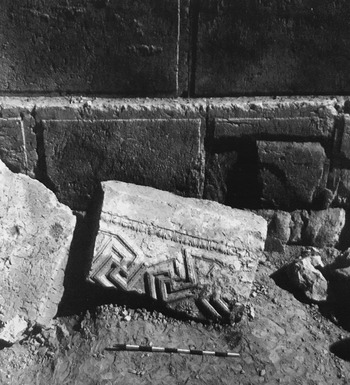
And as has become clear, there was plenty to see by way of glorious architecture and art on the Temple esplanade. Some of the architectural decoration has been uncovered in excavations in the area, and the shallow ornamental domes of the Double Gate vestibule of the Hulda Gates are likely Herodian in date, as Orit Peleg-Barkat has argued in a recent volume on the decorative architectural elements from the Temple Mount excavations.Footnote 65 Figure 2 shows one such fragment—a stunning curvilinear stone with a double meander and a rosette garnish. It may have come from the apse of the royal portico on the southern end of the Temple Mount.Footnote 66 Some five hundred other fragments, including capitals, cornices, architraves, doorframes, and soffits, have been studied by Peleg-Barkat.
Fragment of a decorative stone from the Jerusalem Temple complex of the Herodian period, as discovered fallen along the Southern Wall, east of the Triple Gate. Photo: The Temple Mount Excavations Photo Archive; courtesy of Eilat Mazar, Temple Mount Excavations Publication Project.

For details on the Temple's layout and design elements, we rely somewhat on Philo and later rabbinic teachings (see below), but primarily on two descriptions by Josephus—one in a lengthy excursus in Jewish War 5.184–237, the other in a shorter account from his writings on Herod in Jewish Antiquities 15.391–425. The two Temple descriptions touch on many of the same points, with a few noteworthy discrepancies.Footnote 67 Both fit into a larger pattern evidenced in Josephus's geographic descriptions, where the description of a place is told in the manner he himself experienced it, beginning usually with a panoramic viewpoint and then focusing in on memorable visual details.Footnote 68 As such both also fit nicely into the periegetic tradition, providing for his audience and readers a virtual tour of the Temple, if you will, recreating the sights and sounds of an actual visit. For Josephus's immediate audience in the late first century CE, of course, the virtual would have had to suffice.
In Jewish War, Josephus begins his tour with a comment on the topographic challenges of constructing a flat esplanade on a mountaintop (5.184–89). He then focuses in on the esplanade's surrounding porticoes, whose massive columns were a “striking spectacle” (5.191). “Proceeding across this [exterior plaza] towards the second court of the temple,” writes Josephus, “one found it surrounded by a stone balustrade” (5.193). This is his second stop, where he notes the warning signs on the balustrade announcing to non-Jewish visitors that entrance past this point was strictly forbidden (see above). His third stop is at the gilded gates surrounding the inner courtyard, including the particularly exquisite front gate, which was made of Corinthian bronze (5.201–2). The fourth is the sacred edifice itself, which was marked by an expansive gilded façade pierced by a large open portal. He gives a sense of what it was like to stand in front of the building and look through this portal to get a glimpse of the sanctuary façade within the portico, with its famous golden vine affixed above the doorway and its embroidered tapestry veil hanging before it and depicting a panoramic view of the heavens (5.208–14). For the fifth stop, Josephus moves into the building, and there writes about the Temple appurtenances, such as the lampstand and the showbread, while gesturing also to the “unapproachable, inviolable, invisible” room that is the holy of holies (5.219). No tour went there.
On a clear day the bright Mediterranean sun would have blinded those priests emerging into the Temple forecourt from the darkened chambers of the sanctuary. Had some of the exterior walls of the Temple been plated in gold, as Josephus has it, the glare may have been overwhelming. He seems reminded of that sensation at this point in the tour, just after he had visited the interior spaces of the Temple and just before he describes the altar out front, and writes that the building “radiated so fiery a flash that persons straining to look at it were compelled to avert their eyes, as from the solar rays” (5.222). This radiance of the Temple, he notes, was visible from far and wide. “To approaching strangers it appeared from a distance like a snow-clad mountain; for all that was not overlaid with gold was of purest white” (5.223). He then recreates for his audience the experience of looking up at the exterior walls of the Temple, squinting and straining the eyes at the onslaught of the sun, reaching the top with one's gaze and noticing a line of metal spikes garnishing the roofline. These, he notes, prevented birds from sitting on the Temple roof and defecating on the façade below (5.224). It is an indecorous aside, but one in keeping with the periegetic, where the author points out interesting visual details and offers explanations for them. Incorporated into this approach is a persistent interest in citing the dimensions for the architectural space Josephus describes in order to give a sense of the Temple's immense size—perhaps its most noteworthy feature. This data may derive from survey records of the Roman military.Footnote 69
In Antiquities, Josephus's description of the Temple is notably shorter than the War version, with fewer details on the layout and appearance of the Temple complex, and lacking the relentless citation of dimensions. It begins from above, with observations on the Temple as it would appear to someone viewing it from a nearby hilltop. From that vantage point he describes the complex's impressive stone masonry, its porticoes, and its central sanctuary towering above to such a height that it was visible “at a distance of many stades to those who inhabited the country, especially those who lived opposite or happened to approach it” (15.392–93). Josephus zooms directly into the hanging veil at the doorway into the sanctuary and the golden vine above it—the pièce de résistance of the decorative program of the Temple—“a marvel of size and artistry to all who saw with what costliness of material it had been constructed” (15.394–95). The virtual tour continues with his survey of the porticoes from atop the esplanade and then his descent down onto the streets below, where he examines the gigantic enclosure walls up close (15.399).Footnote 70 He notes the many spoils hung up on its walls, including those Herod had taken from Arabia and dedicated to God (15.402). Put on prominent display possibly at street level,Footnote 71 these spoils (usually weapons or trophies) would have helped communicate Herod's pious beneficence but would also have been curiosities for passersby.
It bears remembering that Josephus's milieu in Rome consisted of social and intellectual elites, including other easterners and Jews, with whom he likely shared portions of his works in oral form as part of his “publication” process.Footnote 72 These individuals were themselves participants in a cultural project of ethnographic inquiry, itself fed by travel and sightseeing. For those unable to travel to the subject areas of that inquiry, or in instances where sites described no longer existed, the vicarious experience was their best opportunity for engagement with the place. Of course, in Josephus's day, Jews living in Rome could find actual spoils and remains of the Jerusalem Temple on view at the newly built Temple of Peace; other remnants were kept in Vespasian's palace (War 7.160–62). Instead of traveling across the Mediterranean to see these holy objects, they could catch a glimpse in their own city.
Conversely, Palestinian Jews living in the wake of the Temple's destruction could now make pilgrimage in reverse in order to lay eyes on the cultic paraphernalia. In rabbinic lore, sages are said to have made the journey to Rome to do just that.Footnote 73 This too was a kind of sightseeing trip coupled with pilgrimage, but one tinged with grief, perhaps, over what was lost. Others visited places where miraculous events recounted in the Hebrew Bible were said to have occurred, or the burial spots of the prophets of Israel.Footnote 74 These pilgrimage sites of Jews in late antiquity were perhaps no match for the splendor of Jerusalem in its heyday, which would have been experienced by some of their ancestors. Some of that splendor comes through in the compendium of rabbinic teachings on the Temple complex that was codified in tractate Middot (measures), though its approach is prescriptive and scholastic rather than periegetic.Footnote 75 It is also referenced in the rabbinic use of the term reʾiyah, “seeing,” as shorthand for making pilgrimage with sacrifice in hand, as if looking at the Temple were the most important part of the journey.Footnote 76
Meanwhile, the sights and marvels of Jerusalem would be viewable to pilgrims on a large scale once again with the rise of the Holy Land as a center of Christian pilgrimage. Deriving from this period are the earliest extant travelogues to the city and the region, namely the sightseeing tours of the anonymous traveler from Bordeaux (333 CE), and of a Christian woman named Egeria from Iberia (380s CE).Footnote 77 The two extant versions of the Breviarius or Handbook on Jerusalem (ca. 500 CE) are the earliest true guidebooks on the city, pointing out important sites a visitor should see, though we may be better off viewing them as publicity materials distributed by shipping agents who profited from pilgrimage travel to the Holy Land.Footnote 78 The Madaba map (sixth century CE) is the earliest surviving diagrammatic representation of the city; a floor mosaic from a church in Jordan, it shows various biblical towns, including Jerusalem, and, among other things, maps the way to salvation.Footnote 79 These testimonies to a vibrant culture of pilgrimage and tourism in late antique Palestine were anticipated by periegetic accounts, travelogues, and visualizations of the spectacles that a trip to Jerusalem in the late Second Temple period offered.
* * * * *
The movement of ancient Jews to Jerusalem for the major pilgrimage festivals, of which Passover was the most prominent, was a significant component in an expanding world of special-purpose travel in the Roman Mediterranean and Near East. The descriptions of the Jerusalem Temple in the Letter of Aristeas, Philo, and Josephus all seem dependent in some way on works of Greek-style periegesis, where the narrator walks through a space and describes it. In the periegetic texts on the Jerusalem Temple, there is an emotional dimension to the visit—a sense of wonder and amazement at the magnificent displays of piety and wealth in the city. The most elaborate of them, by Josephus, caters to a taste for travel in Flavian Rome. Jerusalem's Temple in the late Second Temple era may have been bustling with commercial, municipal, and judicial activity befitting a Roman forum, but as a marvel of construction and craft it offered spectacles to behold. Those spectacles were likely not limited to architecture. Jewish festivals in the city may have incorporated elements characteristic of the Greco-Roman festival, such as musical performances and plays staged in a theater. Ezekiel's tragedy Exagoge could have been performed on the Jerusalem stage. Herod's introduction of games in honor of Augustus in 28 BCE may have contributed broadly to festival culture in the city.
The visual stimuli within this sacred environment could have heightened the emotional response for the pilgrim or visitor. The capacity for wonder can drive the religious impulse, cultivating a sense of something “more”—the belief in an unseen order beyond the profane and the everyday.Footnote 80 It is but one of a plethora of emotions that can shape one's encounter with holy space.Footnote 81 As the Temple in Jerusalem grew in splendor, so did its potential to elicit such an emotional response, and to attract visitors from afar.
A focus on the thrill of experiencing Jerusalem and its Temple firsthand, as a tourist or as a pilgrim, can help counter the cynical or lachrymose view of the Temple in much of the primary source material on the first century CE, with a priesthood that was seen in the eyes of many as far too corruptible and a fiscal arm as too inclined towards profiteering.Footnote 82 Scenes of crowded masses of war-torn and starving Judeans taking refuge within the walls of its temenos in the final stages of a failed revolt (e.g., War 6.283–84) can further color one's image of the place, as can the central role of the site in a seemingly intractable debate on the spatial politics of modern Jerusalem. It bears remembering that prior to its knotted posthistory, and quite separate from the problems that plagued it in the Herodian period, the Temple was at the center of a tourist experience that must have been a source of wonder to Jews and non-Jews alike.