Implications
Adaptation of laying hens to chronic heat stress is essential to maintaining animal welfare and productivity in the context of global warming. Our study shows that the surface temperatures of the shank and comb, measured in this study by infrared thermography, are under genetic control. They therefore constitute potential selection criteria that could be used to improve the capacity of laying hens to dissipate heat in the intent to improve hen’s adaptation to high environmental temperatures.
Introduction
World egg production increased by 81% over the last two decades, mainly in tropical and sub-tropical areas, with South, East and South-East Asia now representing 57% of world production (http://faostat3.fao.org). This flourishing industry is nevertheless expected to be affected by climate change, especially due to heat stress-related problems. The fifth IPCC (Intergovernmental Panel on Climate Change) report published in April, 2014 confirmed the previously reported global warming phenomenon and foresaw an acceleration of the consequences of climate change.
Chickens are particularly sensitive to high ambient temperatures because their heat loss is limited by the insulating property of feathers and the absence of sweat glands. Chronic heat stress induces a reorientation of physiological processes towards survival (Mount, Reference Mount1974; Etches et al., Reference Etches, John and Gibbins2008) and away from production and quality traits (Mashaly et al., Reference Mashaly, Hendricks, Kalama, Gehad, Abbas and Patterson2004; Franco-Jimenez et al., Reference Franco-Jimenez, Scheideler, Kittok, Brown-Brandl, Robeson, Taira and Beck2007; Etches et al., Reference Etches, John and Gibbins2008). The increasing concern about production losses due to high ambient temperatures affects not only tropical and subtropical regions but also temperate countries where heat waves during summer months are becoming more frequent (Saint-Pierre et al., Reference Saint-Pierre, Cobanov and Schnitkey2003; COPA/COGECA report, 2004). Furthermore, massive mortality increases public concern and questions the sustainability of intensive poultry husbandry from an ethical standpoint. It is therefore crucial to improve the hen’s capacity to adapt to heat stress.
The world poultry industry relies on a few major breeding companies that are all located in temperate countries. They provide high performing chickens selected under optimal climatic conditions but not well adapted to high temperatures. To make effective progress, it appears important to include resistance to high temperatures among primary selection objectives, for example by selecting layers for an improved thermoregulation system. One key factor in thermoregulation is the capacity to dissipate heat. In chickens due to the thick insulation coat of feathers on most of the body surface, heat loss happens largely through featherless areas where heat dissipation is most efficient. There is a large body of literature showing that the surface temperature of featherless areas is a valuable parameter that varies with environmental changes and that can be used to evaluate the comfort or thermal stress in chickens (Richards, Reference Richards1971; Giloh et al., Reference Giloh, Shinder and Yahav2012). In birds under heat stress, heat is dissipated through sensible heat loss (by radiation, conduction and convection) and by respiratory–evaporative mechanisms (Seymour, Reference Seymour1972; Marder and Arad, Reference Marder and Arad1989). At temperatures around 30°C, the proportions of heat lost through the two mechanisms are equal (Anderson and Carter, Reference Anderson and Carter1993). Conduction and convection mechanisms depend on the ambient temperature surrounding the animal, and heat loss occurs by direct contact and by movement of the air around the animal. On the other hand, radiation represents heat flow from the surface of the body to the surrounding air, mainly occurring through infrared emissions.
Infrared thermography has in recent years become a valuable tool in veterinary and animal sciences to measure infrared body radiation to detect fluctuations in body surface temperature (Stewart et al., Reference Stewart, Webster, Schaefer, Cook and Scott2005; McCafferty, Reference Mac Cafferty2007; Ferreira et al., Reference Ferreira, Francisco, Belloni, Aguirre, Caldara, Nääs, Garcia, Almeida Paz and Polycarpo2011). The advantage of this technique is that it is non-invasive and of remote assessment, and can measure body surface temperature with minimal manipulation of birds that can bias measurements.
The aim of this study was to investigate whether surface temperature, element of the radiative heat loss, could be used as a selection criterion for adaptation to heat stress in laying hens. This implied to measure surface temperature by infrared thermography and to evaluate its genetic basis through an estimation of its heritability. We also calculated genetic correlations between body surface temperature and feathering or egg quality traits. Body surface temperature was measured on the wing, a feathered area normally not involved in the heat dissipation process, and on the shank and the comb, which are the main featherless areas involved in heat loss in chickens.
Material and methods
All animal care and experimental procedures were approved under No. 2012-05-10 by the Ethics Committee for Animal Experimentation of Val de Loire, registered by the National Committee under No. C2EA-19.
Animal and rearing conditions
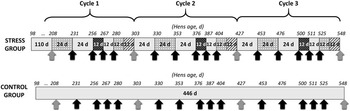
Hens were from a commercial line of brown laying hens, involved in a project aiming at finding strategies of selection to adapt birds to difficult and variable conditions. This conditions included floor rearing to face up to the increasing proportion of laying hens reared on floor, alternative diets to limit soya bean incorporation and high temperatures. They were hatched in November 2011 from 42 sires and 345 dams and reared on the floor until 14 weeks of age. They were then transferred to the henhouse for adult layers and randomly distributed between 6 pens of 200 birds each. Two pens (one in control condition, one in heat stress condition) were equipped with individual trap nests and the other pens had Vencomatic group nests. From 35 to 75 weeks of age, half of the birds were submitted to three cycles of environmental changes, separated by recovery periods during which birds were returned to control conditions. Each cycle was successively composed of 24 days in control conditions, 24 days of diet change, 24 days of recovery period, 12 days of increased temperature, 12 days of recovery, 24 days of combined diet change and increased temperature (12 days with only the diet change followed by 12 days with diet change and increased temperature). The other half of the birds remained under control conditions throughout the experiment. Figure 1 summarizes the complete experimental scheme. The main difference between the control and the alternative diets was the replacement of one third of soybean meal by rapeseed meal, thus providing to a slightly reduced CP content (16.00% v. 17.25%). Ambient temperature and relative air humidity in the pens were on average 28.4°C and 46.9% during heat stress periods, respectively, and 19.6°C and 68.8% during thermo-neutral and control periods.
Experimental design of the three cycles of environmental changes (control condition in grey, diet change (cross-hatched areas), high temperature (dotted areas), combined diet change and high temperature (diagonal hatched areas)). Black arrows indicate the hens’ age when surface temperature and egg quality measures were taken. Grey arrows indicate the hens’ age when surface temperature, feather score and egg quality measures were taken.

Measures
Surface temperature
Infrared thermographic pictures of birds were taken at 28 weeks and at the end of each diet, heat stress and combined diet and heat stress period. Measures were taken in the morning when the lights were turned on. All birds from individual nest pens were measured each time. A sample of 50 birds from each collective nest pen was measured at each period. Mean temperatures were estimated from 9355 infrared wing, comb and shank images taken from 1115 hens. An infrared thermographic camera (FLIR B335; FLIR Systems Inc., Wilsonville, OR, USA) was used, providing a thermal sensitivity of 0.05°C and accuracy of 2°C. Each bird was placed sideways in an open wooden box which was at the same temperature as the pen. Depending on the quality of the images, we obtained one (full body picture) to three images (focussed on wing, comb and shank) per bird. Temperature and humidity of each pen were recorded before obtaining images and entered as parameters in the image analysis software (ThermaCam Pro 2.10© 1997–2010; FLIR Systems, AB, Sweden). Limits of wing, shank and comb areas were drawn manually. Shank area was drawn from hock joint and included toes. Wing area included wing shoulder, bow, bar, primaries and secondaries. Comb area included all parts of the comb from base, points to blade. The mean shank, comb and wing temperature and standard deviations of the temperature of all pixels in each zone were extracted from the software. The emissivity of featherless areas (comb and shank) was set at 0.980, which is the reference value provided by the software for bare skin. For the feathered wing area, we measured surface temperature with a contact thermometer, taken simultaneously with a thermographic image on a sample of 20 birds, and adjusted emissivity value to obtain the closest possible values between the two temperatures. Emissivity was thus set at 0.896 for the wing area.
Egg quality
Egg quality was recorded on two to three eggs per hen in individual pens and on 30 random eggs in collective pens during the last 3 days of each period. Egg width (EWi) was measured with a digital caliper. Eggs and yolks were weighed (EW, YW). Shells were washed and dried at 75°C for 12 h before being weighed (SW). Albumen weight (AW) was calculated as (EW−SW−YW). Yolk, shell and albumen proportions were noted YP, SP and AP, respectively. The egg shape index (ESI) was calculated as in (1):
 $${\rm ESI}\,{\equals}\,100{\times}\left( {{{\rm EWi} \over {{\rm EW}}}} \right)^{{{1 \over 3}}} $$
Shell and yolk colour (L_S and L_Y for luminance, a_S and a_Y for redness index, b_S and b_Y for yellowness index) were measured using a Miniscan Spectrocolorimeter by the CIELAB system. A synthetic colour index (LAB_S, LAB_Y) was then calculated as in (2) and (3):
 $$LAB\_S\,{\equals}\,L\_S\,{\minus}\,a\_S\,{\minus}\,b\_S$$
 $$LAB\_Y\,{\equals}\,L\_Y\,{\minus}\,a\_Y\,{\minus}\,b\_Y$$
The presence of meat and/or blood spots and cracked shells was recorded. The shell breaking strength (EBS) and mechanical stiffness (ESS) were measured by quasi-static compression using an Instron (UK527 High Wycombe, UK) fitted with a 50N load capture at a compression speed of 5 mm/min and at 1 mm/min for stiffness measurements. Shell breaking strength was measured as the maximum force (N) required to fracture the egg. Stiffness was calculated as the mean value for three linear slopes of the force deformation curves resulting from the applied load of 10N on three points on the equator of each egg (about 120° from each other). Albumen height (AH) was measured with a micrometer and the Haugh unit (HU) was estimated as in (4):
 $${HU\,{\equals}\,100}{\times}{\rm log(}AH\,{\minus}\,1.7{\times}EW^{{0.37}} {\rm {\plus}7}{\rm .57)}$$
Feather quality
During the laying period, feather quality was scored on the neck, back and belly at 28 weeks of age and at the end of each period of combined diet and temperature changes. The total number of feather score data was 1033 at thermo-neutrality and 717 at high temperature. A three-point scale (from 0 for a good plumage to 2 for poor plumage) was used for the neck, back and belly zones, as described in the Welfare Quality Assessment Protocol for Poultry (2009).
Genetic analysis
A preliminary analysis of variance was performed to select the fixed effects to be included in the model, using the GLM procedure of SAS (2012). Using the results of this first step, genetic analyses were performed with model (5) for comb surface temperature, model (6) for wing and shank temperature and model (7) for egg quality traits and feathering:
 $$y_{{ijklm}} \,{\equals}\,\mu {\plus}C_{i} {\plus}TG_{j} {\plus}N_{k} {\plus}NP_{l} {\plus}A_{m} {\plus}e_{{ijklm}} $$
 $$y_{{ijlm}} \,{\equals}\,\mu {\plus}C_{i} {\plus}TG_{j} {\plus}NP_{l} {\plus}A_{m} {\plus}e_{{ijlm}} $$
 $$y_{{ijm}} \,{\equals}\,\mu {\plus}C_{i} {\plus}TG_{j} {\plus}A_{m} {\plus}e_{{ijm}} $$
where y ij(k)(l)m is the performance of animal m, µ the general mean, C i the fixed effect of cycle i (i=1 for start of egg-laying on 28 to 43-week-old hens, 2 for the middle of egg-laying on 43 to 61-week-old hens, 3 for end of egg-laying on 61 to 78-week-old hens), TGj the fixed effect of the jth combination of group (control or with environmental changes) and temperature period (j=control or hot), N k the fixed effect of pen type (collective or individual nests), NP l the fixed effect of number of images (l=1 or >1), A m the random additive genetic effect of animal m, and e ij(k)(l)m the random residual effect pertaining to animal m. The pedigree file included 1502 animals (1115 hens with data and their 387 parents).
Traits recorded under thermo-neutral and hot conditions were analysed as separate traits in multivariate analyses to estimate the genetic correlations between both traits.
VCE6 software (Neumaier and Groeneveld, Reference Neumaier and Groeneveld1998; Groeneveld et al., Reference Groeneveld, Kovac and Mielenz2010) was used for the genetic analyses. As not all traits could be included in a single analysis, a series of 76 analyses was run. Each analysis included four traits, that is, one temperature trait and one egg quality or feathering trait at hot and thermo-neutral conditions, in order to test each combination of traits at least once. When the same parameter appeared in different analyses, the results presented below are the average of estimated genetic parameters and the average of the standard errors.
Results
Elementary statistics
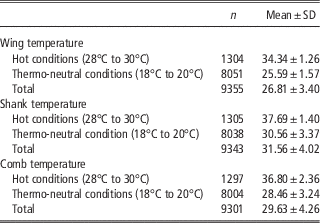
Body surface temperature was 7.1°C to 8.7°C higher during hot periods than at thermo-neutrality (Table 1). This increase under heat stress is close to the 8.8°C difference observed for the ambient temperature between hot and thermo-neutral conditions. During heat stress, body temperature was also more homogeneous than at thermo-neutrality, as shown by the reduction in standard deviation of the surface temperature, especially in heat dissipation zones (−58.5%, −27.2% and −19.7% for shank, comb and wing temperature, respectively).
Elementary statistics on body surface temperature per temperature condition

Elementary statistics for egg quality and feathering are presented in Supplementary Table 1. The shell was the egg component that was most affected by heat stress, with deterioration of its weight, colour and solidity under heat stress. The frequency of egg defects (meat and blood spots, cracked vitelline membrane) was also higher under heat stress. Finally, the average feathering on the belly tended to worsen under heat stress (P=0.07). This non-significant tendency could be expected from the very high coefficient of variation of this trait (i.e. between 232% and 283%).
Heritability estimates
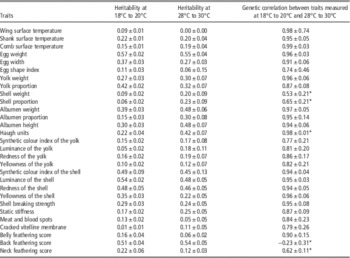
The heritability estimates of temperature and egg quality traits estimated at thermo-neutrality and high ambient temperature are presented in Table 2. Heritability estimates for wing temperature were low, and significantly higher than 0 only at thermo-neutral temperature (0.09±0.01). Heritability estimates were low to moderate, but significantly different from zero for shank and comb temperatures. They were on average 0.04 points higher for shank temperature than for comb temperature.
Heritability estimates for body surface temperatures, egg quality and feathering and genetic correlations between traits measured at thermo-neutrality and during heat stress

*Values significantly different from 1 (P<0.05).
Heritability estimates for egg quality parameters are also presented in Table 2. Heritability estimates were 0.02 to 0.13 higher under thermo-neutrality than at high temperatures for egg weight, yolk proportion, shell breaking strength, luminance and yellowness of the shell. Heritability under heat stress for shell and albumen proportions, albumen height and Haugh units was 0.15 to 0.20 higher than under thermo-neutrality.
Belly, back and neck feathering heritability estimates are also presented in Table 2. Back feathering was highly heritable whatever the temperature condition (0.51 to 0.54). Neck and belly feathering were less heritable (0.06 to 0.22) and heritability was 0.10 higher at thermo-neutrality.
Genetic correlations between wing, shank and comb temperature
Shank and comb temperatures were positively correlated in both conditions, with estimates ranging from 0.42±0.07 at thermo-neutrality to 0.70±0.12 at high temperature. Wing temperature was poorly and negatively correlated to shank and comb temperatures, the values being greater at thermo-neutrality (−0.30±0.16 with shank, −0.37±0.14 with comb) than at high temperature where they were not significant (−0.14±0.12 with shank, −0.13±0.12 with comb).
Genetic correlations between thermo-neutral and hot conditions
The genetic correlations between thermo-neutrality and hot conditions for all thermography results, feather scores and egg quality traits are summarized in Table 2. Except for shell weight, shell proportion and back and neck feathering scores, correlations were all high (between 0.74 and 0.99). The genetic correlations were significantly lower than 1 for shell weight, shell proportion, Haugh units, neck and back feathering. For the latter, the correlation was not significantly different from zero.
Genetic correlations between body temperature and egg quality traits and feathering
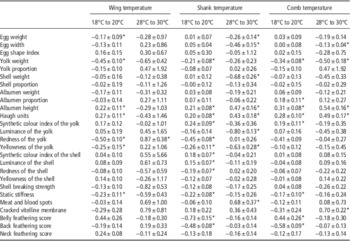
Genetic correlations between body temperature and egg quality and feathering are presented in Table 3. The genetic correlations between body temperatures and the other traits were generally low (<0.40), and the highest correlations were found with shank temperature under heat stress exposure (28°C to 30°C). We found an association between yolk colour and shank temperature: a higher shank temperature was associated with reduced luminance and yellowness of the yolk under heat stress, and with reduced redness of the yolk at thermo-neutrality. The profile of correlation between comb temperature and yolk colour was the same, but with lower and non-significant correlations. Similarly, shell and egg weight were negatively correlated with shank temperature at 28°C to 30°C, but not at 18°C to 20°C. Finally, the presence of egg defects was correlated with body temperature only when hens were under heat stress. It was found that an increase in shank temperature was associated with higher scores for meat and blood spots (i.e. more frequent or larger spots). An increase in comb temperature was associated with more cracked vitelline membranes.
Genetic correlations between surface temperatures and egg and feathering traits

*Values significantly different from 0 (P<0.05).
In contrast to the above traits, belly and back feathering were associated with shank and comb temperature only at thermo-neutrality, better plumage quality being associated with higher body temperatures.
Discussion
Heritability estimates
Body temperature
This study is the first attempt to our knowledge to estimate the heritability of body temperature measured by infrared thermography in poultry. Infrared thermal imaging has undergone major development during the past decade for application to biological research into thermal physiology in mammals (Klir and Heath, Reference Klir and Heath1992) and chickens (Nääs et al., Reference Nääs, Romanini, Neves, Nascimento and Vercellino2010; Ferreira et al., Reference Ferreira, Francisco, Belloni, Aguirre, Caldara, Nääs, Garcia, Almeida Paz and Polycarpo2011). Using infrared thermography, Yahav and Giloh (Reference Yahav and Giloh2012) demonstrated that the main skin zones of heat dissipation were the head (including comb and barbs), the shank and, to a lesser extent, the wing. In our experiment, heritability estimates of wing surface temperature were close to zero. These low values were expected because of the property of contour feathers located on wings to isolate the skin (Kock, Reference Kock2006). This makes the wing temperature mainly dependent on the environment, the temperature measured corresponding essentially to the radiation of environmental heat on feathers. Moreover, because of deterioration of the wing feather coverage over time, the wing surface temperature resulted from the mixed effects of feather and featherless areas, thus making it an unsuitable trait for selection on heat dissipation.
The heritability of shank and comb surface temperatures was low to moderate in both conditions. These estimates indicated that part of the phenotypic variance measured for comb and shank surface temperatures is the result of genetic factors. Featherless skin areas have an important role in the temperature regulation of birds (Wolfenson et al., Reference Wolfenson, Frei, Snapir and Berman1981). Yahav (Reference Yahav2009) demonstrated that birds with better heat dissipation capacities were those which exhibited the greatest peripheral vasodilatation under heat stress (35°C). This supports the hypothesis that genetic variation in the ability to dissipate heat exists between birds, as shown by the heritability values obtained in this study for comb and shank surface temperatures. Of the three body areas analysed, the shank surface temperature may be a reliable trait for introduction of heat dissipation ability in selection programmes. The heritability values obtained in this study for body surface temperatures are consistent with the previous estimates of 0.06 to 0.19 for internal body temperature (Tixier-Boichard et al., Reference Tixier-Boichard, Boichard, Groeneveld and Bordas1995; Loyau et al., Reference Loyau, Berri, Bedrani, Métayer-Coustard, Praud, Duclos, Tesseraud, Rideau, Everaert, Yahav, Mignon-Grasteau and Collin2013) in broilers and adult layers and with those obtained for comb surface temperature in broilers (0.12 at thermo-neutrality and 0.33 in hot conditions, Loyau et al., Reference Loyau, Berri, Bedrani, Métayer-Coustard, Praud, Duclos, Tesseraud, Rideau, Everaert, Yahav, Mignon-Grasteau and Collin2013). Tixier-Boichard et al. (Reference Tixier-Boichard, Boichard, Groeneveld and Bordas1995) found much higher heritability of internal temperature in adult males than in females (0.49±0.03 v. 0.19±0.02), which suggests that measurement of temperature in adult females can be affected by daily variations due to the ovulatory cycle. Indeed, the laying cycle of the hen has an important role in the maintenance of circadian rhythms of body temperature, with an increase in body temperature at the time of prelaying behaviour and oviposition (Kadono et al., Reference Kadono, Besch and Usami1981). In this study, temperature measurements were mostly performed during the morning, after oviposition, but a substantial proportion of hens laid eggs after the measurement time, which may have increased variance in the temperatures recorded. Another possible source of variability in the measurement of comb surface temperature was the surface and the shape of the comb, which is highly variable between birds. This may result in differences in birds’ capacity to dissipate heat through this body part which was not accounted for in this study. The genetic correlations between shank and comb surface temperature were moderately positive, indicating that their genetic control is not entirely the same, even if they both contribute to heat dissipation.
Egg quality traits
One interesting result of this study was that heritability estimates for several egg quality traits were not the same under different ambient temperatures, indicating the existence of genotype–environmental interactions. This could be expected in view of the polygenic nature of the traits analysed that are affected by many genes with small independent allelic contributions. This may lead to different trait values when measured under different environmental conditions (Falconer and Mackay, Reference Falconer and Mackay1996), as the result of a change in the expression of genetic variance. The low cross-environment genetic correlation values obtained for shell weight and shell proportion may thus reflect the fact that different genes control these characteristics in each environment. This means that the same trait measured in two different environments might correspond to two independent traits for which the response to selection is not the same. Low cross-environment genetic correlation values were also obtained for feathering traits. The results for back feathering damage were particularly surprising, with heritability estimates greater than previously reported for feather pecking in young adult laying hens (Rodenburg et al., Reference Rodenburg, Buitenhuis, Ask, Uitdehaag, Koene, van der Poel and Bovenhuis2003; Bennewitz et al., Reference Bennewitz, Bögelein, Stratz, Rodehutscord, Piepho, Kjaer and Bessei2014). However, our estimates were closer to those obtained at older ages (Kjaer and Sørensen, Reference Kjaer and Sørensen1997), indicating that there is an age effect in the heritability estimation for this trait. The negative genetic correlation obtained for this trait is hard to understand, unless it is assumed that there is a certain degree of antagonism between traits for which we do not have a physiological or behavioural explanation.
Plumage condition
The genetic correlation obtained for the neck feathering scores between control and high temperatures was not significantly different from zero, which could suggest completely independent genetic control of neck feathering at thermo-neutrality and at high temperatures. We did not observe any difference between neck feathering scores under heat stress and at thermo-neutrality. Our hypothesis is that this absence of difference results from two opposite processes. Heat stress is associated with poorer plumage conditions, as shown by data on belly and back zones. In contrast, the abrasion of neck feathers in individual nest groups may have been due to friction with the edge of the trap-nest lid, while trapped in the nest. De Haas et al. (Reference De Haas, Bolhuis, de Jong, Kemp, Janczak and Rodenburg2014) showed that neck damage, which is common on commercial farms, is often linked to abrasion. If we consider that the laying rate was greatly reduced by heat stress (data not shown) it might be assumed that the degree of abrasion was less in stressed than in unstressed birds due to a reduced number of nest visits by stressed hens. Moreover, a high production rate has been shown to be associated to molting of neck feathers (de Haas et al., Reference De Haas, Bolhuis, de Jong, Kemp, Janczak and Rodenburg2014).
Genetic correlations between surface temperature and other traits
Except for the correlation between belly feathering and comb temperature at 18°C to 20°C, correlations between feathering scores and shank or comb temperatures were negative, which means that when the feather condition was poor (higher value), with large featherless areas, surface temperatures in the heat dissipation zones were lower. These correlations were much higher at thermo-neutrality than under heat stress, where they were not significantly different from zero. Indeed, hens with a poor feather condition at thermo-neutrality underwent intense heat loss through featherless areas that determined a significant reduction in body temperature. In contrast, under heat stress, the body temperature of the animal was increased and all the dissipation zones have to eliminate as much heat as possible whatever the plumage condition, which would explain the absence of correlation between plumage condition and surface temperatures under heat stress.
At thermo-neutrality, no correlation was observed between egg and shell weight on the one hand and shank and comb temperatures on the other hand. They were instead negatively correlated under heat stress. It has been reported that heat stress generally leads to smaller eggs due to a number of physiological processes including lower blood flow through the ovarian follicles and shell glands (Wolfenson et al., Reference Wolfenson, Frei, Snapir and Berman1981). This effect on the egg shell could be due to respiratory alkalosis, a decrease in total and ionized blood calcium concentration and reduced activity of carbonic anhydrase in the shell gland and kidney (Sauveur and Picard, Reference Sauveur and Picard1987). Moreover, the negative correlation between luminance or yellowness of the yolk and shank temperature at high temperature could be due to lower feed intake and thus intake of carotenoids, which has been shown to be the first trait affected by chronic heat stress in laying hens (Mignon-Grasteau et al., Reference Mignon-Grasteau, Moreri, Narcy, Rousseau, Rodenburg, Tixier-Boichard and Zerjal2015).
Based on these results one hypothesis could be that higher shank temperature would be found in birds suffering from more severely from heat stress and not in birds with a better ability to dissipate heat. The lack of individual feed consumption and laying rata data makes, however, this affirmation difficult to prove and further studies will be required.
Haugh units and albumen height were positively correlated with shank and comb temperatures, especially under heat stress. These results should, however, be taken with caution as a recent meta-analysis of effects of chronic heat stress in laying hens highlighted that the results in the literature for these traits were highly variable and that the effects of temperature on Haugh units and on albumen height were not significant (Mignon-Grasteau et al., Reference Mignon-Grasteau, Moreri, Narcy, Rousseau, Rodenburg, Tixier-Boichard and Zerjal2015).
Conclusions
In birds under heat stress, heat dissipation through sensible heat loss and respiratory–evaporative mechanisms are enhanced in an effort to reduce internal body temperature. Understanding how the capacity to dissipate heat varies between birds and the relationship between body temperature and production and quality traits is particularly important in the light of genetic improvement of chickens for production in high environmental rearing conditions. Non-invasive and automated, infrared thermography is becoming a routine method of measurement of body temperature, especially in mammals. It has been used in birds since the beginning of the 2000s but our study is the first to propose an estimation of genetic parameters of surface temperature using infrared thermography, and of its potential use in selection. Our results show that body surface temperature recorded by thermography is a reliable method to measure sensible heat loss, and that this is partly under genetic control. According to its heritability and its genetic correlations with egg quality and feathering traits, the shank temperature is the most interesting trait for selection. It is also the easiest measurement to standardize and automate on the farm to obtain reliable temperature recording in a large number of animals.
Acknowledgements
The authors are very grateful to Francis Minvielle for providing comments on the manuscript.
Supplementary material
To view supplementary material for this article, please visit http://dx.doi.org/10.1017/S1751731116000616