Introduction
The size of an organism is an important criterion for key ecological processes, and changes in size distributions are affected by many factors including environment, genetic variability in life-history characteristics, predator–prey relationships and competitive interactions (Shin et al., Reference Shin, Rochet, Jennings, Field and Gislason2005). Information on size at maturity is a basic requirement for an ecological management approach to exploited fisheries and also helps in decision making on the mean size of fish stocks when it is associated with other life-history information (Agostinho, Reference Agostinho1985). Size at first maturity is defined as the size at which 50% of individuals attain gonadal maturity (Vazzoler, Reference Vazzoler1996). Environmental parameters like temperature, depth and pressure influence the development of deep-sea organisms (Cartes, Reference Cartes1994, Reference Cartes1998). Moreover, size at first sexual maturity in fish is also influenced by genetic, physiological and environmental factors (Nikolskii, Reference Nikolskii1969). A perfect classification of the state of maturity of fish gonad stages by direct observation is difficult (Forberg, Reference Forberg1983), hitherto direct observation of fish gonad stages helps to identify the fish as adult or juvenile. Studies of length at maturity of deep-sea fishes from the Indian region are scarce; very few studies have been reported from the south-west coast of India (Beni et al., Reference Beni, Ganga and Sobhana2017).
Studies on life-history traits of deep-sea demersal fish species are very rare for Indian waters especially from the Andaman and Nicobar Islands. Most of the studies of the biology of the deep-sea fishes are restricted to the south-west coast of India – catch and biology of Alepocephalus bicolor (Deepu et al., Reference Deepu, Haridas and Kurup2007), biology of deep-sea eel Gavialiceps taeniola (Divya et al., Reference Divya, Hashim and Jayaprakash2007) and length-weight relationship of deep-sea fishes (Thomas et al., Reference Thomas, Venu and Kurup2003; Jayaprakash et al., Reference Jayaprakash, Kurup, Sreedhar, Venu, Thankappan, Manjebrayakath, Pachu, Thampy and Sudhakar2006; Sreedhar et al., Reference Sreedhar, Sudhakar and Meenakumari2013).
Recently, the length-weight relationships of six deep-sea fish species from the shelf regions of western Bay of Bengal and Andaman waters were reported (Aneesh Kumar et al., Reference Aneesh Kumar, Thomy, Deepa, Hashim and Sudhakar2016). The deep sea is very different from the pelagic ocean, as it requires longer periods of atmospheric phenomena to influence the deep, hence it is referred to as ‘seasonless’ (Adams et al., Reference Adams, McGillicuddy, Zamudio, Thurnherr, Liang, Rouxel, German and Mullineaux2011). Most of the species living in the ocean bottom are long-lived; the technical difficulties of undertaking frequent sampling is a major hurdle to making estimations, therefore, we have used available sampling to study deep-sea fishes. The present study provides information on length at maturity and length-weight relationships of five deep-sea demersal finfishes of the Andaman and Nicobar Islands of India.
Materials and methods
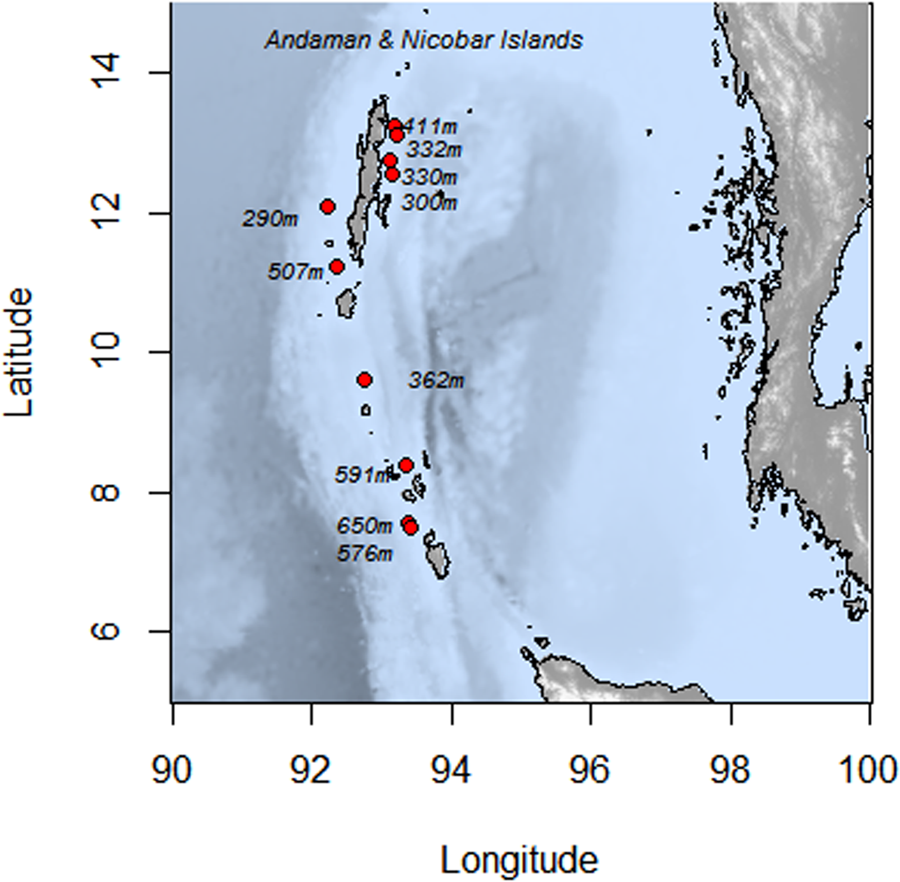
The study area is the deep waters of the Andaman and Nicobar Islands (Figure 1). The Andaman and Nicobar Islands are a group of islands at the junction of the Bay of Bengal and the Andaman Sea and comprise 572 islands. The Andaman and Nicobar Islands are a geographically differentiated zone of the continental Indian coastline. They are located about 150 km north of the Aceh province of Indonesia and separated from Thailand and Myanmar by the Andaman Sea waters. The east Andaman Islands lie in the Andaman Sea and the western islands lie in the Bay of Bengal.
Study area and sampling stations of the fishery survey cruise 349 in the Andaman and Nicobar Islands (Indian EEZ), North-eastern Indian Ocean.

For bottom trawl operations, we used a High-Speed Demersal Trawl – Crustacean Version (HSDT II – CIFT) with a modification known as Crustacean Version (CV). The HSDT II CV has 2-warp twin-otters, a bottom trawling net with a total length of 58.6 m, head rope length of 38 m, foot-rope of 44.5 m and a cod-end with a stretch mesh size of 30 mm, gradually increasing to 130 mm in the front trawl sections.
The survey was carried out in the 10 deep-sea stations in the Andaman and Nicobar region. Material for the present study was collected onboard FORV ‘Sagar Sampada’ (Cruise no. 349), during exclusive fishery cruises (March–April 2016) from the deep waters of Andaman and Nicobar Islands, Indian EEZ (Figure 1). The survey covered the area between 7.33.990°N–13.15.320°N 92.19.580°E–93.22.190°E at depths ranging from 296 to 650 m. The duration of each haul was about one hour with vessel speed kept at 2.30–3.50 knots. All fishes were identified to species level in the laboratory using standard keys (Goode & Bean, Reference Goode and Bean1895; Alcock, Reference Alcock1899; Fischer & Bianchi, Reference Fischer and Bianchi1984; Smith & Heemstra, Reference Smith and Heemstra1986; Froese & Pauly, Reference Froese and Pauly2017).
Length-weight relationship analysis
Specimens were sorted by sex, the length was measured to the nearest 1 mm (total length, TL) using digital callipers and weighed to the nearest 0.1 g (weight, W). The relationship equation W = aLb (Le Cren, Reference Le Cren1951; Ricker, Reference Ricker1973) was used, where W is body weight (g), L is the total length (cm), to express the length-weight relationship of a fish with a constant and b slope parameters (Beverton & Holt, Reference Beverton and Holt1957). Length-weight relationships were established using ordinary least squares regression method (Sokal & Rohlf, Reference Sokal and Rohlf1981; Zar, Reference Zar1999) after transforming the length and weight to logarithms using log W as the dependent variable and log L as the independent variable, following the equation:
 $${\rm Log}\,{\rm W} = {\rm Log\ }a + b\,{\rm Log}\,{\rm TL}$$
Whether the growth of each species was isometric or allometric was tested, using Bailey's t-test; if t significantly deviated from 3 growth is allometric, otherwise it is isometric (Bailey, Reference Bailey2007).
Length at maturity was estimated, and the maturity stages quantified as I, II, III, IV, V, VI by visual examination. The maturity stage for each sex was identified following reproduction studies on marine teleosts from Indian waters (Qasim, Reference Qasim1973). Stages I virgin and II mature in pause were considered as juvenile stages for any length. Since the study was carried out in spring some individuals of species could have started ovary maturation and presented advanced stages which are as considered as maturity in progress.
We recorded size (length), sex and juveniles were recorded as ‘0’ and adults as ‘1’. The estimates of the parameters of the logistic regression model for the sample and the plot of the observed proportions and the fitted sigmoid curve were calculated. From the fitted model, the estimates of L50/L90 (abscissa corresponding to the 50/90% point on the y-axis) were calculated (Mollet et al., Reference Mollet, Cliff, Pratt and Stevens2000; Neer & Cailliet, Reference Neer and Cailliet2001).
The logistic regression model fits a sigmoid curve to the proportion of mature fish by length.
The model is,  $p(x)={e^{b_0+b_1x} / (1+e^{(b_0+b_1x)})}$ where, p(x) is the probability that a fish is mature at a given length x. The parameters in the model b 0 and b 1 determine the shape and location of the sigmoid curve. Once estimates of the parameters of the model are available, the length corresponding to any required proportion (size of the animal for which a given percentage of the animals will be mature) are worked out using the expression (except for 0 and 100%):
 $x=({\ln(p|(1-p))-\hat{b}_{0}) / \hat{b}_1}$ where and are the estimates of the parameters in the logistic regression model. These parameters were estimated using the method of maximum likelihood. All the statistical analyses were performed using R (R Core Team, 2019).
Results
Across all of the samples taken a total of 98 fish species were identified. However, based on the availability of sufficient samples we selected five species belonging to five families for detailed analysis. There were 416 specimens belonging to Alepocephalus bicolor (Alcock 1891), Bathyclupea hoskynii (Alcock 1891) Chlorophthalmus corniger (Alcock 1894), Neoepinnula orientalis (Gilchrist & von Bonde, 1924) and Neoscopelus microchir (Matsubara 1943). The species with numbers and depth of capture are listed in Table 1.
List of species selected for estimation of size at first sexual maturity (L50) and length-weight relationship from demersal fish survey of Andaman and Nicobar Islands of Indian EEZ, North-eastern Indian Ocean

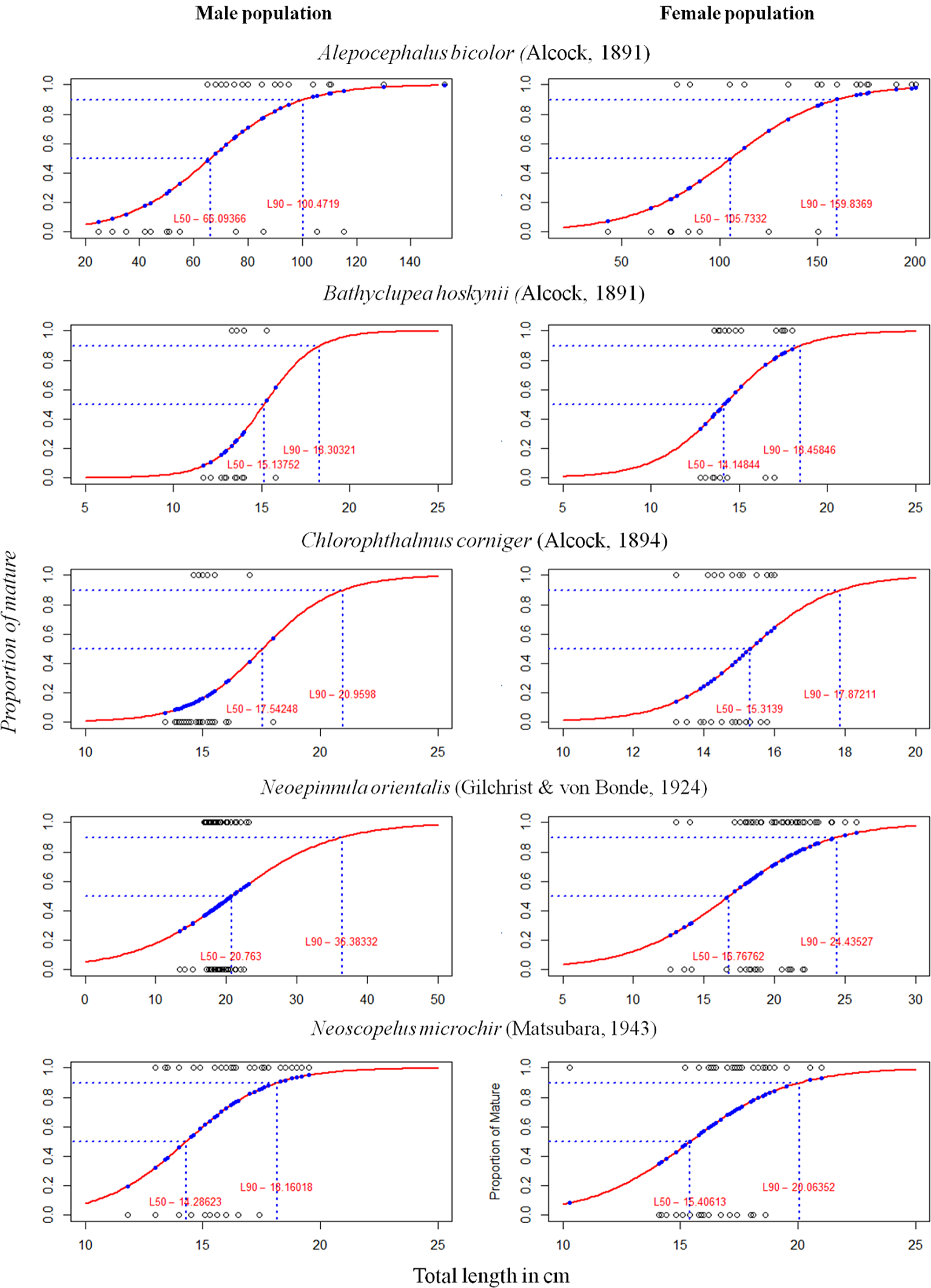
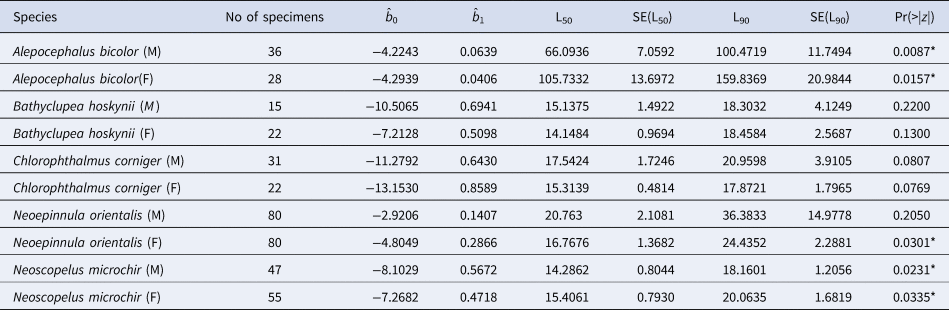
The length at maturity (L50 and L90) is shown in Table 2. Length at first maturity of the five deep-sea finfishes ranged from 14.28 cm (Neoscopelus microchir, male) to 105.73 cm (Alepocephalus bicolor, female). Length at 90% maturity ranged from 17.87 (Chlorophthalmus corniger, female) to 159.83 cm (Alepocephalus bicolor, female). Length at maturity was analysed separately for male and female populations in order to understand the difference between sexes. Length at maturity curves (L50, L90) plotted for the five deep-sea demersal finfishes of Andaman and Nicobar Islands are depicted in Figure 2.
Length at maturity curves (L50, L90) are plotted for five deep-sea demersal finfishes of Andaman and Nicobar Islands.

Values obtained in the estimate of size at first sexual maturity (L50) and size at 90% maturity (L90) of five deep-sea demersal finfishes of Andaman and Nicobar Islands of Indian EEZ, North-eastern Indian Ocean

 $\hat{b}_0$ and
 $\hat{b}_1$ are the estimates of the parameters in the logistic regression model, L50, length at first maturity; L90, length at 90% maturity; SE, standard error; Pr(>|z|), corresponding critical value, *Significant at P < 0.05.
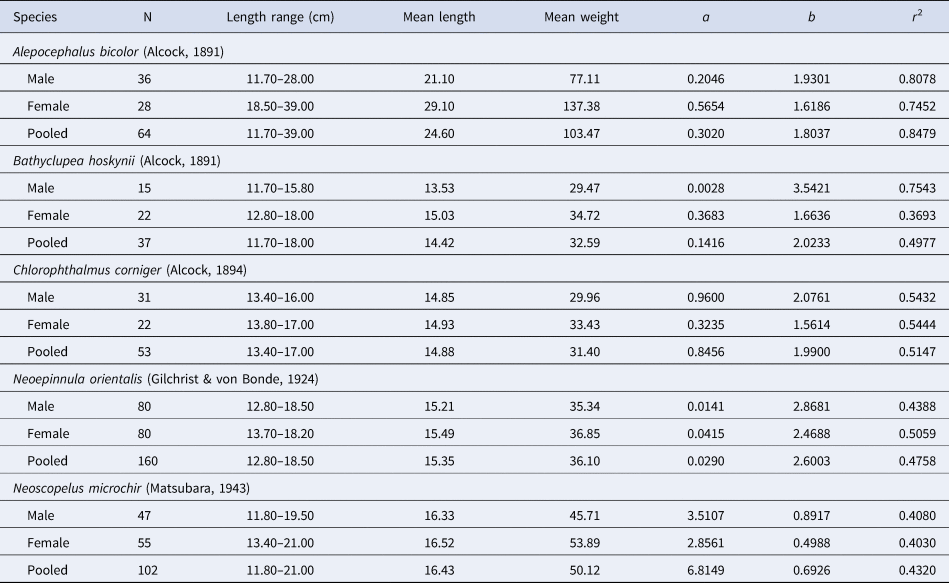
Table 3 shows sample size, mean length and weight, length-weight relationship parameters a and b, 95% confidence limits of a and b, and the coefficient of determination r 2. The b value ranged from 0.69 (Neoscopelus microchir) to 2.60 (Neoepinnula orientalis).
Length-weight relationship of five deep-sea demersal finfishes of the Andaman and Nicobar Islands, Indian EEZ.

N, the total number of samples; a, intercept; b, slope; and r 2, the coefficient of determination.
Discussion
Information on life-history parameters of deep-sea fish is valuable because of the difficulty of sampling and retrieving such information. The present study determined the length at maturity and length-weight relationship of five species of deep-sea demersal finfishes of the Andaman and Nicobar Islands. Deep-sea species are rarely exploited resources from the Indian Exclusive Economic Zone (EEZ). The length-weight relationship is one of the parameters needed for stock assessment methods for fish, as well as size at first maturity. Both parameters are critical estimates for understanding the life history of species and their trophic level. Size at maturity has a role in determining the harvestable size of fished species, while the trophic level is used to determine the life history (r- or k-strategy) of species and their position in the food web; the life history patterns of species vary with the environment they inhabit. Size at maturity also has importance in determining the optimal exploitation pattern (Adams, Reference Adams1980). In the Indian deep-sea fishery, there are low levels of trawling in these depths resulting in poor exploitation of fishes of the deep-sea ecosystem, however, it holds a potential of 1.7 million tonnes of underexploited and unexploited finfish and shellfish (Ayyappan, Reference Ayyappan2011).
The b values of fish may change during life-cycle events such as metamorphosis, growth and onset of maturity (Le Cren, Reference Le Cren1951). The b values in the present study show variations between the male and female populations.
Results of b values of Alepocephalus bicolor when they are compared with previous studies in neighbouring areas showed variation in the growth pattern of fish inhabiting different locations (Deepu et al., Reference Deepu, Haridas and Kurup2007; Sreedhar et al., Reference Sreedhar, Sudhakar and Meenakumari2013). The results of b values of the length-weight relationship of Bathyclupea hoskynii is the first report from the Indian EEZ and there is no previous information available for comparison: the b value of the species is 3.54, 1.66 and 2.02 for male, female and pooled, respectively. The male population showed positive allometric growth, but the female and pooled populations have negative allometric growth. There is a difference observed between the male and female populations of the species. There are several factors that affect length-weight relationship estimates such as maturity, season, sample size selectivity of the fishing gear, geographic locations and sex length class (Thomas et al., Reference Thomas, Venu and Kurup2003; Hossain et al., Reference Hossain, Jasmine, Ibrahim, Ahmed, Rahman and Ohtomi2009; Aneesh Kumar et al., Reference Aneesh Kumar, Thomy, Deepa, Hashim and Sudhakar2016).
Results of b values of Chlorophthalmus corniger showed variations when compared with previous studies in neighbouring areas (Kurup et al., Reference Kurup, Jiji and Venu2005). In Neoepinnula orientalis, b value (b = 2.6003, pooled) in comparison with the studies of the south-eastern Arabian Sea (Beni et al., Reference Beni, Ganga and Sobhana2017) indicates changes (b = 3.230, pooled) of same species inhabiting different geographic area. Results of the b values of Neoscopelus microchir when they are compared with previous studies in neighbouring areas showed smaller values for male, female, pooled respectively (Thomas et al., Reference Thomas, Venu and Kurup2003). From the above observations, it is evident that the b value of the fish population may vary with respect to the geographic region and environmental conditions as a determining factors. Therefore, the use of a length-weight parameter should be restricted to specific length ranges to estimate growth parameters (Morey et al., Reference Morey, Moranta, Massutí, Grau, Linde, Riera and Morales-Nin2003) and applied specifically to a particular geographic region.
In, Alepocephalus bicolor, length at first maturity (L50) was found to be 66.09 and 105.73 cm for male and female populations whereas length at 90% maturity is 100.47 and 159.83 cm; for this species the male and female populations are substantially different in their maturity stages. In a study from the south-west coast of India at a depth range of 520–822 m, males and females attain length at first maturity at 23 and 27 cm respectively (Deepu et al., Reference Deepu, Haridas and Kurup2007); there was a difference with the observations of the present study. The present samples were taken from a depth range of 295–650 m; therefore, more studies are required to understand the variability of length at maturity in different environments. For Bathyclupea hoskynii, length at maturity was observed to be 15.13 and 14.14 cm for male and female populations, respectively, whereas length at 90% maturity was 18.30 and 18.45 cm. In this study, male and female populations do not have much difference (P > 0.05) in the length at maturity of Bathyclupea hoskynii. In Chlorophthalmus corniger length at first maturity was 17.54 and 15.31 cm for male and female populations, whereas length at 90% maturity was 20.95 and 17.87 cm. There is a difference (P < 0.05) in the maturity stages of males and females of Chlorophthalmus corniger. In Neoepinnula orientalis, length at first maturity was 20.76 and 16.76 cm for males and females, length at 90% maturity was 36.38 and 24.43 cm. Length at maturity of Neoepinnula orientalis was estimated as 19.2 cm in males and 19.5 cm in females from the south-east coast of India (Beni et al., Reference Beni, Ganga and Sobhana2017). There was not much variation in the length at maturity of male and female populations from the south-east coast of India, while there is a variation in the maturity stages of the male and female populations in the current study. In Neoscopelus microchir length at first maturity was 14.28 and 15.40 cm for male and female populations, whereas length was 18.16 and 20.06 cm at 90% maturity, with male and female populations showing variation in their size at maturity.
From the above observations, it is evident that some of the deep-sea fishes showed variations in the maturity stages of the male and female population (Alepocephalus bicolor and Neoepinnula orientalis) while a small difference was seen in Bathyclupea hoskynii, Chlorophthalmus corniger and Neoscopelus microchir; this may be attributed to species-specific reproductive characteristics. However, there was a difference observed in the length at maturity of Alepocephalus bicolor (L50, male = 66.0936, female = 105.7332) compared with a previous report on length at maturity of A. bicolor (L50, male = 23, female = 27) from the south-west coast of India (Deepu et al., Reference Deepu, Haridas and Kurup2007). The present study provides information on the least studied deep-sea demersal finfishes of Indian waters. A more detailed study of the biological aspects of the deep-sea fishes would provide more insight into their maturity and population structure. This information on species is useful for framing suitable conservation methods and suitable management measures for proper utilization of the stock.
Acknowledgements
We would like to thank the Centre for Marine Living Resources and Ecology (Ministry of Earth Sciences, Government of India) for funding and providing the facilities of the fisheries oceanographic research vessel ‘Sagar Sampada’. We also thank the chief scientist and the crew.
Financial support
This study funded by the Centre for Marine Living Resources and Ecology (Ministry of Earth Sciences, Government of India) (Grant number: MoES/10-MLR/01/12 dated 4 September 2012).