INTRODUCTION
Maize (Zea mays L) is the most important staple food crop in southern Africa, including Malawi, but yields have stagnated, mainly due to low soil fertility (Sanchez, Reference Sanchez2002). Continuous cropping of land with little use of mineral fertiliser or organic manures has led to the decline in soil fertility and crop productivity on the smallholder farms that predominate (Kumwenda et al., Reference Kumwenda, Waddington, Snapp, Jones and Blackie1996). Deficiencies of N and P in maize-based systems are of most concern (Kumwenda et al., Reference Kumwenda, Waddington, Snapp, Jones and Blackie1996; Nziguheba et al., Reference Nziguheba, Merckx and Palm2002; Wendt and Jones, Reference Wendt and Jones1997). Recent average mineral fertiliser use in Sub-Saharan Africa (SSA) is estimated to be only 8 kg nutrients ha−1 of cropped land per year (African Fertiliser Summit, 2006), which is little changed from estimates made in 1990 (Mwangi, Reference Mwangi1996). Mineral fertilisers are expensive in Malawi (a common situation for land-locked countries in SSA), as all N fertiliser is imported. For example, a 50-kg bag of urea costs MK 2800 or US$25.9 (US$1.13/kg N) on the open market in 2005, preventing most farmers from using N fertiliser on maize. Although P is available from local sources (Wendt and Jones, Reference Wendt and Jones1997), it remains an expensive input for resource-poor farmers.
Maize occupies 70% of the cropped land area in Malawi, with tobacco the most important cash crop (Sauer and Tchale, Reference Sauer and Tchale2009). Relatively small areas are cropped with legumes in these maize-dominated systems. Legumes can provide substantial inputs of N from biological N2 fixation, but the other nutrients contained in their residues are obtained from available soil pools (Giller, Reference Giller2001). The availability of manure is constrained by the small numbers of livestock in Malawi (National Statistics Office, 2009). The limited use of fertiliser, organic manures and legumes results in average maize grain yield below 1 t ha−1 on many fields in Malawi (Kanyama-Phiri et al., Reference Kanyama-Phiri, Wellard, Snapp, Snapp and Pound2008), and just a few 100 kg ha−1 on the most nutrient-depleted fields (Kanyama-Phiri et al., Reference Kanyama-Phiri, Snapp, Kamanga and Wellard2000).
Several initiatives have been undertaken to help smallholders access fertiliser for food crops in Malawi. Following from support through starter packs in the late 1990s, a targeted input programme (TIP) was implemented in 2003–2004 giving 12.5 kg of NPK compound fertiliser and 12.5 kg urea per household for maize production. A broad-based farm input subsidy programme (FISP) began in 2005, which has improved access to fertiliser in much of Malawi, with subsequent benefits to food production, food availability and poverty reduction, but this has proved costly and a challenge to sustain (Dorward and Chirwa, Reference Dorward and Chirwa2011; Government of Malawi, 2008). Nevertheless, the Government of Malawi has managed to continue FISP; it was expected to reach 1.5 million farm families in 2012. In FISP, a household is given two fertiliser coupons, one for a 50-kg bag of urea and another for 50-kg of 23:21:0+4S (NPK), for maize.
The use efficiency of the N provided in FISP is thought to be around 14 kg maize grain kg−1 N applied (Chisinga, Reference Chisinga2008; Government of Malawi, 2008), which is less than half the N use efficiency that can be achieved with maize on smallholder farms with good management (Heisey and Mwangi, Reference Heisey and Mwangi1996; Snapp et al., Reference Snapp, Borden, Rohrbach, Galloway, Cowling, Erisman, Wisniewski and Jordan2002). Poor fertiliser management (inappropriate rates, late application timing and poor placement) and poor field and weed management due to the lack of proper information, knowledge and resources (Dimes et al., Reference Dimes, Muza, Malunga, Snapp, Friesen and Palmer2004; Mushayi et al., Reference Mushayi, Waddington and Chiduza1999) contribute to these fertiliser inefficiencies for smallholder maize in southern Africa (e.g. Giller et al., Reference Giller, Rowe, de Ridder and van Keulen2006).
Given the large recent investments by the Government of Malawi in fertiliser subsidies and the relatively poor returns to this investment, there is an urgent need to help smallholder farmers to use the available mineral fertiliser as efficiently as possible. To explore ways to raise the use efficiency of small amounts of N and P fertiliser on maize, we conducted a participatory on-farm experiment with 12 farmers in a representative smallholder maize farming community in central Malawi during the 2003–2004 cropping season. The aims were to determine expected N and P use efficiencies for smallholder maize, to simulate (in the APSIM crop–soil system model) how these responses may change depending on the seasonal rainfall, and examine with a broader group of farmers how to raise the use efficiencies through improved management, especially better weeding.
MATERIALS AND METHODS
Study site
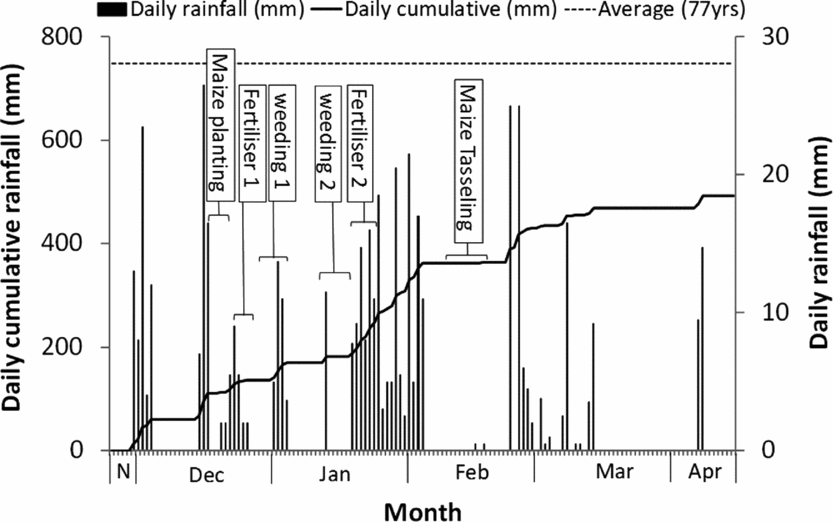
The field research was conducted during the 2003–2004 wet season with the farming community at Kamphenga in Chisepo, central Malawi (13°32′ S and 33°31′ E). Soils in the area are predominantly Ferralsols (sandy loams) of low-to-moderate fertility, underlain by laterite which impedes drainage (Wendt, Reference Wendt1993). The growing season extends from November to April corresponding with the rains. In 2003–2004, total annual rainfall was 492 mm (Figure 1), below the long-term average of 748 mm. Several dry spells occurred during the growing season, including one during flowering, which is a critical period for effective growth and grain yield formation in maize.
Monthly and cumulative rainfall at Kamphenga, Chisepo, in central Malawi during the 2003–2004 growing season. Average in the graph is the average annual rainfall.

Farmer participatory experimentation
Initial discussions focusing on the best use of fertiliser available from TIP were conducted with a large group of 57 interested farmers from Kamphenga during the 2003 dry season. These farmers had been involved in earlier on-farm research in the Chisepo area (see Kamanga Reference Kamanga2002). Together, the researchers and farmers decided to assess the effects of small amounts of fertiliser and weeding on maize yields. From the 57 farmers, 12 were selected randomly by the researchers to host a field trial. The remaining farmers formed 12 groups with the trial hosts and each group managed and monitored the trial at one host farm. The size of the groups was 4–7 farmers depending on proximity to the host field. Trial design, field layout, planting, fertiliser application and harvesting were jointly decided by researchers and the groups of farmers. Farmers interacted with the research team at least once a month and with a research assistant stationed in the area each week. Participating farmers monitored and evaluated the experiments using their own criteria for evaluation, and they recorded their own observations.
The on-farm experiment was laid out in a randomised block design with 3 N rates × 2 P rates × 2 maize varieties, with three replicates, on each of 12 farmers’ fields allocated to two weeding intensities in the 2003–2004 cropping season. The three N treatments (as urea) were 0, 15 and 30 kg N ha−1, applied twice in equal splits at planting and when the maize was knee high. Two rates of phosphorus (0 and 9 kg P ha−1) as triple-super phosphate (TSP) fertiliser were applied at planting. The two maize varieties were MH18, a semi-flint hybrid which is widely used in Malawi, and SC627, a relatively new hybrid release. All plots were 5 m × 10 m with ridges spaced at 90 cm apart. A net plot of 3 m × 5 m (15 m2) was later demarcated for data collection. Maize was planted on favourable rains mid December. Three maize seeds were planted each 0.91 cm in ridges spaced at 0.91 cm, giving a population of 37000 plants per hectare. Apart from weeding, all other management followed farmer practice. To compare the effects of weeding intensity across the 12 fields, six of the farmers were randomly selected to host plots that were weeded just once at 2–3 weeks after planting (WAP), and the remaining six fields hosted plots that were weeded at 2–3 WAP and at 4–6 WAP. During the work, one farmer had a land dispute and abandoned his trial, while three farmers left for seasonal employment on a tobacco estate and the management of their plots was poor. Group members working with these farmers were encouraged to join the remaining farmer groups. Eight farmers and their groups completed the trials: four with plots that were weeded once and four with plots that were weeded twice. All weeding was done by hand-hoe.
Data collection and analysis
Before the onset of rains and prior to planting, soil samples were collected from three points in each field and a composite sample was made for each of the 12 fields to a depth of 100 cm, incremented in 20-cm intervals. The soil samples were sieved to 2 mm and analysed for soil texture, pH, organic matter, %N and available P (Bray method; Anderson and Ingram, Reference Anderson and Ingram1993). Maize grain yield and yield components were obtained from grain and stover samples collected from the net plot of 3 m × 5 m marked in the middle of each plot leaving 1 m each side of the plot width, and 2.5 m either side of the plot length to remove border effects. Subsamples of 5–10 kg grain from each net plot were taken, oven-dried to 60 °C and weighed to determine grain moisture content and dry weight conversion. Further subsamples were collected and analysed for N and P content, using the modified Kjeldahl method (Okalebo et al., Reference Okalebo, Gathua and Woomer1993). Harvest index (the ratio of grain to total above-ground biomass, expressed as a percentage) was calculated from the above-ground dry matter yields. Data were subjected to an analysis of variance. Means between weeding intervals were compared using the standard errors for the differences and statistical significance is quoted at p < 0.001, p < 0.01, and p < 0.05.
With help from a field assistant and the researchers, each host farmer drew a resource allocation map (RAM) to record inputs (seed, labour, fertiliser) and outputs for their fields, and also recorded observations on the experimental plots in field notebooks that had been provided. Labour use (person-days) data on each activity for the plots (to be used in the financial analysis) were recorded by farmers with the field assistant in field notebooks and on the RAMs. During 2003–2005, nine focus group discussions (FGDs) discussed planting the trials, crop responses to the treatments, yields at harvest and follow-ups. All eight host farmers and most of the group members participated in the FGDs, and each FGD involved 8–14 farmers. They were conducted in the local language and responses translated to English by the first author. The FGDs elicited farmer observations about the research, perceptions on the performance of maize and benefits of small amounts of fertiliser, farmers’ knowledge on fertiliser management, and other aspects of crop management including weeding.
Indices of N and P use efficiency
Agronomic indices for N and P use efficiencies were calculated following Dobermann (Reference Dobermann2005) as follows. The agronomic efficiency of applied fertiliser N (AEN) was calculated as yield gain from N application divided by N applied at different P rates (Y N− Y 0/F N), where Y N is maize grain yield as a result of fertiliser N and Y 0 is maize grain yield at zero fertiliser N and F N is fertiliser N applied. Partial factor productivity for N (PFPN) and P (PFPP) were calculated as yield per kg N (kg ha−1) and P applied i.e. (Y N/F N) and (Y P/F P). The apparent recovery efficiency of applied N (REN) and applied P (REP) was calculated as kg N taken up by maize per kg N applied (U N− U 0)/F N, and as kg P taken up by maize per kg P applied (U P− U 0/F P). The physiological efficiency of applied N (PEN) and applied P (PEP) was calculated as yield gain from N application or P application divided by N or P uptake by maize (Y N− Y 0)/(U N− U 0) and (Y P− Y 0)/U P− U 0). Y N or Y P are maize yields (kg ha−1) measured in plots with N or P, Y 0 is maize grain yield (kg ha−1) measured from plots with no N or P application. U N or U P are maize plant N or P uptake measured in above-ground dry matter at harvest (kg ha−1).
Simulations of maize growth in response to N and P fertiliser in APSIM
To analyse further the seasonal factors influencing the response of maize to N and P inputs, the crop–soil system model APSIM v3.1 (Keating et al., Reference Keating, Carberry, Hammer, Probert, Robertson, Holzworth, Huth, Hargreaves, Meinke, Hochman, McLean, Verburg, Snow, Dimes, Silburn, Wang, Brown, Bristow, Asseng, Chapman, McCown, Freebairn and Smith2003; www.apsim.info/apsim/, accessed 11 Sept. 2012) was used to simulate maize growing in response to the environment (solar radiation, temperature, rainfall), management (sowing date, cultivar, time of weeding and fertiliser application) and the inputs (fertiliser N and P) for a typical sandy soil of the Kamphenga area that was characterised for soil water holding characteristics and fertility. APSIM has previously been shown to simulate credibly key soil and crop processes in highly constrained, low yielding maize/legume systems in Malawi (Robertson et al., Reference Robertson, Benson and Shamudzarira2000, Reference Robertson, Sakala, Benson and Shamudzarira2005) and in similar environments in Zimbabwe (Ncube et al., Reference Ncube, Dimes, van Wijk, Twomlow and Giller2009; Shamudzarira and Robertson, Reference Shamudzarira and Robertson2002; Shamudzarira et al., Reference Shamudzarira, Waddington, Robertson, Keating, Mushayi, Chiduza, Grace and Carberry2000).
Soil characterisation and weather data (daily maximum and minimum temperature, solar radiation and rainfall) collated from local weather stations for the period between 1927 and 2004 was taken from previous simulation work reported in Robertson et al. (Reference Robertson, Sakala, Benson and Shamudzarira2005). Using the crop lower limit of maize, this sandy soil had a plant available water capacity (PAWC) of 117 mm. For the long-term continuous simulations, maize was planted annually in response to a date and rainfall planting rule, i.e. Maize (cv. MH18 or SC527, 4 plants m−1, 0.9-m row spacing) would be planted in the period 15 November to 15 January when 20 mm or more of rainfall was received over five days. A factorial of simulations was run for both cultivars and soil types with N (0, 15, 30 kg ha−1) and P (0, 9 kg ha−1) fertiliser applied. For the P treatments, all fertiliser was applied at sowing, but for the N treatments, half of the application rate was applied at sowing and the remainder at 33 days after planting. The annual resetting of crop residues, labile soil P, mineral N and organic C concentration was implemented on day 304 to the initialisation values, so that the seasonal weather effect was the major influence on maize growth. Soil water was determined by the water balance model and was not reset. All simulated data presented are the average yield of the two cultivars as the difference in yield between these cultivars was minimal in most seasons.
Estimation of financial costs and benefits
Costs and benefits were calculated for the trial results based on input and output prices for 2004–2005, when the study was conducted. The farm gate price for maize grain was MK 7 kg−1 (US$0.1), seed of hybrid maize was MK 70 kg−1 (US$0.65), urea-N fertiliser cost MK 80 kg−1 (US$0.81) and TSP was MK 100 kg−1 (US$1.01). In 2003–2004, most smallholder farmers who used fertiliser in the area bought it on the open market since the TIP did not adequately cover the area. Because of this, the open market fertiliser prices were used in the estimation of the economic returns. The use of market fertiliser prices was on the basis that distribution of cheap fertiliser in the current FISP subsidy programme may be expensive for the government and insufficient to cover all farmers (see Dorward and Chirwa, Reference Dorward and Chirwa2011). Additionally, costs and benefits were calculated assuming fertiliser was supplied free (as in the TIP), or at a reduced subsidised price (as in the FISP) of MK 950 (US$7.68) bag−1 (50 kg) in 2005. Labour cost was estimated using the opportunity cost of labour, based on the minimum agricultural wage rate in 2004 of MK 56 man-day−1 (US$0.53). Returns to labour, returns to land and benefit-to-cost ratio were used to evaluate the economics of maize response to fertiliser application. Returns to labour were calculated by dividing the net benefits by the total man-days. Returns to land (represented by the gross margin, GM) are calculated as GM = B − C, where B is the total benefit accrued by using the land, C are the costs associated with use of that land in the same period. The benefit–cost (B/C) ratio indicates the rate of return per unit cost.
RESULTS
Initial soil fertility
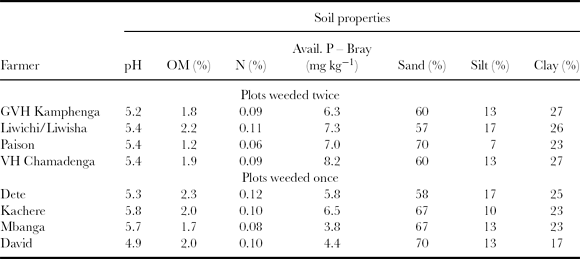
Three of the host farmers’ fields were located on a darker brown sandy clay loam soil (Katondo), and the rest on sandy/sandy loam soils (Mchenga). The sandy/sandy loam (Ferrallitic) soils had a topsoil average pH of 5.4, 2.1% OM, 0.1% N and considerable silt + clay content (36.7%; Table 1). They have low water holding capacity and are prone to leaching of nutrients below the rooting zone. The brown soils (classified as Ferruginous/Ferric Rhodustalf) have a strong structure, low cation exchange capacity of 5.44 cmol kg−1 soil and low available P, but are considered more productive than other local soils.
Soil properties (20-cm depth) of field plots weeded twice or once in Kamphenga, Chisepo, Malawi, in 2004.
Maize yield response to fertiliser and weeding
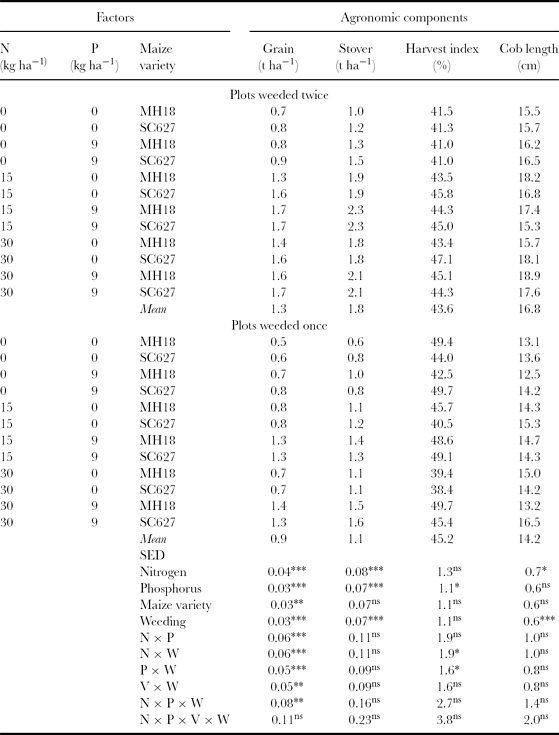
The analysis of yield data averaged across sites showed that weeding twice resulted in significantly (p < 0.001) more maize grain yield (an overall increase of 0.4 t ha−1) than weeding just once (mean of 0.9 t ha−1; Table 2). N fertiliser at 30 kg ha−1 raised the grain yield by 0.6–1 t ha−1 on plots weeded twice, but by only 0.2–0.4 t ha−1 on plots weeded once. There were significant differences in yield (p < 0.01) between the maize varieties; SC627 yielded slightly more than MH18, especially when weeded twice. Stover yields in both weeding treatments followed the same trend. Plots that received both N and P produced the most stover (2.1–2.3 t ha−1). The poorest stover production (0.6 t ha−1) was measured in plots weeded once with no fertiliser. In both weeding regimes, a combination of N and P gave stronger grain yield responses compared with plots where only N or P was applied. Maize yield response to N and P was greater with additional weeding (0.5 t ha−1 in plots weeded twice and 0.2 t ha−1 when weeded once; Table 2), and show complementary benefits of N and P.
Agronomic yield components of maize grown at variable rates of N and P in plots weeded twice and plots weeded once in Chisepo, central Malawi, in the 2003–2004 season. Values presented are averaged across treatments, each replicated three times in four farmer fields.
SED = standard error of the difference; significance: ***p < 0.001, **p < 0.01, *p < 0.05; ns = not significant.
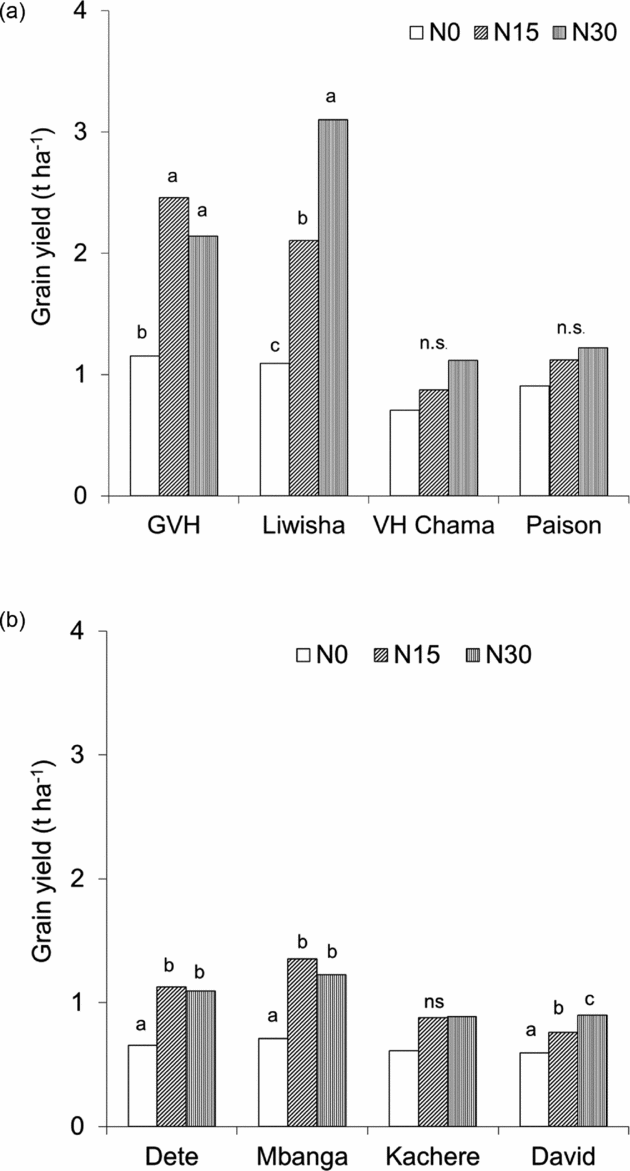
Analysing treatment effects for sites separately, maize grown on the more fertile brown sandy clay soils (fields GVH and Liwichi/Liwisha) and weeded twice responded strongly to 15 kg N ha−1, with an additional response in grain yield at 30 kg N ha−1 at Liwisha (Figure 2a). The smaller responses at the sandy sites (fields Chamadenga and Paison) were not significant. When the crop was weeded just once (Figure 2b), maize yields were low, increased somewhat with 15 kg N ha−1 at all sandy sites, but there was no significant additional response to N at 30 kg N ha−1, except in the field of farmer David. There was a marked difference in the response to P fertiliser between the two soil types. Harvest index ranged between 39 and 50% and did not differ significantly across the three N rates (Table 2). Cobs were longest in the well-weeded treatments with N and P – on average the cobs were 2.6 cm longer in plots weeded twice than those weeded once.
Maize yield responses to N in trials on individual farms: (a) plots weeded twice, (b) plots weeded once in Chisepo, central Malawi, in 2003–2004.
APSIM simulations
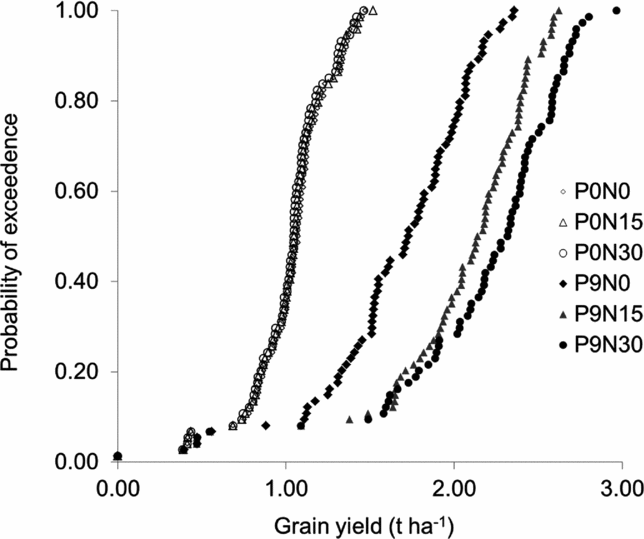
In central Malawi, maize is expected to respond to N at higher rates than 30 kg N ha−1 in most years (Benson, Reference Benson1997). Since the experiment was conducted in a relatively dry season, moisture stress limited fertiliser response. To see how maize may respond to N fertiliser across a wider range of the rainfall seasons expected in Chisepo, simulations were conducted using APSIM. The APSIM simulation of grain yields from a sandy soil site (PAWC = 117 mm) in the 2003–2004 season showed limited yield response to N when no P was applied but a linear response with the application of 9 kg P ha−1. Long-term simulations showed similar effects with yield ranging from 0.85 to 1.5 t ha−1 in 80% of seasons at 0 P regardless of the N application rate (Figure 3). With 9 kg P ha−1 applied, yield exceeded 1.3 t ha−1 in 80% of seasons with no added N and 1.7 t ha−1 with applications of 15 or 30 kg N ha−1. There was 120 kg ha−1 additional grain yield between the simulations receiving 15 and 30 kg N ha−1, indicating that P was still constraining N response.
Maize grain yields for various combinations of N × P fertiliser simulated in APSIM for the seasons between 1927 and 2004 in Chisepo, central Malawi.
Indices for fertiliser use efficiency in maize
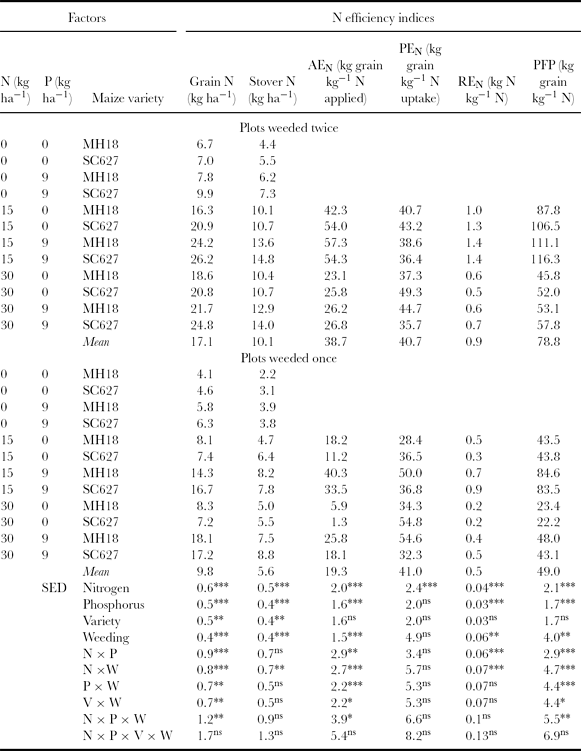
On average, maize in plots weeded twice had 7.3 kg ha−1 more grain N than from plots weeded once (Table 3). Grain N generally increased when 30 kg N ha−1 was applied, although the largest value (26.2 kg N ha−1) was obtained for 15 kg N ha−1 combined with 9 kg P ha−1 in the plots weeded twice. Maximum grain N was 8.1 kg N ha−1 larger in the plots weeded twice than in plots weeded once. Stover N ranged from 2.2 to 14.8 kg N ha−1. It increased with N rate, and plots weeded twice yielded 6.2 kg N ha−1 more stover N than plots weeded once.
Indices of nitrogen use efficiency as affected by N and P application, maize variety and weeding in Chisepo, central Malawi, in 2003–2004. See the text for the explanation of the indices.
SED = standard error of the difference; significance: ***p < 0.001, **p < 0.01, * p < 0.05; ns = not significant.
The agronomic efficiency of N (AEN) was 19.3 kg grain kg−1 N with one weeding, and it significantly (p < 0.001) doubled to 38.7 kg grain kg−1 N with the second weeding (Table 3). AEN improved further with P. Although AEN from weeding twice may serve as an indicator of what can be targeted with good field and fertiliser management, both AEN values indicate scope for improvement in the efficiency of fertiliser use for maize production on smallholder farms. Except for PEN, REN (0.9 kg N kg−1 N applied) and PFPN (78.8 kg grain kg−1 N applied) were higher in plots weeded twice than those weeded once. In general, all the indices indicate the benefit of extra weeding, and the indices were better where N+P were applied, indicating a beneficial interaction between fertiliser and adequate weed management.
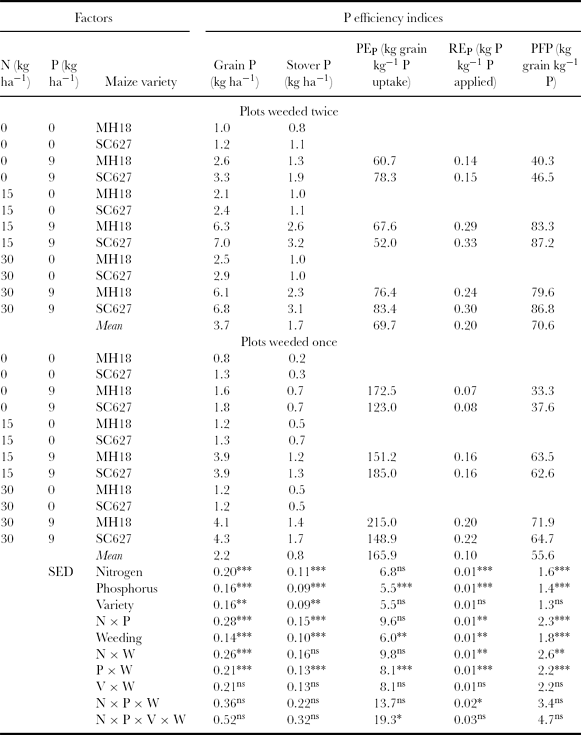
SC627 accumulated significantly more P (p < 0.005) than MH18 in both grain and stover (Table 4). P in grain was on average 1.5 kg P ha−1 greater in plots weeded twice than those weeded once. The PEP was much larger in plots weeded once, suggesting a strong dilution of P in the grain. REP and PFPP were higher in plots weeded twice than those weeded once, suggesting a significant interaction between P and weeding with all the indices.
Indices of phosphorus use efficiency as affected by N and P application, maize variety and weeding in Chisepo, central Malawi, in 2003–2004. See the text for the explanation of the indices.
SED = standard error of the difference; significance: ***p < 0.001, **p < 0.01, *p < 0.05; ns = not significant.
Financial returns
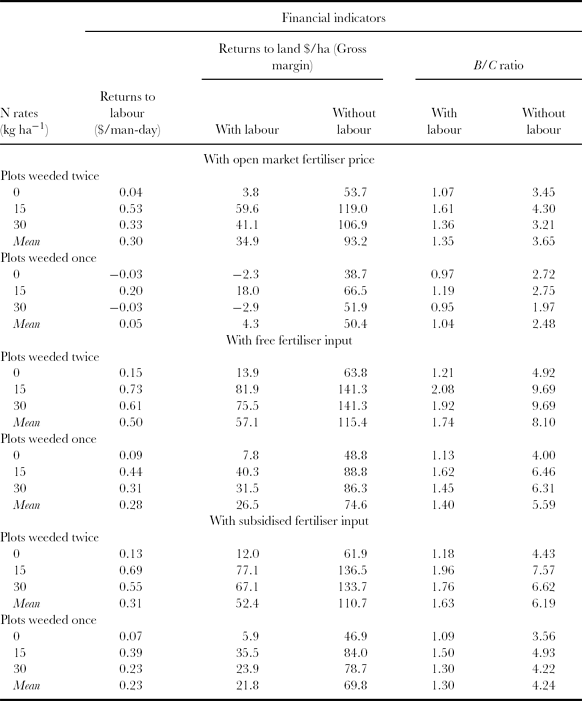
Returns to land and returns to labour are presented in Table 5, using open market prices of fertiliser (as used by Chisepo farmers in 2004), free fertiliser (as in the TIP) and subsidised fertiliser (the FISP). Financial analysis used an opportunity cost of farm household labour equal to the local labour rate in Malawi of US$0.53 man-day−1.
Financial performance of combinations of N and P fertiliser at three price scenarios in fields weeded twice and fields weeded once in Chisepo, Malawi, 2003–2004 season.
With the free or subsidised fertiliser, returns to land with labour included were high (36–82 US$ per ha), and more than doubled with two weedings. B/C ratios approached 2 (Table 5), indicating that it was clearly more economic to apply the fertiliser and to give the extra weeding. A B/C ratio above 1 is often said to indicate that an enterprise will be attractive for smallholders (Mangisoni, Reference Mangisoni2000). At market prices for fertiliser, the returns were far more modest (Table 5). Nevertheless, investing in an extra weeding of maize was equally profitable to the sale of labour by a household. Returns to labour were higher at 15 kg N ha−1 than with 30 kg N ha−1 in plots weeded twice. With just one weeding, the returns to land (including labour costs) were minimal (and positive only at 15 kg N ha−1), but these rose with a second weeding to B/C ratios of 1.6 at 15 kg N ha−1 and 1.36 at 30 kg N ha−1, and the returns more than doubled when labour was not considered (Table 5).
Farmer learning and evaluation of fertiliser on maize
Several observations were made by farmers individually and in the FGDs. Over 70% of the 57 farmers initially involved said in the FGDs that they believed maize needed fertiliser at tasseling and thus they aim to apply it around that time. Above half of these farmers mentioned being constrained by late access to fertiliser and social obligations such as tobacco ganyu (casual work done for other smallholder farmers for food or cash), funeral and illness. From an interaction with researchers, farmers learned that it was best to apply fertiliser much earlier to maize. In the trial FGDs, almost all participating farmers said they had been unaware that small amounts of fertiliser applied at the right time would be profitable, although they had noticed before that even a little fertiliser increased yields. They commented that using small rates of fertiliser allowed them to spread the available fertiliser over a larger area and still obtain high yields. Farmers stated that fertilisers were applied well and in good time in the participatory trials, which contrasted with their normal practice. About 10% of farmers said they were reluctant to use fertiliser in some fields because they feared it would damage their soils. Reference was made to their experience with ammonium sulphate which had been commonly used on maize (and is still available), but is now rarely used for fear of ‘making their soils hard’. Around 90% of farmers described and named the types of fertiliser, indicating that they knew the fertiliser from contact with extensionists or from fellow farmers. They differentiated the fertiliser for basal dressing as ‘wachitowe’ and for top dressing as ‘wobereketsa’ based on the colour and size of granules. However, over 70% of the farmers said they usually applied whichever fertiliser is available and only once, at tasseling. The type of fertiliser they apply depends on what they access, and in the experimental year less than 20% of farmers in the FGDs said that they had used any fertiliser on maize because it was very expensive. About 60% of farmers pointed out that the fertiliser from TIP did not reach them, while it came late for the few that accessed it. Thirty-eight participating farmers observed that maize grew poorly and yielded less in plots that had P only compared with those that received both N and P. They said maize grew vigorously in all plots that were weeded twice and maize growth was generally reduced by the dry spells that occurred in the season. Finally, about half of the participating farmers reported that most fields of maize were damaged by Chiwawu (grey leaf spot caused by Cercospora zeae-maydis), but SC627 was less affected than MH18.
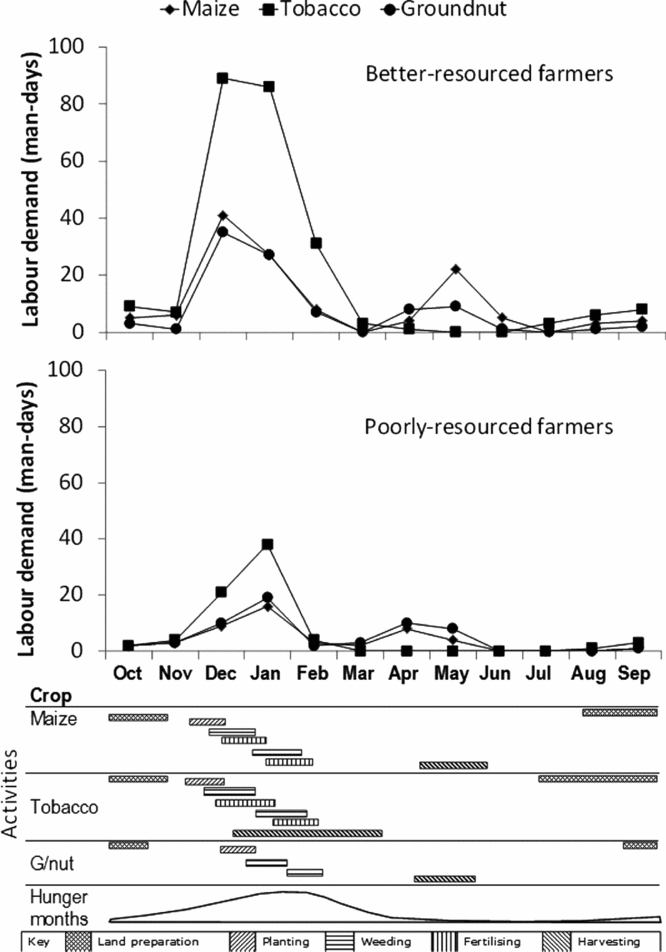
During FGDs at harvest, maize yields were expressed graphically on flip charts as 50-kg bags of maize, for farmers to better understand the effects of weeding and small amounts of fertiliser. Farmers noted that the weeded plots with fertiliser gave higher yields, larger returns to labour and costs invested and they concluded that maize yields are better where fertiliser use is combined with frequent weeding. They were optimistic that they would grow maize that way should they obtain fertiliser, paying attention to extra weeding. Nevertheless, some farmers said weeding for the second time was rarely done because of competing demands for their labour. This coincides with a peak labour demand for processing tobacco (the main cash crop for most farmers) from December to April (Figure 4). Farmers who did not grow tobacco were involved in its processing as ganyu labourers or employed in nearby estates to cover the hunger period. Farmers observed that both maize varieties yielded well in both weeding regimes, but preferred SC627 because it yielded more than MH18, had harder grain and was less affected by grey leaf spot. Farmers said that fertiliser remained an expensive input for them and they wished our project would continue to offer fertiliser for use in field trials. Fertiliser costs declined during 2005–2009, when the FISP coupon system made fertilisers available at the more affordable price of MK 950 (US$7.68) per 50-kg bag of NPK and urea for maize.
Crop labour calendar for better-resourced and poorly-resourced farmers, and hunger months in Chisepo, central Malawi.
DISCUSSION
Overall, grain yield responses to fertiliser (especially at 30 kg N ha−1) were smaller than expected, probably because of the relatively low and poorly distributed rainfall experienced during maize development in the 2003–2004 season (Figure 1). A dry spell during tasseling and anthesis induced moisture deficits for maize, which limited the response of maize to fertiliser, especially on the six trial plots with sandy soils. With the brown sandy-clay soils, which held an additional 30 mm of soil moisture, maize was less water-stressed during this period and it responded to the additional N. In years with good rainfall, larger maize responses to the fertiliser rates used in this study are expected, and when combined with adequate weeding, the application of small amounts of fertiliser should have high payoffs. This conclusion was supported by the APSIM simulations of maize growth and from our more than ten years of experience in Chisepo. Other authors have observed similar effects of dry spells in maize response to N in smallholder farming in the region (Shamudzarira and Robertson, Reference Shamudzarira and Robertson2002). Our results clearly show that if the season is dry, it is essential to do extra weeding to get more from the small amounts of fertiliser available in support programmes. Large grain yield responses to higher rates of N fertiliser were predicted in 80% of the seasons in APSIM, indicating the relatively low risk associated with use of N fertiliser at around 30 kg N ha−1 on maize in central Malawi. P and weeding seemed to compensate each other such that adding P could to some extent remove the need for a second weeding in the presence of a small amount of N. Maize yield responses to small amounts of P have been observed in Zimbabwe and were modelled in APSIM by Whitbread et al. (Reference Whitbread, Mushayi, Waddington, Fischer, Turner, Angus, McIntyre, Robertson, Borrell and Lloyd2004b).
The calculated nitrogen use efficiencies (NUEs) indicate three important factors: the soil N-supplying capacity, the recovery fraction of applied N in the crop and the use of plant N to produce harvestable dry matter, i.e. the physiological N use efficiency (de Wit, Reference de Wit1953, Reference de Wit1992). Soil N-supplying capacity is a function of indigenous and applied N, which is influenced by the level of field, crop and fertiliser management (Dobermann, Reference Dobermann2005). The low values of AEN, PEN and PFPN, and the high values for REN might have been influenced by weeding as well as effects of drought on synchronising N supply and crop demand for N, which all affect the efficiency of use of applied N (Nhlane, Reference Nhlane, Phiri, Saka and Chilembwe2001). Whitbread et al. (Reference Whitbread, Jiri and Maasdorp2004a) obtained similar high values of REN (71–129%) in central sub-humid zones of Zimbabwe and this may confirm the importance of other sources of N in the soil, including N from organic matter. Similar trends were observed with the agronomic indices for P (Table 4). The results agree with other on-farm studies in Malawi, where average NUEs of 19–30 kg grain kg−1 N were obtained for maize (Benson, Reference Benson1997; Kumwenda et al., Reference Kumwenda, Waddington, Snapp, Jones and Blackie1996).
Stronger maize yield responses, better NUEs and larger returns to land and labour in plots that were weeded twice compared with those weeded once demonstrate the need for extra weeding, as Kabambe and Kumwenda (Reference Kabambe, Kumwenda, Jewell, Waddington, Ransom and Pixley1995) previously indicated for smallholder maize in Malawi. Weeding improves the uptake and utilisation of N and P. It reduces competition for nutrients and increases the water use efficiency and the rate of photosynthetic activity in maize (Onken and Wendt, Reference Onken and Wendt1989). Weed build-up can be high with just one hand-hoe weeding (reducing fertiliser uptake by the crop) and may result in a 26–34% crop yield reduction in maize (FAO, 2000). Additionally, it was likely that because of the relatively dry season, there was competition for moisture between the weeds and maize, which would have increased the benefits for maize yield and N use from additional weeding. Because relatively dry years are common in Chisepo (around one in 4 years is as dry as 2003–2004), the benefit from extra weeding should be achieved in many years. While farmers acknowledged the importance of extra weeding to maize yields, it was clear from observations and FGDs that they do not often weed twice. Our discussions with participating farmers in Chisepo indicated that this is mainly because the second weeding coincides with other important activities, principally tobacco harvesting (Figure 4). Most less-well-resourced smallholder farms have food deficits over this time (Figure 4). Where there are no other sources of income, their labour is primarily used in ganyu in tobacco processing and weeding for wealthier farmers, to access food to alleviate food deficits (Pircher et al., Reference Pircher, Almekinders and Kamanga2013, Whiteside, Reference Whiteside2000). Although it is rational and economic for farmers to invest their labour at this time in ganyu (Alwang and Seigel, Reference Alwang and Seigel1999), it has far reaching implications, in that those farmers in ganyu neglect their own fields, produce little maize and so continue to have food deficits. By deciding to invest in a second weeding, they may be able to break out of this cycle of food insecurity. It is even more important now to achieve the best N use efficiency with maize since the market price of N fertiliser in Malawi has almost doubled since 2005 to approach US$2 kg−1 N by 2011 (Andrew Dorward, personal communication). Although farmers should find it (and the financial analysis indicated it was) attractive to invest in more weeding of maize when using small amounts of fertiliser, including in dry years, the alternative sources of food through ganyu may mean it remains more attractive and rational to offer their labour on other farms during the hunger months.
Even if farmers access cheap fertiliser, if poor field management continues, then great variability will remain in factors controlling REN, PEN and PFPN (Cassman et al., Reference Cassman, Dobermann and Walters2002). In addition to extra weeding, much more can be done to improve the benefits from national fertiliser subsidy programmes in Malawi through integrated soil fertility management. Improving the supply of N from several sources by focusing on fertiliser application, the continuous use of organic matter, the use of legumes and timely field operations may enhance synchronisation between crop N requirements and N supply. It is important to encourage farmers to seek ways of adding more organic matter to the soil through composts, animal manure and integration of legumes. More frequent use of annual legumes, as observed by Snapp et al. (Reference Snapp, Blackie, Gilbert, Bezner-Kerr and Kanyama-Phiri2010) in Chisepo and similar nearby locations, may offer great potential to improve the livelihoods of smallholder farmers by improving maize yields, reducing the nitrogen needs and contributing to nutrition security. There are stronger increases in maize yield at acceptable levels of risk if annual legume/maize systems receive moderate amounts of mineral fertiliser (Kamanga et al., Reference Kamanga, Waddington, Robertson and Giller2010). Additionally, farmers may explore targeting their N and P fertiliser to the more fertile soil niches on their farms where use efficiencies of the added fertiliser may be highest (e.g. Giller et al., Reference Giller, Rowe, de Ridder and van Keulen2006; Tittonell et al., Reference Tittonell, Zingore, van Wijk, Corbeels and Giller2007). Efforts should also be directed towards alternatives to manual weeding by smallholder farmers. Although herbicides remain expensive and require farmers to be trained to apply effectively and safely when other types of crop may be present, the use of ‘Bullet’ and ‘Roundup’ herbicide in maize production has been shown to greatly reduce manual weeding and to improve maize yields considerably in Malawi, especially under conservation agriculture (Concern Universal, 2011). This would not only save or unlock labour that could be used for other economic activities but also increase crop land for maize and, thus, improve farmer livelihoods.
CONCLUSION
Small amounts of NP fertiliser raise smallholder maize yields in central Malawi and are used relatively efficiently. Such small applications are financially attractive even when the fertiliser is valued at market rates if combined with adequate weeding. Yield responses (and financial returns) are predicted to exceed those obtained in the relatively dry year of the on-farm experiment in 8 out of 10 years in central Malawi. Maize yields and N use efficiencies are greatly improved when smallholder farmers conduct an additional weeding. These small gains in maize production from the combination of NP fertiliser with adequate weeding on individual smallholder farms can represent a huge increase in efficiency and returns at the national level to a fertiliser subsidy programme. Timely fertiliser and field management are critical and the ongoing Malawi farm input subsidy programme (FISP) would have more local and national impact if smallholder farmers received some training in best use of the fertiliser and are able to invest in extra weeding. Since the results of this study show weeding as an important agronomic practice to raise the efficiency of fertiliser use with maize, but also that labour shortages constrain doing additional weeding, support programmes should consider various ways to assist farmers with weeding. Improved hand-hoes and push-weeders may help, along with a deliberate policy to encourage use of herbicides. A government-supported provision of herbicide vouchers and training to smallholder farmers could increase use of herbicides, raise the sustainability of the FISP, and improve crop yields and food security. Farmers lack liquid finance (cash) to buy fertiliser and herbicides ahead of the season and the FISP has been useful in overcoming this barrier. Accordingly, alternative forms of sustainable forward finance systems may help farmers to access these inputs.
Acknowledgements
We thank the Australian Agency for International Development (AusAID) and the Rockefeller Foundation for their financial support, which was provided through CIMMYT.