He cannot learn to forget but always remains attached to the past: however far and fast he runs, the chain runs with him.Footnote 1
Within the space of three weeks, in March 1868, two eagerly awaited operas by living Italian composers made their way onto the stage of La Scala, Milan, each causing an uproar: Arrigo Boito's Mefistofele and Giuseppe Verdi's Don Carlo. These performances were world and Milanese premieres respectively, one of the reasons for the generous space granted them both in the local press. Despite their markedly different levels of audience success – Mefistofele was a complete fiasco and was withdrawn after three nights, Don Carlo would go on to repeat performances at the next carnival season – both works raised doubts concerning their sheer length: they each lasted around five hours.Footnote 2 To be sure, most of the operas staged at La Scala during the winter 1867–1868 were large in scale: Rossini's Guglielmo Tell, Gounod's Romeo e Giulietta and Auber's La muta di Portici came along together with Verdi's more modestly sized Un ballo in maschera.Footnote 3 One could hardly think of a more ‘monumental’ season for an Italian theatre during that period. But even within this context, Don Carlo in particular struck many because of its astonishing proportions: depictions of the opera as a ‘colossus’ were found in abundance in the press reports.Footnote 4
There is, however, a more arresting way in which Verdi's work was portrayed by Italian critics. On several occasions, as the opera became well known, journalists hailed it as an ‘imperishable monument of art’, one of ‘the most distinguished musical monuments of the modern age’.Footnote 5 Alas, one looks in vain for an explanation of what exactly critics meant by ‘monument’ (they were, for once, rather less than voluble on this point). The most tempting explanations are, on the one hand, the opera's grandeur and extreme length (a legacy of the genre of grand opéra, in which Don Carlo is embedded); and, on the other, the nationalist tone with which musical debates, particularly those about Verdi, had come to be imbued by the end of the 1860s, in Italy as elsewhere. That Don Carlo was to stir up endless arguments between two factions – those who thought Verdi had ‘remained himself’ and those who believed he had surrendered to la musica dell'avvenire – was indeed clear from its very first Parisian performances in March 1867.Footnote 6 Many French journalists had accused Verdi of having become an imitator of Meyerbeer and Wagner, thus losing his individual character. The fact, moreover, that most of them regarded Don Carlos as a French rather than an Italian opera – hence the national importance of the Parisian premiereFootnote 7 – could only add to the political colour of the debates. On the Italian side, discussions were equally high pitched. Most critics sought, predictably given the composer's national status, to defend Verdi's latest work at all costs; but even the most supportive noticed that, for all the traditional set-pieces embedded in the score, his style had undergone deep transformations. Verdi's departure from conventional forms in various numbers, his use of rich orchestral colours and his declamato writing for the voices, were repeatedly pointed out as deviations from his country's musical tradition.
I should like, in my exploration of Don Carlo's ‘monumentality’, first to ask to what extent Verdi's opera in late-1860s Italy may have aroused claims about monumentality for reasons of national pride. I will then explore a different possibility: that the word ‘monument’ might be an acknowledgment of well-definable aesthetic qualities. I will do so by examining two sets of nineteenth-century writings on music that can clarify whether musical monuments are characterised by particular stylistic aspects. Most of the time, monuments display their cargo of (apparently) unshakable solidity. What I should like to address here, however, is their historically contingent, and thus perpetually shifting, meaning. In the case of Verdi's last grand opéra, such meaning was not only tied to contemporary attitudes to the past, the present and the future, it was also remoulded by the composer in the years to come.Footnote 8
Temporal frontiers
Soon after the first phase of Italian Unification came to an end in 1861, most Italian cities underwent rapid transformation.Footnote 9 Old buildings were pulled down and wider roads created to improve communications and circulation, and to address some of the problems caused by the rapid population growth.Footnote 10 In the process, commemorative plaques and monuments were inserted into the new urban landscape, ones intended to celebrate figures of local and national importance from both the recent and less recent past. While the peak in Italian monument-building came in the 1880s and 1890s, particularly during the various governments led by Francesco Crispi, some of these new objects in stone were already on display in the 1860s.Footnote 11 The case of Milan – the most industrialised Italian city and one of the first to be liberated – deserves close attention.
As early as 1859, the year the Austrians were expelled from Lombardy, a plan for restyling Milan's city centre was discussed by municipal authorities. At its core was the widening of Piazza Duomo through demolition of a number of old buildings, as well as the creation of a sumptuous Galleria that would connect the cathedral square with Piazza della Scala.Footnote 12 The Galleria was begun in 1865 under the direction of architect Francesco Mengoni, and opened in 1867 (although it would not be finished until 1878). Significantly, it was conceived as a tribute to Italy's first king, Vittorio Emanuele II, after whom it was named; twenty-five statues of illustrious Italians were placed within it to display Italy's achievements in art and science.Footnote 13 Throughout the 1860s and 1870s, and in subsequent years, monuments were also raised in various Milanese squares to the memory of Italians such as Cavour (1865), Cesare Beccaria (1871), Leonardo da Vinci (1872) and Alessandro Manzoni (1883). Further works in the town centre included the construction of the Stazione centrale, the Cimitero monumentale and the institution of the Museo patrio di archeologia.Footnote 14 Within only a few years, the old medieval centre was deeply transformed; in no other Italian city did the old and the new become so tightly intertwined.Footnote 15
The aim of this wide-ranging plan of urban remodelling was twofold. On the one hand, Milan was rehearsing a vision of the Italian past; on the other, it was attempting by way of urban renewal to fulfil its ambition as the Italian capital of culture, progress and industrialisation. The city's reconstruction was, in short, a tool for renewing civic identity, for helping to shape an imagined national community as well as for displaying a proud commitment to European modernity.Footnote 16 The ambiguity of this project, which implied a strenuous defence of the past as much as projection towards the future, often emerged from writings of the period. As early as 1866, poet and composer Arrigo Boito raised his voice against the widespread demolition, exclaiming sarcastically: ‘Zappe, scuri, scarpelli, / arïeti, martelli, / istrumenti di strage e di ruina, / l'impero è vostro! O tempi irrequïeti!’ (‘Hoes, axes, chisels, / battering rams, hammers, / instruments of massacre and devastation, / power is in your hands, oh restless age!’).Footnote 17 A few years later, journalist Carlo Romussi was similarly distraught: ‘a memory of the past disappears every day in the straightening of a street or the creation of space for a larger house’.Footnote 18 Yet alongside arguments drenched in nostalgia, one could hear very different sentiments, ones that read curiously today:
[Milan] is not the archaeological necropolis […] Milan is not scattered with gravestones pointing to its former greatness, but with those showing its present greatness; it does not have monuments to death…Footnote 19
The remains of the past, in other words, were not always alluring: sometimes disparagingly referred to as anticaglie, they were often disdained as obstacles to the development of an efficient, industrial, truly modern city. The new identity of Milan, as well as of other Italian cities, would emerge from this contested ground.
In recent years, the role played by monuments, museums, archives and various practices of commemoration in the processes of nation-building and the construction of collective identities has received great attention from scholars in various fields. The key work is Les Lieux de mémoire, an extensive series of essays by French historians, edited by Pierre Nora between the 1980s and the early 1990s.Footnote 20 Under the umbrella term of lieux de mémoire are collected all those objects and sites, whether real or symbolic, in which the memory of a group seems to have ‘crystallized’ and through which a sense of identity is preserved.Footnote 21 Nora's highly influential project, which focuses on French nineteenth-century ‘memory sites’, rapidly gave rise to others that are similar (if less exhaustive) in scope; the category of lieu de mémoire has thus also been applied to the study of practices of collective memory in other countries.Footnote 22 This research marks a more general interest in memory studies that has continued since the 1970s. According to Nora, the attention paid during the last few decades to memory and history is the result not only of twentieth-century political and economic crises, but also of what he has called the increasing ‘“acceleration” of history’: the ever greater speed at which our world moves – a world in which the future appears ever less predictable, leading to an obsessive attachment to the past.Footnote 23
However fruitful Nora's lieu de mémoire has proved in various research areas, it nevertheless now appears in need of some revision. Ann Rigney, in an article about the 1859 celebrations for the hundredth anniversary of Robert Burns’ birth, calls attention to the ‘performative turn’ in memory studies during the last decade, with scholars increasingly shifting their focus ‘from static “sites” to performances’ of memory.Footnote 24 Nora's lieu de mémoire, owing both to the term itself and to the way the category has been used by historians, seems to suggest that monuments, museums and other ‘memory sites’ behave as containers carrying an unchanging memorial content – as tools for narrating over and over again the same story about the past. Possibly because of the very notion of lieu, which suggests rootedness and stability, or because most ‘memory sites’ are objects capable of withstanding the passing of time, Nora's term seems to overlook one point: that memory, whether individual or collective, is never static, but rather remoulds itself continuously.Footnote 25
The fixity of the meaning often attributed to monuments and their like with respect to their action as memory and identity ‘inducers’ comes with a second difficulty: that of reconciling their more obvious function of presenting visions of the past with their simultaneous (but less evident) delivery of perceptions and concerns about the future. National monuments are a clear example of tools for remembrance, ones that have stimulated much scholarly attention. As early as the 1970s, German historian George L. Mosse, in his groundbreaking work on the new aesthetics of politics in the age of nationalism and the rise of the masses, described – in the German context – how the style and function of national monuments evolved in the course of the nineteenth and early twentieth centuries. According to Mosse, monuments served as tangible manifestations of the myths and symbols that sustained the nation; they were an integral part of a new, secular religion.Footnote 26 Only a few years later, in an article titled ‘La “statuomanie” et l'histoire’, Maurice Agulhon examined the explosion of monument building in France after the end of the ancien régime. Again, his attention fell on the political meanings and readings of the past conveyed by monuments at different stages of France's nineteenth-century history.Footnote 27 Further work on monuments and commemorative practices has come from scholars in recent years.Footnote 28 Overall, however, the emphasis has remained on the ways in which these ‘memory sites’ – to continue with Nora's problematic expression – served political and ideological functions, asserting images of the past and shaping present collective identities.
I should like in what follows to explore some nineteenth-century Italian responses to Verdi's Don Carlo from a less steady perspective, in order to suggest that the reasons for and implications of depicting the opera as a monument were more complex. These included, among other things, an attempt to envision an Italian (musical) future. First, however, I need to examine briefly the more notorious construction of the composer as a monument. I shall do this by taking a closer look at ‘the man Verdi’ through the looking glass of some of his least perishable nineteenth-century representations.
Giuseppe Verdi: l'uomo di pietra Footnote 29
Yes, it is him! It is the son of the rigorous Muse, / who elevated his Trouvère above so many other masterpieces; / the eagle of the Alps, the eagle of the high mountaintops; / those traits where force and grace are united / and that shine in the faces of men of genius, / thanks to you, Dantan, will never be extinguished!
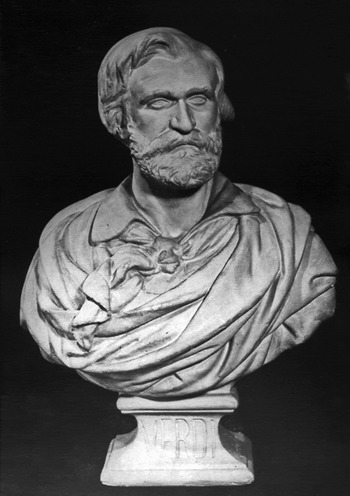
So reads the opening stanza of a poem by François-Joseph Méry, composed in 1866 and entitled Le Buste de Verdi.Footnote 30 Méry, Verdi's collaborator in the preparation of the French Don Carlos libretto, goes on to describe the process through which sculptor Jean-Pierre Dantan infuses inanimate stone with life.Footnote 31 The final product looks so surprisingly alive that ‘devant le modèle on s'écrie: Ils sont deux!’ (‘before the model one cries: There are two of them!’). The poem was written for a soirée organised by Verdi at his apartment on the Champs Elysées in Paris in February 1866. Unable to attend the gathering, Méry sent a letter with the poem, which was conceived as homage to both Verdi and Dantan. The latter had recently finished a bust of the composer, the reason for the celebrations at Verdi's home. According to later reports, the sculpture was displayed in the foyer of the Opéra only a few days after the premiere of Don Carlos.Footnote 32
Jean-Pierre Dantan, bust of Giuseppe Verdi.

The significance of this 1866 bust to my argument lies in its invitation to reflect on ways in which, during the latter part of the nineteenth and especially in the early twentieth centuries, Verdi's image was increasingly expressed in imperishable materials (stone, marble and metal). One likely explanation is, of course, the broad significance the composer had gained as a national and political figure. By the time of Unification, in around 1860, Verdi was something like a national idol, Italy's greatest and most widely known artistic celebrity. What is more, his construction as one of the most potent symbols of Italian patriotism also began at about the same time. Such a process fed on narratives invented and fostered by the composer and his early biographers in the increasingly nationalist climate of the period, and gradually led to the routine association of his early operas with the awakening of Italian national consciousness in the 1840s and 1850s.Footnote 33 Put differently, as early as the 1860s, at a time when Italy was facing political and financial problems, and its international reputation was distinctly precarious, Verdi and his works were being accorded the awe and respect that national monuments are usually intended to awaken.
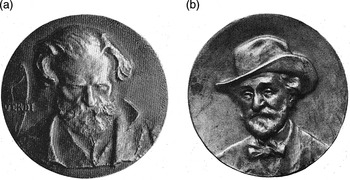
For the same reason, in subsequent decades Italians would raise monuments to Verdi also in a more literal sense. The proliferation, particularly in the early twentieth century, of Verdi medals and statues, as well as streets and squares named after the composer, was certainly due to ongoing appropriation for nationalist agendas. The commemorative events that followed his death in 1901 and the centennial of his birth in 1913, most of which were organised independently by various Italian municipalities in competition with each other, often included the commission of a monument or the issuing of a medal for the occasion.Footnote 34 The most famous monuments built in Verdi's memory (such as the ones in Milan, Parma and Trieste) date from the first or second decade of the twentieth century.
Two Verdi metals; reproduced from Giampiero Tintori, ‘Le medaglie verdiane nelle collezioni del Museo teatrale alla Scala’, in Atti del III° congresso internazionale di studi verdiani (Parma, 1974), 587–606.

The number of Verdi busts, statues and medals dating from the nineteenth century, on the other hand, is surprisingly small.Footnote 35 Dantan's bust is a very early example. What is most striking, the sculpture was placed in the foyer of the Opéra (a French theatre!) immediately after the lukewarm premiere of Don Carlos.Footnote 36 The two most famous Verdi busts sculpted by an Italian artist – those by Vincenzo Gemito, one in terracotta, the other in bronze – date from 1873 and were produced on the composer's commission in Naples, as was a further one of his wife Giuseppina Strepponi. They were not intended, that is, for public display; instead, they were delivered directly to Verdi's home at Sant'Agata.Footnote 37
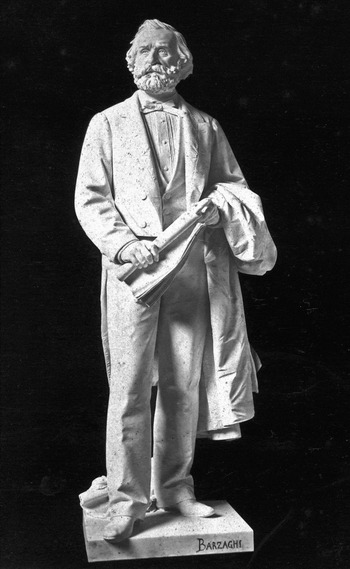
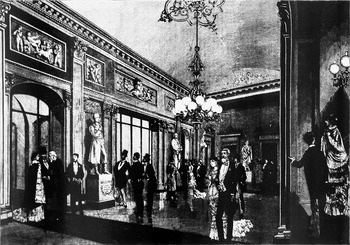
More interesting still, when a few years later Milan dedicated a statue to its most famous (living) adopted son, the news aroused a good deal of debate. In April 1880, following the triumphant success of Aida at the Paris Opéra, a group of distinguished Milanese suggested celebrating Verdi in a solemn ceremony and dedicating to him a statue that would join those of Rossini and Donizetti in the foyer of La Scala.Footnote 38 The news appeared in various local newspapers and caused comment about the appropriateness of dedicating a monument to a living person. ‘The idea of erecting a marble monument to an illustrious living man’ – commented Dottor Verità (alias Leone Fortis) in Il pungolo – ‘makes some shudder with dismay’.Footnote 39 While busts and statues of the living were already common abroad, the habit of solidifying into stone someone still breathing – the critic argued – remained unusual in Italy. Furthermore, the decision to produce such an enduring portrait implied that the person's fame was at an insuperable height, and unlikely to fade.Footnote 40 In 1880 Verdi did indeed meet (at least so it was claimed) this last condition; his artistic triumph in Paris provided the final impetus for the decision about solemn onoranze. However, immortalising the living composer and adding his statue alongside those of his buried predecessors felt problematic, all the more so given that a statue of Bellini was also commissioned, a few weeks later, for the same occasion. In October 1881, the year of Milan's National Industrial Exposition, the long-departed and the alive-and-kicking came together to form the image of Italy's nineteenth-century music history.Footnote 41
Statue of Verdi (by Barzaghi) in the foyer of La Scala.

The foyer of the Teatro alla Scala, with the new busts of Bellini and Verdi. Drawing by Antonio Bonamore, L'illustrazione italiana, 27 November 1881.

The 1881 Verdi (and Bellini) celebrations were in many ways local rather than national. Not only did the idea arise from a group of Milanese, but almost all the authorities at the statues’ inauguration were from that city (with just one representative sent by the central government).Footnote 42 This is less surprising when we consider that most of Italy's post-1861 monuments to politicians, revolutionaries, artists and intellectuals who had glorified the nation were based on a municipal initiative and paid for through public subscription. It is nevertheless also true that once the statues of the four composers were reunited and visible in the foyer of La Scala, their significance was far from merely Milanese; nor did they stand exclusively for a national parade of artistic talents. The frozen figures of the ‘four greats’ also served a practical function: they were reminders, tangible models, of where Italian music should develop in the future, and they appeared at a time when that future no longer seemed clear. ‘The honours granted to a living maestro’ – observed Lodovico Melzi, the president of the Committee for the celebrations – will encourage and advise the young, who are not always moved by tributes to those beyond the grave’.Footnote 43 In the circumstances of late nineteenth-century disputes between supporters and detractors of foreign or Italian music, modern portraits of composers could serve a hortatory function. The same function, as it happens, that on other occasions could be fulfilled by musical compositions.
Buried music
In May 1868 the Teatro Nuovo in Florence presented a work distinctly at odds with contemporary trends in the repertoire of most Italian theatres: Domenico Cimarosa's Il matrimonio segreto. This two-act dramma giocoso, first performed in Vienna in 1792, achieved great success in Florence and was then revived elsewhere in Italy. Although these performances always took place in minor theatres, they provided a ready stimulus for critical debate.Footnote 44 On various occasions Cimarosa's opera, as well as other similarly ‘ancient’ works (to which the Cimarosa performances had drawn attention), were welcomed as ‘monuments’.Footnote 45 The newness of the idea of reviving an old score, at a time when the operatic seasons in Italy consisted for the most part of either new works or the masterpieces of the four most popular nineteenth-century composers, did not go unremarked. Quite the opposite: it appealed to many. For more than one critic, the ‘resurrection’ of Cimarosa's opera could (and should) lead to the rediscovery of further works from Italy's operatic past, ones that had been forgotten in ‘dusty archives’ for too long.Footnote 46 It was not that such operas would become fashionable or sound attractively modern; to some ears Il matrimonio segreto now seemed as ‘archaic and obsolete’ as once it had seemed ‘new’. (After all, even an opera like Mozart's Don Giovanni, in an operatic centre such as Milan, was rarely performed in the second half of the nineteenth century.) Footnote 47 Rather, ancient scores were monuments first and foremost because they spoke of the age to which they belonged; they were traces of a world no longer in existence.
This new leaning towards the musical past was in line with trends summarised by Nietzsche in 1874 as the ‘consuming historical fever’ of his age.Footnote 48 Several, and not only those outside Italy, raised this point: ‘Our century’ – commented an Italian man of letters in 1869 – ‘is idolatrous of the past. Tirelessly archaeological, it seeks the monuments of our fathers, strives to reassemble the remains of time, writes histories, critiques, biographies’.Footnote 49 In an address concerning the teaching of history, Pasquale Villari likewise argued: ‘We are great restorers and repairers of the past […] the past has somehow become sacred to us’.Footnote 50 Paradoxically, the more closely we approach the end of the century – an age captivated by the idea of the future, progress and modernity – the more an attentive knowledge of the past becomes apparent.Footnote 51 As far as the Italian musical scene was concerned, the last decades of the century were characterised not only by the increasing circulation of foreign works, particularly those of Wagner, and tense debates about la musica dell'avvenire, but also by a (very slow) rediscovery of older compositions. The Cimarosa performances of 1868 were only the beginning of a trend that would increase in subsequent years.Footnote 52
‘Agedness’ was not, however, the only reason for Italian commitment to the Cimarosa revivals. According to some, ‘ancient’ scores were also to be encouraged because they could serve a pragmatic function: they could help combat the ‘futuristic’ trends increasingly followed by Italian composers writing under the influence of foreign music. Critic Filebo, for instance, in an article encouraged by the recent performances of Il matrimonio segreto, hoped that these revivals would inaugurate ‘the long-awaited reform and restoration of Italian art’. They could, he thought, counterbalance perilous tendencies among modern composers, who were increasingly drawn by vocal and harmonic complexities blowing in from abroad.Footnote 53 In this respect, a few observations made by renowned critic Filippo Filippi, evidently of a different opinion, are telling. Filippi, a warm supporter of Verdi and increasingly of German music (especially Wagner), reacted against what he described as the ‘ephemeral and exaggerated enthusiasm’ aroused by the Cimarosa revivals:
The audience are right to enthuse […] but those who exaggerate by hailing as a miracle every single note, every single bar are wrong; while in good faith, I believe they shout and get worked up so much in order to hide their real and spontaneous boredom, to which they would have surrendered ten years ago, when there did not exist today's fever for reaction, this itch for anti-progress, to which everything serves as a pretext, even the respectable name of Cimarosa.Footnote 54
Filippi's claim was that ‘Cimarosa's opera can be admired only as a historical monument’. In other words, despite his alignment to the current vogue of depicting the work as monumental, he disliked such anticaglie – as he called the pre-Rossinian works that were fuelling so much debate during that period. Far from providing models for composers at the start of their careers, they should only serve, in his opinion, as documents of a past age.Footnote 55 Thus, once again, as in the aforementioned discussions that would arise about the statues of Verdi and Bellini in 1881, the potential didactic function of monuments came to the fore. This function also explains why monuments were so prone to becoming objects of contestation.
Another episode, at about the same time as the Cimarosa revivals, fostered the description of certain musical works in monumental terms: Rossini's death in Paris on 13 November 1868. The sad news spread quickly through Italy. Commemorative concerts and opera performances took place in many cities, and busts of Rossini were often placed onstage, almost as if to reassure the audience that the composer was still present.Footnote 56 Such sculptures, of course, provided only a surrogate for the recently departed man (who had already been granted a monument by his home town of Pesaro in 1864 and would have several others dedicated to him in subsequent years). Yet they had the advantage of seeming less ephemeral than all-too-human flesh.Footnote 57 Rossini nevertheless also came to be depicted, post mortem, as a musical monument. According to critic Francesco d'Arcais, his operas – of which only a few were still regularly performed at the timeFootnote 58 – were ‘eternal monuments that time has not managed to destroy, and that now shine more brightly than ever’.Footnote 59 What is more, when Verdi suggested that he and other Italian composers should write a composite Mass to be performed on the first anniversary of Rossini's death, the idea was immediately welcomed as an ‘artistic monument’, a ‘monumental score’, ‘the most splendid monument than one could raise to Rossini's memory’.Footnote 60 Well before anyone could guess what it would sound like – the first performance was, as it happened, delayed by more than a century – the composition was added to the lengthening list of musical monuments.Footnote 61 For his part, Verdi seemed reluctant to make monumental claims. Although he did so on more than one occasion, he was quick to add that the Mass would only work as a monument if it adhered to precise conditions: that it should be performed in Bologna (the city in which Rossini had studied and lived for many years) on the anniversary of its dedicatee's death, and that immediately afterwards it should be locked away in an archive. In any other circumstances, it would be ‘a mere work of art’, ‘a mere musical concert’: an object lacking the sacral aura proper to monuments.Footnote 62
The long debates spurred on in the musical press by the Cimarosa performances and the plans for Verdi's Rossini Mass point to something easily overlooked when we address the topic of monumentality: that monuments are less the result of accepted stylistic properties, defining the monumental as an aesthetic category, and more the product of a set of values and beliefs contingent on an historical-cultural context. This shift away from a definition of the monumental in aesthetic (or stylistic) terms towards a more historically imbued understanding clearly lies among the aims of Alexander Rehding's recent book on the topic. As the author warns early on, musical monumentality is deceptively self-evident: it seems to be entirely encapsulated in bombastic and overwhelming sound effects.Footnote 63 Time and again, Rehding attempts to overthrow this view, lending monumentality a significance that is more tightly bound up with historical processes and attitudes.Footnote 64 Overall, however, his project seems to remain suspended between, on the one hand, interpretations that draw on the historically contingent and, on the other, a latent attraction to purely aesthetic (and more absolute) accounts. This emerges, for instance, when Rehding defines nineteenth-century monumentality in music as residing between
two distinct types of magnitude: one component, historical greatness, can be summarized under the modern keywords of collective memory and identity formation, while its other component, physical size, shows a marked tendency toward dramatic proportions (or even lack of any proportionality) that would elicit astonishment from its audiences.Footnote 65
This second element, Rehding goes on to explain, is often linked with the feeling of the sublime. Even if we argued, however, that ‘magnitude’ has to do less with monuments’ physical size than with their impact on the audience, such a claim remains problematic: and this because of the absolute terms of our discourse.Footnote 66
The lack of concern shown by nineteenth-century Italians for the sound of the proposed Mass for Rossini, and the distinctly ‘anti-monumental’ character of Cimarosa's Il matrimonio segreto, confront us with less steady views.Footnote 67 They encourage us to look beyond any fixed stylistic and aesthetic qualities when attempting to explain a work's monumentality. Ultimately, if there is a way in which stylistic features play a part in fostering monumental claims, this will only emerge from examination of a work's relationship to the historical-musical context in which such statements arise. Monuments may aspire to endless life, but they by no means exist in a timeless present.
… ed arbitro s'assise in mezzo a lorFootnote 68
[W]e believe that in such intelligent eclecticism resides the principal character of Verdi's music – and of course in an epoch of transition such as ours, the quality of this music consists in this character, which is also the chief reason for the success of Don Carlos.Footnote 69
As early as March 1867, when Don Carlos was first performed at the Paris Opéra, in its French five-act version, Italian journalists reported the responses Verdi's work aroused in France, as well as, in subsequent months, in Italy and elsewhere. By the time it reached Milan, in March 1868 and in an Italian translation by Achille de Lauzières, the opera was hardly a novelty. It did, however, raise considerable expectations, as well as renewing longstanding disputes between supporters and detractors of Verdi's music. As mentioned earlier, the dominance of the orchestra, the unusual harmonic progressions and the declamato vocal writing pointed, for many, to a break with the Italian musical tradition. Some of these arguments would later reappear in connection with the premiere of the revised, four-act opera at La Scala in 1884; but by that time Italian audiences had become acquainted with much of Verdi's 1867 music, including its most innovative aspects, and debate mostly centred around the newly composed pieces.Footnote 70
Of course, disquisitions about the extent to which Verdi had rejected the Italian operatic past had been part of critical writings for several years. Narratives of progress proliferated, and reflected both the nineteenth-century belief in a steady advance in both the arts and science, and the persistence of a Rossinian legacy as the yardstick against which all new Italian operas were to be judged. Don Carlo, however, arrived at a special moment. For one thing, the 1860s had been marked by a worrying shortage of new composing talent (none of the new works by Italian composers staged at La Scala between 1861 and 1868 was successful).Footnote 71 For another, Verdi's pace of composition after the 1850s had slowed consistently, and his only two new operas in the 1860s had been written for foreign theatres.Footnote 72 To make matters worse, as early as a few years after the achievement of a single geopolitical identity, Italy (as well as its theatrical system) experienced serious financial difficulties; images of crisis and decadence were indeed omnipresent in writings of the period.Footnote 73 In the circumstances, and owing to Verdi's half-new, half-old musical language, Don Carlo awakened feelings of ambivalence: that it lay at the boundary between the ‘old’ and the ‘new’; that it marked both the end and the beginning of a musical era.Footnote 74 What is more, the opera's oscillation between two temporal dimensions matched contemporary perceptions of Verdi in general as a composer whose exact position in the history of nineteenth-century Italian music was increasingly problematic: while most of his pre- Rigoletto operas were becoming old-fashioned and would soon fall out of the repertory, his latest compositions increasingly showed foreign (read ‘futuristic’) influences. As one critic put it, Verdi was ‘that colossus who represents the link between a great past and a greater future’; in the words of another, he was the ‘arbiter between two centuries, between two schools, between two peoples’.Footnote 75
Verdi's use of a novel musical language, one that led some critics to describe Don Carlo in terms of ‘eclecticism’, was thus a feature of the opera that could easily encourage comparisons with the contemporary historical and music-historical moment.Footnote 76 Although such a miscellany of forms and styles did not always appeal to the critics, it was praised on occasion, and this because it appeared to match well the current self-image of Italy and Italian music – both of which were suspended between an increasingly awe-inspiring past and an enticing if still uncertain future. In an article (quoted earlier) published in Il pungolo a few days after the Milan premiere, Leone Fortis went so far as to argue that Verdi's eclecticism was, in an ‘epoch of transition’, the main reason for the success of Don Carlo. More interesting still, it was not only the combination of conventional numbers and innovative pieces that stimulated attempts to read Verdi's opera in connection with contemporaneous circumstances; it was also the most modern aspects of the score, taken by themselves, that occasionally received interpretative attention linking them to that wider scene.
One of the most unconventional pieces of the 1867, five-act Don Carlo was the Grand Inquisitor scene in Act IV. Verdi's attachment to this number, which is characterised by unpredictable musical flow, extensive use of declamation and rich orchestral colours, is well known. The confrontation between Philip II of Spain, and the blind ninety-year-old priest, symbol of the repressive power of the Inquisition, was one of two scenes from Friedrich Schiller's play that Verdi had specifically asked to be included, and this at a very early stage of correspondence with his librettists.Footnote 77 It is thought provoking, to say the least, that the two scenes, the second being the duet for Philip and Posa in Act II, would have very different compositional histories: one (the Inquisitor scene) remained unchanged throughout all versions of the opera; the other (the Philip–Posa duet) underwent the most repeated and thorough-going revision of any part of the score. On various occasions after the opera's premiere, Verdi's special concern for the Philip–Inquisitor duet emerged, a sign that he was aware of the piece's groundbreaking qualities and of its mixed reception by the audiences. In 1869, in a letter to Giulio Ricordi, he lamented:
In D. Carlos I always hear talk of some duets or the aria in Act V, but never of the third act, which is the climax and, I would say, the heart of the drama; nor ever of the Inquisitor's scene, which is elevated somewhat above the other pieces.Footnote 78
A good thirty years later, in June 1900, he continued to regard the duet as especially significant, preparing a vocal-score reduction of its opening fourteen bars for display at Paris's Exposition Universelle.Footnote 79
Verdi cannot, however, have been entirely sincere when, in 1869, he complained that Act III (‘the heart of the drama’) and the Inquisitor scene were never discussed. In fact, the Act III finale and the Philip–Inquisitor confrontation were precisely the moments that had thus far most attracted critical attention. With regard to the duet, comments were not always positive, yet the novelty of Verdi's language was repeatedly remarked upon. After the Paris premiere, Filippi, writing for La perseveranza, observed:
The indeterminacy of form is such, the drama is so rigorously expressed, the word is followed with so much philosophical acumen that Philip's aria and the so-called inquisition duet can be called aria and duet only by name…Footnote 80
Commenting again on the duet in his ‘Studio analitico sul Don Carlos di Giuseppe Verdi’ (published in Ricordi's Gazzetta musicale di Milano in several instalments between January 1869 and July 1871), Filippi voiced his astonishment more clearly:Footnote 81
As soon as the count of Lerma has announced the arrival of the Grand Inquisitor, from the first orchestral chords we realise that we are dealing with a new type of music, full of hidden, tragic meaning. […] the sounds of the orchestra come from the depths of his [the Inquisitor's] viscera. […] this passage […] is the gloomy ritornello of the whole duet, but with very different passages and chords, over an insistent rhythmic movement. […] and so ends this wonderful duet, which the audience cannot appreciate immediately, but which becomes after repeated listening one of the most interesting, most beautiful, most philosophical moments of the opera.Footnote 82
Other critics also wondered at the unheard-of qualities of this music, particularly the recitative-like passages for the voices, which most differentiated Verdi's piece from the Italian, ‘melodic’ tradition.Footnote 83 The strikingly powerful musical battle between the two symbolical figures, representing the powers of State and Church, became thus caught up in the Italian discussions about la musica dell'avvenire, serving as the stage for further confrontations. Indeed, finding an exact position within the current musical scene for this peculiar piece – termed a ‘scène’ by Verdi in his autograph score and often called a ‘dramatic dialogue’ by nineteenth-century critics – turned out to be a matter of real importance.Footnote 84
A few days after the La Scala premiere, the music critic for the Gazzetta di Milano, ‘F. F.’, entered into a debate with the reviewer for Il pungolo, Fortis.Footnote 85 The latter had expressed his views on Don Carlo in three articles, which, despite overall praise for Verdi's work, criticised the excessively conventional character of some pieces.Footnote 86 ‘F. F.’, clearly overstating his colleague's assertions, summarised by saying that Fortis was encouraging Verdi ‘to write an opera entirely on the model of that duet between Philip II and the Grand Inquisitor, which is, we repeat, the most complete indictment of the wagnerian-mefistofelian system’.Footnote 87 We understand from the rest of the article that ‘F. F.’ was neither completely in favour of nor totally against Verdi's opera, in this sense following most of his colleagues. In general, he thought Verdi had been influenced too much by Meyerbeer, and that his individual character – his Italian melodies – was clearest in some of his earlier works. What is most striking, however, is that ‘F. F.’ went on to define the Inquisitor's scene in the following terms: ‘That duet is a miracle of art, but it is the ne plus ultra of indeterminate recitative, of melopoeia without rhythm’.Footnote 88Nec plus ultra: ‘not further beyond’ was the supposed inscription on the Pillars of Hercules, marking the end of the known world. It was a warning for sailors, a limit for navigation. In its more common meaning, however, the expression indicates perfection, the outer limit of what can be achieved. It even has an exemplary value, in some ways similar to that of the ‘classic’. It is perhaps significant that the same critic, in an article published only a few days before, describes the Philip–Inquisitor duet in precisely such terms:
that piece of music with no rhythmic melody, where the melodic line follows closely the words with classic brevity […] is both a glorious victory achieved by Verdi, who has been obliged to renounce the spontaneity of his genius in order to write melopoeia, and the defeat of the musicians of the future; nobody among those who form part of the antimelodic and antirhythmic school will ever be able to write music more unquestionably classic than this…Footnote 89
Tellingly, ‘F. F.’ placed Verdi's distinctly unconventional music for the Inquisitor scene in between the ‘old’ Verdi (the Italian tradition) and la musica dell'avvenire. In this sense, the critic's attempt to ‘classicise’ what often seemed unpromising melodies, ones that lacked any truly ‘melodic’ quality, may well speak of a desire to exorcise the Otherness of Verdi's new, speech-like vocal writing – by camouflaging it in a more acceptable, reassuringly classic disguise. At the least, his stance betrays the extent to which Verdi's scene was politicised in the Italian musical debates: it was seen as a vehicle for solving pressing problems, for reconciling opposite poles. What is more, the duet's unquestionable modernity, albeit disquieting, was beguiling enough for some to propose the piece as no less than a model for future Italian music.Footnote 90
Restoration works
When it came to revising Don Carlo in the early 1880s, Verdi himself must have thought that the time was ripe for taking the Philip–Grand Inquisitor scene as a model for that other political ‘dramatic dialogue’ in the score: the Philip–Posa duet of Act I (Act II in the original, five-act edition). This piece had already given Verdi remarkable difficulty over the past fifteen years. As is well known, it was one of only two numbers he felt compelled to readjust, with the help of Aida librettist Antonio Ghislanzoni, when he produced a revised edition of the score for performances in Naples in 1872. The crucial changes to the scene, however, were those made in 1882–1883, and would result in substantially refashioned music. After the discarding of the original lyrical movements, the piece now recalled the free declamation that characterised the (never modified) scene for Philip and the Inquisitor.Footnote 91
Don Carlo was of course not the first opera Verdi felt the need to revise at a later point. Its ‘restoration’ followed at least four similar undertakings: those to Macbeth (1847; revised version premiered in 1865), Stiffelio (1850; as Aroldo, 1857), La forza del destino (1862 and 1869) and Simon Boccanegra (1857 and 1881). Such revisions, which usually resulted in the heightening of stylistic disparity already at the heart of the original works, were conceived by Verdi at least partly as a response to changing musical tastes: they constitute evidence of how the original operas were received and point to Verdi's unceasing (if often unacknowledged) attention to both critics’ and audiences’ reactions. By ‘updating’ some of the music, particularly the most old-fashioned elements, Verdi hoped to provide a new version of a given opera more suited to modern tastes.Footnote 92 What is most remarkable, however, is that such remakings, starting at least with the late 1860s revision of La forza del destino, took place at a time when, in what we might call his burgeoning literary persona, Verdi was increasingly adopting conservative positions about how Italian music should develop. He himself, that is, entered the contemporary debates in which some recent and less recent operas were, for different reasons and to different ends, being described as ‘monuments’. Verdi's positions have far too often been smoothly summarised under his motto ‘torniamo all'antico, e sarà un progresso’ (‘let's return to the past, it will be a step forward’).Footnote 93 In fact, the composer's late operas and revisions, as well as his correspondence, suggest that his attitudes to the musica dell'avvenire and to the particular path young Italian composers should follow were more complex.
Throughout the 1860s, both the daily and the musical press in Milan were animated by diatribes about musical and aesthetic problems by a group of artists, some of them with impressive musical credentials, known as the Scapigliati (‘the dishevelled ones’).Footnote 94 The intensity of debate about new operas by young Italian composers (Boito's Mefistofele), the latest works of Italy's most famous composer (Verdi's Don Carlo and his revised La forza del destino) and recent compositions by foreign musicians (Meyerbeer's L'africana and Gounod's Romeo e Giulietta) was to some extent the result of the Scapigliati's ‘intellectualism’.Footnote 95 On several occasions Verdi disapproved of their abstruse theorising, lamenting their waffling about such concepts as ‘Art’, ‘Aesthetics’, ‘Past’ and ‘Future’.Footnote 96 Still, starting in the late 1860s and continuing for the next two decades, he occasionally put aside his distaste for such questions and commented, often in contradictory terms, on the future of Italian music. In December 1867 he depicted the role of the artist in a quasi-prophetic manner:
the artist must peer into the future, see new worlds in the chaos; and if on the new path, at its very end, he sees a feeble light, he should not be intimidated by the dark that enshrouds it: he should walk on, and if sometimes he stumbles and falls, he should get up and move ever onward.Footnote 97
Similarly, in a letter to his friend and senator-to-be Giuseppe Piroli, in May of the following year, he went so far as to list the steps modern composers had made in detaching themselves from the early nineteenth-century tradition.Footnote 98 And yet, only three years later, writing to Francesco Florimo, he would voice his famous call for a return to ‘the past’: to l'antico.
But what did Verdi mean by l'antico? And how might this relate to the debates about musical taste and monuments that emerged at the time? Much has been made of Verdi's motto since its appearance. Verdi, in the process of declining an invitation to be director of the Naples conservatory, originally used the phrase as part of his advice on how to improve music education in Italy. He recommended rigorous study of the old Italian masters (particularly Palestrina and his contemporaries), and little exposure to modern music. The danger of seeing modern operas, he argued, was that one could be charmed ‘by their many harmonic and orchestral beauties’ – ‘beauties’ that, interestingly enough, had been one of the hot topics of the debates around Verdi's latest works (Don Carlo in particular). Instead, students should focus on fugue and counterpoint, only afterwards composing their own music. This would save them from the risk of joining the ‘the crowd of imitators’ – another accusation that had recently been made against Verdi himself.Footnote 99 The letter – as Verdi must have expected – was soon published in newspapers and musical magazines, giving the motto its substantial notoriety in subsequent years.Footnote 100 Most interestingly, Verdi's austere advice was retrospectively loaded with alternative meanings, ones that do not always seem to reflect the original (admittedly ambiguous) sense. ‘Torniamo all'antico’ came to represent as much an exhortation for students to practise Palestrinian counterpoint as a rallying cry for those wishing to return to ‘truly Italian’ music (i.e. Rossini)Footnote 101 – as much a call for the rediscovery of the art of bel canto as a case for support, at the turn of the century, for the early music movement.Footnote 102 Verdi's motto, in other words, became weighed down with its own historical baggage.
An element common to all these appropriations of Verdi's statement resides in an attempt to foster the idea of a national(ist) revival of Italian music. What is rarely cited, though, is that Verdi makes another, equally arresting statement in that same letter to Florimo about l'antico: ‘I would have liked, so to speak, to put one foot in the past [passato], and the other in the present and the future, since I am not afraid of the music of the future’.Footnote 103 True, the expression musica dell'avvenire may not on that occasion have referred exclusively to foreign music; it may not have been at odds with the revival of the Italian musical tradition, which Verdi was supposedly supporting. Yet this and other elements – Verdi's invitation to study ‘modern declamation’;Footnote 104 his warning to young composers of the perils he himself had experienced and had cost him hurtful denunciations; his far from simple views on Wagner; the increasingly modern aspects of his late music – could at least invite reconsideration of what l'antico meant to him. Perhaps they might even lead us towards a more nuanced, more open-ended understanding of the older Verdi's call for a ‘return to the past’, and of his attitudes to ‘modern’ music. I cannot, of course, expand on this here. I should like, however, to consider briefly one possible resonance for Verdi of l'antico and try to apply it, if in a loose, non-prescriptive way, to the issue of the composer's late operatic revisions. This will eventually take me full circle back to the topic of monumentality.
‘So, neither the past [passato] nor the future!’, Verdi exclaimed in 1883, writing to Giulio Ricordi. This may sound like a renewed claim to be the long-awaited link that would connect the past with the future of Italian music: a new colossus of Rhodes, perhaps, with one leg on each side of the harbour of music's present. Verdi nevertheless went on to explain:
It is true that I said: ‘Let's return to the past [antico]’, but I mean the past [antico] that is groundwork, foundation, solidity; I mean that past [antico] which has been put on one side by modern exuberance, and to which we must inevitably return sooner or later. For now let's allow the river to overflow. We will build the banks later.Footnote 105
Here l'antico, which Verdi distinguishes from il passato, seems to indicate no musical past, no specific repertory or tradition. The attributes through which he describes it – ‘groundwork, foundation, solidity’ – could hardly be more generic. All of these words, however, confer an element of permanence and stability: far from serving as a historically descriptive concept, l'antico seems to suggest a suspension of all historical referents, the superseding of the contingent, the transitory, by means of the timeless. Perhaps it expressed a personal need, all too understandable in the aging Verdi, to stop what cannot be stopped, the inexorable passing of time.
Verdi's letter to Ricordi, which dates from only a few days before the La Scala premiere of the revised Don Carlo, may invite further thinking about the increasingly solid position that Verdi, both as opera composer and a national figure, had gained with Italian audiences. In the last decades of his life, he was fully aware of his status as both a musical and national ‘monument’, one that would almost certainly survive for many years and thus have an effect on future generations. The active role he took in building his public image is proof of this, as is the ‘operatic’, elevated tone of some of his letters. There is a sense, then, in which Verdi's mature revisions could also be read in this light: as an attempt to ‘monumentalise’ some of his most innovative music, to bestow an abiding status on some of his operas (ones that, in the new repertory-dominated musical system, he felt were going to last).Footnote 106 Verdi's continual preoccupation with the Philip–Posa duet, for instance, and his persistent emphasis on the Inquisitor scene, point to the fact that he was aware of the novelty of these pieces. Moreover, by treating these political conversations with such care, he was also making a point about opera as a genre: about what aspects of human life could be encompassed within the operatic realm.Footnote 107
We have, in all this, encountered one further implication of the concept of the ‘monumental’: the idea of durability and permanence. Modulation to this key might seem to lead away from the core idea of this essay. I have suggested that, if in late 1860s Italy Verdi's Don Carlo was labelled as a monument, it was mainly because it was perceived as poised between the past and the future, and during an historical moment that was as intrigued about these categories as it was uncertain about where to situate itself within the space opening up between them. Put differently, the monumental status of Verdi's opera was linked to the work's very modernity: to its ‘self-consuming actuality’, in Jürgen Habermas's definition; to its resonances with perceptions of time that were widespread in Italy at that period.Footnote 108 The infiltration of the idea of permanence – an idea we can hardly ignore when addressing the topic of monuments – does not, after all, cast any shadow on this point. And this not only because a monument's aspiration to everlasting life cannot, for better or worse, always be fulfilled, but also because, to borrow one of Frank Kermode's thoughts on the ‘classic’, it is all ‘a question of how the works of the past may retain identity in change’: how the model, be it one we call ‘classic’ or ‘monumental’, renews itself from one generation to the next by constantly remoulding its meaning – by, time and again, being made modern.Footnote 109
Robert Musil once suggested that ‘there is nothing in this world as invisible as a monument’.Footnote 110 Relentless presence, that is, brings about concealment. But to those who allow themselves a few seconds to look up, monuments can renew their narrative function. At the least, they can remind us of ‘the value of time’.Footnote 111 The aging Verdi may not always have welcomed the honours his contemporaries conferred on him through imperishable objects made of marble and stone; it was not by such means that he wished to defy the laws of nature. He did, though, take great pains in updating some of his music in order to save it from oblivion. Perhaps he was answering his operatic monuments’ call not to forget. In the words of Verdi's last collaborator, Arrigo Boito, no matter how worn and dated a monument becomes,