Introduction
Panic disorder (PD) is a debilitating condition affecting 2–5% (Guo et al., Reference Guo, Meng, Huang, Fan, Zhou, Ling and Su2016; Kessler et al., Reference Kessler, Chiu, Jin, Ruscio, Shear and Walters2006) of the general population over lifetime. Among them, 80.4% reportedly have comorbid conditions of other anxiety, mood, or substance abuse disorder (De Jonge et al., Reference De Jonge, Roest, Lim, Florescu, Bromet, Stein and Levinson2016) and its impact is stronger than many chronical physical illnesses (Investigators et al., Reference Investigators, Alonso, Angermeyer, Bernert, Bruffaerts, Brugha and Demyttenaere2004a, Reference Investigators, Alonso, Angermeyer, Bernert, Bruffaerts, Brugha and Demyttenaereb). Pharmacotherapy and cognitive behavioral therapy are the two options for first-line treatment. Both of them are effective albeit with limited effect size (Bighelli et al., Reference Bighelli, Castellazzi, Cipriani, Girlanda, Guaiana, Koesters and Barbui2018; Carpenter et al., Reference Carpenter, Andrews, Witcraft, Powers, Smits and Hofmann2018), therefore further research into its etiology is necessary for future interventions. A promising area of enquiry that may shed new light on PD pathology is adverse childhood experiences (ACEs).
ACEs refer to a broad range of stressful experiences that infants, children, and adolescents can be exposed to whilst growing up (Bernstein et al., Reference Bernstein, Stein, Newcomb, Walker, Pogge, Ahluvalia and Desmond2003; Bifulco, Brown, & Harris, Reference Bifulco, Brown and Harris1994). A large body of evidence has shown that ACE-exposed adults are at higher risk of various psychiatric and physical disorders (Edwards, Holden, Felitti, & Anda, Reference Edwards, Holden, Felitti and Anda2003; Heim & Nemeroff, Reference Heim and Nemeroff2001; Takizawa, Maughan, & Arseneault, Reference Takizawa, Maughan and Arseneault2014; Walker et al., Reference Walker, Gelfand, Katon, Koss, Von Korff, Bernstein and Russo1999); it might be anticipated that there should be a significant relationship between ACEs and PD. However, an estimate of the magnitude of this relation is absent from the current literature. The present study aimed to conduct a meta-analysis to estimate the overall odds ratio (OR) of having PD in adults who had ACEs compared to those who did not experience ACEs.
The present review, in addition to obtaining an estimate of the relationship between ACEs and PD in adulthood, also sought to consider the relative importance of different ACE types. ‘ACEs’ is a broad term encompassing experiences from malnutrition, poverty to physical abuse, parental mental health, lack of positive nurturance, and so on (Smith & Pollak, Reference Smith and Pollak2021). It is therefore reasonable to question if ACEs can be treated as one homogeneous group and be assumed to have similar neurobiobehavioral effects that in turn give rise to PD. Naturally, to explore the potential mechanisms, it would be beneficial to examine the specific ORs associated with different types of ACEs.
This task however is challenged by the lack of consensus among the literature over how to best conceptualize ACEs (Afifi et al., Reference Afifi, Salmon, Garces, Struck, Fortier, Taillieu and MacMillan2020; Guyon-Harris, Humphreys, & Zeanah, Reference Guyon-Harris, Humphreys and Zeanah2021; Karatekin & Hill, Reference Karatekin and Hill2019; McLaughlin, Sheridan, & Lambert, Reference McLaughlin, Sheridan and Lambert2014; Pollak, Vardi, Putzer Bechner, & Curtin, Reference Pollak, Vardi, Putzer Bechner and Curtin2005). Originally ACEs were classified into three main forms: abuse, neglect, and household dysfunction (Edwards et al., Reference Edwards, Holden, Felitti and Anda2003; Felitti et al., Reference Felitti, Anda, Nordenberg, Williamson, Spitz, Edwards and Marks1998). A later deprivation-threat/trauma dimensional framework was proposed (McLaughlin et al., Reference McLaughlin, Sheridan and Lambert2014; Zeanah & Sonuga-Barke, Reference Zeanah and Sonuga-Barke2016). Synthesizing the progress in neuroscience, Smith and Pollak (Reference Smith and Pollak2021) pointed out that the conventional sociolegal categories (i.e. abuse, neglect, household dysfunction) are not likely to map onto human biology. Moreover, it has been argued that it is very difficult to classify an experience on a definite deprivation-threat dimension as ACEs tend to be highly interrelated (Dong et al., Reference Dong, Anda, Felitti, Dube, Williamson, Thompson and Giles2004). For example, deprivation is often accompanied by perceived threat and chronic threat may also commonly co-occur with deprivation. The same authors further objected to the assumption that a specific type of ACEs is associated with a corresponding specific effect. They subsequently hypothesized that the form of an adversity has little effect on its impact, and that the ultimate neurobiological outcome depends on more lucid elements such as the developmental period, the intensity of the event(s), the child's environment, social context, and perception of the experience.
As a result, we believed that it would be premature to limit the ACE subgrouping approach to being either categorical or dimensional. We instead opted to test out multiple approaches. To be specific, we investigated whether the effect of ACEs on PD varies among groups divided by (1) categories such as abuse, neglect and dysfunction; (2) by spectrums of high or low in deprivation/threat and (3) by other means such as number of exposures (intensity) and time of the exposure (developmental period).
As there is no conclusive list of ACEs, we felt it was preferable to include as many types of ACEs as possible in the meta-analysis and thereby produce a richer understanding. In addition to the 10 items in the early ACE studies (Felitti et al., Reference Felitti, Anda, Nordenberg, Williamson, Spitz, Edwards and Marks1998), we applied the extended list (physical abuse, sexual abuse, emotional abuse, emotional neglect, physical neglect, exposure to domestic violence, household substance abuse, household mental health problems, parental separation or divorce, parental problems with police, spanking, peer victimization, household gambling problems, foster care placement or child protection agency contact, poverty, and neighborhood safety) suggested by a recent factor analysis study based on data from 1000 children and 1001 parents (Afifi et al., Reference Afifi, Salmon, Garces, Struck, Fortier, Taillieu and MacMillan2020) when screening citations.
In summary, we sought to (i) obtain an estimate of the relationship between ACEs and PD in adulthood and (ii) consider how different ACEs subtypes may be related to PD by taking multiple classification approaches (i.e. sociolegal, dimensional, cumulative effect, and developmental period of the exposure).
Methods
Search strategy and selection
The study was pre-registered at PROSPERO (ID: CRD42018111506). We searched for English articles in PsycINFO, MEDLINE, EMBASE and PILOTS using the following keywords: (child* OR adolescent*) AND (trauma OR abuse OR neglect OR maltreatment* OR adversity* OR separation* OR loss*) AND panic. The last search was run in June 2021. Inclusion criteria were studies that recruited: adults with diagnosis of PD (panic group); adults with no PD or PA (non-clinical control group) and assessed ACEs in both groups. Exclusion criteria were studies with participants who were under 18 years old or adults who reported traumatic events that had happened when they were over 18 years old.
A total of 2,967 citations were returned: 987 were duplicated, 1,980 were then screened by their titles and abstracts. In total, 1,921 were found to be irrelevant, leaving 59 for further assessment. Of these, 25 more citations were removed due to: non-representative control group (11), missing ORs/missing critical data to calculate the ORs (9), non-listed ACEs (4), and identical dataset used by two separate studies (1). There were, therefore, 34 studies eligible for final analysis (see online Supplementary Fig. S1).
Data extraction
The study design, nature of the participants, ACE types, and ACE measures were summarized by JZ. JZ and PW graded the quality of the studies independently following the STROBE checklist for cohort, case-control, and cross-sectional studies (https://www.strobe-statement.org/fileadmin/Strobe/uploads/checklists/STROBE_checklist_v4_combined.pdf) (Vandenbroucke et al., Reference Vandenbroucke, von Elm, Altman, Gøtzsche, Mulrow, Pocock and Initiative2014). Scores based on a scale of one to five, with five being best quality, were given to each of the 22 items, then the standardized total score (maximum 100) was converted to high (above 90), medium, and low (below 75). Missing ORs and their 95% confidence intervals were derived from the number of incidences of the four conditions (panic without ACE, panic with ACE, control with ACE, and control without ACE). Missing standard errors were estimated from confidence intervals utilizing the algorithm recommended by the Cochrane handbook:

https://training.cochrane.org/handbook/current/chapter-06#section-6-3-2. Taking the advantage of the robust variance estimation (RVE) model (discussed in the next section), we created one record for each point estimation. Multiple records were generated for studies that reported multiple ORs, either of various ACE types or of different populations.
Effect size analysis
Conventionally two models, fixed effects or random effects, are routinely used in meta-analysis. Compared to fixed-effect models, random-effects model relaxes the implausible assumption that all studies have exactly the same effect size. The relaxation allows the model to incorporate between-study errors. Nevertheless, both models share another assumption that effect sizes from different studies are independent, where there is generally no reason to presume such an assertion. It is obviously violated when a study produces several estimates based on the same individuals or when there are clusters of studies that are not independent (e.g. carried out by the same investigator or share the same dataset). Such violations are even more exigent in the current study when we tried to extract multiple indices of ACEs from one study. Therefore, we used RVE, a meta-analytic method for dealing with dependent effect sizes without knowing their covariance structure (Hedges, Tipton, & Johnson, Reference Hedges, Tipton and Johnson2010; Tipton, Reference Tipton2015). The R package robumeta (https://cran.r-project.org/web/packages/robumeta/index.html) was chosen to run the analysis. However, RVE retains the advantage of being able to account for between-study variance as in random-effects model.
Effect size interpretation
To interpret the strength of the OR in epidemiological studies, Chen, Cohen, and Chen (Reference Chen, Cohen and Chen2010) provided a calculation that maps OR to Cohen's d. They suggested that at a 5% disease rate in the non-exposed group, OR 1.52, 2.74, and 4.72 are equivalent to Cohen's d = 0.2 (small), 0.5 (medium), and 0.8 (large), respectively.
Subgroup difference analysis
We used the robumeta package (https://cran.r-project.org/package=robumeta) in R to run meta-regression supporting RVE and Wald tests to ascertain whether the effect sizes of subgroups are statistically different. Wald tests are hypothesis tests that involve multiple constraints on the regression coefficients (Gourieroux, Holly, & Monfort, Reference Gourieroux, Holly and Monfort1982). In other words, it determines if the predictive variable(s) in a linear model is significant.
Heterogeneity and moderator analysis
Heterogeneity was estimated using I 2 statistics (Higgins, Thompson, Deeks, & Altman, Reference Higgins, Thompson and Deeks2003). The heterogeneity was expected to be high given the diversity of ACEs and study designs.
In order to identify possible sources of heterogeneity, we used the R package ‘metacart’ (https://cran.r-project.org/web/packages/metacart/index.html) to assess the impact of potential moderators such as study quality, study design, sampling, and assessment methods. The package uses classification and regression trees (CART) model to identify multiple moderators and their interactions simultaneously (Li, Dusseldorp, Su, & Meulman, Reference Li, Dusseldorp, Su and Meulman2020). The reasons that we selected CART instead of the regular meta-regression model are threefold. First, the linear assumption of the relation between moderators and effect size is not always warranted. Second, when the number of included studies is small, meta-regression suffers from low statistical power (Tanner-Smith & Grant, Reference Tanner-Smith and Grant2018). Third, since behavioral and medical research are susceptible to multiple confounding factors, the number of moderators can be too large to fit into one meta-regression model. Conversely, the tree model is good at dealing with non-linear situation with many predictor variables that may interact, and produce easy-to-interpret results (Dusseldorp, van Genugten, van Buuren, Verheijden, & van Empelen, Reference Dusseldorp, van Genugten, van Buuren, Verheijden and van Empelen2014).
In brief, tree-based models split the data multiple times according to certain cut-off values in the predictor variables. A CART output forms a tree where each fork is a split in a predictor variable and each end (leaf) node presents a final prediction for the outcome variable.
Publication bias analysis
Determining the level of publication bias is problematic as the conventional approach such as the funnel plot or Egger's test cannot be applied to clustered multiple point estimates where the assumption of independence would be violated. Mathur and VanderWeele (Reference Mathur and Vanderweele2020) introduced an advanced method which relaxes the distributional and asymptotic assumptions. Accordingly, the R package PublicationBias (https://cran.r-project.org/web/packages/PublicationBias/index.html) was used to return the S-values and significant funnel plot.
The S-value, defined as the severity of publication bias, is the ratio by which affirmative studies (i.e. studies whose findings support the research questions) are more likely to be published than non-affirmative studies that would be required to shift the pooled point estimate (or the upper limit of the confidence interval) to the null hypothesis value. In other words, it is the minimum number of unpublished studies with a mean point estimate of zero (or another fixed value) that would need to be included in the meta-analysis to reduce the pooled estimate to ‘statistical non-significance’ (Rosenthal, Reference Rosenthal1979). A bigger S-value implies greater robustness to publication bias. Although there is no clear cut-off defined for S-value as it is a newly developed method, we referred to a previous study (Frederick & VanderWeele, Reference Frederick and VanderWeele2020) and concluded that the results were unlikely to be sensitive to publication bias as both values were bigger than 10.
Results
Study summary
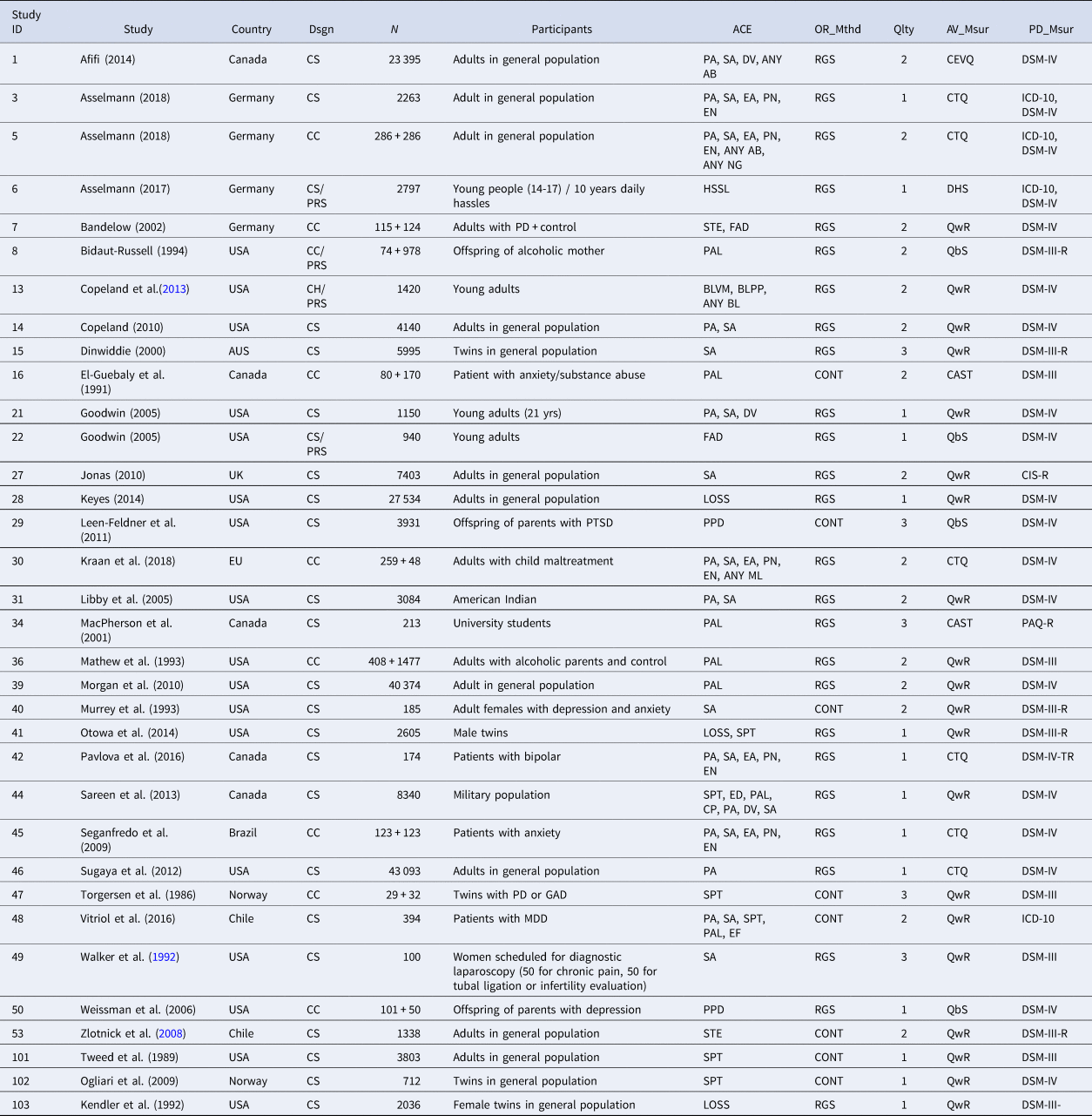
We identified 34 studies between 1985 and 2018 with a total of 192 ,182 participants (Table 1: study summary for study characteristics). Nine of these are case-control studies (5, 7, 8, 16, 30, 36, 45, 47, 50), while the rest are cross-sectional including one cohort study (13). The number of participants varied from 61 to 43,093. Fourteen studies assessed more than one type of ACE (1, 3, 5, 7, 13, 14, 21, 30, 31, 41, 42, 44, 45, 48); three studies examined one ACE but reported separate ORs for males and females or for different age groups (15, 28, 39); two studies evaluated a set of ACEs in each gender (44, 45); and four studies recruited participants in one gender only (40, 41, 49, 103). The majority of the studies used recognized clinical criteria to assess PD (DSM-III, DSM-IV, and ICD-10) but saw diverse methods of ACE assessment. Ten studies adopted standardized questionnaires (1, 3, 5, 6, 16, 30, 34, 42, 45, 46), and the remaining 24 studies developed their own methods or relied on screening criteria based on the characteristics of the samples.
Study summary

CS, cross-sectional; CC, case-control; CH, cohort; PRS, prospective; ANY AB, any abuse; SA, sexual abuse; PA, physical abuse; EA, emotional abuse; ANY NG, any neglect; PN, physical neglect; EN, emotion neglect; PAL, parental alcoholism; PPD, parental mental illness; FAD, family anxiety disorder; SPT, family separation; LOSS, loss of loved ones; CP, child protection; HSSL, daily hassles; DV, domestic violence; ED, economic deprivation; BLPP, bully perpetrator; BLVM, bully victim; ANY BL, any bullying; STE, other traumatic event; ANY ML, any maltreatment; QbS, characteristics of participants; QwR, questions design by the study; CTQ, childhood trauma questionnaire; THQ, trauma history questionnaire; CAST, children of alcoholics screening test; CEVQ, childhood experiences of violence questionnaire; DHS, daily hassles scale; RGS, regression modelling; CONT, incident counts; 1, high; 2, medium; 3, poor.
The studies can be classified as ACE studies which explored the influence of a specific ACE (6, 13, 14, 15, 27, 28, 40, 41, 46, 49, 101, 102, 103) or a collection of ACEs (1, 3, 5, 30, 31, 42, 44, 48, 53), and panic studies which were interested in early experiences within the PD population (7, 21, 45, 47). There were seven comorbidity studies (16, 21, 40, 42, 45, 47, 48, 49) that recruited participants with other psychiatric conditions (PTSD, bipolar, major depression, and substance use). Whereas the panic studies focused on PD only, the ACE studies dealt with a range of psychiatric disorders. In addition to the association between PD and ACEs, two studies inquired into gender differences (44, 45), and one study compared the impact of trauma in childhood and adulthood (53). It is noteworthy that the majority of the studies relied on retrospective reporting to sample the prevalence of ACEs; only four studies utilized prospective sampling (6, 8, 13, 22).
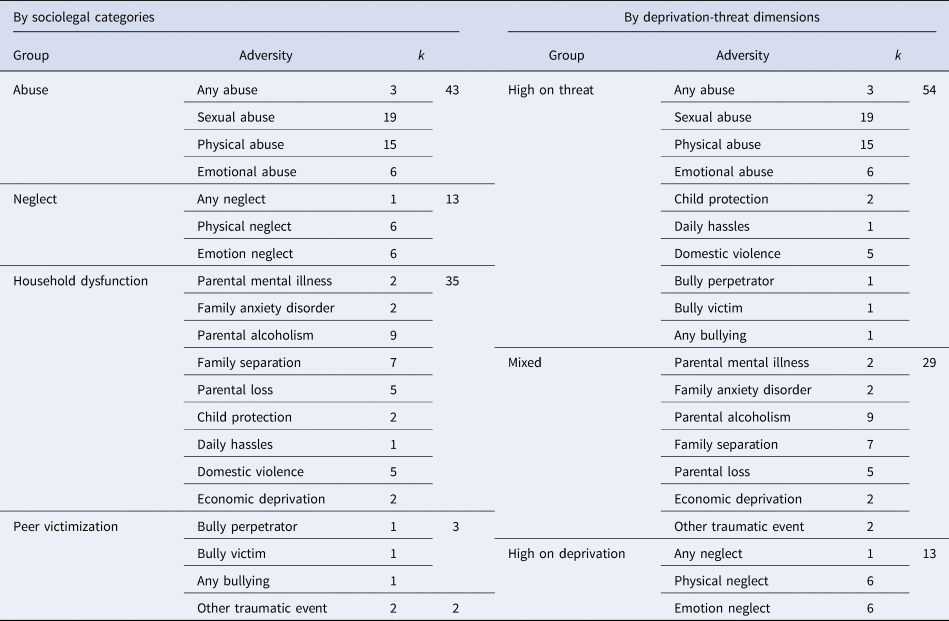
In respect of ACE types, most studies included physical, sexual, and emotional abuse/neglect, which are the conventionally representative ACEs, fewer studies included covert parental and familial conditions. Altogether, five looked at parental alcoholism (8, 16, 34, 36, 39), four family mental illness (7, 22, 29, 50), and eight studied parental loss/separation (28, 41, 44, 47, 101, 102, 103). Regarding the more recently recognized ACEs, one studied bullying (13), one studied daily hassle (6), one studied economic deprivation (44), and one studied involvement with child protection agencies (44). We organized the 20 ACEs by two approaches, the sociolegal and threat-deprivation perspectives (see Table 2). The left part of Table 2 shows four groups: abuse, neglect, household dysfunction, and peer victimization (i.e. the sociolegal classification), while the right side enumerates three groups: high on threat, high on deprivation, and mixed, based on the dimensional model. These subgroups are inevitably arbitrary due to the yet to come objective measures for ACE classification.
ACE summary

K, number of extracted data entries, not number of studies.
Overall and subgroup effect size estimates
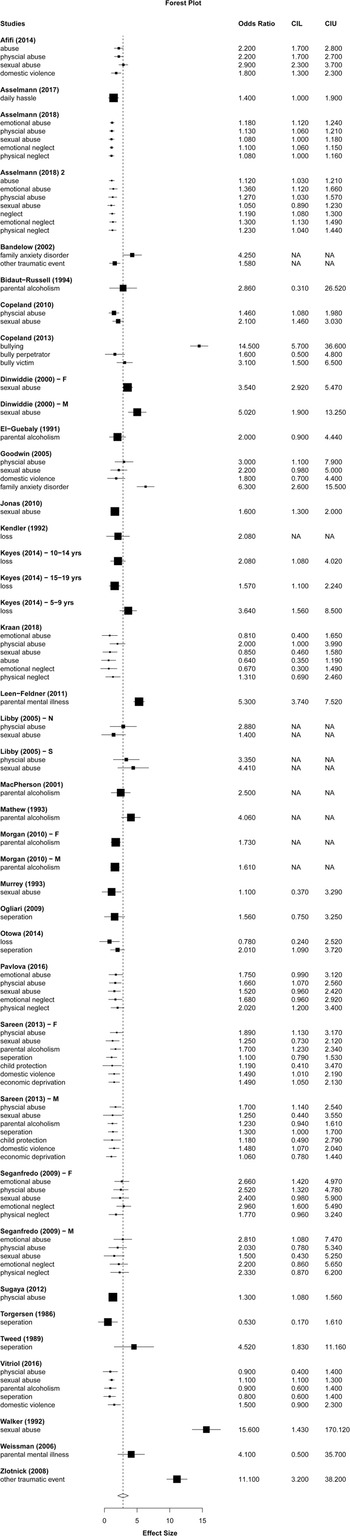
Ninety-six effect sizes extracted from 34 studies were entered into our main analysis (see online Supplementary Table S1; or https://osf.io/m3dsy/ for csv file). Although the data were extracted from 34 studies, several studies published point estimates of identical ACEs obtained from different samples. Therefore, the R program recognized 40 clusters. Subsequently, we marked these subgroups as separate studies in the results (see Fig. 1).
Forest plot

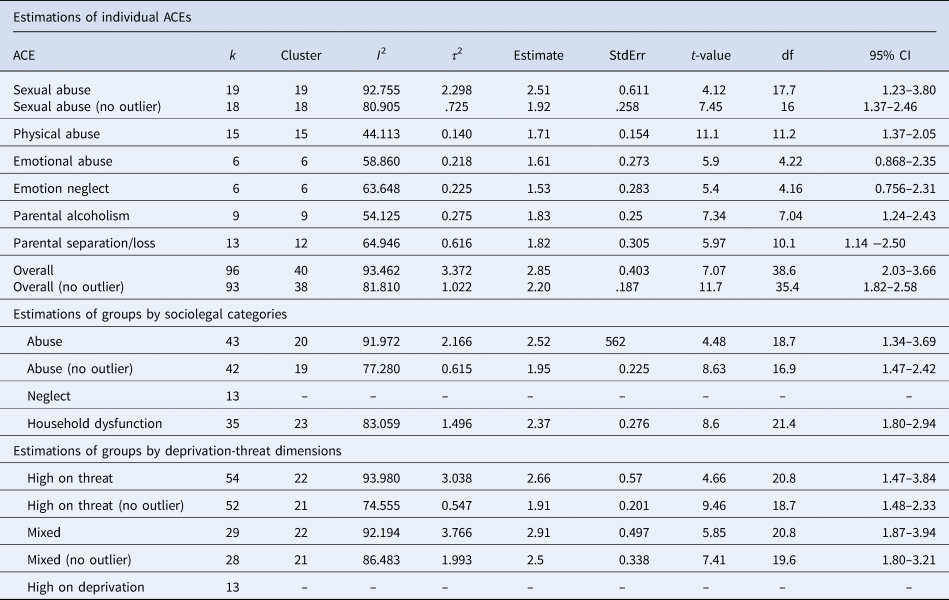
The forest plot (Fig. 1) displays the distribution of the point estimates. The RVE model yielded an overall OR of 2.85, 95% CI (2.03–3.66). Three studies stood out for their large effect size. Copeland, Wolke, Angold, & Costello (Reference Copeland, Wolke, Angold and Costello2013) reported 14.5, CI (5.7–36.6) on bullying (both perpetrator and victim), Walker et al. (Reference Walker, Katon, Hansom, Harrop-Griffiths, Holm, Jones and Hickok1992) reported 15.6, CI (1.43–170.12) on sexual abuse and Zlotnick et al. (Reference Zlotnick, Johnson, Kohn, Vicente, Rioseco and Saldivia2008) reported 11.1, CI (3.2–38.2) with other trauma. Analysis was not feasible for several individual ACE types (physical neglect, parental mental illness, family separation, parental loss, child protection, daily hassles, domestic violence, economic deprivation, peer victimization, other traumatic event, and neglect group), either because the sample sizes were too small, or the degree of freedom was insufficient (smaller than four). A post-hoc decision was paid to pool family separation and parental loss effects together as a ‘parental separation/loss’. Pooled results for single ACE types and subgroups are presented in Table 3. These ranged from 1.53, 95% CI (0.756–2.31) for emotional neglect, to 2.51, 95% CI (1.23–3.8) for sexual abuse. All abuse types increased the odds of having a PD with the exception of emotional abuse and emotional neglect.
Pooled OR estimates

–: df<4, pooling not applicable; k: number of point estimates; Cluster: number of clustered groups.
With respect to groups (either sociolegal, or deprivation-threat dimensions) the mixed group yielded the largest OR [2.91, 95% CI (1.87–3.94)]; this remaining the case even after outliers were removed. All groups significantly increased the odds of having PD.
Heterogeneity was moderate for physical abuse, emotional abuse, and parental alcoholism, while considerably greater for all other ACE subtypes and groups. Heterogeneity was substantially reduced after excluding the outliers; adjusted ORs were therefore used as final results for discussion.
Subgroup difference
There was no significant difference detected among the effect size of subgroups either by sociolegal categories (p = 0.261) or threat-deprivation dimensions (p = 0.145; see Supplementary Appendix C: original R outputs of subgroup difference analysis). This pattern of results remained even when excluding outliers (ps = 0.350 and 0.341, respectively).
Moderators
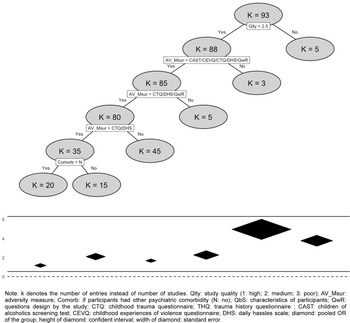
Study design, OR calculation method, quality of study, participants with comorbid psychiatric disorders, and adversity assessment method were entered into the multiple moderator analysis. Only study quality, comorbidity, and ACE assessment method were identified as influential moderators (see the original R output in Supplementary Appendix A). Figure 2 illustrates the splitting process and six more homogeneous subgroups identified by the CART model. Studies measuring ACEs based on the characteristics of the sample without further assessment (AV_Msur ≠ CAST/CEVQ/CTQ/DHS/QwR, k = 3) reported the highest pooled OR [4.9, 95% CI (3.8–6.0)], followed by the group of lower study quality [Qlty > 2.5, k = 5, OR = 3.7, 95% CI (3.1–4.3)]. The remaining 85 entries formed four similar groups where the type of ACE measure mainly accounted for heterogeneity. It is worth noting that the comorbidity group (Comorb ≠ N, k = 15) reported significantly higher mean OR 2.0, CI (1.7–2.4) than the non-comorbid group [Comorb = N, k = 20, 1.1, CI (0.9–1.3)].
Moderator tree

Publication bias and sensitivity test
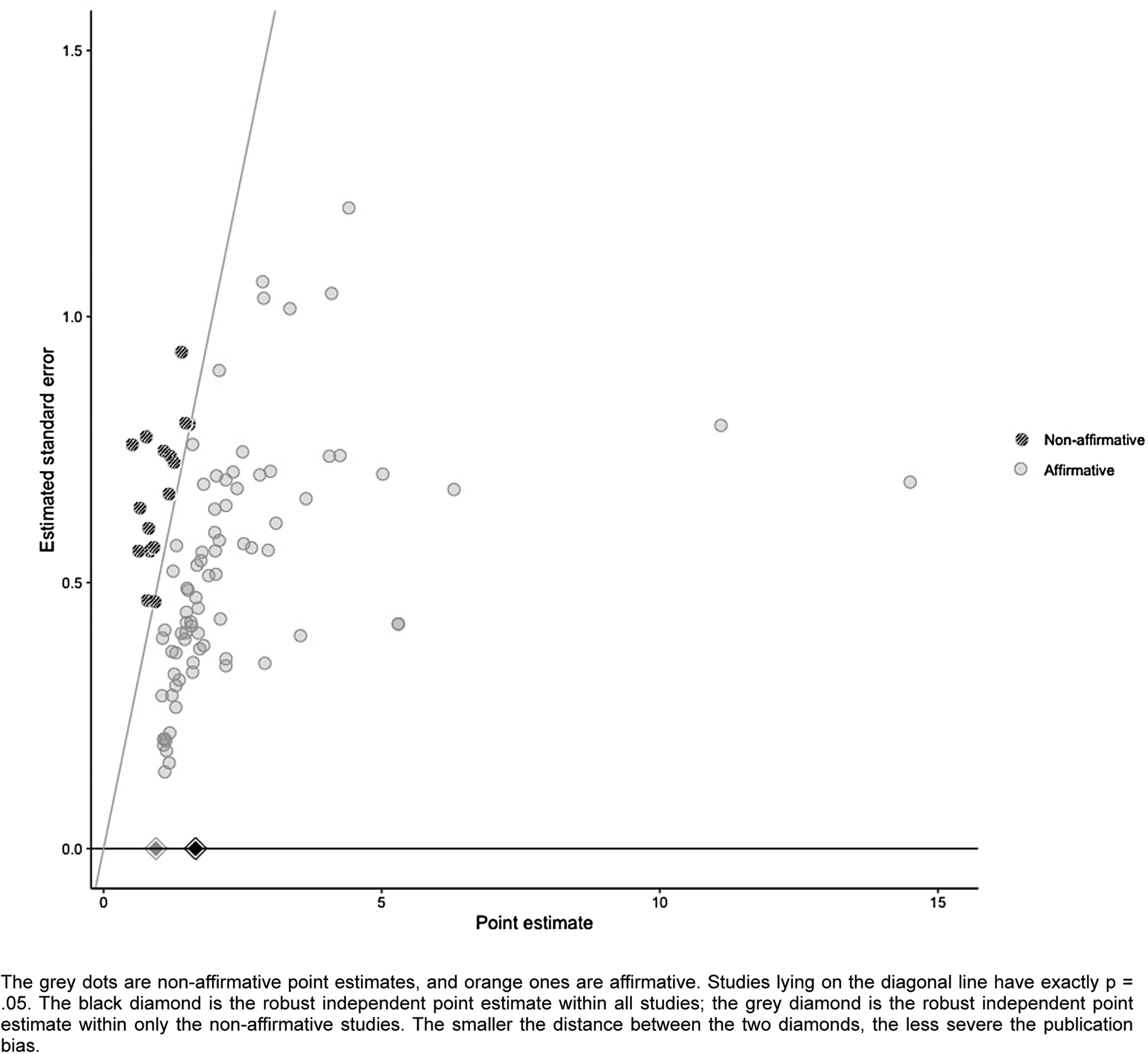
The significant funnel plot (Fig. 3) demonstrates an unconventional funnel plot. The effect size distribution is skewed toward affirmative studies, and there is a tendency to a positive correlation between effect size and standard error, which suggests publication bias.
Funnel plot.

We conducted sensitivity testing by measuring the S-values of null hypothesis (OR = 1), and a value close to 1 (OR = 1.1); the results are presented in Table 4. Based on the robust model which took account of the dependent clusters, it appeared that it would be almost impossible to shift the estimated magnitude from the pooled effect size estimate suggested in the present study to the null hypothesis, since it would require the number of non-affirmative studies to be more than 200 times of the number of affirmative ones. Likewise, the ratio between non-affirmative and affirmative studies would need to be as high as 72 in order to shift the OR to 1.1.
Publication bias sensitivity test

Note: severity of publication bias (S) required to attenuate $\mathop {\hat{\mu }}\limits^\dot ^{\prime}$ (effect size) or $\hat{\mu }^{lb^{\prime}}$
 (the upper limit of the CI) to null (q = 1) or q′ = 1.1 on the odds ratio. Values are conservatively rounded down to the nearest integer.
Discussion
With the assistance of an RVE model, we overcame the issue of clustered point estimates and conducted a meta-analysis assessing the magnitude of the association between childhood adversity and PD. Our analysis returned a mild to medium strength association between ACEs and PD. We should note that although the overall magnitude is stronger than some of the individual ACEs, it should be interpreted with great caution due to high heterogeneity. Based on their medium levels of heterogeneity and small variance, we are inclined to conclude that pooled results within individual types of ACEs are more robust.
Moderator analysis revealed that, apart from common methodological factors such as study design, quality, and measurement issues, comorbidity was the only clinical factor that influenced the effect size and ACEs were more prevalent in the comorbid population (Fig. 2). It is estimated that the majority (80%) of the PD population present comorbidities (De Jonge et al., Reference De Jonge, Roest, Lim, Florescu, Bromet, Stein and Levinson2016) while there were only seven citations in this review that were comorbidity studies, it is unclear whether other studies excluded comorbidity cases for better controlled data or they neglected to report the condition. Thorough investigation on this subject with qualitative magnitude will be valuable information. If stronger link was found in ACEs and PD with comorbidity than PD only, it would suggest early-life stress could be a global risk to mental illnesses.
Looking for specificity between types of ACE and PD was another goal of the study. If we classify the results into significant or non-significant based on whether the confidence intervals contain the null hypothesis value, sexual abuse, physical abuse, parental alcoholism, and separation/loss are significant risks for PD, whereas emotional abuse and neglect are not. However, considering the number of entries (k = 6) and the degrees of freedom (df <5) were much lower than those eligible for pooling, we are uncertain if they are an artefact of insufficient data. Moreover, from the continuous point of view, the effect sizes of emotional abuse and emotional neglect are somewhat homogeneous with regard to the pooled estimates and their confidence intervals overlapped with others, it is more likely that the mean ORs are not statistically different from the other ACEs.
The study also explored the specificity by exploring two systems for conceptualizing ACEs. One divided the ACEs from a sociolegal point of view and the other dissected them against threat-deprivation dimensions. No difference was found among the ORs of these subgroups by either grouping method; on the contrary, we observed consistent pooled estimations. ACEs are one of many factors that may predispose people to developing PD; other factors such as genetic disposition and life events could have attenuated the between-ACE variations. Nevertheless, the non-conclusive results could also imply that the current ACEs constructions (abuse, neglect, dysfunction, threat, deprivation, etc.) might not be able to successfully account for the neurobiobehavioral impacts of ACEs that lead to PD. This may be consistent with Smith and Pollak's hypothesis that other elements such as perception and attachment are the real drivers to specificity.
These findings add to the concerns raised about the measurement of ACEs, as these domains are not often integrated in ACEs studies. Although the neuroscience in ACEs research has progressed beyond the traditional sociolegal categorical models, there is a lag in the clinical studies. In the 34 reviewed studies, despite many of them examining multiple types of ACEs, none of them reported the cumulative data that are sufficient to allow the calculation of the ORs of PD and varied number of ACEs. The developmental period in which the child experienced the adversity is even less studied. Only one out of the 34 studies compared the impact of ACEs that occurred at different age groups and no study at all was concerned with the other dimensions (environment, social context, and attachment).
Clinical implications
The mild, albeit consistent, link between ACEs and PD should not be overlooked in delivering PD treatment. The learning prospective of PD and ACEs has provided ample evidence that hyper(re)activity to stressors formed at an early age remains deep-seated in the complex human stress-response system (Dempster, O'Leary, MacNeil, Hodges, & Wade, Reference Dempster, O'Leary, MacNeil, Hodges and Wade2020; Shonkoff et al., Reference Shonkoff, Garner, Siegel, Dobbins, Earls, McGuinn and Care2012), and that these chronic patterns create extra obstacles to extinction learning and to behavioral change (Soltani & Izquierdo, Reference Soltani and Izquierdo2019). A study that investigated the role of childhood trauma in CBT outcomes for PD with agoraphobia found that ACEs predicted greater psychopathology at pretreatment, poorer treatment response, and higher relapse rates (Michelson, June, Vives, Testa, & Marchione, 1998). It may be that assessment protocols for PD should include ACEs history. To improve treatment efficacy, clinicians may also consider adapting the number of sessions, treatment modalities, treatment components, and case management for PD patients with history of ACEs.
Limitations and future research
We sought to be as inclusive as possible in order to evaluate the impact of ACEs on PD as extensively as possible. However, there was an absence of eligible studies that would allow us to address the planned list. Even when we obtained a few point estimations for family mental illness, bullying and other trauma, the data were not sufficient to approximate a pooled effect size. Family mental illness, in particular anxiety disorders, provides a unique perspective to examine the combined effect of genetic and environmental risks. Bullying (e.g. bullying at school, cyberbullying) is a growing concern for school-age children and adolescents. Our understanding of its pernicious effect on PD could have been advanced if data were available; more research is needed.
For the same reason, our analysis did not take account of the other dimensions (e.g. intensity, developmental period, cumulative effect) that might be more neurobiologically meaningful. Whether these newly proposed dimensions are more pertinent to the PD etiology and whether they foster a more sophisticated ACE construct need to be tested. Besides the absence of a concrete ACE definition at the conceptual as well as at operational level, the moderator analysis suggested the major source of heterogeneity resides within the ACE measures. We speculate that developing reliable and meaningful new ACE measures will be a continuous endeavor to the field.
PD presents a broad set of presentations in terms of symptoms, severities, and comorbidities, and assessing the relationship between ACEs and these PD characteristics may bear more fruitful findings.
Conclusions
Our literature search returned 34 studies with a total of 192 182 participants. Ninety-six estimations of 20 types of ACEs were extracted. An RVE model, supporting meta-analysis for clustered estimations, returned mild to medium overall OR and significant but small ORs across sexual abuse, physical abuse, parental alcoholism, and parental separation/loss. Homogeneous mean effect sizes were yielded across subgroups. No between-group difference was identified by either sociolegal classification (abuse, neglect, household dysfunction) or threat-deprivation dimensions (high on threat, high on deprivation, and mixed). The non-conclusive results either suggest the effects of ACEs on PD are truly comparative, or it raised the question whether the categorical or dimensional constructs of ACEs are the definitive ways to conceptualize the impact of ACEs on later mental health.
Supplementary material
The supplementary material for this article can be found at https://doi.org/10.1017/S0033291721004505.
Author contributions
J.Z. and R.M.S. designed research; J.Z. and P.W. did the literature search and study quality rating; J.Z. and R.M.S. did the citation screening; J.Z. analyzed data; R.M.S and S.S. contributed to the paper draft; J.Z. wrote the paper.
Financial support
This research received no specific grant from any funding agency, commercial or not-for-profit sectors.
Conflict of interest
None.