Introduction
As part of a revision of the genus Buellia in the Iberian Peninsula, several specimens previously identified as Buellia hypophana and B. reagens have been studied. These are well characterized by their xanthone content, by the presence of a K+ purple-red yellow pigment mainly located in the hypothecium and the medulla below it, and by the rather large, 1-septate ascospores with additional pseudosepta when overmature. A thorough literature search (e.g. Poelt Reference Poelt1969; Clauzade & Roux Reference Clauzade and Roux1985; Wirth Reference Wirth1995b; Marbach Reference Marbach2000; Nordin Reference Nordin2000) revealed that, in addition to the two species mentioned above, other taxa might be involved in the Iberian flora, such as B. andicola Müll. Arg. ex Zahlbr., B. hypoleuca H. Magn. and B. thiopoliza (Nyl.) Boistel. A study of the type material of these taxa has shown that they are all conspecific and well accommodated in the genus Tetramelas Norman, except B. hypoleuca which is a synonym of Phaeorrhiza sareptana var. sphaeorocarpa (Th. Fr.) H. Mayrhofer & Poelt.
A second aim of this study is to provide a key for all known Tetramelas species, which are so far treated in many dispersed contributions (Marbach Reference Marbach2000; Kalb Reference Kalb2004; Nordin Reference Nordin2004; Nordin & Tibell Reference Nordin and Tibell2005; Giralt et al. Reference Giralt, Paz-Bermúdez and Elix2009).
Material and Methods
This study is based on herbarium material from G, H, LISU, M, PO and from the private herbaria of J. Etayo (Spain), K. Kalb (Germany) and P. P. G. van den Boom (The Netherlands). Lichen morphology was examined by standard techniques using stereo and compound microscopes. Only free, mature ascospores lying outside the asci have been measured. Measurements were made on material mounted in water at ×1000 magnification. Mean value ( ) and standard deviation (SD) were calculated and the results are given as (minimum value observed)
± SD (maximum value observed).
, SD and n (the total number of ascospores measured) are given in parentheses. The terminology used here for the asci follows Rambold et al. (Reference Rambold, Mayrhofer and Matzer1994), Nordin (Reference Nordin2000) for the excipulum-type, Nordin (Reference Nordin1997) for the ascospore septation and Giralt (Reference Giralt2010) for the ascospore and ontogeny-types.
Chemical constituents were identified by thin-layer chromatography (e.g. Culberson & Ammann Reference Culberson and Ammann1979; Culberson et al. Reference Culberson, Culberson and Johnson1981; Culberson & Johnson Reference Culberson and Johnson1982) and high performance liquid chromatography (HPLC) (Elix et al. Reference Elix, Giralt and Wardlaw2003).
The key to species has been constucted from our own data and the following literature: Nordin (Reference Nordin1999, Reference Nordin2000, Reference Nordin2004), Giralt et al. (Reference Giralt, Barbero and Elix2000, Reference Giralt, Paz-Bermúdez and Elix2009), Marbach (Reference Marbach2000), Foucard et al. (Reference Foucard, Moberg and Nordin2002), Kalb (Reference Kalb2004), Nordin & Tibell (Reference Nordin and Tibell2005) and Bungartz et al. (Reference Bungartz, Nordin, Grube, Nash, Ryan, Diederich, Gries and Bungartz2007).
The Species
Tetramelas thiopolizus (Nyl.) Giralt & Clerc comb. nov
MycoBank No.: MB561208
Lecidea thiopoliza Nyl., Flora 56: 244 (1878); type: France, Arvernia, sur les rochers qui dominent la Bourboule prés du Mont Doré, Lamy, 1877 (H-NYL 10368!—lectotype, selected here; H-NYL 10367—isolectotype!). Two additional specimens (H-Nyl—10366! and G—290893!) could also be original material but the collection date is 1878 or is lacking, respectively).—Buellia thiopoliza (Nyl.) Boistel, Nouv. Flore Lich. 2: 230 & 233 (1903).
New synonyms: Buellia hypophana (Nyl.) Zahlbr., Cat. Lich. Univ. 7: 367. (1931).—Lecidea hypophana Nyl. apud Hue, Bull. Soc. Bot. France 34: 473 (1887); type: France, Auvergne, Cantal, à la Roquevieille, 1886, Fuzet (H-NYL 10648—holotype!).
Hypoflavia andicola (Müll. Arg. ex Zahlbr.) Marbach, Bibliotheca Lichenologica 74: 292 (2000).—Buellia andicola Müll. Arg. ex Zahlbr., Acta Horti Gothob. 2: 25 (1925–1926); type: Chile, Anden, über Moosen, ex Herbarium Hampe 1877 (G290798—holotype!).
Buellia reagens H. Magn., Broteria IV: 148 (1947); type: Portugal, Beira Alta, Serra da Estrela-Caldas de Manteigas, 850 m, sur le granite moussu, 1944, Tavares (LISU).
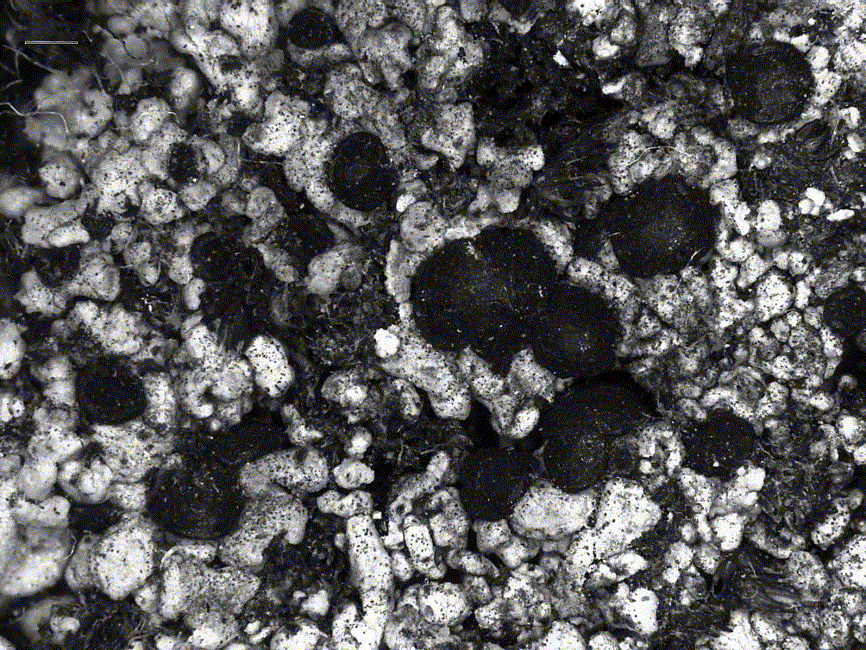
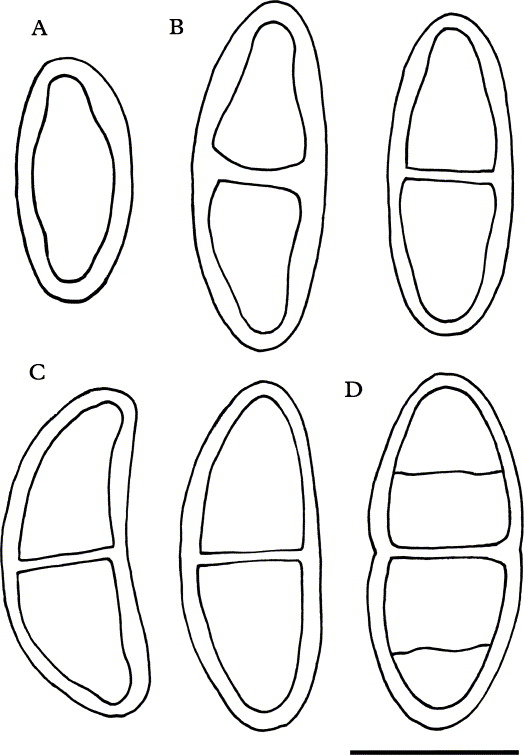
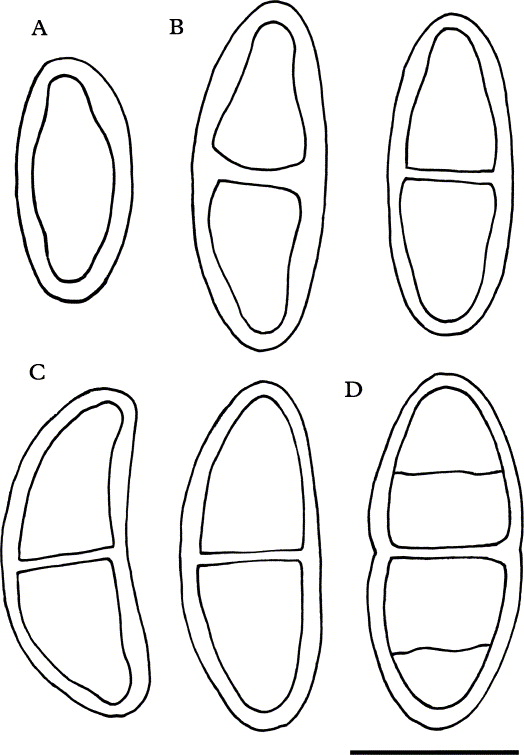
(Figs 1 & 2)
Tetramelas thiopolizus (G 290893), habitus. Scale = 500 µm.

Tetramelas thiopolizus, ascospore ontogeny and variability (hb. v. d. Boom 19535). A, immature non-septate ascospore with subapical thickenings; B, young Callispora-type ascospores; C, mature Buellia-type ascospores; D, overmature ascospore with a pseudoseptum per cell. Scale = 10 µm.
Thallus subsquamulose, areolate; areoles discrete and bullate to usually contiguous, sublobate, some almost lobate-effigurate, plane to verrucose, whitish grey, ochraceous, yellowish, yellowish orange to dull brown; basal part of some areoles include a yellow pigment reacting K+ purple-red. Medulla normally I+ weakly violet (microscope slide!) rarely I−.
Apothecia lecideine, adnate to sessile, black, up to 1·25 mm diam., often confluent. Proper margin initially thick and prominent, becoming thinner and finally ±excluded. Disc plane to convex, epruinose. Excipulum proprium very well developed, up to 100 µm thick, including some C+ orange crystals (microscope slide!), prosoplectenchymatous, outer part brown, N−, inner part paler
(see Nordin Reference Nordin2000, Fig. 4A & B). Epihymenium brown, N−, with C+ orange crystals (epipsamma). Hymenium colourless, 60–100 µm high, without oil droplets, often including rows of some C+ orange crystals. Hypothecium dark brown, basal part with a yellow pigment reacting K+ purple-red. Paraphyses, apical cells strongly swollen, up to 7 µm diam., brown. Asci Bacidia-type. Ascospores (14–)17–22·5(–27) × (6·5–)7·4–9·1(–11) µm [ = 20 × 8·2 µm; SD = 2·5 × 0·8 µm; n = 190], 1-septate, apices pointed, straight or slightly curved, smooth at ×1000; when young with subapical inner wall thickenings (Callispora-type, Fig. 2B), when mature without any inner wall thickening (Buellia-type, Fig. 2C), some showing a pseudoseptum or endospore septa (see Nordin Reference Nordin1997, Fig. 11) in each cell when overmature (better seen in K) (Fig. 2D); ontogeny type C (subapical inner wall thickenings are distinct before the septum is developed, Fig. 2A).
Conidia bacilliform 4–6 × 1 µm.
Chemistry. 6-O-methylarthothelin, arthothelin and an unknown yellow pigment in all specimens examined except in the two known Andine specimens where arthothelin is absent [corresponding to B. andicola (G-holotype and hb. Kalb-29314)]. Low concentrations of several additional unknowns have also sometimes been detected. Thallus C+ pale to deep orange, K+ yellow-orange to orange, KC+ orange to deep orange and UV+ orange (the distinctness of these spot tests varies in a single thallus and must be dependent upon the concentration of xanthones); basal part of the hypothecium and medulla below it always including the K+ purple-red yellow pigment; basal part of the medulla of the areolae sometimes including the K+ purple-red yellow pigment. This yellow pigment was tentatively identified by HPLC as cinnamomeic acid B (cf. Paz-Bermúdez & Giralt Reference Paz-Bermúdez and Giralt2010).
Observations. Phylogenetic studies based on genetic data have shown that the genus Tetramelas Norman constitutes a well founded segregate of Buellia s. lat. (Helms et al. Reference Helms, Friedl and Rambold2003; Nordin & Tibell Reference Nordin and Tibell2005). The genus was resurrected by Marbach (Reference Marbach2000). Later, it was emended with the addition of new diagnostic characters: the presence of 6-O-methylarthothelin (Kalb Reference Kalb2004), the relative thickness of the parts of the ascospore wall (proper wall >1/2 thickness of the perispore) (Nordin Reference Nordin2004) and the inner wall thickenings of the ascospores (±Callispora-type) (Giralt et al. Reference Giralt, Paz-Bermúdez and Elix2009). Since then, thirteen species have been combined into this genus and one new species has been described.
Buellia thiopoliza contains 6-O-methylarthothelin and has ascospores with Callispora-type thickenings. The spores are often curved, have pointed apices and may become tri-septate at maturity. The paraphyses have strongly swollen apical cells and the conidia are bacilliform. This set of characters fits well with the definition of the genus Tetramelas and therefore the new combination Tetramelas thiopolizus is proposed here.
According to Kalb (Reference Kalb2004), in addition to the presence of xanthones, other diagnostic characters for Tetramelas include the typically muscicolous habitat, the large ascospores and the arctic-antarctic or alpine-subalpine distribution. All these features are also present in T. thiopolizus.
Tetramelas thiopolizus is thus characterized by the subsquamulose-areolate thallus containing 6-O-methylarthothelin and usually arthothelin, the presence of a yellow K+ purple-red pigment mainly concentrated in the basal part of the hypothecium, the thick proper excipulum that is brown in the outer part and paler in the inner part, and the large, smooth, 1-septate ascospores showing Callispora-type thickenings when young and sometimes a pseudoseptum in each cell when overmature.
Among all Tetramelas species known, T. thiopolizus is clearly distinguished by the presence of the yellow K+ purple-red pigment. The occurrence of yellow pigments (eumitrin and secalonic acid A) was already reported in that genus in, for example, T. graminicola (Øvstedal) Kalb. Concerning cinnamomeic acids, they are present in the medulla of Buellia capitis-regum W. A. Weber (Nordin Reference Nordin2000).
The main differences observed between the type material of B. andicola, B. hypophana and B. thiopoliza, also noted in the corresponding original descriptions, lay in the ascospore size and in the intensity of the yellow colour of the thallus, that is in the intensity of the spot test reactions with C, K and KC. In our opinion, both characters are insufficient to separate taxa since large ascospores typically show a broad range of variation and since the concentration of xanthones might vary in the same thallus. Buellia thiopoliza has a yellowish thallus and contains arthothelin and 6-O-methylarthothelin whereas B. andicola is greyish to ochraceous and contains only 6-O-methylarthothelin. Buellia hypophana (greyish to ochraceous) has not been examined chemically due to the very scanty type material. Thalline reactions with C, K and KC are stronger in B. thiopoliza than in B. andicola and B. hypophana. Concerning the ascospores, they are on average somewhat shorter in B. andicola and in B. hypophana than in B. thiopoliza but not significantly according to the statistical calculations: B. andicola: (14–)17·2–21·1(–23) × (7–)7·5–9(–10·5) µm [
=19 × 8·2 µm; SD = 2 × 0·7; n = 42]; B. hypophana: (14·5–)17–22·3(–26)× (6·5–)8–8·4(–11) [
= 19·6 × 8·4 µm; SD = 2·7 × 0·9 µm; n = 44]; B. thiopoliza: (14–)17·9–23·5(–27) × (6·5–)7·2–8·7(–10) µm [
= 20·7 × 8 µm; 2·8 × 0·8 µm; n = 48].
The type material of B. reagens (LISU) was not available for study. However, according to the original description (Tavares Reference Tavares1947), B. reagens “seems exceedingly well characterized by the chemical reactions”. These reactions are the “K+ intensely (violet) red” hypothecium and the “K+ yellowish and C+ intensely orange yellowish-grey thallus”. The measurements given for the ascospores are “15–17(–20) × 8–9 µm”. Material studied here and mentioned in the protologue (LISU), as well as the specimen collected close to the type locality (hb. v. d. Boom-17327), have ascospores (16–)17·8–22·5(–25) × (6·5–)7·5–9·3(11) µm [
= 20·2 ×8·4 µm; SD = 2·4 × 0·9 µm; n = 55].
Two features distinguish the Andine specimens (corresponding to B. andicola) from all other specimens examined. They lack arthothelin and the I+ medullar violet reaction. However other Tetramelas taxa may or may not contain arthothelin in addition to 6-O-methylarthothelin [e.g. T. chloroleucus (Körb.) A. Nordin, T. concinnus (Th. Fr.) Giralt and T. insignis (Nägeli ex Hepp) Kalb, see Giralt et al. Reference Giralt2000 and Bungartz et al. Reference Bungartz, Elix and Nash2004, Reference Bungartz, Nordin, Grube, Nash, Ryan, Diederich, Gries and Bungartz2007]. Moreover, xanthones, especially when present in traces, are difficult to detect with routine thin-layer chromatography (TLC). HPLC is a far more sensitive method of detection and identification for this category of compounds. As with other chemical data given for Tetramelas species, those included here for B. andicola are based only on TLC analyses. Concerning the medullar reaction with iodine, it has been shown to be variable in other species of Tetramelas, as, for example, in T. concinnus (cf. Scheidegger Reference Scheidegger1993; Bungartz et al. Reference Bungartz, Elix and Nash2004 and Giralt et al. Reference Giralt, Paz-Bermúdez and Elix2009).
Except for the differences mentioned, all specimens studied here are congruent in the following characters: the ecology (on mosses in alpine/sub-alpine/montane habitats), the thalline morphology, the anatomy and pigmentation of the proper excipulum, the morphology and ontogeny of the ascospores, the presence of the yellow K+ purple-red pigment in the hypothecium, the large apical cells of the paraphyses and the shape and size of the conidia.
It should be noted that Poelt (Reference Poelt1969) had already tentatively proposed to synonymize B. hypophana with B. thiopoliza. He probably did so because of the very similar original descriptions.
The genus Hypoflavia Marbach was segregated from Buellia s. lat. by Marbach (Reference Marbach2000). According to this author, the main diagnostic character of the genus Hypoflavia is the presence of a yellow pigment in the hypothecium and the excipulum which reacts K+ yellow-orange or violet. Additional generic diagnostic features are the occurrence of norstictic acid and the presence of subapical wall thickenings in the ascospores (Callispora-type). The genus includes two species, the generic type Hypoflavia velloziae (Kalb) Marbach and H. andicola (Müll. Arg. ex Zahlbr.) Marbach. The former is known from three Brazilian localities including the type; the latter from the type locality in Chile and one additional locality in Venezuela (hb. Kalb 29314).
According to our investigations, the two known specimens of Hypoflavia andicola have a yellow pigment in the thallus and apothecia which reacts K+ purple-red but instead of norstictic acid, as described by Marbach (Reference Marbach2000), they contain 6-O-methylarthothelin. They fit well with the generic concept of Tetramelas and indeed correspond well to T. thiopolizus.
Surprisingly, the known specimens of Hypoflavia velloziae lack the yellow pigment in the hypothecium and the excipulum considered by Marbach (2000) as the main diagnostic character for the genus Hypoflavia. The K+ yellow-orange reaction described by Marbach (op. cit.) for these apothecial parts of H. velloziae is the typical reaction given by norstictic acid before the formation of red crystals. Furthermore H. velloziae contains norstictic acid also in the thallus, lacks xanthones, has slightly enlarged apical cells of the paraphyses [(2–)3–4 µm diam.] and fusiform conidia (6–9 × 1–1·5µm), a character hitherto unknown for this species and which, according to Marbach (2000), is diagnostic for the genus Gassicurtia. All characters mentioned above do not accommodate H. velloziae in the genus Tetramelas. Consequently, only H. velloziae is retained in the genus Hypoflavia, which now includes only this species.
Ecology and distribution. Tetramelas thiopolizus grows on mosses or plant debris on rocks or earth, at medium to high altitudes in the mountains of both hemispheres. In the Southern Hemisphere, it is known from the Andes of Chile (type locality) and Venezuela (Marbach Reference Marbach2000: sub Hypoflavia andicola). In the Northern Hemisphere, it occurs in the mountains of the Iberian Peninsula (Rico Reference Rico1992; Terrón-Alfonso et al. Reference Terrón-Alfonso, Burgaz and Álvarez Andrés2000; van den Boom & Jansen Reference van den Boom and Jansen2002; van den Boom Reference van den Boom2003; Pérez-Ortega & Álvarez-Lafuente Reference Pérez-Ortega and Álvarez-Lafuente2006; Paz-Bermúdez & Giralt Reference Paz-Bermúdez and Giralt2010: sub B. hypophana; and Tavares 1947: sub B. reagens); Austria (Türk & Hafellner Reference Türk and Hafellner1993, Reference Türk, Hafellner and Niklfeld1999: sub B. hypophana); France (type localities of Lecidea thiopoliza and L. hypophana); Germany (Wirth Reference Wirth1995a: sub. B. thiopoliza); and Italy (Nimis & Martellos Reference Nimis and Martellos2008: sub B. hypophana). According to Nimis & Martellos (op. cit.) the species occurs also in Siberia (Russian Federation).
Tetramelas thiopolizus also grows on mosses at altitudes of 1600–1900 m in Macaronesia from where it has been reported as B. hypophana from two localities in Madeira by Kalb & Hafellner (Reference Kalb and Hafellner1992) and from one locality in Gran Canaria (Canary Islands) by Hafellner (Reference Hafellner1995).
The records of B. hypophana by Etayo (Reference Etayo1990a, b) from the western Pyrenees (Navarra, Spain) refer to Tetramelas chloroleucus and those by Beauchamp et al. (Reference Beauchamp, Vust and Clerc2007) from Switzerland (Valais) with filiform conidia, probably to Buellia punctata f. muscicola Hepp ex Koerb. em Arnold (cf. Poelt Reference Poelt1969: 141), because of the small ascospores and the muscicolous habitat.
Additional specimens examined. Portugal: Minho: Castro Laboreiro, musgos do penedo no castelo, 1915, Sampaio (487L, PO) (sub Buellia insignis var. geophila). Beira Alta: Serra da Estrela-Sra. do Desterro, Cabeça da Velha, sobre o granito musgoso, 950 m, 1946, Tavares (LISU); Serra da Estrela-Sra. do Desterro, sobre os blocos graníticos de um pinhal, sobre o granito musgoso, 800 m, 1945, Tavares (LISU-71); Serra da Estrela-Entre as Lagoas Escurra e Comprida, sobre Andreaea em granito, c. 1600 m, 1947, Tavares (LISU-2223); Serra da Estrela, SW of Manteigas, NE of Lagoa Comprida, Lagoa Redonda, N exposed steep granite, 1625 m, 1995, van den Boom (hb. v. d. Boom-17327) [sub. B. reagens H. Magn. (= B. pulchella C. Tav. non Tuck.)]. Trás-Os-Montes: N of Bragança, Montesinho, path to storage lake with Pinus and granite outcrops, small Quercus wood and Betula near source, sheltered S exposed granite ± horizontal, 6°45·2′W; 41°56·5′N, 1200 m, 7 viii 1997, van den Boom (hb. v. d. Boom-19535).— Spain: Extremadura: 41 km ENE of Plasencia, N of Jarandilla, 1–3 km N of Guijo de Santa Bárbara, along path E of river Jaranda, acid rock on SW slope, 1400 m, 1989, van den Boom (hb. v. d. Boom-8880) [sub B. hypophana].—Venezuela: Mérida: Libertador, Pico Espejo, SE von Mérida, Loma Redonda, 8°35′N; 71°00′W, 4200 m, 1989, Kalb & Kalb 29314 (hb. Kalb) (sub B. andicola).
Specimens of Hypoflavia velloziae studied for comparison. Brazil: Bahia: Chapada diamantina, Serra do Tombador, etwa 1 km vor der Stadt Morro do Chapeú, 1000 m, an Vellozia, 1980, Kalb (K. Kalb: Lichenes Neotropici nº 363, holotype, hb. Kalb); zwischen Mundo Novo und Morro Chapeú, 1000 m, 1980, Kalb 28758 (hb. Kalb). Minas Gerais: Serra do Espinhaço, Serra do Caraça, umbegung des Klosters Caraça (Hauptsammelgebiet von Vainio), 1978, Kalb & Plöbst 28952 (hb. Kalb); NW-Hangdes Berges Carapuça, Groutas do P. Trombert, in feuchtem, dunklem Primärwals, 1978, Kalb & Plöbst 28730 (hb. Kalb).
Phaeorrhiza sareptana (Tomin) H. Mayrhofer & Poelt var. sphaerocarpa (Th. Fr.) H. Mayrhofer & Poelt
Nova Hedwigia 30: 793 (1979) [1978].
New synonym: Buellia hypoleuca H. Magn., Bot. Not. 109: 150 (1956); type: Austria, Südtirol, Wintschgau, trockene Felsen oberhalb Graun am Reschensee, on earth, 1955, J. Poelt (M—holotype!).
For additional data on this taxon see Magnusson (Reference Magnusson1956, sub B. hypoleuca), Mayrhofer & Poelt (Reference Mayrhofer and Poelt1978) and Mayrhofer & Moberg (Reference Mayrhofer and Moberg2002).
Key to all known species of Tetramelas
1 Lichenicolous, on foliose Physciaceae; thallus absent (endokapilic) ... 2
Not lichenicolous or, if lichenicolous, thallus present ... 3
2(1) Ascospores 3-septate ... T. pulverulentus (Anzi) A. Nordin & Tibell
Ascospores 1-septate ... T. phaeophysciae A. Nordin & Tibell
3(1) Thallus sorediate; ascospores (1–)3-septate, 24–40 × 7–11·5 µm; containing 6- O-methylarthothelin and traces of the anthraquinones eumitrin and secalonic acid A; on plant debris; known only from South Georgia ... ... T. graminicola (Øvstedal) Kalb
Thallus not sorediate; ascospores smaller; eumitrin and secalonic acid A always lacking ... 4
4(3) Hypothecium with a yellow pigment reacting K+ purple-red. Ascospores 1- septate, (14–)17–22·5(–27) × (6·5–)7·4–9·1(–11) µm, when overmature showing sometimes an additional pseudoseptum per cell; on mosses growing on rock or ground; mountains of both hemispheres ... T. thiopolizus (Nyl.) Giralt & Clerc
Hypothecium without yellow pigment, K− ... 5
5(4) Thallus without xanthones C−, KC−, UV−, white and chalky containing only atranorin (K+ yellow); ascospores 1-septate, 15–25 × 7–10 µm; muscicolous and saxicolous; mountains of northern Europe ... T. papillatus (Sommerf.) Kalb
Thallus always containing xanthones (C+ or KC+ or UV+ orange), not white and chalky; atranorin present or not ... 6
6(5) Apothecia with norstictic acid, K+ red (forming crystals); ascospores (1–)3- septate, 26–34 × 8–10 µm; usually on calciferous ground, rarely lignicolous; arctic-alpine ... T. terricola (A. Nordin) Kalb
Apothecia without norstictic acid, K− (no red crystals) ... 7
7(6) Saxicolous ... 8
Corticolous, lignicolous, terricolous, muscicolous or on plant debris ... 9
8(7) Ascospores 1(–3)-septate, 13–21 × 6–10 µm; thallus with arthothelin and often 6-O-methylarthothelin; Northern Hemisphere ... T. concinnus (Th. Fr.) Giralt
Ascospores (1–)3-septate, 17–28 × 8–11·5 µm; thallus only with 6-O-methylarthothelin; Southern Hemisphere (antarctic) ... ... T. granulosus (Darb.) A. Nordin
9(7) Corticolous or lignicolous ... 10
Terricolous, muscicolous or on plant debris ... 14
10(9) Ascospores 3-septate ... 11
Ascospores 1-septate, rarely 1(-3)-septate ... 12
11(10) Ascospores 19–27·5 × 7·5–10·5 µm; thallus only with arthothelin; subalpine; Northern Hemisphere ... T. triphragmoides (Anzi) A. Nordin & Tibell
Ascospores 23–38 × 6–13 µm; thallus only with 6-O-methylarthothelin; arctic-(sub)alpine; Northern Hemisphere ... T. geophilus (Sommerf.) Norman
12(10) Ascospores 13–23 × 6–11 µm; thallus with 6-O-methylarthothelin and rarely traces of arthothelin; alpine-subalpine; Northern Hemisphere ... ... T. chloroleucus (Körb.) A. Nordin
Ascospores larger, > 23 µm ... 13
13(12) Ascospores 1-septate, 27–31 × 10–11 µm; thallus with 6-O-methylarthothelin, atranorin and lobaric acid; high tropical mountains ... ... T. regiomontanus Marbach
Ascospores 1(-3) septate, 23–32 × 9–13 µm; thallus with 6-O-methylarthothelin and rarely traces of arthothelin; high European mountains ... ... T. insignis (Nägeli ex Hepp) Kalb
14(9) Ascospores 3-septate ... 15
Ascospores 1-septate or 1(-3)-septate ... 16
15(14) Ascospores 26–34 × 8–10 µm; apothecia containing norstictic acid (K+ red crystals); thallus with atranorin, arthothelin and rarely 6-O-methylarthothelin; arctic-alpine ... T. terricola
Ascospores 23–38 × 6–13 µm; apothecia without norstictic acid; thallus containing only 6-O-methylarthothelin; arctic-(sub)alpine ... T. geophilus
16(14) Ascospores 13–25 × 5–7·5 µm; thallus containing atranorin and 6-O-methylarthothelin; known only from New Zealand ... T. confusus A. Nordin
Ascospores larger, > 25 × 7·5 µm ... 17
17(16) Ascospores 1-septate, 27–31 × 10–11 µm; thallus with 6-O-methylarthothelin, atranorin and lobaric acid; high tropical mountains ... T. regiomontanus
Ascospores 1(-3)-septate, 23–32 × 9–13 µm; thallus with 6-O-methylarthothelin and rarely arthothelin; high European mountains ... T. insignis
The authors are indebted to the keepers of G, H, LISU, M and PO and to J. Etayo, K. Kalb and P. P. G. van den Boom for the loan of herbarium material used in this study and to J. A. Elix for carrying out the HPLC analyses and giving additional comments on the chemistry. The first author is grateful to the Spanish Government for funding of the project CGL2007-66734-C03-02/BOS.