

Introduction
Sports participation is widely recognised for its physical and psychological benefits, including lower risks of depression and anxiety, improved cardiovascular fitness, and enhanced social well-being (Eather et al. Reference Eather, Wade, Pankowiak and Eime2023; Warburton and Bredin Reference Warburton and Bredin2017). Team sports promote social connectedness and resilience (Zuckerman et al. Reference Zuckerman, Yan and Okely2021). Yet, competitive environments also expose athletes to significant psychological stressors. Intense training, performance pressures, and injury risk contribute to psychological distress, while overtraining and perfectionism heighten the risk of fatigue, underperformance, and burnout (Hill and Madigan Reference Hill and Madigan2017; Rice et al. Reference Rice, Purcell, De Silva, Mawren, McGorry and Parker2016; Weakley et al. Reference Weakley, Halson and Mujika2022).
Athlete burnout can be defined as a multidimensional syndrome comprising emotional and physical exhaustion, reduced sense of accomplishment, and sport devaluation (Raedeke and Smith Reference Raedeke and Smith2001). It is strongly associated with adverse outcomes, including depressive symptoms, sleep disturbance, somatic complaints, and dropout from sport (Brenner et al. Reference Brenner and Watson2024; Glandorf et al. Reference Glandorf, Madigan, Kavanagh and Mallinson-Howard2025). Among these, depression is especially prevalent with evidence showing that psychological exhaustion and reduced accomplishment consistently predict higher depressive symptoms (Sarmento et al. Reference Sarmento, Frontini, Marques, Peralta, Ordoñez-Saavedra, Duarte and Clemente2021).
Burnout is also linked to somatic symptoms such as fatigue, pain, and gastrointestinal discomfort, often in the absence of clear medical causes (Hammarström et al. Reference Hammarström, Rosendahl, Gruber and Nordin2023). The autonomic and –hypothalamic–pituitary-adrenal system’s stress-related disruptions contribute to reduced stress tolerance and physical exhaustion (Gerber et al. Reference Gerber, Best, Meerstetter, Walter, Ludyga, Brand and Gustafsson2018; Traunmüller et al. Reference Traunmüller, Stefitz, Gaisbachgrabner, Hofmann, Roessler and Schwerdtfeger2019). Athletes with high burnout levels report greater frequency and severity of somatic symptoms, including cardiovascular and musculoskeletal disturbances (Koutsimani et al. Reference Koutsimani, Montgomery and Georganta2019), highlighting the psychophysiological toll of burnout and the importance of identifying protective factors.
Resilience, the dynamic process of adaptation following exposure to stressors (Ungar Reference Ungar2013), has been identified as a potential buffer against burnout’s negative effects (Cai et al. Reference Cai, Mei, Yang and Luo2025). This includes both personal resilience, characterised by coping skills and self-regulation, and relational resilience, characterised by social support, such as from coaches, teammates, and the community (Ungar Reference Ungar2013). While some evidence suggests resilience protects against depressive symptoms and somatic complaints in athletes (Drew and Matthews Reference Drew and Matthews2019; Gupta and McCarthy Reference Gupta and McCarthy2022), findings thus far have been inconsistent, and conceptual and methodological variation hinder resilience research in sport (Kegelaers Reference Kegelaers2023). Additionally, limited research has examined the potential protective role of resilience in the relationships between athlete burnout and depressive/somatic symptoms, within a unified model.
Gaelic Games (GG), which are traditional Irish sports played by individuals of all ages, provide a unique context for examining these processes. Despite holding amateur status, GG athletes train and compete at professional intensity while balancing education or employment under strong community expectations (Geary et al. Reference Geary, Kitching, Campbell and Houghton2025; Hughes and Hassan Reference Hughes and Hassan2017). Inter-county athletes face demanding schedules and limited recovery frameworks, increasing vulnerability to burnout and psychological distress (Woods et al. Reference Woods, Dunne, Gallagher and McNicholl2025). Research on GG mental health remains scarce, and most studies of athlete burnout focus on professional or collegiate sport (Jackman et al. Reference Jackman, Lane, Wells, Kirby and Bird2024). Emerging evidence points to high rates of burnout and depressive symptoms in GG players (Woods et al. Reference Woods, Dunne, McArdle and Gallagher2020). More recent evidence suggests that contextual factors play an important role in burnout trajectories, and vary by athletes gender, perceived motivational climate, and sport-specific commitment (Woods et al. Reference Woods, Dunne and Gallagher2023, Reference Woods, Dunne, Gallagher and McCarren2024, Reference Woods, Dempsey, Dunne and Gallagher2026). However little is known about the role of resilience in shaping outcomes.
The study aimed to examine the mediating role of personal and relational resilience in the relationship between burnout and depressive/somatic symptoms amongst GG athletes, while accounting for gender and student status. Offering the first investigation of its kind in this amateur-elite context, the study aimed to assist in informing targeted, culturally relevant interventions to safeguard the psychological well-being of GG athletes.
Methods
Data collection
A purposive snowball sampling strategy was employed to recruit adult GG athletes with direct lived experience relevant to the study aims. GG athletes were recruited to complete an online survey hosted on Pavlovia Surveys (Open Science Tools, Nottingham, UK) software between January and February 2025. A link to the survey was disseminated using purposive sampling methods, including distribution via social media channels (X, WhatsApp) and through networks associated with GG (local clubs, county boards, and player associations). The study was additionally promoted through GAA-focused Instagram accounts to increase visibility among active players and the broader GG community. To enhance recruitment reach across competitive standards and sporting codes, inter-county players affiliated with the (Gaelic Athletic Association (GAA), Ladies Gaelic Football Association (LGFA), and Camogie Association (CA) were contacted directly and invited to disseminate the survey within their club and inter-county team networks. Recruitment was further supported through existing GAA networks, club contacts, and participant word-of-mouth engagement, enabling access to individuals with relevant experience and familiarity with the sporting context under investigation. Participants were additionally encouraged to share the survey link within their own sporting circles.
Participants were required to be over 18 years of age and actively playing GG at the time of completing the survey. All participants consented to the survey and ethical approval was granted by the Undergraduate Research Ethics Committee- School of Psychology.
Participants
Participants were 225 GG athletes aged between 18 and 59 years (M = 27.0, SD = 9.4), of which 66% identified as male (n = 149), and 34% as female (n = 76). Approximately half were students (48%, n = 109), vs non-students (52%, n = 116). Most participants played at club level only (n = 192, 85%), while 34 (15%) played both club and inter-county. Gaelic football was the most commonly played sport (n = 117, 52%), followed by ladies’ Gaelic football (n = 33, 15%), camogie (n = 27, 12%), hurling (n = 19, 8%), Gaelic football and hurling (n = 17, 8%), and ladies’ Gaelic football and camogie (n = 12, 5%).
Measures
Patient Health Questionnaire-9 (PHQ-9; Kroenke et al. Reference Kroenke, Spitzer and Williams2001). A 9-item self-report measure assessing severity of depressive symptoms (e.g., “Little interest or pleasure in doing things”). Responses were rated on a 4-point Likert scale ranging from 0 = not at all to 3 = nearly every day, with total scores ranging from 0 to 27. Higher scores indicated more severe depressive symptoms. Internal consistency for the present sample was very good, Cronbach’s alpha α = 0.83.
Patient Health Questionnaire-15 (PHQ-15; Kroenke et al. Reference Kroenke, Spitzer and Williams2002). A 15-item measure assessing somatic symptoms (e.g., “Headaches”). Items were rated on a 3-point Likert scale ranging from 0 = not bothered to 2 = bothered a lot, with total scores ranging from 0 to 30. Higher scores indicated greater somatic symptom burden. Internal consistency was good, α = 0.73.
Adult Resilience Measure-Revised (ARM-R; Resilience Research Centre 2018): A 17-item measure designed to assess resilience across two domains: (a) personal resilience, (e.g., “I cooperate with people around me”), and (b) relational resilience (e.g., “My family stands by me during difficult times”). Items were rated on a 5-point Likert scale ranging from 1 = not at all to 5 = a lot, with total scores ranging from 17 to 85. Higher scores indicated greater resilience. Internal consistency was α = 0.74 and α = 0.83 for personal and relational resilience respectively. The ARM-R is a widely used and validated self-report measure of socioecological resilience (Jefferies et al. Reference Jefferies, McGarrigle and Ungar2019).
Athlete Burnout Questionnaire (ABQ; Raedeke and Smith Reference Raedeke and Smith2001): This is a validated 15-item measure assessing athlete burnout across three core dimensions: (a) emotional and physical exhaustion (e.g., “I feel extremely tired from the demands of sport”); (b) reduced sense of accomplishment (e.g., “I am not achieving much in sport”); and (c) sport devaluation (e.g., “I’m not into sport like I used to be”). Responses were rated on a 5-point Likert scale, ranging from 1 = almost never to 5 = almost always, with total scores ranging from 15 to 75. Higher scores indicated greater burnout severity. Internal consistency for the present sample was very good, (a) α = 0.89, (b) α = 0.81, (c) α = 0.82. Recent psychometric evidence indicated that the ABQ is the gold standard measure of athlete burnout (Grugan et al. Reference Grugan, Olsson, Vaughan, Madigan and Hill2024).
Procedure
The study was additionally promoted through GAA-focused Instagram accounts to increase visibility among active players and the broader GG community. To enhance recruitment reach across competitive standards and sporting codes, inter-county players affiliated with the GAA, LGFA, and CA were contacted directly and invited to disseminate the survey within their club and inter-county team networks. Recruitment was further supported through existing GAA networks, club contacts, and participant word-of-mouth engagement, enabling access to individuals with relevant experience and familiarity with the sporting context under investigation. Participants were additionally encouraged to share the survey link within their own sporting circles, facilitating snowball recruitment and broadening dissemination across multiple counties and playing levels. This recruitment strategy enabled access to a geographically dispersed sample of GG athletes across multiple playing codes and competitive standards while maintaining participant anonymity and accessibility through online participation.
Analysis approach
A mediation analyses within a structural equation modelling (SEM) framework with maximum likelihood estimation was applied, using IBM SPSS (v29) and AMOS (v29) software. The hypothesised model examined the mediating role of resilience (personal and relational) in the relationship between athlete burnout (emotional and physical exhaustion, reduced sense of accomplishment, sport devaluation), and depressive and somatic symptoms. Gender and student status were also included as control variables. Goodness of model fit was examined using of the following indices: Chi-square test of fit (χ 2), with p values > 0.05 indicating excellent fit, Tucker Lewis index (TLI) and comparative fit index (CFI) with values >0.90 indicating good fit and values ≥0.95 indicating excellent fit; and root mean square error of approximation (RMSEA) and Standardised root mean squared residual (SRMR) with values ≤0.08 and ≤0.05 indicating very good and excellent fit respectively. The significance of indirect effects were estimated using a bias-corrected bootstrap (n = 5000 resamples) with a 95% confidence interval.
Results
Preliminary analyses
The means, standard deviations, and intercorrelations between variables are presented in the supplementary material. No evidence of multicollinearity was observed (all r < 0.70). There was no missing data, and all variables were normally distributed.
Mediation model
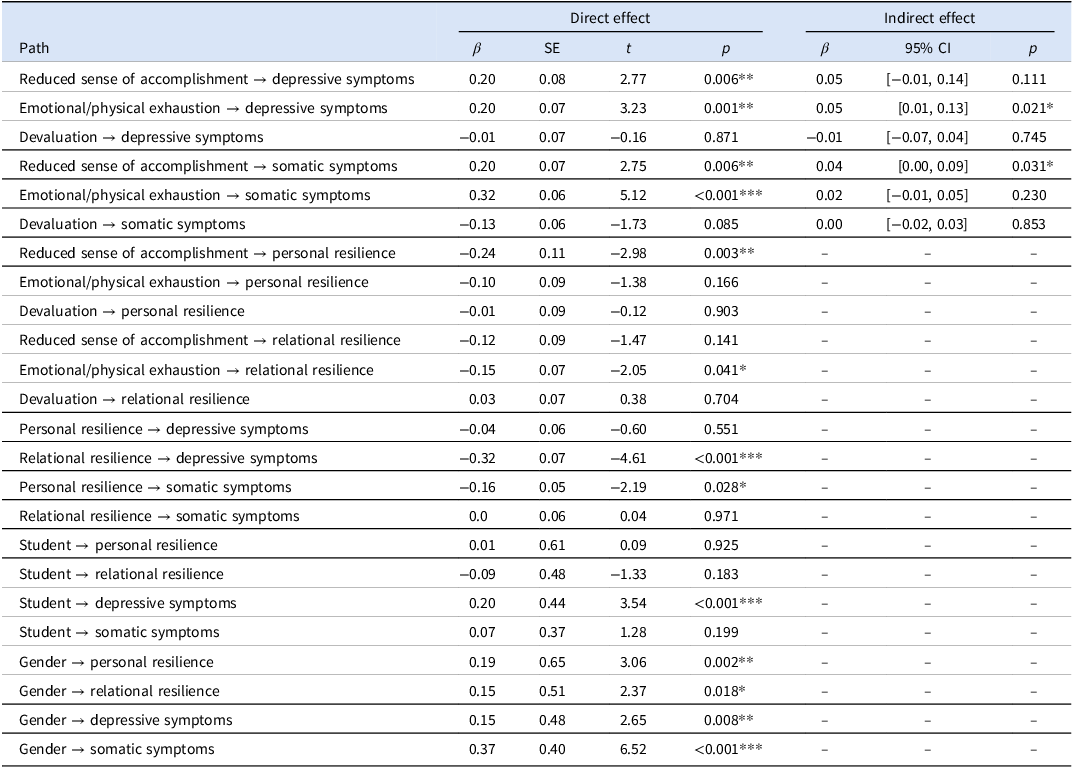
Figure 1 shows the standardised path coefficients. Table 1 contains all standardised direct and indirect effects.
The impact of athlete burnout on depressive symptoms and somatic symptoms via personal and relational resilience.
Note: Standardised estimates for significant paths at p < 0.05 are presented. Non-significant paths are represented with dotted lines.

Model path coefficients and estimates

Table 1. Long description
A table comparing direct and indirect effects of various factors on depressive symptoms, somatic symptoms, personal resilience, and relational resilience. The table has 30 rows and 10 columns. Column headers are Path, Direct effect beta, Direct effect SE, Direct effect t, Direct effect p, Indirect effect beta, Indirect effect 95 percent CI, and Indirect effect p. Row labels include paths such as Reduced sense of accomplishment to depressive symptoms, Emotional/physical exhaustion to depressive symptoms, Devaluation to depressive symptoms, Reduced sense of accomplishment to somatic symptoms, Emotional/physical exhaustion to somatic symptoms, Devaluation to somatic symptoms, Reduced sense of accomplishment to personal resilience, Emotional/physical exhaustion to personal resilience, Devaluation to personal resilience, Reduced sense of accomplishment to relational resilience, Emotional/physical exhaustion to relational resilience, Devaluation to relational resilience, Personal resilience to depressive symptoms, Relational resilience to depressive symptoms, Personal resilience to somatic symptoms, Relational resilience to somatic symptoms, Student to personal resilience, Student to relational resilience, Student to depressive symptoms, Student to somatic symptoms, Gender to personal resilience, Gender to relational resilience, Gender to depressive symptoms, and Gender to somatic symptoms. Each row contains values for beta, SE, t, p, beta, 95 percent CI, and p under the respective columns. Notable trends include significant p-values for several paths, indicating strong direct and indirect effects.
Note. *p < 0.05, **p < 0.01, ***p < 0.001, β = standardised path coefficient.
The model demonstrated excellent fit to the data, χ 2(7) = 14.10, p = .049, CFI = 0.99, TLI = 0.93, RMSEA = 0.07, SRMR = 0.05. The total model explained 31.2% of the variance in the somatic symptom scores and 32.6% of the variance in the depressive symptom scores.
Emotional/physical exhaustion independently predicted higher depressive symptoms (b = 0.20, p = 0.001) and negatively predicted relational resilience (b = −0.15, p = 0.041). Additionally, relational resilience negatively predicted depressive symptoms (b = −0.32, p < 0.001). The indirect effect of emotional/physical exhaustion on depressive symptoms via relational resilience was significant (b = 0.01, p = 0.022), showing that resilience partially mediated the effect of emotional/physical exhaustion on depressive symptoms.
Emotional/physical exhaustion predicted greater somatic symptoms (b = 0.32, p < 0.001). However, relational resilience did not significantly predict somatic symptoms (b = 0.00, p = 0.971), thus relational resilience did not mediate the relationship between emotional/physical exhaustion and somatic symptoms.
Reduced sense of accomplishment predicted greater somatic symptoms (b = 0.20, p = 0.006), and negatively predicted personal resilience (b = −0.24, p = 0.003). Additionally, personal resilience negatively predicted somatic symptoms (b = −0.16, p = 0.028). The indirect effect of reduced sense of accomplishment on personal resilience via relational resilience (b = 0.04, p = 0.033) was significant, supporting the mediating role of personal resilience in this relationship.
Reduced sense of accomplishment was significantly related to higher depressive symptoms (b = 0.20, p = 0.006). However, personal resilience was not related to depressive symptoms (b = −0.04, p = 0.551).
Sports devaluation was not related to depressive symptoms (b = −0.01, p = 0.871), somatic symptoms (b = −0.13, p = 0.085), personal resilience (b = −0.01, p = 0.903), or relational resilience (b = 0.03, p = 0.704).
Student athletes were significantly more likely to report higher depressive symptoms that non-students (b = 0.20, p < 0.001), but not somatic symptoms. Female athletes reported higher depressive (b = 0.015, p = 0.008) and somatic (b = 0.37, p < 0.001) symptoms than male athletes, but also significantly higher personal (b = 0.19, p = 0.002) and relational (b = 0.15, p = 0.018) resilience levels.
Discussion
The study examined the mediating role of resilience on the predictive association of burnout on (1) depressive and (2) somatic symptoms in Gaelic Games athletes. The findings highlight the distinct protective functions of relational and personal resilience, offering nuance to existing models of athlete well-being.
Emotional/physical exhaustion predicted depressive symptoms and negatively predicted relational resilience. Relational resilience mediated the relationship between emotional/physical exhaustion and depressive symptoms, indicating that strong interpersonal networks buffer the depressive effects of exhaustion-related burnout. This is consistent with prior research linking burnout to higher depressive symptoms (Sarmento et al. Reference Sarmento, Frontini, Marques, Peralta, Ordoñez-Saavedra, Duarte and Clemente2021) and greater resilience to reduced depressive symptoms (Drew and Matthews Reference Drew and Matthews2019; Gupta and McCarthy Reference Gupta and McCarthy2022) in athletes. In contrast, emotional/physical exhaustion did not predict personal resilience. Also, personal resilience did not mediate the link between reduced sense of accomplishment and depressive symptoms, suggesting that internal coping resources may be less effective in protecting against this form of psychological distress. The findings offer additional nuance to prior research by identifying that interpersonal resilience, rather than personal resilience, is the more salient buffer against burnout’s effects on depressive outcomes in amateur team sports.
A differing pattern was observed for somatic symptoms. While emotional/physical exhaustion predicted somatic symptoms and personal resilience, relational resilience, which was protective against depression, was not associated with somatic symptoms. However, personal resilience mediated the relationship between reduced sense of accomplishment and somatic symptoms, highlighting the potential protective role of internal coping strategies against physical manifestations of stress. This extends prior research linking burnout to somatic symptoms (Koutsimani et al. Reference Koutsimani, Montgomery and Georganta2019), by identifying that personal resilience may act as a buffer in this relationship. In combination, the findings indicate that the relevance of resilience depends on outcome type: social support may buffer depressive symptoms, while personal coping resources may reduce somatic strain.
Sport devaluation showed no significant associations with depressive or somatic symptoms, or with resilience, whereas the other two forms of burnout were significantly associated with each. This finding suggests that sport devaluation may play a less central role in amateur, community-based athletes, possibly emerging later in the burnout process or functioning as a coping mechanism to manage prolonged stress (Gustafsson et al. Reference Gustafsson, Kenttä and Hassmén2011; Yu et al. Reference Yu, Xing and Yang2025). While Raedeke and Smith’s (Reference Raedeke and Smith2001) multidimensional model of burnout was partially supported, the findings suggest that in GG, sport devaluation is less critical to mental and physical health outcomes than other burnout dimensions.
Compared to males, female athletes reported higher depressive and somatic symptoms, but also higher personal and relational resilience levels. This is consistent with research showing that female GG players feel undervalued, under-resourced, and face unique social pressures and challenges (Woods et al. Reference Woods, Dempsey, Dunne and Gallagher2026), and highlights that the importance of resilience-based coping may be particularly pronounced for female athletes.
A limitation of the study is its sole focus on GG athletes, potentially limiting generalisability to other contexts, and cultural and organisational influences such as coaching practices, team dynamics, and community expectations were not examined. Additionally, some subgroup comparisons, such as type of GG sport, were constrained by small sample sizes, and other relevant variables, such as injury history or playing experience, were not included.
Tailored interventions which aim to strengthen personal resilience-based coping skills may be effective in reducing the impact of reduced sense of accomplishment on somatic symptoms in athletes. Similarly, interventions which aim to strengthen relational resilience, such as peer-support initiatives, may assist in reducing the impact of emotional and physical exhaustion on depressive symptoms. Tailored approaches that account for contextual and demographic factors are likely to enhance intervention effectiveness.
Supplementary material
The supplementary material for this article can be found at https://doi.org/10.1017/ipm.2026.10218.
Acknowledgements
None.
Funding statement
This research received no specific grant from any funding agency, commercial or not-for-profit sectors.
Competing interests
The authors declare none.
Ethical standards
The authors assert that all procedures contributing to this work comply with the ethical standards of the relevant national and institutional committee on human experimentation and with the Helsinki Declaration of 1975, as revised in 2008. Ethical approval was granted by the Undergraduate Research Ethics Committee- School of Psychology.



 Open access

