


Ducheyne and De Fruyt (Reference Ducheyne and De Fruyt2026) raise an important concern that the conceptual boundary between toxic and incompetent leadership is insufficiently defined, creating a risk of conflation that carries real consequences for how organizations diagnose and respond to harmful leadership behavior. We share their view that destructive leadership behavior does not always originate from malevolence, and that greater nuance is needed to reduce stigmatization and to make the complexities of destructive leadership more discussable. At the same time, we argue that the focal paper’s proposed route to nuance rests on criteria that are neither reliable nor uniquely tied to either toxicity or incompetence and leave specific types of destructive leadership unaccounted for. In doing so, the framework risks reproducing the very ambiguity and stigmatization it aims to resolve while also generating a new and more serious risk: providing a conceptual justification for treating genuinely harmful leadership behavior as a development problem rather than an accountability problem.
Critique 1: Feedback unresponsiveness and psychological unsafety are not diagnostic
As a first distinguishing criterion, Ducheyne and De Fruyt propose that toxic leaders reject feedback and thereby sustain psychological unsafety, whereas incompetent leaders accept feedback, develop over time, and avoid entrenching unsafe climates. However, most people tend to respond defensively to negative feedback about their interpersonal behavior, particularly when it is delivered in the heat of the moment, in an accusatory tone, or by someone they do not trust (Vranjes et al., Reference Vranjes, Lyubykh, Hershcovis and Caza2025). Leader benevolence or integrity do not guarantee openness to feedback, nor do they guarantee that the leader will create a safe environment for their employees. Furthermore, responsiveness to feedback can be strategically performed rather than genuinely enacted (Hewlin, Reference Hewlin2003). A toxic leader may signal receptiveness and engage in impression management when it serves their interests and in that way convincingly deceive followers and the organization. Feedback unresponsiveness and ensuing psychological unsafety are thus not exclusively diagnostic of toxic leadership. Using this criterion risks producing false positives by mischaracterizing leaders who react defensively to feedback as toxic while simultaneously creating false negatives, where strategically responsive yet problematic leaders evade detection.
Critique 2: Trustworthiness and intent invite stigmatization and moral licensing
Ducheyne and De Fruyt’s article further proposes that incompetent leaders are distinct from toxic leaders by their perceived trustworthiness. They suggest that incompetent leaders are low in competence yet high in benevolence and integrity, which yields higher perceived trustworthiness. In contrast, toxic leaders may be capable but are low in benevolence and integrity, resulting in low perceived trustworthiness. Our concern about this criterion is threefold.
First, trustworthiness is not a stable leader-level property, but a follower judgment shaped by individual characteristics such as trait anger (Brees et al., Reference Brees, Martinko and Harvey2016) and attribution style (Martinko et al., Reference Martinko, Harvey, Sikora and Douglas2011), meaning the same leader may be seen as trustworthy by those who benefit from their behavior and deeply untrustworthy by those who bear its costs (Thoroughgood et al., Reference Thoroughgood, Padilla, Hunter and Tate2012). Moreover, because harmed followers tend to attribute negative outcomes to the leader’s character rather than to situational factors (Ross, Reference Ross and Berkowitz1977), using perceived untrustworthiness as a defining criterion risks stigmatizing incompetent leaders as toxic. Second, the authors’ treatment of intent is internally inconsistent: Although they define toxic leadership as potentially intentional or unintentional (p. 13), intent resurfaces as the implicit distinguishing criterion throughout the paper, most explicitly in their claim that “broad labels that conflate harmful intent with capability deficits hinder theoretical progress and practical relevance” (p. 18). Third, relying on intent as a distinguishing criterion risks morally licensing well-intended destructive behavior. Leaders who engage in abusive supervision rarely report a desire to harm as motivation; instead, they frame their behavior as serving pro-organizational goals (Watkins et al., Reference Watkins, Fehr and He2019). Treating good intent as a defining criterion thus creates room for leaders and organizations to justify destructive behaviors as the mere product of incompetence, increasing the risk of false negatives and downplaying the seriousness of this behavior.
Critique 3: The missing patterns of destructive leadership
Our third critique is that the toxic/incompetent binary does not adequately capture two other highly prevalent forms of destructive leadership. The first concerns competent leaders who occasionally engage in destructive behavior under specific circumstances (e.g., Barnes et al., Reference Barnes, Lucianetti, Bhave and Christian2015). For instance, a leader with limited impulse control or poor stress regulation may lash out under pressure, producing genuinely harmful behavior that is episodic rather than chronic. Such leader behavior is too dispositionally rooted to reflect mere incompetence yet too episodic and amenable to change to meet the authors’ definition of toxic leadership. The second are leaders who, through environmental reinforcement, social modeling, and leadership socialization (Mawritz et al., Reference Mawritz, Mayer, Hoobler, Wayne and Marinova2012), have gradually come to view destructive behaviors—such as managing through fear or deprioritizing employee well-being—as normal and effective, leaving them unable to recognize their behavior as problematic despite broadly good intentions. This pattern is too sustained and entrenched to reflect mere incompetence yet too lacking in unethical intent to meet the authors’ definition of toxic leadership. Both patterns fall outside the toxic/incompetent binary because the distinguishing criteria proposed by Ducheyne and De Fruyt are based on the individual leader (see for example their table, p.14), leaving destructive leadership that is situationally triggered or organizationally reinforced without an adequate category.
Towards a deeper understanding of destructive leadership
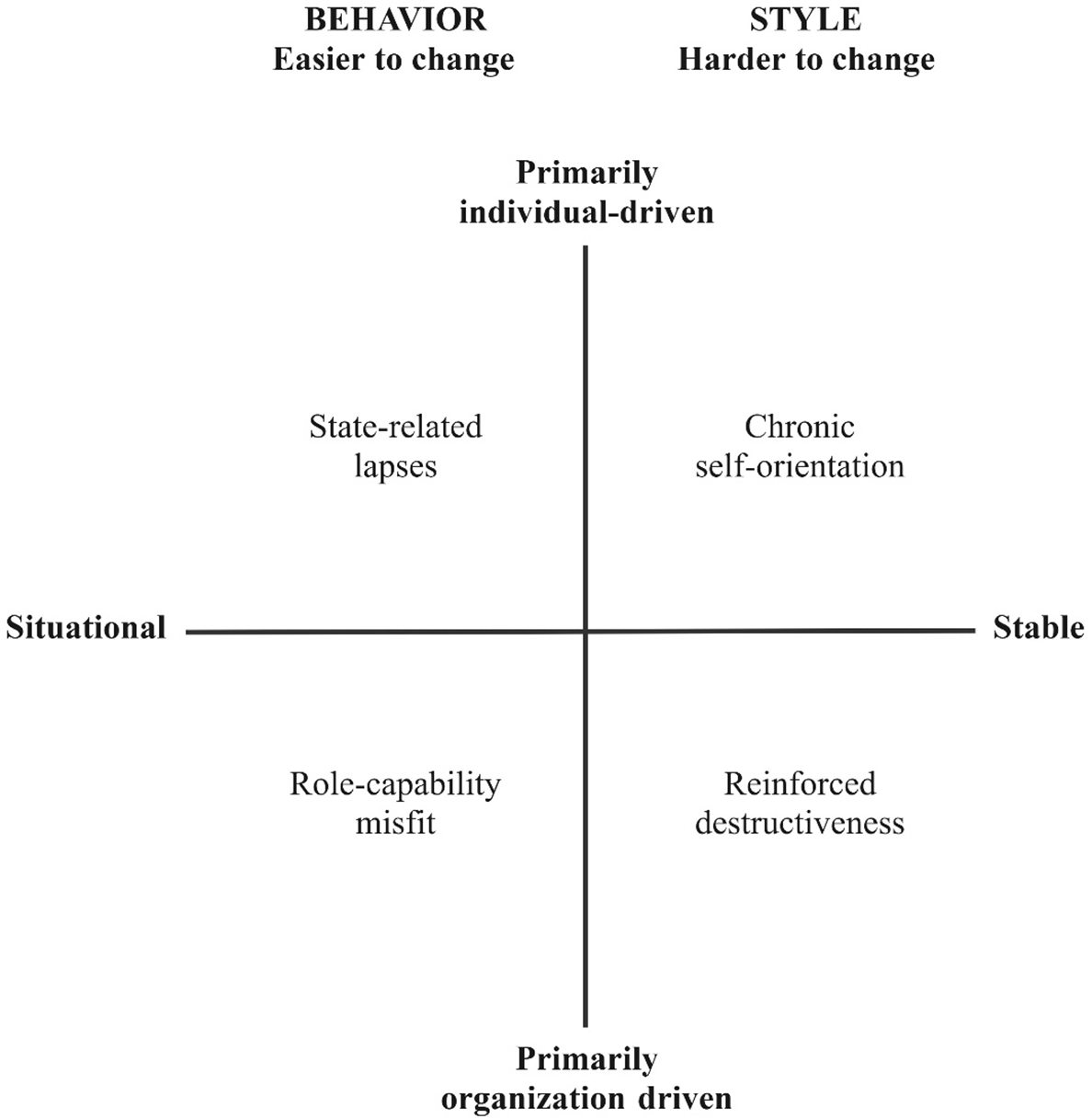
We propose an alternative model of destructive leadership that does more justice to the relational, contextual, and systemic factors that co-shape destructive leadership. We argue that two dimensions offer meaningful and valuable insight into the different types and causes of destructive leadership. The first is stability (situational or stable), and the second is source (individual or organizational; see Figure 1).
The Stability/Source Model of Destructive Leadership.

Regarding stability, we see situational destructive leadership as episodic or clustered destructive behaviors that are limited to specific situations, whereas stable destructive leadership reflects a persistent pattern that is repeatedly enacted across situations, up to the point where it becomes a style. Unlike definitions that restrict destructive leadership to repeated patterns, we thus adopt a behavioral definition (following Krasikova et al., Reference Krasikova, Green and LeBreton2013) that allows for incidental expressions of destructive leadership, yet that may mark the start of sustained patterns. By emphasizing the stability dimension, we also acknowledge a practical reality: there is no readily available heuristic that allows employees to determine whether a supervisor’s harmful behavior reflects a situational lapse or a stable pattern. Understanding the true nature of different types of destructive leadership is inherently difficult, and it often requires repeated exposure to harmful behavior before employees and organizations begin to recognize the pattern for what it is (Breukel et al., Reference Breukel, van Dijk, Nijs, van Engen and Duijndam2026).
Regarding behavioral source, we argue that some destructive behavior originates primarily from stable individual dispositions, whereas other destructive behavior can be traced back to the surrounding organizational context. Although individual and organizational factors interact in enabling destructive leadership behaviors and are not readily visible, we argue that certain indicators can help identify the behavior’s primary source. When behavior is primarily driven by individual tendencies, leaders will likely show similar patterns of behavior across different contexts, including outside the leadership role (e.g., a leader whose pattern of self-promotion, entitlement, or disregard for others is consistent across professional and personal relationships). When behavior is primarily driven by the organizational context, the destructive pattern will be largely confined to the leadership role and setting (e.g., a technically skilled professional who, upon promotion, adopts a coercive leadership style while maintaining collaborative and respectful relationships with peers outside that context).
In combination, these two dimensions create four quadrants: state-related lapses, role-capability misfit, chronic self-orientation, and reinforced destructiveness. State-related lapses refer to situational, individual-driven destructive leadership behaviors. They are caused by a leader’s individual vulnerabilities, such as reduced self-regulatory capacity, insecurity, or heightened threat sensitivity. When triggered, these vulnerabilities create temporary episodes of destructive leadership behavior. These vulnerabilities can be improved through feedback, coaching, and training (e.g., Iodice et al., Reference Iodice, Cannito, Chaigneau and Palumbo2022; Yeow & Martin, Reference Yeow and Martin2013).
Role-capability misfit represents situational, organization-driven destructive leadership behaviors that tend to be created by an incongruence between the leader’s current capabilities and the role demands. As a consequence, the leader is likely to show instances of destructive leadership behavior that are symptomatic of lacking leadership capabilities, such as avoiding difficult conversations, poor listening skills, and a tendency to escalate rather than de-escalate conflict. Such displays of destructive leadership may be temporary until role-related capabilities have been attained but can become sustained in case of a lack of capacity, feedback, and/or training (cf. The Peter Principle; Peter & Hull, Reference Peter and Hull1969). This type of destructive pattern most closely resembles what the authors label as “incompetent leadership.”
Chronic self-orientation delineates destructive leadership behaviors that are stable and individual driven. They tend to be caused by certain stable, role-independent, motivational tendencies that consistently prioritize self over others. Although this chronic orientation to put themselves first might sometimes serve the organization when interests align, it is likely to result in various destructive leadership behaviors at the expense of employees (Bueno-de la Fuente et al., Reference Bueno-de la Fuente, Núñez-Rodríguez, de la Fuente-Anuncibay and González-Bernal2025). Furthermore, due to the innateness of the leader’s self-orientation, interventions such as feedback, coaching, and training may have little effect in improving the leader’s behaviors. This destructive pattern most closely resembles what the authors label as “toxic leadership.”
Reinforced destructiveness refers to stable and organization-driven destructive leadership behaviors that tend to be created by the organizational culture and norms. Specifically, the leader operates in a context that repeatedly normalizes, rewards, or fails to sanction destructive leadership behavior, so that these behaviors become a stable and viable way of leading in that environment (e.g., Matos et al., Reference Matos, O’Neill and Lei2018). Because destructive leadership behaviors that fall in this quadrant are more learned than innate, leaders can unlearn them, but substantial time and effort may be needed to help them understand why the behavior is destructive and not normal. Furthermore, as long as the context does not change, it is unlikely that such leaders will change their behavior.
Future directions for research and practice
As recognizable as the binary between a toxic and an incompetent leader is, we believe it is important to move the academic and public debate beyond the binary of the “evil leader” and the “benevolent fool.” Doing so requires attending to forms of destructive leadership that this binary obscures. Our model points to two areas that are relatively under-researched in this regard. First, we see an overrepresentation of research that treats destructive leadership exclusively as a stable style rather than examining more incidental and situational behaviors. Although sustained patterns are highly relevant, this emphasis limits our understanding of how destructive leadership emerges and develops over time. Understanding the origins of destructive leadership requires a focus on incidental, situational, destructive leadership behavior and the intrapersonal and organizational dynamics that support this evolvement.
Second, most of the destructive leadership literature has primarily focused on leader traits and other relatively stable individual differences as explanations for destructive leadership. This focus has implicitly shaped the way we think about destructive leadership as being the realm of “toxic leaders,” whereas the role of organizational structures, systems, and culture in eliciting, enabling, and sustaining destructive leadership has often received less attention. To develop a more nuanced understanding of the different ways in which destructive leadership behavior emerges and becomes sustained, we encourage the field to more explicitly incorporate contextual explanations and to examine how organizational elements interact with leader vulnerabilities and follower dynamics.
For practice, our model implies that the key question is not whether a leader is incompetent or toxic, but to assess (a) whether destructive leadership behavior appears situational or stable across situations and (b) whether the behavior is primarily driven by individual or organizational factors. This may help prevent premature stigmatization through labeling while also supporting more accurate recognition of cases in which destructive leadership is becoming persistent. A practical implication is that earlier identification of situational patterns and triggers may be especially important, because once destructive leadership becomes stable, it is harder to change. Rather than prescribing specific interventions here, we emphasize the principle of matching interventions to the observed pattern and its primary driver. Overall, we hope that our model offers inspiration for adequately recognizing, studying, and addressing different forms of destructive leadership.
Funding statement
Open access funding provided by Tilburg University.
Competing interests
The authors declare none.

 Open access

