

1 Introduction
The REACH directive of the European Union (EU Directive 1907/2006, enacted on 1st July 2007) was implemented in Austria in 2008. The directive established a completely new, EU-wide, regulatory framework for chemicals. REACH is the acronym of the directive on the registration, evaluation, authorization, and restriction of chemicals.
The system that is still being implemented throughout all EU member states (and EEA members, Norway, Iceland and Liechtenstein) aims at protecting human and environmental health by regulating and limiting the risks associated with potentially harmful chemical substances (e.g., European Commission, 2003; ECHA, 2014; Hansen, Reference Hansen and Bergkamp2013; Bergkamp & Herbatschek, Reference Bergkamp, Herbatschek and Bergkamp2013; Georgiou et al., Reference Georgiou, Rheinberger and Vainio2018). In order to achieve these goals, the REACH system comprises the following key elements:
∙ Reversion of the burden of proof: While regulating authorities formerly had to prove that chemicals could harm human health or the environment (e.g., the Austrian Chemicals Act until 2007), the REACH system prescribes that the chemical industries (producers, importers, downstream users) are responsible for providing the respective data, analyses and risk assessments in order to show that the effects of chemicals on human and environmental health are reasonably small. Industries have especially to demonstrate that substances of very high concern (SVHC) are adequately controlled, and that risks are as low as reasonably possible.
∙ Information concerning the production chain: Information on all potentially harmful substances (with some threshold levels determined by the amount of chemicals in use) has to be provided in regard to all of the steps and chains in the manufacturing process as well as the way they are used by producers, importers, retailers, and other users.
∙ Specific evaluation tools and frameworks (e.g., safety data sheets, scientific studies) are implemented for all SVHC regarding effects on human health and environmental conditions.
∙ The use of existing evaluation data, as well as the sharing of evaluation costs among companies, is mandatory.
In order to enforce these core elements of the REACH directive and to provide all the necessary data, the European Chemicals Agency (ECHA) was established as the responsible EU agency in Helsinki (Finland); ECHA is not directly enforcing the directive, as this is the responsibility of the national authorities. ECHA evaluates all submitted registrations of chemical substances; the authorities of all EU member states then assess the materials with regard to the effects on human health and the environment. Based on these evaluations and risk assessments, the national authorities, as well as ECHA, may suggest a ban or restriction on the use of such substances to the European Commission. The authorities may also make the proposition that chemicals must undergo a preliminary clearing process and cannot be used until authorized (e.g., clearing a substance that has formerly been evaluated as being harmless while it turns out at a later point that the substance may indeed be harmful or risky) (ECHA, 2014). With regard to the costs for industries, all information and data, as well as evaluation studies, have to be provided by chemical companies (single or consortia); the authorities will start the evaluation procedures only if all of the dossiers are complete. While authorities had to bear the costs before the REACH system came into existence, it is now the responsibility of companies to provide the records and to invest their funds on admission procedures.
In 2005, a consortium of several Austrian ministries, industrial associations and the chamber of labor, commissioned a benefit-cost analysis (BCA) on the assessment and economic evaluation of costs and benefits of the implementation of the REACH system from an ex ante perspective. This BCA (Getzner, Reference Getzner2006, Reference Getzner2008) clarified major uncertainties in regard to chemical policies and new frameworks, and underlined that, owing to the substantial lack of data, especially in respect to the effects of chemicals on human health from an epidemiological perspective, there is a substantial need for further studies. The conclusions of this BCA were thus rather weak, stating that it was more likely than not that the REACH system would be beneficial in every way for the Austrian economy. These conclusions were drawn on the basis of numerous scenarios and analyses of the sensitivity of input data (benefits, costs) and their results.
About ten years later, in 2014, the Austrian Ministry of the Environment’s Department of Chemicals commissioned a new research study dealing with experiences with the REACH system. The new study should use more recent data for a new evaluation of the effects of the REACH system on the Austrian economy (see Dudley, Reference Dudley2017, for a discussion on ex ante vs. ex post assessments of chemical regulations). This study included an assessment on both the economic effects (production and added value) associated with the increased costs of the REACH system for chemical industries. Furthermore, a BCA was carried out which took into account the manifold costs and benefits (in regard to human health, effects on the environment, as well as the effects of innovation and productivity improvements) (Getzner et al., Reference Getzner, Mahlberg, Plas, Schweighofer, Schwärz and Zak2015). From an economic perspective, the benefits of the REACH system are of high interest for research projects: besides the potentially positive general effects on human and environmental health, additional benefits originate in the improvements in safety at work. Furthermore, there are additional information on chemicals, and productivity gains through technological and social innovations (such as chemical leasing, clean production, and closed-loop material flows). In this sense, the BCA is both an ex post assessment dealing with experiences within the REACH framework between 2008 (the year of the implementation) and 2014. It is also an ex ante study taking into consideration the costs and benefits as well as the full effectiveness of the REACH system in 2044.
This paper focuses on the BCA part of this study, and is structured as follows: Section 2 presents a short methodological overview of this BCA, while Section 3 presents data on various human and environmental health benefits. Section 4 is concerned with cost estimates, while in Section 5 the results are given. In Section 6 the results are discussed and conclusions are drawn.
2 BCA – the methodological framework for the REACH system
Data and information on the potential human and environmental health benefits of regulating chemicals are not readily available (Getzner, Reference Getzner2008). Of course, there are numerous studies on the effects individual chemicals have on human health, and eco-toxicological studies show the effects of certain chemicals on environmental indicators (for a broad overview of assessment methods in regard to chemicals see Chiu, Reference Chiu2017; cf. also Georgiou et al., Reference Georgiou, Rheinberger and Vainio2018, with respect to assessing the social relevance of the regulation of chemicals). However, the implementation of a whole system of regulations on chemicals, including the provision of information on users, would need a different approach in terms of data and information. Existing estimates regarding the epidemiological effects of chemicals (or their reduction) exhibit large confidence intervals. In addition, many potential human health aspects of chemicals, such as, multiple chemical sensitivity (MCS), are still highly uncertain (e.g., Rogers, Reference Rogers and Wexler2014; Georgiou et al., Reference Georgiou, Rheinberger and Vainio2018).
In order to account for these multiple uncertainties and the lack of data, the benefits and costs of the REACH system are established on the basis of a variety of quantitative and qualitative methods. The economic analysis is based on data and information provided by various sources; however, detailed medical or ecological studies on the REACH system are still not available for Austria, and could not be carried out within the framework of this analysis.
Based on official statistical data, literature and materials, the following approach was chosen.
∙ Research in the relevant literature and the analysis of several databases and statistics on the
* general aspects of the REACH system and its development;
* potential effects of the REACH system in regard to safety at work and the health of employees (e.g., work-related diseases, accidents), as well as the health of the public at large (e.g., allergies, accidents at home or during leisure activities, and MCS); primary data and study sources are accessed that are provided by several Austrian institutions, such as the Austrian Statistical Office, the General Insurance of Accidents, and the Austrian Board on Road Safety;
* effects of the REACH system on companies in regard to innovation, improvement and increase in production, and competition;
* environmental and ecological effects of chemicals.
∙ Discussions with stakeholders and experts (chemical industries, Department of Labor, and the Austrian Agency for Workplace Safety) in order to assess the effects of the REACH system qualitatively.
∙ Interviews with experts, and surveys.
∙ Draft of a baseline scenario, implementation of sensitivity analyses, and discussion on assumptions.
All data for the period of 2014 to 2044 are fed into a BCA model; since the REACH system has been implemented stepwise since 2008, the costs have been included since then. However, it can be reasonably assumed that the benefits will gradually develop and increase so that the full implementation and effectiveness of the system – scheduled to materialize in 30 years from the beginning of the observation period – will be attained. In addition, our model takes the growth of the population into consideration (Statistics Austria, 2014a ).
As the uncertainty of benefits are still overwhelming, owing to the lack of epidemiological data and statistics on the effects of regulating chemicals on human health, the main inputs to the BCA are still vague. Therefore, in this paper, a baseline scenario has been conceived in which, although conservative with regard to avoiding an overestimate of benefits and an underestimate of costs, the most probable or most reasonable estimates of benefits (and costs) are considered. Sensitivity analyses will then be carried out in order to test the reliability of the BCA results.
3 The REACH system benefits
3.1 A general qualitative view of the benefits
As a first general impression of the effects of the REACH system, the quantification of benefits is still uncertain, even after several years have passed since the implementation of the system in Austria. A report made by the European Commission (2013) emphasized that it could be too early for comprehensive attempts to quantify and value the benefits of REACH. While each dossier on the risks of a certain chemical substance submitted to ECHA contains an assessment of the effects, comprehensive data necessary for the estimation of economy-wide benefits are still not available. However, the first positive effects and tendencies have been reported. One major positive effect has been identified in the provision of a broader informational base for handling potentially hazardous chemicals (e.g., Hammerschmidt & Marx, Reference Hammerschmidt and Marx2014). Standard safety data sheets and the availability of information have reduced the nominal risks over the whole chain of production and use; and the substitution of SVHC has increased significantly. In the following paragraphs, some important results of the interviews with experts and workshops are presented (documented in detail in Getzner et al., Reference Getzner, Mahlberg, Plas, Schweighofer, Schwärz and Zak2015).
The Association for Consumer Information confirmed that the REACH system has brought about an 80% to 90% reduction of potential harmful chemicals (SVHC) in many final consumer goods since many chemicals are banned in the production of consumer goods, based on the comprehensive lists described in several annexes to the REACH directive.
The Department of Product Safety (Ministry of Labor, Social Security and Consumer Rights), however, saw a number of gaps regarding available data and assessments for final consumer products. The Ministry confirmed that even administrators and policy makers still suffer from data problems especially on the effects on human health and the environment as multiple (and not single) factors cause health problems.
The Department of Occupational Healthcare and Industrial Hygiene, of the same Ministry, assumed that the benefits of the REACH system will fully materialize only if the system is in place for quite some time owing to the mid- and long-term effects of changes in production processes. Safety data sheets are especially relevant in this context since companies are provided with information referring to the DNEL of substances (“Derived no effect level”).Footnote 1 According to the department’s experts, it is still too early to provide exact assessments of the “undoubtedly positive effects” (original quote from the department’s statement). The department has positively noted that the REACH system has raised the general awareness of potentially harmful substances. Interestingly, the REACH system has also improved the communication between different public authorities dealing with workplace safety, human health, and environmental affairs.
The Institute of Water Quality, Resource and Waste Management (Vienna University of Technology) acknowledged that the REACH system provides a single, Europe-wide framework for the assessment of chemicals. Even producers outside the EU conform to the REACH system in terms of evaluating chemicals and avoiding hazardous substances because products that include SVHC are banned from the European markets (of course, producers outside the EU may use hazardous substances for products for non-EU markets within the regulatory frameworks of targeted markets).
For the experts of the Austrian Chamber of Commerce, there were only minor positive effects of the REACH system on environmental health and ecological quality (e.g., protection of water resources). While big chemical companies have adapted very well to the new system, smaller producers and importers, as well as downstream users, are still struggling with the complexity of this regulation.
Finally, the Institute of Forest, Environmental and Natural Resource Policy (Vienna University of Natural Resources and Life Sciences) underlined the potentially significant effects of the new regulatory system on innovation and productivity in terms of sustainable and cleaner production (see also Hansjürgens & Nordbeck, Reference Hansjürgens and Nordbeck2005).
While it seems to be safe to conclude from the manifold reviews of diverse stakeholders that the REACH system will provide substantial benefits for human health, at least in the long run, experts in all institutions are generally skeptical regarding the possibility to quantify the benefits of the REACH system with the necessary precision to calculate a BCA.
Turning to the analysis of the relevant literature, Reihlen and Lüskow (Reference Reihlen and Lüskow2007) analyzed 13 different studies on the potential benefits of REACH. By means of a standardized classification, the authors find three kinds of benefits that are especially relevant. First, the positive productivity effects on chemical (and other) companies may originate from the reduction of production costs associated with improved information and co-operation along the production chain. Second, the system will bring about positive effects on human health in addition to traditional occupational health standards and public health policies. Third, improved information on occupational health risks through chemicals leads to a reduction of occupational diseases and accidents, and healthcare costs of companies, workers, and the social security system. The REACH system may lead to a reduction of public healthcare spending owing to fewer hazardous chemicals in consumer products, and more information for consumers in order to arouse and increase an awareness of the effects of chemicals on health.
While the benefits for occupational health are broadly discussed in the literature, the costs and benefits for chemical industries have been on the political agenda since the first drafts of the new chemical regulations. Hanschmidt et al. (Reference Hanschmidt, Lulei and Paetz2013) considered the development of the REACH system to be such that (in 2013) it was still too early to draw firm conclusions on the benefits and costs for chemical industries. A major concern of these industries is the optimization and simplification of all REACH related procedures. Administrating the safety data sheets is complex, and the information and communication from authorities to companies should be improved.
The most comprehensive analysis of data on nominal risks, the “REACH baseline study” (Eurostat, 2012), classifies risks of over 200 substances along a system of indicators mirroring the diverse potential effects of chemicals on human and environmental health. Substances are chosen based on the lists of substances in the REACH system as SHVC or substances with a high volume of production (HVP), since the registration of all these chemicals had to be submitted until 2010.Footnote 2 From the group of 87 such substances, 62 were indeed registered. The REACH system – by being enforced – led companies that were producing or using some of the original SVHC to abandon these substances immediately. On the basis of assessments of exposure and toxicity, risk characterization ratios are estimated.
3.2 Quantification and valuation of human health benefits
3.2.1 Diseases attributed to exposure to chemicals
From the viewpoint of the REACH system, two concepts are used to assess the effects of a substance on human health. If, in the EU member states, there are no safety limits available, the exposure to chemicals is assessed by the DNEL (Nies et al., Reference Nies, Musanke, Püringer, Rühl and Arnone2013), differentiated according to social groups (e.g., workers) and the greatest likelihood of exposure. However, not all of the EU member states have implemented the DNEL concept. In addition, the DNEL is complemented with the derived minimal effect level (DMEL) for genotoxic, mutagenic or carcinogenic substances (see AUVA, 2014; Püringer, Reference Püringer2011). However, the DNEL ultimately mirrors society’s acceptance (and knowledge) of the risks of cancer and other diseases, and of the potential differences between work-related risks and general public health risks. McKee et al. (Reference McKee, Tibaldi, Adenuga, Carrillo and Margary2018) show, by the example of hydrocarbon solvents, that the calculation of the DNEL requires a range of assessments as well as assumptions, e.g., those made by the ECHA in regard to the value of assessment factors (cf. also ECOTEC, 2003).
The exposure to particles, gases and chemicals at work may, of course, have serious consequences on the health of the employees. The most severe and widespread diseases are cancer and chronic pulmonary diseases, such as asthma and COPD (chronic obstructive pulmonary disease), as well as all kinds of dermatitis. However, of the total number of diseases, the proportion of occupational diseases cannot be estimated exactly.
For the EU-27, the economic costs that ensue on account of cancer were ascertained by Luengo-Fernandez et al. (Reference Luengo-Fernandez, Leal, Gray and Sullivan2013). In 2008, 2.45 m inhabitants in the European Union were diagnosed to have cancer, of which, 1.23 m died as a result. For the year 2009, the economic costs amounted to EUR 126 billion (bn). These included the costs for treatment amounting to approximately EUR 51 bn. Productivity losses were estimated to be approx. EUR 52 bn (for both mortality and morbidity), and the value of informal (family) care amounted to about EUR 23 bn (Luengo-Fernandez et al., Reference Luengo-Fernandez, Leal, Gray and Sullivan2013, p. 1167). Regarding the Austrian situation, we can transfer these broad figures to the Austrian context by accounting for differences in the prevalence of the different types of cancer, incidence and mortality, and the Austrian population (e.g., age structure). As will be outlined below (see table 3), one case of non-fatal cancer will be valued by the mean costs of EUR 652,000 per capita for Austria.
While cancer is certainly the most serious disease, asthma is one of the most frequent diseases related to chemicals (Jeebhay & Quirce, Reference Jeebhay and Quirce2007). Even if cause–response models are not well established, it is estimated that the origin of 2% to 6% of asthma cases can be connected directly to occupational risks to health (Bardana, Reference Bardana2003). While, Boschetto et al. (Reference Boschetto, Quintavalle, Miotto, Lo Cascio, Zeni and Mapp2006) estimate that 15% of all other respiratory diseases, such as COPD, have their origin in workplaces where there are risks to health.
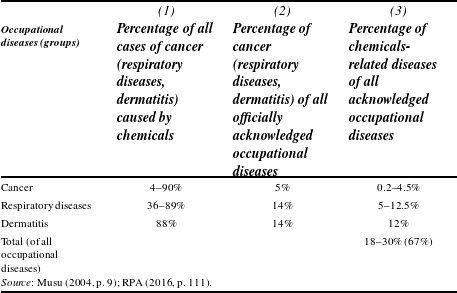
Pickvance et al. (Reference Pickvance, Karnon, Peters and El-Arifi2005) studied the potential reduction of COPD and dermatitis through the REACH system. The estimated incidence of these diseases in connection with chemicals is based on a meta-analysis and review of PubMed studies and other databases. Taking these results into consideration, the costs of diseases related to chemicals are estimated (see also RPA, 2003). The costs of the health care system, the reduction of productivity, as well as the impaired quality of life (measured by quality adjusted life years, QALYs) are included. Musu (Reference Musu2004) presents a general view of studies on occupational diseases related to or otherwise caused by chemicals which include Eurostat data; for instance, he estimated that between 18% and 30% of all occupational diseases in Europe are related to or caused by chemicals. He estimated that about 5% of all occupational diseases are cases of cancer. Table 1 summarizes the estimations of the proportion of occupational diseases caused by chemicals that are subject to REACH regulations: Out of all cases of cancer, the proportion of cases of cancer caused by chemicals varies widely, and is estimated to be anything from 4% to 90% (column (1)). If all of these occupational diseases are taken into consideration, it is estimated that 5% are cancer (i.e., cancer originating at work, column (2)). Taking all occupational diseases together and combining columns (1) and (2), the proportion of the cases of cancer caused by chemicals, in regard to all occupational diseases, is from 0.2% to 4.5% (column (3)). In total, Musu (Reference Musu2004) estimated the percentage of occupational diseases related to chemicals to be 18%–30%, while RPA (2016) present data estimating the proportion to be 67%.
Occupational health risks and diseases related to chemicals.

There is a number of crucial assumptions for estimating and including the health benefits in the BCA. For instance, the reduction of diseases caused by or attributed to chemicals within a given period of time (i.e., the course taken by the REACH system to reduce health risks within a given period) has to be modeled. Therefore, in this paper it is assumed that the incidence of diseases was not reduced within the first six years after the REACH system was implemented to account for the time-consuming adaption of the economy to new regulations. Heitmann and Reihlen (Reference Heitmann and Reihlen2007) showed that companies may react differently to new regulation; some may be hesitant to adapt while others, based on market pressure and image concerns, change production processes and products even before a new regulation (of chemicals) is enforced. Even the European Commission (2018) still stresses that the “impacts on the protection of human health and the environment will take a number of years to become visible” (p. 39). The most recent report of the European Commission (2018) acknowledges that REACH has led to a significant broadening of information on substances, and that risk management policies have greatly improved. The effects on human health and environmental conditions are, however, still hard to quantify since “the majority of impacts will materialize in the future, for example, because of latency periods; even if changes in incidence (such as rates of cancer cases) can be observed, it is difficult to attribute these changes to different drivers/interventions.” (European Commission, 2018, p. 46).
Furthermore, it has to be taken into account that many diseases develop only over a (prolonged) period of time; a short-term reduction of the exposure to chemicals might not lead to an equivalent reduction of cases of occupational diseases (e.g., cancer). Therefore, it is assumed that there will be a constant (linear) development until 2044, when the full effectiveness of REACH is to be expected. That is, by the end of 2044, 12.5% of the respiratory diseases and 20% of the cases of dermatitis that are attributed to chemicals will have been prevented (the assumptions are based on RPA, 2003; RPA, 2015; Öko-Institut, 2016). These assumptions are conservative as, e.g., RPA (2016, p. 112) presents data on the significant reduction of cases of skin conditions attributed to chemicals in the U.K. by 31% from 2008 to 2013. For the EU as a whole, RPA (2016, p. 114) estimates that skin conditions affected by chemicals have been reduced by 41% from 2008 to 2013; of course, not all of these reductions may be attributed to the REACH framework.
The improvement of human health in regard to these kinds of diseases is foremost valued by savings in treatment costs (for details, see table 3 below). Taking the cost per case and the development of the reduction of diseases over a specific period of time, the savings that can be made in the annual costs in the European Union may range from EUR 0.66 bn to 6.2 bn (after 10 years), and from EUR 21.2 bn to 160.7 bn (after 30 years). Comparing these potential benefits to the potential costs of the REACH system of EUR 2.8 bn up to 5.2 bn for the chemical industries and downstream users (European Commission, 2003) gives a first impression of the importance and the probable huge benefits of this regulatory system (see also Musu, Reference Musu2006; RPA, 2003).
3.2.2 Occupational diseases attributed to chemicals regulated by REACH in Austria
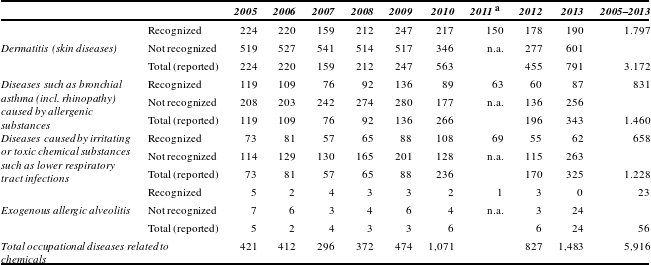
Official statistical data on occupational diseases and premature retirements currently cover 52 kinds of disease. A special analysis was made to account for all of the occupational health problems that are potentially attributed to chemicals. Dermatitis and respiratory diseases were accounted for especially over the period from 2005 to 2013 to obtain a comprehensive concept of such diseases attributed to chemicals at workplaces. In table 2 the numbers of both recognized and not recognized cases of diseases are to be found, and the total cases reported of occupational diseases attributed to the exposure to chemicals at the employee’s workplace. In 2013, close to 1,500 recognized cases of an occupational disease attributed to the exposure to chemicals were recorded.
Selected occupational diseases in Austria (no. of cases, 2005–2013) caused by the exposure to chemicals.

a In 2011, some information is not available owing to a change in the methods used to collect and classify data.Source: Own calculations based on a special analysis by AUVA (2014).
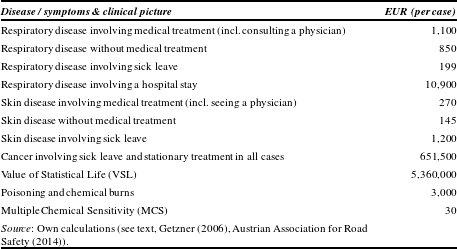
Values of diseases (EUR per case, 2013 prices) related to the use of chemicals.

Data on the specific health care costs associated with these recognized diseases and occupational accidents are rare. In a review paper, Rühl (Reference Rühl2007) reports that the total annual costs for Germany amount to EUR 500 million (m) for occupational diseases (asthma, dermatitis). Batzdorfer and Schwanitz (Reference Batzdorfer and Schwanitz2004) estimate these costs for Germany at about EUR 550 m per year.
Chemicals may also lead to early retirement. In Austria, about 2,400 early retirements were counted in 2013; 77 fatalities attributed to chemicals were recorded (own calculation based on AUVA, 2014; more details can be found in the supplementary materials on the journal’s website available at https://doi.org/10.1017/bca.2018.16).
3.2.3 Allergies and Multiple Chemical Sensitivity (MCS)
Allergies may occur both at workplaces and in the general population owing to contacts with potentially hazardous substances. Regarding occupational exposures, the toxicity of chemicals might lead to sensitization of the skin and the respiratory system (trachea); while at a one-off contact, severe reactions of the immune system might occur, the permanent contact for even very small exposures might lead to more serious and aggressive secondary immune responses (Kimber et al., Reference Kimber, Basketter and Dearman2010). The exposure to chemicals is also connected to various allergic reactions; however, by now, about only 80 chemicals are currently known to cause allergic reactions of the respiratory system (Kimber et al., Reference Kimber, Dearman, Basketter and Boverhof2014). For instance, substances such as diisocyanates and reactive artificial colors may also cause skin allergies (Kimber & Dearman, Reference Kimber and Dearman2002). Not only industrial chemicals but also consumer products, such as cosmetics, may be the cause of allergic contact dermatitis (Corsini et al., Reference Corsini, Galbiati, Nikitovic and Tsatsakis2013). In general, however, many allergic reactions or allergies are still not completely understood.
Even more disputed is the clinical presentation of MCS (e.g., De Luca et al., Reference De Luca, Raskovic, Pacifico, Thai and Korkina2011; Bolt & Kiesswetter, Reference Bolt and Kiesswetter2002; Miller, Reference Miller1996). MCS refers to a variety of chemical intolerance which are caused by very limited exposure which would normally not lead to any reaction (e.g., Bock & Birbaumer, Reference Bock and Birbaumer1998).
Many studies emphasize the manifold clinical descriptions of MCS (Lacour et al., Reference Lacour, Zunder, Schmidtke, Vaith and Scheidt2005) as well as the social and psychological factors regarding the causes, diagnosis and treatment of MCS (Das-Munshi et al., Reference Das-Munshi, Rubin and Wessely2007). Patients may be employees with regular contacts to chemicals at their workplace, as well as people living in an environment exposed to chemicals. Symptoms may range from heart and circulatory problems to digestive and respiratory problems; psychological conditions may also occur (Winder, Reference Winder2002). The health restrictions for everyday life can be significant (Skovbjerg et al., Reference Skovbjerg, Brorson, Rasmussen, Johansen and Elberling2009). The range of prevalence rates in the general population have been estimated to be from 0.5 to 6.3% (Bauer et al., Reference Bauer, Schwarz and Mai2008; Andersson et al., Reference Andersson, Johansson, Millqvist, Nordin and Bende2008). However, differences in the estimations also stem from diverse data sources; general practitioners estimate the prevalence rates to be about 0.5% while self-reported rates may be up to 9% (see for Germany: Hausteiner et al., Reference Hausteiner, Bornschein, Hansen, Zilker and Förstl2005).
In regard to the effects of the REACH system in its aims to improve consumer protection, the regulations can also affect the ingredients and use of consumer products. For instance, Kaberlah et al. (Reference Kaberlah, Augustin, Bunke, Schwarz and Oppl2011) examined a variety of consumer products containing potentially problematic substances and emphasized that one of the main elements of the REACH system is the obligation of producers and distributors to fully inform consumers about products containing SVHC (of course, the REACH framework complements many other product standards regulating substances in products). Still, the system may have some loopholes in regard to potentially hazardous chemicals belonging to category III that may be carcinogenic, mutagenic, or reprotoxic, even if only very small amounts of these substances are included in the products, or if producers outside the EU use hazardous substances in small amounts without declaration (Kaberlah et al., Reference Kaberlah, Augustin, Bunke, Schwarz and Oppl2011).
3.2.4 Leisure or home accidents
Dealing with chemicals at home can be a serious threat to health, resulting in unintentional harm such as poisoning or corrosive burns, and a great danger especially for children. For Austria, a recent survey (Herry Consult, 2013) pointed out that the economic costs of accidents attributed to chemicals at home may amount to EUR 62.8 m per year. This estimation is based on the costs of treatment, productivity losses and the reduced quality of life; Sommer et al. (Reference Sommer, Brügger, Lieb and Niemann2007) found comparable numbers.
For the recent years that are relevant in regard to REACH regulations, the Association for Road Safety, which is also dealing with home accidents, has made a special analysis of ICD accidents related to chemicals.Footnote 3
The data show that there is a slight and continuous downward trend in the number of home accidents that were recorded and treated in hospitals. While there is no clear picture in regard to the REACH system, the reduction from 2006 (782 cases) to 2010 (631 cases) was approximately 40 cases per year (own calculations based on a special analysis by the Austrian Association for Road Safety (2014); detailed data can be found in the supplementary materials at the journal’s website). Additional information, provided by the REACH system, may in general increase the awareness of consumers that the contact with chemicals can be a risk, and that therefore they should be very cautious and careful when handling potentially hazardous substances.
Based on the costs per day for treatment in a hospital, the indirect costs (productivity loss, quality of life), a single case of a home accident in which a chemical is involved and thus relevant to the REACH system, may come up to about EUR 3,300.
3.2.5 Summary of economic values of diseases and accidents attributed to chemicals
For the calculation and evaluation of the REACH system health benefits, several assumptions have to be made taking into account the specific (marginal) effects of REACH (e.g., the percentage of chemical diseases that may be reduced owing to the regulation) compared to the regulations before 2008. Furthermore, the BCA model includes a number of values for different diseases (and fatalities) originating in the exposure to chemicals.
In the case of skin diseases and based on the data discussed above, it can be reasonably assumed, that about 3% of all cases can be attributed to the exposure to chemicals. Approximately 25% of these cases need medical treatment (see Getzner, Reference Getzner2006, based on Diepgen, 2001, who argued that between 15% to 36% of these cases would need medical treatment). These assumptions are based on the literature discussed above and on the assessments of experts from several institutions as described in Section 3.1 above. It has to be stressed that there is no indisputable, quantitative evidence regarding epidemiological studies. The effects of REACH are, however, conservative estimates as regards the high percentage of occupational diseases, the accidents at home and at work that are attributed to or caused by chemicals. Anyway, this assumption is tested in sensitivity analyses.
Analogous to skin diseases, it is also assumed that 3% of all cases of respiratory diseases are attributed to the exposure to chemicals. However, there is no data available on the need for medical treatment; thus, the effects of chemicals on health may therefore be underestimated in the BCA model.
For both kinds of diseases, a conservative starting point is assumed. About five years after the implementation of the REACH system, it was assumed that the effects on health would gradually increase by 5% annually throughout the remaining 25 years of the whole observation period, i.e., until 2044.
The data on cancer is much more refined. In order to model the effects of the stricter regulation of chemicals, it was assumed that 4% of all cases of cancer resulted through exposure to chemicals (cf. Musu, 2005; RPA, 2015 and 2016). A first approximation of the economic evaluation of fatalities was based on the VSL (Value of Statistical Life) which was published by the European Union-wide research project ExternE (1999). This value was also adapted to the current price level and GDP growth (for a discussion on different money values of the effects on health in the context of chemical policies, see Alberini, Reference Alberini2017). However, the ExternE values were outdated and thus methodologically problematic. For this reason, the VSL used in this BCA is based on two meta-analyses. Within the framework of benefit transfer, exchange rates at purchasing power, as well as GDP differentials and growth rates, and the elasticities of the VSL in regard to GDP, are used to estimate a value of VSL for Austria at the price and GDP level in 2013 (the baseline year for our BCA).
First of all, in the study made by Lindhjem et al. (Reference Lindhjem, Navrud, Braathen and Biausque2011) the estimates of the VSL were based on a meta-analysis of stated preference studies for reducing risks, such as, willingness to pay. The authors made several estimates of the whole, as well as trimmed samples, of their observations, and of different sources of risks (environmental, traffic, and health). Accounting for exchange rates, inflation, GDP (per capita, at purchasing power parity), and an elasticity of the VSL in regard to an income of 0.7 to 0.9, the mean VSL for Austria amounted to EUR 5.4 m (2013 prices), with a lower (upper) limit of EUR 4.3 m (EUR 6.4 m).
Second, in the study made by Bellavance et al. (Reference Bellavance, Dionne and Lebeau2009) a comprehensive meta-analysis on revealed preference studies on the VSL was based on labor market data. By taking their mean VSL as well as the weighted means of the VSL, and by taking into consideration the elasticity of the VSL in regard to income of 0.84 to 1.08,Footnote 4 a mean VSL in Austria is obtained. It is again based on the exchange rate, inflation and the GDP, in regard to the purchasing power, and amounts to EUR 8.6 m with a lower (upper) limit of EUR 8.1 m (EUR 9.0 m).
To avoid the inclusion of unreasonably high values of statistical life, in this paper the moderate VSL of EUR 5.4 m is taken, which is based on the values transferred from the meta-analysis made by Lindhjem et al. (Reference Lindhjem, Navrud, Braathen and Biausque2011).Footnote 5
In regard to MCS, 0.5 is the lowest prevalence rate to be found in the relevant literature – and is assumed (it is based on German data provided by Hausteiner et al., Reference Hausteiner, Bornschein, Hansen, Zilker and Förstl2005). This value may sound very conservative; however, there is still no exact definition or classification, of MCS. In order to include some value in the BCA model, we assume that per case, the economic costs amount to EUR 30.
For poisoning and chemical burns, it is again assumed that 3% of all cases are related to chemicals that are regulated by REACH. Table 5 presents the actual values used for different kinds of illnesses in this BCA (in regard to the methodological problems of transferring values between countries and in the context of the regulation of chemicals, see Navrud Reference Navrud2017).
3.3 Effects of the REACH system on the environment
In regard to the potential effects on the environment of REACH-regulated chemicals, especially SVHC, the regulation may bring about a significant reduction. Positive effects on the environment originate in the safer handling and treatment of chemicals, and in widespread information. In addition, the risk management of chemicals and the a priori assessment of product safety contribute to improved environmental conditions (Reihlen & Lüskow, Reference Reihlen and Lüskow2007).
Ecotoxicity has recently become a major topic in the European policy on chemicals (Sobanska et al., Reference Sobanska, Cesnaitis, Sobanski, Versonnen, Bonnomet, Tarazona and De Coen2013), with studies on terrestrial as well as aquatic toxicity, and toxicity for sediment life forms (Tarazona et al., Reference Tarazona, Sobanska, Cesnaitis, Sobanski, Bonnomet, Versonnen and De Coen2014; Versonnen et al., Reference Versonnen, Tarazona, Cesnaitis, Sobanska, Sobanski, Bonnomet and De Coen2013; Cesnaitis et al., Reference Cesnaitis, Sobanska, Versonnen, Sobanski, Bonnomet, Tarazona and De Coen2013). Scialli (Reference Scialli2008) explored the effects of REACH on development and reproductive toxicity. However, detailed data is still lacking on the overall effects of the REACH system on environmental health.
For the BCA model, there is thus no data readily available that can be used to assess how and to what extent the environment is affected. Thus, a different approach was chosen. Data is available on diverse chemicals, and (mostly solid) waste containing hazardous substances causing soil and water contamination. In addition, the amounts of hazardous waste to be specially treated are recorded in the integrated NAMEA statistics (Statistics Austria, 2014b ) for the period from 1998 to 2007.Footnote 6 On average, the costs to treat hazardous waste can be assumed to be approximately EUR 200 per ton.
In order to value the necessities for the future treatment and decontamination (cleaning up) of contaminated soil and toxic waste sites, that are reduced by the REACH regulation, it is assumed that owing to the REACH system there will be a 5% reduction of the cleanup costs (cf. Austrian Environmental Protection Agency, 2007). While the REACH system is certainly not directly influencing the necessity to cleanup hazardous waste sites, it can be safely assumed that SVHC will be detected sooner, and such sites will be significantly reduced. In this way, the savings in defensive costs are taken as a proxy for the value of decreasing the environmental burden owing to hazardous materials.
3.4 Effects on businesses and companies
The effects of the REACH system on companies, especially the chemical industries, are still under debate. Nordbeck (Reference Nordbeck, Hansjürgens and Nordbeck2005) assumed that before the REACH system was introduced, innovations in the chemical industries were centered mostly on new chemical compounds and cosmetics, and on more efficient production technologies for extant substances. CSES (2012a ) revealed that the potentials of innovations were probably small in the short run. However, the European Commission (2013) expected, on account of the REACH system, substantial innovations to be made, over a long-term period, in the chemical industries.
Van Wassenhove et al. (Reference Van Wassenhove, Lebreton and Lorenz2008) studied the effects on the international competitiveness of European chemical industries in a review of more than 40 studies. While short-term costs vary significantly between the studies, these costs may be substantial (see also Section 4 below). However, studies often differentiate between the direct costs of implementing new regulations (e.g., the cost of scientific studies, fees to be paid for consultations, when submitting registration documents and safety data sheets). Indirect costs may, on the one hand, accrue when there are market changes, and changes in the availability and costs of alternative (substitute) substances (changes of producer and consumer surplus owing to altered production processes and product characteristics). On the other hand, new environmental regulations have often brought about new integrated production technologies (cleaner production) resulting in the reduced consumption of materials and energy, and higher productivity (e.g., Ramanathan et al., Reference Ramanathan, He, Black, Ghobadian and Gallear2017; Domazlicky & Weber, Reference Domazlicky and Weber2004; Bergkamp, Reference Bergkamp and Bergkamp2013). The benefits of cost savings in companies and of higher productivity may offset or even significantly surmount the costs of these companies (direct costs, costs of implementing the regulations and new technologies). In the long run, the results of the study made by Van Wassenhove et al. (Reference Van Wassenhove, Lebreton and Lorenz2008) indicate convincingly that there will be no major risks in the international competitiveness of European chemical industries.
Thus, the REACH system may change the direction and incentives for innovations; first of all, there are new regulations and incentives to substitute hazardous substances (Hansjürgens & Nordbeck, Reference Hansjürgens and Nordbeck2007). Second, the availability of information on such chemicals has been improved to a significant extent. While the tempo of innovations is unknown, the REACH system may certainly provide incentives for the research and development of new substances and compounds. However, the potential of companies to adapt to the current regulations differs among the chemical industries. Large companies have the means to invest in new technologies, and in R&D.Footnote 7
For the BCA model, it is assumed that indirect costs – namely, the additional costs of changes in the production processes, or the substitution of certain substances – have to be considered. The influence of these costs (or benefits) is examined in a sensitivity analysis to find out if the effects of innovation are greater than the costs of implementation. The relevant variable is thus the net costs/benefits of these changes.
4 The costs of implementation
In regard to the costs of implementing the REACH system, a wide range of studies is available. Based on the cost data of the 25,000 registrations which were submitted until 2010, CSES (2012b ) estimated the costs of the companies for the administration of the REACH system to be EUR 2.1 bn with a reasonable range from EUR 1.1 bn to 4.1 bn. The costs were evenly distributed between the companies in the chemical industries (Angerer et al., Reference Angerer, Nordbeck and Sartorius2008). However, smaller companies, which make up about 95% of the companies in some branches of the chemical industry, may face problems in funding the registration of substances owing to the lack of economies of scale (Gubbels-van Hal et al., Reference Gubbels-van Hal, Pelkmans and Schrefler2013). Whether the problems of smaller companies will indeed materialize has to be seen by the end of the current registration period, which is until 2018.
The BCA model of this paper ascertains the costs of the REACH system for the Austrian economy in two ways. On the one hand, selected companies of the chemical industries were surveyed using a comprehensive questionnaire. The costs associated with the registration of chemicals after 2008 under the REACH regime are recorded. Such costs are for studies (dossiers), the ECHA registration fees, conference fees, the costs of experiments, consulting and information fees. However, companies did not state what their costs were for, such as, the internal vocational training of employees, or the costs of extending workplace safety measures. On the other hand, the costs of Austrian companies are estimated on the basis of statistical data provided by ECHA, which amount to about EUR 8.3 m per year.
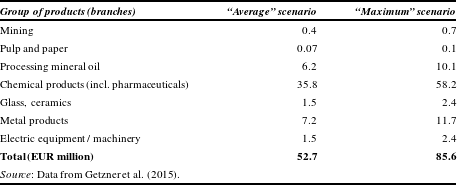
In order to account for the differences in cost estimations, two scenarios were tested. In the average scenario the mean costs of a range of estimates are assumed; and the BCA model includes REACH total costs of EUR 53 m. In the maximum scenario the maximum of relevant estimates are assumed and account for the total costs of EUR 86 m. These costs are valued at the prices in 2013, and they are the total costs of companies for the period from 2008 to 2014; these costs were transformed into annual average costs for the period of 2008 to 2014 in the cost-benefit calculation. After the full implementation of the system (i.e., after 2014), the BCA assumed a linear reduction of the annualized costs which should continue until the end of the observation period in 2044, since the registration and administration costs are highest after the (mandatory) implementation, e.g., for already existing SVHC. In table 4 the implementation costs of different groups of products are shown. The distribution of costs mainly associated with the chemical industries is of especial importance in regard to the effects on the economy.
Total costs of implementing the REACH system in Austria (aggregated costs of companies for the period of 2008 to 2014; EUR million, 2013 prices).

5 Results of the benefit-cost analysis
5.1 The main results of the basic scenario as a starting point for sensitivity analyses
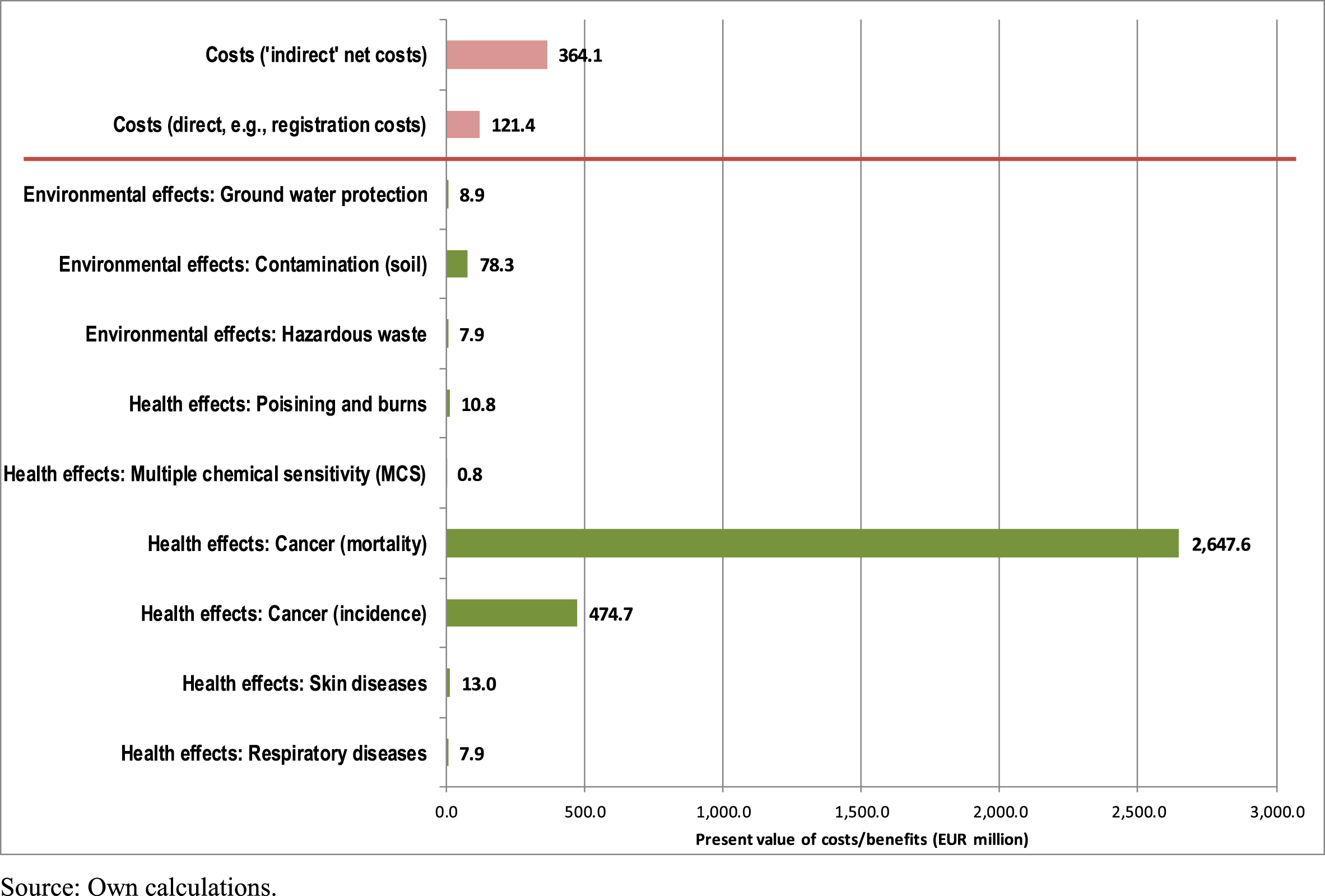
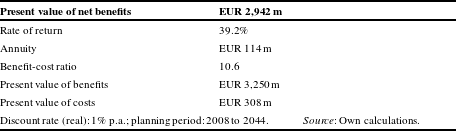
The following results are calculated based on the mean values of all benefits and costs on the assumption of a basic scenario. As there are many uncertainties involved, the calculation begins with the conservative values of the costs and benefits. These costs and benefits are then varied in sensitivity analyses. For this baseline scenario, the implementation of the REACH system leads to significant net benefits. For the period from 2008 to 2044, it is estimated that net welfare benefits of about EUR 2.5 bn will be obtained by this system of regulating and evaluating chemicals. Given the high internal interest rate (rate of return) of approx. 39%, and a benefit-cost ratio of over 10, this regulatory framework is also a highly efficient investment of the Austrian economy even taking into account the scarcity of resources. Interestingly, RPA (2015) estimates the benefit-cost ratio of several regulations on chemicals, e.g., several elements of the REACH system, also in the range of 9 to 10. Table 5 presents the results of this basic scenario in detail; the calculations assume a very modest 5% reduction of all health problems attributed to chemicals, and a population growth according to the official Austrian statistical prognoses. The discount rate is set at 1%.Footnote 8 Figure 1 shows an overview of the significance of each category of benefits and costs as a result of the implementation of the REACH system in Austria. The benefits to be had by reducing chemicals-related mortality and morbidity by exposure to chemicals are the highest and influence the whole calculation which can be expected, given the nature of chemical regulations. The next section therefore presents selected sensitivity analyses in which the main parameters are varied.
Benefits and costs of the REACH system for the Austrian economy (basic scenario, 2008 to 2044; EUR million, 2013 prices).

Results of the BCA of the REACH system for the Austrian economy (basic scenario, 2008 to 2044; 2013 prices).

5.2 Sensitivity analyses of probable deviations from the basic scenario
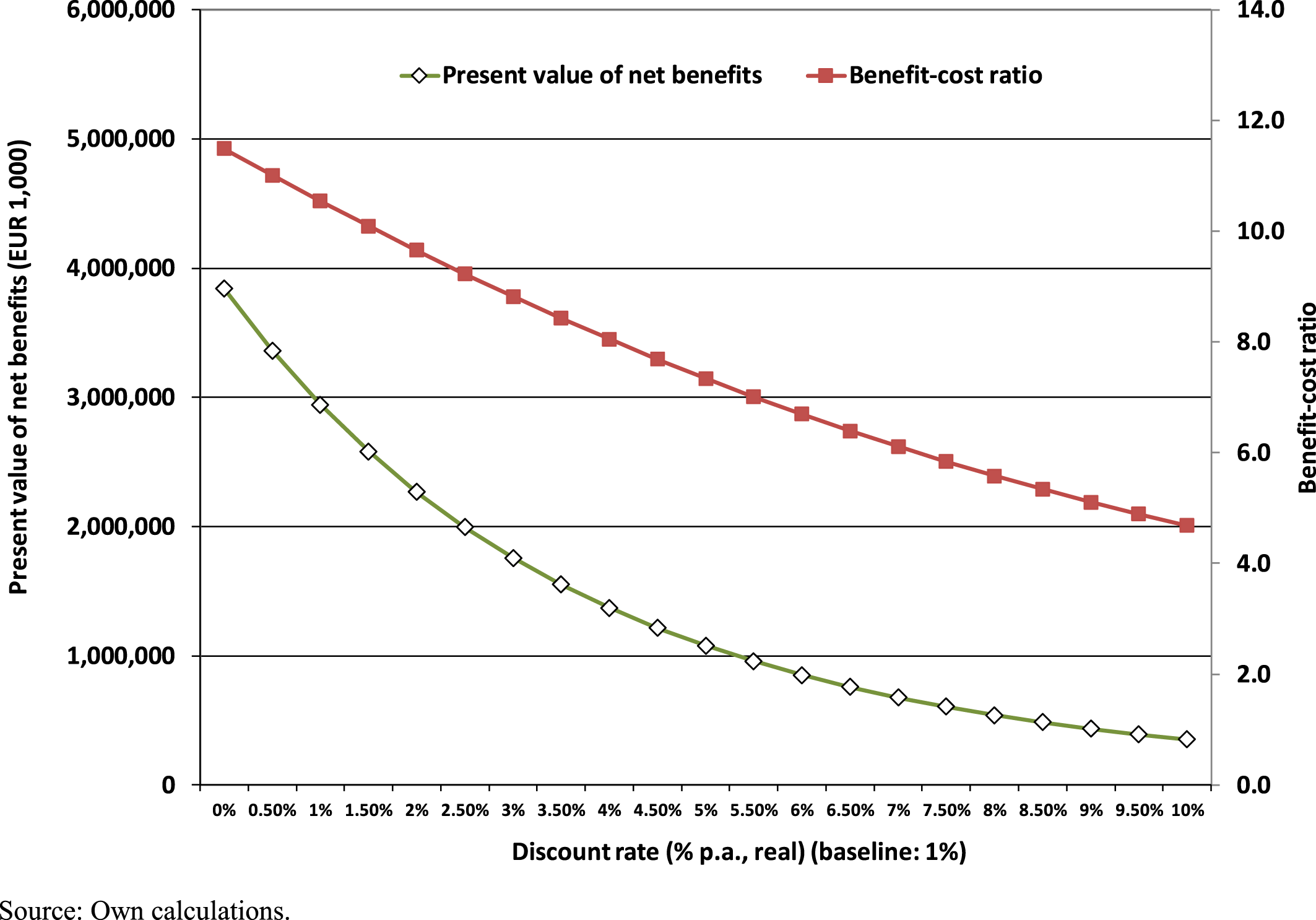
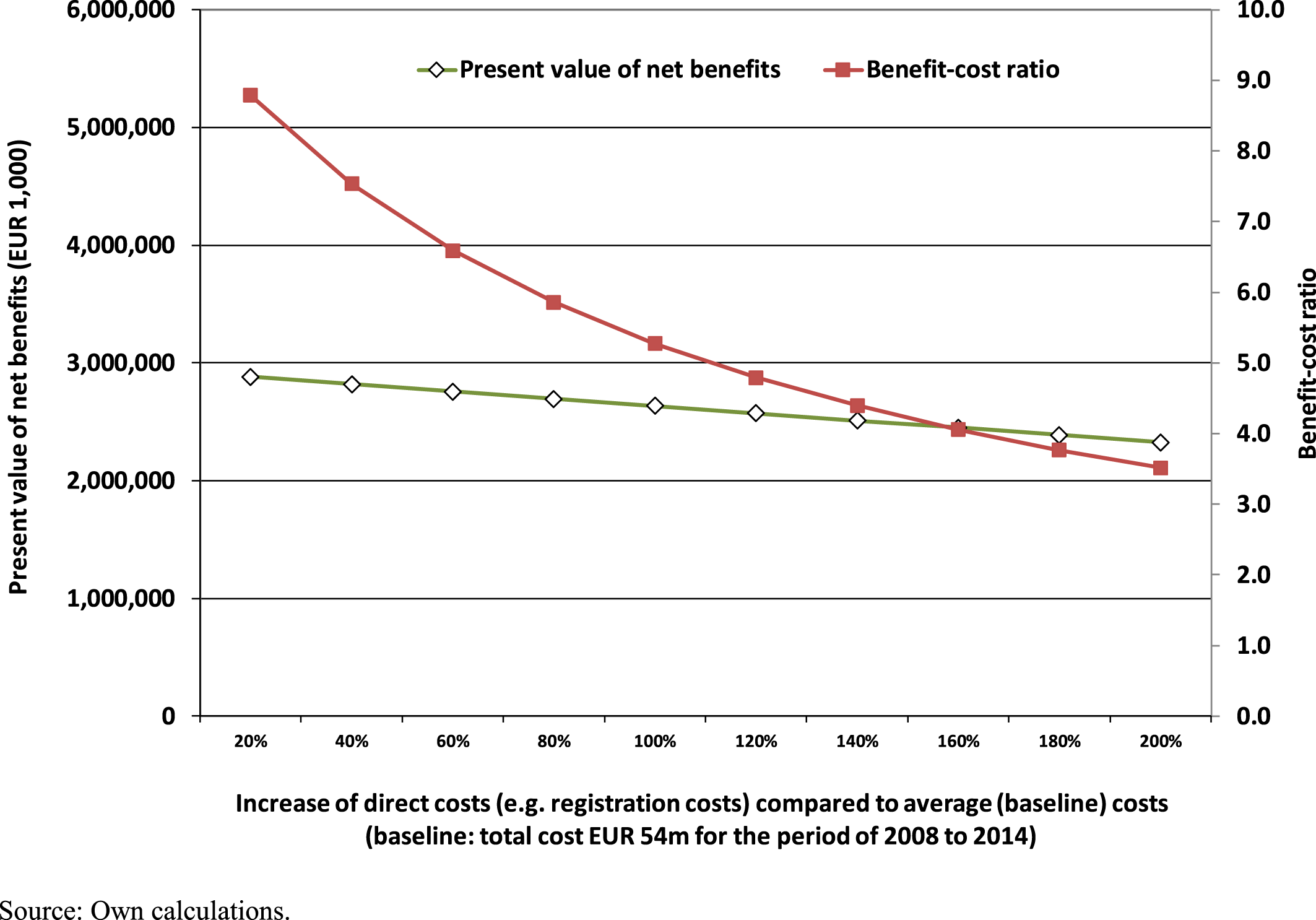
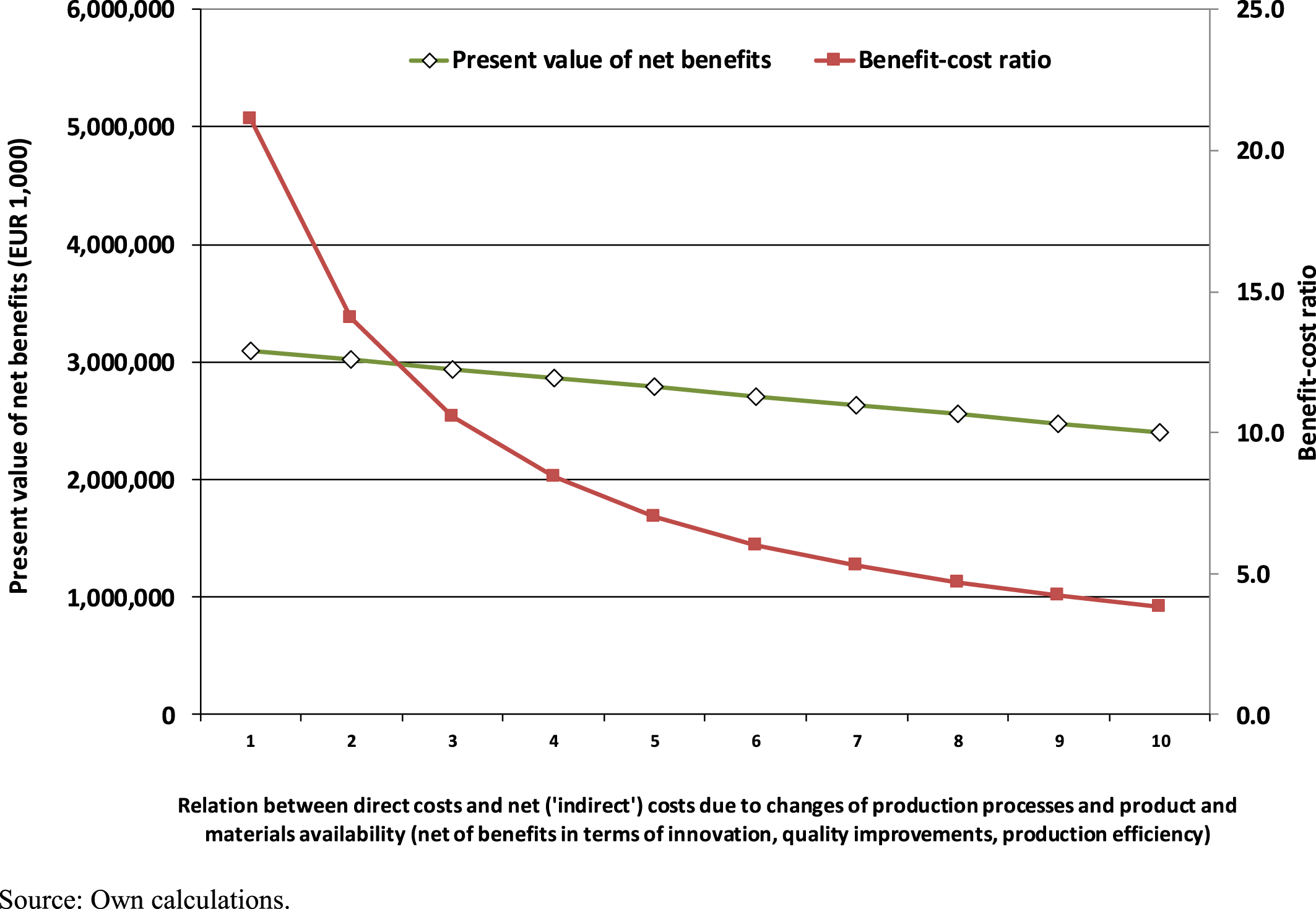
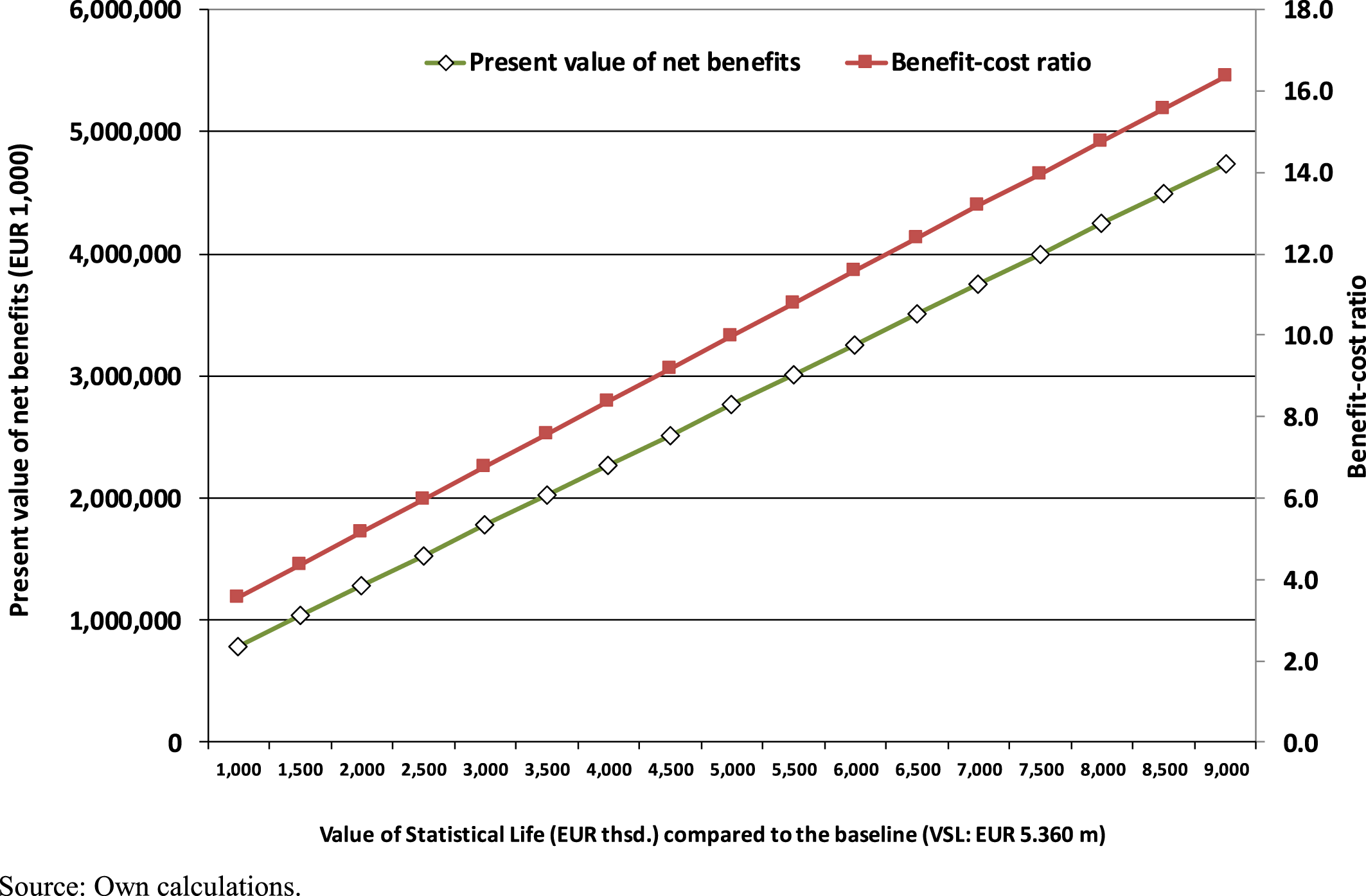
The present calculations are based on a number of assumptions. Therefore, when interpreting the results of the baseline scenario and the sensitivity study, one has to consider that the individual benefit and cost components were determined using the best available data, even though they can partially be subject to considerable uncertainties and information gaps. A series of sensitivity analyses (reliability tests) allow for a more differentiated view of the results of the main scenario, and it shows which factors are relevant in the economic assessment of the REACH framework. Sensitivity analyses also identify the threshold levels of a range of variables (e.g., health benefits as a result of regulating chemicals) above which REACH will generate a net benefit for the Austrian economy. In particular, the costs of REACH (introduction and enforcement), the discount rate, and the extent of the positive health effects, as well as the economic evaluation of the effects on health are of particular importance in the sensitivity analyses. The following Figures 2–6 show a selection of reliability tests that were carried out.
The sensitivity analyses emphasize that even with very pessimistic assumptions of the extent of individual cost and benefit components, the overall REACH system achieves a consistent net benefit for the Austrian economy. The reliability tests (Figure 2) show that if the discount rate is quadrupled (4% instead of 1% in the main scenario), the economic surplus will still be around EUR 1.2 bn (instead of EUR 2.5 bn in the main scenario). If the discount rate is increased even further to 7% (10%, respectively), the net benefit of the REACH framework for Austria will still amount to EUR 677 m (EUR 351 m). At the same time, the benefit-cost ratio will drop from 10.6 to 8.1 (discount rate of 4%), to 6.1 (discount rate of 7%), and to 4.7 (discount rate of 10%).
Sensitivity of results with respect to variations of the discount rate.

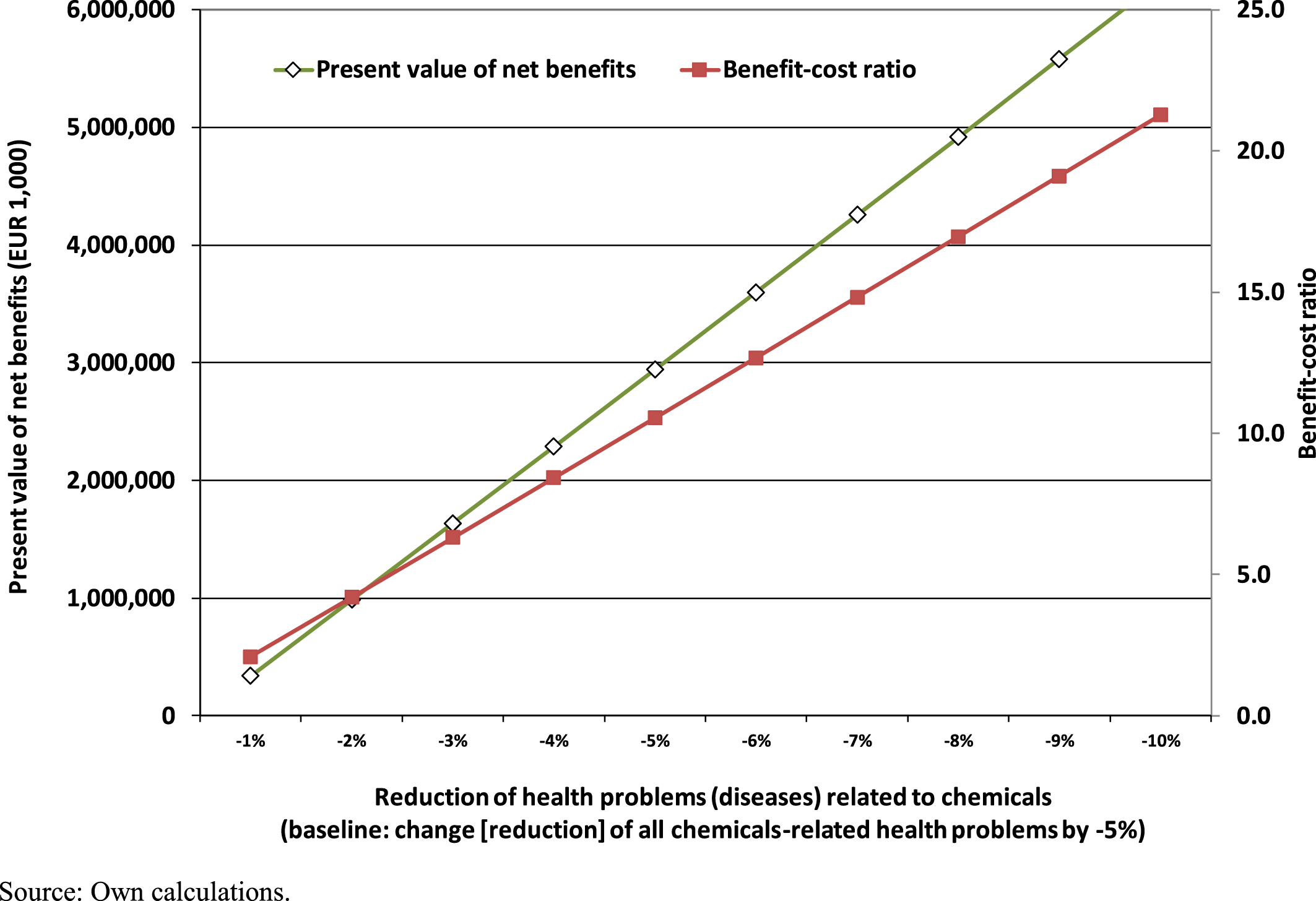
With regard to the assumed effects on health, even if only 1% of all diseases attributed to chemicals (rather than 5% in the baseline scenario) can be avoided through the REACH framework, the net benefits would still be around EUR 300 m, and the benefit-cost ratio would drop from 10.6 to 2.1 (Figure 3).
Sensitivity of results with respect to the reduction of diseases related to chemicals.

The increase in the direct costs of REACH (e.g., registration and testing costs) hardly influences the result, because even if direct costs are doubled, the surplus falls just below EUR 2.7 bn; at the same time, doubling direct costs decreases the benefit-cost ratio from 10.6 to 5.6 (Figure 4).
Sensitivity of results with respect to direct costs of implementing the REACH framework.

An increase in indirect net costs (e.g., costs and benefits of adjustments in production and products) also has little impact on the net economic benefit. If indirect costs are assumed to be ten times of the value of the direct cost (instead of triple costs), the net economic benefit will be reduced from around 2.9 to EUR 2.4 bn. The benefit-cost ratio drops to 3.84.
Sensitivity of results with respect to indirect net costs of implementing the REACH framework.

Finally, the sensitivity analysis stresses the importance of the VSL for the BCA. Figure 6 shows that a drop of the VSL from the baseline value of EUR 5.360 m to only EUR 1.0 m leads to a reduction of the net present value of net benefits to EUR 788 m and to a drop of the benefit-cost ratio to 3.6.
6 Discussion and conclusions
Based on the uncertainties of the data and information on the effects of REACH as presented and discussed in the context of this paper, the economic costs and benefits can be assessed only in a rather wide range and in the context of the sensitivity analyses. This study begins from a baseline scenario, in which conservative cost and benefit estimates are taken into account with a possible and probable average estimated by the authors. The single cost and benefit components are then subject to variations in a sensitivity analysis over a very wide range of values to show whether, and to what extent, significantly higher or lower costs or benefits affect the results of the BCA. In the baseline scenario, the net benefits of the REACH framework are substantial and amount to about EUR 2.9 billion (bn) with a benefit-cost ratio of 10.6. All sensitivity analyses suggest that even a significant reduction of assumed benefits or an increase of costs would neither lead to a negative estimate of net benefits nor a reduction of the benefit-cost ratio below 1.
Sensitivity of results with respect to variations of the value of statistical life (VSL).

These results suggest that, from an efficiency point of view, the implementation of the REACH system in Austria provides, or has already provided, positive net benefits in a wide field of possible effects of regulating chemicals. This is due to the considerably beneficial effects on human health (workplace, general health), which is directly reflected in a (potential) reduction of diseases and accidents related to the use and handling of chemicals. However, based on the data currently available, it is not possible to provide a precise quantification of the monetary values of economic benefits owing to the introduction of the REACH framework. While sensitivity analyses are a common ingredient of benefit-cost analyses in general, this study relies more heavily on varying the different variables in a wide range. For instance, it is still uncertain how many cases of morbidity or mortality the REACH framework may prevent. This paper assumes that the reduction of these cases over a 30-year period will be 5% of all diseases attributed to chemicals. The analysis shows that even if only 1% of the diseases attributed to chemicals are prevented by the REACH system, the net benefits are still positive for the Austrian economy.
To sum up: The BCA demonstrates, with a rather high probability, that the regulation of chemicals by means of the REACH system leads to an overall net benefit for the Austrian economy.
While a net benefit of REACH therefore seems to be likely, it is important for the interpretation of these results that this analysis can neither address potential industry-related and company-specific problems in transforming and changing the production and use of chemicals, nor clarify the question how costs and benefits are distributed among chemical companies, stakeholders (workers) and the public. While benefits from REACH through the associated innovation effects in companies may be expected, the main benefits for workers and companies lie in workplace-specific effects on human health.
This BCA ascertained benefits and costs of the REACH system for the Austrian economy; the question remains whether results can be transferred to other European countries. The transfer of values to other countries may certainly result in a first impression of potential benefits and costs. Possible methods for this transfer are the consideration of the elasticity of values with respect to income (GDP), and changes in the overall price level of the economy. However, for a more thorough analysis, one would especially need to study the country-specific costs of diseases (such as treatment costs and productivity losses), and to include statistics on the morbidity and mortality of diseases related to chemicals.
While policy recommendations of this BCA seem to be straightforward in regard to improvements of the REACH system and the lowering of costs for chemical companies, there are still many open research questions. The economic evaluation of human health and diseases related to chemicals is certainly a major task of the scientific community. However, there still is (and probably will be for a long time) a need for basic data on the concrete, quantifiable effects of chemicals on human health and environmental conditions, especially in regard to the combined effects of different chemicals, the linkages to allergies and MCS. In this respect, the REACH system has brought about an important policy innovation in terms of the shift of the burden of proof; formerly, authorities had to prove that chemicals would be harmful if they were to be banned. The REACH system has implemented a regulatory framework in the European Union – with effects world wide along the whole production chain – that produces information (safety data sheets, scientific studies) on chemicals with specific relevance to human health and environmental conditions. This is certainly a major step forward to make the precautionary principle of the EU’s environmental policy strategy operational.
Acknowledgments
This paper is part of a comprehensive economic analysis of the implementation of the REACH system commissioned by the Austrian Ministry of Agriculture, Forestry, Water Management and Environment (BMLUFW-UW. 1.2.4/0096-VI/5/12) under the lead of T. Jakl. The authors are thankful for the collaboration in the whole project team, especially to C. Plas, J. Schweighofer, M. Schwärz, and B. Mahlberg, who worked on different research questions, such as the assessment of stakeholders, the chemical industries, and the REACH system effects on the economy in regard to value added, prices, and employment. The authors are also very grateful for the many comments made by attendees of the Annual Conference of the Society for Benefit-Cost Analysis, Washington (D.C.), March 2016, and to the anonymous reviewers of this paper. All errors are, of course, the responsibility of the authors.
Supplementary material
To view supplementary material for this article, please visit https://doi.org/10.1017/bca.2018.16.