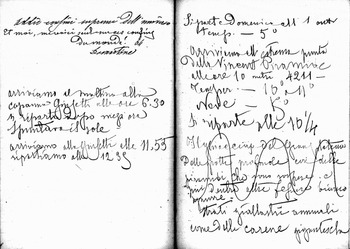
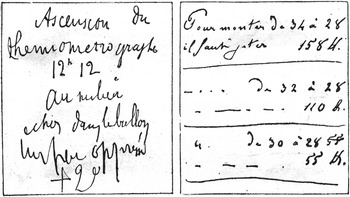
After climbing Monte Rosa, the highest peak of the Italian Alps, in February 1885, the physiologist and internationally renowned expert on human fatigue, Angelo Mosso (1846 – 1910), copied a line of poetry into his notebook from the famous French romantic writer Alphonse Lamartine that reads in English: “And I, here I am alone at the frontier of the world” (see fig. 1). The quotation reappears in the printed account of the tour that Mosso published subsequently: “I could neither express the emotion I felt, nor the magic of the view. . . . One feels that one has reached the outer frontier of the world” (Mosso Reference Mosso1885, 90f.; emphasis added). On the summit itself however – the moment to which these poetic reflections referred – the physiologist had confined himself to prose. He noted time, height, and temperature, before leaving the spot after fifteen icy minutes. In his magisterial book on Alpine physiology, L'uomo sulle Alpi, which came out in 1897, Mosso recorded the event and explained the conspicuous tremor of the handwriting in his diary: “I was very tired.”Footnote 1
Mosso's diary (top left Lamartine, center right summit notes), Reference Mosso1885 (Biblioteca Angelo Mosso, Torino).

My essay is about the two kinds of written speechlessness that face each other on Mosso's pages: One, on the left, that links a sublime experience to poetry; the other, on the right, that links physical exhaustion to a shaky handwriting. I argue that they represent two different cultures of mountaineering – of traveling, experiencing, and inscribing the Alps, that have differentiated and, to a certain extent, followed each other during the course of the long nineteenth century. One, around 1800, that centered around the aesthetic category of the sublime and linked tourists’ and naturalists’ visual perceptions to a search for images and words; the other, beginning in the 1850s, that centered around the physiological category of fatigue and linked bodily locomotion to analog traces such as handwriting, photography, and mechanical curves. Complementary to Victorian mountaineering and its cult of virile force, Angelo Mosso and contemporary colleagues developed an experimental physiology of fatigue and altitude. Eventually, their pioneering research prepared the ground both for the scientific study of work and for aviation medicine that developed in the early twentieth century.
Demarcating a blurry zone between sublimity and fatigue, Mosso's Alpine expeditions offer key material for studying the transition from aesthetics to physiology, from romantic symbols to analog tracings of the mountain experience, or, to make creative use of Lorraine Daston's term, from the “wordless subjectivity” of picturesque travelers to the “wordless objectivity” of fin de siècle life scientists (Daston Reference Daston1994). In the following, I consider Alpine travel journals to see how the aesthetic conventions of sublimity were exhausted and how writing became a physiological trace.Footnote 2
1. The picturesque voyage . . .
Until well into the eighteenth century, Livius’ ancient view of the foeditas Alpium, the ugliness of the Alps, was barely contested. Peaks were nameless, maps were nonexistent, and whoever set out for the inhospitable area dividing northern Europe from Italy did so out of sheer necessity (cf. Wozniakowski Reference Wozniakowski1987, 217f.). Take the symptomatic prayer of an English monk who had to cross the Great St. Bernard Pass in 1178 on his way to Rome: “Lord, restore me to my brethren, that I may tell them that they come not to this place of torment” (quoted in Engel Reference Engel1977, 17). Similarly, when the German father of classicism, Johann Joachim Winckelmann, traversed the St. Gotthard in 1760, he shut the windows of his coach to avoid the ugly sight of rocks and snow (cf. Koschorke Reference Koschorke1990, 121).Footnote 3
Only thirty years later, the German professor of philosophy, Christoph Meiners, expressed a grievance which has been unrelenting ever since. Meiners, the tourist, complained about the international crowd of tourists which populated Chamonix, the once quiet village beneath the slopes of Mont Blanc: “The arrival of so many visitors has fed the inhabitants such an industrious zeal that the travelers feel extremely bothered” (quoted in Begemann Reference Begemann1987, 99). For my line of argument it is important to understand that the new and fashionable “picturesque voyage” to Switzerland established a thoroughly visual approach to the Alps. Traveling to Chamonix or the Oberland glaciers meant to privilege the eye, i.e. to visit vantage points, to practice quiet contemplation, and to transform the mountain landscape into a series of images or words that simulated images (cf. Geimer Reference Geimer2002, 10). According to Johann Gottfried Ebel's Anleitung auf die nützlichste und genußvollste Art in der Schweiz zu reisen, which came out in 1793, “every foreigner coming to Chamonix should ascend the Montanvert to contemplate the prospect of the Mer de Glace, and to enjoy the whole scenery; it is much too unique to be missed” (quoted in Wagner Reference Wagner, Großklaus and Oldemeyer1983, 246). On the grassy slope, which could be climbed easily and offered a spectacular view of Mont Blanc in the background, Europe's traveling class indulged in the new picturesque gaze. Ever since an octagonal “Temple de la Nature” was constructed on the summit, inviting Rousseauian reveries, comfortable picnics, and painting sessions, reproductions of the view became a common cliché. Every Romantic traveler, it seems, who visited the Swiss Alps paid his duty call to Montanvert – from Goethe to Carl Gustav Carus to Mary Shelley's tragic hero Victor Frankenstein. A word on commerce: Since 1800, the Montanvert could be reached by horse. In the 1830s, a hostelry followed, in 1880 a Grand Hotel, and 1908 saw the advent of rails. Only the Mer de Glace, whose nearby crevices had once evoked convenient shudders, meanwhile retreated to higher grounds.Footnote 4
Just as the adjectives “picturesque,” “pittoresque,” and “malerisch,” which referred explicitly to painting, the Alpine tourists’ equipment clearly revealed their concern for visuality: Guidebooks in English, French, and German described the view at chosen locations, indicated the most beautiful vantage points and the most favorable viewing times. (Certainly, sunsets ranked exceedingly high.) So-called Claude Glasses, concave, tinted hand-sized mirrors, assisted in translating prospects into the picturesque genre – by providing frames, the brownish colors of Claude Lorrain, and enlarged and sheltering foregrounds or repoussoirs. Finally, diaries and sketch-books were at hand for those who preferred to capture their views immediately in drawings and poems.Footnote 5 Thus equipped, the picturesque traveler practiced the new aesthetics of sublimity. Along with the discovery of the Alps during the second half of the eighteenth century, these aesthetics enabled overwhelmed beholders of mountains to overcome their confusion symbolically by transforming their initial speechlessness into pictures and words. In 1816, the picturesque traveler Percy Bysshe Shelley wrote his famous poem on Mont Blanc under the immediate impression of the deep and powerful feelings excited by the objects which it attempts to describe, as the poet assured, and in “ecstatic wonder not unallied to madness” (quoted in Nicolson Reference Nicolson1997, 387f.). Like Winckelmann, Shelley still considered mountains terrible, and would not consider climbing them. But, prepared by authors of the new aesthetics such as Rousseau, from the safe distance of the valley, Shelley could contemplate the glaciers with “delightful terror,” by now the most prolific sentiment for works of art. The once disgusting sight of mountains produced in romantic beholders an initial stammering that was most favorable to poetic production. Accordingly, the sublime code time and again produced paradoxical descriptions of speechlessness. Lamartine is again a perfect illustration of this new attitude. His poem Desire begins with the opening line: “Oh! If I only had words, pictures, symbols to depict what I feel!”Footnote 6 – before moving on to a lengthy description of the Alpine landscape that the poet contemplates.Footnote 7
2. . . . and its discontent
At a time when the romantic mountain genre was only beginning to unfold, Horace Bénédict de Saussure, the Genevan professor of natural history, already transcended it. Upon seeing Mont Blanc for the first time, he promised a reward for anyone who would guide him to the summit. To reach the lofty “laboratory of nature,” as Saussure put it, where the geological insights would be deeper and the physical phenomena stronger than in the plains, and to discover “grandiose spectacles of every kind” – rustling waterfalls, thundering avalanches, and the frozen sea of the glaciers – were ends of comparable, if not equal, importance to the Swiss father of modern mountaineering (Saussure Reference Saussure1779, VIII).Footnote 8 Almost three decades after his bidding, in 1787, when his dream finally came true, Saussure could not help but stomp around the mountaintop in anger. Far above the tree line, the sublime shudder had turned into a physical calamity. Staggering, short of breath, and completely exhausted, the professor was in no disposition to enjoy the prospect from the summit. “I was like a gourmet invited to a superb banquet whose utter revulsion prevented him from enjoying it,” he wrote retrospectively, expressing his bitter regret that the climax of his Alpine journeys had, in a way, taken place without him (quoted in Schama Reference Schama1995, 490). The scientific observations Saussure was eager to accomplish even aggravated the painful sensations. He realized that his physical affliction grew stronger as he directed his attention to the instruments. “In this thin air, every careful observation is exhausting . . ., and after observing one of the instruments I was forced to rest and draw breath, just like after a rapid climb” (Saussure Reference Saussure1796, 175f., cf. 145). Watching his guides fall asleep on the snow, Saussure managed, at least, to collect the data that were most important to him. After four and a half painful hours, the party set out for the tedious descent.
One should not read Saussure's unsettling account as a document of failure. In spite of the difficulties, the naturalist considered the view from the top of Mont Blanc as a geological revelation that allowed him to grasp the structure of the surrounding mountain chains in a “coup d'oeil” (cf. Bigg Reference Bigg2007, 77). In fact, the late eighteenth and early nineteenth centuries’ literature of exploration and discovery is generally saturated with physical hardships.Footnote 9 Dorinda Outram has convincingly argued that the fragile bodily presence pervading this literature possessed an important epistemological function. It invested the naturalists’ hardly verifiable assertions with scientific reliability (cf. Outram Reference Outram, Livingstone and Withers1999). When Humboldt, in 1802, claimed to have climbed Mount Chimborazo (and, incidently, to have surpassed Saussure's famous altitude record) he explicitly referred to the painful physical alterations he had experienced: “They are a kind of gauge for the rarefaction of the air and for the absolute height one has reached” (Humboldt Reference Humboldt1853, 149). From a late nineteenth-century point of view, with its ideal of mechanical objectivity and its efforts to have the observer disappear behind his instruments, such remarks may seem strange. Before the advent of the ideal of the objective, uninvolved scientist, however, they lent traveling naturalists’ findings a physical form of authenticity.
In the case of Humboldt, the close attention to bodily reactions had, of course, a much broader significance than simply to ensure reliability. Ever since his early self experiments on nerve and muscle irritation, Humboldt conceived of the human body as an instrument suited to measure the forces of nature (cf. Dettelbach Reference Dettelbach1999, 477f.). According to Alexandre Métraux, Saussure used a comparable strategy. His Voyages dans les Alpes make continuous reference to the rhythms, sensations, and limitations of the naturalist's body, thus turning it into a fine tuned “apparatus” of natural philosophy (cf. Métraux Reference Métraux and Naumann2005, 61f.).Footnote 10 Saussure's disturbing high altitude experience on the top of Mont Blanc, though, marks the origin of a historical transmutation: In the wake of his famous ascent of the Alps’ highest peak, the naturalist's body turned gradually from being an instrument to becoming the object of Alpine science while, in a complementary movement, the physical handicap of mountaineering turned from an inevitable circumstance into mountaineering's very purpose.
Indeed, the decades that separate Saussure from the Victorian climbers are marked by a recurring experience. While the appeal of Mont Blanc and other high summits became ever more self-evident, the pioneers of mountaineering reported their loss of sight and speech. What the eighteenth-century philosophers of the sublime had assured, that only detached beholders could enjoy a terrible mountain scene, became a painful certainty. In the snowy heights, any attempt to master the challenging landscape symbolically was thwarted by vertigo and somnolence. Take the example of John Auldjo, who accomplished the fourteenth ascent of Mont Blanc in 1827. At the summit, his romantic ambitions had thoroughly left him: “The mind was as exhausted as the body, and I turned with indifference from the view, and throwing myself on the snow, in a few seconds I was soundly buried in sleep.” To the aesthetics of the picturesque voyage, one might say, succeeded the anesthetics of the mountain tour (Auldjo Reference Auldjo1828, 47).
From its early days of Alpine exploration, thus, the crucial moment on the overlooking summit could hardly be contemplated or described since vision and speech, attention and memory were all badly affected. From less elevated vantage points, climbers’ initial vertigo was soon tamed by the new visual habits of the time – think of Goethe's panoramic self-therapy on the tower of Strasbourg's cathedral. In the high Alps however, things took a different route. On the summit of Mont Blanc, Saussure was more concerned with himself than with the scenery, a distraction that explains why his Voyages feature a panorama from the less elevated Mount Buet, not from their spectacular climax. As the suffering body denied aesthetic pleasures and made scientific observations distressful, the mountaineers’ afflicted attention shifted slowly from the mountains to their own selves. Saussure himself spent considerable time measuring his body temperature and counting his pulse and respiration rate when he stayed 16 days on the Col du Géant the year after his famous Mont Blanc ascent – even if his main goal was to carry out physical, meteorological, and geological observations (cf. Saussure Reference Saussure1796, 315–18). When Frederic Clissold set out for the tenth Mont Blanc ascent in 1822, he renounced scientific instruments altogether. Instead he intended a “psychological self-experiment: observing the properties of the soul when it is forced to release such new and noble energies.” A new esteem for adventurous self-experiments took over where classical natural philosophy had reigned.Footnote 11 Eventually, it evolved into middle class mountaineering and its experimental sibling, high altitude physiology.Footnote 12
During the first half of the nineteenth century, however, the English public expressed strong objections. To take high risks without pursuing any classic scientific goal seemed utterly dubious. Even the mountaineers’ mental health was called into question. In its 1852 edition, John Murray's Handbook for Travellers in Switzerland, the English tourist's bible, still declared that most Mont Blanc climbers were “persons of unsound mind” (quoted in Hansen Reference Hansen1995, 300).
3. Magic Images
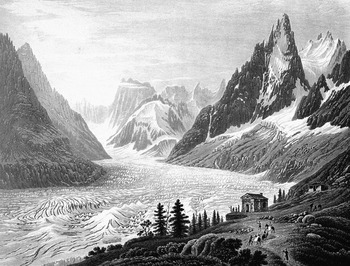
In order to understand the historical depth of the transformation from an aesthetic regime of mountaineering to a regime I call “physiological,” i.e. a regime that tied the mountain experience – including mountain aesthetics – ultimately to physical exhaustion and physical heroism, it is worth taking a closer look at the Alpine imagery of the time. The collapse of the picturesque voyage also affected painting and illustration. The rich iconography of romantic mountain landscapes that had been established around 1800 dissolved as the pioneers of mountaineering left the valleys for the peaks (see fig. 2). This iconography had been firmly tied to the older type of Alpine voyaging, to a travel culture of visual impressions that kept the sublime mountains at a distance. But painting vanished where contemplation was replaced by locomotion, and where the Alpine “theater” was turned into a “playground.”Footnote 13
“Mer de Glace vue du Montanvert,” aquatint by Samuel Birman, 1826.

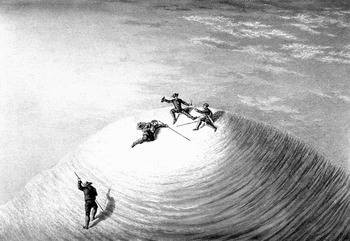
Accordingly, writers on Alpine aesthetics from Chateaubriand to Georg Simmel have declared mountains and paintings to be incompatible. In 1841, the French landscape painter Étienne Delécluse wrote: “In the high regions of the Alps . . . no art is possible. The Alps are not picturesque, they are lethal” (quoted in Vellozzi et al. Reference Vellozzi2002, 363). And even John Ruskin, the eloquent mouthpiece of Turner and of mountain painting in general, insisted on the indispensable distance between the artist and his Alpine sujet (cf. Dirlinger Reference Dirlinger2000, 126). As a matter of fact, the sparse attempts to produce art in the high mountains failed to develop a stable iconography. In Britain, satirical drawings in Punch-style had a short-lived success around 1850 (see fig. 3). However, in the second half of the century, the whole genre was indicted by realists. “There are painters who . . . make accuracy of form a minor consideration, the inaccuracy generally being on the side of exaggeration of steepness in mountain forms,” stated a prominent member of the London Alpine Club apodictically in 1882 (Donkin Reference Donkin1882, 65).
“Ascension d'Albert Smith au Mont Blanc le 13 août 1851. Arrivée au sommet,” aquatint by George Baxter, 1853.

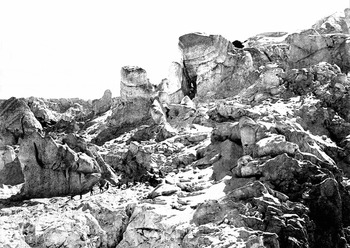
In July 1861, while critics were still arguing over the status of mountain painting, the French “Photographe de l'Empereur” Auguste Rosalie Bisson and 25 porters succeeded in exposing collodion plates on the summit of Mont Blanc. Up to then, the Bisson brothers had mainly photographed glacial panoramas from medium heights on behalf of the French geologist Daniel Dollfus-Ausset. They had been invited to present their work at the Académie des Sciences. With these new images, the brothers gained immediate public and commercial success. “What solitude, what silence, what desolation!” reveled the writer and art critic Théophile Gauthier. He declared that only photography was capable of rendering a valid representation of the high mountains and, on the occasion, once again diagnosed the end of art: “Art, as we know it, does not reach higher than vegetation. It stops where the last plant dies shivering. Beyond is the inaccessible, eternity, infinity, the domain of God. . . . If a painter climbed this high the colours on his palette would freeze” (Gauthier Reference Gauthier1862; see fig. 4).Footnote 14
“Savoie 42, Passage à la corde,” photograph by Bisson frères, 1862.

Most critics were fascinated with the pragmatic dimension of the photographs. The German review Photographischer Almanach of 1862 considered what it meant to expose collodion plates on the summit of Mont Blanc:
Certainly, it is not an easy task to take photographs at 16,000 feet above the sea level. First of all, it was necessary to set up a tent in order to prepare the plates. The operator had to avoid trembling from cold or agitation. By then, the somnolence had become general; everybody else succumbed. When the plate had been exposed, there was no water at hand to rinse it. It had been planned to melt snow with the lamps, but in this atmosphere, the lamps only burned with very small flames. A man was ordered to keep the lamps burning; he fell asleep. He was replaced by another man, who suffered the same. (Quoted in Chlumsky Reference Chlumsky and Folkwang1999, 165)
Only Bisson's cast-iron discipline “in spite of his delicate constitution,” as the author of the Almanach noted, led to success (quoted in ibid.). Henceforth, the public could climb up Mont Blanc – “without sharing the fatigue” (Du Pays Reference Du Pays1861a, 190). They could not yet reach the summit, however. After returning from his expedition, Bisson found that the very three plates he had exposed on the top of the mountain had flocculated due to the cold, and were thus worthless. Susan Sontag has considered “heroism of vision,” i.e. the ability and attitude of photographers to capture images in inaccessible or dangerous places, an important trait of early photography (Sontag Reference Sontag2001). In 1861, the successful, unsuccessful Bisson incarnated the photographic hero in a tragic version.
For the first time, his images showed the legendary heights of Mont Blanc, a landscape that belonged to France, since Savoy had joined the country in 1860. But for his contemporaries, it seems, the landscape itself was less exciting than the heroic deed that had made it visible: the photographer's amazing “oeuvre de Romain” in a hostile environment (D'Arve Reference D'Arve1876, 137). Slightly paradoxically, after giving another wordy account of Bisson's arduous expedition, Ernest Lacan, the editor of the Moniteur de la Photographie, declared: “They [i.e. Bissons images] elucidate the difficulties that the author had to overcome, and the dangers to which he had to expose himself far better than all words” (Lacan Reference Lacan1862, 93).
Beyond the mere climbing, it was the photographic process itself that elicited admiration. In the age of wet collodion (that lasted until the 1880s), photographic glass plates were exceedingly heavy and could only be sensitized on the spot, by using lightproof tents and carefully tempered water. Transferring collodion technology to such an unfavorable environment meant to maximize the difficulty. Viewers therefore received Bisson's mountain photography as highly recursive: “I look with admiration and wonder at certain magnificent photographs of the Oberland mountains . . ., mentally picturing the train of porters carrying the tent, the huge camera, and all the outfit necessary for that cumbersome . . . process,” noted William Donkin, the famous English mountain photographer, in 1882, commenting on the works of his predecessors (Donkin Reference Donkin1882, 67; emphasis added).Footnote 15 How could a camera get there? How could a photograph be taken there? Bisson's contemporary public had felt the same astonishment. Take Ernest Lacan's remark in the Moniteur de la Photographie: “How Mr. Bisson has been able to successfully realize this print under such conditions I cannot explain to myself; but the result is there” (Lacan Reference Lacan1862, 93).
André Bazin, Roland Barthes, and other theorists of photography have assured us that the medium has a magic character. Being the result of a factual contact with light waves, they argue, a photograph is less a sign than a part of its referent, and less an image than a proof.Footnote 16 Indeed, as the imperial commissaire spécial in Chamonix, Edmond de Catelin, wrote in 1861, Bisson's “magic images” had less in common with the landscape paintings of the picturesque tourists than with the contemporary habit of Victorian mountaineers to collect stones on the summits they had conquered (D'Arve Reference D'Arve1876, 135). Edward Whymper, the winner of the Matterhorn-race of the 1860s, proudly declared that his collection of minerals reproduced the forms of the mountains on which they had been collected. As an amateur geologist, Whymper was not surprised at such coincidence: “Why should it not be so if the mountain's mass is more or less homogeneous? The same causes which produce the small forms fashion the large ones” (Whymper Reference Whymper1871, 215).
And the same mixture of resemblance and tangency, I suppose, was at work in Bisson's photographs, if not in terms of geology, then in terms of physiology. Collodion plates showed reactions to the Alpine environment that were similar to those of mountaineers: with analogical faith they recorded hardships and handicaps such as cold and trembling hands. In 1869, George Soulier eventually managed to publish the first photograph of the summit of Mont Blanc: a low-contrast, cloudy image, quite obviously bare of any immediate visual appeal (see fig. 5). “What will reveal itself to our eyes up there?” (Du Pays Reference Du Pays1861b, 95). The question that had bothered the photographic public since Bisson's first failed attempt was finally answered – by little more than gray fog. Soulier's decision to publish his print cannot have been based on sheer aesthetic quality. In his reflections on the magic character of photography, André Bazin has observed that “no matter how fuzzy, distorted, or discolored, no matter how lacking in documentary value the image may be, it shares, by virtue of the very process of its becoming, the being of the model of which it is the reproduction” (Bazin Reference Bazin and Trachtenberg1980, 241). Soulier's photograph, one could further assume, did not carry a visual value despite but precisely because it was out of focus. The prospect from the summit of Mont Blanc itself had always been disappointing. But in addition to the legendary location, the plate had faithfully registered the operator's trembling body. With strong visual evidence it indicated what it meant to sojourn at a place which was, as Saussure had already ascertained, not made for men.Footnote 17 The Alpine photography of the 1860s was spectacular thanks to its “physiological” surplus: it furnished evidences of fatigue.
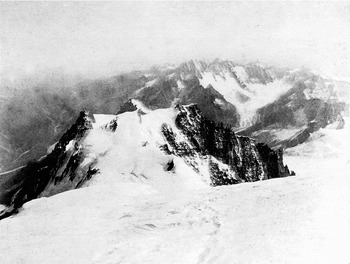
“Sommet du mont Blanc,” photograph by Charles Soulier, 1869.

4. Traces of Fatigue
At the time the Bisson brothers undertook their photographic expeditions to the Oberland glaciers and Mont Blanc, the vivid descriptions of visual disturbance and speechlessness was about to disappear from the Alpinist literature. Earlier authors in the wake of Horace Bénédict de Saussure's pioneering ascent had indulged in great detail in the hardships of mountaineering. As late as the 1840s, its symptoms were generally subsumed under the title of “mountain sickness.”Footnote 18 But the British and continental middle-classes that flocked to the Alps from the mid-1850s, inaugurating what has been called the “Golden Age” of Victorian mountaineering, widely ignored their own physical woes. The esteem for self-experiments shared by the early adventurers was on the wane. Displaying their national, class, and gender identities, the new middle-class climbers longed for heroic deeds and held their tongues about the disturbing effects of thin air and fatigue.Footnote 19 Edward Whymper's voluminous Scrambles in the Alps of 1871, one of the most popular Victorian mountaineering books, does not contain a single reference to serious mountain sickness. Complaining of such presumed conceit, the French physiologist Paul Bert (who had carefully examined the journals of the different European Alpine clubs during the 1870s) wrote:
Finally, the point of honor has intervened; one almost fears the mountain sickness as being ridiculous . . . . In the past, one used to search the symptoms in one's self, boasting of having experienced them like a mysterious danger. Today, one refuses to observe them, to confess them at all. Sometimes they are denied. (Bert Reference Bert1878, 128)
Repressed by the Victorians, the handicap of mountaineering found a new home in the life sciences, where it was turned into an object of systematic experimental study. Since the 1850s, physicians and physiologists such as Paul Bert, Claude Bernard's disciple and successor at the Sorbonne, went to the library to consult the older literature by amateurs, criticizing what they considered to be dubious observations and alleged facts.Footnote 20 “The better part of the voyagers . . . are tourists to whom everything in the mountains is new. Overwhelmed by the scenery . . . they get carried away by their imagination and . . . report what they consider precise recollections. Most of these facts . . . are dubious,” wrote the French physiologist A. Le Pileur, railing against the physiological self-observations of dilettante adventurers (Le Pileur Reference Le Pileur1845, 80f.). Beyond the professional boundary work that seems inevitable on such occasions, Le Pileur's skepticism touched on a serious problem: how could a collapsing observer, with failing senses and stammering voice, observe his very own collapse?
The precarious and fleeting character of travel impressions, the means of sharpening and preserving them, had been a subject of discussion since the eighteenth century. It is hardly surprising that much thought was spent on writing techniques. A treatise such as Franz Posselt's Apodemics or the Art of Traveling, one of the most successful German books of its genre from 1795, put much emphasis on note-taking. By means of the fountain-pen and portfolio – the latest achievements of travel equipment – events should be jotted down, if possible, on the spot itself to avoid the uncertainties of subsequent memory (cf. Hartmann Reference Hartmann and Bausinger1999). Saussure took this rule to heart when he assured his readers that whenever possible he had always taken notes in the field and made clean copies within 24 hours (cf. Saussure Reference Saussure1779, xi). But contrary to the gentle Italian surroundings of the classical Grand Tour, taking notes in the mountains was not particularly pleasant. Saussure's own scribblings reveal how difficult it could be to commit readable words to paper with freezing or trembling hands: some of their passages have not been deciphered to this day.Footnote 21
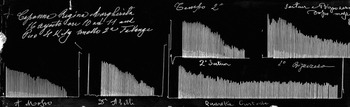
In the long course of the nineteenth century, such failures of signification gained increasing attention. The shaky characters, the white pages, and the unfinished journals of victorious or failing explorers fired the imagination of an epoch that discovered handwriting as a trace of grandeur. They were turned into autographs whose tremor seemed to point directly to their heroic origins. After Bisson had returned from his Mont Blanc venture, the imperial Commissaire spécial in Chamonix Edmond de Catelin published an account of the expedition in which he cited copiously from Bisson's own journal, “a precious manuscript,” as Catelin specified, “that I would like to photograph using its author's technique to present it in its proper value.” The journal had secretly been turned into an autograph. Its exceptional value derived from the lofty scene in which it was written and where, as Catelin asserted, even the best inks tended to freeze (D'Arve Reference D'Arve1876, 138). In addition to personal autographs of fame, genius, and insanity, nineteenth-century collectors gathered such “situational” autographs of heroism, suffering, and disaster. Apart from mountaineering, such documents originated especially within aeronautics and polar exploration. After the tragic accident of the hot-air balloon “Zénith” in Paris in 1875, Gaston Tissandier, the only survivor and publisher of La Nature, gave an account of the lethal ascent. “We are ascending. Crocé is panting. We are breathing oxygen. . . . Sivel has fallen asleep. . . . Sivel is jettisoning. Sivel is jettisoning,” he cited verbatim from his “hardly readable” notes, “written without any clear memory.”Footnote 22 In addition, Tissandier published writing samples of his unfortunate companions, Joseph Crocé-Spinelli and Théodore Sivel (Tissandier Reference Tissandier1875, 340) (see fig. 6). This widespread genre reached an eerie climax when Robert Scott's journal of his fatal South Pole expedition in 1912 was found in the arms of his dead body. Its shocking last sentences moved the Western world: “It seems a pity, but I do not think I can write anymore. . . . Send this diary to my wife!” With dying forces and never ending precision, Scott had crossed out “wife” and written “widow” instead (quoted in Spufford Reference Spufford1997, 333f.). Facsimile prints of the journal circulate to date.
Writing samples of Crocé-Spinelli and Sivel (from Tissandier Reference Tissandier1875).

Physiologists intervened at the very same point, where the writing hand began trembling. They used simultaneous writing since the era of romantic self-trials, experiments with pharmacological inebriation, vertigo, and optical delusions. An early instance of medical attention to handwriting can be found, for example, in Karl Philipp Moritz’ Magazin für Erfahrungsseelenkunde, the first psychological journal in Germany. In 1783, the Magazin covered the case of the Berlin councilor Johann Joachim Spalding who had suffered a frightening attack of mental confusion. Luckily, the event had occurred to him while he was writing out a receipt in his office. In the psychological treatment of Spalding's case, the unfinished business document played the role of a graphic trace that testified to the otherwise fleeting psychic episode and gave hints about its pathological nature. As the readers of Moritz’ Magazin could learn, the councilor had noted “funfzig Thaler durch Heiligung des Bra-” (“fifty thaler per sanctification of the Bra-”) instead of the intended “Funfzig Thaler halbjährige Zinsen” (“fifty thaler of semestral interest”) (cf. Hagner Reference Hagner2006, 41ff.). Similar mishaps occurred in the laboratory diaries of Humphrey Davy, the English chemist who discovered the anesthetic effect of nitrous oxide in the 1790s. To document and decipher his intoxication, Davy relied on simultaneous writing – and has left journals that consist, in large sections, of scribblings (cf. Griesecke Reference Griesecke and Trinks2001; Hagner Reference Hagner2001). Alexander von Humboldt, who had started his scientific career with a series of self experiments on nerve and muscle irritation, showed physiological interest in his writing as well. “I suffer from rheumatism,” he commented in his Italian diary in 1805, “which somewhat constricts me and makes my pretty little handwriting even more curious” (quoted in Bourguet Reference Bourguet2004, 15).
I have briefly alluded to these different examples to show that since the late eighteenth century handwriting had acquired a physiological opacity that referred to the writer's body.Footnote 23 In the second half of the nineteenth century, this psycho-physiological reading of writing became very widespread – a development that must be seen in connection with the birth of the so-called graphic method. Since Carl Ludwig's first mechanical recording of the heartbeat in 1847, a whole family of self-registering instruments had been introduced into the life sciences that allowed for the translation of physiological functions into analogue curves. In the eyes of many physiologists, these curves represented the language of nature itself. The French doyen of the graphic method, Étienne-Jules Marey, argued that writing and reading curves enabled physiologists to overcome the two main obstacles of their science, i.e. “the defectiveness of our senses for the discovery of truths, and, second, the inadequacy of language to express or to transmit those that we have acquired” (quoted in Brain Reference Brain1996, 446).
At this point it is time to return to the mountains. Since Saussure, modern mountaineers had lost both sight and speech. It thus makes perfect sense that in 1866, Marey's colleague and coworker Auguste Chauveau climbed Mont Blanc to trace his pulse and respiration curves during the ascent. Chauveau's subsequent account shows, first, how the epistemic functions of both language and sensory perception were delegated to analogue curves, and second, how the expedition journal itself was subdued to the new regime of the analog. In order to “keep the range for arbitrary . . . estimates as small as possible,” Chauveau refrained from considering any personal impressions and relied wholly on the material evidence that his instruments and his writing hand had produced. Their diagnosis was clear enough: the curves showed strong variations in pulse and respiration. Of particular significance was Chauveau's diary: As he approached the summit, his handwritten notes had turned into unreadable scribbles, before they finally expired. Far from deploring this breakdown of signification, the physiologist appraised his tremor “as an index of apathy,” a carrier of physiological knowledge to be read by the expert. Ripped of its semantics, the travel journal began to speak as a physiological trace.Footnote 24
Chauveau's expedition marks a significant transition point for the history of speechlessness in the Alps. The “wordless subjectivity” of romanticism eventually gave way to the “wordless objectivity” of analog recording. The silent language of curves replaced the stammering language of poetry, the conventional signs of travel journals turned into symptoms, and sublimity gave way to the new reference object, fatigue. In the valleys, where constantly growing crowds of tourists continued to practice the picturesque genre, sublime feelings were ever more suspected to be nothing but stereotypes. “The sight of Mont Blanc threw Mr. Pontifex into conventional ecstasy,” we read in Samuel Butler's late nineteenth-century novel The Way of All Flesh (quoted in Nicolson Reference Nicolson1997, 373). It would be mistaken, though, to assume that sublimity ceased to exist. To this day, we read of the threatening grandeur of nature that modern mountaineers still – and allegedly truly – experience. My claim is rather that motor activity subverted the old contemplative, visual regime of the Alpine journey. By the 1860s, even the psychic and sensory contents of mountaineering were mediated by locomotion, whether in the orthodox mountain aesthetics of the London Alpine Club or, towards the end of the nineteenth century, the respective reflections of Nietzsche. In each case, “significant” Alpine sensations had to be gained through physical effort and fatigue.Footnote 25 The tourist who did not seriously bring his body into play, remained stranded in the worn out realm of Butler's “conventional ecstasy.”
In the wake of Chauveau, an experimental culture emerged in the Alps that engaged with the main physiological issues of the fin de siècle, including the conversion of food into work, the relation between nerves and environment, and, above all, fatigue. But while continental life scientists embraced the Alps as a laboratory landscape for muscular thermodynamics, their English colleagues remained skeptical. In 1869, for instance, the French physician Louis Lortet had claimed that mountain sickness was caused by a decrease in blood heat through excessive climbing. The English physician Thomas Clifford-Allbutt repeated the experiment in the following year. As a member of the Alpine Club, he apologized to his fellow climbers for scrambling in Switzerland with a thermometer in his mouth – and found his blood heat constant. Should he ever notice, he wrote, that his body could not produce enough heat to carry him up a mountain, he would boat on the Rhine and visit the cave in the Rhône glacier instead, “use of umbrella included” (Clifford-Allbutt Reference Clifford-Allbutt1872, 218). The episode shows that the anxiety about the body and its decreasing forces that was embedded in fin de siècle physiology, stood contrary to the proud athletic ideals of English mountaineering. As George Steiner has noted, this antagonism is typical of nineteenth-century culture in general: “For every text of Benthamite confidence, of proud meliorism, we can find a counterstatement of nervous fatigue” (Steiner Reference Steiner1971, 11).
The Victorian animosity towards Alpine fatigue studies cannot be found in Italy. The physiologist Angelo Mosso, whose notebook from Monte Rosa I have discussed above, was able to turn his mountain physiology into a publicly funded discipline. He involved the Italian Alpine Club (where the academic and political classes of the young Italian kingdom met), the Italian military (which trained considerable contingents of mountain infantry), and mountain-loving Queen Margherita herself as generous allies for his widely publicized fatigue research. In 1902, he crowned his work by inaugurating the International Laboratory of Physiology on Monte Rosa, which, in the following years, hosted an international crowd of life scientists, and represented the heyday of Alpine physiology around 1900 (cf. Pagliani and Aggazzotti Reference Pagliani and Aggazzotti1911). Chateaubriand's old suspicion from 1806, that “in reality, the much debated splendour of mountains is based on the fatigue that they arouse,” had been turned into an experimental culture (quoted in Wozniakowski Reference Wozniakowski1987, 8f.). A disciple of Marey and author of Alpine travel journals, Mosso documented exhaustion, vertigo, and somnolence in an overflowing archive of mechanical curves and handwriting. He constructed a whole slew of new recording instruments and collected the shaky summit scribblings of his fellow climbers from the Italian Alpine Club for the kind of physiological analysis that had been ushered by Auguste Chauveau and that deciphered mechanical curves and handwriting alike as physiognomic traces of exhaustion and anoxia (see fig. 7).Footnote 26
Fatigue curves of Mosso and his co-workers, Monte Rosa, 1894 (Biblioteca Angelo Mosso, Torino).

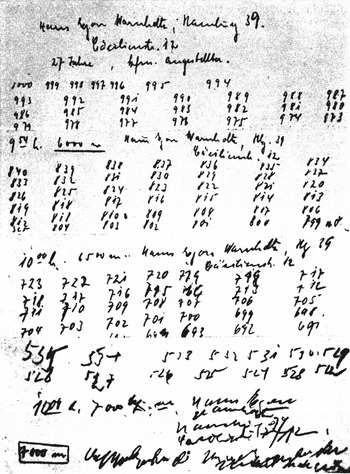
The method reached far into the emerging new branches of physiology, notably into the science of work and aviation medicine: Mosso's coworker Zaccharia Treves extended writing analysis to manual labor. The Berlin physiologist Nathan Zuntz, who had used Mosso's altitude laboratory on Monte Rosa around the turn of the century, examined the journals of Prussian aeronauts (cf. Treves Reference Treves1899; Zuntz et al. Reference Zuntz1905, 449). In 1936, finally, the Hamburg aviation physician Heinrich Lottig proposed a new aptitude test for German air-force pilots. In the “writing test,” subjects had to undergo an artificial ascent in the pressure chamber while jotting down numbers and words (see fig. 8). Lottig claimed that writing was best suited to reveal the psychic and physical changes of the subject during the ascent, enabling a reliable physiological diagnosis. At the bottom of the reproduced page we see how the subject, at an artificial height of 7,000 meters, finally lost his words (Lottig Reference Lottig1936, 15f.).Footnote 27 “If I only had words, pictures, symbols to depict what I feel!” Lamartine, the romantic, had uttered a century earlier with reference to himself on a Swiss mountain top. The written speechlessness in the pressure chamber was altogether different. Instead of symbolizing sublimity, it indicated anoxia and fatigue. Writing, the old medium of romantic sensibility, had become a physiological trace.
Writing test (from Lottig Reference Lottig1936).