Introduction
In recent years, much attention has been devoted to the issue of the colonial origins of divergence, especially in the Americas. The emerging empirical literature suggests that South America was poorer than North America during the colonial period (Allen et al. Reference Allen, Murphy and Schneider2012; Arroyo Abad et al. Reference Arroyo Abad, Davies and van Zanden2012, Reference Arroyo Abad and van Zanden2016; Challú and Gómez-Galvarriato Reference Challú and Gómez-Galvarriato2015; Lindert and Williamson Reference Lindert and Williamson2016). To explain this divergence, three broad categories of arguments exist. The first set can be labeled as neoclassical. In these arguments, the wage premiums to be gained by moving to North America from Britain were larger than those for moving to the Spanish colonies from Spain. According to that logic, the incentive to invest in human capital was proportional to the wage gap (Allen et al. Reference Allen, Murphy and Schneider2012). Hence, early migration patterns set the course for divergence. The second set of arguments emphasizes differences in topography, indigenous populations, disease environment, land quality, and natural resources as crucial determinants (Engerman and Sokoloff Reference Engerman and Kenneth2000, Reference Engerman and Kenneth2002, Reference Engerman and Kenneth2011). These initial endowments affected institutional developments and led to divergence. The third set emphasizes the different legal systems (i.e., legal origins—see La Porta et al. [Reference La Porta, Lopez-de-Silanes and Shleifer2008]) that each colonial power brought with them to the New World (Dell Reference Dell2010; North et al. Reference North, Summerhill, Weingast, de Mesquita and Hilton2000) and asserts that they set the stage for divergence.Footnote 1
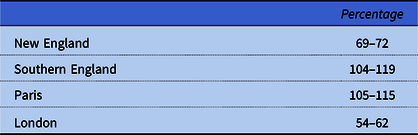
The attention of the parties involved has been squarely focused on the Spanish and British colonies. The French have been ignored in this literature, this despite the fact that there is a rich literature discussing the role of French versus British legal origins (Glaeser and Shleifer Reference Glaeser and Shleifer2002; La Porta et al. Reference La Porta, Lopez-de-Silanes and Shleifer2008; Mahoney Reference Mahoney2001). This leaves aside the substantial French holdings in the Americas.Footnote 2 The most notable among these holdings was Quebec, which included more than 75 percent of Canada’s population until 1760.Footnote 3 Recent research on living standards in Quebec during the colonial era suggests that it was quite poor by North American standards (Arsenault Morin et al. Reference Arsenault Morin, Geloso and Kufenko2017; Geloso Reference Geloso2016, Reference Geloso2019a; Geloso and Macera Reference Geloso and Macera2020). In fact, as can be seen in table 1, with wages roughly equal to 70 percent of those in New England (the poorest of all the American colonies—see Lindert and Williamson Reference Lindert and Williamson2016: 62–64), Quebec appears to have been the poorest in all North America. Given that living standards in urban Mexico, Bogota, rural Mexico, and Potosi stood, respectively, at 82.0 percent, 53.7 percent, 48.6 percent, and 43.9 percent of those in New England, it seems that Quebec was a middling colony in the Americas (Allen et al. Reference Allen, Murphy and Schneider2012; Geloso Reference Geloso2019a; Geloso and Macera Reference Geloso and Macera2020). This is supported by other evidence such as height data, which suggests that French-Canadians were shorter than black and white Americans, equally as tall as Argentinians and taller than other inhabitants of Latin America (Arsenault Morin et al. Reference Arsenault Morin, Geloso and Kufenko2017).
Real wages in Quebec as a percentage of wages in New England, Paris, London, and Southern England, average from 1688 to 1775

Source: Geloso (Reference Geloso2019a: table 3 ).
This important French colony, which diverges from the rest of North America, is an inviting research subject for another reason. While Quebec shares a common geographical and environmental background with the British colonies to its south (i.e., the environmental differences are far smaller than with Spanish colonies), it had dramatically different institutions. The most distinctive institutional feature relates to the system of land tenure known as seigneurial tenure. This was a feudal import from France in which the King granted estates to landlords. The British maintained the system when they conquered the colony in 1760. These landlords (seigneurs) were required to grant land (free of charge) to peasants who then had to provide free labor for a fixed number of days each year, and pay a myriad of small and not-so-small taxes to finance the production of public goods ranging from roads to mills. The seigneur had the right of monopoly over milling and could impose entry barriers on potential competitors. Moreover, the seigneur had permission to administer justice in his estate—a right that he used to enforce his other rights, and for which he collected fees. Finally, once settled, the peasants faced a combination of de jure and de facto restraints on their ability to leave the estate, which made them somewhat vulnerable to their seigneur’s arbitrary decisions by restricting their mobility. Quebec’s differences in terms of living standards and institutional features, and its similarities to its neighbors in geographic terms, offer an inviting combination.
Historians tend to agree that the institution of seigneurial tenure was unhelpful. However, they debate the extent of the harm it caused, with much of the discussion devoted to its effects on farming productivity. In this article, I will highlight other channels that have recently been considered by economic historians and how they suggest nonnegligible effects. I propose an additional channel that would have affected development early on: that of seigneurial tenure as a predatory institution. The seigneur as a predator is only an additional channel through which the institution would have impacted the economy. The features described in the preceding text check all the boxes needed to assert that the seigneur was indeed a predator. First, he had the ability to restrict the population’s movements (albeit not perfectly). They could not leave without incurring legal penalties. To leave in all legality, they had to pay a substantial tax to the seigneur. Second, the seigneur had the right, and the ability, to extract revenues from them (either directly, through taxes, or indirectly, through market power). Third, the main good produced by the seigneurs, the administration of justice, served to enforce their control, which is consistent with the claim of Moselle and Polak (Reference Moselle and Polak2001) that predators will produce the goods (public and private) that support their regime.
In this article, I first highlight that the seigneurial tenure had many channels (affecting farming productivity, regressive redistribution of income, barriers to competition, monopolies, restrictions on internal mobility, etc.) through which large cumulative effects materialized. Then I contend that seigneurs can be likened to predators, thus constituting another channel through which the institution affected development (“The Context and the Institution”). Calculating the burden of seigneurial tenure (“The Burden of Seigneurial Extractions and Public Goods”) by adapting a commonly used method in the field of economic history, I find that seigneurial duties represented 5.19 percent to 6.89 percent of incomes. This is a high proportion compared to the rest of North America, but not to Europe. Nevertheless, this burden was large enough to alter the returns from voluntary migration (“Discussion”). This alteration limited the materialization of economies of scale from population growth—an important ingredient for economic development in other frontier economies such as the 13 colonies (see notably Allen et al. Reference Allen, Murphy and Schneider2012; Mancall and Weiss Reference Mancall and Weiss1999), as well as Alvarez-Nogal and Prados de la Escosura Reference Álvarez-Nogal and Prados De La Escosura2013 for an application in the case of Spain).
The institution of seigneurial tenure is a complex one. I do not pretend that this argument explains all the many ways in which it impacted the colony’s growth. Nor does it exclude the other proposed explanations of divergence within the Americas.Footnote 4 Rather, it ought to be an important complement.
The Context and the Institution
Living Standards in Colonial Canada
Generally, historians of colonial Canada argue “there can be little doubt that his [the French Canadian’s] standard of living was substantially higher than that of most of the peasants in France, or that it compared favorably with living standards in rural New England” (Harris Reference Harris1966: 166). The definition of “favorably” has rarely been specified, nor has it been seriously tested except with a few estimates based on limited data sets that showed widely contradictory results (Altman Reference Altman1998; Egnal Reference Egnal1996, Reference Egnal1998).Footnote 5 Recent work based on the account books of religious congregations, which provided wage, income, and price data, filled this gap (Geloso Reference Geloso2016, Reference Geloso2019a; Geloso and Bédard Reference Geloso and Bédard2018; Geloso and Kufenko Reference Geloso and Kufenko2015; Geloso and Macera Reference Geloso and Macera2020; Paquet and Wallot Reference Paquet and Wallot2007) and has shown Quebec to be consistently the poorest area in North America up to the 1850s. This has been complemented by height data showing that, from the 1780s to the 1820s, French-Canadians were the shortest people in North America (Arsenault Morin et al. Reference Arsenault Morin, Geloso and Kufenko2017). Quebec was ahead of many parts of Latin America, but not by wide margins and behind regions like Argentina and urban Mexico.Footnote 6
These results require explanation. Why was there so little growth and why was the French colony poorer than the neighboring American colonies? Commercial life always exists within an institutional framework. In the case of Canada, one key institution is seigneurial tenure. Given that seigneurial tenure principally affected farming, an activity in which 80 percent of the colony’s population was involved, its role in terms of shaping the rules of the game has often been considered, but never through the lenses that will be proposed here.
To best understand its effects, one must describe the system of seigneurial tenure in terms of the four channels that could have made it a predatory institution: the taxes and duties paid by peasants; the de jure and de facto restrictions on peasants’ mobility; the monopolies granted to seigneurs; and the permission to administer justice which was granted to seigneurs.Footnote 7 This then allows me to highlight the possible mechanisms by which seigneurial tenure might have hindered development.
Taxes and Duties under Seigneurial Tenure
When a seigneur was granted an estate, he had to concede land freely to censitaires. However, once the land was freely conceded, the censitaire paid the seigneur sums of money as cens et rentes, that is rent for the acquisition and use of the land. These rates, which some argue were modest, were established in relation to land held rather than the amount of land farmed. Other obligations were associated as well, such as the corvée, whereby the peasants had to work for the seigneur on certain days (generally three days, with an opt-out payment of 60 sols per day not worked).Footnote 8 Censitaires were also subject to the lods et ventes, an 8.33 percent tax paid to the seigneur upon selling their land. This was probably one of the taxes that the seigneurs cherished the most as it composed close to one quarter of the total seigneurial revenues (Dechêne Reference Dechêne1974: 138) even though it was an occasional tax.Footnote 9
Some nuances are in order. Peasants did apply some “passive resistance” (ibid.) by “omitting” to pay the seigneurs. The latter often had to go to court (sometimes their own courts, see more in “Administration of Justice” and “Public Goods”) to collect the sums owed plus interest. However, the ability to evade seigneurial dues fell over time as the colony became more densely populated (Dessureault Reference Geloso2019). In the early years, the ratio of land to population was high enough to give the peasant some bargaining power with the seigneur (there were nevertheless important barriers—see “Mobility Restrictions”).Footnote 10 However, the increase in population and the introduction of marginally less productive lands to farming lessened their bargaining power over time. This strengthened the hand of the seigneurs relative to the censitaires and it explains why seigneurial dues became increasingly burdensome over time and in longer-established seigneuries.Footnote 11
Mobility Restrictions
The cens et rentes were only minor taxes in comparison to the lods et ventes, which represented a de facto restraint on mobility as it increased the cost of moving. The lods et ventes was a tax fixed at 8.25 percent of the sale price that the seigneur would collect each time a plot of land was sold between censitaires. While the seller could conceal the true price of a transaction, the seigneur had the option to purchase the land at the listed price (thereby canceling the transaction) and then sell it at a higher price. Censitaires generally declared the actual sale price. This was a de facto restriction on mobility that made the peasants captive. This reinforced the de jure prohibition on peasants simply abandoning their land. These restrictions on mobility were crucial ingredients in the persistence of seigneurial tenure. As they were relatively immobile, the seigneurs could extract the taxes and duties from their censitaires with little risk of defection. This is not to say that mobility was impossible, but it was hindered to a degree that was not negligible.Footnote 12 Thus, the de jure and de facto restrictions avoided the erosion of the seigneurs rents by preventing peasants from voting with their feet (Vahabi Reference Vahabi2016).
Monopolies and Barriers on Entry and Exit
When granted his estate, the seigneur received a monopoly right on milling. He alone had the right to operate a mill for the purpose of producing flour, and the censitaires could not bring their wheat to any mill other than that of their seigneur. However, the seigneurs were legally mandated to build a mill, and the fee (the banalité) was set permanently at one out of every 14 units of wheat brought to the mill. The seigneurs were very active in having this right recognized; competing mills were torn down and peasants were punished for going to another estate. Seigneurs also had clear monopoly rights over timber on their estate (Courville Reference Courville2008: 132–133; Ouellet Reference Ouellet1980: 345). Given the importance that timber held for a frontier economy such as Quebec, this was not a negligible right.
The seigneurs also had the ability to constrain entry in other activities. A censitaire could also be a firm trying to open a particular factory within a given estate. In this case, the seigneur would impose the same conditions as for any other censitaire. However, if the seigneur operated his own factory (e.g., a sawmill, a carding mill, a fulling mill, a potash factory), he would not be subject to these taxes. This meant that a seigneur could impose entry and exit barriers. For example, a seigneur operating a sawmill would operate free of the duties of seigneurial tenure, but any competitor within his estate would be forced to pay them. Their ability to set barriers to entry and exit granted them a significant level of market power.
Administration of Justice
Until 1760, the seigneurs were also granted the right to administer justice.Footnote 13 This permission was not limited to the basse justice (i.e., affairs involving small sums) as seigneurs could also administer haute justice (i.e., criminal affairs), and they extracted numerous different legal fees in the process. But the most important aspect of this authority relates to the moyenne justice. This level of legal administration involved penal affairs involving small penalties (roughly the equivalent of two days wages), tutelage for minors, probates, and all affairs regarding seigneurial rights and obligations. This meant that seigneurs administered the system that enforced their own rights. Historians tend to agree that this constituted an important management tool.
The Impact of Seigneurial Tenure on Development and the Seigneurs as Predators
How would the features described here (barriers to competition, monopolies, restrictions on internal mobility, etc.) have affected economic development in Quebec? While no historian believes they benefitted development, there is no agreement on the channels by which they affected development and the extent of the effects they had.
Most of the debates on the institution’s effects have centered on agricultural development and productivity. This is for two reasons. The first is that Quebec was a largely agricultural society and most income (as high as 70 percent according to Altman [Reference Altman1988]) stemmed from farming. The second is that seigneurial tenure, so it is argued, would have reduced the ability to invest in one’s farm and that fewer investments translated into lower incomes. Those who argue that the institution had limited adverse effects, such as Percy and Szostak (Reference Percy and Szostak1992), cite figures showing a small total factor productivity gap between French and English areas during the nineteenth century (Lewis and McInnis Reference Lewis and McInnis1980), which they take as a proxy for the institutional differences.Footnote 14 However, the numbers they cite suggest productivity differences of between 7 percent and 14 percent.Footnote 15 This constitutes a useful lower bound estimate of the total costs of the institution. Thus, the most minimalist of cases is the following: given that farming was 70 percent of the economy, institutional effects on farming productivity reduced incomes per capita by between 4.9 percent and 9.8 percent. Given the numbers in table 1, this is sufficient to account for between a twelfth and a quarter of the difference observed with New England during the eighteenth century. Thus, even the lower bound admitted to in the literature implies a significant negative effect in comparative terms.
However, that is a very minimalist assessment. Economists like Altman (Reference Altman1983, Reference Altman1987), Geloso et al. (Reference Geloso, Kufenko and Hinton2017), Geloso and Macera (Reference Geloso and Macera2020), and Geloso and Lacombe (Reference Geloso and Lacombe2016) argue that the institution would have affected the economy through a multiplicity of channels. Altman (Reference Altman1983, Reference Altman1987) states that, by transferring income from peasants to landlords, seigneurial tenure altered the distribution of income, and consequently the pattern of effective demand and investment. Because the seigneurs consumed largely imported luxury goods, Altman argues that the dues “biased spending patterns” toward the purchase of these imported luxury goods and “consequently, [made] output and productivity in the handicraft and agricultural sectors, most probably, less than they would have been without seigniorial dues” (Altman Reference Altman1983: 374). This argument was echoed in different, but less sophisticated terms, by Philips (Reference Philipps1974). While it remains unmeasured in terms of income, it would add to the lower bound accepted by Percy and Szostak (Reference Percy and Szostak1992).
A more recent vein of argument comes from Geloso and Macera (Reference Geloso and Macera2020) and Geloso and Lacombe (Reference Geloso and Lacombe2016). The former argued that the restrictions on the censitaire’s mobility, and the ability of seigneurs to restrict entry into certain sectors of nonfarm economic activity, had a significant effect on wage rates. The legal rights of seigneurs allowed them clear monopolies on certain spheres of economic activity while allowing them to erect entry barriers into some nonfarm activities. For example, if a firm was trying to open a textile factory in a seigneur’s estates, it would have to pay taxes to the seigneur. However, if a seigneur operated a factory himself, these barriers did not exist. Thus, the seigneur had an incentive to erect some barriers. Simultaneously, the restrictions on mobility described in the preceding text limited the ability of households to take on work far from the plot they received. This meant that the seigneur could be likened to a monopsonist on the nonfarm labor market. By being able to restrict entry into sectors such as timber, textiles, and milling, seigneurs were reducing the number of firms demanding workers in a given estate, which meant that they held greater abilities to fix wages—an ability that was only heightened by the fact that censitaires were restricted in terms of their ability to move. Using data from the early nineteenth century to run a regression discontinuity design with nonseigneurial areas, Geloso and Macera (Reference Geloso and Macera2020) found that this “monopsony channel” reduced wage rates for unskilled workers by between 17.6 percent and 47.1 percent. This figure, they argue, is sufficient to eliminate close to half of the income per capita gap between Quebec and the United States at that point in the nineteenth century. They also find that it retarded industrial development, as the seigneurs’ incentives not to demand too much labor for fear of increasing wages also meant fewer industrial investments.
The last channel is a health-related one uncovered by Geloso and Lacombe (Reference Geloso and Lacombe2016). In the journals of travelers, as well as within government papers, flour in the colony was often described as being very poor. Sometimes referred as dark flour because of the dirt it contained, the low quality was often mentioned as a health issue for colonists. Using the features inherent to the transformation of wheat into flour, Geloso and Lacombe built a model explaining how the features of seigneurial tenure regarding milling provided strong incentives for underinvestment in flour quality. The model’s features conformed with empirical evidence. While they could not measure the effect of this channel, it compounds all the other channels to increase the overall cost imposed by seigneurial tenure.
All these channels fall within the realm of neoclassical economics as they all rely on price theoretical arguments. There is an additional feature, that with which this article is most concerned, that would have compounded them, and which speaks to political economy considerations: that of the predatory nature of the seigneuries.
Normally, a predatory state is represented as “a grabbing hand” that appropriates resources for the purpose of enriching rulers, as opposed to “a helping hand” that appropriates resources for the purpose of producing public goods (Buchanan Reference Buchanan1975, Reference Buchanan1980); Brennan and Buchanan Reference Brennan and Buchanan1980[2000]; Frye and Shleifer Reference Frye and Shleifer1997; North Reference North1981; Moselle and Polak Reference Moselle and Polak2001; Robinson Reference Robinson1999; Rotberg Reference Rotberg and Rotberg2004).Footnote 16 This grabbing hand can have a long shadow in terms of socioeconomic outcomes (Banerjee and Iyer Reference Banerjee and Iyer2005). The main difference here is that the “public state” (i.e., the French crown) delegated authority to “private states” (i.e., the seigneurs) who could then exercise strong taxation powers and monopoly rights over a captive population.Footnote 17 The “public state” gained revenues from the granting of these privileges (which it enforced when contested), but had to expend very little. By restricting mobility of the censitaires, the seigneur created a captive population that could not easily defect. Thus, he had the ability to exact taxes and duties from the population within his estate and he was unconstrained in his ability to do so. This is a predatory feature.Footnote 18 The burden of the exactions the seigneur made was unaccompanied by the production of public goods by the seigneurs. The “private states” took on some responsibilities, notably the administration of justice that can be considered as a public good, however, as Moselle and Polak (Reference Moselle and Polak2001) emphasize, the goods (public or private) that predator states provide are not about welfare enhancement; they are about reinforcing control, or increasing rent extraction. In the case of seigneurial tenure, the right to administer justice served as a tool to shore up the enforcement of seigneurial rights. As such, the public good of providing judicial services protected the predatory features of the institution. I also point out that seigneurs rarely produced the other goods to which the laws surrounding seigneurial tenure obliged them. This predatory feature of seigneurial tenure would have compounded the others and, even at the lower bound, it could have amounted to a significant economic effect.
The necessity here, therefore, is to measure the burden imposed by seigneurial tenure, to document how poorly public goods were provided, and to show how what was produced served to protect the seigneur’s right. This is the task of the next section.
The Burden of Seigneurial Exactions and Public Goods
Burden
To measure the burden of seigneurial tenure, historians have tended to produce estimates based on representative cases. Richard Harris (Reference Harris1966: 160–66) estimates seigneurial dues at somewhere between 5 percent and 10 percent of the average farm household income. Using a similar methodology, Louise Dechêne (Reference Dechêne1974) argued that the burden equaled 14 percent of the average household’s income. Both estimates were based on hypothetical farms and total output. Another method of measuring the burden of the duties, used by Altman (Reference Altman1983, Reference Altman1987) and Greer (Reference Greer1985), is to calculate it as a percentage of the “marketable surplus” (net output minus subsistence consumption) from farm production. Altman found that dues absorbed between 26 percent and 47 percent of farm households’ marketable surpluses between 1688 and 1739.Footnote 19 Greer (Reference Greer1985: 136) found a figure of 44 percent in 1765 in the parish of St-Ours. Numerous scholars have criticized as problematic the assumption that households produced a surplus and sold the remainder.Footnote 20 Basically, while the burden of exactions in monetary terms might be well measured, the income over which it is divided is not properly defined. Thus, these estimates are fragile to assumptions.
A viable improvement is possible by adjusting the method of welfare ratios commonly used by cliometricians to create standardized measures of living standards (Allen Reference Allen2001, Reference Allen2009, Reference Allen2015; Allen et al. Reference Allen, Murphy and Schneider2012; Arroyo Abad et al. Reference Arroyo Abad, Davies and van Zanden2012; Baten et al. Reference Baten, Ma, Morgan and Wang2010; Broadberry et al. Reference Broadberry, Campbell, Klein, Overton and van Leeuwen2015; Challú and Gómez-Galvarriato Reference Challú and Gómez-Galvarriato2015; Lindert and Williamson Reference Lindert and Williamson2016). Welfare ratios are created in two steps: the first consists in creating consumption baskets, which are akin to a poverty line (i.e., they use absolute quantities of goods) that is then adjusted for family size (the standard assumption is the equivalent of three adult males). The second step consists in calculating how many times this basket could be acquired during one year of work at the given wage rates. Generally, there are two baskets used. The first is the “bare bones” basket that is, as its name suggests, the minimum level of consumption necessary to ensure survival. This basket generally relies on the cheapest sources of calories such as oatmeal (Allen Reference Allen2015) and provides slightly less than 2,000 calories per day. The second is the “respectable” basket that includes more sophisticated food items such as bread and there are greater quantities of calories consumed.
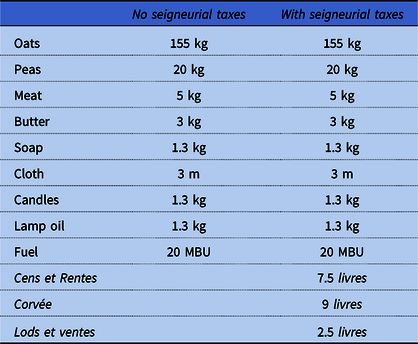
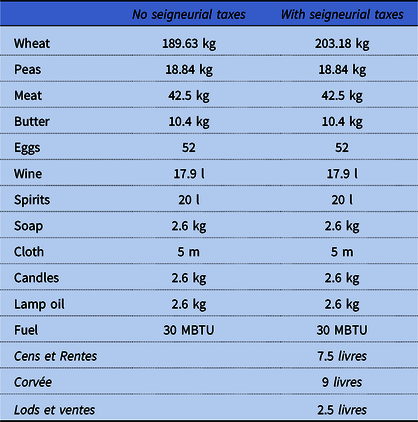
Here, I simply modify the two baskets to include a pretax and a posttax basket. The difference yielded between the two presents the extra labor income needed to pay these taxes. To do this, I rely on the wage and price data assembled by Geloso (Reference Geloso2019a, Reference Geloso2019b) for the period between 1688 and 1775. These data permit the construction of the baskets that can then be used for the purposes of measuring the burden imposed by the institution. In tables 2 and 3, the left column highlights the basket without any of the duties that seigneurial tenure would have imposed. To factor in the duties, I simply add them to the cost of that basket (see second column of tables). I am fully aware that this is an imperfect method. However, it has the substantial advantage of creating a standardized unit of measure that will, in the “Discussion” section, permit international comparisons.
Bare bones basket to measure burden of seigneurial tenure

Respectable basket to measure burden of seigneurial tenure

Factoring in the cens et rentes is easy, as they were not taxes on output, but rather on assets held in the form of arpents held per farm. It is well accepted that the average concession hovered around 90 arpents (1 arpent = 0.845 acre) in area (Dépatie Reference Dépatie1988). I use the same rates as Altman (Reference Altman1983). To factor in the cost of using the mill (i.e., the milling fee associated with the right of banalité), I increase the wheat requirement by 1/14th—the amount of the milling toll. For the lods et ventes, I rely on Altman’s (Reference Altman1983: 343) assumption that the average income generated per 100 censives varied between 200 and 300 livres for the seigneurs, which meant a tax of 2 to 3 livres/year per household. Finally, the corvée could be avoided by paying 3 livres per day (up to a maximum 9 livres). Most of the seigneurs favored the cash payment.
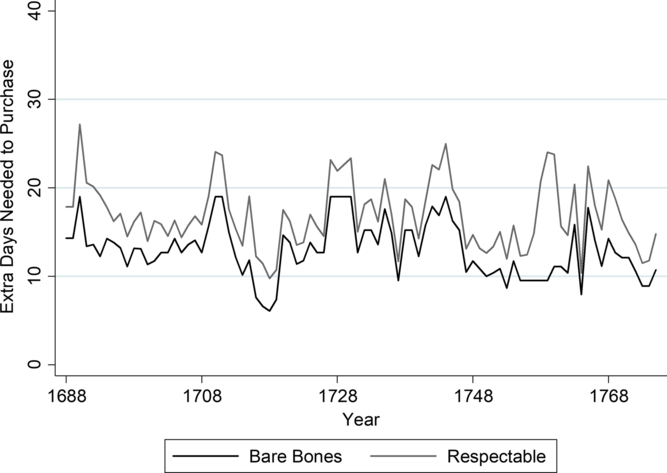
By computing the differences in working days, I find that between 1688 and 1775 the burden of taxes was equivalent to between 12.98 days and 16.92 days of work (see figure 1). The burden was relatively stable (except periods of rapid inflation that decreased the real weight of the nominally fixed duties like the cens et rentes). Assuming a 250-day work year—the standard assumption used in welfare ratios and a plausible one for Canada given historical evidence (Geloso Reference Geloso2019a)—the burden represents between 5.19 percent and 6.77 percent of income.
Burden of seigneurial tenure in extra days of work.

Public Goods
The duties paid to seigneurs did not finance the production of goods that were necessarily welfare enhancing. The seigneurs were mandated to provide three goods and services: roads, flour mills, and the administration of justice (until 1760). The first two they did not provide, but the last they provided efficiently, largely because, while it produced a service needed by the population, it also allowed the seigneurs to enforce their rights.
Although they were supposed to maintain functioning routes of trade, seigneurs were largely inactive in that regard. When they did provide such roads, they did so through the corvée, which meant that the peasants shouldered the burden of building and maintaining them. The roads they did build generally linked to the local mill (when there was one), to the parish church, or to the rangs (the road along which censitaires were placed). Beyond this, the seigneurs did not provide much. This was deemed a problem sufficiently large that the colonial government took responsibility for constructing the main road between the two largest cities in the early eighteenth century (Bussières Reference Bussières2009; Sansfaçon Reference Sanfaçon1958: 3–4). The seigneurs also withheld roadbuilding between the different seigneuries. Of the 37 seigneuries between Montreal and Québec City, none had roads linking two of them together (Sansfaçon Reference Sanfaçon1958: 3). This should not be surprising, as building routes that led outside a seigneurie would have reduced the costs to a defecting censitaire.
As for flour mills, seigneurs held the sole right to operate one within their estates. However, they had the legal obligation to provide the service and to do so at a fixed price. In 1686, the colonial administration mandated landlords to build a mill or risk losing their titles, but the edict issued in 1686 was ignored until 1707. As it turns out, it was not officially promulgated until the intendant, Jacques Raudot, noticed that the procureur général had never issued its promulgation, no doubt due to the fact that numerous seigneurs were members of the colonial administrative body known as the Conseil souverain (Deschênes Reference Deschênes2009: 153). Close to three decades after the legal registration of the edict, more than 40 percent of estates did not have a mill (Altman Reference Altman1983: 364). Historians agree that although the colonial government was legally mandated to restrain their exactions, seigneurs were able to ignore the legal obligation to build a mill until their seigneuries were sufficiently populated to make provision of the service profitable at the fixed price (Harris Reference Harris1966: 78).Footnote 21
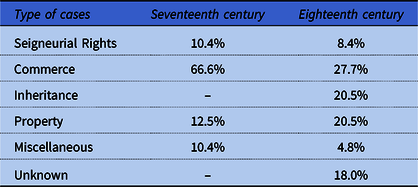
The seigneurs did, however, provide efficient administration of justice. A seigneur had the right to exercise the administration of justice through the establishment of a seigneurial court. In this court, local cases, generally the smaller ones, were heard. While recently settled (i.e., thinly populated) seigneuries rarely had the means to establish these courts, the longer settled and more densely populated ones did establish them. Most of the prominent ones, notably those administered by religious congregations, which represented 25 percent of all conceded land and 34 percent of the population (Jaenen Reference Jaenen1976: 71), had such courts. Dickinson (Reference Dickinson1974: 346) estimates that in the district of Quebec,Footnote 22 the seigneuries that had courts represented 60 percent of the population. In so doing, the seigneur was providing a service of adjudication from which the population could benefit. But the adjudication of conflicts related to the system of seigneurial tenure also fell under the purview of these courts. Some of the earliest work on this aspect of seigneurial tenure was produced by Dickinson (Reference Dickinson1974) who found that for Notre-Dame-des-Anges in Quebec City, a sizeable share of cases heard had to do with the enforcement of seigneurial rights (see table 4): 10.4 percent in the seventeenth century and 8.4 percent in the eighteenth century.Footnote 23 This is why historians point out that the “judicial system remains the tool of the seigneur,” rather than that of censitaires (Garneau Reference Garneau, Alain and Benoît2009: 64). Not all the cases heard were related to seigneurial tenure and the rates charged in these courts for hearing cases were generally lower than in royal courts (Dickinson Reference Dickinson1974: 344; Reference Dickinson1982). They were also closer than the royal courts, which were in urban centers. As such, the institution did provide some benefits for the censitaires (Dickinson Reference Dickinson1974: 339). However, the seigneurs also gained revenues from this (as fees would be collected), and they could simultaneously enforce their own rights. The good provided served their interests.
Types of cases heard before the Notre-Dame-des-Anges court

Source: Dickinson (Reference Dickinson1974: 335).
To see how the administration of justice could serve to their advantage, it is worth considering that many disputes regarding milling ended in courts administered by the seigneurs. Bearing in mind that the seigneurs had the monopoly right to operate a mill and that no censitaire was free to bring his grain to the mill of another seigneur, disputes between censitaires and seigneurs would be decided in courts administered by the latter. In the eighteenth century, there are several cases of court disputes regarding censitaires going to other mills in numerous areas across the colony: Sorel (1730), Demoure (1716), Argentenay (1736), and Rivière du Sud (1742) (Archives du Séminaire du Québec, Reference Dessureaultn.d.). All these cases were decided in favor of the seigneurs. In his work on seigneurial justice, Dickinson (Reference Dickinson1982: 126) also points to similar court conflicts. Thus, in contrast with the American colonies to the south where this potential conflict of interest did not exist,Footnote 24 the ability of the seigneurs to administer justice also modestly weakened the security of property rights.
Discussion
If the seigneurs acted predatorily, how can this be related to Canada’s economic development? The way the burden was calculated in the preceding text allows us to answer this question. Historians tend to agree that the seigneurial system of Canada was not nearly as burdensome as similar institutions in Europe. Given the size of the colonial government (see Desbarats Reference Desbarats1997),Footnote 25 we can consider the burden of seigneurial dues to be equal to the near totality of taxes in Canada during the French colonial era. Hoffman (Reference Hoffman1996) places the duties of seigneurial tenure in France at 18 percent to 35 percent of rent near Paris, which, given that rent represented roughly the same share of total costs as labor, means that the burden may have been roughly equal to between 9 percent and 17.5 percent of total income. While this is a crude approximation, it shows that taxes were higher in France than in Canada by a factor of between 1.7 and 3.4. However, this does not mean the institution’s predatory features did not hinder the colony’s development.
Without accounting for seigneurial duties and using the bare bones basket, the French colonists appear to have been 15.5 percent richer than the inhabitants of Paris (Geloso Reference Geloso2019a). As highlighted previously, the New World had land-abundant frontier economies in which labor and capital were scarce relative to Old World economies. The high land-to-labor ratio meant low prices for untransformed foodstuffs, but high prices for manufactured goods that had to be imported or produced with scarce production factors. Because the bare bones basket relies heavily on the former, it advantages the New World. When we shift to the respectable basket, which includes more goods whose relative price was lower in the Old World than in the New World (Geloso Reference Geloso2019a), the advantage falls to 4.8 percent. These advantages are probably not sufficient to justify the expense of moving to the New World during the eighteenth century (Williamson Reference Williamson2011), which represented close to a full year of per capita income.Footnote 26
Differences in taxes would have greatly affected migration returns (and thus migration decisions). To see the potential effect, I recalculated the welfare ratios to adjust for taxes. In table 5, the first column shows the gap between an untaxed Canada (i.e., assuming that Canada had had no seigneurial tenure) and a taxed Paris. At the bare bones level, the advantage widens from 15.5 percent to between 26.9 percent and 40 percent. At the respectable level, the advantage widens from 4.8 percent to between 15.1 percent and 27.0 percent. When we account for taxes in both regions (see second column of table 5), we can see how much the tax wedge between both areas eroded the returns from migration to the New World; it melted the potential advantage by close to half. Had seigneurial exactions not existed in Canada, it seems plausible that migration would have been a more attractive course of action for Frenchmen. However, when exactions are considered, they subtract a sufficiently large share of the gains to bring into question the viability of emigrating.Footnote 27
The impact of seigneurial tenure on Quebec’s relative living standards

Source: Adapted from Geloso (Reference Geloso2019a) to include tax burdens mentioned in text.
Another way to see how much this tax wedge might have played a role is by considering the American colonies to the south of Quebec that had dramatically lower taxes than in England and no feudal dues (Davis and Huttenback Reference Davis, Huttenback, Ransom, Sutch and Walton1982; Rabushka Reference Rabushka2008). The difference in tax burden probably made the New World more attractive to the British who sought increases in living standards. Most assessments of living standards in the American colonies relative to England place it roughly on par regarding incomes (Geloso Reference Geloso2019a; Lindert and Williamson Reference Lindert and Williamson2016: 62–63). However, these assessments do not account for taxes overall. Edwin Perkins (Reference Perkins1988: 205) placed the burden of all taxes in the United States at below 1 percent of income. Using the income figures provided for New England by Lindert and Williamson (Reference Lindert and Williamson2016: 62), the locally imposed total tax burden calculated by Rabushka (Reference Rabushka2008: 779) for the region represents 0.66 percent of income. Including the burden of imperial taxes, the figure increases to around 0.85 percent of income. In comparison, given the income figures for Great Britain for 1770 (Lindert and Williamson Reference Lindert and Williamson2016: 62), the tax burden of the average Briton represented 8.54 percent of his income (Palmer Reference Palmer1959[2014]: 115). Rabushka, using a different income denominator arrives at an even higher figure of taxes representing 11.5 percent of income (Reference Rabushka2008: 726). Adjusting the figures for Southern England and New England provided by Geloso (Reference Geloso2019a) to replicate columns 1 and 2 of table 5, we can see how much the tax differences affected the returns from migration between England and its colonies (see columns 3 and 4 of table 5). As the tax wedge appears to have been greater between England and its colony than between France and her own colony, it did not significantly alter the returns from migrations.
For two reasons, this is a crucial point for understanding why seigneurial tenure would have hindered Canada’s early development. Unlike the American colonies, migration to New France was very limited and state directed. The maximum number of immigrants estimated during the era of French rule (1608 to 1759) stands at 29,373 individuals, but only 9,300 remained in Quebec (Boleda Reference Boleda1990: 177). Of those who stayed, a sizable share were reluctant migrants (Moogk Reference Moogk1989) and would have included the famed “King’s Daughters” (roughly 800 orphans, widows, and young unmarried women), convicted salt-smugglers, wayward sons given deportation orders (Paul Reference Paul2008), soldiers who had their transatlantic trip paid for by the crown, some slaves, and captured British subjects.Footnote 28 This accounts for less than 10 percent of net migration out of France during the period from 1580 to 1760 (Eltis Reference Eltis1999: 151) and the levels of migration for France (100,000) were significantly behind those out of Britain (746,000) and Spain (539,000). As such, the population growth of the colony was slow (446 percent from 1688 to 1760 as opposed to 580 percent for the 13 colonies over the same period).
The New World was a frontier economy in which land inputs were abundant. In this situation, Malthusian pressures were weak as more land could be ploughed to accommodate population growth, and problems associated with Malthusian checks (Crafts and Mills Reference Crafts and Mills2009; Nicolini Reference Nicolini2007) were largely nonexistent in the New World. Sustaining rapid population growth in combination with stable or increasing living standards is suggestive of the view “that the high rate of population growth was also transformed into a high rate of growth of gross domestic product” (Rosenbloom and Weiss Reference Rosenbloom and Weiss2014: 42). One could argue that population size did not matter given the amount of idle resources. However, for thinly populated economies like those of North America, an increase in population enlarges the market, which entails a greater scope for specialization and returns to scale, that is Smithian growth (see Davis Reference Davis2008; Morgan Reference Morgan1997). This means that there is room for entrepreneurs specializing in particular fields of activity. Moreover, greater population density means a greater circulation of ideas. This latter point is probably the most important and refers to a debated literature in economics that concerns “scale effects.” Scale effects arise when ideas (read: information) are nonrival inputs in the production of intermediate goods needed to generate final products. As population increases, more and more inputs are cheaply made available for intermediate production.Footnote 29
The most recent estimates of income per capita growth for the 13 colonies (Lindert and Williamson Reference Lindert and Williamson2016; Mancall and Weiss Reference Mancall and Weiss1999; Mancall et al. Reference Mancall, Rosenbloom, Weiss, Guinnane, Sundstrom and Whatley2003; Rosenbloom and Weiss Reference Rosenbloom and Weiss2014) and Spanish colonies (Arroyo Abad and Van Zanden Reference Arroyo Abad and van Zanden2016) suggest that during the overcoming of the initial challenges of colonization, incomes per capita increased. However, they soon stabilized while population continued to increase. This evolution of income per capita is consistent with scale effects. While the marginal returns of capital (and land) were declining, population growth was allowing room for specialization into new economic activities (e.g., banking, shipbuilding, shipping) that offset the effects of declining marginal returns on capital (and land) and allowed incomes per capita to be stable in spite of rapid population growth. Phrased differently, the expansion of population opened the door to “Smithian” effects that cancelled “Malthusian” effects. This rephrasing is useful because, despite rapid population growth, the American colonies did not seem to experience “Malthusian pressures.” In contrast, econometric evidence for Quebec between 1688 and 1858 assembled by Geloso and Kufenko (Reference Geloso and Kufenko2015) shows strong signs that “Malthusian pressures” existed in the colony until the mid-1760s despite much more modest population growth. Given its relatively small demographic size, the scope for specialization was limited and numerous efficiency-improving firms could not emerge in Quebec. This meant the declining marginal returns of capital bore a heavier brunt on Quebec than in the British American colonies. This is also consistent with recent evidence assembled by Geloso (Reference Geloso2016) showing no growth in per capita incomes in Quebec between 1688 and 1762 and complements the stagnation in real wages found by Geloso (Reference Geloso2019a).
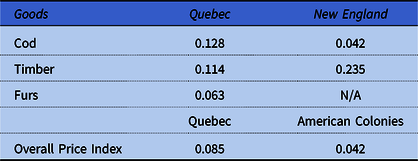
There was an additional advantage conferred by high migration. Thanks to their size and access to the British market, the Americans had the option of harnessing important economies of scale and becoming part of a large trading network. In addition, when wars rendered trade difficult and risky, the Americans had a large domestic market upon which to rely. This was not the case for New France. Contrary to the American colonists who could trade with other colonies, the French had a very limited trading network (Geloso Reference Geloso2016, Reference Geloso2019b). One manner of operationalizing this additional insight is to draw from the points of Lindert and Williamson (Reference Lindert and Williamson2016) regarding price volatility being detrimental to growth in the American colonies. If price volatility depends partly on the size of the domestic market, then we can loosely tie higher levels of the latter to lower levels of growth. Using the reported volatilities (measured as the standard deviation [SD] of price changes in logs) from Lindert and Williamson (Reference Lindert and Williamson2016), I compared the volatilities of relevant goods (furs, cod, and timber constituting the virtual totality of Quebec’s exports during the colonial era). In table 6, Quebec appears to exemplify higher levels of volatility not only for export prices, but also for the overall price level. This is a complement to other elements of evidence regarding the role of market size (and how lower levels of migration made markets smaller).
Comparison of price volatilities (SD of log-price changes) between 1700 and 1775

Source: The Canadian price data is taken from Geloso (Reference Geloso2019b) with the exception of fur prices, which come from the work of Lunn (Reference Lunn1942).
Note: I used the same periods as Lindert and Williamson to remain comparable. The price index used for the United States is taken from McCusker (Reference McCusker1992). However, adding the period from 1688 to 1700 (for which prices exist) suggests higher levels of volatility for Quebec.
Conclusion
Scholars of Canadian history, concentrating on the institution’s impact on farm efficiency, have relied on numbers that suggest an effect equivalent to between 4.9 percent and 9.8 percent of per capita income. These figures that focus on a single channel explain between a twelfth and a quarter of the gap in incomes between Quebec and New England found by Geloso (Reference Geloso2019a) for the seventeenth and eighteenth centuries. However, there are channels other than farm efficiency through which seigneurial tenure would have reduced living standards suggesting that the figures mentioned in the preceding text constitute the lower bound of the institution’s economic effects. In this article, I contended that seigneurial tenure had predatory features that complemented these other channels. Landlords held the ability to tax a population whose mobility they could also restrain. While the rights that were given them by the crown implied the production of certain services and goods, they often shirked these obligations, but they did produce the service of the administration of justice because it implied the gain of some revenues while enforcing their rights as seigneurs. These features appear to fall under the category of what economists would consider “predatory.” This added to the negative effects materializing through other channels.
Relying on a modification to the commonly used measure of welfare ratios that serves to compare countries in the more distant past, I found that the burden of seigneurial tenure stood between 5.19 percent and 6.77 percent of income. While the taxes imposed by this system (constituting the virtual totality of the Canadians’ tax burden) were not as heavy as those levied on their French counterparts, they were heavy enough to dramatically alter the returns to migration in a manner that was not echoed in the British American colonies. In other words, had seigneurial duties not existed, the gains from migration would have been substantial—likely enough to overcome the costs of migration. Thus, the difference in seigneurial dues likely discouraged migration, which also explains why a sizable number of those who came to Canada were considered “reluctant exiles” (Moogk Reference Moogk1989). Had seigneurial duties not existed, the gains from migration would have been substantial—likely enough to overcome the costs of migration.
This is of relevance to economic growth. In frontier economies like the colonial economies of the New World, larger populations and greater population densities meant greater economies of scale, more nonrival inputs (i.e., information), and a greater scope for specialization. Because land was abundant, increases in population also came with negligible Malthusian countereffects, which allowed population and production to grow at similar paces (or the latter to grow faster than the former). By slowing down the population growth of the colony through migration, seigneurial tenure deprived the colony of its most efficient method of sustaining increases in per capita incomes.
This channel of delayed development adds to existing channels (see notably Altman Reference Altman1983, Reference Altman1987; Phillips Reference Philipps1974) that emphasize the institution’s deleterious effects on farm efficiency (Percy and Szostak Reference Percy and Szostak1992), nonfarm sector wages, and industrial activity (Geloso and Macera Reference Geloso and Macera2020). All the features of seigneurial tenure can be considered, by any economist, as deleterious. This does not mean that the effects need operate through a single channel. Bad institutions can affect living standards through a multiplicity of channels. Here, it has been argued that as a predatory institution, seigneurial tenure constituted one of these.
Adding the layers of effects of seigneurial tenure to explain Quebec’s relatively different course of economic development up to the twentieth century constitutes a rich research agenda. The consideration of other channels, notably on technological adoption and patterns of early specialization, may help advance the cause of creating a full portrait of the institution’s effects. Another course of action might be to consider the political economy of the early adoption of seigneurial tenure in the colony. All these challenges, if met, could help solve a puzzle in Canadian economic history while also expanding the knowledge of historians and economists interested in divergence within the Americas.