Writing in 1960, Alan Lomax heard how his present would sound as our past: ‘To the musicologists of the twenty-first century our epoch may not be known by the name of a school of composers or of a musical style. It may well be called the period of the phonograph or the age of the golden ear, when, for a time, a passionate aural curiosity overshadowed the ability to create music.’Footnote 1 This article examines a project born out of Lomax's own passionate aural curiosity and his foregrounding of recording technology – the Columbia World Library of Folk and Primitive Music – using it to sound out the history of mid-century ethnographic field recording. Released by Columbia Records in 1955, the World Library was Lomax's brainchild, but required a complex network of international collaboration, technologies, institutional support and competition, legal and aesthetic frameworks to materialize. More than simply telling its story, this article attempts to get a handle on the various agencies compressed into the World Library, and what the implications of this compression are for listening back on the twentieth century, as its music and its sounds continue to resonate.
The first task is to make sense of its incredible title: ‘Columbia’, ‘world’, ‘library’, ‘folk’, and ‘primitive’ are terms that offer a feast for critical analysis. It is not possible to grapple adequately with the genealogy and politics of each term here, but for my purposes the most important point is that ‘world’, ‘folk’, and ‘primitive’ stand, in the twentieth century at least, as Western constructs for the classification and circulation of sounds and sound objects.Footnote 2 Recordings – commissioned, produced, archived, reproduced, disseminated, consumed – occupy a central space in the movement of music in the twentieth century, straddling phenomena of nationalism, globalization, and cosmopolitanism, being at once carefully controlled by a host of gatekeepers, business interests, advocates, state funders, collectors, validators, interpreters, and also evading such control in the hands and ears of listeners.Footnote 3
To probe the history of field recording, then, is to conduct a material history. Certainly a World Library connotes materiality; and understanding musical traditions in the long twentieth century requires understanding how they have been represented on record, how ‘intangible cultural heritage’ has been made tangible.Footnote 4 The World Library speaks to ethnographic field recording more broadly in its modern means of production coupled with its representations of music as pre- or anti-modern. As constructs for circulation, the terms folk and primitive serve to present peoples and musics as existing uncontemporaneously from those doing this subjectifying through the power of definition.Footnote 5 Ana Maria Ochoa terms this splitting of time a ‘division of sonic labour’,Footnote 6 which captures the use of modern technologies to represent aesthetic stasis that is a feature of the World Library: Lomax, on the sleeve of the volume of English music, wrote of the music it housed as ‘an echo from the land of melody that England must have been two centuries ago’, as though his microphone was dialled into the traces of pre-industrial history, re-sounding the nation.Footnote 7
The World Library serves as a productive object of study on several levels: as an entextualization of mid-century cultural politics, and attitudes towards musics and their collection; as a means to understand more about the practices of cultural production behind the recording of the world's musics and their movement; to fathom the kinds of transnational labour – institutional, material, sonic – involved in constructing these musics; to explore how sound is treated in converting oral traditions into aural anthologies; to amplify the liminal space where scholarship and major record labels overlap. More, it tells us much about how two mid-century technologies – magnetic tape and the long-playing record – impacted on fieldwork and its products, and the agency of these technologies runs centrally through this article. While the World Library should be considered as a whole, in order to make sense of it as a work of cultural production and to get close enough to trace its specificities, the bulk of my analysis is dedicated to the production of two albums in the collection: those of Scottish and of English music. Even within Europe, where Lomax conducted his fieldwork, the political climates and institutional and disciplinary configurations, in various nations after the Second World War, were starkly different, and each volume of the series in which Lomax was involved as fieldworker has a very different story.Footnote 8 The networks through which the World Library was produced, though, were very much international, and central to my aims is a theorization of how field recordings are rendered suitable for the public ear, how the World Library was a product of, and fed back into, the aural public sphere – to borrow another useful term from Ochoa – of post-war Europe.Footnote 9
This is most commonly theorized as mediation. But Jonathan Sterne has recently argued that ‘media are not middle terms, intervening in otherwise more primary, fundamental, or organic relationships’, and his proposed alternative, mediality, seems a better fit for the World Library.Footnote 10 Media did not come to the field recordings housed in the World Library after the fact, stealing them away, corrupting pure communication; media were built into the recordings in the first instance. It was produced according to a sensibility of what I would like to term the audio-exoteric: a project of writing sound with a quality of mediality, constructed specifically for communication to the general public. So when Martin Stokes prompts us to think about music in a global field of translation – in which, drawing on literary theory, ‘originals may be produced with translation in mind, and thus, in a sense, already be “translated” at the point of origin’ – we can bring this thought to the World Library, perhaps to the history of ethnographic field recording more broadly: the audio-exoteric is compressed into what we hear at, or even before, the point of production, in efforts to legitimate, preserve, and disseminate certain musics and musical traditions.Footnote 11
This article builds on the emerging corpus of scholarship on Lomax's work in Europe – which so far is good on establishing his movements and detailing what he recorded, but less good on addressing the agency of recorded sound, and probing the labour involved in constructing and disseminating a world library.Footnote 12 I will explore these histories and ideas by first retracing the genesis and production of the World Library, before drawing out some of its implications for music historiography and the conceptualization of sound. I will then conclude by shifting perspective to the present digital dissemination of field recordings, addressing the agencies of the past.
Making World Music
Recording the world's music was not a new idea in the 1950s. From the very onset of the recording industry, commercial labels – alongside and sometimes in collaboration with folklorists, anthropologists, philologists, and enthusiasts – were active in making recordings and establishing markets globally.Footnote 13 This history is also one of interconnection between sound archives and colonial outposts and administrations; and many recordings were made with educational or preservationist intentions, which may or may not have been connected with commercial motivations.Footnote 14 Despite the overlaps, commercial ventures drew the ire of academically inclined folklorists: George Herzog wrote in 1936, ‘the commercial companies can hardly be relied upon to put out authentic records of primitive music. The pseudo-primitive or the broken down primitive melody is considered more saleable’; Béla Bartók went even further, announcing the following year, ‘it is well known that these companies are also busy recording the folk music of exotic countries; those records are bought by the natives, hence the expected profit is there. However, as soon as sales diminish for whatever reasons, the companies withdraw the records from circulation and the matrices are most likely melted down.’ This, for Bartók, ‘represents vandalism’, and he encouraged nations to legislate against such wanton destruction, trumpeting: ‘the radio and gramophone, therefore, will sooner or later develop into a calamity equivalent to any of the seven Egyptian plagues, even topping them, because the spread of these devices is infinite’.Footnote 15
It is a familiar refrain – often repeated and resounding still. Lomax, for his part, riffed on the entropy theme with his concept of ‘cultural grey-out’: a process of homogenization that would ‘fill the human skies with the smog of the phoney’ and unhook music from communities.Footnote 16 The notion of cultural entropy was, in part at least, a motivating force behind the World Library – Lomax wrote of his intention as to ‘preserve all our best things from decay’.Footnote 17 Other agencies were enacted on multiple fronts: technological – the recent availability of magnetic tape and the advent of the LP; professional – Lomax had failed in his agitations for a collaboratively produced set of albums at an International Folklore conference in Indiana in 1950; and, most pressingly, political – his name appeared in Red Channels, accusing him of Communist influence in American radio and television in the same year.Footnote 18
It was a project bound up with mid-century ideas about culture collecting. It was an outcome of the competing internationalisms of the Cold War. It was an effort to stake out a place for certain traditional musics in a shifting cultural climate. And it was born of Lomax's political desire to open up channels of communication by using the tools of the culture industry against itself, and, more broadly, to use the past to make a better future. All of which can be found in a letter Lomax wrote to the BBC head of central programme operations, Brian George, hoping to use existing recordings made by the BBC to make up his albums of British music. Lomax wrote:
It is only in the last generation that good recordings, taken from authentic singers in their own places have been made. Now they exist by the hundreds and must be published in such a form that the general public may hear them. This can only be done by a large commercial house. Such publication, now undertaken by Columbia, is bound to enrich world culture, deepen human understanding and forward the ideals of tolerance and freedom.Footnote 19
This is not the kind of rhetoric usually associated with major label record releases. But contra to easy arguments about major labels, a monolithic culture industry and musical expropriation – arguments that Lomax made himself, vividly characterizing ‘canned music made in Tin Pan Alley, bottled in movie studios and recording salons, and poured out at a helpless public through millions of black loudspeakers’ – his ideas fell upon favourable ears high up the ranks at Columbia.Footnote 20
Goddard Lieberson was born in England in 1911, and was raised in Washington State. He had become politically active by the time he moved to New York in 1939, had accompanied John Hammond on recording trips in the southern United States, and had been stage manager for Hammond's ‘Spirituals to Swing’ concerts. He was musically omnivorous and supported pop recordings to pay for Columbia's Masterworks division, and rose through the ranks to become president of the label in 1956.Footnote 21 Columbia had its own history of releasing folk music before Lomax came along: with an on and off ownership of Okeh Records, and with its own American Folk Music and Blues Division. It was Lieberson who gave the go-ahead, although not the money, to compile a world library, and Lomax set sail for Europe on 24 September 1950.
After working briefly in Paris, he arrived in London in December, which would be his base for the next eight years. Lomax, intending to gather existing recordings rather than make new ones for his library, set about developing an international network of collaborators and fellow anthologists, and had been casting around for assistance in Britain before he even arrived. From Paris, he wrote to John Lorne Campbell on the island of Canna, asking if he would be willing to edit the British volume. He wrote to Valentine Britten, BBC Gramophone librarian, to explain he was seeking ‘records by real country singers and musicians, choirs, etc., the real authentic article – of good acoustic quality – and of both scientific and (some) popular interest’.Footnote 22 He sought further help from the BBC, with whom he had already worked when broadcasting Transatlantic Call through CBS between 1943 and 1945, asking his contact Geoffrey Bridson to ‘round up all the material available in BBC and in England on disc so that I can listen to all of it in one place at one time and maybe sit right down then and there with my Magnecorder and make the copies’.Footnote 23
Similar plans and processes of cultural production were unfolding elsewhere. Lomax's diaries contain strings of countries for his library and people to do the work: a to-do list from early 1951 reveals he was planning to write to contacts in Norway, Yugoslavia, Portugal, India, and China, and to travel to the Soviet Union under the direction of Alan Bush, whom he had met in Durham in April. Elsewhere, collating other lists allows the full scope of the projected World Library to emerge: albums were mooted, planned, proposed, scraped together, scrapped altogether, completed, rejected, or forgotten for (in Lomax's words) French Africa, British East Africa, North Africa, South Africa, Argentina, Brazil, Venezuela, Chile, Mexico, the West Indies, American Indian music, North America, Canada, Australia and New Guinea, New Zealand, Polynesia, Japan, The Ryukyus, Formosa and Korea, Indonesia, Far East, Indo-China–Malaysia, Arab World, Palestine, Israel, Greece and Turkey, Soviet Union, Hungary, Czechoslovakia, Yugoslavia, Bulgaria, Romania, Norway, Sweden, Finland, Holland and Belgium, Switzerland, Italy, Spain, France, Ireland, Scotland, and England.Footnote 24 Of the eighteen volumes that were released (fourteen in 1955, four appearing subsequently), Scotland and Spain were compiled by Lomax, with some assistance, mostly containing recordings he made himself; five more – Ireland, England, Yugoslavia, and two Italian volumes – he edited in collaboration with others; and eleven were assembled by experts working in each respective area.
Much of this work can be deemed institutional labour, in that Lomax was operating through and seeking collaboration with institutions both large and small. Inevitably this informed and inflected Lomax's actions and the production of the World Library. He was keen to stress his institutional connections, stretching from his previous work at the Library of Congress, through his present engagement with Columbia, and into future archival deposits of his collection. The World Library was to be ‘a real monument’, Lomax wrote in a diary entry.Footnote 25 He played on prestige in approaching folklorists and collectors to work with him; even more so with the singers and performers whose voices and bodies were to be assembled on the discs, as evinced in Lomax's writing to Scottish musicians whose recordings he wanted to use:
Thank you for your songs, which will be listened to by scholars and just ordinary people with the greatest interest and pleasure. The people of Scotland recorded about 25 hours of their folksongs this summer. The whole set will go to the University of Edinburgh folklore archive for the permanent benefit of the Scottish people. Some will go to the BBC Permanent Records Library, some will be published by the Columbia Records Company in New York City, and some will be used in my BBC broadcasts. And all will end up in a museum in the U.S.Footnote 26
As well as using prestige to build connections and secure access, Lomax shuttled between institutions in securing an income for himself during his time in Europe. As well as funding his work on the back of his, not uncontroversial, share of royalties from ‘Goodnight, Irene’, he was paid regularly by the BBC for producing programmes for the Home Service and Third Programme, Columbia sent him advances of $3,000 in 1952 and $1,000 in 1953, and UNESCO paid him 52,500 Francs in autumn 1953 for twelve radio programmes of fifteen minutes, built from the recordings he had gathered making the World Library, and to be made available to broadcasters globally.Footnote 27
As well as financing the World Library, these institutions shaped its content. Szwed gives the example of Lomax's reluctance to work in Spain while Franco was in power, but being forced to by Columbia's insistence on a Spanish album to sate the appetite for Spanish guitar and flamenco music in the United States.Footnote 28 Institutional mediality runs even deeper, however; extant collections of recordings were themselves initially made for specific purposes and specific projects. The BBC, for example, was running its own Folk Music and Dialect Recording Scheme (1952–7) concurrently with Lomax's time in Europe, employing Seamus Ennis and Peter Kennedy to make recordings ‘for the purposes of broadcasting’ according to a clear collectors' brief that stressed sonic intelligibility and avoiding ‘material of doubtful authenticity (e.g. music hall or popular songs, singers who have been subjected to outside influences, etc.)’.Footnote 29
Certainly, too, the institutions to which Lomax was connected in Britain informed the kinds of collaborations he was able to navigate.Footnote 30 More than many folklorists, Lomax was enmeshed in the mechanisms of commerce and mass media, deeming this a necessary move in questing for what he later termed cultural equity. He proclaimed to Brian George that the World Library would ‘present the oral tradition in all its magnificence and on equal terms with the tradition of written music’, and that ‘authentic folklore does not yet compete with Bing Crosby or, even, Béla Bartók’.Footnote 31 Later he wrote to Charles Seeger to defend the project on the grounds that ‘the most important fact about our series is that the richest and most powerful record company is willing to publish our field results and that other such companies may follow suit’.Footnote 32 And Lomax had form on this, compiling a List of American Folksongs on Commercial Records in 1942, and describing this music as being ‘in a healthier condition, roving the radio stations and recording studios than it has been or ever will be in the notebooks of collectors’.Footnote 33
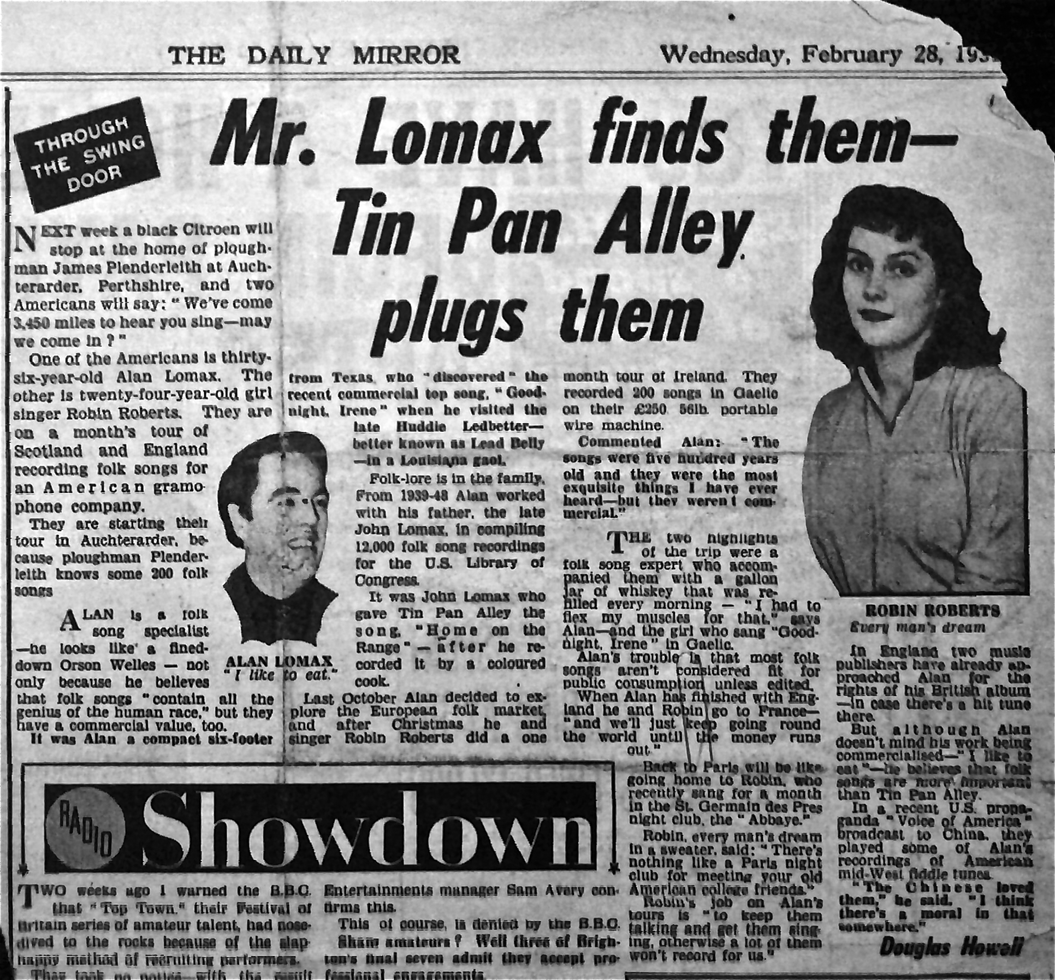
Not everyone shared his opinions, though, and upon his arrival Lomax tapped into a cool seam of suspicion in Britain that conflated his culture collecting and connections to commerce with an Americanized consumer society and commodification. From this footing, he was perhaps not helped by the British media, which published articles making such connections explicit (Figure 1).
Daily Mirror article, 28 February 1951. Used by kind permission of the Mirrorpix Photo Archives.

Linking Lomax to Tin Pan Alley, linking his sound recording with his food shopping, describing his visit as an exploration of the ‘European folk market’ – these things did not sit kindly with many of those already working in the field. This in turn prompted Marie Slocombe, head of the BBC Recorded Programme Library, and whose job among other things was to select and reject field recordings for BBC preservation, to write to producers at BBC Glasgow to distance the corporation from Lomax amid these rumblings.Footnote 34
Initially keen on the project, John Lorne Campbell wrote to Lomax that there should be a volume of Scottish music rather than a single LP to represent Britain. He offered a list of types of song that should be included, and agreed to gather a selection of his own recordings made in the Outer Hebrides for the World Library.Footnote 35 Yet he was spooked by Lomax's conditional agreement to a Scotland LP, on the grounds that recordings should be sufficiently ‘pleasing’ for the album to sell well, and not only backed out of the project but tried to prevent Lomax working in Scotland at all.Footnote 36 It was because of this suspicion that Lomax ventured to Scotland to make his own recordings.
But there is another reason for this rejection that links back to institutional labour and, ultimately, competition. Campbell was president of the Folklore Institute of Scotland (FIOS), which had published, under the auspices of the Linguaphone Institute, a set of five twelve-inch discs of Gaelic music in 1950.Footnote 37 That FIOS intended to continue releasing anthologies of its own was the reason Campbell formally gave for rejecting Lomax's advances: ‘we prefer to retain the best of our Gaelic folksong recordings for publication in such an album, especially as very careful work will be necessary upon the texts and translations of such songs’.Footnote 38 So the World Library was far from the only project sounding out traditional musics. Other international projects were up and running: Romanian ethnomusicologist Constantin Brăiloiu was working with UNESCO on releasing his Collection Universelle de Musique Populaire (1951–8) on 78s; Laura Boulton was releasing LPs of various nations' musics through Folkways Records. Lomax was aware of these other projects and felt threatened by them. ‘Boulton is very aggressive and is after my job’, he wrote in his diary in 1952; ‘There can't be two competing series.’Footnote 39
On top of this, the early to mid-1950s marked a period of renewed interest among major labels in world music, linked to socio-technological developments enabling increased tourist travel, and an awareness of the sales potential of authenticity. Keir Keightley has recovered the story of Capitol Records 1956 series Capitol of the World, which wore its authenticity quite literally on its sleeve: ‘Recorded in the country of the music's origins | Captured in flawless high-fidelity | A remarkable series of albums for world music-travellers.’Footnote 40 It was against such works that the World Library was positioned.
Competition for Lomax existed both synchronically and diachronically; as well as competing with other concurrent anthological projects, he was striving for discovery. He became frustrated in Scotland, for instance, writing in his diary on 16 July 1951:
This is the second day of the bothy ballad country of Scotland. Here Ford, Ord and Gavin Greig have preceded me, not to speak of the BBC trucks. There is absolutely no chance of recording anything unrecorded, of saving anything unsaved. Old trails, old tunes, old singers and old stuff. I'm growing more and more irritated. At least one should be employed in searching out something new and desperate to be known.Footnote 41
Despairing at ‘old stuff’ while claiming to be (re-)presenting traditions may seem to be a contradiction in terms, but this comment begins to make sense when viewed through the lens of competition. Linked to institutional labour and the recordist's aesthetic preferences, competition becomes entextualized into field recordings themselves, which is to say that another reading of the ‘field’ in field recording is one of cultural production, as explicated by Bourdieu, in which individuals and institutions are engaged in constant competition and position-taking for cultural legitimacy.Footnote 42
Zooming in further allows us to examine how these competing and contradictory interests and agencies were enacted. The specificities of mediality and the audio-exoteric, time and temporality, place and movement, and the ways in which sound recordings drift into new networks, can be heard more clearly by following a single recording. Stanyek and Piekut have recently proposed replacing the overused and wilted ‘schizophonia’ with a corrective term, ‘rhizophonia’, which describes ‘the fundamentally fragmented yet proliferative condition of sound reproduction and recording, where sounds and bodies are constantly dislocated, relocated, and co-located in temporary aural configurations’.Footnote 43 It is precisely this dislocation, relocation, and co-location that characterizes the movement of field recordings in the World Library. I will briefly illustrate these ideas through a recording of ‘Haul on the Bowlin'’ – the very first track on the England volume of the World Library.
The BBC arranged a recording session for 8 June 1942 in Bristol. Stanley Slade, a retired sailor and well-regarded shanty singer, was to record a number of songs onto disc, backed by a BBC chorus, with piano-accordion accompaniment for certain tracks. Slade would teach the songs he wanted to record to the professional singers, who were to set down seven or eight tracks – ‘Haul on the Bowlin'’ being one of them. The resulting recordings were then to be used for radio programmes such as Country Magazine, and held in the BBC sound archive as library music for ‘incidental use’ in drama productions.Footnote 44 Slade had initially involved himself with the BBC's sound work, frustrated by the corporation's representation of sea shanties in broadcasts.Footnote 45
Several years later, the BBC sent Peter Kennedy to Bristol in 1949, in part to produce more recordings of Slade, who was increasingly intransigent with the conditions of recording for the corporation. Kennedy had the idea of replacing the BBC chorus with people hauled in off the street, ‘to get voices that weren't necessarily trained and some musical, some very un-musical, sounds; but very much natural work-song sound, because we were trying to capture that authentic effect’.Footnote 46 He made further recordings of Slade, and even arranged a studio session to record a 78 for HMV's Education Department in early 1950, only for the singer to die a week before it was scheduled to take place. Kennedy remained keen to make use of the existing recordings, and wrote to Marie Slocombe at the BBC in January 1951 in an attempt to ‘instigate a campaign’ for the BBC ‘to sell Folk Music records of such typical English amateur talent as Stanley Slade, Harry Cox, Village Choirs etc.’.Footnote 47
When Lomax enlisted Kennedy to compile and co-produce the England LP for the World Library, Slade was therefore high on the list of suggestions, and while Lomax shared Kennedy's enthusiasm, he preferred the 1942 BBC recordings to those made by Kennedy, and dubbed a handful onto tape.Footnote 48 In particular, he had no problem identifying ‘Haul on the Bowlin'’ as aligning with his musical aesthetics, as he had already recorded a performance of the same song in America, by Richard Maitland in 1939 at Sailors' Snug Harbor, a retirement home for seamen in Staten Island, New York.Footnote 49
He consulted the BBC in July about rights ownership, but contractual negotiations were ongoing between the BBC and Columbia – with Lomax as mediator – at the time of his writing. A sticking point was Lomax's initial desire for exclusive rights being assigned to Columbia upon the World Library's release. And although Lomax had backed down by mid-July, his initial demand triggered a response from the BBC that would shape the England LP's contents. Slocombe, with one ear turned towards music history and the other towards future broadcasts, sent an internal memo on 27 July, offering a compromise on the request for recordings of Slade:
The singer is now dead and with him, so far as I know, dies the genuine tradition of shanty singing going back to the clipper ships themselves. I therefore think we would have reasonable grounds for saying that we would only be willing to release one (or at the very most two) of the seven or eight items we have from this particular singer.Footnote 50
Slocombe as gatekeeper here exerts her institutional authority, itself in turn impacting on which bits of Slade's voice drifted from the archive to the record rack. But further questions remain, not least concerning the implications of including a professional BBC chorus in a library of folk and primitive music, and of including a song that was well travelled and long since transnational in a collection attempting to define and render a nation audible.
Lomax set up his own binaries as to what was and was not folk music around musical literacy and training. He asked for ‘real country singers’ in his letters to archivists in England.Footnote 51 In Scotland, this binary becomes clearer and serves as the basis of selection and rejection. Lomax set himself up for a day of listening at Glasgow Permanent Records Library, scrawling down notes as he listened, choosing not to make copies of recordings of various performers: Robert Watson was dismissed as a ‘trained’ singer; Ramsay Sinclair a ‘horrible singer’; Dan Williams as having a ‘horrible vaudeville style’; and, worst of all, Sidney McEwan as a ‘sentimental crap singer’.Footnote 52 The ‘trained’ and the ‘crap’ were, for Lomax, not unconnected. Elsewhere, an album of Norwegian music never made it past the production stage, for reasons explained by Lomax to Fredrik Wulfsberg of the Norwegian Embassy in London:
The music is excellent, but apparently Dr Sandvik [who had collated recordings at Lomax's request] did not understand that I wished to use largely documentary recordings in the series. Therefore his records, made by singers trained in the conventional European sense, will not conform to the standards of the rest of the series and the contribution of Norway will seem rather strange.’Footnote 53
The combination of the BBC moderating access to recordings, the exigencies of the audio-exoteric in working for Columbia, and Lomax's own aesthetic frameworks coalesce to produce a limit to this sonic labour, to give shape to the World Library, and to create an outside in which certain sounds and traditions and their modern instantiations are absented and repressed.Footnote 54 This can be heard as an example of grouping, taken from Actor-Network-Theory (ANT), which presents a challenge to definitions of groups – like folk music, or tradition – as stable entities, flipping concepts on their head, and asking how they were constructed in the first place. To borrow more ANT parlance, Lomax becomes the recruiting officer, gathering the sounds to constitute the folk and the primitive in his project. He also becomes the spokesperson for the grouping – a role he gave himself (‘we, who speak for the folk in the marketplace’) – while trained singers become the anti-group against which various musics are assembled and accorded a new logic.Footnote 55
Yet there is slippage. The boundaries are permeable and leaky. The inclusion of Stanley Slade and the BBC chorus suggests that the audio-exoteric trumps the aversion to musical training, and Lomax and Kennedy had to work hard to conceal these inconsistencies and sonically translate such anomalies: in a 1956 BBC radio broadcast, as part of the series A Ballad Hunter Looks at Britain in which the two men strengthened the group they had formed, Lomax passed the microphone to Kennedy, who enthused on how Slade:
took command of the astonished BBC choir like a first mate tackling a green ship's crew. Stanley was a perfectionist and often before he permitted a recording, he drove the poor choristers through a two or three-hour rehearsal, until he had them hoarse-voiced and shouting like seamen at the ropes. But old Stanley was always in the lead, yanking them along with his rough old shantyman's voice.Footnote 56
The traces of cultural production are found elsewhere. The BBC's mismanagement of metadata caused its own problems: in struggling to trace information on recordings, Brian George wrote to the BBC's assistant head of programme contracts to admit that ‘in some cases we have invented titles for material recorded by us as folk singers are apt to be rather vague about these things’.Footnote 57 Later, Kennedy wrote to Lomax that he was getting creative with his sleeve notes: ‘The BBC, unfortunately, have no texts. One must either guess or hope that that the singers themselves [not all of whom were still alive] will supply the rest.’Footnote 58 His problems were not only to do with written information, either. They were also to do with sound – ‘I have been trying to get on with the texts but find it very difficult to hear what the singers are saying in many cases’; ‘one has to simply guess a lot of the songs owing to bad quality’Footnote 59 – and the sound of recordings emerges as an important force in the cultural production of the World Library.
There was no volume of Welsh music. Kennedy had asked about it: ‘What are you going to do about Wales, by the way, you left it rather vague?’ Lomax maintained that five minutes of Welsh music on the England album would suffice: ‘that will mean a close approximation of what we'd eventually like to have as the Album of Folk Music from England and Wales. They belong together as complementary musical ideas.’Footnote 60 The issue reappeared in a letter from Esme Lewis of Barry, Glamorgan. Lewis commends Lomax on his work for radio and television, but goes on to offer a mild reproach: ‘one thing only has puzzled me Mr Lomax! i.e. your exclusion of Wales. You will find many beautiful folk songs here – dealing with different subjects and containing ample variety of mood in the music.’ Lewis even offers to sing for Lomax, having previously recorded an album of Welsh folk songs for HMV.Footnote 61 But a Welsh album never appeared.
Lomax did, however, travel to Wales, making recordings in Treorchy in December 1953 (a month after Lewis's letter). He also sent letters to potential collaborators at Welsh institutions, seemingly in an effort to gather material for a Welsh album. Dora Herbert Jones of University College, Swansea wrote back: ‘the large number of records made while I was collecting these in Wales are now too faint for much use to be made of them. Only a fortnight ago the BBC … tried to use some of these early records and found that they were useless.’Footnote 62 As well as aspects of musical performance and adherence to abstract notions of authenticity, then, issues of format, technology, and preservation – in other words, contributing factors to the sound of music – impacted on the World Library's contents. Jones continued: ‘of course, they were made on phonographs and have had no attention paid to them since they were done some 30 years ago’.
Degradation – of human voice, of recorded sound, of some imbrication of the two – reappears as a limiting factor when Argentine ethnomusicologist Isabel Aretz supplied Lomax with an LP's worth of music, only to have them rejected on sonic grounds:
As a collection for a Museum it is excellent. However, I am desolated to say that it is not ready for publication in my series. In general the difficulties are two: 1. So many of the singers are old with badly broken voices; 2. A number of the best records are rather badly distorted or have a bad surface noise … I say that as musical folklore the material is of very high order but I am certain that many of your old men are not for the general public.Footnote 63
In this instance, the recordedness of the recordings, the degree to which technology intrudes on the listening experience, prevents a nation's admission to the World Library. Lomax, presumably with Bing and Béla still in mind, was concerned with sourcing recordings of a particular audio quality for representation in the marketplace, for communication to a large audience.
Further probing of institutional limit and the absented outsides of the World Library reveal still more agencies and shaping factors. Lomax leant on the BBC to obtain recordings from the Canadian Broadcasting Corporation, on the understanding that they were to be used in radio broadcasts. After making copies to send to Marius Barbeau, with whom he was collaborating on a Canada LP, and sparking a row between the two institutions, the BBC head of copyright finally had to write to Lomax, drawing his attention ‘to the section 4.3 of the Canadian Copyright Act of 1921’.Footnote 64 Lomax replied from the Hotel Nueva York in Madrid:
For the first time students of music and culture will have a good idea of how men have sung in every quarter of the globe, and most important, ordinary listeners everywhere will get acquainted with the peoples of the world in terms of the most understandable of the arts. Folk music can thus help to build for peace. Perhaps you will feel this explanation is unnecessary, but actually this is what is involved in the matter under discussion rather than section 4.3 of the Canadian copyright act of 1921.Footnote 65
Ultimately, Lomax was forced to back down, and the CBC recordings were removed from the Canada album. This clash between what Myers terms regimes of value – in this instance between a utopian vision of the dissemination of the world's musics and the legal protection of cultures, voices, and identities; more broadly of the contestations over culture as it takes on new forms of materiality – has become an increasingly prevalent aspect of world music production and politics.Footnote 66 It also reveals two further properties of the World Library: first, that in addition to aesthetics and technology, the heterogeneous networks through which the World Library came to be are also legal, with national copyright law enacting an agency of its own in international cultural production; second, that the singers and performers – whose voices and bodies are the source of such cultural struggles – so easily slip through the network, are represented but not consulted, are adopted and adapted through complex collector–institution arrangements, and become part of the transnational traffic in culture, with the slightest leakiness in copyright protection leading to entirely unpredictable reorganizations and recontextualizations.Footnote 67
At the same time, there is a risk of underplaying the agency of the performers; many of those whom Lomax recorded in Scotland seemed happy with the prospect of dissemination and recognition. Elizabeth Barclay of Shetland wrote to Lomax to say ‘it gives me great pleasure to think that I was able to contribute to your album and so help make Scottish folksongs better known’; Rachel MacLeod of Barra wrote that her friends Mary Gillies and Mary Johnston were ‘delighted that they are about “to come into their own at long last”. Many a song they have given to song gleaners, now they are about to get honourable mention – thanks to you Mr Lomax’; Calum Johnston expressed his good wishes, writing ‘if, by these songs which I learnt in my youth, I can contribute a little towards giving pleasure to others then I am quite happy’; and Kate Nicolson of South Uist replied to a Lomax letter, ‘I am glad you enjoyed your trip to the Highlands so well. I must say we were only too pleased to be of any use to your recording.’Footnote 68
Not much of the labour that was built into the World Library's production was factored into reviews upon its release. Instead it was heralded as a faithful document of traditional musics, with reviewer Howard LaFay fashioning his own model of cultural entropy, asserting that ‘this monumental project was undertaken in the nick of time … fortunately for us and for succeeding generations, the World Library reflects the full, mellow beauty of the sunset of this musical tradition’.Footnote 69 The grouping that Lomax and his collaborators performed is re-performed, and strengthened in the process. The World Library as entextualization of mid-century cultural concern is contextualized back into public discourse, with reviews helping to supervise its reception. Folk and primitive musics are mapped against a familiar anti-group: pop. And the sound of the recordings, in particular, is championed; Alan Merriam and Charles Haywood, reviewing the World Library, praised it as a ‘major contribution to the study of folk music’:
This, in large measure, is due to the fact that all the material was recorded ‘in the field’. There is no impression of the recording studio here, no contrivances with mikes, or setting up of proper balances. There is a pervading feeling of truth – this is how the folk sings, dances, or plays.Footnote 70
Sound scholars have done a good job of problematizing, if not debunking altogether, such affirmations of truth and the notion of fidelity in sound reproduction.Footnote 71 Nevertheless, this argument – that field recordings are the truthful counterpart to the artifice of the studio – has proven to be quite persistent, challenging a pair of (false) dichotomies, highlighted by Frith and Lastra, that have dominated perceptions of sound recording: first, that live music equates to natural communication and truthfulness, while recorded music is artificial, to be treated with suspicion; second, that recorded sound is either ‘phonographic’ – sonically faithful in its reproduction of reality – or ‘telephonic’ – privileging intelligibility and particular aspects of sound at the expense of others.Footnote 72 What must be considered in the case of the World Library, of field recording, and of folk music, is how technologies are wilfully made to vanish in the maintenance of a discourse of sonic transparency.
Listening Across Sound
Mitch Miller misread the script a little. Miller would ordinarily be positioned outside the network of folk music history: contributing significantly to music production techniques, crafting an echo chamber out of a toilet and claiming to make the first multitrack recording in 1949; something of a giant of the music industry in the twentieth century. Speaking as head of A&R at Columbia, he credited Lomax, rather than the music he had gathered, as being ‘an authentic’ in an interview for a World Library review in Newsweek. He continued: ‘for Lomax, feeling and emotional delivery are more important than rough edges on the voice. In fact, the rough edges are part of the attractiveness of the style.’Footnote 73 In some respects, Miller's assertion is a pre-echo of Barthes's concept of the grain of the voice: the materiality of the body, history and tradition and memory and language, swelling out through the corporeal pulp of the human form.Footnote 74 The point that neither Miller nor Barthes make, which has been corrected since, is that for the grain of the voice to be audible beyond a finite space and time, a host of technologies are required.Footnote 75
For Paul Theberge, writing on the sound of music, the grain of the voice is revealed with uncommon closeness thanks to the microphone. Moreover, it was privileged and made voluptuous as a result of sound entering a new stage of rationalization in the 1950s, with the advent of recording studio practices of isolation, selective emphasis (reverb, equalization, compression, etc.), and spatial placement in the mix.Footnote 76 Haywood and Merriam's review of the World Library, which credits field recordings as being truthful on the grounds that they were made outside of studios, must therefore be considered against what else was happening in music – specifically music production – at the time. The World Library was released in 1955. ‘Rock Around the Clock’ had just stormed to the top of the UK charts.
The implications of thinking synchronically across music worlds – or cultural pluralism, as discussed by David Clarke – should thus be extended to thinking across discourses and aesthetics of music production and, ultimately, across sound; what is being endorsed – by Lomax, by Mitch Miller, by Haywood and Merriam – is broadly sonic. Lomax himself asked Columbia of their plans for ‘advertising this first attempt to document the sound of mankind’.Footnote 77 And his Magnecorder can be slotted in alongside Elvis and Darmstadt in Clarke's formulation of significant mid-1950s musical phenomena that occurred concurrently but are usually kept apart in historiography, ‘normally kept in their safely separate historical containers, now rearticulated in a potentially volatile chain of meaning’.Footnote 78 Richard Peterson's question, ‘Why 1955?’ – directed towards the advent of rock music – can also be asked of the World Library: why then, and with what consequences?Footnote 79
A complex and variegated network of institutional labour and limit, recording technology, aesthetics of sound, copyright law, competition, archival preservation and cooperation; contingent and conditional processes of grouping and translation; mediality – for the field recordings housed in the World Library to make the cut, each of these phenomena had first to be compressed into their audible exteriors. Lomax and his fellow moderns and anthologists worked to convert the oral into the aural, to shift the storage of music from bodies to tape, sounding some nations, but not others, on the basis of their abilities to perform this compression and conversion.Footnote 80
And were the voices on the World Library not voluptuous? Not only did Lomax stress ‘good acoustic quality’ in his approach letters to archivists, he also later revealed to Kennedy that he employed the same production techniques and rationalized sonic approach as developed by those crafting sound in studios: ‘in all my albums I have helped the records a lot with the filter bank, the echo chamber, and I've also had a good engineer, who knew about making master tapes for records, socking up all the gain that he could, but careful not to sock on too much. It's a specialised job.’Footnote 81 (Kennedy, meanwhile, was conscious of the sonic space of recording locations, using gym mats ‘to deaden the echo’ in halls, while working for the BBC in 1952.Footnote 82) Lomax's embrace of the latest technologies here was characteristic of his career, but these methods and production practices also serve to complicate the idea of a clean dichotomy of studio and field production. Not that all recordings are the same; but they may be more alike than we think. Both recordist and recording technology must be considered together – neither solely determines the form of a recording – and placed into the complex webs of relationships that created the recording scenario in the first place. The ontology of field recordings is thrown open to question by such practices: a question that can only be answered by tracing the specificities of field recording projects, and probing the institutions that commission them.Footnote 83 In any case, Haywood and Merriam's triumphalism – ‘this is how the folk sings, dances, or plays’ – serves to elide materiality, to make technology, mediality, and production technique disappear, and seems more like an exercise in performativity, an investment in the grouping, than an accurate description of the cultural production etched into the grooves of the discs.
Magnetic tape – patented in 1898; developed in Nazi Germany and, to a lesser degree, by the US military in the Second World War; used in radio from 1947; available to field recordists shortly thereafter – was a boon: ‘gone the needle rasp of the aluminium disc; gone the worry with the chip and delicate surface of the acetates. Here was a quiet sound track with better fidelity than I had imagined ever possible; and a machine that virtually ran itself, so that I could give my full attention to the musicians.’Footnote 84 Lomax frequently emphasized the agency of machines in his writing, folding recordist and recording device into one.Footnote 85 He also had a tendency to posit himself and his technologies as being ‘primitive’, in an effort to align himself with those whose music he sought and to gloss over the division of sonic labour involved in his work.Footnote 86 This holds for the World Library: Lomax wrote of cutting and editing tape as ‘a job like weaving’, linking new technologies with traditional arts in a direct material genealogy.Footnote 87
But magnetic tape also afforded increased possibilities for the recombination and suture of sounds, undermining temporal continuity in the process.Footnote 88 It was, in other words, modern. Lomax's tape weaving was hemmed in, however, by another new technology: the long-playing record, developed by Columbia and introduced to the market in 1948. And when he writes in the same diary entry, ‘I'm almost done – about three or four minutes over and about to make final decisions’, the determining agency of format looms over the World Library.
This was a project not merely made possible by but indeed made for the LP. Lomax wrote of the format as ‘a near perfect means for publishing a folk song collection … one LP encompasses as much folk music as a normal printed monograph and presents the vital reality of an exotic song style as written notation never can’.Footnote 89 Format governs the dimensions of the collection, however, and exactly how much ‘vital reality’ can fit onto a release is pre-determined, again undermining the very notion of reality on record.Footnote 90 To be more specific, in attempting to write a nation onto two sides of a microgroove disc, Lomax chose to whittle down tracks of different styles and times and cultures to often little more than thirty seconds of sound. JoAnne Mancini terms this use of the LP format ‘anthological modernism’, in which technology was used to ‘convert dozens of songs into a visionary whole that did not itself resemble a commercial product but rather a collection of sacred texts’.Footnote 91 And I run with the idea of anthological modernism here: the World Library, with its complex relationships with mass media, definition of nation states through international cultural production, and its splitting and reordering of time by assembling supposed survivals of pre-modernity on modern materials can be heard precisely this way.
Presenting music in fragments has its own implications. The LP has been interpreted as a pedagogical format, affording listeners more time to become familiar with new musics, and to allow ‘performer identities to assume coherence across a significant body of vocal performances’.Footnote 92 Fragmentation, by contrast, limits the coherence of performer identity, even stylistic identity, and the most coherent identity to emerge is that of the anthologist. The World Library is not Lomax presenting the musics he and others collated, not even representing, but becoming the musics, in an act of what Bourdieu has written of as transubstantiation. Here, ‘the representative receives from the group the power of creating the group … he raises those whom he represents out of their existence as separate individuals, enabling them to act and speak through him as a single person … [and] acts upon the group through the magic of the slogan’, in this case Folk and Primitive Music, and the nation or region in question.Footnote 93 Redolent of Benedict Anderson's Imagined Communities, then, nations emerge and are constructed from fragments, energetically and rhizophonically, by anthologists in temporary, yet monumental, aural configurations.Footnote 94
Transubstantiation is linked to terminology. Lomax and many others referred to themselves as collectors – Lomax even called himself a ‘ballad hunter’ – with profound implications for the thingness of the music they recorded and for questions of ownership also. It follows that the World Library is a collection, which appears not so much as a library but more like a museum. Museums – characterized by Myers as playing fields of power struggles – are connected at root to culture collecting, and, by extension, cultural politics.Footnote 95 And anthropologists have led the way in revealing the ways in which these connections are concealed by new logics of exhibition: for Myers, ‘it requires denying or repressing the actual history of power, relationships, and commerce that resulted in collecting the objects in the first place’; while for James Clifford, drawing on Susan Stewart, museums ‘create the illusion of adequate representation of a world by first cutting objects out of specific contexts and making them “stand for” abstract wholes’; finally, ‘historical relations of power in the work of acquisition are occulted’, and ‘the time and order of the collection erase the concrete social labour of its making’.Footnote 96 These politics are arguably shot through the entire history of ethnographic field recording, but seem particularly pertinent to a project such as the World Library: with its repression, or compression, of history; its abstract wholes in the form of nations; its erased social (and material and sonic) labour.
What are the politics of magnetic tape? Of cutting, fragmenting, splicing, pasting, recombining, suturing, sequencing, representing?Footnote 97 It may seem on first listen that hearing the sounds of recorded voices is hearing people speak for themselves, but what of the communication that remains on the cutting room floor? What happens to communication when the listener presses stop? What does it mean that we can now listen to Stanley Slade on vinyl, CD, and online, but only in a recording scenario he disliked and agitated against at the end of his life? His deadness is potent, but his agency is ultimately tethered to the logic of the collection, leaving Slade with little control over which bits of his voice are enrolled in sonic presents and futures.Footnote 98
The World Library, heralded by Lomax on the sleeve of each record as a pure reflection of a techno-cultural utopia – ‘in a thin stack of records one may carry about in two hands, the profoundest and most communicative of the arts will be documented. Vox humana!’Footnote 99 – is more accurately the work of the sonic bricoleur. Developing Lévi-Strauss's concept, revisiting Lomax as sonic bricoleur adds nuance to the notion of ‘the man who recorded the world’, in specific consideration of his work in Britain. The bricoleur, for Lévi-Strauss, is one who creates from whatever is at hand, taking from the world's finite and heterogeneous material culture, repurposing and recontextualizing it for their specific project.Footnote 100 In retracing the World Library, Lomax's labour and Lévi-Strauss' design bear uncanny similarity:
Consider him at work and excited by his project. His first practical step is retrospective. He has to turn back to an already existent set made up of tools and materials, to consider and reconsider what it contains and, finally and above all, to engage in a dialogue with it and, before choosing between them, to index the possible answers which the whole set can offer to his problem.Footnote 101
Lomax as sonic bricoleur, with his Magnecorder as audio suction pump, took precisely these actions, dubbing whatever extant recordings were available to him – even some that strictly were not available to him – engaging in dialogue with them, and spooling out tape to embody nations, entextualizing cultural politics onto vinyl, rendering his take on tradition exoteric, carving out sonic space in Europe's post-war aural public sphere.
Hearing Anew
Listening in to the musical present, and the widespread digitization and online dissemination of field recordings, reveals a pair of contradictory patterns. On the one hand, recordings are protean, slippery, and continue to drift, accruing new meanings and becoming enrolled in unpredictable and uncontrollable configurations.Footnote 102 Despite their intended monumental status, the field recordings selected for the World Library have proved elusive.Footnote 103 The circulation of the World Library has largely been the movement of limited material objects between listeners, unhooked from the forces that brought it to the market in the first place.
On the other hand, the new digital environments in which field recordings now circulate are bound to the logic of the collector and the initial collection, and – by housing recordings in bespoke online archives, rather than, say, Spotify – in some regards re-perform, even strengthen, past groupings in new listening forums. Sterne writes: ‘once granted, legitimacy can be treated as natural or inherent, and legitimate institutions can themselves become tools of endorsement or marginalisation’.Footnote 104 In the case of the World Library, these decisions were made long ago, based on the kinds of material and institutional labour I have discussed; the past, which enacted agency when the World Library was being assembled, enacts agency again in the present.
At the time of the World Library, in ‘the age of the golden ear’, these recordings were considered the best available – best according to any number of the agencies that have appeared in this article – and they were selected for preservation and dissemination on the criteria of the audio-exoteric. So thinking across sound becomes more complicated when it is also performed across time and format.Footnote 105 In any case, Lomax – just like Lévi-Strauss' bricoleur, who ‘may not ever complete his purpose but he always puts something of himself into it’Footnote 106 – continues to be heard through the music he gathered. And the various other agencies compressed into the World Library remain obscured, but nevertheless remain.