The historian David Sorkin has defined early nineteenth-century German Jewry as a subculture, a distinct minority-group culture that was largely composed of elements of the German bourgeoisie of education (Gebildeten), yet functioned as a ‘self-contained system of ideas and symbols’.Footnote 1 Ironically, the isolation of the German-Jewish subculture was a direct consequence of the project of emancipation, which rather aimed toward complete social integration through Jewish regeneration and adaptation to the culture of the German bourgeoisie. But since integration was substantially hindered in the restoration era, the persistence of the emancipatory movement prompted a new kind of identity. Herewith, argues Sorkin, lies the paradox of the German-Jewish subculture, which ‘could neither recognize nor acknowledge that their ideology, designed to foster integration, had become a basis of separation’.Footnote 2
Sorkin's arguments provide significant perspectives on the musical work of Felix Mendelssohn – the grandchild of Moses Mendelssohn – who was quite literally raised on the knees of Jewish emancipation and most probably experienced the cultural confusion of the German-Jewish subculture. As Ruth HaCohen puts it, Mendelssohn was part of a German-Jewish generation that was born after the French Revolution and had ‘taken into account (unlike their parents’ generation) that revolutions can and do burst out, that social order is precarious, and that violence is one of the ways through which momentous changes are introduced’.Footnote 3 In other words, Mendelssohn lived in a historical moment when the general European society came to realize that social reality is volatile and the German-Jewish subculture sensed that the path to social integration would not be a direct one. Accordingly, Mendelssohn's music indeed reflects a self-conscious attempt to produce, express and advance the universal ideals of the enlightenment and construct distinctively German aesthetics. But, precisely in doing so, this music also bears witness to a distinctively German-Jewish subcultural stratum.
In this article I examine the impact of Mendelssohn's unique cultural position on his music as it is reflected in the Lieder ohne Worte (Songs without Words) for piano solo. In exposing generic and formal tensions within these allegedly plain miniatures, I subscribe to HaCohen's observation that unlike the ‘German-born Romantic (narcissist) artist, who could have felt alienated from society’, Mendelssohn was also ‘estranged from his own art/self’.Footnote 4 But while the import of estrangement leads HaCohen to focus on intricate semiotic relations between musical and verbal texts in Mendelssohn's songs, I associate Mendelssohn so-called sociocultural estrangement with musical formal ambiguities. I specifically argue that the lyrical simplicity projected by the lieder framework is continuously destabilized by various formal features, which evoke other generic frameworks and generate structural and stylistic complexities that exceed the narrow scope of the piano miniature.
But how can we establish a convincing connection between instrumental miniatures like the Lieder ohne Worte and Jewishness? And, more fundamentally, why focus specifically on these instrumental works in this cultural investigation? In discussing the theorization of music and sociocultural identity, Georgina Born and David Hesmondhalgh propose an ideal–typical distinction between two moments of musical representations of identity: one is the construction of identities, in which music assumes a formative role as a socio-cultural agency; the second is the reflection of identities, in which music is ‘driven by sociocultural identities that are ontologically and sociologically prior’.Footnote 5 Born and Hesmondhalgh emphasize that ‘there is a need to acknowledge that music can variably both construct new identities and reflect existing ones’, and yet, as explanatory schemes, ‘each brings insight in relation to different sociomusical phenomena’.Footnote 6
Without dismissing the formative role that music plays within sociocultural contexts, in this research I wish to better understand the interrelationship between musical formations and sociocultural realities. I will therefore focus on the reflective connections between the German-Jewish subcultural disposition and Mendelssohn's music. In doing so, I will conduct formal analysis of selected case studies of the Lieder ohne Worte and position them within broader cultural imaginaries to understand how certain musical identifications – which are ‘powerfully formed and influenced by larger discursive, ideological, social, and generic forces’ – take shape in, and give shape to, musical utterances.Footnote 7 Placed in this analytical framework, the apparent referential and political neutrality of the piano lieder is precisely what makes them an ideal case study to examine the intersections of aesthetics, politics, and cultural positioning, which do not necessarily express cultural ambivalence, yet inevitably perform it.
The article is divided into three parts. In the first part I present my main argument, proposing an analogy between Mendelssohn's stylistic ‘conservatism’ and the anachronistic world view of German Jewry during the rise of German nationalism in the restoration era. In the second part, I focus on the music. First, I exemplify the generic heterogeneity of the Lieder ohne Worte, which feature ‘progressive’ stylistic frameworks associated with the lied traditions yet concurrently point toward the formal ideals of eighteenth-century classicism. Second, I present a formal analysis of two piano lieder, Op.19 No. 5 and Op. 30 No. 4, which demonstrate one of the types of Mendelssohn's ambiguous approach to style and genre – the permeation of sonata-form procedures into the framework of lyrical forms (sonaticization) – and prefigure a duality of simple and compound forms that characterizes many other piano songs.Footnote 8
Finally, in the last part of this article I position the formal analysis of the piano songs within a broader context through Heinrich Heine's essay Die Romantische Schule (The Romantic School). Despite prominent differences between Heine and Mendelssohn with regards to aesthetic tendencies, political stance, and approach to both the German and the German-Jewish cultures, Heine's text provides an invaluable perspective on their shared cultural habitat and singular historical moment. Specifically, this text sheds crucial light on the negotiation of Jewishness within German culture and its position in relation to aesthetic movements, historical changes and political climates.
The Mendelssohn Problem: Styles, Genres, And Subculture
In coining the title the ‘Mendelssohn Problem’ for his 1974 edited volume, Carl Dahlhaus wished to hint at the aesthetic, stylistic and technical implications of Mendelssohn's historical characterization as a musical classicist. The ‘problem’ of Mendelssohn's musical classicism therefore pertains to issues like the tension between epigonism and an ‘original, underivative, stage of style’, the confusion between classicism in a music-historical sense and as an aesthetic category, Mendelssohn's relation to the musical conventions of the late eighteenth century and to more contemporaneous trends, and so on.Footnote 9 As Michael P. Steinberg astutely observes, however, the supposition of a Mendelssohn problem is by no means a neutral – musical stylistic – one. This choice of words, asserts Steinberg, ‘conjures a rhetorical, ideological, and political parallel: the Mendelssohn problem, “the Jewish problem”’.Footnote 10 Thus, while Dahlhaus focuses on the technical and musicological issues pertaining to the allegedly problematic aspects of Mendelssohn's music, his words nevertheless disclose the ideological stratum that turned these issues into a problem: the ‘Pandora's box’ of Mendelssohn's Jewishness.
By identifying the ‘Jewish problem’ that underlines the ‘classicism problem’, Steinberg certainly sets up the stage to understand Mendelssohn's music against the backdrop of his socio-cultural position. Yet instead of crystallizing this musical-cultural connection, Steinberg harnesses it to make his broader claim that a general ‘anxiety of classification’ is the real ‘problem’ that underlines both Mendelssohn's classicism and his Jewishness.Footnote 11 This assertion, important as it is, underestimates a crucial link between Mendelssohn's aesthetic approach and the political-cultural propensities of the German-Jewish subculture in the early nineteenth century. I specifically refer the correlation between Mendelssohn's conservative and backward-looking ‘classicism’ and the politically orthodox devotion of German Jewry to the older ideals of the Enlightenment in the first half of the nineteenth century.
According to Sorkin, there were two phases of emancipation before 1840. Starting in the 1780s, the project of Jewish emancipation in Germany partook in the more general ‘reorganization of the German states through an extension of natural rights and individual freedom’.Footnote 12 In that political context, emancipation was essentially conceived as a quid pro quo in which Jewish regeneration would precede rights, which specifically meant that German Jews should assimilate themselves to the German bourgeoisie of education.Footnote 13 Nonetheless, the political reality changed after the defeat of Napoleon and the Congress of Vienna in 1815, when German and European rulers sought to restore order by ‘safeguarding the balance of power’ and – in the specific context of German territories – preclude any wide-ranging political or constitutional development.Footnote 14 In this new reality, the project of emancipation no longer coincided with the political agenda in the German states and was therefore substantially hindered. What Sorkin describes as the illusionary condition of German-Jewish culture was their persistent adherence to the older ideals of Bildung and Jewish regeneration when the rulers basically kept the project of emancipation at arm's length and making its ideals obsolete.
Looking at the Mendelssohn problem from the lens of a political and conceptual German-Jewish anachronism, I specifically assume a certain connection between the ideals of the past and the musical style of the past: the world view of the Aufklärung [enlightenment] and the backward-looking classicism that supposedly underlines Mendelssohn's aesthetics. But now we should also turn the spotlight on the musical side of the equation and ask whether the category of classicism – and its counterpart, romanticism – correspond to Sorkin's historical demarcations. Broadly speaking, the classical and the romantic are problematic categories as they fuse and confuse between history, musical styles, aesthetic ideals and value judgment. Adding to this, the ideological agendas that have often underlined the classical–romantic duality blur historical boundary lines as they tend to subjugate historical and musical strata rather than explain and describe it.
On the other hand, the categories of classical and romantic music, however problematic, still imply a notable difference that relates to Sorkin historical analysis. Dahlhaus validates this boundary line, stating that the ‘thesis that the musical canon of forms did not change with the transition from the classical to the Restoration period – the time of Romanticism, of classicism and the Biedermeier – appears an exaggeration, in view of the Romantic Lied, the lyrical piano piece and the symphonic poem’.Footnote 15 These arguments merit a closer reading as they encapsulate several observations that pave the way to deduce a musical-historical boundary that corresponds to Sorkin's analysis.
First, Dahlhaus does not talk about the classical and the romantic, but rather about the classical and the ‘Restoration period’. In doing so, he provides a more historically oriented outlook. Following this, Dahlhaus also makes a distinction between ‘classical’ and ‘classicism’: the former designates the historical period that precedes the ‘Restoration period’; whereas the latter denotes a later stylistic tendency. Finally, and most important for our purposes, Dahlhaus specifies the central stylistic and aesthetic innovations of the Restoration era: the lied, the interrelated lyrical piano piece, and the symphonic poem.Footnote 16
The generic innovations that Dahlhaus mentions disclose the multivalent and ambivalent connection between the classical and the Restoration eras, especially in the context of instrumental music. Within generic frameworks that crossed the alleged seam of the turn of the nineteenth century and the Restoration period – including the symphony, the string quartet and the solo sonata – the ‘dependence on the classical’ was inherent.Footnote 17 But within the new genres prefigured by the lied tradition on the one hand (including the lyrical piece) and the symphonic poem on the other, such dependence was by no means immanent.
Against the background of the generic continuities and discontinuities that Dahlhaus identifies, we may differentiate between two meanings of Mendelssohn's so-called classicism. The first, which is the common one, is Mendelssohn's alleged tendency to solidify connections with the musical past in a manner that is more intense, profound, or explicit than that of other ‘romantic’ composers. The second meaning of classicism I propose here refers specifically to the destabilization of the new, historically unprecedented, generic framework of the lyrical piece through compositional approaches and formal procedures that allude to extant genres and styles of instrumental music.Footnote 18 In this latter sense, Mendelssohn's Lieder ohne Worte externalize the features of a lyrical ‘new’ genre, yet still conceal elements that crystalize fundamental connections to older ones.
Granted, the more specific meaning of classicism in the wordless songs is prefigured by Mendelssohn's classicistic tendencies in the broader sense. But still, it is important to make this distinction for two central reasons. First, the ambivalence of new and old generic frameworks provides a more accurate account of Mendelssohn's stylistic approach without relying on vague conception of classicism and romanticism. Second, the idea of destabilizing a fairly new lyrical genre through extant formal approaches reveals a special case in which the alleged dependence on older features is implicit. In this regard, the wordless songs differ from more ‘classical’ works by Mendelssohn in the sense that they conceal certain formal propensities underneath a lyrical-surface level rather than externalize it. And herewith lies the key to understand the more fundamental connection between Mendelssohn's Jewishness and the piano lieder.
In their stratified design, the Lieder ohne Worte produce a subtle yet intense tension between the external projection of lyrical frameworks and the internal nesting of features associated with older – classical – models. This stylistic tension not only correlates with the conflict of new political climate and old agendas and world views, but also embodies the alleged confusion of a German-Jewish subculture, which seeks to negotiate the ideals of the past into the present. And thus, through the assumed parallelism between the musical approach and the cultural stance we can better understand the convergences of musical styles, aesthetics, and socio-cultural systems and solidify the connection between collective imaginaries, individual experiences, and musical production.
[Un]Framing Mendelssohn's Lieder Ohne Worte
To delve deeper into the confluence of Mendelssohn's Lieder ohne Worte and his affiliation with a German-Jewish culture, I will first focus on the musical works themselves. This musical investigation will be guided by three fundamental questions. First, if Mendelssohn's piano songs are construed as lyrical pieces, then what is the lyrical piece, and how do the piano lieder correspond to it? Second, what are the musical elements that exceed the boundaries of the lyrical piece within the Lieder ohne Worte, and can we associate them with other genres? Finally, does the destabilization of the lyrical piece brings about any unique formal modalities?
Commentators frequently treat Mendelssohn's Songs without Words as a generic puzzle whose solution lies within the framework of the lied tradition. In his attempt to define the ‘Lied ohne Worte’, Larry Todd thus describes the ‘Venetianisches Gondellied’ Op. 30 No. 6 as a ‘romantic, impressionistic miniature that calls out for words’, musing that ‘Mendelssohn conceived the music with text but then deleted it, leaving in place only the special title as a vestige of the union of words and music’.Footnote 19 Elsewhere, Todd places the generic reference to vocal music on a more technical ground, stating that the piano lieder ‘typically have clear song like qualities (e.g., lyrical treble melodies supported by an arpeggiated form of accompaniment) and frequently cast in ternary song form, suggesting again the trappings of the texted art song’.Footnote 20
Accordingly, the ‘Gondellied’ Op. 30 No. 6 appears to articulate the three central characteristics that Todd defines. First, the song features a distinct treble melody, which is not only lyrical in a stylistic sense but also in the sense that it suits a vocal execution (that is, predominated by scale-wise motion, restricted to relatively narrow range, and features melodic leaps that are never too big). Second, there is a characteristic ostinato accompaniment that provides the basis for the introduction of the piece (bars 1–6) and lasts throughout. Lastly, the thematic layout of the song suggests a three-part ABA′ form with an A part that presents a periodic structure (bars 7–21); a middle B section that emphasizes the dominant of the home key (bars 23–32); and following a four-bar retransition in bars 33–36, a reprise that leads to a coda (as we shall see, this analysis is unsubstantiated by the harmonic motion, which suggests a different formal layout).
But even if the ‘Gondellied’ is captured neatly in the framework of songs, the same does not apply to all Lieder ohne Worte. The piano lied in B minor, Op. 30 No. 4, is one prominent example that demonstrates the blurring of generic boundaries within Mendelssohn's piano pieces. On first glimpse, this piece indeed exhibits several features that relate to songs and lyrical genres in general. It includes a distinct upper part, an ostinato accompaniment of consecutive semiquavers in the piano, and it is cast in a three-part ABA′ ‘song form’ with a repeated A part in B minor, a 38-bar B part that ends in F-sharp (the dominant of B), an extended return of the A part, and a coda. Nevertheless, Op. 30 No. 4 is conspicuously different from the ‘Gondellied’ in two respects: it does not include a poetic title, and its upper part is certainly not as lyrical and ‘singable’.
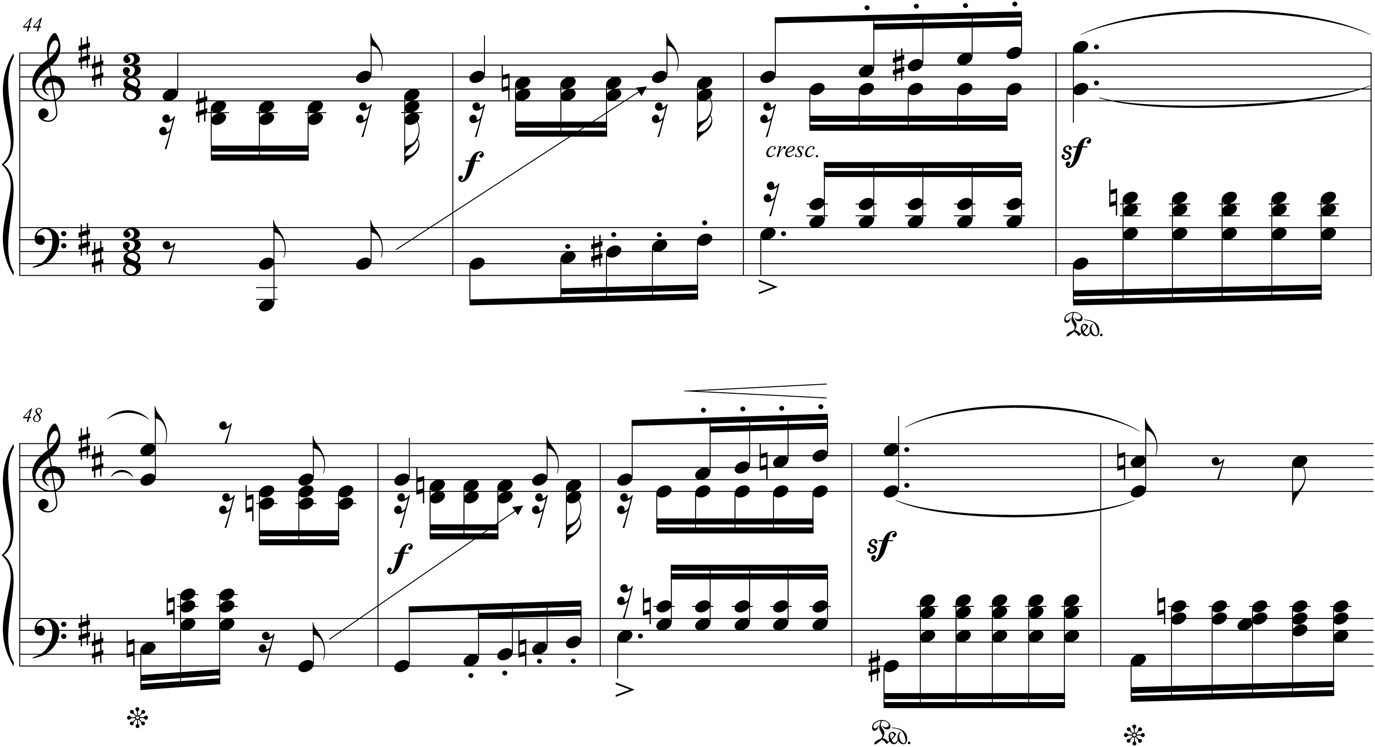
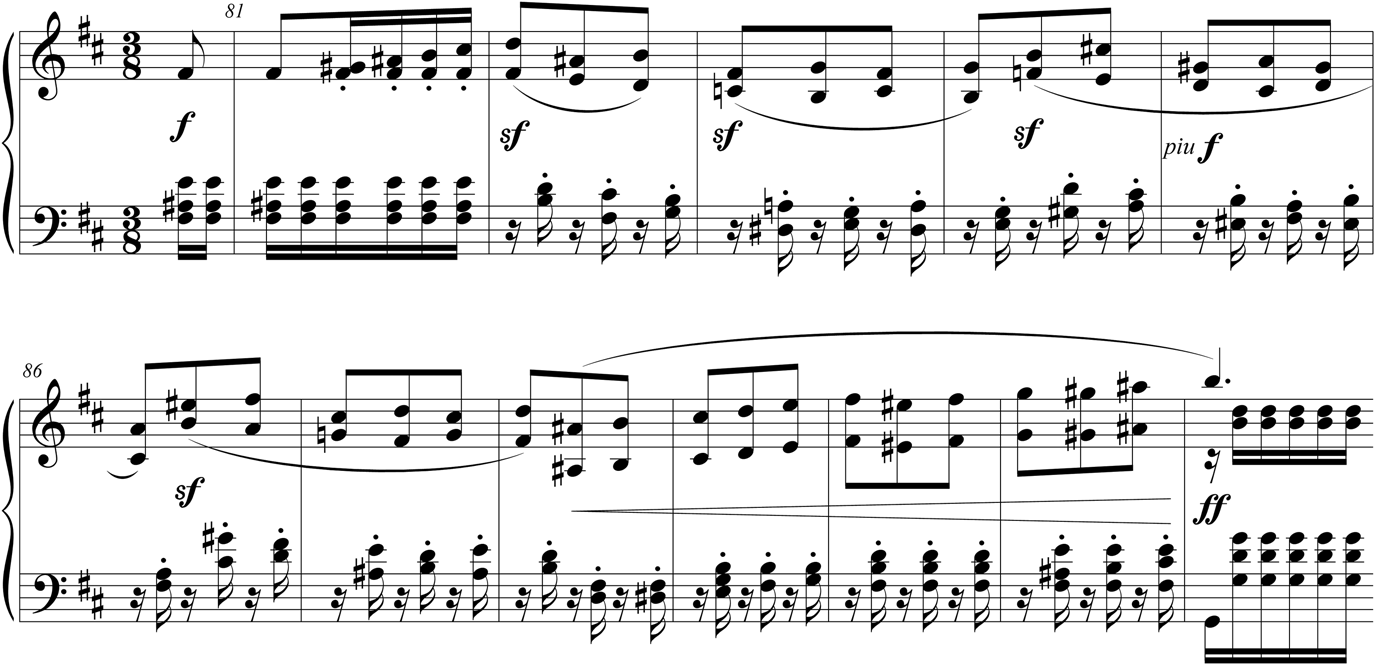
These non-lyrical elements are indicative of more substantial ones that further destabilize the boundaries of vocal conventions. The segment in bars 44–52, for example, presents a polyphonic imitation between the right-hand and left-hand parts, which emphatically exceeds the boundaries of song textures (Ex. 1). Likewise, the segment in bars 81–90 strictly abandons the distinction between melody and accompaniment and shifts to a characteristically instrumental texture in which the left-hand part complements right hand (Ex. 2). Finally, from a formal perspective the piece is indeed subdivided into three parts, however, the first and the last parts (exposition and recapitulation) suggest a complex design that includes two separate sections – or theme-like units – and accordingly, suggest a dialogue with other musical forms and genres (I will soon delve deeper into these issues).
Mendelssohn, ‘Lied ohne Worte’, Op. 30 No. 4, bars 48–52

Mendelssohn, ‘Lied ohne Worte’, Op. 30 No. 4, bars 81–92

This brief foray into two of Mendelssohn's piano lieder suffices to show that the generic, stylistic, and formal aspects of this corpus weave a complicated web that cannot be untangled with the mere reference to vocal genres and song forms. Indeed, these pieces feature musical elements that are undisputedly related to vocal genres. At the same time, the potency of these elements varies from piece to piece and there is a multitude of stylistic and formal irregularities that counterbalance the reference to vocal music.
To be sure, Op. 30 No. 4 is by no means a prototypical ‘Lied ohne Worte’, but neither is the ‘Venetianisches Gondellied’ Op. 30 No. 6. Of the eight published volumes of the Lieder ohne Worte, six were published during Mendelssohn's lifetime, between 1831 and 1845, and two were published posthumously after his death. Within each volume there are pronounced differences between the pieces – in terms of key, tempo, mood, length, and so on – which explicitly suggest that their generic framework is flexible. Even more so, as Mendelssohn's piano lieder encompass at least 15 years of compositional work, they exhibit various formal and aesthetic approaches that cannot be contained within prototypes or subsumed under fixed categories. This, however, does not mean that there is no common denominator. Rather, it implies that our interpretive approach must work its way through the flexibility of the wordless songs and accordingly assume some level of interpretive elasticity.
Beyond the oxymoronic title of the works and the generic shuttling between the lyrical and the instrumental, the flexibility of Mendelssohn's piano lieder also stems from a distinctive formal approach, which tends to destabilize the schemes and boundaries it itself implies. This formal aspect is an essential element that warrants special consideration as it constitutes a juncture of compositional techniques, musical genres and styles. Form, in this sense, provides one of the important keys to understand the uniqueness of this corpus of works in a purely musical domain, and – as we shall see in the final part of this article – constitutes a realm that allows us to solidify connection with sociocultural constellations.
In acknowledging the central position of musical form, I rely on some of the basic assumptions of the New Formenlehre. To follow Paul Wingfield and Julian Horton, the New Formenlehre – especially as conceptualized by James Hepokoski and Warren Darcy – rejects the ‘binary perception that forms either reinforce known structural categories, or else spring unmediated from their primary material’, and endorses the notion of form as a dialogue. Viewed through this prism, the musical form of a piece is construed as a ‘compound of “sounding” events and the prior abstract conception that they either evoke or evade’.Footnote 21 Form is thus perceived as a system of musical events, conventions, and conceptualizations, which constitutes an avenue of interaction with other works, composers, musical epochs, theories, and so forth.
More broadly, my focus on musical form grows out of the conception that underlines this study, that is, the supposed connection between sociocultural disposition and musical utterances. This means that unlike various forms of musical semiotics – which elicit attempts to decipher what the work ‘says’ – ‘dialogical’ formal interactions dwell within a realm of collective and historical imaginaries and therefore embody or reflect sociocultural contexts rather than relate to them. Also, I should comment that while I do adhere to some of the general concepts of Hepokoski and Darcy, I rely on the analytical categories to a much lesser extent. In this regard, I surely agree with Wingfield and Horton that the analytical system of the former is less flexible than their dialogic conceptual framework, ‘defining formal procedures according to the extent to which they resemble the generic layout, and organising the results into a hierarchy of defaults’.Footnote 22 As the following analyses evince, I find that William Caplin's formal functions provide the flexible and suitable categories to approach more subtle musical processes that interact with the sonata style.
To address the formal dialogues implied by the Lieder ohne Worte, I will first relate to the framework of lyrical genres and the lyrical piece. According to Dahlhaus, lyrical generic frameworks are mainly focused on the musical content, that is, the motif, the theme, and their semiotic and symbolic connotations. To capture this prominence of the musical content, Dahlhaus even devises the term of a musical ‘tone’, which designates a kind of individualized, unique, and distinct voice that predominates the piece. From a formal perspective, the prominence of musical content is consequential, since it upsets the form–content equilibrium through which Dahlhaus generally perceives musical behaviour and brings about a marginalization of musical form. And so, Dahlhaus is led to the conclusion that in the lyrical genres, form is either schematic, meaning a simple and strictly conventional structure that functions as a ‘bare shell’; or it is completely disintegrated, subjugated to the whims of the musical content.Footnote 23
On first glance, the above-mentioned case study of the ‘Venetianisches Gondellied’ Op. 30 No. 6 validates Dahlhaus description, revolving around the semiotic content of the music through its referential title, musical elements of the barcarolle, and a corresponding formal ‘simplicity’. But a closer look suggests otherwise. In his analysis of the same piece, William Rothstein indeed notes that ‘[t]his piece appears to be a typical three-part song form, ABA′, with a brief introduction and a somewhat longer coda’. But he also points out that the harmonic design yields a different interpretation since the ‘main theme’ in bar 37 does not occur in the tonic but rather over a cadential dominant. Thus, ‘the point of thematic return sounds, harmonically, like part of an authentic cadence’.Footnote 24 To better understand this, I will consider the segments preceding this thematic return.
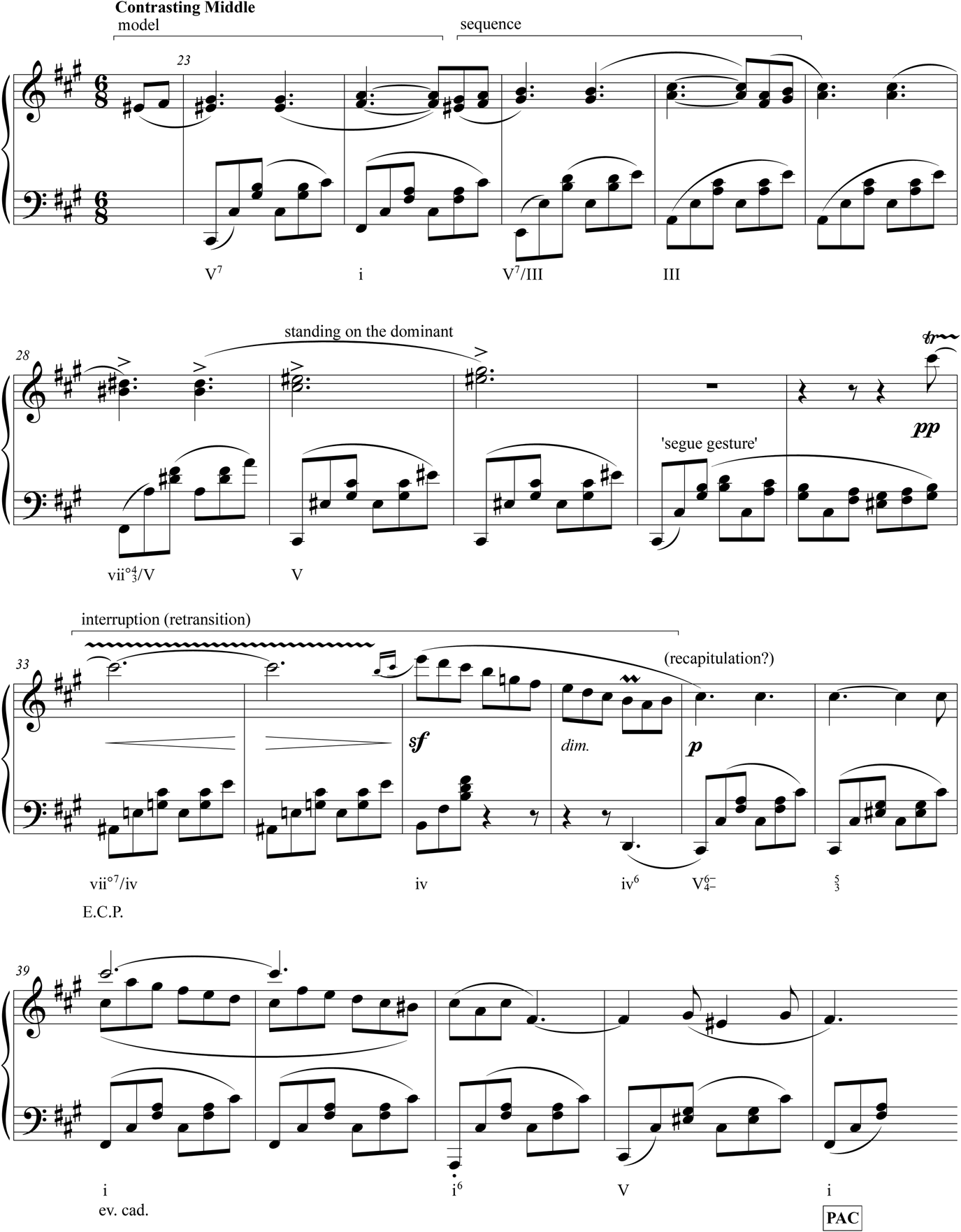
In direct relation to the small ternary layout, bars 31–32 produce the dominant arrival that marks the end of the contrasting middle and imply some form of reprise (or at least a return of the tonic; see Ex. 3). In addition, a thematic reprise is specifically signalled by the ensuing occurrence of the left-hand part ‘segue gesture’, which appears before each of the previous iterations of the main thematic unit (compare with bars 5–6 and 13–14). But then, instead the projected reprise, the music is interrupted with the unforeseen trilled C# in the upper register and the unexpected diminished seventh chord that underlines it. Naturally, in relation to the preceding contrasting middle, the diminished-seventh chord of bar 33 constitutes a disruption that delays or postpones the expected reprise. But looking forward, the same diminished chord turns out to be the starting point of an expanded cadential progression (E.C.P.), leading to B minor subdominant in bar 35 and the cadential dominant in bar 37, whereupon the abovementioned thematic reprise occurs.
Mendelssohn Venetianisches Gondellied’, Op. 30 No. 6, bars 23–43

In pointing out the discrepancy between harmonic layout and the small-ternary formal scheme, Rothstein describes a moment of functional ambiguity in which the thematic material implies the starting point of a formal reprise, and the underlining harmony marks a medial position within a cadential progression. As a result, the framework of the ABA′ ‘song form’ is problematized through the harmonic design, which fuses what only appears to be a reprise to the contrasting middle through a continuous cadential progression.Footnote 25 Clearly, these formal procedures fit neither of Dahlhaus's suggested categories. The deviations from the formal conventions of the small ternary exceed the boundaries of its ‘schematic’ realization yet are not radical to the extent that the form ‘disintegrates’. If so, how should we account for this formal approach?
Dahlhaus himself provides an answer to this question by characterizing Mendelssohn's musical forms as – yet again – ‘problematic’. In this context, however, the term ‘problematic’ bears a more specific meaning, indicating that Mendelssohn follows the lead of Beethoven, whose formal structures, ‘unlike those of the romantic period, are neither schematic nor disintegrated but problematic’.Footnote 26
In essence, the categories of problematic, schematic and disintegrated structures mark different kinds of relationship between formal conventions and musical content. As previously mentioned, the conception of schematic or disintegrated form construes form as an inevitable by-product of the musical content, and therefore, inconsequential. In contrast, the notion of problematic form – which is clearly prefigured by the sonata form – assumes a fundamental state of negotiation where musical content is determined through the formal functions it fulfils and concomitantly, musical form ‘organically’ emerges from the mediated content of thematic components. For Dahlhaus, what makes this state inherently ‘problematic’ is the difficulty of classifying such formal events of ‘thematic process thus set in motion’ using pre-existing ‘imaginary rules’ of form.Footnote 27
It should be noted that the ‘problematization’ of Mendelssohn's piano songs in particular does not sit well with Dahlhaus's system, which essentially positions the ‘“Romantic” melodic and harmonic structural-type of the “song without words”’ as diametrically opposed to the processes of problematic form. Viewed through this lens, the ‘song without words’ structural-type can be incorporated within a formal process as a ‘song-like theme’ yet it cannot constitute that process. Granted, these limiting and mutually exclusive conceptions of the lyrical piece and the problematic form surely indicate an analytical lacuna. At the same time, they also provide a loose conceptual framework to highlight a distinctive feature of Mendelssohn's piano songs, implying that these works exceed the formal scope of the lyrical piece – at least, as defined by Dahlhaus – by employing procedures and approaches that recall extant generic frameworks relating the late eighteenth-century Viennese classicism.
But the Songs without Words do not merely reproduce the formal problems of the Viennese Classicism.Footnote 28 They also develop and appropriate them to the density of musical miniatures and their positioning within generic and stylistic intersections. For this reason, it is crucial to remove the formal peculiarities of the piano lieder from the ‘problematic’ discourse of negation perceive them in a more concrete manner. To this end, I will hereby focus on the duality of formal scales as one of the central elements that characterize Mendelssohn's piano songs. By this duality, I refer the ways in which the piano songs open up a space between realizations of simple schematic song forms and complexities of compound formal entities.Footnote 29 Thus, in their tendency to expand, extend and elongate the formal components of the small ternary, the piano lieder push the consolidation of formal functions to the limit and project a juxtaposition of relatively independent sections. On the other hand, the same tendency to expand and stretch thematic units is also what undermines and destabilizes the syntactical procedures that establish thematic networks.
To demonstrate the duality of simple and compound forms, I will focus on two case studies – Op. 19 No. 5 and Op. 30 No. 4 – in which the simple ternary form is expanded by means of procedures specifically associated with the sonata form. Before I do so, however, I wish to situate these sonaticized expansions of the song form in the context of my musical analysis and the broader argument of this article. The term sonata relates to two distinct yet interrelated concepts: the formal scheme of the sonata form, and the formal approach of the sonata ‘style’. As previously mentioned, the sonata scheme was prevalent in the late eighteenth century and persisted throughout the nineteenth century. Therefore, to map the duality of song and sonata form onto the tension of the ‘old’ and ‘new’ or the conflict between progressiveness and conservatism – neat as it may be – would essentially be wrong.
But in contrast to the persistence of the sonata scheme in the nineteenth century, the sonata style associated with it did indeed become obsolete. To cite Wingfield and Horton, there is a ‘decisive schism in the development of sonata form … marked by the dissociation of style and form’. This dissociation of formal schemes and musical styles was propelled by aesthetic inclinations toward lyrical pieces and the concurrent ‘emergence of a body of theory – the Formenlehre tradition – which reified practice into a set of didactic norms’.Footnote 30 Against this background, the allusion to sonata form strategies within the framework of the lyrical piece does not imply a formal duality but rather suggests a stylistic tension between an allegedly conservative formal approach, which is associated with the sonata form, and so-called progressive aesthetic propensities associated with lyricism. And this tension constitutes a distinctive formal profile that is surely prefigured by sonaticized piano lieder yet is just as relevant for many other pieces in this corpus.
Op. 19 No. 5: Simplifying Complexity
Like many piano songs, Op. 19 No. 5 consists of a simple three-part form: it starts with a repeated exposition that progresses from F-sharp minor to the relative key of A major; continues with developmental middle section that leads back to the tonality of F-sharp by an elongated standing on the dominant; and concludes with an abridged recapitulation that reiterates only the second half of the exposition – this time in the parallel key of F-sharp major – and moves toward a concluding coda. In conformity with this lyrical ‘song-form’ layout, the work also exhibits a distinctive ‘tempest style’ marked by the perpetuum mobile texture, expressive melody that grows out of that texture, and various melodic dialogues between the lower and upper parts.
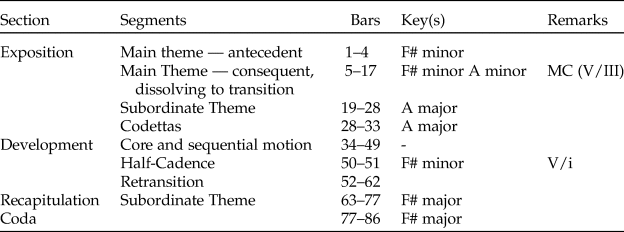
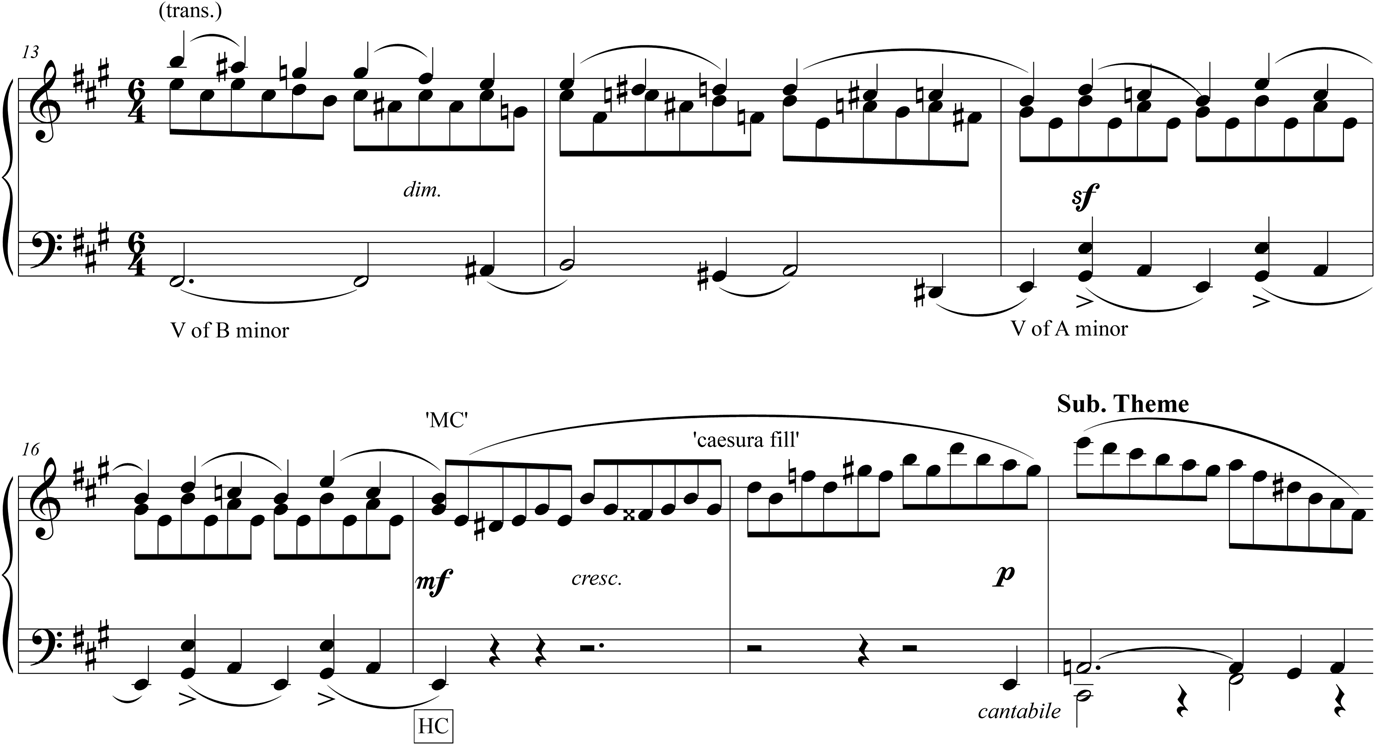
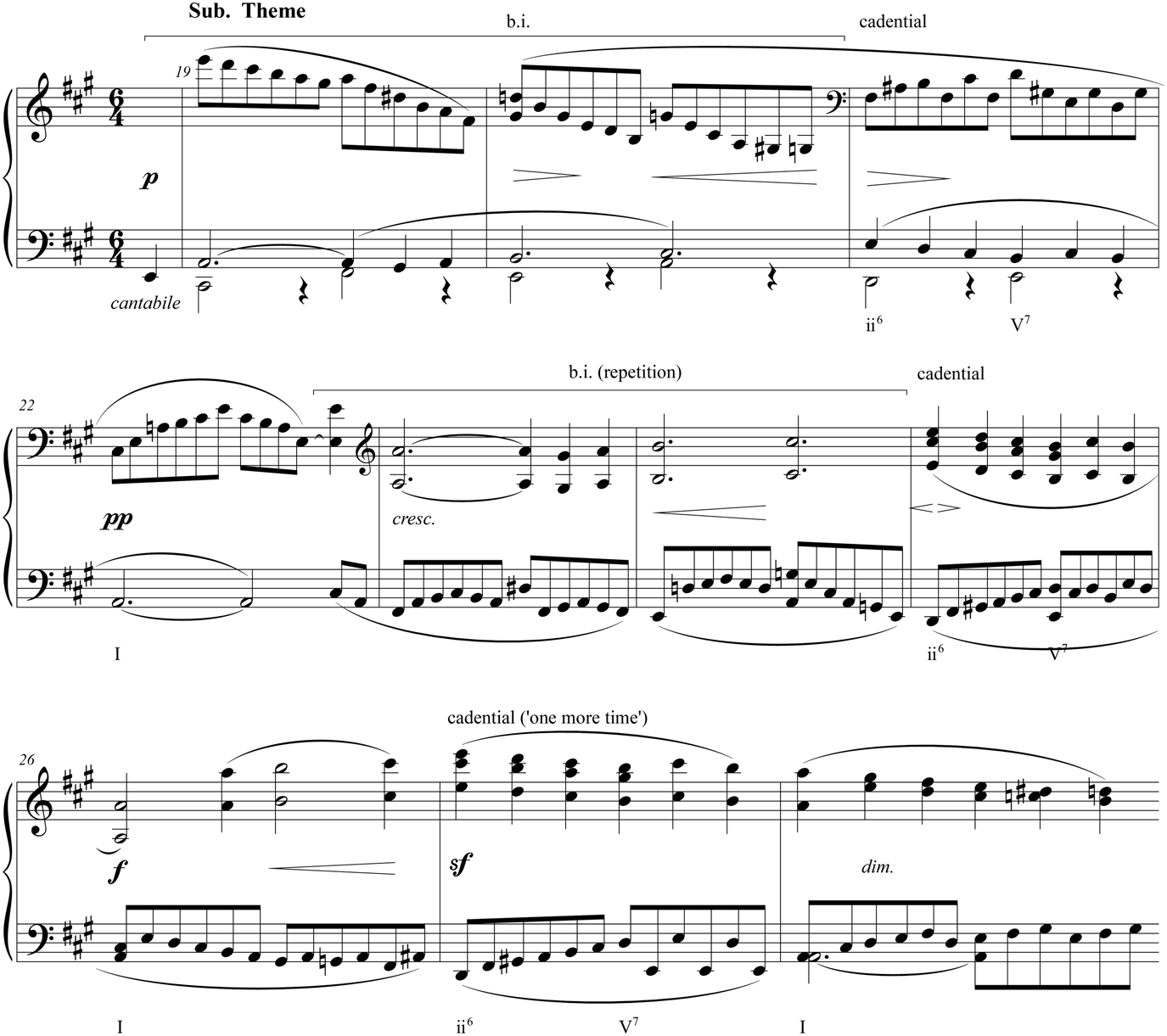
At the same time, Op. 19 No. 5 – unlike most piano songs – explicitly entails inter-thematic complexity that articulates a tonal contrast. In this regard, it surely is sonata-like. The connection of this work with the sonata style is established primarily in the exposition (see Table 1): it starts with an opening main theme that is designed as a period, and whose consequent is fused with a transition; the latter transitional segment arrives at V/III (the relative major) in bar 17, wherein a medial caesura (MC) occurs; following this, a subordinate theme in A major ensues, presenting a sentential design with a repeated basic idea in bars 19–26, a cadential progression in 27; and finally, a series of codettas that follows the A major PAC in bar 28.
Mendelssohn, ‘Lied ohne Worte’ Op. 19 No. 5, sonata form layout

In accordance with the exposition's reference to the sonata form, the large-scale form can be construed as what Hepokoski and Darcy call a type 2 sonata form, meaning a sonata whose ‘tonal resolution’ consists of the subordinate theme alone.Footnote 31 A sense of a sonata style is also enhanced by the developmental character of the middle section. This latter commences with a core technique in bars 34–41 – presenting a four-bar segment in A minor that leads to a sequential repetition in B minor – and moves on to a more rapid sequential motion in descending fifths in bars 42–45. Following this, the section features the conventional developmental procedure of motivic condensation and fragmentation in bars 46–49, which paves the way to a half-cadence in bars 50–51.
Despite the clear references to the sonata style, however, what is striking in Op. 19 No. 5 is the way in which it plays down its own sectional layout and complex thematic design: smoothing the edges of its thematic constituents and producing a sense of a lyrical seamless flow.Footnote 32 At the broadest level, a sense of simplification emerges out of the large-scale form of the lied, the so-called type 2 sonata. As Hepokoski and Darcy maintain, this formal type condenses the more common three-rotation layout of the sonata form – exposition; development; recapitulation – into a binary ‘double-rotational’ form that consists of ‘two cycles through an extended thematic pattern’: the first of which constitutes the exposition and the second combines the development and the recapitulation.Footnote 33 Thus, the expositional presentation of the main and subordinate themes in this piano lied projects a parallel rotation that starts by reintroducing main-theme material in remote tonal regions in the development section and continues with the tonic return of the subordinate theme. Such layout, within the narrow scope of this piece, could even bring to mind a simple binary ABA′B′ form.
In addition to the curtailed overall design, the work achieves a sense of condensed continuity and non-sectional cohesion through the formulation of the parts themselves. A closer look at several elements in the exposition will demonstrate this. On the surface level, the perpetuum mobile quaver texture that spans the entire section acts as an adhesive element that connects contrasting segments. This textural function is mostly at play in the half-cadence caesura (MC), bars 17–18, which marks the end of the so-called transition and prepares the arrival of the subordinate theme (Ex. 4). There, the prominence of the texture countermands the thematic differentiation as the right-hand part presents a ‘caesura-fill’ figure that grows out of the middle part in the previous two-measure segment, spins upward as it prolongs the dominant harmony (E7), and flows into the subordinate theme.Footnote 34
Mendelssohn, ‘Lied ohne Worte’, Op. 19 No. 5, bars 13–19

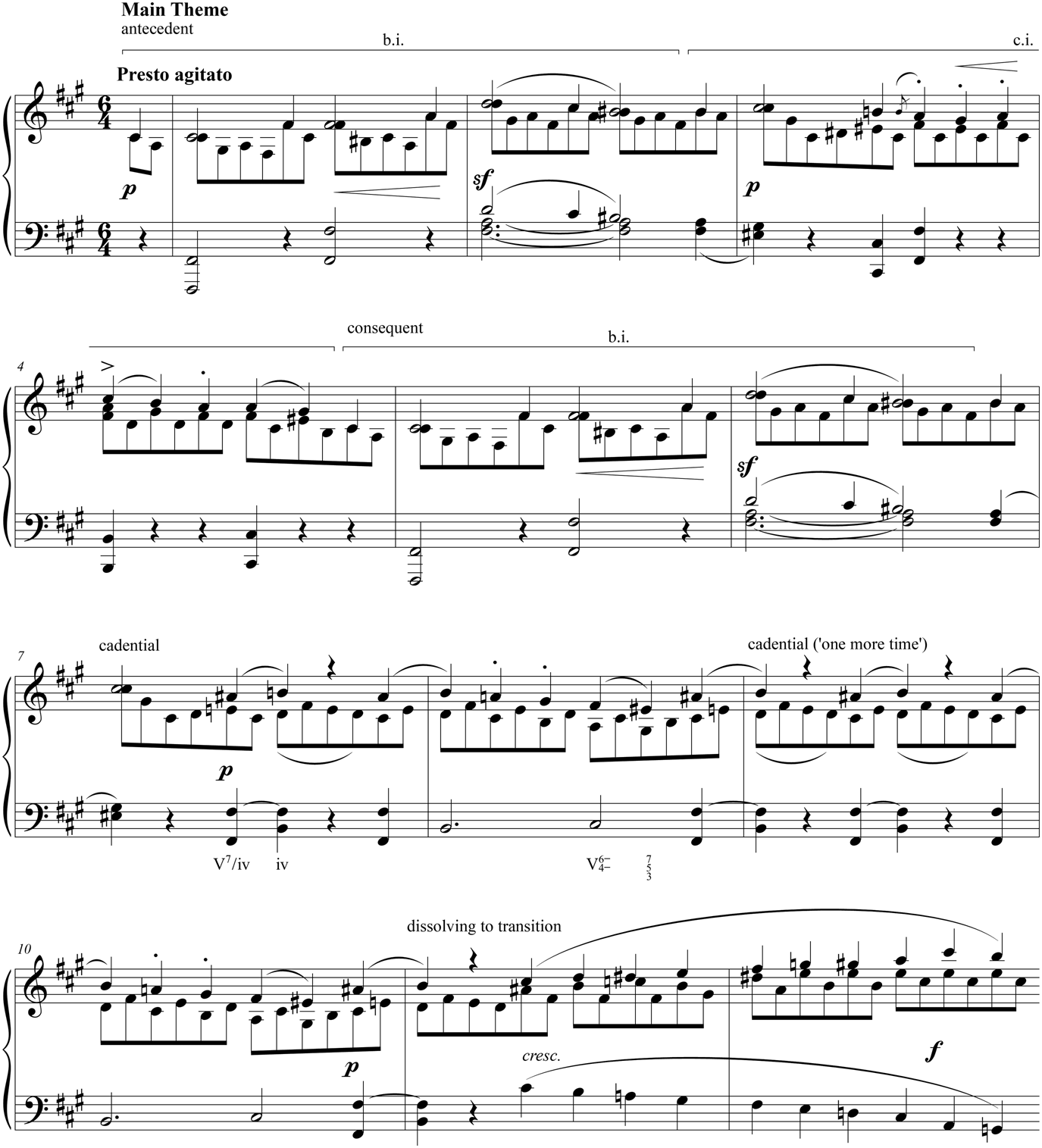
From a formal perspective, the flow of the exposition is enhanced by the omission and disfiguration of the projected cadential punctuations. Indeed, the main theme arrives at a cadential progression in bars 7–8, yet the cadence is evaded with another iteration of the cadential progression begins (‘one more time’). As the repeated cadence is evaded once again in bar 11, however, the main theme ultimately dissolves into the transition and the projected cadence is annulled (Ex. 5). The transition also disfigures the projected half-cadence. Even though this segment indeed ends with a medial caesura, it produces an obscure cadential progression that emerges out of elongated dominant of B minor in bar 13 and abruptly shifts – through a highly chromaticized sequential motion – to the dominant of A minor, without really going through the tonality of A (see Ex. 4). As a result, the only unequivocal cadential progression in the exposition is the one that concludes the subordinate theme and the entire exposition in bars 27–28.
Mendelssohn, ‘Lied ohne Worte’, Op. 19 No. 5, bars 1–12

In counterbalancing the disfiguration of the previous cadential moments, the design of the subordinate theme rather revolves around a cadential function (Ex. 6). The first segment of the theme presents a two-bar basic idea that is immediately followed by what seems to be a two-bar cadential progression. The second segment reiterates the first one, and therefore reintroduces the same cadential progression, which this time, leads to yet another iteration of the cadence that concludes the theme (‘one more time’). Thus, while the subordinate theme presents a cohesive design, it still produces a sense of formal deficiency and redundancy as it features three iterations of the same cadential moment and completely withholds a medial function (continuation or a periodic half-cadence). In doing so, this unit acts as a tonally and motivically independent unit (which is also emphasized by the distinctive dialogue between the left- and right-hand parts), yet it also produces an incomplete thematic design that highlights its own subservient cadential function within the exposition, in which sense, it rather acts more as a closing section in relation to the preceding sections.
Mendelssohn, ‘Lied ohne Worte’, Op. 19 No. 5, bars 19–28

To conclude this analysis and pave the way to the following one, I wish to single out Mendelssohn's treatment of the subordinate unit, which is not only a central element in the allusion to sonata form but also the crux of the tension between simple and compound forms. In this case, such tension generally results from a conflicting concurrence of features that produce states of formal indeterminacy, meaning, states in which formal markers are suggested, implied, yet not realized in an unequivocal manner (or not realized at all). Thus, as a central moment of formal indeterminacy the subordinate area can be construed as an independent thematic unit due to the preceding medial caesura effect and its own relative cohesiveness. Concurrently, the destabilization of cadential markers in the main theme and the transition, along with the deficient formation of the subordinate unit itself imply that the same thematic unit also functions as a closing section within a single continuous formation.
Tempting as it may be, the conflict between different formal implications does not have to be resolved, and even if it can be, the alleged solution is inconsequential in the framework of this analysis. Much more important in this context is revealing formal conflicts – moments of formal indeterminacy – and acknowledging the generic tensions they engender. In this way, the analysis mainly unfolds and disentangles the temporally dense formal layering of the piano lieder, defining not what it is as a cohesive entity, but what it can be as a multi-layered formation.
Op. 30 No. 4: Complicating a Simple Structure
Op. 19 No. 5 is indeed the only piano song that explicitly combines sonata form strategies and the more cohesive framework of the song form. Yet, precisely for this reason, it also prefigures more ambiguous instances of sonata form allusion. The ‘Lied ohne Worte’ Op. 30 No. 4 is one of those instances that exhibit a much more subtle – even precarious – encounter of the song and sonata form. In this regard, Op. 30 No. 4 performs what Steven Vande Moortele defines as ‘sonaticization’ – it adopts sonata-form strategies ‘outside of the framework of a complete sonata form movement’.Footnote 35
To reiterate some of the abovementioned observations regarding this piano lied, the work outlines a three-part form with a repeated exposition in B minor, a 38-bar contrasting middle that ends in F-sharp (the dominant of B), an extended recapitulation, and a coda. Combined with the agitato texture of repeated semiquavers and a clear separation between the upper part and the accompaniment, this work establishes solid links with the lyrical genres. Thus, in accordance with Dahlhaus's arguments regarding the tangential nature of musical form in lyrical genres, the ‘schematic’ layout of the ternary design in the larger scale is also complemented by a sense of formal ‘disintegration’ at the intra-thematic level.
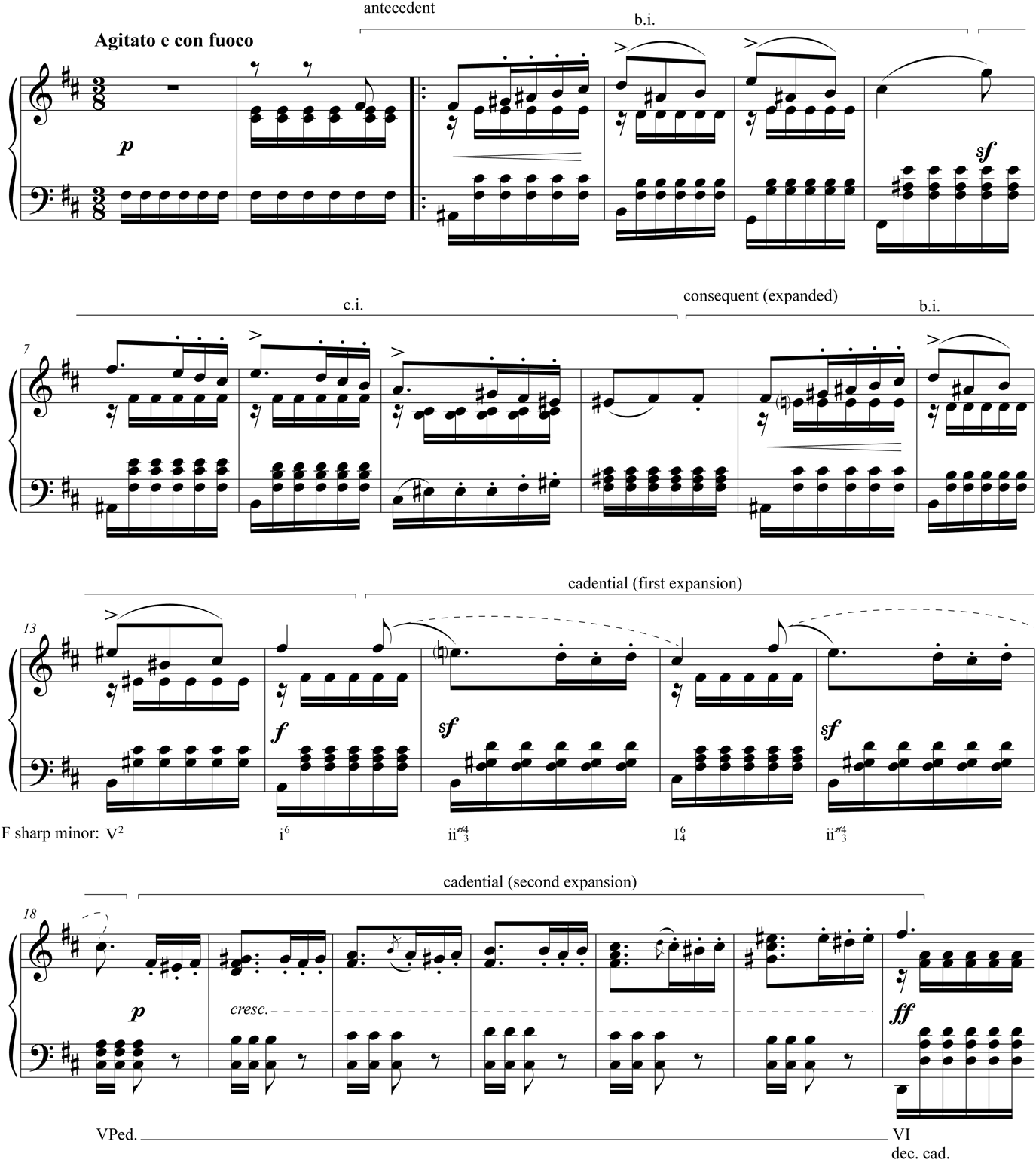
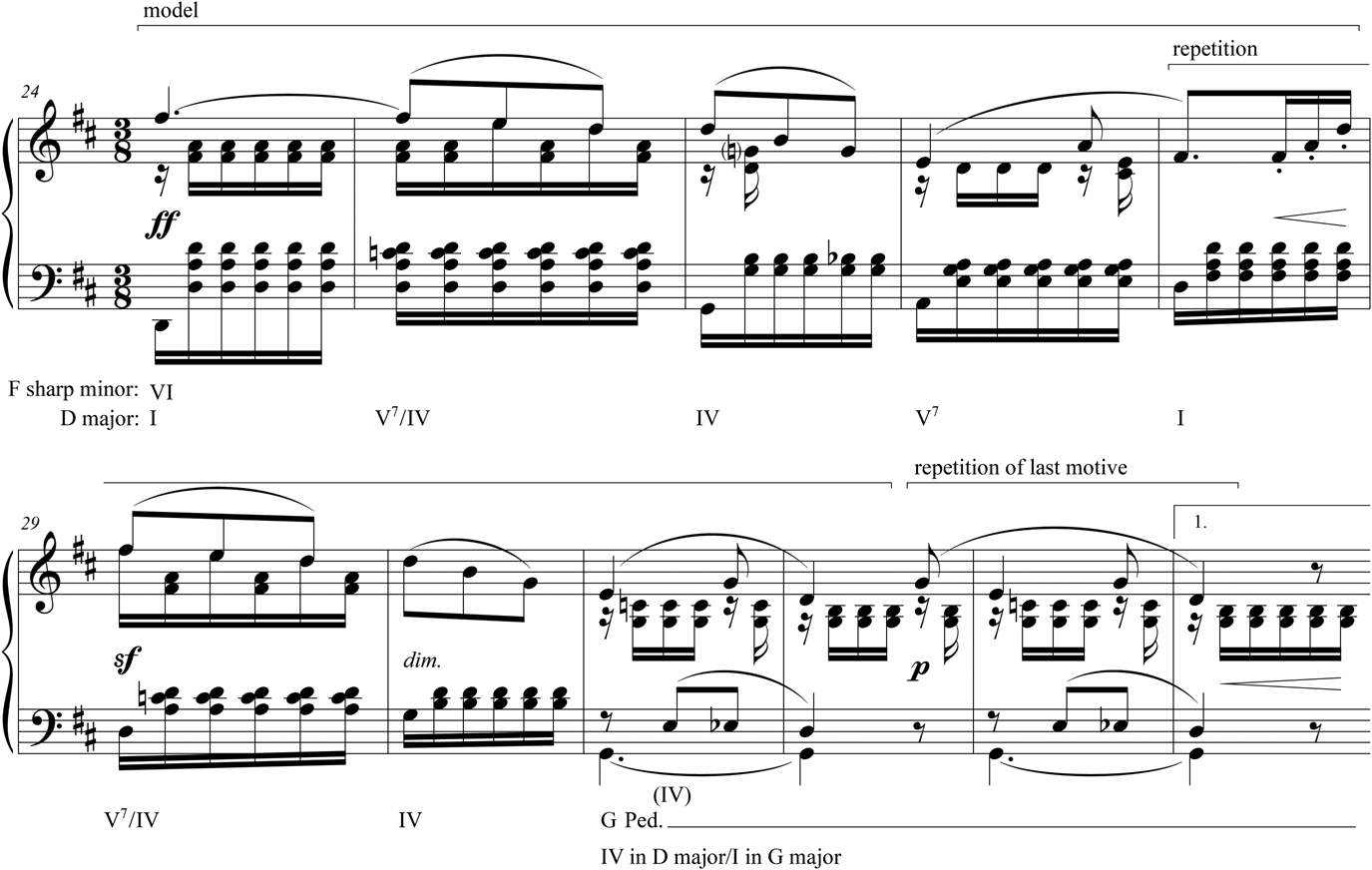
A closer look at the exposition will demonstrates the disintegrated character of the form (Ex. 7). Following two bars of thematic introduction, a main period starts off with an eight-bar antecedent, a consequent that modulates to the minor dominant (F-sharp minor), and an expanded cadential progression. This cadential progression already revokes the projected periodic symmetry as it features two expansions: first, a repetition of a two-measure idea in bars 15–18 (marked by a dashed slur in the Ex. 7), and then, an emphatic elongation of the cadential dominant in bars 18–23. Moreover, instead of resolving the intensive cadential progression, bar 24 produces the deceptive resolution of D major (VI of F-sharp minor).Footnote 36 This marks the first substantial point of tonal and formal destabilization. While techniques based on cadential deficiencies (deceptive, abandoned, evaded) often lead to extensions that postpone the expected resolution, in this case the so-called extending segment abruptly shifts to D major while introducing new thematic material and different texture; in so doing, it interrupts the preceding progression rather than expanding it.
Mendelssohn, ‘Lied ohne Worte’, Op. 19 No. 4, bars 1–24

The new part – starting at bar 24 – features an elided repetition that implies an independent thematic formation, starting with a five-bar segment (bars 24–28) and a varied repetition thereof (bars 28–32; Ex. 8). Yet in lieu of a medial function or a cadence, the music comes to a standstill on G major and fades away by echoing the last two bars (bars 32–33 and 33–34). The absence of a cadential punctuation marks a second point of destabilization that further enhances the tonal and formal ambiguity of this exposition. From a tonal perspective, the opening four-bar segment establishes the tonality D major through a tonic prolongation progression that includes a local tonicization of the subdominant (G). Nonetheless, the second iteration of the progression destabilized the centrality of D major as it comes to halt with the arrival of the tonicized G major, which also introduces a neighbouring motion to C major (IV of G). This rather positions G major as the tonic.Footnote 37 As a result, the formal function of the closing section remains unclear: it sustains some level of thematic independence through tonal and motivic contrasts with the main period; yet in its obscure tonal trajectory and imperfect thematic design it rather acts as a dependant thematic extension that grows directly out of the main period.
Mendelssohn, ‘Lied ohne Worte’, Op. 19 No. 4, bars 24–34

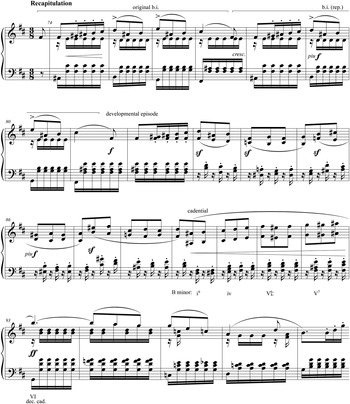
But whereas the exposition seems to validate Dahlhaus's observations regarding a ‘schematic’ or ‘disintegrated’ form that merely complies with the impulses of the motivic material, the thematic and tonal relationships between the exposition and the recapitulation yield another interpretation. The recapitulation produces an abridged version of the original main period, consisting of two exact repetitions of the original four-bar basic idea (bars 74–81; Ex. 9). Forgoing the periodic structure of the exposition, the music dissolves into a developmental episode, which leads to a cadential progression in the main key of B minor (bars 89–92). But still following the path of the exposition, the cadential progression does not lead to the tonic as it resolves deceptively to G major in bar 93 (the VI of the tonic), which initiates a tonally adapted repetition of the entire second part. This procedure rings the bells of the sonata principle.
Mendelssohn, ‘Lied ohne Worte’, Op. 19 No. 4, bars 74–97
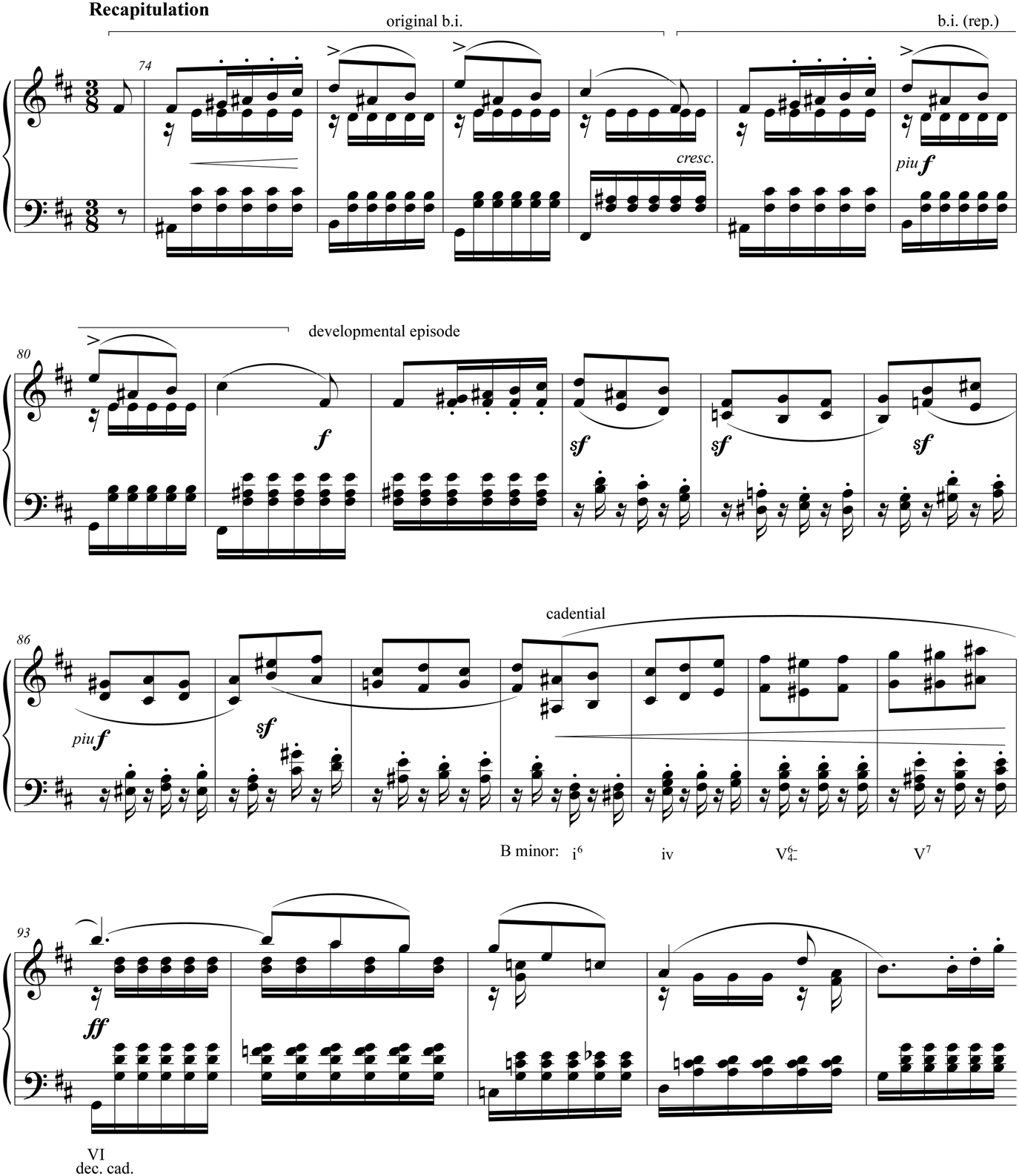
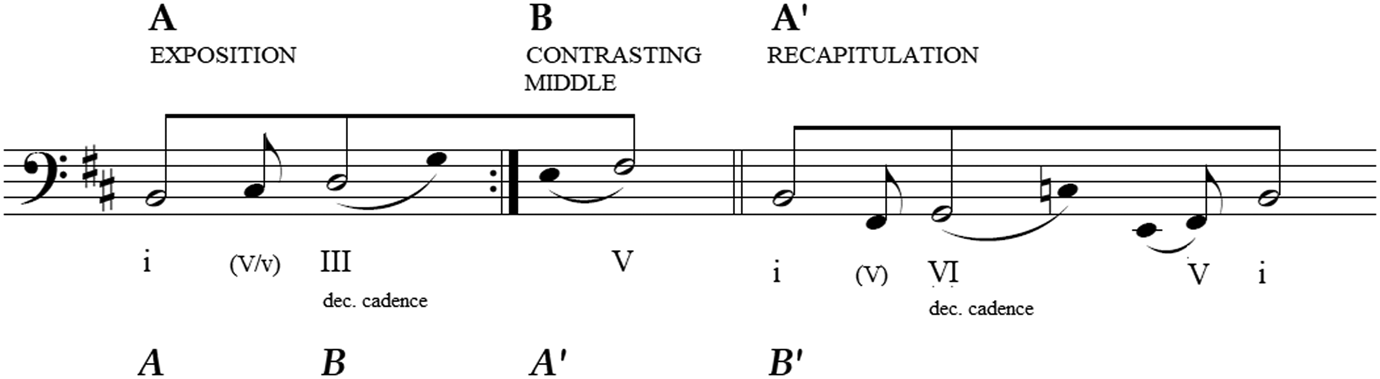
The presence of two possibly independent units in the exposition and their tonal adaption in the recapitulation undoubtedly alludes to the sonata principle, namely, the large-scale resolution produced by the reiteration of a non-tonic subordinate theme in the tonic. True, the sonata principle is only partially fulfilled since the original segment in D major (III) returns in G (VI) instead of the tonic. Nonetheless, there is still a tonal parallelism between the harmonic function of D major within F-sharp minor (as the submediant of the secondary tonality) and the function of G within B minor (as the submediant of the main tonality; see tonal plot in Ex. 10).
Mendelssohn, ‘Lied ohne Worte’ Op. 30 No. 4, tonal plot

As stated above, the allusion to sonata is not important in itself but only to the extent that it reveals a duality of simple and compound forms and exposes distinctive states of formal indeterminacy. And so, like Op. 19 No. 5, the formal indeterminacy in this song revolves around the subordinate segment (in the exposition as well as in the recapitulation), which functions as a cadential extension within a single continuous design yet suggests a thematic multiplicity by differentiating itself from the main period through a tonal shift, accompaniment texture, new motivic material and a period-like independent formation. But what about the middle section? What role does it play within the work and in relation to the formal indeterminacy of the outer sections?
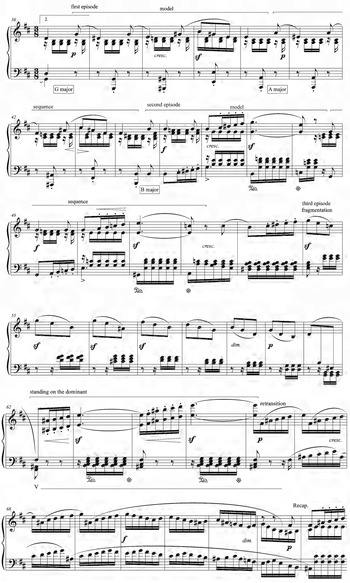
The contrasting middle section, in bars 36–73, certainly evokes the features of a development section (Ex. 11). This reference to the middle section of the sonata form stems from the usage of model-sequence technique and the presence of more erratic harmonic behaviour and sharp textural or dynamic changes. Thus, there are two episodes of sequential motion: the first in bars 37–44 and the second in 45–52. As is often the case in development sections, the third episode produces a sense of fragmentation and acceleration with one-bar units leading to a dominant arrival in bar 62. Finally, bars 62–66 feature an embellished ‘standing on the dominant’ that signals the end of the development/contrasting middle and the recapitulation, which indeed materializes after a perpetuum-mobile retransition in bars 67–73.
Mendelssohn, ‘Lied ohne Worte’, Op. 19 No. 4, bars 36–74

But as much as the connection between the opening section and the contrasting middle suggests exposition–development relationships, it also articulates another formal layer that undermines the entire ternary framework and intensifies a state of formal indeterminacy. This layer, as I shall demonstrate, is retroactively projected by the recapitulation.
As previously mentioned, the recapitulation transposes the subordinate unit yet does not alter its internal design. As a result, the subordinate area comes to a standstill with the arrival of C pedal point and does not provide a cadential ending. But since such non-tonic ending cannot fulfil the expected function of a tonal and rhetoric closure, the recapitulation extends the original layout of the exposition and introduces yet another extension. This later extension is based on the motivic material of the contrasting middle, which in this context, seems to flow directly out of the same subordinate unit en route to the expected perfect authentic cadence in B minor.Footnote 38 This extension has a direct bearing on the interpretation of the exposition and its relation to the contrasting middle.
Indeed, the expositional subordinate unit partially articulates an ending function through non-cadential means such as the static G pedal point, a sort of fade-out effect, and the ensuing return sign. Nonetheless, in perceiving this moment through the lens of the recapitulation, the boundary line between the exposition and the contrasting middle – that is, after the exposition repeat – seems almost imperceptible. Thus, the G major that concludes the exposition in bar 36 flows directly into the middle section, which also features a conspicuous motivic connection with the repeated G anacrusis motif that cuts across the repeat sign (see Ex. 11). As a result, Op. 30 No. 4 implies not two, but three formal layers (see Ex. 12). There is the interrelated small ternary and sonata form, in which formal indeterminacy pertains primarily to the thematic uniformity or multiplicity of the outer parts (marked above the staff in the example). But there is also, in the larger scale, another layer that cuts across the ternary layout, and suggests a binary ABA′B′ form, wherein the A denotes the main period and B the fusion of the so-called subordinate area and the middle section (marked below the staff, in italics in Ex. 12).
Mendelssohn, ‘Lied ohne Worte’ Op. 30 No. 4, formal layers

Subcultural Perspectives: ‘Problematic’ Classicism in Heine's Romantic School
In the previous section of this essay, I exemplify the generic and formal ambivalence of Mendelssohn's Lieder ohne Worte, in which the ‘new’ stylistic framework of the lyrical piece is destabilized by traces of ‘old’ or ‘conservative’ formal approaches. As the analyses demonstrate, Mendelssohn's piano songs are not only artistically ‘problematic’ in the same way that Beethoven's forms are, but they also harness such formal intricacies to produce significant stylistic tensions. In this manner, the lyrical and reserved ‘tone’ of the musical surface is counterbalanced and negated by more intricate formal processes that lie underneath it. Building on these observations, in this section of the article I relate the stylistic and generic multidimensionality of the piano lieder music with the German-Jewish subculture, mediating between the apparently neutral musical elements and the cultural disposition of German Jewry through Heinrich Heine's essay The Romantic School.Footnote 39
While Heine is clearly not a mouthpiece for Mendelssohn, his shared German-Jewish perspective on aesthetic changes and literary trends is substantial and revealing in the context of this essay, especially due to Heine's preoccupation with the political and ideological context of German culture. Following his immigration to France in 1831, Heine wrote a series of ‘histories’, which included the Conditions in France (1832), The Romantic School (1833–35), and On the History of Religion and Philosophy in Germany (1834–35). Of these, The Romantic School was specifically addressed toward the French public with the stated purpose of amending misconceptions of German romanticism. But as much as this essay approached German culture from without – from an ‘objective’ point of view – it also placed itself in direct dialogue with German romantics, from within. Thus, despite the guise of a historical research or an aesthetic study, Heine's text also constitutes a polemical essay intended to criticize German politics and the ideology of German romanticism.
The Romantic School, according to Azade Seyhan, opens up a space of history writing that is ‘unencumbered by criteria of veracity’ in which ‘anecdotes, memories, personal impressions, conversations, and letters relativize one another’.Footnote 40 As such, Heine's multi-layered text allows a glimpse of a very personal approach, which nevertheless presents itself in an inquisitive and explanatory manner. This perspective is especially illuminating in the context of this discussion given that Heine and Mendelssohn – who by no means shared the same opinions or manner of expression – have common conceptual origins stemming from the ideals of emancipation and the hope of social integration. In this regard, I would subscribe to Ruth HaCohen's broad observation that Mendelssohn and Heine's ‘respective Jewish background, however scant, reasserted itself at some crucial moment in the course of their creative lives’.Footnote 41
Most importantly, with Heine's Romantic School we come full circle and return the murky concepts of the classical and the romantic. Placed in this context, however, these terms are not examined as historical, aesthetic or analytical categories, but rather as nineteenth-century conceptualizations that could demonstrate different approaches to late eighteenth- and early nineteenth-century German culture. Like Hegel, Heine mentioned the classical–romantic duality to indicate a direct relation between the perception of divinity throughout the history of religion and forms or styles of artistic expression.Footnote 42 Classical art is thus associated with the ‘the materialism’ of the pantheistic ancient world whereas romantic art relates to the ‘Christian spirituality’ of the Middle Ages. But whereas Heine follows Hegel's path – and that of various romantic thinkers – with respect to the conceptual connection between history, religiosity and aesthetics, he deviates from Hegel's perception of historical and cultural progression.
Hegel specifically perceived the classical as an earlier stage of spiritual development, which inevitably led to a higher form of spirituality in the form of the romantic. In opposition to this teleological approach, Heine construes history as a pendulum that moves between materialism and spiritualism, classical and romantic. Accordingly, he states that the romantic Christian-Catholic theories of the Middle Ages were needed as a ‘salutary reaction against the horribly colossal materialism which had developed in the Roman Empire’.Footnote 43 Following that, the classical disposition of the reformation constitutes another swing of the historical pendulum, wherein artists ‘breathed free again; the nightmare of Christianity seemed lifted from their chests’.Footnote 44 And finally, a romantic era once again sought to counterbalance the classical demeanour of the reformation with a ‘reawakening of the poetic spirit of the Middle Ages’.Footnote 45
The contrast between the Hegelian teleology and Heine's perception of history has far-reaching consequences. By construing a classical–romantic pendulum, Heine dissociates himself from a discourse that is specifically underpinned by a post-enlightenment doctrine of salvation, thereby emphasizing his political and ideological stance. Thus, Heine endorses the protestant and so-called classical German enlightenment, which produced the ‘most magnificent and holy things which Germany had ever produced’: the ideas of ‘humanity’, ‘universal brotherhood of men’, and ‘cosmopolitanism’. Conversely, he criticizes the Catholic connotations of the narrow-minded German romanticism, which ‘went hand-in-hand … with the striving of the governments and the secret societies’, endorsing patriotism that ‘hates all foreign things’ and ‘no longer wants to be a citizen of the world or a European, but just a narrow German’. Footnote 46
Herewith we arrive at one of the important links between Heine's critique and Mendelssohn music, namely, their grappling with the historical boundary between the ‘classical’ era of the late eighteenth century – the end of the reformation according to Heine – and the ‘romantic’ era that follows the French revolution. By this, I do not imply that Mendelssohn himself necessarily shared Heine's perception or had the same political stances. Rather, I identify Heine's verbally expressed and Mendelssohn's musically surmised preoccupation with the duality of the ‘classical’ and the ‘restoration’ eras as a locus of sociocultural and political encounters, which prominently reflects certain experiences and conceptions of the German-Jewish subculture.
In the German-Jewish context, Heine's critique is surely consistent with the pro- enlightenment position that Sorkin describes. But the relationship between Jewishness and enlightenment ideals is also suggested by Heine himself through his use of Jewish imagery. In describing how Gotthold E. Lessing was fighting for the ideal of ‘progressive humanity’, Heine mentions the words of an anonymous ‘German author’ who maintained that Lessing resembled the ‘pious Jews’ building the second temple while fighting against their enemies.Footnote 47 In a less direct manner, Heine connects the lyrical abilities of Goethe – his prototypical ‘classical’ author – with the magical feats of the biblical figure of Moses, which he contrasts with his surrounding ‘Egyptian magicians’.Footnote 48
Despite Heine's conclusive rhetoric, one should not be hasty to accept his aesthetic systematization, or at least not the parallelism he proposes between political and aesthetic criticism. As stated above, by substituting Hegel's teleological model of history – progressing from the classical into the romantic – with a circular one, Heine situates himself outside the nimbus of post-enlightenment discourse of spiritual and cultural evolution. Yet by doing so, he also removes the concepts of the classical and the romantic from the realms of ideological, philosophical or stylistic value judgment. Because history constantly moves between material classicism and spiritual romanticism, the classical and the romantic become complementing opposites. But if so, how should we perceive Heine's own aesthetic critique?
Heine states that ‘[i]n world history, not every event is the immediate outcome of another; all events rather influence each other reciprocally’.Footnote 49 History, in other words, does not necessarily move in a linear manner. Hence, alongside Heine's historical pendulum that eminently swings between the classical and the romantic, he also assumes that certain aesthetic moments acquire a preeminent independence and persist as currents and undercurrents that constantly intermix. In this light, it appears that what Heine endorses in the literary figures of the late eighteenth century is not their classical disposition, but rather their artistic ability to transcend their own historical disposition – to the extent possible – and reflect the dialectical persistence of materialism and spiritualism. And by the same token, he rejects early German romanticism because it had forsaken this broad-minded approach in favour of one-dimensional adherence to Catholic and nationalistic movements.
To give one prominent example of a revered ‘multi-dimensional’ figure, Heine clearly construes Lessing as an author of neo-classic enlightenment, stating that ‘[t]he same great social ideal lives in all of his works, the same idea of progressive humanity, the same religion of reason’. At the same time, however, he dissociates that same figure from classicism by comparing him with the Germanic commander Arminius – who defeated the Roman legions – and asserting that ‘Lessing freed our [German] theater from foreign rule and showed us the triviality, the ridiculousness, the tastelessness of imitating French pseudo-Hellenism’.Footnote 50 Conversely, Heine puts his finger on the narrow-minded disposition of the Romantics by classifying the new German romantic School of the Schlegels as a ‘doctrine’ that began with a ‘judgment of past art works and with a prescription for future ones’.Footnote 51 And in the same vein, he states that in their adherence to Catholicism, the Romantics were ‘crowding back into the old prison of the mind from which their forefathers had freed themselves so vigorously’.Footnote 52
With this admittedly vague distinction between the ‘multi-dimensional’ approach of late eighteenth-century writers the ‘one-dimensional’ disposition of writers associated with the early romanticism, we arrive at a more nuanced understanding of Heine's German-Jewish stance and its relation to Mendelssohn's Lieder ohne Worte. In contrast with his allegedly conclusive criticism, Heine's stance remains highly fragmented, vague and indeterminate. He indeed expresses his political opinions in a very direct manner and hardly refrains from stating his own aesthetic preferences. Yet given Heine's complex approach to history, aesthetics, and culture, it seems that his candour mainly serves as a mask that conceals a highly malleable assemblage. In this sense, Heine is more occupied with destabilizing frameworks – be they philosophical, aesthetic, generic, etc. – than he is with establishing cohesive and coherent utterances. This is a feature that Heine and Mendelssohn – who are so different from one another – nevertheless share.
Despite the views of authors like Dahlhaus and Leon Botstein, who maintain that the classical features of Mendelssohn's music stem from an ideological core, to perceive Mendelssohn's wordless songs as expressing some sort of critique would be a gross oversimplification.Footnote 53 The tension between conservatism and progressiveness, the ‘old’ and the ‘new’, simple lyricism and complex sonata style in Mendelssohn's wordless songs does not stem from a social critique and cannot be construed as a decipherable utterance. Rather, these tensions and conflicts reflect individual and collective experiences, which – especially in the context of a German-Jewish subculture – hardly correspond to the unified, cohesive, and solidifying frameworks through which we tend to perceive them.
Very much like the stratified and paradoxical nature of the German-Jewish culture, Mendelssohn's piano lieder indistinguishably intermingle the expression of individuality with the negotiation and re-negotiation of collective imaginaries and experiences. As formative artistic products, these works mediate ideological systems, political stances, and personal experiences. As reflective musical formations, they accordingly feature generic frameworks and stylistic dispositions in a manner that is unfixed and unstable. And still, what makes these works unique is the way in which they capture the intricate and eclectic dispositions of German-Jewish subculture in a manner that projects a sense of simplicity, uniformity and even naivety.