Introduction
The study of borrowing in music implies “the use in a new composition of one or more elements from a specific piece” (Burkholder Reference Burkholder2001). This calls for distinctions between broadly recognised categories, such as quotation, allusion, modelling, intertextuality, and parody amongst others. To take just one example, “parody” in music can be understood in three distinct ways. First, it refers to work that humorously or satirically exaggerates or distorts elements of another piece, much as the French composer Camille Saint-Saëns playfully borrowed and transformed a theme from Danse Macabre in the “Fossils” movement of his orchestral suite The Carnival of the Animals. “Parody” may also apply to a composition in which a new text replaces the original, as, for instance, in nineteenth-century American “songsters” that contained lyrics on presidential candidates with each song specifying the popular tune to which it should be sung (Kelly and Gorzelany-Mostak Reference Kelly and Gorzelany-Mostak2016). Finally, “parody” can also refer to a composition that reinterprets and transforms the musical material of a pre-existing work. An example of this is Abii ne Viderem (1994) by the Georgian composer Giya Kancheli (1935–2019), in which he reworks motifs from J.S. Bach’s Two-Part Invention No. 4 (BWV 775) (Ciantar Reference Ciantar, Vassallo and DeBattista2024: 225). Moreover, a musical work may even bring into it a combination of these categories, as with Igor Stravinsky’s opera The Rake’s Progress, which draws on various forms of musical references, including stylistic borrowing through allusions and imitation, paraphrasing, and references to musical tropes associated with eighteenth-century opera. These and other examples reveal the fluid relationship between the aforementioned categories and their role in music-making, and also underscore the broader politics of musical borrowing when understood as a process imbued with a range of intentions, objectives, and impacts, from those that may be labelled aesthetic to others aimed at serving institutional purposes.
In ethnomusicology and world music studies, musical borrowing has been a topic of great interest. For instance, Alan Merriam (Reference Merriam1964: 177) notes that “one of the most frequently mentioned techniques of composition is that which involves taking parts of old songs and putting them together to make a new one.” Bruno Nettl (Reference Nettl2015: 50) refers to an Arapaho elder taking a motif from one song, something else from another, and a phrase from a third, to make up a new Peyote song. Additionally, world music repertoires, such as gamelan music and musical traditions rooted in established and broadly diffused melodic modal systems such as the raga, all attest to some kind of musical borrowing as an approach to creativity. For example, when Michael Tenzer (Reference Tenzer2000: 153) refers to the Kebyar repertoire in Balinese gamelan music, he notes that this “borrows from, and is engaged in continuing dialog with other gamelan repertoires” within the tradition that encompasses dance-theatrical works, compositions for ritual use and secular entertainment, as well as klasik (classical) and baru (new) styles. Similarly, in Indian classical music, several Carnatic rāgas were incorporated into the Hindustani tradition to such an extent that the interplay between the two systems is often cited as a striking example of cultural unity in diversity (Toshniwal Reference Toshniwal2021).
Smaller repertoires, such as the festive wind band marches repertory on the Mediterranean island country of Malta, offer additional compelling examples of how catchy melodies have been reused, reworked, and imitated both within a musical genre and across different musical genres for a range of intents and purposes. In Malta, a significant number of festive marches are composed each year by local Maltese composers. These works are often commissioned by band aficionados for performance by local wind bands during the annual town or village feast. Each of these wind bands, understood here as a group of musicians playing a combination of woodwind, brass, and percussion instruments, is affiliated with a band club (known in Maltese as każin tal-banda), that is, an institution with its own premises, a statute, and members. Apart from having their own wind band, these clubs provide free musical tuition to whoever wants to learn a band instrument, as well as assisting strongly in the organisation of the annual local feast. Like wind and brass bands across the world, Maltese wind bands reflect as well as shape social, cultural, and political realities. This may be noted, though occurring in distinct contexts, in processes described by Gregory Booth (Reference Booth1990, Reference Booth2005). Booth’s work on brass bands illustrates their development in accordance with local contexts while simultaneously preserving elements of their colonial legacy. This may be applied to wind bands in Malta, where musicians, for instance, parade during local festive events in uniform suggestive of military attire. In relation to this, Reily and Brucher’s (Reference Reily and Brucher2013) examination of the world’s brass bands illustrates how these bands, which, like most Maltese wind bands, came into existence under colonial rule, readjusted to suit the needs of local populations. This leads to a new social organisation that accommodates shifting identities and aesthetic conflicts in post-colonial societies. All this shows how communities appropriate and reframe external cultural forms to suit their own needs and narratives of identity. Furthermore, other studies on brass and wind bands such as those mentioned above and others by Sakakeeny (Reference Sakakeeny2013, Reference Sakakeeny2015, Reference Sakakeeny, Vū Kính and de Quadros2020), Politz (Reference Politz2018, Reference Politz2023), Talusan (Reference Talusan2021) and Ciantar (Reference Ciantar2025) among others, reveal how wind and brass bands are not only musical ensembles but dynamic social actors strongly engaged in identity politics as they project cultural heritage, forge community solidarity, and reinvent themselves according to changing socio-political conditions. In other words, their music is a site where individuals and groups negotiate, communicate, and stake their multiple identities. In this sense, musical borrowing may be at the foreground whereby history and contemporaneity, as well as diverse musical genres, come together to fulfil an array of intents.
Melodic borrowing in its different forms within the Maltese festive marches repertoire is so prevalent that it actively contributes to what many band enthusiasts perceive as a defining characteristic of the Maltese marching style. As previously demonstrated in Ciantar (Reference Ciantar2013: 18), processes of musical translation within the repertoire under discussion reveal that some marches incorporated melodies borrowed from popular nursery rhymes, such as “Rock-a-bye Baby,” and Italian popular songs, including “Arrivederci Roma.” Others, as this article will show, borrowed from other locally composed festive marches. In most instances, this process has overlooked ownership and copyright. This appears to stem from the belief, repeatedly voiced to me by both band enthusiasts and composers of these marches, that “all music emerges from other music.” Statements such as this suggest prima facie a cultural context wherein the communal and developmental properties of music take precedence over individual intellectual property rights, with the effect being a disregard for formal copyright. This may broadly dovetail with Timothy Rice’s (Reference Rice2014: 42) observation that “in many cultures this notion of personal ownership is nonexistent: sometimes no one owns the music or everyone does.” Here, legal frameworks often struggle to accommodate the nuances of musical borrowing (Bonadio and Zhu Reference Bonadio and Zhu2023). A notable example of musical borrowing in the repertory in question and the nuances that such a process implies transpires from the micro-history of a trio of a popular Maltese wind band march titled Victory.
By drawing on the trio section of this march, the present article contends that the politics of musical borrowing are without limits, operating across multiple directions and at different layers within an intricate web of references. More generally, it suggests that musical borrowing has the capacity to foster engagement, to give more value to the familiar, to blur distinctions between musical genres, and to generate dialogues between source and spin-off, as well as between recognition and (re)interpretation. In this respect, the argument resonates with Justin A. Williams’s (Reference Williams2014: 168) observations on the several modalities through which borrowing operates in hip-hop. For instance, he notes that drawing on the genre’s past can confer a sense of “historical authenticity”; incorporating sonic codes from other genres, such as jazz, can shape reception; borrowing and mixing for particular listening spaces can affect the sonic qualities of recordings; posthumous vocal sampling can place an artist in a broader canon or lineage; whilst the reuse of musical phrases can signify affiliations between rappers across collaborations (ibid.). Building on these insights, the present article turns to the case of the trio from Victory, tracing its transformations as it was reworked into another festive march, adapted as the chorus of a football song, reconfigured in the 1980s as a political song sung in the streets of Valletta, Malta’s capital, and eventually in Pyongyang (North Korea’s capital). This micro-history is examined through a range of theoretical perspectives on borrowing in music and processes of creation more broadly. To sustain this analysis, the article draws upon diverse sources, including established literature, musical scores provided by local band clubs, journalistic reports and letters published in Maltese newspapers, contributions in Maltese band club booklets, my childhood recollections, and available online recordings.
Expressive power in the hypertext
The march Victory was composed in the mid-1940s by the Maltese composer Vincenzo Ciappara (1890–1979) in celebration of the Allied victory over the Axis Powers in World War II. Locally, the march gained unprecedented popularity and diffusion as it was played by various wind bands all over the island, especially during festa celebrations. Festa is the Maltese term for a week or so of celebrations that take place both indoors (that is, through church services) and outdoors in honour of the patron or secondary saint of the locality. Outdoor celebrations include aerial and ground fireworks, street decorations, food vending, merrymaking and socialisation, as well as the participation of wind bands playing marches during flamboyant parades around the locality. The strong popularity of Victory has sometimes led to musicians playing it from memory, as noted by the late Maltese band leader Vinny Vella (1947–2019) in a radio interview: “all the musicians [knew] this march … by heart and they [didn’t need] to have the musical parts to play from” (Cilia Reference Cilia2012: 84). Even today, Victory is still very popular and cherished by most band enthusiasts and festa goers.
It seems that the popularity of this march spread quickly and served the colonial needs well of that time. For instance, in an article published in a Maltese annual band club booklet, the author’s father recounted that during the Victory Parade in London on 8 June 1946, the BBC broadcast a special programme featuring national anthems and musical pieces for each of the Commonwealth nations that had fought alongside the Allies. For Malta, the piece chosen to represent the nation was Ciappara’s Victory (ibid.). In that sense, Victory served as a musical embodiment of the triumph of a nation that had endured a war and experienced the highest concentration of exploding cordite per square mile, unparalleled elsewhere in the world. In addition to Victory, Ciappara composed two other marches with colonial connections: Lilibet, dedicated to Queen Elizabeth II, and Coronation March 1953, composed to mark the Queen’s coronation. The same imperial bond of Malta with the British Crown was also expressed in other Maltese band marches, such as Coronation, a festive march in celebration of the same event, and Welcome the Royal Family, which was composed on the occasion of Queen Elizabeth II’s first visit to Malta as Queen in 1954. Both marches were composed by Giuseppe (a.k.a. Joseph) Azzopardi (1908–1968), an acquaintance of Ciappara.
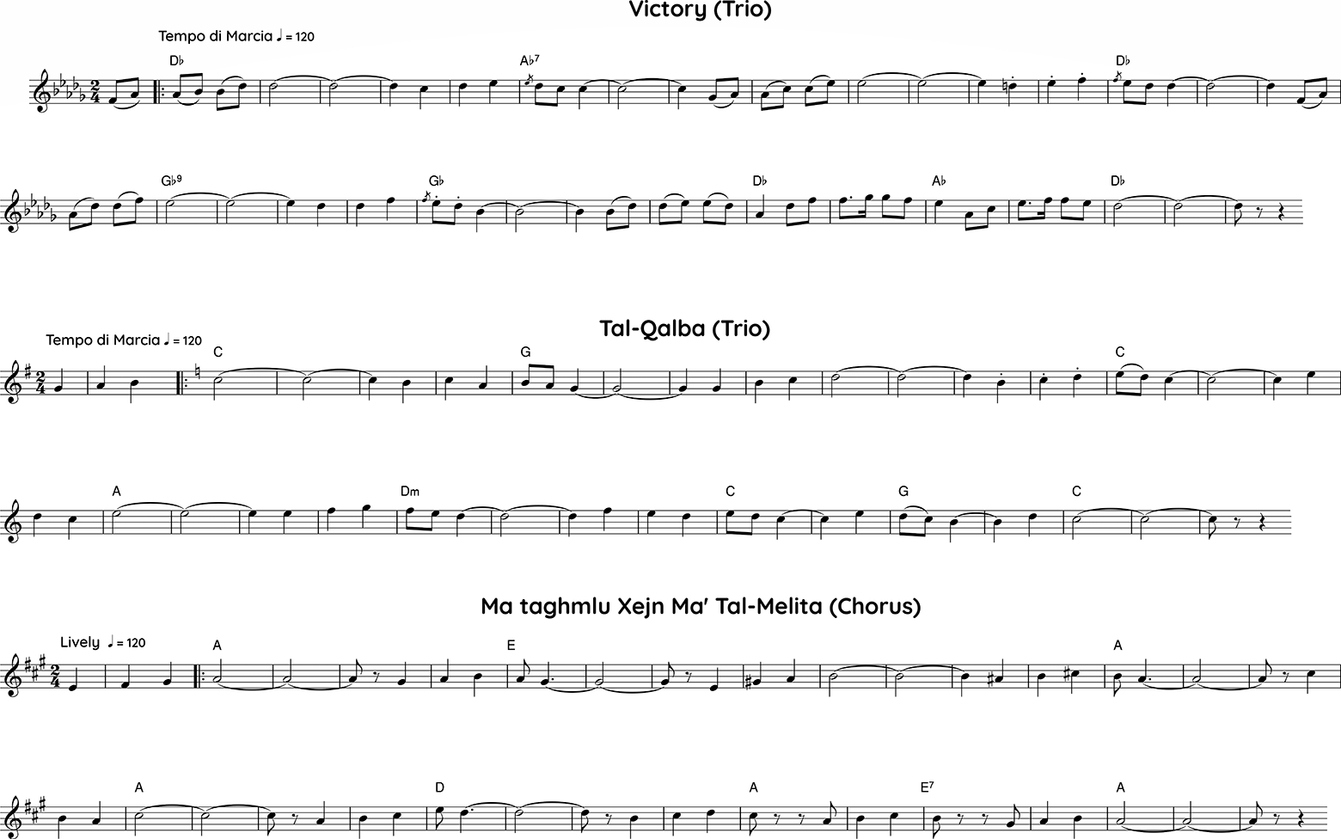
Ciappara is still considered among Maltese wind bands as “The King of Maltese Marches” as it is believed that his marches served as a model in the toning down of militancy, thus making them more appropriate for festa celebrations. For instance, in Victory, Ciappara forges a fine balance between, on one hand, the military tone of the introduction and the two subsequent strains and, in contrast, the catchy and cheerful trio (see Figure 1). In the context of Maltese festive marches, the trio is the most anticipated section. In this context, the trio is typically characterised by a melodious tune that, if particularly appealing, is frequently hummed or whistled by band enthusiasts along with the band playing during a parade, as well as in everyday settings at the workplace to alleviate the monotony of routine tasks. I observed both in my experience as a native Maltese, as well as a former active musician in these bands. The trio of Victory became so popular that words were sometimes matched to it by band club supporters in the course of a marching parade to tease in a serious or playful manner opposing band/s in the same locality. In this sense, while such marches are central in the fostering of festivities and community binding, they also serve to express pique and competition between band clubs in the same village or town. Playfulness in the trio of Victory is generated by its catchy melody and the whimsical calls and responses between the low and high instrumental sections of the band, the latter supported by the unison rhythmic playing on the cymbals.Footnote 1
The transformation of the trio from Ciappara’s festive march Victory.

Figure 1. Long description
A sheet music document containing three distinct musical excerpts arranged vertically.
1. Top Section: Titled Victory Trio. The tempo is marked Tempo di Marcia quarter note equals 120. The key signature has five flats. The melody begins with a pickup note and includes chord symbols above the staff: D flat, A flat super 7, D flat, G flat super 9, G flat, D flat, A flat, and D flat. It consists of two lines of music.
2. Middle Section: Titled Tal-Qalba Trio. The tempo is marked Tempo di Marcia quarter note equals 120. The key signature is C major with no sharps or flats. Chord symbols above the staff include C, G, C, A, D m, C, G, and C. It consists of two lines of music.
3. Bottom Section: Titled Ma taghmlu Xejn Ma’ Tal-Melita Chorus. The tempo is marked Lively quarter note equals 120. The key signature has three sharps. Chord symbols above the staff include A, E, A, A, D, A, E super 7, and A. It consists of two lines of music.
Eventually, the trio of Victory was reworked in a march composed a few years later by Maltese composer Giuseppe Busuttil (1894–1960).Footnote 2 Busuttil titled his march Tal-Qalba with a dedication to the Maltese band club known by the same name.Footnote 3 The Tal-Qalba trio mimics the trio of Victory in many respects, including the melodic line, the calls and responses between the high and low instruments, as well as the harmonic rhythm over which the melodic line unfolds (see Figure 1).Footnote 4 One notes here a hypertextual relationship between the two trios, which, when applying the hypertextual theory as explained by literary theorist Gérard Genette (Reference Genette, Newman and Doubinsky1997), unites the hypertext (in this case, Tal-Qalba) to the hypotext (Victory). In Genette’s words, “[hypertextuality is] any relationship uniting a text B (which I shall call the hypertext) to an earlier text A (I shall of course call it the hypotext) upon which it is grafted in a manner that it is not that of commentary” (Genette Reference Genette, Newman and Doubinsky1997: 5). In this regard, Graham Allen (Reference Allen2022: 104) notes that “what Genette terms the hypotext is termed by most other critics the inter-text, that is a text which can be definitely located as a major source of signification for a text.” As a literary example of this, Graham (ibid.) posits that Homer’s Odyssey serves as a principal inter-text, or in Genette’s (Reference Genette, Newman and Doubinsky1997) terminology, a hypotext, for Joyce’s Ulysses. According to Genette (ibid.), a hypertext emerges through the transformation or imitation of a hypotext—two fundamental processes that define his theory. Expanding on Genette’s theory but with an application to music, this form of hypertextuality allows listeners familiar with the original to perceive subtle connections, thereby enhancing and enriching their overall listening experience. Examples of hypertextuality from world music are several; perhaps one such popular, widely known is the classic ballad “Barbara Allen.” The ballad has its roots at least as far back as the seventeenth century in Scotland and England. While there is no one “original” canonical version, the hypotext would be the fundamental melodic contours, narrative forms, and communal textual tropes that define this ballad. As the ballad was passed on and memorised over the generations, minor misremembrances, wilful manipulations, or creative interpolations have accumulated, leading to an evolving repertoire of “Barbara Allen” hypertexts.Footnote 5
More specifically, to the trio in question, whether Busuttil borrowed from Victory intentionally or coincidentally is not clear. What seems certain though is that Tal-Qalba trio, as the hypertext, drew upon the immense popularity of the trio in Victory (the hypotext) and this helped in making the former hugely popular among festa enthusiasts (see, for instance, Sammut Reference Sammut1982: 6). A deeper examination of this hypertextuality reveals a parallel with Mary S. Woodside’s observations on intertextuality in nineteenth-century French vaudevilles. Woodside (Reference Woodside, Burns and Lacasse2018: 209) argues that “the memory or shadow of the hypotext forms part of the expressive power of the hypertext.” Similarly, Tal-Qalba appears to have gained remarkable popularity by what Woodside termed as the “memory or shadow” of the hypotext, composed of the music itself as much as of the life that has breathed meaning into it. In this sense, hypertextuality encompasses both the imitation, connection, and transformation of the hypotext as well as the life that makes it, encompassing boundless associative perceptions, (re)interpretations, narratives, and related performance contexts all functioning in a mutual and multidirectional way with what just seems as solely a “musical sound.” At this stage, it is worth noting that Ciappara’s catchy trio has been taken up by other local composers as a noteworthy formula for the making of a successful trio, as evidenced by other Maltese march trios beyond Busuttil’s. Such process resonates with Jacques Derrida’s (Reference Derrida and Kamuf1994: 20-21) assertion (albeit, in this case, on a smaller scale) that “a masterpiece always moves … in the manner of a ghost.” Additionally, the multiplier effect of musical borrowing attains deeper insights when music is understood as “an ensemble of coded voices” (Toynbee Reference Toynbee, Clayton, Herbert and Middleton2012: 164) and its creation as “a matter of selecting … coded voices that are shared within a given musical community” (ibid.: 169). Such coded voices are musical as much as they are social, perceptual, associative, and memorable, all in simultaneous interplay.
Trio to Tribute
In 1979, the Maltese-Australian football team Melita Eagles released their team song, “Ma Tagħmlu Xejn Ma’ Tal-Melita” (“You are no Match for Melita”), to celebrate winning the football championship league that season (Zammit Reference Zammit1982: 22).Footnote 6 The song was composed and recorded by the Maltese-Australian pop band Banda Cyclone, with lyrics by Joe Farrugia, the band’s vocalist. As its chorus, it used a composite of the trio melodies from the two previously mentioned marches, albeit with less rhythmic activity, which in turn facilitated the matching and comprehension of the lyrics. The same chorus retained specific musical features from the two trios, notably the predominantly stepwise melodic motion and implied phrasing that suggests an antecedent-consequent relationship (see Figure 1), corresponding with the vocal lines. All this maintained a close relationship with the trios of both marches and, by implication, with the celebratory spirit of festa they evoked. Eventually, the Melita Eagles’ song gained substantial popularity not only within the Maltese community in Australia but also in Malta, largely due to its frequent airplay on local cable radio.Footnote 7 This can be understood in light of the fact that, in the 1960s and 1970s, state radio in Malta played an important role in promoting popular songs in Maltese to encourage local talent and give more exposure to local musicians. This was further enabled by the increased presence of Maltese DJs on local radio, who included more songs in Maltese during their breakfast and call-in shows.Footnote 8
Examined in some detail, the use of this composite trio melody in the chorus of the Melita Eagles song invited listeners to engage in a subconscious dialogue with a well-known Maltese march. Consequently, this melody was imbued with a meaning that echoed the merriment typical of Maltese festas. Indeed, the use of this trio melody as the chorus in this song injected into the Melita Eagles song the benefits of the familiar in music that, consequently, made it more engaging and endowed it with great appeal. This parallels Ingrid Monson’s (Reference Monson1994: 303) assertion when referring to intertextual and intermusical associations in jazz and how this engages listeners: “… a chain of associations may set off that engage the listener and unite her or him with a community of other individuals who share a similar point of view.” This shared context enriches what Monson’s refers to as the “community of interpreters,” composed of both performers and audience members (ibid.: 305).
Each musical experience, whether through listening or performance, is a dynamic process of interactions in which individual preferences and broader cultural narratives and associations merge to create new and/or renewed interpretations and meanings of sound. In this regard, Michael Leslie Klein (Reference Klein2005: 4) argues that the boundaries of music are not fixed. Instead, he insists, beyond its defined structure and the silence surrounding it, music is entangled in a network of references to other music, making its unity fluid and context-dependent. He also notes that musical texts engage in a form of dialogue with one another, which, in light of the present discussion, includes the “music itself” as much as the life and all the interconnections that each music brings into its existence. Such a dialogic perspective dovetails with Mikhail Bakhtin’s theory of dialogism, which recognises that “all existence is a web of interconnections from which meanings are being continually generated” (Hynes Reference Hynes, Coghlan and Brydon-Miller2014). In this sense, compositions, genres, and composers do not exist in isolation but influence and affect each other in a kind of incessant intertextuality. Moreover, just as listeners seek constant renewal in their choice of music, the meanings and emotions attributed to music are also shaped by the complex interconnections that transpire in the course of these dialogues. Examples such as these bring to light the fascination of tracing “what one song draws from another and how each person—artist or producer, musician or consumer—uses old threads to weave new meanings” (Burkholder Reference Burkholder, Burns and Lacasse2018: xviii). In relation to this, culturally attuned listeners of the Melita Eagles’ song, both locally and in Australia, were engaged in making sense of the dialoguing process taking place between the song and its source(s), both with their own social lives. Indeed, when referring to dialogism, William Echard (Reference Echard, Burns and Lacasse2018: 179) rightly notes that:
…an advantage of the dialogic perspective is that it does not require us to separate or choose between the formal structure of a text and its social life but rather highlights the manner in which formal features of a text embody social histories and interactions.
The distinctiveness of festa celebrations familiar to most Maltese, as socially and culturally embedded in the two marches, and their trios in particular, served in part as central to the celebratory mood evoked in the chorus of the Melita Eagles song. In itself, this exemplifies, to borrow from Echard (ibid.), the “mobilization of familiar signifiers” when employed strategically within and across musical genres to evoke particular emotions, associations, and responses. In relation to this, when referring to cross-genre borrowing in music, Greasley and Lamont (Reference Greasley, Lamont, King and Prior2013: 28) observe that since “most listeners are constantly seeking a fresh renewal of what they are listening to” such borrowing may serve as a means to fulfil that need. That said, such blurring can also haze the distinction between an artist’s original contribution and the work of others—an issue of significant ethical concern. Musical borrowing in cross-genre contexts not only blurs the seemingly fixed boundaries between musical categories but also propels these distinctions more deeply into the nexus of “evolving social formations” (Born Reference Born, Clayton, Herbert and Middleton2012: 270). This is particularly evident when a musical genre is perceived “as a process enabling potential convergence or translation between musical figures … and social identity formations” (ibid.). Additionally, the transformative capacity of musical borrowing reflects—and is often driven by and/or meshed into—the complex and dynamic processes of hybridity. As Tong Soon Lee (Reference Lee and Lee2021) demonstrates in his discussion of multiculturalism and Peranakan music in Singapore, such hybridity is potentially enough to even position culture as a generative space for reconsidering dominant conceptions of nationalism.
Musical borrowing, partisan politics, and international diplomacy
Following the success of this song and its popularity in Malta, Maltese composer and bandmaster John J. Pace (1945–2023), arranged with consent the Melita Eagles song into a trio for his march titled Il-Messaġġ (“The Message”) (Anonymous 1982a). He did this while serving as bandmaster at a local band club. The Maltese daily newspaper L-Orizzont (Anonymous 1982a: 16) described, although somewhat imprecisely in its reference to the march rather than just the trio, the origin of Il-Messaġġ and its integration into the Melita Eagles song as follows:
…in April 1980, … [the] Secretary of the Santa Marija Band Club in Ħal-Għaxaq, approached the band club’s bandmaster, Mr. John J. Pace, and requested that the music of this song be adapted into a march. This was due to the fact that a large number of the club’s supporters had become accustomed to singing this cheerful [song] melody.
And so it happened, … bandmaster Pace arranged the song’s music into a lively march [trio] while faithfully preserving ... the original song, resulting in a substantial resemblance between the song and the march. Since then, [the march] has become so popular and sought after that it has now also been included in the march repertoire of various local band clubs. [My translation from Maltese]
Pace’s Il-Messaġġ was first performed in August 1980. It was later added to the repertoire of the Malta Labour Party wind band, of which he was also bandmaster, and subsequently performed by the same band at Labour Party political events, especially in the months leading up to the December 1981 general election (ibid.).
In parallel to this, and also in the early 1980s, the Melita Eagles song was adapted into a political parody song with lyrics by Carmelo Duca (Anonymous 1982b: 8). The song’s original title, “Ma Tagħmlu Xejn Ma’ Tal-Melita,” was modified to “Ma Tagħmlu Xejn Mal-Perit Mintoff” (“You are No Match for Perit Mintoff”), reframing the piece as a tribute to then Prime Minister Dom Mintoff (1916–2012).Footnote 9 This was first performed by the late Maltese pop singer Tony Gauci (1945–2010) during the 1981 general election campaign at a coffee morning held in honour of a Labour Party candidate (ibid.).Footnote 10 The song honoured Mintoff as the one who inspired national pride among the Maltese people and affirmed allegiance to his leadership (Ciantar Reference Ciantar, Vassallo and DeBattista2024: 235). As in the Melita Eagles song, the lyrics of “Ma Tagħmlu Xejn Mal-Perit Mintoff” employ the first-person plural only shifting to the second-person plural in the chorus to tease the opposing Nationalist Party (ibid.). It is worth noting here that since the end of World War II, Malta’s political system has evolved into a predominantly two-party system, characterised by the dominance of the centre-left Labour Party (Partit Laburista) and the centre-right Nationalist Party (Partit Nazzjonalista).Footnote 11

Long description
The table is divided into two sections: Verse and Chorus.
Verse section:
* Row 1: Għandna nkunu lkoll ferħanin translates to We should all be happy.
* Row 2: B’dan il-mexxej tagħna l-Maltin translates to With this leader of us Maltese.
* Row 3: Nirreferi għal Dom Mintoff translates to I’m referring to Dom Mintoff.
* Row 4: Li bih aħna ferm kburin translates to Of whom we are all proud.
* Row 5: Kemm-il darba lilna isejjħilna translates to Every time he calls us.
* Row 6: [Jekk hu s-Sibt inkella l-Ħadd translates to [Be it a Saturday or a Sunday.
* Row 7: Għax aħna konna kapaċi] translates to We are able to answer his call].
* Row 8: Nagħtu risposta lil kulħadd translates to And prove our worth to everyone.
Chorus section:
* Row 9: Ma tagħmlu xejn, mal-Perit Mintoff (x3) translates to You are no match, for Perit Mintoff (x3).
* Row 10: Ma tagħmlu xejn (x3) translates to You are no match (x3).
* Row 11: eċċ. translates to etc.
When referring to the reliance on popular culture by politicians, John Street (Reference Street and Shepherd2003: 301) observes that politicians often find themselves needing to “engage with the repertoire of techniques and gestures of popular culture” and this was a case in point. Subsequently, Gauci’s song was commercially recorded and broadly disseminated, reaching audiences within Malta and across the Maltese diaspora. Its reception was particularly notable among Labour Party adherents in immigrant communities in Australia, Canada, and the United States. It was also performed live at Labour Party events and broadcast on state radio and television, despite contravening broadcasting regulations aimed at upholding political impartiality.
In the meantime, the popularity of Il-Messaġġ among local bands spread like wildfire, and consequently, it was performed by various wind bands in Malta during festive events. In relation to Gauci’s song, the trio of Il-Messaġġ became politically “situated” in the sense that festa aficionados and other listeners aware of its political connotation could link it to the political lyrics of “Ma Tagħmlu Xejn Mal-Perit Mintoff.” This long-standing association, however, has recently attenuated or undergone redefinition, reflecting ongoing efforts by Maltese band clubs and the local Roman Catholic Church to decouple partisan politics from festa. After all, these celebrations are mainly intended to foster community cohesion and reinforce ecclesiastical ties. Indeed, whenever this march is performed during festa street parades, the second part of the trio—a reproduction of the chorus from the Melita Eagles song—often elicits a mass sing-along by club supporters marching in front of the band, chanting instead “Ma tagħmlu xejn mal-banda tagħna” (“You are no match for our band”).
In a fiercely contested general election, such as that of December 1981, the song became an effective tool of propaganda, further fuelling Dom Mintoff’s cult of personality. Eventually, the December 1981 general election was won by Labour. The victory celebrations held later that month in Valletta attracted large crowds of supporters, as reported by L-Orizzont (Anonymous 1981: 3):
Merchants Street and Republic Street [in Valletta] were packed with people, all waving those beautiful flags with the emblems of the Labour Party on a red background. You would think of them as waves with flags accompanied by the singing of Socialist anthems and that proud chant on the lips of everyone present: “You’re no match for Perit Mintoff” [My translation from Maltese]
In another Labour Party victory celebration held in January 1982, the chanting of “Ma tagħmlu Xejn Mal-Perit Mintoff” was reported as follows:
The demonstrators, all carrying flags of the Workers’ Party and blowing whistles, sang various party anthems accompanied by a participating band. Undoubtedly, however, the most popular song throughout the demonstration was “Ma Tagħmlu Xejn Mal-Perit Mintoff” (Anonymous 1982c: 16) [My translation from Maltese]
In this network of musical parodies, allusions, and transferences, some band aficionados implied that the trio of Il-Messaġġ was an arrangement of Gauci’s song, a claim which John J. Pace denied in an extensive explanation in the daily L-Orizzont (Anonymous 1982a: 16) and also in a letter he wrote to the editor of the same newspaper (Pace Reference Pace1982). Other contributors to the same newspaper noted that the trio in Pace’s march reproduced the trio of Il-Qalba (Sammut Reference Sammut1982: 6), unaware that Pace had actually arranged the Melita Eagles’ song at the request of the band club officials, as already explained. This entire debate about authorship, however, failed to refer to Ciappara’s trio as the primary source.
As previously noted, among Labour supporters, the political parody song honouring Dom Mintoff gained huge popularity and, as I recall, it was played in car stereos by Labour supporters to show political allegiance and sympathy towards Labour and its leader. The song was eventually performed in North Korea’s capital, Pyongyang, during Mintoff’s second official visit there in July 1982,Footnote 12 that is, seven and a half years following his first visit there in January 1975. Since that first visit, Malta has continued to establish diplomatic relations with North Korea, which has resulted in soft loans to Malta and agreements in a range of sectors, such as agriculture and sports. For instance, a 1977 issue of a government journal titled Il-Gżejjer (“The Islands”) reports the donation of twenty tractors by the North Korean government to the Maltese Department of Agriculture (Anonymous 1977). Also, the same journal of January 1979 reports a one-and-a-half-hour show of high calibre by North Korean gymnasts, which was held in Malta in January of that year (Anonymous 1979). Mintoff’s second official visit in 1982, apart from official meetings with the then Prime Minister Ri Jong-ok and his deputies and other ministers, included an official banquet hosted by the then North Korean President Kim Il Sung. At the banquet, official speeches by both Mintoff and Kim Il Sung aspired for more collaboration between the two countries (Anonymous 1982d: 14). Indeed, this was endorsed in a signed protocol between the two countries in Pyongyang in a range of sectors that included energy, defence, and even music (Protocol on Economic and Technical Cooperation 1982). Regarding music, following Mintoff’s visit in North Korea a small number of North Korean music teachers were brought to Malta to assist in the teaching of musical instruments at the Johann School of Music, the then state music school in Valletta (Frendo Reference Frendo1997: 81). It was during Mintoff’s second visit in Pyongyang that a concert was held in his honour during which event “Ma Tagħmlu Xejn mal-Perit Mintoff” was sung. A YouTube video of that performance shows an all-female North Korean choir singing the song in Maltese, accompanied by an instrumental ensemble composed of violins, a double bass, flutes, clarinet, accordion, and percussion, which maintained the upbeat march-tempo of the marches and songs mentioned earlier.Footnote 13 The arrangement of the song, undertaken in Malta, was then dispatched to North Korea through established diplomatic channels (John J. Pace, pers. comm., 14 June 2021). The performance transpired as a manifestation of the mutual respect and good diplomatic relations between the two countries. It aimed at enhancing diplomatic rapport, at the same time underscoring the role of performative acts in shaping perceptions and facilitating cross-cultural understanding, particularly in politically sensitive scenarios. It also leveraged cultural expression as a tool to build goodwill and strengthen bilateral ties, along with reliance on political rhetoric. Furthermore, it transcended national boundaries, becoming part of a broader transnational discourse in an attempt to demonstrate that cultural products can serve as vehicles for international engagement and political manoeuvring.
Concluding remarks
In conclusion, Ciappara’s Victory march trio was reworked both within the Maltese wind band march repertoire and beyond, such as in football and political popular songs. The broader politics implied in all this were varied. Such borrowing broke down distinctions between musical genres, underscored the value of the familiar in music, generated debates about authorship, fulfilled institutional and partisan political intents, merged creative inputs, served to convey allegiances and sympathies, simultaneously transcending national boundaries and building diplomatic rapport in highly sensitive political situations . Throughout this process, the original work retained its “shadow” presence across various musical endeavours, even as shifts in meaning and purpose occasionally overshadowed its perceived value. At each stage the underlying aim was to forge meaningful connections between the borrowed material, its familiar value, and its inherent aesthetics, all within the context of its social life. These connections elicited a range of responses as shaped by personal, collective, and institutional motivations. As DeNora (Reference DeNora2000: 3) aptly observes, “just as music’s meanings may be constructed in relation to things outside it, so, too, things outside music may be constructed in relation to music.”
Within this process of musical borrowing, dialogism emerged as a central framework, enabling a web of interconnections through which musical experience flows across both personal and collective dimensions. As Robert E. Innis (Reference Innis, Neves-Pereira and Pinheiro2023: 141) observes, “creativity is an essentially dialogic phenomenon,” a perspective that, by extension, highlights the dynamic and strong interplay between the source and its reshaping, the personal and the collective, and reality and its reimagining. This dialogic engagement allows for boundless reinterpretations and transformations across various facets of human experience. The reworking of Ciappara’s march trio presents a compelling example of this dynamic and complex process, one in which new meanings were inscribed, dialogic relationships established, and social, cultural, and political exigencies of the time fulfilled.
Acknowledgements
This paper was supported by an internal research grant from the University of Malta.