In 2008, a Northern Ireland Tourist Board publication introduced Belfast visitors to The Famous Faces of North Belfast. They included Irish president Mary McAlesse, Olympic gold medalist Dame Mary Peters, actor Sir Kenneth Branagh, flautist Sir James Galway and “Buck Alec . . . the hard man of North Belfast” and one of the city's “extraordinary characters.” Readers learned that he was a reserve policeman “involved in the Troubles” of the 1920s and was subsequently notorious via association with street fights, Al Capone, and a bizarre penchant for keeping pet lions.Footnote 1 His commemoration in august company might have perplexed the senior police officer who, in 1922, investigated his role in the loyalist paramilitary group the Ulster Protestant Association (UPA) and branded him a “corner boy” and a “Protestant gunman of the worst type.” The police held Robinson responsible for at least three killings, stating that his “ordinary amusement is murder.”Footnote 2 He was only twenty year olds at this point, but Robinson's criminal record stretched back to 1913 and included convictions for assault, robbery, larceny, indecent behavior, and riotous behavior.Footnote 3 This article charts Robinson's life and its place in social memory in late twentieth-century and contemporary Belfast.Footnote 4 It focuses on the role of violence as a route to status for working-class men, probing what the social memory of “hard men” reveals about attitudes to violence while also analyzing their relationship with Belfast's political elite. In the process, it addresses two recently reopened themes. The first of these is social memory of those “traditional” working-class communities obliterated by redevelopment in the second half of the twentieth century; the second is historians’ uses of Norbert Elias's analysis of violence and the “civilizing process.”
Today, Robinson features as a significant figure from a lamented, vanished community in Belfast social memory. His violent reputation places him there, but it has also served a number of other functions over the past century. During his lifetime, it fostered his entrepreneurial criminality, placing him in a category with hard men in other cities who deployed force to attain cultural and economic capital.Footnote 5 The hard man also had potential instrumental value for the wider community. This was particularly true of Belfast, a city beset by episodic passages of communal bloodletting, where having feared individuals living in one's midst had appeal even for the “respectable.” Positive memories of such personalities feature in narratives bemoaning crime in modern-day Belfast and in connected folkloric accounts of neighborhoods decimated by urban redevelopment. Their favorable positioning accords with the social memory surrounding Glasgow's Billy Fullerton or East London's Kray twins, whose actions are recalled as having been choreographed by honorific mores that ensured violence was enacted only on other villains. Neighbors were unmolested by hard men who “offered protection to the community's more vulnerable members.”Footnote 6 These sanitized accounts fit the “urban pastoral,” which Raphael Samuel and Paul Thompson suggest is a motif of working-class communal memory: its “characteristic tone is elegiac”; the slum represents “the symbolic space of the world we have lost.”Footnote 7 Pursuing a similar theme, Chris Waters argues that social dislocation caused by postwar slum clearance prompted a nostalgic longing for the past.Footnote 8 In the most iconoclastic development of this perspective, Joanna Bourke suggests that sentimental nostalgia punctuates working-class autobiography, recalling social relations “through a golden haze.” In consequence, “conflict is forgotten in favour of doors that are always open, the neighbour who was never seen is neglected in favour of the neighbour who always shared.”Footnote 9 However, Ben Jones has recently questioned the ubiquity of nostalgia in working-class memory, describing a variety of storytelling traditions that “defy simple categorization” and noting many examples of less than neighborly relations in the autobiographical sources explored by Bourke.Footnote 10 He urges attention to the times and locations from which memories emerge, as well as to a narrator's gender, age, and life trajectory. This article will explore these competing views on nostalgia and social memory in the context of Belfast.
Jones also emphasizes social memory's political dynamic. His own research outlines how autobiographies published by QueenSpark Books stemmed from a critique of the planning process in 1970s Brighton. Robinson's connections with the unionist political elite provide an added politicized element to his remembrance, prompting this article's second area of investigation: a reassessment of the dynamic among class, masculinity, violence, and the “civilization process.” The social memory that situates Robinson as a figure from a period of greater communal civility does not tally with a straightforward reading of the “civilization process.” Elias's theory, first published in German in 1939, became available in English between 1979 and 1982. An ambitious piece of historical sociology, it represented an attempt to chart differences between the historical stages of Western society in terms of manners, emotions, and everyday behavior.Footnote 11 It delineates changes in the power of the state and in the nature of habitus that placed greater constraints on individuals, reducing the boundaries of legitimate violence. Even though a poll of the International Sociology Association, conducted in 1998, placed The Civilizing Process in the top ten sociology books of the century, historians’ responses are best described as respectfully skeptical. Numerous historians have echoed aspects of Elias's account, describing the emergence of public codes of manliness that eschewed interpersonal violence.Footnote 12 John Tosh, for example, has outlined how the “respectable” embraced “an entrepreneurial, individualistic masculinity, organized around a punishing work ethic, a compensating validation of the home, and a restraint on physical aggression.”Footnote 13 However, Tosh and others have indicated the uneven impact of the “civilizing offensive” on working-class men.Footnote 14
In approaching Robinson's history from the bottom up, via working-class social memory, this article supports that perspective by providing alternative understandings of violence. Moreover, it suggests that Robinson's association with Belfast's political elite also prompts an exploration of other aspects of Elias's model. Processual sociologist Stephen Mennell, who maintains that Elias's work is too frequently interpreted as a simple teleological and irreversible process, is of value in this regard. Mennell's reading of Elias suggests that the “civilizing process” remained fragile in localities where “danger and insecurity arose again in society” and where “civilizing pressures” were “weak and inconsistent.”Footnote 15 This was true of Belfast, a city beset by political instability. One outcome was episodic flirtations between the respectable unionist political elite and loyalist “corner boys.” Robinson was associated with, among others, Northern Ireland's first minister of home affairs, Sir Richard Dawson Bates, and populist firebrand, Rev. Ian Paisley. Mennell also argues that while changes in habitus increased the capacity for controlling aggressive behavior, it is less clear that it reduced the instrumentally rational use of violence.Footnote 16 By extending this argument to explore communal understandings of violent behavior, this article analyzes Robinson's activities after 1922 and his sanitization in social memory. Ultimately, his transformation from killer to character enabled the utilization of his memory in the political projects of unionists. They tapped into Robinson's toughness (without being contaminated by his murderous deeds) in weaving a vision of an embattled Protestant community, articulating how the “civilized” Ulsterman might be forced to do the state's job for it and respond, in kind, to “terrorist” republican violence.
This article has three sections. The first describes the locality in which Robinson grew up and outlines his involvement in the 1920s Troubles. It explains his role in loyalism's murderous fringe and its connections with the Ulster unionist leadership. Robinson's transformation to street hard man and Belfast character is the subject of the next section, which discusses his criminal career in the United States and Belfast and his instrumental use of violence. The final section surveys the complex remembrance of Robinson following his death. It analyzes his legend's inclusion in recollections of rugged Belfast masculinity, which crossed the sectarian divide, and explains the role of the hard man in social memory and his place in debates about working-class nostalgia. The selective nature of this social memory created a space for the deployment of Robinson's mythology in the projects of unionist representatives, just as his violence had utility for an earlier political generation. This aspect of the discussion highlights the extent to which Northern Ireland diverged from interwar Britain's pathway toward the delegitimization of violence and highlights the unevenness of Elias's “civilizing process.” The article concludes by comparing remembrances of Robinson with those of individuals involved in similarly bloody assassinations by Michael Collins's Irish Republican Army (IRA) and offers a suggestion on how this particular case study fits into historiographical understanding of Irish memory.
The material drawn upon in this analysis emanates from a range of locations. Police reports provide insights into the violence of the 1920s, Robinson's role within it, and the connections between extreme loyalism and unionist political leaders. Details of Robinson's life after the 1920s and his subsequent incorporation in Belfast social memory requires the utilization of a diverse range of source material. This includes the local newspaper coverage given over to his activities and subsequent funeral; autobiographical accounts of life in working-class Belfast; and the representations of Robinson in local histories written by individuals from both sides of the city's sectarian divide. These include playwright Martin Lynch and the ex-docker, turned novelist, John Campbell, who was a boyhood friend of Robinson's son. In 1983, Robinson, then elderly and clearly in mental decline, provided two comparatively short interviews for the Ulster Folk and Transport Museum as part of a folklore project. Together with the interview conducted in the following year with two of his daughters, they provide some biographical detail while also demonstrating the extent to which Robinson was a participant in his own self-mythologization.Footnote 17
BUCK ALEC'S BELFAST
Robinson spent the majority of his life in dockside Belfast, which nestled between Belfast Lough and York Street to the north of the city center. The area first experienced sectarian violence in 1825 and was a continual hotbed of conflict thereafter, featuring conspicuously in the riots of 1838, 1843, and 1886. It again witnessed murderous disturbances in 1920–22 and 1935.Footnote 18 Heavily populated and categorized by a social geographer as a “slum,” the neighborhood was home to carters, dock laborers, and textile workers.Footnote 19 Religion more than class was the most potent determinant of social segregation in Belfast, but the Dock ward had a greater degree of religious mixing than the norm. Its Catholic population was 29 percent in 1901, rising to 43 percent by the 1930s, compared to a city figure of 24 percent. However, the district's micro-level segregation was intense with religious residential clusters formed at opposite ends of streets.Footnote 20 In 1911, Robinson lived with his parents and two sisters at 12 Vere Street. Only two Catholic families lived in close proximity (in numbers 1–34), while Catholics predominated at the street's other end (numbers 35–77). Its employment structure was also representative of the area. Of the economically active males, 78 percent were unskilled, with 62 percent (including Robinson's father) listed as laborers. Of the 46 females listed with occupations, 78 percent, including Robinson's sister Sarah, worked in the textile industry that employed large numbers of Belfast women. The census described his mother as a “housewife,” although Robinson later claimed that she was a “maternity nurse.” It is possible that she was one of many midwives without formal training who operated in working-class communities well into the twentieth century. This role would have offered her a significance position in the neighborhood's female networks.Footnote 21
Protestants dominated the city's skilled worker elite. In 1911, Catholics made up only 10 percent of those employed in engineering. This contrasted with their overrepresentation (46 percent) in dock laboring. However, as Protestants represented three-quarters of the workforce, they also outnumbered Catholics in the majority of unskilled and semiskilled jobs. While “the Protestant community had nearly all the plums,” Tony Hepburn opines, this was “a long way from saying that nearly all the Protestant community had plums.”Footnote 22 Competition for unskilled employment was, therefore, a source of constant tension. In consequence, employers and trade unions adopted strategies that minimized sectarian conflict. In one of the clearest examples, Protestant dock laborers worked on vessels sailing to and from Britain while their Catholic peers serviced those heading further afield. They were also members of separate trade unions, the London-based National Union of Dock Labourers and the Irish Transport and General Workers Union. This separation was the result of a split that followed a brief moment of unity during the 1907 Belfast dockers' strike, led by the iconic James Larkin, which features heavily in the city's socialist folk politics.Footnote 23
As Ireland approached partition, the lid blew off Belfast's sectarian pressure cooker. On 21 July 1920, loyalist workers expelled thousands of Catholics and smaller numbers of “rotten Prods” (the term used for Protestant socialists or radical trade unionists) from the shipyards, ushering in a period of sectarian violence that lasted until October 1922. During this period in Belfast an estimated 498 died, 2,000 received serious injury, 10,000 fled their workplace, and 23,000 abandoned their homes.Footnote 24 If Catholic co-workers in everyday occupations were suspect, those who were members of the Royal Irish Constabulary caused even greater concern. As the IRA's campaign intensified against British forces throughout Ireland, northern unionists demanded resolute counterinsurgency tactics.Footnote 25 They lobbied for the creation of a Protestant-dominated reserve police force to counter republicanism. Veterans of the paramilitary Ulster Volunteer Force (UVF) provided the nucleus of the Ulster Special Constabulary (the Specials), formed in October 1920. The Specials’ subsequent involvement in sectarian violence ensured Catholic alienation. One notorious unit, commanded by District Inspector John W. Nixon, employed the upper floors of the Brown Street barracks to rain sniper fire upon Catholic neighborhoods. Meanwhile, cases believed to involve “well-targeted retribution against republican activists afforded even respectable unionists considerable satisfaction.”Footnote 26
Recruitment criteria for the Specials were undemanding: according to one veteran of the organization, at least one district commander's view of recruits was that “the younger and wilder they are the better.”Footnote 27 Despite his lengthy criminal record, Robinson joined the C1 section.Footnote 28 Shortly after, he demonstrated his physical prowess by winning the middleweight title at the Royal Ulster Cobstabulary boxing championships.Footnote 29 His membership of the extremist UPA also testified to his aggressiveness. District Inspector Spears reported diplomatically, in 1922, that this group's origins were unclear, “but I gather that it was formed by well-disposed citizens for the protection of Protestants and Loyalists against Sinn Fein aggression.” It subsequently attracted the “least desirable of the Protestant hooligan element,” bent on “the extermination of Catholics.” Protestants were also intimidated; the UPA obtained funding “at the point of a gun” from publicans, shopkeepers, and cinema managers.Footnote 30 Despite this, the group did not top the Ulster unionist government's policing agenda, and nationalists alleged collusion between the unionist leadership and the violent loyalist fringe. Republican-leaning local historian Joe Graham subsequently described the UPA as “throwaway murderers,” used and discarded by the unionist elite. His assessment is supported, if in less colorful language, by academic sources.Footnote 31 Although the IRA's campaign in Northern Ireland closed in June 1922, UPA bloodletting continued until the government acted and interned Robinson and fifteen comrades in October. This was an insignificant number when contrasted with the 728 republicans detained between May 1922 and December 1924.Footnote 32
According to Paul Bew, Peter Gibbon, and Henry Patterson, the incorporation of thousands of Protestants in the Special Constabulary was part of a unification of Protestant class fractions, during which the unionist leadership was “obliged to concede a portion of its power to the Orange section of the working class.”Footnote 33 Alan Parkinson's recent consideration of this period situates the UPA in this process. He suggests that Prime Minister Sir James Craig hoped that the co-option of its “more reliable elements” into the Special Constabulary would regulate the UPA in an “effective manner.”Footnote 34 Police files on UPA members disclose how its murderous East Belfast branch became engaged in this cross-class alliance. This relationship drew upon the claims to respectable status provided by the membership of the East Belfast Men's Temperance Club, shared by the UPA operatives and several unionist leaders. The club's honorary president was David Anderson, a Belfast magistrate, who lobbied for the release of internee Frederick Pollock by describing “Fred” as “a respectable law abiding citizen.” Detective Inspector Spears, however, labeled Pollock a “dangerous gunman.”Footnote 35 Honorary vice president of the club was Captain Herbert Dixon, a member of Parliament who was supportive of Robert Craig, “the brain of the UPA in Ballymacarret.” Dixon paid the funeral costs when Craig's daughter died.Footnote 36 Another honorary vice president was Sir Richard Dawson Bates, who as minister of home affairs signed internment orders. Robinson claimed later that he acted as Bates's bodyguard. He also claimed another influential figure, William Grant, as a cousin.Footnote 37 Grant, a shipwright who rose subsequently to be Northern Ireland's Minister for Health and Local Government, played a pivotal role in creating cross-class alliances within unionism. He was instrumental in establishing the Ulster Unionist Labour Association, in 1918, to counter socialist and republican influences in the workplace. A document seized from UPA internees cited Bates, Dixon, and Grant as unionist leaders expected to lobby on their behalf.Footnote 38 Grant lent his respectable voice to this task, composing a plea on behalf of Craig.Footnote 39 The most charitable interpretation of these intercessions is that the UPA group had purposefully played the role of respectable working-class men (implied by apparent support for temperance) to hoodwink their social superiors, in effect becoming Belfast equivalents of Bill Banks.Footnote 40 However, it is more likely that their political and social superiors were engaged in their own calculative role-play in which the language of respectability masked darker deeds. Whatever these men's views on alcohol, they shared no temperance toward violence.
Robinson was described as taking “delight in killing” and as “the principal leader, as he never takes intoxicating liquor.” Suspected of killing and wounding “many people,” police reported that he “openly boasts about doing so.”Footnote 41 Robinson was clearly confident of political protection in the unlikely event of fearful witnesses testifying against him. He was alleged to have thrown “a bomb off a tram” toward a group of men, of shooting dead “a young fellow named Hughes on the top of a tram car,” and of assassinating a sixty-five-year-old man in a cinema.Footnote 42 A local newspaper recorded the bedlam that ensued in the aftermath of the last of these murders:
There was a rush for the exit doors on the part of a number of the spectators, and within the building, all was at once a scene of confusion, those who heard the shots not knowing that others would follow, while some of the younger people who were present on the occasion fainted.Footnote 43
Police informants claimed Robinson murdered Catholic neighbor Jane Rafferty in her home, while her Protestant husband was away at sea, and that he proclaimed, “I have put another spy out of the way. I put three through her head.”Footnote 44 When interviewed by the Ulster Folk and Transport Museum in 1983, an elderly Robinson cryptically acknowledged involvement in close-quarter killings. When asked if he regretted his time as a gunman, he replied, “No, I wasn't a bit sorry. Coz I went on my own and done the job. . . . Then there's no tales told. Many a one I give in the house till.”Footnote 45 Although this does not conjure up images of heroic masculinity, Robinson might have welcomed police descriptions of him written in 1922: “He does not know what fear is, and would go any place to shoot and kill with rifle, revolver, or bomb.” During his internment, officials debated dispatching him to relatives in Chicago on his release. Writing without irony, one police officer stated, “I am quite prepared to certify his application [for entry to the USA], as I consider he would make a very useful citizen in Chicago.”Footnote 46
Despite the serious allegations levelled against him, in November 1922 Robinson was released from prison and received an exclusion order that led to his departure for England.Footnote 47 The following July, despite the fact that he had illegally reentered Belfast at one point, this restriction was revoked. The police then designated Robinson, referred to as Buck Alec for the first time, as a “married man [who] had no doubt had a useful lesson.”Footnote 48 The employment of his sobriquet, together with reference to his marriage, suggested the authorities hoped Robinson might settle down to a domesticated lifestyle. This was not to be. He made court appearances for firearms offenses in 1925 and 1927, receiving six months imprisonment with hard labor on the latter occasion.Footnote 49 Shortly after the second case, he left for the United States, accompanied by his first wife, who was to divorce him shortly thereafter.Footnote 50
ONE OF BELFAST'S EXTRAORDINARY CHARACTERS
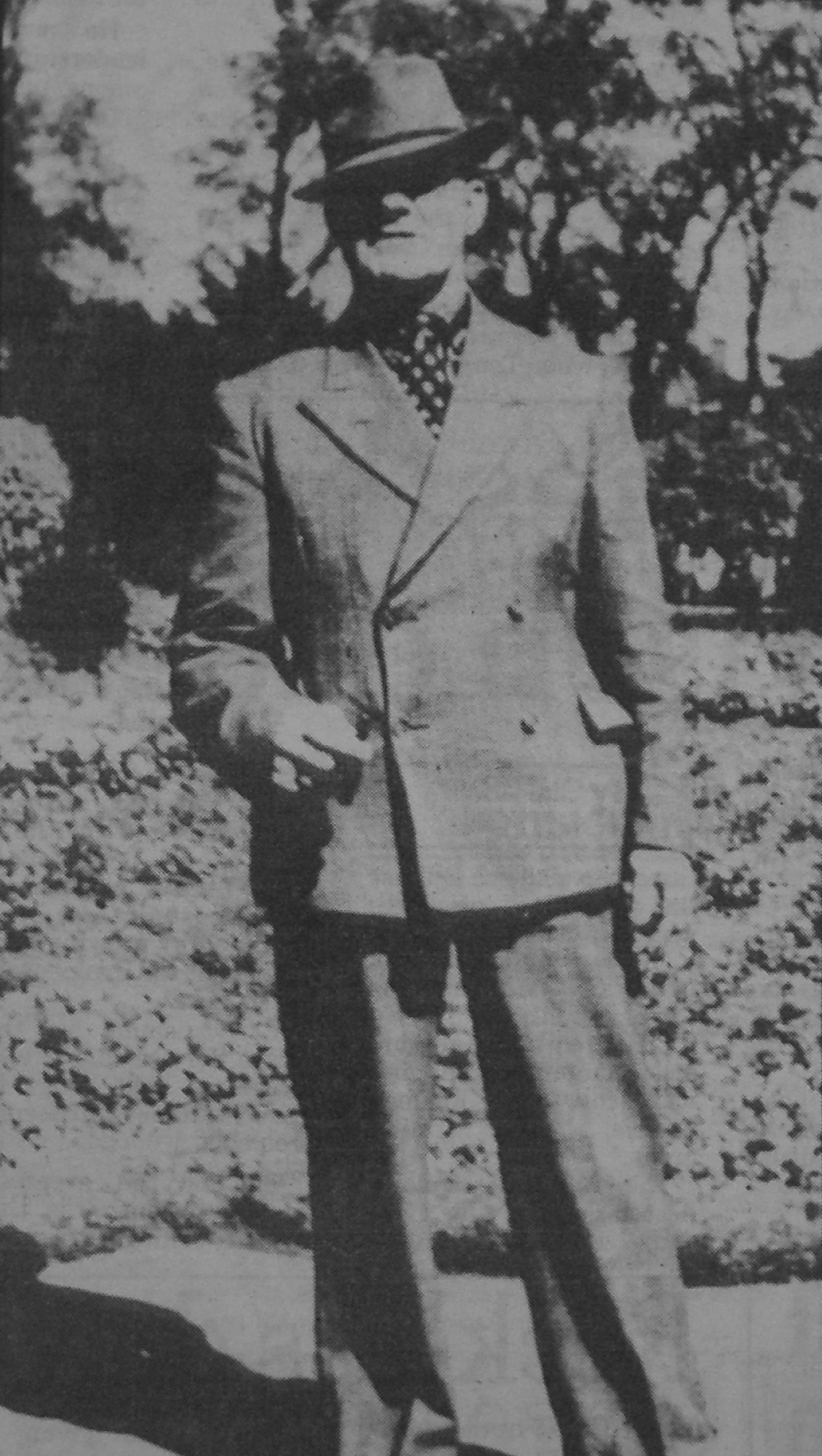
Robinson's American sojourn augmented his mythology. One claim, which appeared in the Belfast press following his death, was that his criminal career in the United States ended when no less a figure than FBI director J. Edgar Hoover interceded to have him deported.Footnote 51 Belfast folklore locates him in prohibition-era Chicago, operating as a hit man and bodyguard for Al Capone.Footnote 52 The Capone link also surfaced at the funeral of Robinson's wife, in the early 1990s. The Belfast novelist John Campbell, who knew Robinson's family well, wrote a short story about Buck Alec that recalled that one mourner claimed to have spied a group of well-dressed sun-tanned strangers. He believed them to be “The Mafioso . . . flown in especially to pay their respects to Alec's missus.”Footnote 53 A number of interwar Glaswegian hard men who visited the United States were also associated with the iconic Capone and the culturally loaded concept of the gangster. As Andrew Davies explains, Capone was a “ubiquitous figure” in the interwar British press and “his Hollywood counterparts were cult figures.”Footnote 54 This intriguing connection provided an attractive entry on the curriculum vitae of those laying claim to hard man repute. Photographs of Robinson from the 1930s, published in the Belfast press at the time of his death in 1995, suggest a sartorial attachment to gangster chic (fig. 1). Moreover, when captured on tape by the Ulster Folk and Transport Museum in 1983, he peppered the recording with the argot of gangster movies, describing one Belfast rival (Patrick “Silver” McKee) as “That dirty rat, that rat!”Footnote 55 Robinson claimed to have operated as a bootlegger in Harlem. Probed on the mafia and Capone, he was strikingly indifferent:
[H]e was only a wee fella. He was only a wee lad. . . . No, they gave me no trouble. . . . I minded my own business. . . . I mixed with them and I drunk with them, in their places. I always found them straight up because they were like myself; they wouldn't talk. “How's business?” “OK.” [Then] you'd have a drink.Footnote 56
Whether Hoover was involved or not, Robinson returned to Belfast in the early 1930s, where he met his second wife, who was—according to his daughters from that relationship—a fish and chip shop employee.Footnote 57 He amassed a reputation as a street fighter and was prominent in the eviction of Catholic families from their homes in the York Street area during sectarian violence in July 1935.Footnote 58 One Catholic woman recalled that Robinson visited her grandfather shortly afterward to guarantee his safe return to York Street.Footnote 59 The man was the local pawnbroker and, therefore, a significant cog in communal financial networks, whatever his religious affiliation. An instrumental tendency in Robinson's behavior was also evident, in 1943, when he conspired with Catholic criminals to export 1.5 ton of stolen binding wire to the Irish Free State. He received six months imprisonment for this offense, the prosecution describing him as “a thug and a bully who would bring his weight to bear on any side that would hire him.”Footnote 60
Robinson in gangster chic.

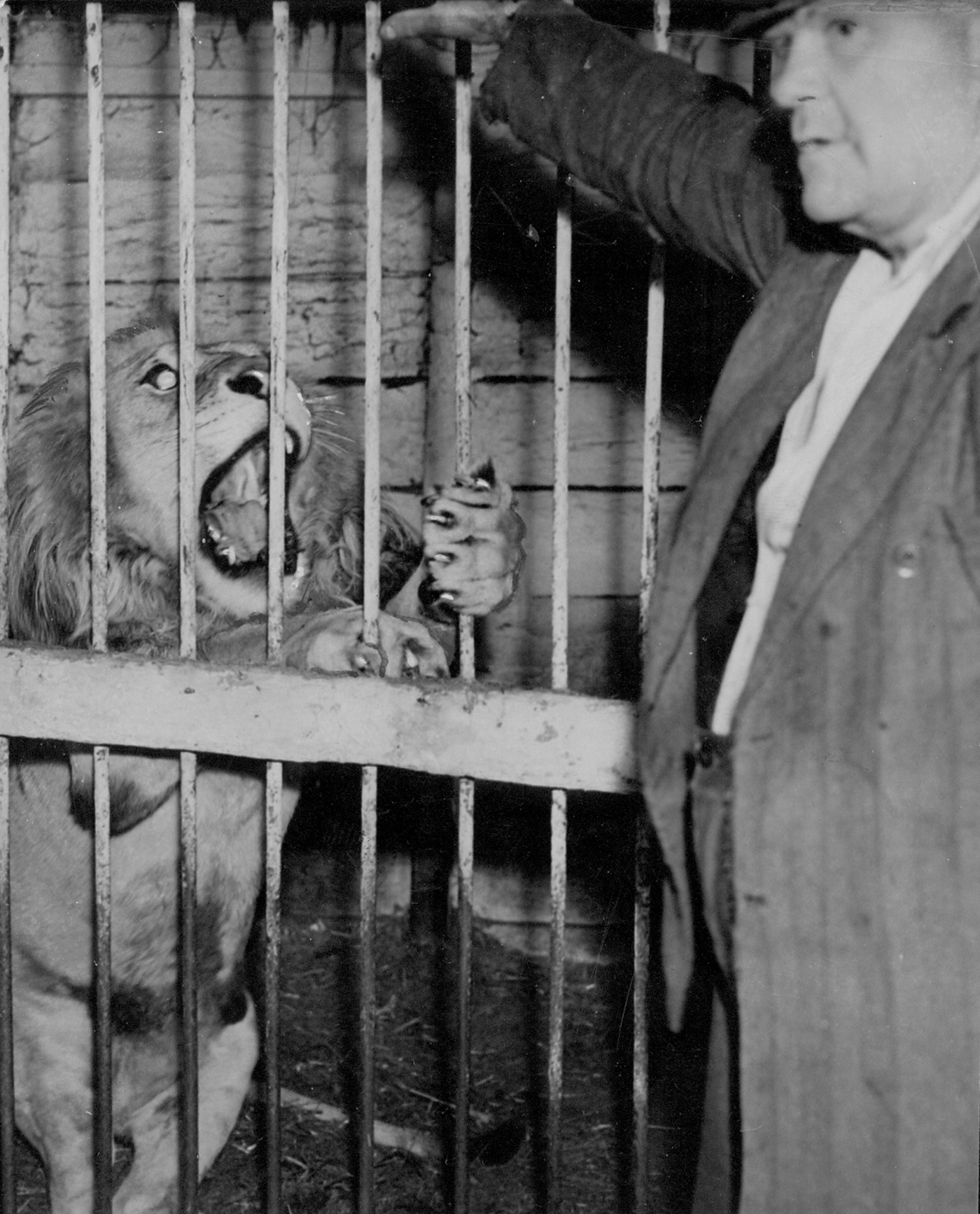
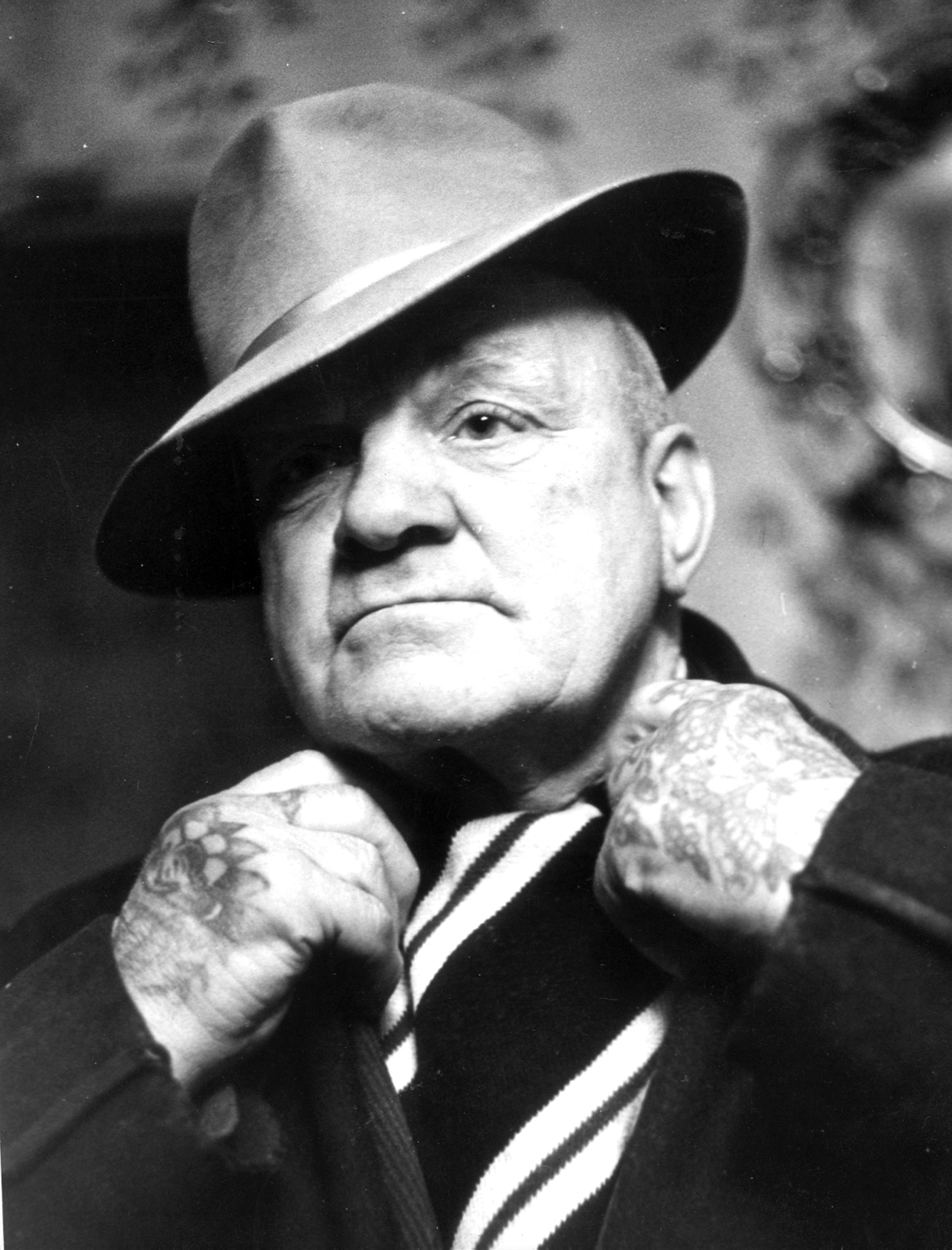
Robinson spectacularly enhanced his fearsome repute through the acquisition of a series of lions, from Dublin Zoo, which he displayed at city center premises and traveling shows (fig. 2).Footnote 61 According to some strands of Belfast folklore, crowds marveled as Robinson placed his head in the lion's mouth. There were claims that his safety was ensured by the removal of the lion's teeth.Footnote 62 However, Robinson himself revealed that both aspects of this story were untrue and remarked, “Sure, they cannot eat if they have no teeth.”Footnote 63 Although pet lions brought Robinson a unique standing among Belfast's hard men, he maintained his status as a street fighter by combatting younger rivals. Born in 1936 and raised close to Robinson's family home, novelist John Campbell witnessed “his incredible courage” during the 1950s when those Campbell describes as “reputation seeking sparrows” took on the “ageing eagle.”Footnote 64 One such “sparrow” was William Cochrane, who in July 1952 appeared at Robinson's door shouting: “I will take Buck Alec on any time!” Robinson overcame him in the subsequent confrontation, at which point Cochrane's brother emerged from the spectators to shatter a bottle on Robinson's head. This act violated the masculine code associated with the “fair fight,” ensuring that witnesses, including Robinson, were prepared to testify against the Cochranes and leave a record of the event. We know, therefore, that a bloodstained Robinson chased the brothers from the scene, demonstrating that at fifty his prowess was sufficient to see off two men twenty years his junior (Figure 3 illustrates that Robinson was still an impressive figure in middle age).Footnote 65 This was a remarkable accomplishment for a man who six months earlier sued a local company for negligence, claiming he had slipped on oil seeping from its premises. Robinson testified that he had sustained a fracture of the spine, making him permanently unfit for manual labor and unable to continue in his occupations of docker and wrestler.Footnote 66
Robinson with one of his pet lions.
Robinson in his later years.
Robinson obviously exhibited the entrepreneurial characteristic of Tosh's hegemonic males, if not their other traits.Footnote 67 This attribute also promoted his attentiveness to Belfast's gambling networks, which included acting as bodyguard to racetrack bookmakers.Footnote 68 How he negotiated this role is a matter for speculation, but Robinson did provide his own rationalization for his interest in illegal pitch and toss venues during the 1983 interview:
I used to go round the gambling dens . . . looking for the hard guys and they were the easiest to take on. I never seen a hard man yet that I couldn't lick. I took delight in picking at hard guys that were around the pitch and toss and saying “Mr, you're what? Get out of it!” . . . . They were taking money off people, bumming drink.Footnote 69
Robinson offered an altruistic vision of his motives, which he contrasted sharply with those of Patrick “Silver” McKee, a Catholic from the Market's area of Belfast. McKee, who was twenty-five years younger, usurped Robinson's place in the hierarchy of Belfast hard men when the two became embroiled in a tussle for control of a protection racket at Dunmore greyhound racing track during the 1940s. McKee was the victor, but then he engaged in a further turf war, with Shankill Road Protestant James “Stormy” Weatherall, which elicited newspaper headlines about “gangsterism” in Belfast.Footnote 70 These events echoed the racetrack gang fights that had fascinated the British popular press in the 1920s and 1930s, as control of gambling protection rackets formed one of the bedrocks of “organized crime” during that period.Footnote 71 Four decades later, Robinson labelled McKee a “bum and a moocher,” claiming: “I wouldn't entertain him. . . . He is one of those fellas: ‘Give me something! Give me something!’ I wouldn't give him daylight. . . . If he is demanding money with menaces . . . I'll give him a crack on the jaw.”Footnote 72 This suggests a selfless altruistic impulse, resembling Ronnie Kray's claim that he and his brother Reggie “looked after things in the East End” to ensure “there was never any of this mugging of old ladies.”Footnote 73 In reality, as well as profiting from gambling, it appears that Robinson acted in a fashion akin to Glasgow gang members who “exploited their individual and collective reputation for violence to extort money, goods and services from a wide range of both legitimate and illicit businesses.” When interviewed in 1984, two of his daughters recalled receiving treats from local shopkeepers and felt they were offered in homage to their father's status. They did not consider that it could have been a product of fear.Footnote 74 It seems also that Robinson exerted pressure on trade union officials to secure a number of elusive dockers’ badges, for himself and for his associates.Footnote 75 This offered access to daily employment at a time when large numbers of Belfast dockers faced the ravages of casualization and provided opportunities for theft and black market trading.Footnote 76
Robinson's last reported brush with the law, in 1959, followed a fight in a Belfast pub. In the courtroom sequel, the resident magistrate was entertained to have him in his court and asked: “Is this the lion tamer?” He was amused further by Robinson's defense, which was that he knocked his victim unconscious because of his use of bad language. The arresting officer noted that “Robinson had often assisted the police” and that he once helped him “take a violent prisoner into custody.” Sentencing Robinson to two months imprisonment, the magistrate noted that he was “a well-known figure in the city” who was “not a bad fellow in many ways, and a useful citizen at times.”Footnote 77
LIFE AFTER DEATH
The commemoration of Robinson took a number of forms following his death in 1995. Belfast is renowned for its wall murals, and he has featured on at least two: both in working-class Protestant enclaves. The most recent one, created in 2009 (fig. 4), is by Italian artist Daniela Balmaverde as part of the Re-imagining Communities Project. According to the press release issued at its unveiling, the mural “celebrates Belfast citizens of note.”Footnote 78 The muralist's paint provided an appropriate metaphor for Robinson's remembrance, glossing over the “gunman of the most dangerous type” in its representation of a quirky folk figure. Robinson appears with a lion rather than a gun and is represented alongside other well-known Belfast Protestants, such as Sir James Galway. The earlier mural, now replaced, had also featured the triumvirate of Galway, Robinson, and lion. However, it was primarily through oral not visual culture that Robinson's place in social memory was established. His funeral provided an initial opportunity for various figures to interpret his legend from their own perspective. The event attracted a large number of local reporters who published the reflections of a variety of mourners. Gusty Spence, who founded the modern UVF in 1966, insisted on its historical continuity with the original carriers of the name. He remarked that “Buck was a UVF gunman . . . a hard man but he was also a family man and kind-hearted.”Footnote 79 Robinson's son, Dennie, fired off a legitimization of his lethal violence:
He was called Buck Alec because he shot so many people—he bucked the system. He was a law unto himself. But anybody he shot, and I know quite a few of the people he shot, he was quite justified in shooting them. . . . He was a policeman fighting for his country and the people he shot were the enemies of the country. . . . After the Troubles he carried on shooting people. There was a lot of old scores to settle.Footnote 80
Mural depicting Robinson on Belfast's York Road (photographed 2002).
The tone of the Irish News, the Belfast daily newspaper with a predominantly Catholic readership, was cool. It mocked the “moustachioed blokes in long sinister black coats” who attended the funeral alongside “old, good-natured toothless men and varicose veined women.” It argued that references to Robinson as a “gunfighter” masked paramilitary violence with less threatening movie images of the “OK Corral.” The dominant sentiment was reported to be that Robinson's heart was in “the right place” and that “he was kind to children but not stray cats or dogs,” which he “fed to his lions, but nobody seemed to mind—he was a character after all.”Footnote 81 Despite the Irish News's tone, numerous Catholics attended the funeral. The deceased's status as a “character” and the fact that parts of Robinson's legend transcended sectarian differences explained this.Footnote 82 He had a function in a particular manly identity, existing in an ecumenical cultural space chiseled out of a set of masculine work and leisure practices. Journalists also sought the views of Martin Lynch, a Catholic, ex-stevedore, and author of the play Dockers (1981). He told them they were
witnessing the funeral of a legend. He was one of the great Belfast characters. Now there were some good aspects and some bad aspects to that character but the total was legendary. He confided to my father that he regretted the gunman stuff. He revelled in being a hard man, but he said he regretted being used by the unionist establishment to stir up sectarian trouble.Footnote 83
Lynch deployed Robinson to mythologize Belfast's docklands in a fashion that resembled the Liverpool waterfront described by Pat Ayers. Dockers there established a formidably strong sense of shared identity, based partly on the physically demanding and dangerous nature of their labor and despite being compelled to face the daily humiliation of competing for casual employment. Emasculation in the workplace amplified the significance of privileges associated with male authority within the family, particularly the right to leisure. Conspicuous consumption, male networking, and reciprocity, most often occasioned via drinking sessions in local pubs, were highly significant. Lack of control in the workplace, and irregular wages, were assuaged further by a culture of pilfering.Footnote 84 As was the case in numerous working-class communities, the display of physical strength became, as Jerry White explains, “the touchstone of masculinity.”Footnote 85 Violent contests provided for a hierarchy of esteem, in which the pub and the street were central to masculine performance. Displays of fighting prowess “dramatized and endorsed the customary association between ‘hardness’ and masculine status which permeated life in working-class districts.”Footnote 86
Placing Robinson in this cultural framework explains the kudos he received from his peers, even those on the other side of the sectarian divide. A local history, written in 1990 by Denis Smyth, depicted Robinson warmly and did not reference him in the section on the sectarian violence visited upon Smyth's Catholic community in the dockland district of Sailortown in the 1920s and 1930s. Smyth recalled a pub visit by “the Buck,” who was in his “best finery [of] a crombie overcoat, a beautiful Prince of Wales’ check suit, hand-made brogue shoes, a velour hat . . . a walking stick and two watches, one on each wrist.” Smyth concluded with an account of a bar room melee in which a Robinson “haymaker” missed his opponent, hit a Guinness barrel, and sent “stout flowing everywhere.” To comprehend fully Smyth's deployment of Robinson in a celebration of unbowed dockland masculinity, membership of which involved no need to kowtow to social superiors by role-playing respectability, it is necessary to view his summation of Sailortown:
For that district had its fair share of punters, gamblers and drinkers, and all with their little idiosyncrasies. Indeed, some of the “strokes” that those “wise guys” and “merchants” would get up to would deserve a book all of its own, for those characters and their ingenuity, resourcefulness and wit deserve wider recognition.Footnote 87
That Smyth compiled his book following the “piecemeal dismemberment” of Sailortown to make way for a section of the M2 motorway, which took place in the 1970s and 1980s, intensified the psychological motivations for his elegy.Footnote 88 Smyth omitted the younger Robinson's sectarian attacks on dockside Catholics because his status as a “character” had a powerful resonance in the discourse of dockland community. This “mixed” community, in which Catholics and Protestants shared social space in ways that were not common elsewhere in Belfast, clearly had the potential to produce particular forms of social memory. Moreover, Smyth's avowal of socialism—he was nicknamed Big Red by workmates—led him to seek ties between Protestant and Catholic dockers by drawing on the area's history of working-class solidarity, such as the 1907 strike.Footnote 89
This reinforces the value of Jones's exhortation that we examine the social relations that lie behind the production of social memory. With this in mind, it is likely that Catholics from other Belfast districts might not share the same perspective on Robinson. In the late 1990s, the local historian Joe Graham, who grew up in Ballymurphy in West Belfast, campaigned successfully against a proposal to paint a mural in Sailortown featuring Robinson. Graham had encountered Robinson in his dotage and found him “very affable” with “a great working class sense of humour,” but he could not overlook the fact that “as a young man he was a monster.”Footnote 90 Graham also had strong ties to Ardoyne, the area to which many of the Catholics forced to abandon their homes in 1935 by Robinson and other loyalists fled. However, when Graham placed a blunt account of Robinson's violence in the 1920s on the online version of his local history publication Rushlight, it generated positive comments on Robinson. One contributor registered confusion because his Catholic grandparents, “who would have been young adults during [Robinson's]. . . murderous spree” gave him an impression of “a loveable Belfast eccentric parading around Belfast with a toothless lion on a leash.”Footnote 91 Robinson's attraction lay in his individualistic working-class masculinity, which validated a gendered memory of dockland selfhood.
While toughness was a motif of dockland masculinity, in Belfast the reputation of particular districts and individuals had a wider resonance. In a city that had witnessed murderous communal invasions, stories about violent individuals from certain localities did not undermine the sense of strength, gregariousness, and vitality of those areas for their tellers. Rather, they bolstered a particularly masculine remembrance. In his anthropological account of sectarian violence in the 1980s, Allen Feldman argues that “the differential relation of the hard man to other men became a metaphor for the relation of the hard man's community to other places.” Moreover, individual hard men owed their status to “the oral culture and moral order of the local community.”Footnote 92 In testimony collected by Feldman in 1985 and 1986, the past (and hard man) was contrasted positively with the present (and the paramilitary gunman). The hard man represented community-based ethics that circumscribed the use of violence. One Catholic male, a former dockside resident, outlined this worldview:
I see a clear distinction here. You couldn't be a hard man if you were willing to terrorize women or young people or engage in petty thieving. There is a terrible difference between that and the man who stands on his own two feet and says, “OK I'll take your best man and fight him.” Buck Alec was not afraid of anybody, shape or size. Apparently, he was prepared to stand toe to toe and fight it out with an equal.Footnote 93
There is a significant dissonance within this statement between the “clear distinction” being made and the lack of firsthand knowledge of Robinson indicated by the final sentence.
Similar tensions exist in Belfast autobiographies written by men and women from the “respectable” working class. One such individual is Sir James Galway. His memoir begins with an overarching sketch of the York Street district on an “urban pastoral” canvass, which is described as a “very respectable little area . . . warm and comradely [with] little violence.” In a neighborhood where it was important to be a character of some sort, Galway cherished his musical gifts: “Music was highly regarded . . . perhaps even more than the ownership of a lion, although that was regarded as a pretty big status symbol.” In an aside that undermined his introductory scene setting, Galway remarked that the “lion didn't cause people half the anxiety Buck Alec did. He could not walk along the street when he had a skin full without bashing somebody.”Footnote 94 Belfast's female working-class autobiographers have been silent on Robinson, one reason being that the individuals concerned did not live near the docks. Moreover, stories about hard men circulated most commonly in male-dominated pubs that were also the location for bravado and aggression. Most important, however, is the adherence to respectability in female narratives, ensuring that violence is almost invisible.Footnote 95 May Blood's autobiography charts aspects of her childhood on the Shankill Road during the 1940s. It reveals that her uncle Willie was “well known as a bare-fist fighter and had a reputation as a bit of a ‘hard man,’” but it offers no further detail. She shares the sense that communal values have eroded: “[T]here was little of the anti-social behavior which blights communities today. If anybody got out of line the men would have said, ‘Now, come on, this'll not do.’ But they would have done so in a supportive way, not in a threatening way.”Footnote 96
The selectivity of recall and interpretation found in these autobiographies also surfaced in the context of Robinson's relationship with unionist politicians. Here, too, remembrance of Robinson proved significant. The discerning nature of that process masked the problematic nature of the “civilizing process” in the Belfast context. Jon Lawrence's analysis of changing attitudes toward violence in interwar Britain provides helpful contextualization.Footnote 97 He explains that the widespread terror inflicted by the “wild men” on both sides of the Anglo-Irish War between 1919 and 1921 led British politicians to question “state-authored violence” and “the role of force in the maintenance of imperial rule.”Footnote 98 In a parallel development, there was “a dramatic shift in what constituted legitimate popular involvement in public life” with the rowdy “political crowd” losing its legitimacy. Whereas politicians had previously championed the unruly nature of public politics, “new traditions of peaceableness and moderation” became “the dominant motif of interwar political discourse.”Footnote 99 Lawrence's discussion shares themes in common with Mennell's rereading of Elias. Lawrence foregrounds the “complex process of negotiation and contestation” that led to the delegitimization of violence in state and nation.Footnote 100 Shifting the spotlight to Northern Ireland adds credence to Lawrence's (and Mennell's) view that the “civilizing process” is a metanarrative that requires careful application in discrete periods and places. In Northern Ireland, an aggressive, popular Protestant masculinity found new life in the controversial reserve paramilitary police force that included the young Robinson. In addition, Belfast did not adopt the modern public politics seen in Britain. The Orange Order retained a role as an instrument of street politics; its annual Twelfth of July parade “effectively became a ritual of state” and served as a magnet for tension during passages of political turbulence.Footnote 101 Ulster electioneering also remained stubbornly unreconstructed. Hustings in Belfast's Dock ward, for example, remained rowdy well into the twentieth century. Robinson surfaced here also, providing security to the unionist candidate (and his agent, Ian Paisley) in the 1949 election.Footnote 102
Over four decades later, Paisley, then leader of the Democratic Unionist Party and consummate impresario of popular Protestantism, attended Robinson's funeral (see Figure 5). He shouldered the coffin and lauded Robinson as “a rare character, a typical Ulsterman, an interesting facet of Ulster's history.”Footnote 103 These curiously juxtaposed terms led to the assumption that Robinson typified a strand of Protestantism dear to Paisley's heart. The verbal juggling indicated the difficulties of placing Robinson within the mainstream “ethno-history” of Protestant Ulster, in which pride of place is taken by those who fought with the Thirty-Sixth (Ulster Division) at the Battle of the Somme. However, unionist “deep memory” also contrasted the loyalty of the Somme with the disloyalty of the Easter Rising of 1916. In this context, Robinson's violence could be rationalized as a response to treachery.Footnote 104 No other politician proved more adept at shadowboxing with the hard men of Ulster loyalism, or at dangling the prospect of populist violence before successive governments, than Paisley. Lines from one speech in 1981 may well have reminded Robinson of his youth: “[T]here are men willing to do the job of exterminating the IRA. Recruit them under the crown and they will do it. If you refuse, we will have no other decision to make but to do it ourselves.”Footnote 105 Paisley's presence at Robinson's funeral validated the dead man's bloody defense of Northern Ireland in the 1920s. Earlier in his career, Paisley “courted” John W. Nixon, the former police officer accused of leading murder squads in the 1920s who subsequently became a unionist member in the Northern Ireland Parliament.Footnote 106 The specter of Nixon and Robinson, whose memories were associated with horrific violence but unblemished by convictions for murder, enhanced Paisley's powerful rhetoric. Moreover, the sanitization of Robinson in social memory, including the willingness of some Catholics to forge less sectarian myths about Belfast's past, enabled Paisley's appropriation of his legend.
The funeral of Alexander “Buck Alec” Robinson.
CONCLUSION
The Irish Free State, like Northern Ireland, emerged from bloody origins. It came to terms with this violence through the creation of a series of myths about the nation's birth. A notable example is the remembrance surrounding Bloody Sunday 1920, during which the IRA shot and killed fifteen men suspected of being British intelligence officers. Later that day, the British military opened fire on a large crowd gathered at Croke Park to watch a Gaelic football match and extinguished fourteen more lives.Footnote 107 The day is remembered as part of a heroic struggle for Irish independence, not least in the movie Michael Collins (1996). However, Ann Dolan opines that republicans breached “some hierarchy of horror” in shooting several victims in front of their wives and within earshot of their children. Nine were still wearing pajamas, which “seemed to tip the scales of horror even further still.”Footnote 108 History has not recorded Jane Rafferty's attire when Robinson came to extinguish her life in 1922. As noted earlier, he apparently claimed she died because she was a spy. Although academic appraisals suggest fewer than half of those shot by the IRA on Bloody Sunday were intelligence agents, in Irish nationalist memory they “were all spies because murder could not be part of the founding myth of a nation.”Footnote 109 Robinson's appearance in The Famous Faces of North Belfast does not match the glamour of a Hollywood blockbuster, but both artifacts are highly selective in their treatment of violence. The moral codes imprinted in the remembrance of Robinson sanitized his violence, identifying him with a working-class past obliterated by urban change and the decline of community. In an important strand of Belfast working-class social memory, references to Robinson's sectarian violence appear as hazy footnotes, allowing space for numerous colorful anecdotes in a communal history in which class, for once, trumps religion.
Accounts of Irish historical memory have delineated two “alternative cultural codes,” through which nationalists/Catholics and unionists/Protestants structure the past.Footnote 110 Rooted in the response to urban redevelopment and the dislocation of established working-class communities, the accounts in which Robinson features bear similarity to a form of Irish memory that Guy Beiner has identified as a “traumatic tradition.” He describes this as inherently subaltern and traceable within both nationalist and unionist memory.Footnote 111 This form of memory is highly politicized, as are Belfast accounts depicting vanished working-class communities as victims of history. While Ben Jones questions the ubiquity of nostalgia in the popular memory of working-class communities, evidence from Belfast demonstrates the powerful lure of this sentiment. Jones is right, however, in counseling researchers against trite uses of the label nostalgia and in urging detailed exploration of its creation. It is productive to endorse Alessandro Portelli's view that the importance of testimony like that offered by Denis Smyth is “not in its adherence to fact, but rather its departure from it, as imagination, symbolism and desire emerge.”Footnote 112 Scrutinizing nostalgia enables historians to investigate how individuals use historical memory as a departure point for social commentary. Although Smyth's book includes amusing anecdotes about Buck Alec but omits reference to his earlier sectarian violence, it should not be labeled as the contradictory memories of an aging man. Rather, it represents an interaction with conflicting subjectivities spawned by the cultural, economic, and political experiences of Belfast's troubled society.
In favorably comparing the past to the present, this example of social memory serves to remind us of the complexity of the “civilizing” dynamic. It supports Mennell's view that it had a lesser impact on instrumental uses of violence. It also highlights the brittleness of the process in localities such as Belfast. In probing the relationship between political elites and the perpetrators of street violence in twentieth-century Belfast, it draws attention to the danger of framing understandings of the relationship between class and masculinity, in any kind of “civilizing process” in a hierarchical model. Robinson's role in working-class social memory resembles cultural uses of the hard man discovered elsewhere. However, he has also been involved in a very different form of memory project: one offered up by the ultrarespectable, teetotal, evangelical, populist message of Ian Paisley, who weaved Robinson's folklore into his model of an Ulster Protestant masculinity ready to fight a dirty war if the state did not act with telling aggression.
The ultimate irony of Robinson's story is that so many interpretations are placed on the life of an individual who set out to have a significant role in the manufacture of his own myth. Many working-class males journeyed through a transitory stage during which a violent reputation served as a useful marker of their masculinity. Very few held fast to this persona throughout their lives, and most settled down to a more domesticated lifestyle as the Belfast police anticipated Robinson would. In this respect, the maturation experienced during the male life cycle resembled an individualized equivalent of the civilization thesis. This raises the question of whether or not Robinson had his role as urban legend forced upon him by the accentuated notoriety of his youth and was playing the one hand left available to him. If so, he received mixed rewards. It appears that he did not amass a personal fortune through his involvement with the Belfast underworld. He was no Al Capone, and he lived out his final years in modest circumstances before becoming, at some point in the late 1980s, resident of a psychiatric hospital. He was a heavy drinker, suggesting that earlier police observations that he was teetotal were inaccurate.Footnote 113 A second explanation is that alcohol assisted Robinson in managing psychological problems associated with posttraumatic stress disorder, as was the case with former IRA men involved in close-quarter killings.Footnote 114 A further alternative is that Belfast's bars provided the spaces in which Robinson most readily achieved acclaim, measured out in pints bought by admiring or wary fellow drinkers. Eventually outmuscled by younger men, and deprived of his role in gambling networks, he pulled an ace from his sleeve by purchasing a series of lions. One suspects that these were not quite the feline pets the police had in mind when they envisaged the domestication of Buck Alec. The choice cemented his exalted place in Belfast folklore and represented a spectacular form of self-dramatization that came to be the leitmotif of his colorful character status, ensuring that the dominant color associated with him was not blood red.