Introduction
Genetic diversities in the genome of indigenous livestock species in developing world are reservoirs of rare but valuable genes for production, adaptation and resistance to endemic diseases. Diversity is the product of interaction between environmental and genetic effects leading to the differentiation of the morphological, physiological and productive traits which are vital to all production systems, as it provides the raw materials for breed improvement, and for adaptation to changing circumstances (Ceriotti et al., Reference Ceriotti, Caroli, Rizzi and Crimella2003).
DNA-based technologies are now the methods of choice for genetic characterization of livestock (Arora et al., Reference Arora, Bhatia, Mishra and Joshi2011); but its acceptance and applications in developing world are limited primarily due to the myriads of challenges such as its high cost, lack of infrastructural facilities and dearth of trained experts. Nevertheless, in the recent decades, advances in the field of biotechnology has opened up a completely new area at molecular levels with the method of techniques, such as routine electrophoresis employed for the detection of polymorphism at protein and enzyme loci as well as other serological and immunogenetic procedures for measurement of variation (Salako, Ijadunola and Aregbesola, Reference Salako, Ijadunola and Aregbesola2007).
Protein/allozyme polymorphs remain tremendously useful, especially in developing countries, because of their utility, cost and amount of genetic information accessed or simplicity involved in data interpretation (Rege and Okeyo, Reference Rege, Okeyo, Ojango, Mamfors and Okeyo2006). A major plus for biochemical characterization is that biochemical markers do not depend on environmental factors, stable throughout ontogenesis and have a simple type of inheritance (Lee et al., Reference Lee, Mukherjee, Agamuthu and Panandam1995). Though investigation on the genetic diversity of farm animals using microsatellite markers and other high technology procedures have been carried out in developing world; nevertheless, blood protein markers of farm animals have also been widely used for genetic structure and phylogenetic studies among breeds and types (Boujenane et al., Reference Boujenane, Ouragh, Benlamlih, Aarab, Miftah and Oumrhar2008; Zahrane et al., Reference Zahrane, Boulbaba, Brahim, Lazher and Sami2011; Akinyemi and Salako, Reference Akinyemi and Salako2012), characterization and estimation of genetic diversity within and among breeds and species (Akinyemi and Salako, Reference Akinyemi and Salako2012; Yakubu and Aya, Reference Yakubu and Aya2012).
Duck production is at the stage of infancy in Nigeria. Duck population was ranked third (9 553 911) after chicken (101 676 710) and guinea fowl (16 976 907) respectively (NBS, 2012) In Nigeria. Muscovy duck is the prevalent genus of duck reared in Nigeria (Duru et al., Reference Duru, Akpa, Saidu, Olugbemi and Jokthan2006; Oguntunji, Reference Oguntunji2013) and is reared as a dual-purpose bird for meat and egg production but its meat output greatly outweighs its egg output in Nigeria (Oguntunji, Reference Oguntunji2013). At present, information on how Muscovy ducks were introduced to Nigeria in literatures are scanty. However, a report by Blench (Reference Blench1995) suggested that they were probably introduced on the sea-coast by the Portuguese and spread inland. Another undocumented version claimed that they were introduced by the Portuguese slave traders and explorers in the fifteenth century.
Studies on biochemical characterization and estimation of genetic diversity in Muscovy duck using blood protein polymorphism are scarce. Electrophoretic analysis of blood proteins and enzymes would be of immense contribution to the characterization of this locally adapted waterfowl and also provide insights into the genetic diversity existing among them. It has been documented that animal genetic resources in developing countries, in general, were being eroded through the rapid transformation of the agricultural systems, in which the main cause of the loss of indigenous animal genetic resources was the indiscriminate introduction of exotic genetic resources, before the proper characterization, utilization and conservation of indigenous genetic resources (FAO, 1999). Mariante and McManus (Reference Mariante and McManus2004) corroborated this that studies were needed to characterize, identify and differentiate populations, while origin and history of breeds should be documented. In view of the foregoing, this study was undertaken to characterize and to investigate genetic diversity and similarity existing among ecotypes of Muscovy ducks found in Nigeria using blood protein markers.
Materials and methods
Animals
Blood samples were collected from unrelated 80 birds comprising 40 male and 40 female adults locally adapted Muscovy ducks in Nigeria. They comprise randomly sampled 20, 40 and 20 Muscovy ducks from the Rain Forest, Derived Savanna and Guinea Savanna agro-ecological zones which are herein referred to as ecotypes, respectively. These animals were extensively managed and owned by small scale holders. The climatic conditions of the study area have been earlier described by Oguntunji et al. (Reference Oguntunji, Aderemi, Lawal and Alabi2008) and Yakubu (Reference Yakubu2011).
Laboratory analysis
About 3–5 ml of whole blood was collected from the wing vein of each apparently healthy bird into correspondingly labelled heparinized and unheparinized tubes. Heparin was added to act as anti-coagulant and blood contamination was prevented using separate syringes and needles for individual birds. These samples were kept refrigerated in ice packs and transported to the Animal Breeding and Genetics Laboratory of the Department of Animal Science, University of Ibadan, Ibadan, Oyo State, Nigeria for electrophoresis analysis.
The blood samples were centrifuged at 4 °C for 20 min at 3 000 rpm in order to separate plasma and erythrocyte. Erythrocytes were washed with 9 percent NaCl to free them from plasma proteins and were then lysed with fourfold cold distilled water in order to release the haemoglobin. Then plasma and haemolysates aliquots were stored at 4 °C prior to electrophoresis analysis.
The lysed red blood cells were used to determine haemoglobin (Hb) and carbonic anhydrase (CA) genotypes while plasma was used to detect transferrin (Tf) genotypes. Similarly, unheparinized blood samples were centrifuged at 4 °C for 20 min at 3 000 rpm in order to separate serum for electrophoresis analysis of albumin (Alb).
Electrophoresis polymorphisms were performed for the CA, Hb, Alb and Tf using cellulose acetate strips. The electrophoresis procedures for CA, Hb and Tf have been described by Akinyemi and Salako (Reference Akinyemi and Salako2012) while Alb was electrophoresed with Tris Citrate pH 8. After electrophoresis, each strip was stained for few minutes and thereafter covered by destaining solution until the electrophoresis bands were visible, air-dried and scored.
Statistical analyses
All the investigated loci were co-dominant and gene frequencies were calculated by direct gene counting method. Genetic variability within the ecotype and sexes were estimated as follows.
Percentage of polymorphic loci (percent P): qualitatively, a marker is said to be polymorphic if it has two alleles and its most frequent allele in the population has a frequency of at most 99 percent (Sanjalj, Hemant and Robert, Reference Sanjalj, Hemant and Robert2000; Nyamsamba et al., Reference Nyamsamba, Nomura, Nozawa, Yokohama, Zagdsuren and Amano2003).
Heterozygosity (H): estimates of heterozygosity within ecotype was measured as the unbiased estimate of mean heterozygosity (Nei, Reference Nei1978).
 $$\left( H \right) = 1 - \sum {X_i^2}$$
where: X = the gene frequency of the ίth allele in a locus, ί = the number of loci.
 $${\rm Effective}\,\,{\rm number}\,\,{\rm of}\,\,{\rm alleles}\,({n_{\rm e}}):{\rm 1}/{\rm 1} - H$$
where: H = heterozygosity (Nyamsamba et al., Reference Nyamsamba, Nomura, Nozawa, Yokohama, Zagdsuren and Amano2003).
Results
Genotypic distribution among locally adapted Muscovy ducks in Nigeria
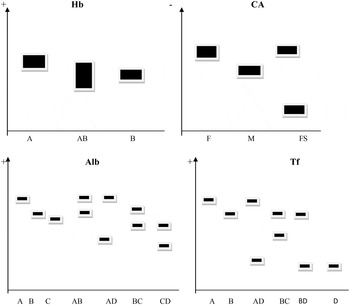
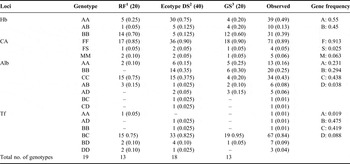
The genotype frequencies of haemoglobin, carbonic anhydrase, transferrin and albumin are presented in Table 1. Besides, the electrophoretic patterns of the four blood protein markers are illustrated in Figure 1.
Diagram showing relative position of electrophoretic patterns of four protein loci in the locally adapted Muscovy duck in Nigeria using cellulose acetate paper strip.

Distribution of four blood protein genotypes in three ecotypes of locally adapted Muscovy ducks in Nigeria.

(): Sample size analysed in parenthesis.
1 RF, Rain Forest.
2 DS, Derived Savanna.
3 GS, Guinea Savanna.
Haemoglobin
Three distinct genotypes of Hb (AA, BB and AB) were observed in the three ecotypes; however, HbAA genotype was prevalent (0.49) across the ecotypes.
Carbonic anhydrase
Electrophoretic analysis of CA locus revealed three distinct genotypes (CAFF, CAFS and CAMM); nevertheless, genotype CAFF was prevalent in the three ecotypes.
Albumin
Seven distinct genotypes were observed at the albumin locus and incidence of AlbCC was the highest.
Transferrin
Of the six genotypes typed for transferrin, genotype TfBC was the most frequent genotype in the sub-populations under study.
It is worthy of note that homozygous genotypes were prevalent at Hb (87.5 percent), CA (95 percent) and Alb (85 percent) loci of the studied population while heterozygous genotypes were prevalent (93.75 percent) at Tf locus.
Allelic frequencies distribution
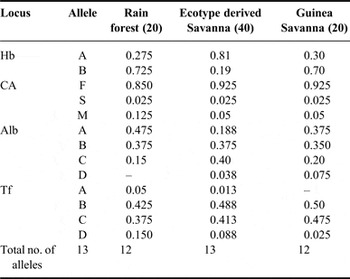
The allelic frequencies of the four protein loci in the three ecotypes of Muscovy ducks are presented in Table 2.
Allelic frequencies at haemoglobin, carbonic anhydrase, albumin and transferrin loci in three ecotypes of the locally adapted Muscovy duck in Nigeria.

(): Sample size analysed in parenthesis.
Haemoglobin
Two alleles were expressed at the Hb locus of the three ecotypes. General analysis (Table 1) indicated prevalence of HbA (0.55).
Carbonic anhydrase
Alleles F, S and M were expressed at the CA locus of the studied populations. Combined data of the three ecotypes (Table 1) indicated further that allele CAF was prevalent (0.913).
Albumin
Four alleles (A, B, C and D) were identified at the Alb locus. General analysis (Table 1) indicated prevalence of allele C.
Transferrin
Four allelic variants were detected at Tf locus. Alleles C (0.475) and B (0.419) predominated in three ecotypes (Table 1).
Genetic diversity among ecotypes
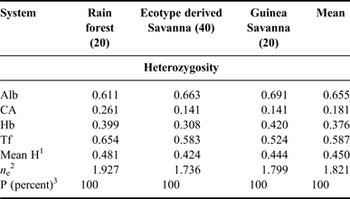
The results of the genetic variability among ecotypes are presented in Table 3.
Genetic variability at four loci in three ecotypes of locally adapted Muscovy duck in Nigeria.

(): Sample size analysed in parenthesis.
1 H, heterozygosity.
2 n e, effective number of alleles.
3 P (percent), percentage of polymorphism.
Heterozygosity (H)
The heterozygosity value of the three ecotypes ranges between 0.424 and 0.480 while the average for the three ecotypes was 0.45.
Percentage of polymorphic loci (percent P)
All the protein-coding loci studied in the three ecotypes were 100 percent polymorphic.
Effective number of alleles (n e)
The n e ranges between 1.736 and 1.927; however, the average for the three ecotypes was 1.821.
Sex differences in gene and genotype frequencies distribution of blood proteins in the Muscovy ducks in Nigeria
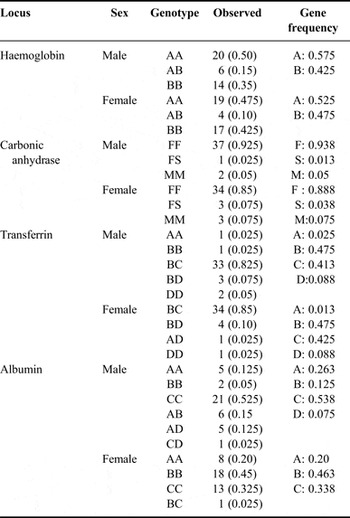
The sex differences in gene and genotype frequencies of Hb, CA, Alb and Tf of male and female Muscovy ducks are presented in Table 4.
Gene and genotype frequencies (in parenthesis) of four blood protein markers in adult male and female Muscovy ducks in Nigeria.

Haemoglobin
Three genotypes and two alleles were expressed at Hb locus in the two sexes. Genotype HbAA and allele A were the most frequent in both sexes.
Carbonic anhydrase
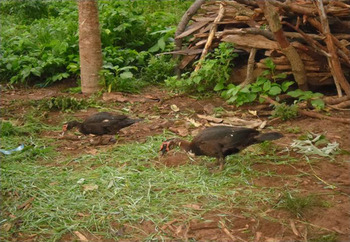
Three distinct genotypes were observed at the CA loci of both sexes. The CAFF genotype and allele F were prevalent in both the male and female ducks Figure 2.
Scavenging adult female (left) and male (right) Muscovy ducks.

Transferrin
Five genotypes were observed in drakes while four were expressed in females. Comparative sex-associated genotype expression of Tf revealed that genotypes TfAA and TfBB were only found in males while TfAD was only expressed in female ducks. Four alleles each were expressed in both sexes. Alleles B and C were the most frequent in the two sexes.
Albumin
Six of the seven genotypes expressed at the Alb locus were observed in male ducks except BC. Conversely, only four were observed in female ducks. Besides, allele C and B was prevalent in male and female Muscovy ducks, respectively.
Genetic diversity in male and female Muscovy ducks
Estimated genetic variability of male and female Nigerian Muscovy ducks are shown in Table 5.
Estimated genetic variability of male and female Muscovy ducks in Nigeria.

(): Sample size analysed in parenthesis.
1 H, heterozygosity.
2 n e, effective number of alleles.
3 P, percentage of polymorphism.
Heterozygosity (H)
Result of the average heterozygosities of the sexes indicated that females had higher estimated value than males (0.485 vs. 0.455).
Effective number of alleles (n e)
The n e for male and female ducks was 1.835 and 1.923, respectively.
Percentage of polymorphism (percent P)
All loci investigated in both sexes were polymorphic (100 percent polymorphic).
Blood protein genotype frequencies distribution
Haemoglobin
Reports of empirical studies of blood protein polymorphism in Muscovy ducks and in relation to agro-ecological zones are scarce to compare with the results of the present study. However, results of the related studies in other poultry species such as chicken (Yakubu and Aya, Reference Yakubu and Aya2012), chuckar (Alectoris chuckar) and pheasant (Phasianus colchicus) (Ugur et al., Reference Ugur, Ismaila, Vahdettin and Ibrahim2006) are in agreement with the three genotypes reported for Muscovy ducks in this study.
The higher frequency of HbAA agrees with previous reports on Nigerian indigenous chickens (Salako and Ige, Reference Salako and Ige2006; Yakubu and Aya, Reference Yakubu and Aya2012) and in Chuckar and Pheasant (Ugur et al., Reference Ugur, Ismaila, Vahdettin and Ibrahim2006). The prevalence of HbAA genotype among Nigerian Muscovy ducks may probably suggest adaptive roles for this genotype under harsh tropical environment.
Carbonic anhydrase
Scarcity of related studies in Muscovy ducks and other poultry species on carbonic anhydrase did not permit head-to-head contrast. It is worthy of note that a new variant was observed at this locus in five ducks and was temporarily designated as “MM”. The electrophoretic band of this new allele was just below the F and far from the S bands.
Albumin
Empirical studies on the electrophoretic analysis of Muscovy ducks and other duck breeds are scare to validate results obtained in the present study. It is noteworthy that all the seven genotypes observed across the ecotypes were present in Derived Savanna ducks. This may probably be attributed to the larger sample size than in the other two ecotypes.
Transferrin
The observed six Tf genotypes reported in the present study for Nigerian Muscovy ducks was higher than the three reported for Kerinci ducks in Indonesia (Nur, Yusrizal and Manin, Reference Nur, Yusrizal and Manin2012). While genotype TfBC was prevalent in the population understudy; genotype TfAA was prevalent in Kerinci ducks (Nur, Yusrizal and Manin, Reference Nur, Yusrizal and Manin2012).
Prevalence of homozygous genotypes at Hb, CA and Alb loci is consistent with a related study on waterfowl whereby deficiency of heterozygosity at five loci of Lesser Snow Geese (Kuznetsov, Baranyuk and Takekawa, Reference Kuznetsov, Baranyuk and Takekawa1998) was reported. Cooke, Parkin and Rockwell (Reference Cooke, Parkin and Rockwell1988) suggested that deficiency of heterozygotes may be explained by scoring errors, null alleles, selection against heterozygotes and inbreeding. To the best of the knowledge of the authors, the population understudy has not been subjected to selection in any form and the sampled population was random mating; thereby foreclosing possibility of selection and inbreeding influencing predominance of homozygote genotypes. Barring any error in scoring of the genotypes; a major possible underlying factor for the prevalence of the homozygotes in the present study was Wahlund effect.
Allelic frequencies distribution
Haemoglobin
The observed differences in prevalence of different alleles in different ecotypes “tempted” to suggest possible adaptive role of these alleles in different environments. Nevertheless, the predominance of HbA allele in the Nigerian Muscovy ducks is consistent with similar reports in other poultry species, such as Chuckars and Pheasant (Ugur et al., Reference Ugur, Ismaila, Vahdettin and Ibrahim2006) and Nigerian local chickens (Salako and Ige, Reference Salako and Ige2006; Yakubu and Aya, Reference Yakubu and Aya2012).
Carbonic anhydrase
To the best of the knowledge of the authors, the reported new allele designated as “M” in this study has not been reported previously either in Muscovy duck or any other poultry species. Ordás and San Primitivo (Reference Ordás and San Primitivo1986) also reported a new allele (M) at CA locus of a Spanish dairy sheep and its estimated frequency was 0.01. Similarly, Ibeagha-Awemu and Erhardt (Reference Ibeagha-Awemu and Erhardt2004) reported low frequency of 0.063 for this rare variant allele in Black-faced Mutton sheep. The low frequency of this rare allele in Nigerian Muscovy duck could be adduced to typing error or alternatively possibly indicates its negligible contribution to adaptation of this waterfowl in the study area and possibly its non relevance with yet-to-be-identified economic traits.
Albumin
Four alleles expressed at the Alb locus of Muscovy ducks in the present study contradicts the three reported for dabbling ducks (Paulauskas et al., Reference Paulauskas, Tubelyte, Baublys and Sruoga2009). It is noteworthy that allele B alone contributed about one-third (0.350–0.375) of the allelic composition of the three ecotypes. This probably points to the importance of this allele to the survival and yet-to-be-known physiological role it played in the population understudy. Conversely, alleles A and B predominated among dabbling ducks of Palaearctic region (Paulauskas et al., Reference Paulauskas, Tubelyte, Baublys and Sruoga2009).
Transferrin
Four alleles at the Tf locus of the Nigerian Muscovy duck in this study was higher than the two reported for Kerinci duck (Nur, Yusrizal and Manin, Reference Nur, Yusrizal and Manin2012) but lower than five in dabbling ducks of Palaearctic region (Paulauskas et al., Reference Paulauskas, Tubelyte, Baublys and Sruoga2009). Comparable allelic frequencies and prevalence of alleles B and C in the studied population probably suggest importance of these alleles to their survival and adaptation to the study area.
Genetic variability among ecotypes
Heterozygosity (H)
Though comparable study on heterozygosity at biochemical protein loci of Muscovy duck is scarce; however, the range of average heterozygosity in the present study (0.424–0.481) is comparable to 0.43 and 0.41 reported for Pekin and Muscovy duck in Iran using 13 microsatellite markers (Ahmadi et al., Reference Ahmadi, Rahimi, Vafaei and Sayyazadeh2007) but higher than the ranges 0.185–0.366 and 0.094–0.119 reported for dabbling ducks (Paulauskas et al., Reference Paulauskas, Tubelyte, Baublys and Sruoga2009) and Lesser Snow Geese (Chen c. caerulescens) of Wrangel Island (Kuznetsov, Baranyuk and Takekawa, Reference Kuznetsov, Baranyuk and Takekawa1998), respectively using blood protein markers. Furthermore, the mean H obtained for Muscovy duck in this study (0.45) is lower compared to 0.514, 0.527, 0.8079 and 0.86 reported for Beijing and Cherry Valley duck lines (Wu et al., Reference Wu, Huang, Ma, Hu, Hao and Li2009), Muscovy ducks in China (Wu et al., Reference Wu, Liu, Hou and Huang2008) and ten Chinese indigenous egg-type duck breeds, (Hui-Fang et al., Reference Hui-Fang, Wei-Tao, Jing-Ting, Kuan-Wei, Wen-Qi, Wei and Wen-Juan2010) respectively, using microsatellite markers. Higher values obtained in those studies could be linked to higher number of alleles segregating at different loci. This corroborates the well-established fact that heterozygosity values obtained with microsatellite markers are generally higher, due to the higher level of polymorphism than those obtained with protein markers (Ibeagba-Awemu and Erhardt, Reference Ibeagha-Awemu and Erhardt2004; Akinyemi and Salako, Reference Akinyemi and Salako2012).
A major possible underlying factor responsible for comparable and moderate heterozygosity values cum diversity in the present study among the ecotypes might be attributed to the unrestricted “gene flow” between ducks of different ecotypes through inter-regional trade and human movement; thus promoting intermingling and exchange of genetic materials among ducks of different ecotypes. Furthermore, since this locally adapted waterfowl has not been subjected to selection for genetic improvement or undergone directional selection for a particular blood protein genotype in the study area; therefore, the comparable estimated H values for the ecotypes are suggestive that these sub-populations are under the influence of similar evolutionary forces.
Furthermore, it is worthy of note that the average H of each ecotype (0.424–0.481) and the estimated mean value (0.450) for the three ecotypes using blood protein markers in this study were within the recommended range (0.3–0.8) for markers to be useful for measuring genetic variation in a population (Takezaki and Nei, Reference Takezaki and Nei1996). Heterozygosity (H) is one of the indices used to assay genetic variation of each population and the value indicates the diversity level of the marker (Wu et al., Reference Wu, Liu, Hou and Huang2008).
The estimated average H within the recommended range indicates genetic variability in the studied ecotypes and suggests further the possibility of exploring this for genetic improvement of this waterfowl. Genetic diversity as observed in the studied population is an important attribute of a specie/population for adaptation to diverse environmental challenges. Besides, it is also a veritable tool for animal breeders in selection and genetic improvement of farm animals. The moderate heterozygosity value reported for the three ecotypes lends credence to the widely believed assumption that gene pools of the locally adapted animals are rich and are reservoirs of rare genes.
It is worthy of emphasis that in the three ecotypes, highest estimated mean H was obtained at Tf and Alb loci compared with CA and Hb. Higher mean H values at TF and Alb loci are attendant effects of higher number of genotypes (7 and 6, respectively for Alb and Tf; 3 each for Hb and CA) and alleles (4 each for TF and Alb; 3 each for CA and Hb). Various studies have shown that higher number of allele affects estimated heterozygosity values (Akinyemi and Salako, Reference Akinyemi and Salako2012).
Percentage of polymorphic loci (percent P)
Complete polymorphism at the protein-coding loci investigated in this study corroborated the report of Nur, Yusrizal and Manin (Reference Nur, Yusrizal and Manin2012) on indigenous Kerinci duck in Indonesia where the three loci examined were polymorphic. Conversely, only 7 of the 15 loci examined in dabbling ducks were polymorphic (Paulauskas et al., Reference Paulauskas, Tubelyte, Baublys and Sruoga2009). The observed polymorphism is an indication of absence of selection with respect to the investigated loci and reinforce the widely reported diversity in the genome of indigenous livestock species in developing countries.
Effective number of alleles (n e)
Effective number of allele (n e) is an index used to reveal the genetic diversity of the populations and also to assay the effect of alleles in each population (Wu et al., Reference Wu, Liu, Hou and Huang2008). Empirical reports on n e in Muscovy duck using biochemical markers are sparse. Of recent, Wu et al. (Reference Wu, Liu, Hou and Huang2008) reported 5.7351 for Chinese Muscovy duck. This value is higher compared to the result of this study. The disparities observed in the two populations could be linked to the higher number of alleles (281) and 20 (microsatellite) loci examined by Wu et al. (Reference Wu, Liu, Hou and Huang2008). The higher values obtained for the ecotypes and the population under study in general suggested that the sub-populations have better abilities to keep the effective alleles when selection, mutation or genetic drift have occurred (Wu et al., Reference Wu, Liu, Hou and Huang2008).
Sex differences in blood protein polymorphism in locally adapted Muscovy duck in Nigeria
Related studies on association of sex with biochemical polymorphism of blood proteins in Muscovy duck are sparse to compare with results of the present study.
Haemoglobin
The higher frequencies of HbAA genotype in male and female Muscovy ducks in the present study were in agreement with the report of Yakubu and Aya (Reference Yakubu and Aya2012) on male and female Nigerian local chickens but contrasted with the report of Salako and Ige (Reference Salako and Ige2006) on Nigerian indigenous chickens where heterozygous males and females predominated. The prevalence of HbA gene in male and female Muscovy ducks is in tandem with reports on Nigerian local chickens (Salako and Ige, Reference Salako and Ige2006; Yakubu and Aya, Reference Yakubu and Aya2012). The high frequency of HbA in the two sexes of Nigerian Muscovy ducks is a pointer to the absence of sex-influence on its expression.
Carbonic anhydrase
Prevalence of higher frequency of CAFF genotype and allele CAF in the two sexes indicate absence of sex-influence on its expression and also indicates the importance of gene F to the survival and adaptation of this water fowl to the study area.
Transferrin
Prevalence of genotype TfBC in the two sexes coupled with higher frequency of genes TfB and TfC is a clear indicator of the importance of the two genes in the population under study. Besides, similarities in the distribution of the genes of the two sexes also indicate that sex had no influence on the expression of the Transferrin genotypes and alleles.
Albumin
Since the sexes of the population under study have not been selected on the basis of a particular blood protein; discrepancies observed in relation to the genotype and gene frequencies of Alb in this study may possibly be attributed to sex effect. A related study on waterfowl also reported exclusive expression of some alleles at the five loci of male and female Lesser Snow Geese (Kuznetsov, Baranyuk and Takekawa, Reference Kuznetsov, Baranyuk and Takekawa1998). Predominance of genes A and B in males; B and C in females possibly indicate the possibility of unknown sex-specific or sex-related physiological advantages those genes confer on each sex. However, disparities observed in distribution of this protein marker are subject to confirmation with a large sample and or studies conducted in controlled environment.
Estimated genetic variability of male and female Muscovy ducks in Nigeria
Comparative studies of the association of sex with genetic diversity estimated from blood protein markers are lacking to validate the result of the present study.
Heterozygosity (H)
The average H for the two sexes were within the range (0.3–0.8) required for a species to qualify for genetic improvement (Takezaki and Nei, Reference Takezaki and Nei1996) and also indicates further allelic richness and diversity of this population. Besides, the estimated H for the male and female Muscovy ducks in this study were higher than the values reported for male (0.094–0.130) and female (0.114–0.119) Lesser Snow Geese (Kuznetsov, Baranyuk and Takekawa, Reference Kuznetsov, Baranyuk and Takekawa1998).
Effective number of allele (ne)
Higher values of n e in females compared to males could probably be attributed to the attendent effect of higher H of females.
Percentage of polymorphic loci (percent P)
Polymorphicity at all loci of examined in this agrees with similar studies on both sexes of Nigerian local chickens (Salako and Ige, Reference Salako and Ige2006; Yakubu and Aya, Reference Yakubu and Aya2012).
Conclusion
Similarity in frequencies of biochemical protein genotypes and alleles in the three ecotypes and between the sexes is an indication that neither ecotype nor sex influence their distributions and that they are under similar evolutionary forces.
The values of the estimated genetic diversity parameters for the ducks in this study indicate that all ecotypes are variable in their genome and that there are chances for genetic improvement if crossed with exotic or Muscovy ducks from another population not covered in this study.
Besides, application of DNA technologies such as microsatellite markers would help a lot to elucidate further genetic diversity existing in this waterfowl as they have been shown to be more informative due to generation of many loci and alleles.
Acknowledgement
None.