


This article explores how the social structure of informal credit markets evolved in three urban areas of the Ottoman Balkans – Salonika [Selanik, Θεσσαλονίκη] (including the city of Veroia [Karaferye] located in its hinterland), Vidin [Vidin, Видин] and Ruse [Rusçuk-Русе] – between the late seventeenth and the early nineteenth centuries. This was a period of profound economic, institutional and political transformations, driven by the establishment of different systems of tax farming (iltizâm, malikâne, eshâm) and an increasing concentration of land ownership. From the seventeenth century onwards, the Ottoman government, pressed by increasing financial needs, began to auction to private entrepreneurs belonging to local elites (provincial notables and high-ranking functionaries) the right to collect taxes on portions of imperial land for a limited period of time (iltizâm).Footnote 1 Later on, tax-farming rights were converted into life-term tenure (mâlikane), although in many cases holders of short-term iltizâm acted as subcontractors in the provinces. The consolidation of large estates (through sultanic grants (temliks), conversion of uninhabited lands into plantation-type estates, purchase of land and foreclosure) was another lucrative investment for the top ranks of provincial society who participated in the malikâne system. A variant of tax farming introduced in 1775 was eshâm, under which the government securitized a fraction of the annual revenue generated by an asset and then offered it for sale to investors, who received their share of the allocated annual revenue in the form of a life-term annuity. In fact, both malikâne-iltizâm and eshâm were internal borrowing mechanisms for the central treasury, closely related to the formation of an early modern state and serving the ultimate aim of integrating provincial capital-holders into the center (Aydın Reference Aydin1998, pp. 24–98; Cezar Reference Cezar1986, pp. 19–57, 81–8; Çizakça Reference Çizakca1996, Reference Çizakca2014; Genç 2009, pp. 101–204; Özvar Reference Özvar2003, pp. 9–89; Rizk Khoury Reference Rizk Khoury1997, pp. 7–10, 76–112). However, the two systems differed in terms of socio-economic composition. As it required sophisticated political networks and extensive capital, malikâne-iltizâm was dominated by members of the economic and political elites (Salzmann Reference Salzmann1995, pp. 55–208). By contrast, the eshâm system aimed to attract the capital accumulated by middle-income groups in the provinces, for it was open to Muslims (including religious functionaries),Footnote 2 non-Muslims, and even women and children. As a consequence, it provided a broader and more diversified social base for borrowing by the Ottoman treasury.
Most of the existing literature contends that the increasing political and economic power of tax farmers and large landowners also shaped the social composition of local credit markets.Footnote 3 While some authors focus on their relationship with big bankers (sarrafs) (Barkey Reference Barkey2008, pp. 233–66; Cezar Reference Cezar, Imber and Kiyotaki2005; Yaycioglu Reference Yaycioglu2016, pp. 80–1, 130), others emphasize the dominant role of wealthy local elites in credit markets in the provincial economies (Göçek Reference Çizakca1996, pp. 59–62; Faroqhi Reference Faroqhi, Keyder and Tabak1998, pp. 88–91). The consensus view is that the huge profits generated by large estates and tax farms allowed local and imperial elites to invest a larger volume of resources in other lucrative businesses, such as moneylending, in order to diversify their investment portfolio (Davidova Reference Davidova2013, pp. 57–65, 67–74; İnalcık Reference Inalcik, Keyder and Tabak1998, pp. 26–9; Ianeva Reference Ianeva2009). In her study on the credit market of nineteenth-century Haifa, Ecchia (Reference Ecchia2014) also shows that local notables were able to strengthen their position in the loan market through informal connections despite the expansion of banking institutions in the region. Interestingly, a number of reports on moneylending in the Ottoman lands prepared by imperial bureaucrats in the 1830s reached the same conclusion. These reports emphasized that the majority of lenders consisted of local elites and state officials who charged usurious interest rates (Berber Reference Berber Akif2014, pp. 52–6). However, the Ottoman bureaucrats, far from being unbiased observers, looked at local economies and social relationships from their own centralist perspective (Tezcan Reference Tezcan2010, pp. 225–40). In their campaign to undermine the political power of local elites, they had a vested interest in presenting the latter as greedy moneylenders so as to reinforce the legitimacy of their own position (Salzmann Reference Salzmann1993, pp. 405–12; Reference Salzmann2004, pp. 179–99; Rifaʻat Abou-El-Haj Reference Abou-El-Haj2005, pp. 66–71).
This article contributes to this literature by studying the social composition of credit relationships in three important urban areas of the Ottoman Balkans. I find that the impact of tax farming and land ownership concentration on the social composition of informal credit markets varied significantly across the Empire to reflect local social and economic characteristics. In fact my analysis suggests that the middle gentry (including rank-and-file soldiers, religious functionaries, traders and artisans), rather than provincial magnates, dominated the urban loan markets of Ruse, Vidin and Salonika in the eighteenth and early nineteenth centuries. The article is structured as follows. Section i describes the sources used to study the social groups that dominated in moneylending activities. Sections ii, iii and iv deal with the cases of Salonika, Vidin and Ruse respectively. Section v concludes.
I
My study investigates the social groups that dominated moneylending in Ruse, Vidin and Salonika (including Veroia) between the late seventeenth and the early nineteenth centuries. These three regions were selected for two reasons. First, they are representative of the economic, social and institutional changes caused by the introduction of tax farming and the concentration of land ownership. Second, their different sizes and socio-economic characteristics help us better understand the relationship between tax farms, large estates and informal credit markets. As the most populous city in the Ottoman Balkans in the early nineteenth century, Salonika had a population of 40,200 (c. 53,000 including Veroia) and became an attractive commercial hub for merchants and artisans (Todorov Reference Todorov1983, p. 313; Lampe and Jackson Reference Lampe and Jackson1982, pp. 39–40; Svoronos Reference Svoronos1956, pp. 7–28). With a population of around 32,000 in the 1830s, Vidin had turned into a strategically important city during the Russo-Austrian-Turkish wars of the eighteenth century. As an increasing number of local troops and janissaries came to be based at military posts along the Danube River, the social characteristics of the province changed significantly (Gradeva Reference Gradeva2012, pp. 331–52). Ruse had around 24,500 inhabitants in the early nineteenth century and served traditionally as a supply center for the nearby military garrisons. However, from the 1740s onwards it turned into a thriving entrepôt center for Ottoman and Transylvanian merchants in coincidence with the intensification of commercial traffic on the Danube (Stoianovich Reference Stoianovich1960, p. 310; Todorov Reference Todorov1983, p. 313; McGowan Reference Mcgowan1981, p. 41; Reference Mcgowan, Faroqhi, McGowan, Quataert and Pamuk1994, pp. 738–9).
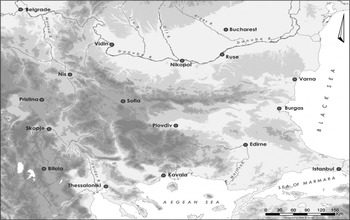
Major towns in the Ottoman Balkans

For this research I rely on four types of documents recorded in the registers of local courts (sicils). The first type consists of records of property transactions, including the transfer of large estates, houses, shops, mills and gardens. The second type of documents contains the division of the local tax burden (tevzi) by district authorities across reapportionment units (tevzihanes), usually villages, for the purpose of lump-sum tax collection.Footnote 4 Together with the records of property transactions, these registers allow us to identify the holders of large estates. The third type of documents are the records of tax farms. Together with the ahkâm registers (which recorded the decisions of the central administration in response to petitions by tax farmers related to political, administrative and economic matters in provinces), these documents provide rich information about the names of tax farmers and the value of tax-farming units.
The fourth type of documents are probate inventories (terekes). They provide the name of deceased individuals, their honorific titles if they were male, the names and titles of their fathers and the names of villages and neighborhoods in which they lived, a list of their properties (estate and movable assets) recorded at a worth generally in line with market prices (Ceylan Reference Ceylan2016), as well as their outstanding loans and debts. While the record-keeping practices of Ottoman courts usually specified clearly the names and titles of the lender and borrowers, there was almost no mention of the pertaining debit interest in probate inventories. Actually, to comply with the precepts of the Islamic law, this interest was disguised under various euphemisms such as çuhabahası (payment for cloth) and registered as such in court records (Kuran Reference Kuran2013, pp. 152–3, 166–9, 170–1). However, even such usage was rarely referred to in registered loans in probate inventories. Therefore, we cannot know exactly whether these loans entailed the payment of any interest. Given the fact that they were registered at the court, the interest rate of such loans normally fluctuated within the authorized range of around 10–15 percent. Regardless of whether they lent loans on an interest-bearing or interest-free basis, this study defines as a moneylender any individual who appeared as a creditor at least once for any amount.
In the case of Vidin, I used 2,724 probate inventories found in 58 court registers covering the period 1698–1855, which allow me to identify 3,001 loans. The sample for Ruse is based on 478 probate inventories from 29 court registers for the period 1685–1855, reporting 475 loans. For the Salonikan districts I use 1,005 probate inventories from 81 court records of Salonika and Karaferye covering the period 1740–1816; these recorded a total of 1,479 loans. Table 1 provides details about the number of probates for different subperiods, the average and median wealth and the share of the wealthiest 10 percent over total wealth (a rough measure of wealth inequality),Footnote 5 while Table 2 gives the number of loans and their average size for different subperiods in the three towns.
Wealth in the sample of probate inventories

Number and average size of loans

Note: Court scribes expressed the net value of an individual's estate in different monetary units like guruş, akçe, para and esedi guruş. For standardization, values reported in probate inventories are converted into guruş at a rate of exchange of 1 guruş to 40 para to 120 akçe. For exchange rates of Ottoman akçe, see Pamuk (Reference Pamuk2000, pp. 163, 237).
Although probate inventories provide detailed information about the economic activities and wealth of the deceased, they have serious limitations. Under the Islamic inheritance rules, the redaction of inventories was compulsory only when there were minors (sagîr, i.e. minor children), missing or mentally ill persons among the heirs (Bozkurt Reference Bozkurt2012, pp. 91–120). However, heirs could request the intervention of court officials in case of conflicts about the division of the inheritance (Coşgel and Ergene Reference Coşgel and Ergene2012, p. 311). On the other hand, since Islamic courts charged a fraction of the estate's overall value as inheritance tax, heirs had an incentive to avoid the court's involvement in the division of the estate (Ergene Reference Ergene2002, p. 29). Thus, it is likely that our sample of probate inventories is affected by a selection bias in favor of the wealthy segment of the society – a common problem especially relevant for the study of historical trends in income and wealth inequality (Soltow and van Zanden Reference Soltow and Van Zanden1998, p. 20). Recent studies on court usage in the Ottoman lands have observed that probate inventories tend also to underrepresent women and non-Muslims (not subject to Islamic rules of inheritance: Coşgel and Ergene Reference Coşgel and Ergene2012, p. 313). In our samples, both groups are in fact underrepresented. In the Vidin sample of probate inventories, only 15 percent are related to women; they are 18 percent in Ruse and 13 percent in Salonika. In a similar fashion, we find a bias against non-Muslims. For instance, in Ruse in the early nineteenth century non-Muslims were about one-third of the population, but represent only 15 percent of our sample of estate inventories. In Vidin and Salonika, with 78 and 74 percent of non-Muslim population respectively, their percentage of probate inventories is around 9 and 1 percent.
As a consequence, we lack precise information about what percentage of deaths was actually covered by estate inventories. Following Coşgel and Ergene (Reference Coşgel and Ergene2012, pp. 312–13), however, we can provide a rough estimate. Assuming that the total number of residents in Vidin fluctuated around 32,000 during the period under study and the annual crude death was around 0.035 percent, we can estimate that around 175,800 residents died between 1698 and 1855 (32,000*0,035*157 years). Therefore, the Vidin sample (2,724 inventories) seems to represent only 1.5 percent (2,724/175,000) of all deaths. This ratio was 0.3 and 0.7 percent for Ruse and Salonika (and Veroia) respectively. However, if we consider only the Muslim population, the representativeness of our sample is significantly higher. For instance, for Vidin, with a Muslim population of approximately 7,000, the estimated total deaths are around 38,000 (7,000*0,035*157), of which about 6.4 percent (2,480/38,000) are covered by our Muslim estate inventories. The figures are 0.4 and 2.7 percent for Ruse and Salonika (and Veroia) respectively.
In our probate inventories, a significant number of registered loans were in favor of family members, spouses in particular. Rather than an economically motivated investment, this marital borrowing served to secure the wife not only a mihr (dowry) but also cash money paid prior to the husband's death. A large portion of the mihr incumbent upon the husband was often paid off from the inheritance to the wife following his death. However, in cases where the husband considered the amount of the mihr insufficient, he could go to the court to leave a record testifying that his wife had lent him money, thus requiring the reimbursement of the prearranged debt from the inheritance together with the assigned mihr. Such debt–credit relationships were most likely outside the concerns of economically motivated investment; therefore they are excluded from the scope of the study.
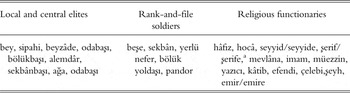
Since the Ottoman society consisted of extremely heterogeneous social groups, the economic and political boundaries of different social segments are always difficult to classify. In this study I am using modern (hence, somehow problematic) categories for classifying groups in the early modern Ottoman society (Tülüveli Reference Tülüveli2005, pp. 17–27) (see Table 3). The first group is represented by local elites and includes high-ranking administrative and military officials who usually bore prestigious titles like bey, sipahi, beyzâde, odabaşı, bölükbaşı, alemdâr and ağa. These individuals frequently participated in local decision-making processes and could testify as witnesses in court. Although these titles did not always reflect the individual's position within the social hierarchy, the titles ağa, bey, beyzâde continued to refer to individuals who were affiliated with the provincial state apparatus.Footnote 6 As a second group, the title molla gradually became a civilian title throughout the eighteenth century, while civilians of modest means, including artisans and craftsmen as well as merchants, constituted a provincial middle gentry relatively more heterogeneous than the local elite. The group of low-ranking janissaries who usually bore the title beşe also encompassed soldiers with various ranks such as yerlü nefer and sekbân. Janissaries were often classified as members of specific divisions (bölük), so we distinguish soldiers from civilians who also bear the same title. As a consequence of a high degree of penetration of civilians (especially artisans and merchants) into the ranks of janissaries, the term beşe thus turned into an occupational and honorific title conferred on artisans, merchants and rank-and-file soldiers, particularly in Vidin. As a third group, religious dignitaries consisted of prayer leaders, Quran reciters, religious teachers, dervishes and descendants of the Prophet designated by the titles molla, el-hâc, hâfız, hocâ, seyyid/şerife, mevlâna and imam. The social significance and meanings of these titles underwent significant changes, which transformed the titles molla and el-hâc into less prestigious and civilian markers of social status during the eighteenth century.
Title distribution in Ruse, Vidin and Salonika

a A number of women claimed descent from the Prophet Muhammad and bore the religious titles şerife, emire and seyyide, which conveyed power and prestige in the Ottoman society. Women with these titles are thus categorized as religious functionaries.
II
The Salonika hinterland was a region affected relatively early by the institutionalization of the mâlikane system. In the 1740s, townsmen with modest means had managed to get access to small-scale tax-farming contracts. Over time, however, tax farmers who did not hold any political and military office in the local administration became an exception. In the 1760s, for instance, the family of Hacı Ahmed was one of the few households among the middle gentry who occupied a tax farm in Salonikan districts.Footnote 7 Members of his family acted as tax farmers of the Salonikan dye-house (boyacıbaşılık mukâta‘ası) for yarn, silk and clothes (peştemals). Like other civilian families, Hacı Ahmed's probably failed to keep control of his tax farm, which was later held by a more influential political figure, Seyyid Ahmed Efendi.Footnote 8 In fact, in the late eighteenth century an increasing number of tax farms came to be administered by local notables and state officials. The petition submitted by Hacı Ahmed and his sons to the Ottoman authorities in 1766 provides interesting insights into changes taking place in the local tax-farming market. In this document, they protested against the improper collection of revenues of their tax farm and claimed that indigo (dyestuff) merchants across the region circumvented tax-farming rules by selling goods in the countryside without the permission of the owner of the Salonikan dye-house. Their case suggests that civilian tax farmers who lacked political and military prestige were not able to supervise the collection of tax revenues and could not cope with elusive practices of tax-paying subjects. Local elites and state officials, on the other hand, could easily utilize their political networks and social prestige for the collection of their tax revenue as the management of lucrative tax farms required both a good deal of wealth and social status.Footnote 9 Therefore, between the 1740s and 1770, state officials and the powerful local notables with official and prestigious titles held all major farms, such as the tax farms of the octroi duty and the stamp tax on cotton cloth.Footnote 10 As shown in Table 4, only 11 percent of the tax farms were offered to low-ranking janissaries, while almost 75 percent were assigned to prominent members of the Salonikan society and high-ranking state officials. A mere 5 percent of the contracts in the region were granted to civilian Salonikans without official titles. It appears that although the state introduced the eshâm system in 1775 to expand the pool of funds for the financing of the state, it did not alter the propensity of local notables to invest their money in tax farms.
Socio-political profile of tax farmers in the Salonikan districts, 1740–1816

A similar concentration of tax farms in the hands of upper-ranking state officials and local notables could be observed in the whole Balkans during this period. In her study on the geographical coordinates of the eighteenth-century lifetime tax-farming contracts, Ariel Salzmann (Reference Salzmann1995, pp. 171–81) shows that the investments of non-officials in the tax-farming market were considerably lower in the Balkans than in Anatolia. Surprisingly enough, only a few religious dignitaries (including scholars, prayer leaders, judges and descendants of the Prophet) acquired tax-farming contracts in Salonika districts. Given the fact that in the first half of the seventeenth century this group had accumulated considerable wealth and acted as ambitious entrepreneurs in the region, their limited participation in the tax-farming market in the following century could be explained by the decline of their political influence in the region, although their economic power remained intact.Footnote 11
Particularly after the 1750s, the records of property transactions of the Salonika court show that an increasing number of prominent local political figures invested also in agricultural estates in the countryside – a process that became more visible in the late eighteenth and early nineteenth centuries.Footnote 12 The tevzi records illustrate the scale of concentration of large estates in the hands of local elites.Footnote 13 In the 1750s the group of large-estate owners consisted not only of the wealthiest and most powerful members of the society, but also of low-ranking janissaries, religious dignitaries and civilians. By the end of the century, however, this heterogeneity almost disappeared and prominent families, together with a few janissaries, almost monopolized surplus revenues from these large estates.Footnote 14 Possibly, families with smaller capital had come to believe that only the powerful local notables, thanks to their wealth and political relationships, could acquire tax farms and large estates. It seems clear, however, that the virtual monopoly of local elites in these two markets went hand in hand with a declining participation of the middle gentry.
The hypothesis that local elites played a dominant role also as lenders in local credit markets is not supported by our sources, however. Although civilians held only 5 percent of the tax-farming contracts in the period 1740–1816, almost 40 percent of the moneylenders identified through probate inventories in Karaferye were local civilians. In the same period, I found a total of 418 borrowers, 68 percent of whom consisted of civilians. Only 45 out of the 285 civilian debtors borrowed money from elite inhabitants of the region, while 102 civilian debtors received credit from residents without honorifics. The average size of loans granted by elites to civilians was 146 guruş, whereas civilians lent on average 41 guruş to elite borrowers. Considering that a typical house was worth around 75 guruş during the second half of the eighteenth century, it seems that credit relations involving local elites often revolved around high amounts especially in the period 1740–70.
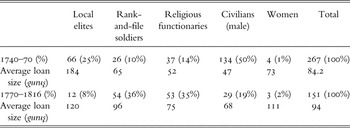
As shown in Table 5, female members of Salonikan households were absent in the tax-farming market, whereas they emerged as private lenders in the loan market. Religious functionaries accounted for only 9 percent of the Salonikan tax farms but their share in the loan market of the town was about 22 percent. Religious functionaries appeared as lenders in 90 loans, while they were borrowers only in 33 cases in the period 1740–1816. It appears that they were able to develop close relations with civilians in the loan market throughout the eighteenth century. In 20 cases they borrowed from civilians, while they frequently extended credits to individuals without titles (70 loans). Like religious functionaries, rank-and-file soldiers including janissaries and paramilitary groups (sekbâns) were actively involved in credit operations with civilians. In the period 1740–1816 they appeared as creditors in 80 loans, 69 of which involved credit relations between rank-and-file soldiers and civilians. In the period between 1740 and 1770, local elites made up 25 percent of moneylenders in the region. But it seems clear that from the 1770s onwards they appeared less and less in the local loan market, so civilian borrowers came to receive credit mainly from their fellow townsmen, janissaries as well as religious functionaries. For instance, there were a total of 151 registered loans during the period 1770–1816, but the members of the local elite appeared as moneylenders only in 12 loans. Probate inventories between the 1740s and the 1770s also show that low-ranking janissaries, religious dignitaries and civilians were the majority of those deceased whose assets included substantial cash; by contrast, only 20 percent of the deceased belonging to the elites left behind cash at the time of their deaths. In the late eighteenth and early nineteenth centuries, this percentage shrank further while liquid capital accumulated in the hands of non-elite groups.
Socio-economic profile of moneylenders in Salonika and Karaferye, 1740–1816

The declining visibility of local elites in the local loan market after the 1770s went hand in hand with the changes in the socio-economic profile of their creditors. During the late eighteenth and early nineteenth centuries, five religious functionaries, one woman, two janissaries and two civilians loaned money to local elites who had, however, been borrowing from a more homogenous pool of creditors around the mid-eighteenth century. In the period 1740–70, loans involved 47 elite borrowers, 45 percent of whom secured credit from notables. At the same time, 17 out of these elite borrowers obtained credit from civilians, with the average level of such credits amounting to 90 guruş, almost three times smaller than the average size of the outstanding credits between the elites. Toward the end of the century, the average size of the outstanding credits between the elites, however, dropped down to 73 guruş, while the average amount that the elites borrowed from civilians rose to 90 guruş.
Since tax farms are not included in probate inventories, we do not have precise information about what percentage of the elite lenders or borrowers held tax farms in the region. Assuming that individuals with elite titles had a higher probability of being tax farmers, one would conclude that local elites had less liquid capital and showed little interest in local credit markets, particularly after the 1740s. We can advance three possible explanations. First, tax farmers were probably involved in credit operations with Istanbul-based financiers rather than with local groups. In his study on eighteenth-century Kütahya, Murat Dağlı suggests that the social, political and financial networks connecting high-ranking office-holders and private moneylenders were much better established in Istanbul. According to Dağlı, ‘these networks not only allowed those who were seeking loans to connect with the lenders, but also allowed the lenders to assess their risks, and use their political relations to recover their loans if need be’ (Dağlı Reference Dağli2012, p. 164). Perhaps, local tax farmers perceived credit relations as a means to consolidate their patronage networks, which indeed played an important role for the protection of their tax-farming privileges. Second, tax farming was more lucrative and less risky than individual loans in a period characterized by higher demographic fluidity. The ahkâm and court registers have preserved abundant records of complaints raised by the prebendal elites to the Ottoman authorities against ‘the mobility of individuals’. As ordinary civilians resettled in different areas, the riskiness of personal loans undoubtedly increased.Footnote 15 Third, in order to make their own estates more attractive for mobile peasants and keep them on the land, owners of large estates took the responsibility for the payment of lump-sum taxes on behalf of their own peasants (deruhdecilik).Footnote 16 As a different form of tax farming and collective credit, the large estate owners paid these lump-sum taxes to the state in advance in return for the right to collect the taxes at the time of harvest in kind or cash. Thanks to this strategy, they succeeded in binding peasants to their own farmhouses, thereby reducing the risk of runs by cash-poor debtors in a world where labor rather than land was at a premium. These advance payments were indeed categorized as a type of small-scale tax farming rather than loans, as they were mainly a product of expanding lump-sum tax collection not only for regularized extraordinary levies but also for local expenses.Footnote 17 A consequence of the system was that liquidity was channeled to the state treasury rather than to the urban loan market.
A plausible hypothesis is that, as a result of the new role of estate owners as middlemen between their peasants and the state, prominent local elites had to continuously allocate money into this business and stood away from offering direct cash loans in the local market. This notion, which can also explain the paucity of liquid money in probate inventories of the local elite, is supported by Gara (Reference Gara and Anastasopoulos2005). In her study of the loan market in seventeenth-century Karaferye, she observed that the largest capital owners, such as military elites and religious dignitaries, had shaped the local credit market around the mid-seventeenth century when tax-farming practices and large estates were not fully established. Religious functionaries and military elites of Karaferye appeared in 41 and 33 percent of loans registered between 1600 and 1650 respectively. This suggests that the increasing participation of local military elites in the tax-farming system and their investment in the consolidation of large estates dramatically changed the socio-economic profile of the local credit market, as the middle gentry came to play a prominent role as lenders.
III
Situated nearly 500 km to the north of Salonika, Vidin gradually became a frontier region as a result of military campaigns throughout the seventeenth century. Here the demographic structure and socio-economic status of social groups were reshaped by the emergence of a new military and political administration. Especially after the war against the Holy League (1683–99), the region turned into a highly militarized area with a considerable number of janissaries. In 1750, janissaries and local troops stationed at the military posts of the region numbered 5,440 – the largest janissary contingent in the Balkans (Gradeva Reference Gradeva2012, p. 340). Over time the janissaries turned into naturalized residents and formed alliances with urban guilds. Court records shows how deeply the sergeants of the janissary divisions (ağas) and low-ranking janissaries penetrated into different sectors of the local economy.Footnote 18
There exists little doubt that, especially in the first half of the eighteenth century, tax farming appeared as a most lucrative business, thus attracting a substantial amount of capital from janissaries and administrative elites.Footnote 19 Between 1698 and 1770, 19 percent of all tax farmers in the region were low-ranking janissaries, while central and local elites were able to obtain around 59 percent of tax-farming contracts. Later on, from the 1770s to the 1820s, the share of low-ranking janissaries fell to 8 percent, whereas military and administrative elites now acquired 87 percent of all contracts. However, the declining role of janissaries of lower and middle rank in the tax-farming market does not seem to reflect a relative loss of economic power compared to top-ranking janissary officials and administrative elites in the region.
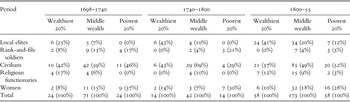
As summarized in Table 6, probate inventories for the period 1740–1800 suggest that the richest 20 percent of residents consisted mainly of administrative elites, wealthy traders, janissaries of low and middle rank, religious dignitaries and high-ranking janissary commanders. In this period, almost 40 percent of these wealthiest inhabitants were either janissaries or traders who bore the titles of low-ranking janissaries, whereas before1740 low-ranking janissaries made up almost 28 percent of the richest quintile. In a similar fashion to Salonika, therefore, this suggests that the accumulation of substantial capital was not a sufficient condition for the access of wealthy investors to the tax-farming system, where political and military hierarchies set the rules, especially after the 1760s.
Wealth distribution by social groups in Vidin

The growing influence of military and administrative elites in tax farming in fact coincided with a faster pace in the consolidation of large landed estates in the Vidin region. According to Gradeva (Reference Gradeva2012, pp. 347–9), the establishment of units for tax administration (nezaret) founded on the landed property of imperial and vizirial households, the assignment of a specific source of tax revenue for janissary salaries, as well as the expansion of military units in the late seventeenth and early eighteenth centuries, led to the emergence of a new system of land ownership named gospodarlık. In this system, peasants lost their title deeds and began to pay taxes to the state and intermediaries, who were local military elites and janissaries. However, according to İnalcık (Reference Inalcik1992, pp. 83–100; Reference Inalcik, Keyder and Tabak1998, pp. 29–33), under this new land regime, this intermediary function did not allow military elites and janissaries to become fully established as landowners. Moreover, it was only after the 1760s that local elites eagerly began to invest in the purchase of farmhouses, mills and storehouses, as the rising international demand for agricultural products turned the countryside of the region into an attractive source of profits. In a similar vein, based on Hristo Gandev's studies on the transformation of public lands into private large estates, McGowan (Reference Mcgowan1981, pp. 59–61) also suggested that the consolidation of large landed estates gained momentum in the Vidin area only in the second half of the eighteenth century. My findings are consistent with both İnalcık's and McGowan's analyses.
Between 1698 and 1760, farmhouses were rarely traded in the real estate market and local entrepreneurs showed little appetite for the purchase of mills, storehouses and large plots of arable land, which were considered as the most valuable assets of a typical large estate in Vidin. Probate records of this period show that only 1 percent of the richest quintile owned large plots of land, while almost 5 percent of this richest group (6 individuals out of 125 deceased registered in the probate inventories) possessed warehouses or mills. In this period, investors in large estates, storehouses and mills, which required a significant amount of capital, were a minority. One of them was İbrahim Ağa, a commander of military units who died in 1722 and left behind an estate of 32,000 pares comprising two water mills and a half share of a horse-mill valued at a total of 14,240 pares.Footnote 20 His investment pattern was an exception in the early eighteenth century. After 1760, however, although the average real value of these mills did not change significantly, the ownership of a mill among the richest 20 percent of the residents, especially high-ranking janissaries and commanders, rose to 6 percent.
More importantly, although in the earlier period merely 1 percent of the wealthiest group in the society possessed big estates and large parcels of arable land, this ratio rose to 13 percent in the period period 1760–1800, a trend which indeed continued well into the 1830s. As in the case of Salonika, the growing interest of military and administrative elites in farmhouses went hand in hand with the rising flow of their capital into these large estates. Together with their rising investments in tax farming, this reallocation of capital was reflected in the declining share of cash in their probate estates. Given that one dönüm of vineyard in the region cost around 15–20 guruş (1800–2400 akçes) on average, we could take 2000 akçes as a threshold marking a significant amount for loanable money. In the early eighteenth century, 35 percent of individuals who left behind significant amounts of cash (i.e. more than 2,000 akçes) came from administrative and military elites, whereas in the later period their share fell to 22 percent. In the late eighteenth century, it was rank-and-file janissaries who held liquid capital as the major assets of their portfolios.
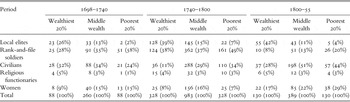
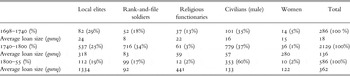
As shown in Table 7, changes in investment patterns had profound consequences for the socio-economic profile of credit markets in Vidin. Throughout the period under study the share of military and political elites in the loan market fell from 29 to 25 percent. In the late seventeenth and early eighteenth centuries, rank-and-file soldiers consisting solely of janissaries constituted 18 percent of all moneylenders in the region, while in the following period (1740–1800) janissaries appeared as lenders in 34 percent of all loans. The prestigious position of janissaries in the region came to an end with the formal abolition of janissary corps after the 1826 rebellion. Their share in the loan market declined sharply, while civilians became more visible in credit relations in the period 1800–50.
Socio-economic profile of moneylenders in Vidin, 1698–1855
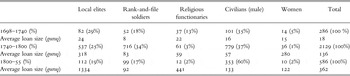
In the period 1698–1740, there were a total of 286 borrowers, 99 of whom were local elites. These elite borrowers obtained credit mainly from the members of local elite (25 loans), janissaries (27 loans) and civilians (29 loans). Only in 14 loans did religious functionaries appear as lenders to local elites. The average size of loans offered by civilians to the elites was 17 guruş, whereas civilian lenders lent an average of 35 guruş to each elite borrower. In the subsequent period (1740–1800), credit relations involving elite debtors and civilian lenders determined the contours of the loan market. Toward the late eighteenth century, the majority of elite borrowers began to receive credit from civilians. The number of all registered loans during the period was 2,129, with local elites appearing as borrowers in 618 loans. In 244 cases, civilians lent money to local elites, who in turn received credit from janissaries in 157 loans. In 244 cases, civilian creditors lent an average of 35 guruş to each elite borrower. During the same period, 176 out of the 618 elite borrowers took loans from individuals with administrative and military titles, with the average amount of these credits being around 480 guruş. As was the case in the Salonikan countryside, the average size of outstanding credits between the elites (142 guruş), however, declined after the 1800s. In contrast, the average amount that elites borrowed from civilians (141 guruş) experienced a dramatic increase. In the period 1800–55, there were a total of 186 elite borrowers, only 19 percent of whom received credit from local elites. Following the turn of the century, civilians turned into the main creditors of local elites in the market as they lent money to elites in 119 loans.
From the 1690s to the 1850s civilians acted as the main creditors of residents without titles. In the initial subperiod, i.e. from 1698 to 1740, there were a total of 79 civilian borrowers, 36 percent of whom entered into debt contracts with civilian lenders. These individuals borrowed money from religious functionaries (13 cases), elite groups (20 cases), women (5 cases) and janissaries (4 cases). In the subsequent subperiod, however, janissaries became one of their main creditors while civilians continued to receive credit mainly from their fellow townsmen. In the period 1740–1800, civilians appeared as borrowers in 423 cases, 193 of which involved civilian lenders. The loans in question had an average size of 90 guruş, while 120 janissaries lent an average of 56 guruş to each civilian borrower. As in Salonika, credit relations involving elite lenders and civilian borrowers revolved around high amounts (248 guruş) in the period 1740–1800 across Vidin. On the other hand, after the 1800s the average size of outstanding credit between civilians (175 guruş) almost doubled. From 1800 to 1855 there were 231 loans involving civilian borrowers, 150 of which involved civilian lenders, while janissaries were their creditors in only 26 cases. Civilians also became important creditors of the janissaries during the period under study, although janissaries preferred to borrow mainly from their fellows in the period 1740–1800. In the late seventeenth and early eighteenth centuries, janissaries appeared as borrowers in 84 loans, 24 of which were related to local elites as lenders. Thirty-one out of these 84 borrowers took credit from civilian lenders, while 22 loans between janissaries were registered in probate inventories. During the period, the average size of loans involving janissaries as borrowers was 17 guruş, whereas the same figure rose to 86 guruş in the following subperiod (1740–1800). From 1740 to 1800, there were 196 local elites who lent an average of 177 guruş to each janissary, while the average size of credits among janissaries in a total of 370 loans was 70 guruş. In 312 cases involving loans civilians lent an average amount of 46 guruş to janissaries. But like local elites, the majority of janissaries used civilians to borrow money from in the period 1800–50, when janissaries appeared as borrowers in a total of 118 loans. Half of these loans were extended by civilians, while in only 31 cases did janissaries prefer to borrow from their fellows.
In the early decades of the eighteenth century, civilians appeared as lenders in 35 percent of all loans, whereas in the following period (1740–1800) their share slightly increased.Footnote 21 In fact, the rising role of janissaries and civilians in the local loan market in the period 1740–1800 was probably linked to the well-known phenomenon of the rising permeability between low-ranking janissaries and civilians in this period, which has been recently analyzed by many scholars (Yi Reference Yi2004, pp. 135–48; Yılmaz Reference Yilmaz2011, pp. 175–223). Several studies on different Ottoman towns show that throughout the eighteenth century janissaries joined the ranks of guilds, while ordinary craftsmen and members of the guild entered into the system of janissaries.
Eighteenth-century Vidin followed a similar trend. The transformation of the town into a military stronghold blurred social distinctions between janissaries and craftsmen. Court records provide further evidence. In the first half of the eighteenth century craftsmen appeared in the court records with civilian titles indicating their profession, while later on many craftsmen came to bear the titles of janissaries.Footnote 22 Since in this study craftsmen bearing the titles of janissaries are categorized as low-ranking janissaries, the permeability between janissaries and civilians gives a possible explanation for the rising share of janissaries in the loan market during the period 1740–1800. To what extent the rising influence of high-ranking janissaries and administrative elites in the markets of tax farming and large estates in the second half of the eighteenth century determined this permeability remains a matter of debate. However, it seems plausible that, with the concentration of tax farming and large estates in the hands of military elites, janissaries of low and medium rank diverted their resources from tax farming to credit activities after the 1760s. Since the region acquired strategic relevance after the Russo-Ottoman War, the central government used the iltizâm-malikâne system to promote the creation of a strong local military class. As a result, Muslim elites and military leaders loyal to Istanbul had privileged access to tax farms and large estates – a privilege they owed less to their economic power than to the changing military and political circumstances in the city – while their presence in the local loan market experienced a sharp decline throughout the eighteenth century. In turn, low-ranking janissaries were increasingly displaced from tax-farming contracts, as they were not able to compete with the high-ranking military elites despite their growing wealth.
IV
In the region around Ruse prominent members of the provincial and central elite began to form large estates and consolidate their power in the countryside earlier than their peers in Vidin and Salonika (McGowan Reference Mcgowan1981, p. 217; İnalcık Reference Inalcik, Keyder and Tabak1998, pp. 29–30; Kokdas Reference Kokdas2014, pp. 139–44). Even in the 1650s, many large estates were already integrated into the apportionment system of taxes and local expenses. According to McGowan (Reference Mcgowan1981, pp. 78, 199), the number of large agricultural estates in Ruse reached a ceiling at the end of the seventeenth century and remained stable afterwards. This picture is confirmed by our sources. In the tevzi records for the years 1751–2, court scribes recorded 43 big estates belonging to local elites; virtually the same number (42) was reported almost 26 years later.Footnote 23 The number of farmhouses and farmers in the local economy remained stable from the 1700s to the 1830s, and local elites owned most of them. In the records of probates compiled from 1690 to 1740, seven big estates, large arable lands and mills were listed as real properties of the deceased, four of which were owned by administrative and military elites (ağas and beys) while civilians possessed two large estates.
During the second half of the eighteenth century, local elites intensified their investments in large estates; in the first half of the nineteenth century their share rose to 70 percent. In the same fashion, local and central elites held 79 percent of all tax farms in the period 1760–1810, although approximately two-thirds of tax farms of all sorts had been auctioned to local elites in the early eighteenth century. The percentage of tax farms assigned to civilians remained in the range of 10–15 percent over time. Similarly to Vidin and Salonika, also in Ruse administrative and military elites strengthened their position in tax farming of large landed estates. However, unlike in Vidin and Salonika, this did not translate into a decline of their participation in local loan markets, which actually increased over time.
This evidence raises the question of what can explain such a different social composition of moneylending activities in Ruse in spite of the strong similarities with Vidin and Salonika as far as the malikâne-iltizâm system and landownership concentration are concerned. Here I propose an explanation based on the military, political and social characteristics of the region. In the period 1685–1740, members of the military and political elites (identified on the base of military and administrative titles) represented only a quarter of the wealthiest quintile; the rest was represented by janissaries (around 8 percent), religious dignitaries (around 17 percent) and especially civilians (around 42 percent). Although this group possessed accumulated capital, they lacked the political networks required to participate in the tax-farming system.
By combining information from probate inventories on wealth distribution (Table 8) and lending activities (Table 9) across different social groups, we can shed further light on the evolution of the local credit market.
Wealth distribution by social groups in Ruse

Socio-economic profile of moneylenders in Ruse

Inventories for the period 1685–1740 reveal that around 80 percent of the deceased individuals (16 civilians and 3 religious functionaries out of the 24 deceased in our sample) who bequeathed more than 2,000 akçes were civilians and religious dignitaries. In our sample, only 4 out of these 24 individuals were janissaries. The concentration of cash in the hands of civilians might also explain why they appeared as main lenders in the loan market in the same period. In the period 1740–1800, they accounted for 43 percent of the wealthiest quintile in our sample and remained active moneylenders in the credit market. Local elites accounted for almost 43 percent of the city's richest quintile in the same period, and their share in the local credit market also increased. The presence of janissaries in the wealthiest quintile gradually vanished in the course of the century. Elite debtors in the market borrowed money mainly from civilians throughout the eighteenth century. In the period 1685–1740 there were a total of 27 elite borrowers making up 30 percent of all recorded borrowers in the market. Fifteen out of these 27 individuals were able to secure credit from civilians, while eight persons loaned an average of 18 guruş to each elite borrower. The average size of loans involving civilian lenders and elite borrowers (i.e. 17 guruş) was not very much different from that between elites. In the following subperiod (1740–1800), the socio-economic profile of the loan market did not drastically change, for the elites accounted for 41 percent of all borrowers.
The records indicate that 42 out of the 82 elite borrowers obtained loans from civilians, while the number of cases involving outstanding credit between elites was only 23 during the period. After the 1800s, people with administrative and military titles, however, began to borrow mostly from elite groups (46 loans), while civilians appeared as creditors of the elites in 36 cases. Although the average amount of money borrowed by elites was around 2,375 guruş, the average size of loans between elites was around 4,000 guruş – an amount almost three times higher than the average in the loan market. From the 1740s, an increasing number of elites lent money to civilians, possibly thanks to their growing liquid funds. In the late seventeenth and early eighteenth centuries, the number of credits offered to civilians was 50, only eight of which involved elites as lenders. In contrast, after the 1740s elites appeared as lenders in almost 30 percent of loans involving civilian borrowers.
The factor behind the rising economic clout of elites in Ruse was the growing integration of the city in the Danubian trade, which benefited civilians first and local elites later. In fact European observers depicted the city as a flourishing port and center of trade from the 1780s onwards.Footnote 24 Court records reveal that the main assets of the civilians belonging to the wealthiest quintile were commercial goods and shops, rather than estates and agricultural lands. Shipping was another flourishing business in the region. Already in the early eighteenth century most individuals who owned vessels used in river trading had a civilian, janissary or religious background. Over time river trade and transport drew the attention of the military and political elites. As the suffix zâde and double titles (ağa and el-hâc) suggest, El-hâc Ömerzâde Mehmed Ağa was one of the prominent members of local elites around 1830. He was one of the wealthiest personalities of the region, and his most valuable asset was ship-owning rather than landed property.Footnote 25 The expanding involvement of elites in commercial activities and their enrichment may also contribute to explain their substantial moneylending activities. Considering that a prestigious house was worth more than 1,000 guruş in the eighteenth century, in our sample for the period 1685–1740 there was no elite individual who bequeathed such an amount in cash. In the period between 1740 and 1855, however, among all inventoried deceased individuals who left behind more than 1,000 guruş in cash, 38 percent were members of military and political elites. Although this is by no means evidence of their moneylending activities, it suggests that their holdings of liquid, loanable funds increased substantially over time, which is consistent with their increased participation in the local loan market after the 1740s, as shown in Table 9.
V
Recent studies have considerably expanded the body of knowledge about tax farming and public finances in the Ottoman Empire.Footnote 26 However, our understanding of its impact on provincial economies is still quite limited. As Boğaç Ergene rightly contends, the debate about the exploitative nature of tax farming says nothing about its impact on economic and social substructures. The same holds true for existing research on the concentration of land ownership. By studying the social composition of local credit markets and its historical evolution in Salonika, Vidin and Ruse, this study sends a warning against generalizations.Footnote 27 Although the presence of a wealthy and homogeneous elite investing in tax farming and land was a common trait to the three cities, its role in local credit markets was significantly different and interacted dynamically with local social and economic characteristics, as well as with military and political factors. These three cities were exposed to the influence of flourishing regional and international markets throughout the eighteenth century. Although the impact of trade was especially visible in Ruse, in all three cities civilians with no direct government affiliation, rather than military and political elites, played a pivotal role as moneylenders in local credit markets. Lending by local elites was never dominant in Salonika (25 percent in 1740–70) and became negligible over time (8 percent in 1770–1816). In turn, civilians in the first part of the period (50 percent in 1740–70) and later on other social groups (rank-and-file soldiers and religious functionaries accounted for 71 percent in 1770–1816) provided most of the credit in the informal local market. Over time the importance of local elites as moneylenders decreased in Vidin (from 29 percent before 1740 to 19 percent after 1800) and increased in Ruse (from 21 to 33 percent), but was never dominant. In both towns, civilians represented the social group more active in lending, reaching 60 percent of loans in Vidin after 1800 and keeping a share above 52 percent in Ruse throughout the whole period. These findings are consistent with the notion, proposed long ago by Jennings (Reference Jennings1973) in his study of seventeenth-century Anatolia, that the supply of capital available for credit was not the monopoly of any small clique of big moneylenders. The fact that different social groups were active in moneylending may reflect the fact that an increasing circulation of coinage facilitated the access of all sectors of the society to cash money, as suggested by Hanna (Reference Hanna2003, pp. 33–9) for the case of Egypt and Pamuk (Reference Pamuk2000, p. xix) for the empire in general. Therefore our findings are relevant for the current debate on monetization and commercialization of the Eurasian region in the eighteenth century. This study corroborates Hanna's (Reference Hanna2002, pp. 1–10) claim that the dynamics of monetization and commercialization in the early modern world can be better understood through the lens of local differences instead of generalizations, the individual instead of the state, and the interaction between social factors instead of static institutions.