Pharmacotherapy with selective serotonin reuptake inhibitors (SSRIs) is a first-line treatment for individuals with moderate to severe major depressive disorder (MDD) (Kennedy et al., Reference Kennedy, Lam, McIntyre, Tourjman, Bhat, Blier, Hasnain, Jollant, Levitt, MacQueen and McInerney2016). Nonetheless, symptom reduction is often less than ideal, with fewer than half of all patients responding to the first intervention (Rush et al., Reference Rush, Trivedi, Wisniewski, Nierenberg, Stewart, Warden, Niederehe, Thase, Lavori, Lebowitz and McGrath2006; Trivedi et al., Reference Trivedi, Rush, Wisniewski, Nierenberg, Warden, Ritz, Norquist, Howland, Lebowitz, McGrath and Shores-Wilson2006). Identifying patient characteristics associated with increased likelihood of response to treatment is therefore a vital step toward personalized treatment and improved outcomes.
A wide range of biopsychosocial variables have been examined as potentially informative predictors of treatment response in MDD, including childhood maltreatment, inflammatory markers, genetic variation, and an array of structural and functional neuroimaging indicators (Nanni et al., Reference Nanni, Uher and Danese2012; Uher et al., Reference Uher, Tansey, Rietschel, Henigsberg, Maier, Mors, Hauser, Placentino, Souery, Farmer, Aitchison, Craig, McGuffin, Lewis, Ising, Lucae, Binder, Kloiber, Holsboer, Müller-Myhsok, Ripke, Hamilton, Soundy, Laje, McMahon, Fava, Rush and Perlis2013; Fonseka et al., Reference Fonseka, MacQueen and Kennedy2017; Jha et al., Reference Jha, Minhajuddin, Gadad, Greer, Grannemann, Soyombo, Mayes, Rush and Trivedi2017a). Less research has examined the prognostic utility of motivational tendencies, despite evidence showing that variation in reward and punishment sensitivity is associated with the etiology, course, and neurobiology of depressive illness (Kotov et al., Reference Kotov, Gamez, Schmidt and Watson2010; Quilty et al., Reference Quilty, Mackew and Bagby2014a; Allen et al., Reference Allen, Carey, McBride, Bagby, DeYoung and Quilty2017).
Much of the literature linking motivational systems to depression is grounded in Jeffrey Gray's Reinforcement Sensitivity Theory (RST). RST posits that motivational behaviors, including approach and avoidance tendencies that are generated in response to reward and punishment, are governed by a ‘conceptual nervous system’ comprised of several subsystems with neurobiological underpinnings (Gray, Reference Gray1982; Gray and McNaughton, Reference Gray and McNaughton2000). Sensitivity to threat and punishment is primarily regulated by the Behavioural Inhibition System (BIS), which promotes passive avoidance and cautious inhibition when an organism encounters a conflict between goals. Neuroanatomically, the amygdala and hippocampus have been implicated as important substrates of the BIS, as these two subcortical structures are vital to detecting conflict and responding to motivationally salient information (Trew, Reference Trew2011; Allen and DeYoung, Reference Allen, DeYoung and Widiger2017). Evidence from molecular genetics, positron emission tomography studies, and pharmacological manipulations has also linked BIS to variation in underlying serotonergic transmission (for reviews, see Allen and DeYoung, Reference Allen, DeYoung and Widiger2017; DeYoung et al., in press).
The counterpart to the BIS is the Behavioural Approach System (BAS), which is responsible for organizing approach behavior and activating positive emotion in the presence of reward (Gray and McNaughton, Reference Gray and McNaughton2000). Two subcomponents of the broader BAS system, labeled Drive and Reward Responsiveness, reflect the distinction between incentive (‘wanting’) and hedonic (‘liking’) components of reward, respectively (Peciña et al., Reference Peciña, Smith and Berridge2006; Berridge et al., Reference Berridge, Robinson and Aldridge2009; Allen and DeYoung, Reference Allen, DeYoung and Widiger2017). Neurobiologically, BAS is primarily mediated by dopaminergic projections that originate in the substantia nigra and ventral tegmental area and extend to both subcortical and cortical regions, including the nucleus accumbens and caudate, anterior cingulate, and the ventromedial prefrontal cortex (Trew, Reference Trew2011; Allen and DeYoung, Reference Allen, DeYoung and Widiger2017; DeYoung et al., in press).
Relations between BIS/BAS, depression, and treatment response
Empirical research on RST supports reliable links between Gray's motivational systems and depression, with currently depressed individuals endorsing higher levels of BIS and lower levels of BAS compared with non-psychiatric controls (for a review, see Bijttebier et al., Reference Bijttebier, Beck, Claes and Vandereycken2009). Prospectively, studies typically find that BAS is a better predictor than BIS of course of illness and MDD diagnosis at follow-up (Kasch et al., Reference Kasch, Rottenberg, Arnow and Gotlib2002; McFarland et al., Reference McFarland, Shankman, Tenke, Bruder and Klein2006). Nonetheless, the predictive utility of BIS and BAS has yet to be examined in an active treatment sample, despite several studies showing that treatment-mediated change in neuroticism and extraversion, considered to be proxy indicators of BIS/BAS, is associated with response to antidepressants (Quilty et al., Reference Quilty, Meusel and Bagby2008b; Tang et al., Reference Tang, DeRubeis, Hollon, Amsterdam, Shelton and Schalet2009).
In the current study, we build off these prospective findings by examining whether baseline scores on BIS or BAS, or early changes in BIS or BAS during the first 2 weeks of treatment, can serve as clinical indicators of patient response. Other studies have found that early change in a variety of indicators – including quality of life, activity level, psychomotor functioning, and work productivity – is predictive of eventual treatment outcome (Gorwood et al., Reference Gorwood, Vaiva, Corruble, Llorca, Baylé and Courtet2015; Jha et al., Reference Jha, Greer, Grannemann, Carmody, Rush and Trivedi2016a, Reference Jha, Minhajuddin, Greer, Carmody, Rush and Trivedi2016b, Reference Jha, Teer, Minhajuddin, Greer, Rush and Trivedi2017b). Early change in biomarkers may also be useful in optimizing outcomes (Leuchter et al., Reference Leuchter, Cook, Marangell, Gilmer, Burgoyne, Howland, Trivedi, Zisook, Jain, McCracken and Fava2009). Nonetheless, similar questions have yet to be examined using clinical indicators that capture variation in basic motivational tendencies and serve as proxies for the biological systems in which they are instantiated.
We address these questions via a secondary analysis of clinical measures included in the CAN-BIND-1 study, the first in a series of intervention trials involving participants with MDD who complete a battery of psychometric, molecular, neuroimaging, and electroencephalographic measures in addition to self-report and observer-rated clinical scales. Phase 1 involves 8 weeks of open label treatment with escitalopram, with responders [defined as achieving ⩾50% reduction on the Montgomery–Åsberg Depression Rating Scale (MADRS)] continuing on this treatment phase for a further 8 weeks, and non-responders receiving adjunctive treatment with aripiprazole (Lam et al., Reference Lam, Milev, Rotzinger, Andreazza, Blier, Brenner, Daskalakis, Dharsee, Downar, Evans, Farzan, Foster, Frey, Geraci, Giacobbe, Feilotter, Hall, Harkness, Hassel, Ismail, Leri, Liotti, MacQueen, McAndrews, Minuzzi, Müller, Parikh, Placenza, Quilty, Ravindran, Salomons, Soares, Strother, Turecki, Vaccarino, Vila-Rodriguez and Kennedy2016; Kennedy et al., in press).
The present study
The primary objectives of this investigation were to explore whether (a) baseline BIS and BAS or (b) early changes in BIS and BAS were associated with reductions in depressive symptoms over the course of 8 weeks of treatment with escitalopram. We also had two secondary objectives. First, we sought to replicate previous findings showing baseline differences in BIS/BAS between healthy controls and individuals with MDD, drawing on the largest sample ever used to examine this question. Second, we also examined whether early changes in BIS/BAS would be associated with patient response to an additional 8-week course of adjunctive aripiprazole in a subset of our sample that did not respond to the initial 8 weeks of SSRI treatment.
We made no hypotheses regarding the prospective utility of baseline BIS and BAS given the lack of extant findings addressing this question, but we expected that early decreases in BIS and increases in BAS would predict post-treatment symptoms. We also hypothesized that the combined serotonergic and dopaminergic effects of aripiprazole would be partially mediated by early improvements in BAS during the first 2 weeks of adjunctive treatment. Aripiprazole has several mechanisms of action in reducing depressive symptoms, one of which may be related to its activity as a partial D2 receptor agonist that elevates dopaminergic signaling when dopamine is decreased, as in MDD (Dunlop and Nemeroff, Reference Dunlop and Nemeroff2007; Blier and Blondeau, Reference Blier and Blondeau2011). Pharmacological manipulations have shown that the effects of D2 agonists and antagonists are moderated by variation in BAS (DeYoung, Reference DeYoung2013; Allen and DeYoung, Reference Allen, DeYoung and Widiger2017), suggesting it may serve as a useful proxy of aripiprazole-mediated changes in dopaminergic transmission.
Methods
Procedure
The authors assert that all procedures contributing to this work comply with the ethical standards of the relevant national and institutional committees on human experimentation and with the Helsinki Declaration of 1975, as revised in 2008. Data were collected across six different sites in Canada. Ethical approval was obtained by all participating centers. All participants provided written consent to participate.
The study design consisted of a screening visit followed by a baseline visit and 8 weeks of open-label treatment with escitalopram (10–20 mg). Individuals who did not respond to escitalopram were prescribed adjunctive aripiprazole (open-label, 2–10 mg) and were followed for an additional 8 weeks (Lam et al., Reference Lam, Milev, Rotzinger, Andreazza, Blier, Brenner, Daskalakis, Dharsee, Downar, Evans, Farzan, Foster, Frey, Geraci, Giacobbe, Feilotter, Hall, Harkness, Hassel, Ismail, Leri, Liotti, MacQueen, McAndrews, Minuzzi, Müller, Parikh, Placenza, Quilty, Ravindran, Salomons, Soares, Strother, Turecki, Vaccarino, Vila-Rodriguez and Kennedy2016; Kennedy et al., in press). At the screening visit, participants provided informed consent and completed a medical exam, psychiatric and reproductive history, and physical exam (patients only) to determine eligibility. For a full schedule of when each clinical assessment was administered, see online Supplementary Table 1.
Participants
Participants included 210 individuals diagnosed with MDD (63% female) and 112 healthy participants (63% female), age ranging from 18 to 61 years (depressed: M = 35.22, s.d. = 12.62; control: M = 33.04, s.d. = 10.74).Footnote †Footnote 1 All participants in the depressed group had a primary diagnosis of MDD according to the Diagnostic and Statistical Manual of Mental Disorders, Fourth Edition, Text Revision (DSM-IV-TR; American Psychiatric Association, 2000). Diagnostic status was assessed via the MINI International Neuropsychiatric Interview (Sheehan et al., Reference Sheehan, Lecrubier, Sheehan, Amorim, Janavs, Weiller, Hergueta, Baker and Dunbar1998). Participants with any history of an Axis I or Axis II disorder were ineligible for the healthy comparison group. Healthy participants received no treatment but completed the same assessments as the depressed group (with the exception of the BIS/BAS scales at week 10).
All participants in the depressed group were exhibiting a depressive episode of at least moderate severity (rated as a total MADRS score of ⩾24) for a minimum of 3 months at the time of screening. Participants were also required to be free of psychotropic medications for at least five half-lives before their baseline assessment. Participants were not included in the study if the MINI interview yielded a bipolar I or II diagnosis, a significant Axis II diagnosis, acute suicidal risk, or clinically significant substance abuse or dependence in the past 6 months. Participants were similarly excluded if they were pregnant or breastfeeding, had failed four or more adequate pharmacological interventions, had initiated psychological treatment within the past 3 months with an intention of continuing, or had a previous failure or intolerance of escitalopram. Anxiety disorders were the most common type of co-occurring disorder: 25% of participants met criteria for generalized anxiety disorder (GAD), 11% for agoraphobia, 23% for social anxiety disorder, 16% for panic disorder, and 7% for post-traumatic stress disorder (PTSD). A small percentage of participants met criteria for current bulimia nervosa (5%) or obsessive compulsive disorder (OCD; 4%). Fewer than 3% met criteria for an alcohol use disorder and 2% met criteria for a non-alcohol substance use disorder.
The non-responder sample included 90 participants who did not exhibit a 50% or greater reduction in MADRS scores following 8 weeks of treatment with escitalopram. Non-responders were 59% female, and ranged from 18 to 61 years of age (M = 35.86, s.d. = 12.92). Rates of co-occurring disorders were similar as in the full sample (GAD = 28%; agoraphobia = 12%; social anxiety = 21%; panic disorder = 8%; PTSD = 9%; bulimia nervosa = 6%; OCD = 4%; non-alcohol substance use disorder = 2%; alcohol use disorder = 6%).
Measures
BIS/BAS scales
The BIS/BAS scales (Carver and White, Reference Carver and White1994) is a 20-item self-report questionnaire measuring responsivity to actual or anticipated punishment (captured by the BIS subscale) or reward (captured by the BAS subscale). The BAS subscale can be decomposed into three lower-order subscales: Drive (BAS-DR), Reward Responsiveness (BAS-RR), and Fun-Seeking (BAS-FS). BAS-DR and BAS-RR have been linked empirically to incentive and hedonic reward sensitivity, respectively, whereas BAS-FS reflects sensitivity to rewarding stimuli that are also risky in nature (Quilty et al., Reference Quilty, DeYoung, Oakman and Bagby2014b). The BIS/BAS scales were administered to all participants at week 0 and week 2. In non-responders, the BIS/BAS scales were again administered prior to the initiation of aripiprazole (week 8) and 2 weeks later (week 10).
Quick inventory of depressive symptomatology-self report (QIDS-SR)
The QIDS-SR (Rush et al., Reference Rush, Trivedi, Ibrahim, Carmody, Arnow, Klein, Markowitz, Ninan, Kornstein, Manber and Thase2003) is a 16-item self-report questionnaire designed to assess the severity of nine diagnostic symptoms of MDD according to the DSM-IV (American Psychiatric Association, 2000). Scores range from 0 to 27 with higher scores indicating greater symptom severity, and a score ⩽5 indicative of remission. Participants completed the QIDS-SR at weeks 0, 8, and 16.
Montgomery–Åsberg depression rating scale (MADRS)
The MADRS (Montgomery and Åsberg, Reference Montgomery and Åsberg1979) is a clinician-rated interview-based measure of depression severity consisting of 10 items, administered at weeks 0, 8, and 16. Scores range from 0 to 60 with higher scores indicating more severe symptoms, and a score ⩽10 indicating remission.
Dimensional anhedonia rating scale (DARS)
The DARS (Rizvi et al., Reference Rizvi, Quilty, Sproule, Cyriac, Bagby and Kennedy2015) is a 17-item self-report scale that assesses variation in reward-related interest, motivation, effort, as well as consummatory pleasure. The DARS total score for each participant was multiplied by −1 such that higher scores would reflect more severe anhedonic functioning. Participants completed the DARS at weeks 0, 8, and 16.
Snaith–Hamilton pleasure scale (SHAPS)
The SHAPS (Snaith et al., Reference Snaith, Hamilton, Morley, Humayan, Hargreaves and Trigwell1995) is a 14-item self-report measure of anhedonia that assesses one's ability to experience pleasure following a rewarding stimulus or anticipate pleasure prior to reward. Scores across the 14 items are summed to derive a total scale score; higher scores reflect greater anhedonia. Participants completed the SHAPS at weeks 0, 8, and 16.
Statistical analyses
Analyses were conducted using SPSS Version 24 and Mplus Version 6.00 (Muthén and Muthén, Reference Muthén and Muthén1998–2011). In total, 18 of the 210 participants in the depressed group were lost to attrition by week 2 (9%) and 28 total participants were lost to attrition by week 8 (13%). There was limited missing data due to other sources: four participants were missing the week 0 QIDS, nine were missing the week 0 SHAPS, and 10 were missing week 2 BIS/BAS data. Similarly, at week 8, two subjects were missing MADRS data, five were missing the QIDS, eight were missing the DARS, and 15 were missing the SHAPS.
For the non-responder sample, four participants (4%) were lost to attrition by week 16. There was minimal missing data due to sources other than dropout: one subject was missing the DARS at week 8, three were missing the SHAPS at week 8, and seven were missing BIS/BAS at week 10. At Week 16, one subject was missing the DARS and four were missing the SHAPS.
Analyses were conducted using maximum likelihood estimation to take advantage of all available data, and missing data were modeled under the assumption that observations were missing at random. When possible, outcome data from intermediate time points (MADRS weeks 2, 4, 6; QIDS weeks 2, 4) were included as auxiliary variables to ensure all available information was used in the estimation of missing values. Participants were excluded from any analysis in which they were missing both baseline and endpoint outcome data; final sample sizes for statistical tests are reported in Tables 1–5.
Group differences in reward and punishment sensitivity

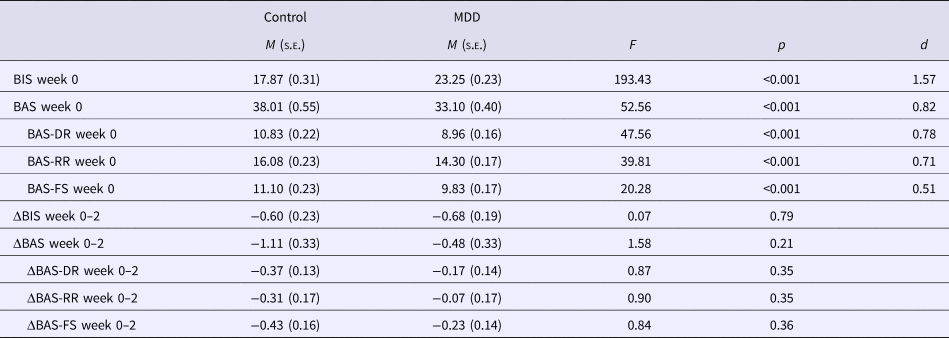
MDD, major depressive disorder; BIS, Behavioural Inhibition System; BAS, Behavioural Approach System; BAS-DR, BAS drive subscale; BAS-RR, BAS reward responsiveness subscale; BAS-FS, BAS fun-seeking subscale.
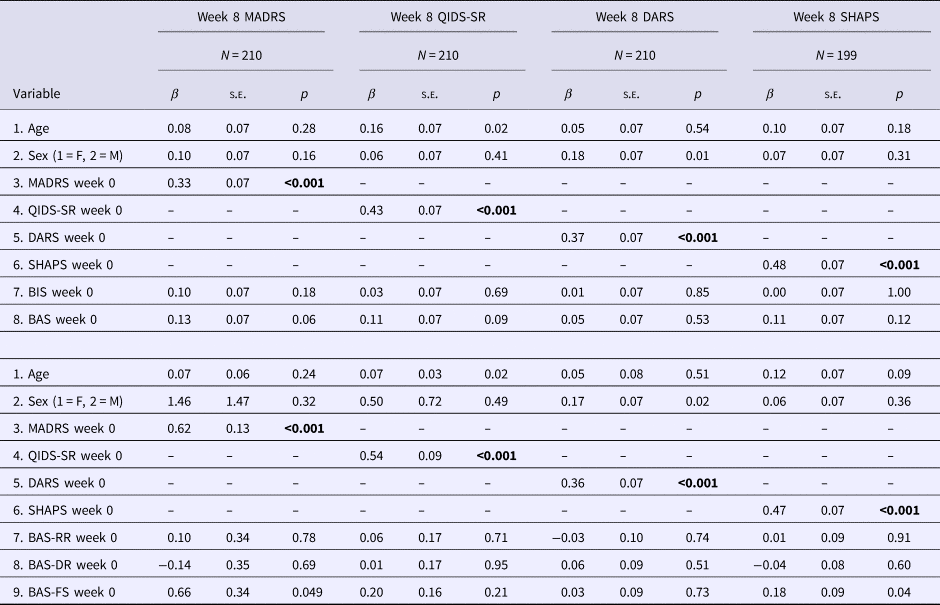
Multiple regressions predicting week 8 depression and anhedonia from BIS/BAS at baseline

Note: Bold signifies an effect survived Bonferroni correction for multiple comparisons.
MADRS, Montgomery–Åsberg depression rating scale; QIDS-SR, Quick Inventory of Depressive Symptomatology – Self Report; DARS, dimensional anhedonia rating scale; SHAPS, Snaith–Hamilton pleasure scale; BIS, Behavioural Inhibition System; BAS, Behavioural Approach System; BAS-DR, BAS drive subscale; BAS-RR, BAS reward responsiveness subscale; BAS-FS, BAS fun-seeking subscale.
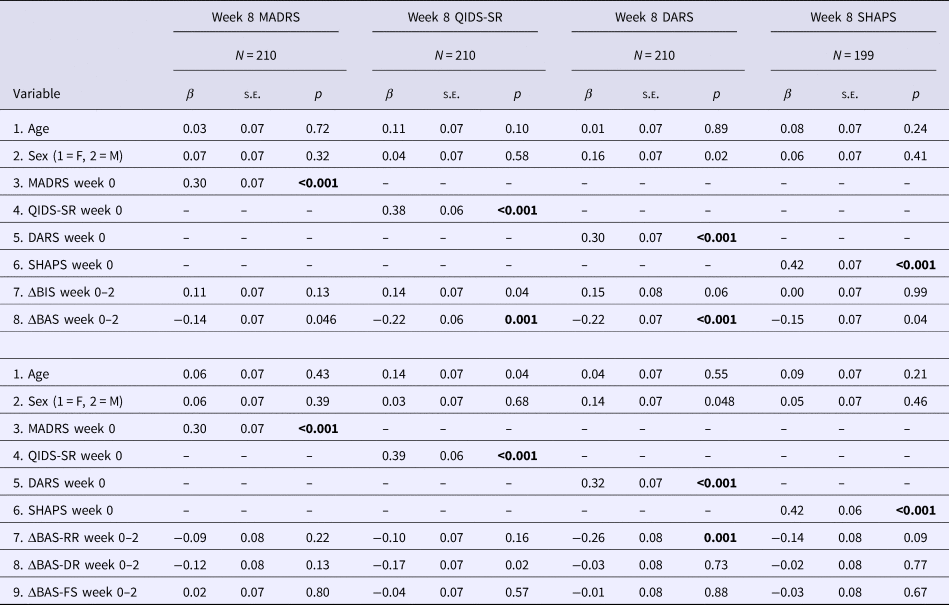
Multiple regressions predicting week 8 depression and anhedonia from early change in BIS/BAS

Note: Bold signifies an effect survived Bonferroni correction for multiple comparisons.
MADRS, Montgomery–Åsberg depression rating scale; QIDS-SR, Quick Inventory of Depressive Symptomatology – Self Report; DARS, dimensional anhedonia rating scale; SHAPS, Snaith–Hamilton pleasure scale; BIS, Behavioural Inhibition System; BAS, Behavioural Approach System; BAS-DR, BAS drive subscale; BAS-RR, BAS reward responsiveness subscale; BAS-FS, BAS fun-seeking subscale.
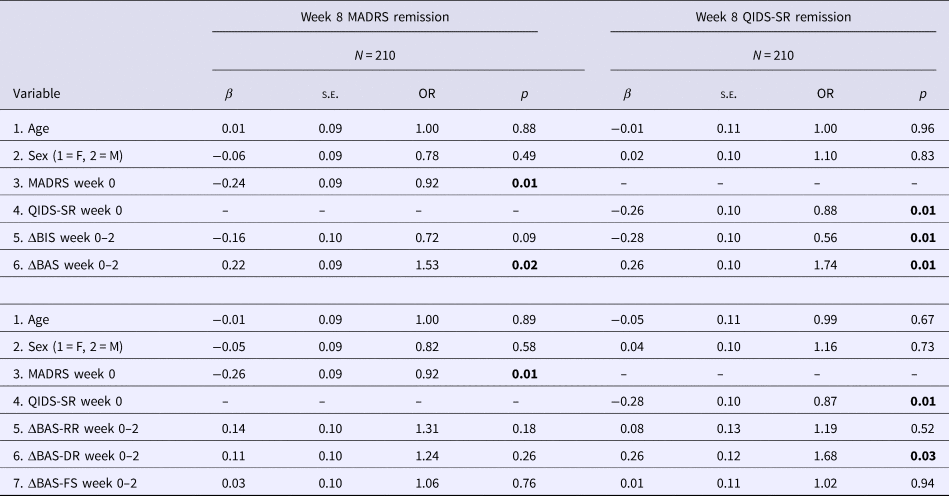
Logistic regressions predicting week 8 remission status from early change in BIS/BAS

Note: Bold signifies an effect is significant at p < 0.05.
MADRS, Montgomery–Åsberg depression rating scale; QIDS-SR, Quick Inventory of Depressive Symptomatology – Self Report; DARS, dimensional anhedonia rating scale; SHAPS, Snaith–Hamilton pleasure scale; BIS, Behavioural Inhibition System; BAS, Behavioural Approach System; BAS-DR, BAS drive subscale; BAS-RR, BAS reward responsiveness subscale; BAS-FS, BAS fun-seeking subscale.
Multiple regressions predicting depression and anhedonia in non-responders from early change in BIS/BAS

Note: Bold signifies an effect survived Bonferroni correction for multiple comparisons.
MADRS, Montgomery–Åsberg depression rating scale; QIDS-SR, Quick Inventory of Depressive Symptomatology – Self Report; DARS, dimensional anhedonia rating scale; SHAPS, Snaith–Hamilton pleasure scale; BIS, Behavioural Inhibition System; BAS, Behavioural Approach System; BAS-DR, BAS drive subscale; BAS-RR, BAS reward responsiveness subscale; BAS-FS, BAS fun-seeking subscale.
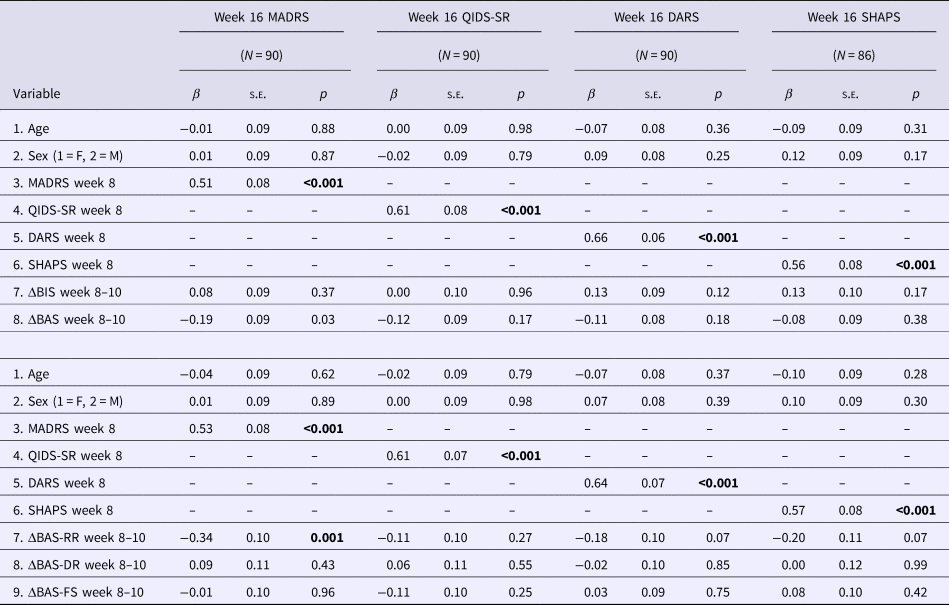
All analyses controlled for age, sex, and baseline scores on the outcome of interest. BIS and BAS were entered as simultaneous predictors in regression analyses to ensure that any observed effect was driven by unique variance associated with reward and/or punishment as opposed to shared variance between the two constructs. The three BAS subscales, which were anticipated to be positively correlated, were similarly treated as simultaneous predictors to control for their shared variance. For analyses examining change in BIS, BAS, and BAS subscales, we regressed each participant's week 2 score on their baseline score and saved the standardized residual. A similar approach was applied to measuring change in BIS and BAS between weeks 8 and 10, following the initiation of aripiprazole in non-responders. Each of our primary research questions were evaluated across four outcome measures (MADRS, QIDS-SR, DARS, and SHAPS) using two different sets of predictors (BIS/BAS broadband scores and BAS subscale scores). Accordingly, we applied a Bonferroni correction to account for multiple comparisons, dividing the standard α-value of 0.05 by 8 (four outcomes × two sets of predictors) to yield a corrected α-level of 0.0063. Follow-up logistic regressions using the traditional 0.05 α-level were also conducted to determine if change in BIS/BAS or the BAS subscale-predicted remission status at week 8 and week 16 (for non-responders only).
Results
Descriptive statistics and group differences in reward and punishment sensitivity
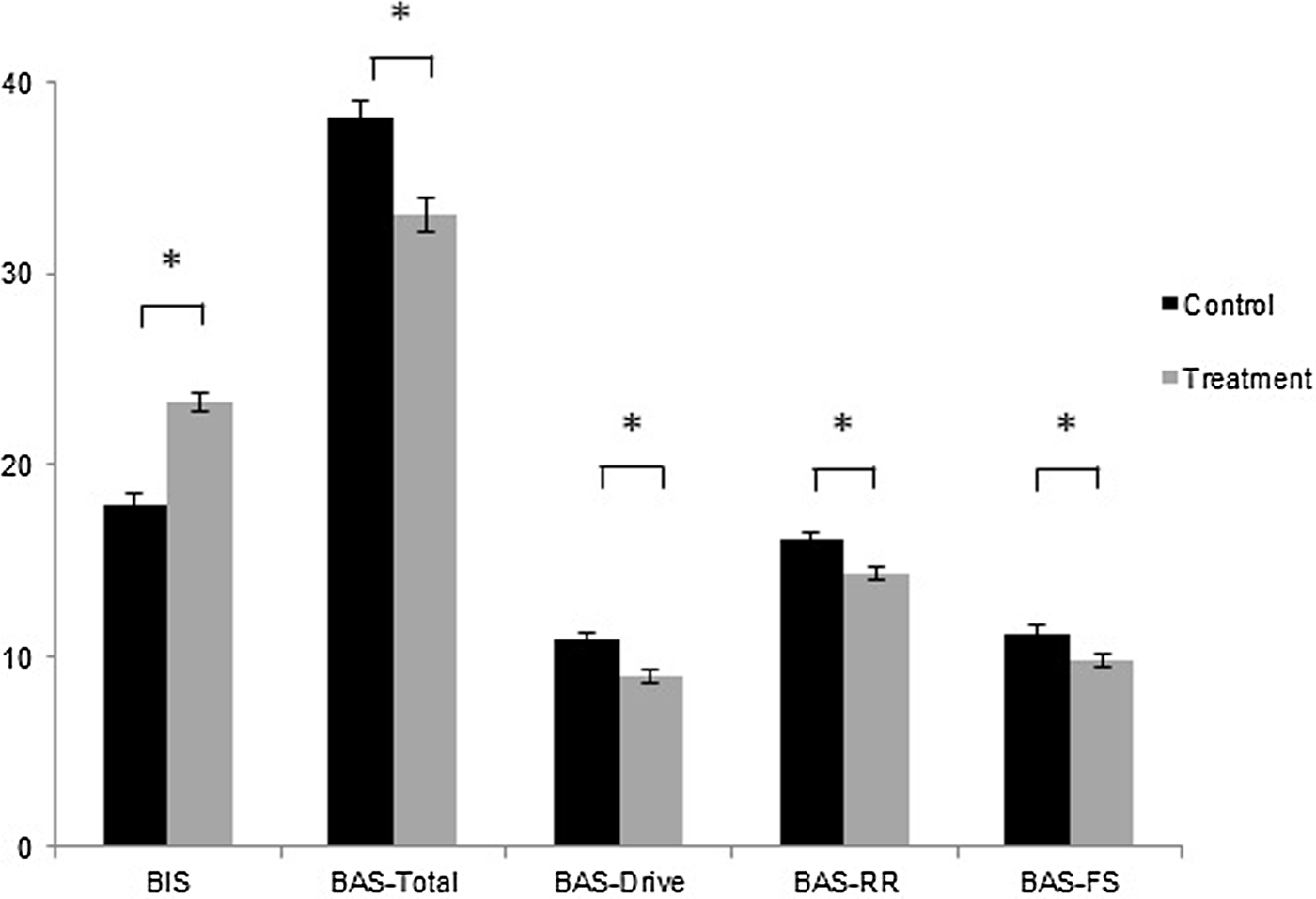
Group comparisons of baseline BIS/BAS and early change in BIS/BAS are displayed in Table 1 and Fig. 1. Analyses of covariance revealed that individuals with MDD demonstrated higher baseline BIS and lower BAS levels compared with the healthy controls, with large effect sizes. Similarly, the depressed group scored lower on all three BAS subscales. There were no significant group differences in the degree of change in BIS/BAS scales between baseline and week 2. Test–retest correlations between baseline and week 2 for the BIS/BAS and the BAS subscales ranged from r = 0.62 (BAS-RR) to r = 0.77 (BIS) in the healthy comparison sample and from r = 0.64 (BAS-RR) to r = 0.73 (BAS) in the treatment sample, indicating high 2-week stability in reward/punishment sensitivity across both groups. Within the MDD group, paired sample t tests indicated a significant decrease in BIS from baseline to week 2 (t = 3.57, p < 0.001), but no significant change in BAS or its subscales during the same period. Within the non-responders, total BAS (t = 2.40, p = 0.02) and BAS-RR (t = 2.38, p = 0.02) significantly increased from week 8 to week 10; there was no change in BIS, BAS-DR, or BAS-FS during the same period. Finally, correlations between the BIS/BAS scales and the four outcome measures were modest to moderate in size (no correlations had an absolute value above 0.43 in the full sample, or 0.51 in the non-responder group; see online Supplementary Tables S2 and S3), suggesting that the BIS/BAS scales retain unique variance despite being associated with symptoms over time.
Baseline differences in BIS, BAS, and BAS subscale scores between healthy controls and individuals diagnosed with MDD. *p < 0.001.

Relations between BIS/BAS and response to escitalopram
Relations between baseline levels of BIS and BAS and response to escitalopram are displayed in Table 2. Neither baseline BIS nor BAS was significantly associated with change in depressive or anhedonic symptoms. Similarly, no BAS subscales were associated with symptom change (baseline BAS-FS was positively associated with week 8 MADRS and SHAPS scores, neither effect survived an adjusted α-level of 0.0063).
Results examining the association between early change in BIS and BAS and improvements in depressive and anhedonic symptoms are displayed in Table 3. Increases in total BAS were associated with improvement in the DARS and QIDS-SR at week 8 (effects for the MADRS and SHAPS were significant at the traditional α-level of 0.05, but did not survive Bonferroni correction). Change in BIS was not associated with any of the week 8 outcomes. Follow-up logistic regressions examining whether early changes in the BIS/BAS predicted remission status at week 8 are presented in Table 4. Early improvements in BAS were associated with a higher likelihood of remission at week 8 on both the MADRS and QIDS-SR. Similarly, decreases in BIS predicted a higher likelihood of remission as assessed by the QIDS-SR. Adjusting for age, sex, and baseline depressive severity, a receiver operating characteristic (ROC) curve predicting remission at week 8 from early change in BAS yielded area under the curve values of 0.61 for the MADRS and 0.63 for the QIDS-SR, indicating only modest classification accuracy. Early change in BIS was a similarly poor classifier of remission status on the QIDS-SR at week 8 (AUC = 0.61).
At the subscale level, increases in the BAS-DR during the first 2 weeks of treatment predicted greater reduction of depressive symptoms on QIDS-SR at week 8, though the effect did not survive correction. As seen in Table 4, change in BAS-DR also predicted remission status on the QIDS-SR (AUC = 0.62), but not the MADRS. Increases in BAS-RR during the first 2 weeks of treatment were associated with greater improvement in anhedonia symptoms at week 8 as measured by the DARS. Finally, to ensure that any observed effects were not simply reflective of co-occurring changes in depressive symptoms, analyses using the MADRS and QIDS (for which we had data at baseline and week 2) were repeated controlling for change in depression during the first 2 weeks of treatment, rather than baseline depression. Results from these analyses are presented in online Supplementary Table S4. There were no substantive changes to the original results.
Relations between BIS/BAS and response to adjunctive aripiprazole in non-responders
Results of regression analyses examining whether early change in BIS and BAS predicted treatment response in escitalopram non-responders who received an additional 8 weeks of adjunctive aripiprazole are displayed in Table 5. Improvements in BAS during the first 2 weeks of combined escitalopram/aripiprazole treatment were associated with lower scores on the MADRS at week 16. At the subscale level, early improvements in BAS-RR also predicted lower scores on the MADRS at week 16. This effect did not apply to BAS-FS or BAS-DR, suggesting that the effect of change in total BAS on the MADRS was driven by improvements specific to BAS-RR. Nonetheless, follow-up logistic regressions yielded no significant effects of change in BIS/BAS or the BAS subscales on the remission status at week 16 (see online Supplementary Table S5).
Finally, changes in BIS and BAS during the first 2 weeks of augmentation with aripiprazole were not significantly associated with anhedonic symptom improvement from week 8 to week 16. Similarly, none of the three BAS subscales exhibited a pattern of early change that was associated with improvements in anhedonia at week 16. As in the full sample, analyses in the non-responders were similarly repeated controlling for change in depression during the first 2 weeks of aripiprazole. Results from these analyses are presented in online Supplementary Table S6. There were no substantive changes in the results reported in Table 5.Footnote 2
Discussion
The current study examined whether variations in the basic motivational systems that govern reward and punishment sensitivity are associated with symptoms of MDD, both at baseline and following a standard regimen of pharmacotherapy. Overall, we found strong evidence for deficits in both motivational systems among individuals with MDD, with deficits in the reward system being linked to anhedonia specifically. Moreover, changes in reward sensitivity during the first 2 weeks of treatment predicted patient response at week 8 in the full sample and at week 16 in the smaller non-responder sample.
Our results provide additional support for theoretical models linking MDD to disturbances in motivational systems (Depue and Iacono, Reference Depue and Iacono1989; Clark and Watson, Reference Clark and Watson1991; Gray and McNaughton, Reference Gray and McNaughton2000). Specifically, participants with MDD exhibited decreased reward sensitivity and increased punishment sensitivity compared with healthy controls, replicating previous studies in considerably smaller samples (Kasch et al., Reference Kasch, Rottenberg, Arnow and Gotlib2002; Pinto-Meza et al., Reference Pinto-Meza, Caseras, Soler, Puigdemont, Pérez and Torrubia2006).
Prospectively, we found little evidence supporting the value of BIS or BAS as baseline predictors of treatment response, despite other studies showing that traits closely related to BIS and BAS are associated with differential response to treatment when multiple interventions are used (Bagby et al., Reference Bagby, Quilty, Segal, McBride, Kennedy and Costa2008; Quilty et al., Reference Quilty, De Fruyt, Rolland, Kennedy, Rouillon and Bagby2008a). More compelling links between BIS/BAS and treatment response were uncovered when we examined early changes in reward and punishment sensitivity. Specifically, early improvements in BAS during the first 2 weeks of treatment with escitalopram were associated with fewer depressive and anhedonic symptoms at week 8. Importantly, these effects did not reflect sample-wide improvement in BAS scores (i.e. there was no ‘normalization of BAS’). Nonetheless, there were substantial early changes in BAS within individuals in the sample, and our results suggest that treatment outcomes are better for those of whom BAS does increase.
At the subscale level, improvements in BAS-RR uniquely predicted scores on the DARS at post-treatment. This effect did not generalize to the SHAPS, though it did withstand correction for multiple comparisons, suggesting it is unlikely to represent a Type II error. Whereas the DARS was designed to assess aspects of both incentive and hedonic reward capacity, e.g. items measure desire (wanting) and pleasure (liking), the SHAPS focuses exclusively on the inability to experience pleasure. Thus, it is possible that the association between early change in BAS-RR and improvements in the DARS reflects treatment-induced increases in hedonic capacity leading to enhanced incentive motivation, in part because enhanced pleasure during the consumption of a reward is also likely to spur an increased desire to attain future rewards (DeYoung et al., in press; DeYoung, Reference DeYoung2013).
Early change in BIS was associated with a higher likelihood of remission as assessed by the QIDS-SR, but was unrelated to our other outcomes. This was surprising given a recent meta-analysis that identified neuroticism as the personality trait that changes the most following administration of an SSRI (Roberts et al., Reference Roberts, Luo, Briley, Chow, Su and Hill2017). Others have found that BIS does not prospectively predict the course of MDD (McFarland et al., Reference McFarland, Shankman, Tenke, Bruder and Klein2006; Pinto-Meza et al., Reference Pinto-Meza, Caseras, Soler, Puigdemont, Pérez and Torrubia2006), suggesting it may be a state dependent characteristic of depression as opposed to a true marker of trait vulnerability (Bijttebier et al., Reference Bijttebier, Beck, Claes and Vandereycken2009). Alternatively, the discrepancy could be linked to differences between neuroticism and BIS, as neuroticism includes forms of externalizing negative affect that are not measured by BIS. One recent review found that SSRI-mediated change in neuroticism is driven primarily by reductions in anger and hostility, at least in healthy subjects (Ilieva, Reference Ilieva2015). If the true effect of SSRIs on neuroticism is indeed confined to reductions in anger and hostility, then an association between change in BIS- and SSRI-induced symptom reduction would be unlikely.
Finally, the current study was the first, to our knowledge, to examine relations between change in reward and punishment sensitivity and treatment outcome in non-responders receiving an adjunctive atypical antipsychotic agent. Early improvement in BAS-RR during the first 2 weeks of treatment with adjunctive aripiprazole was negatively associated with MADRS scores 6 weeks later, at the conclusion of the study. At present, the underlying neurobiological mechanism by which aripiprazole leads to changes in reward responsiveness is unclear, but alterations to dopaminergic transmission would seem to be a potential candidate given aripiprazole's action as a partial D2 receptor agonist. Nonetheless, other receptor effects mediated by aripiprazole may also influence reward responsiveness, and more integrative investigations would be helpful in clarifying these effects.
This study had several limitations. First, the BIS/BAS scales rely on self-report, which allows for the possibility that observed effects were state-dependent. Nonetheless, SSRI treatment produces greater change in traits related to BIS and BAS than placebo, even after controlling for symptom change, indicating that SSRI-induced trait change is not merely a function of mood state (Tang et al., Reference Tang, DeRubeis, Hollon, Amsterdam, Shelton and Schalet2009). Relatedly, observed associations were typically weaker for the MADRS compared with the QIDS-SR. Others have found that associations between personality and psychopathology are weaker when symptoms are assessed with interview-based measures as opposed to self-report (Kotov et al., Reference Kotov, Gamez, Schmidt and Watson2010). Consequently, larger samples may be needed to ensure adequate power to detect associations between BIS/BAS and psychopathology on interview-based measures. Finally, AUC values indicated that early change in BIS and BAS were poor classifiers of remission status at post-treatment, suggesting they may have limited clinical application at present. Nonetheless, our findings still offer important insights into the mechanisms that mediate patient response. Future research will be needed to examine whether classification accuracy can be improved with more precise measurement of reward and punishment sensitivity (e.g. combining self-report with behavioral indices), or by considering reward/punishment sensitivity in conjunction with other prognostic indicators.
Overall, the current study provides compelling evidence that MDD is associated with prominent deficits in the motivational systems governing reward and punishment sensitivity, and that change in these motivational systems – and particularly reward sensitivity – is associated with patient response to treatment. We hope future researchers will integrate these findings with neurobiological and behavioral paradigms in order to inform research into the etiology of MDD, the mechanisms underlying treatment response, and the potential clinical utility of motivational change.
Supplementary material
The supplementary material for this article can be found at https://doi.org/10.1017/S0033291718002441
Acknowledgements
We are indebted to all patients and clinicians for the time and effort they dedicated to their involvement in this research.
Financial support
CAN-BIND is an Integrated Discovery Program carried out in partnership with, and financial support from, the Ontario Brain Institute, an independent non-profit corporation, funded partially by the Ontario government. The opinions, results, and conclusions are those of the authors and no endorsement by the Ontario Brain Institute is intended or should be inferred. Additional funding is provided by the Canadian Institutes of Health Research (CIHR), Lundbeck, Bristol-Myers Squibb, Pfizer, and Servier. Funding and/or in kind support is also provided by the investigators’ universities and academic institutions. All study medications are independently purchased at wholesale market values.
Dr Uher has been supported by the Canada Research Chairs Program (award number 231397), and the Canadian Institutes of Health Research (grant reference numbers 124976, 142738, and 148394).
Dr Müller is supported by the Canadian Institutes of Health Research (CIHR Operating Grant MOP 142192), the National Institutes of Health (R01MH085801), and the Centre for Addiction and Mental Health Foundation (Joanne Murphy Professorship in Behavioural Neuroscience).
Dr Frey has received grant/research support from Brain and Behavior Research Foundation, Canadian Institutes of Health Research, Hamilton Health Sciences Foundation, J.P. Bickell Foundation, Ontario Brain Institute, Ontario Mental Health Foundation, Ontario Ministry of Research and Innovation, Pfizer, Physicians' Services Incorporated Foundation, and Teresa Cascioli Charitable Foundation, and has received consultant and speaker fees from Lundbeck.
Dr Lam has received honoraria for ad hoc speaking or advising/consulting, or received research funds from Akili, Allergan, Asia-Pacific Economic Cooperation, BC Leading Edge Foundation, Brain Canada, Canadian Institutes of Health Research, Canadian Depression Research and Intervention Network, Canadian Network for Mood and Anxiety Treatments, Canadian Psychiatric Association, CME Institute, Janssen, Lundbeck, Lundbeck Institute, Medscape, Mind Mental Health Technologies, Otsuka, Pfizer, St. Jude Medical, University Health Network Foundation, Vancouver Coastal Health Research Institute, and VGH Foundation.