INTRODUCTION
Autobiographical memory is impaired in patients diagnosed with schizophrenia. Their ability to recall personal events and facts from their lives is reduced (Baddeley et al., 1996; Feinstein et al., 1998; Riutort et al., 2003). Moreover, they recall few specific autobiographical memories (Riutort et al., 2003). The deficit of autobiographical memories is particularly marked in late adolescence and early adulthood (Elvevag et al., 2003; Feinstein et al., 1998; Riutort et al., 2003). Recently, conscious awareness associated with autobiographical memory has been investigated in schizophrenia (Danion et al., 2005). In non-mentally ill people, autobiographical memories may be associated with two kinds of conscious awareness, namely conscious recollection and feelings of knowing (Conway & Pleydell-Pearce, 2000; Tulving, 1985). Conscious recollection corresponds to the experience of traveling through subjective time and mentally reliving past events. Because most of consciously recollected memories are primarily related to our past and present goals, motivations, and desires, they are the support of a subjective sense of self insofar as we are able to recognize ourselves in our goals and desires and to produce a personal narrative. Such memories convey the belief that the self experiencing the present is the same as the self that experienced the past. In contrast, the subjective experience of simply knowing corresponds to mere awareness of self-related knowledge not present to the senses, and it is associated with a more abstract, conceptual sense of self. The states of awareness may be assessed using an experiential first person approach, where conscious recollection and simply knowing are operationally, defined in terms of the Remember/Know procedure (Conway et al., 1996; Piolino et al., 2003; Tulving, 1985).To explore the states of awareness associated with autobiographical memories in patients diagnosed with schizophrenia, Danion et al. (2005) used such an approach combined with an autobiographical memory enquiry. The enquiry was divided into 4 periods: From childhood to 9 years of age, from 10 to 19 years of age, from 20 years of age to one year before the test, and the current year. For each period, 3 events were investigated: a meeting or an event linked to a person, a trip or journey, and a family event. The results showed that the frequency of Remember, but not Know, responses associated with autobiographical memories was reduced in patients diagnosed with schizophrenia, indicating that the frequency of conscious recollection in autobiographical memory is reduced in these patients. Once again, the deficit was particularly marked in late adolescence and early adulthood.
When non-mentally ill people over the age of 35 are asked to recall autobiographical events that have occurred during their lifetime, there is a great preponderance of events dating back to when they were aged between 10 and 30. It has been proposed that this phenomenon, referred to as the reminiscence bump, is a product of the privileged encoding of experiences highly relevant to an individual during adolescence and early adulthood, both critical periods for the development and consolidation of identity (Conway & Pleydell-Pearce, 2000; Fitzgerald, 1988). Based on evidence that public and private events have different lifespan distributions relating to two different aspects of identity, it has been proposed that the reminiscence bump itself comprises two components (Holmes & Conway, 1999). An early component concerns memories relating to social identity corresponding mainly to public events that occurred when “rememberers” were aged between approximately 10 and 20 years old. During this period individuals may identify with a particular cultural, social, political, or religious group with whom they share common goals and desires. The notion of public event is not referring to semantic knowledge, but rather a memory of a personally experienced episode (e.g., the individual was directly involved in the event, or has its own experience of the event). A later component concerns autobiographical memories relating to the last stage of personal identity development and corresponding to private events that occurred when the individuals were between the ages of approximately 20 and 30. This is the period when individuals' goals and desires are to interact with significant others and to form close personal relationships. Consciously-recollected memories from these two periods are believed to play a crucial role in the emergence of a coherent, stable subjective sense of identity (Habermas & Bluck, 2000). The relationship between autobiographical memory and identity is further supported by a neuropsychological study of patients with Alzheimer's disease showing that impairments of autobiographical memory, particularly for early adulthood, were related to changes in the strength and quality of identity. These findings support the critical role of early adulthood autobiographical memories in identity and suggest autobiographical memory loss affects identity (Addis & Tippett, 2004).
It has long been recognized that schizophrenia is associated with a disturbance of personal identity and the sense of self (Bleuler, 1911; Hemsley, 2005; Jaspers, 1963). The time when the deficit of autobiographical memories in patients diagnosed with schizophrenia is particular marked (i.e., late adolescence and early adulthood) corresponds to the period during which personal identity is being constructed and consolidated. It has thus been proposed that schizophrenia is associated with impaired autobiographical memories that pertain to the last stage of personal identity development and lead to abnormalities of the subjective sense of self (Riutort et al., 2003). However, previous studies of autobiographical memory in schizophrenia used traditional autobiographical memory enquiries, which did not make it possible to establish that the defect of autobiographical memory concerned memories highly relevant to personal identity. The issue of the relationship between autobiographical memory and identity may be addressed through the exploration of the reminiscence bump phenomenon. Such was the aim of this study. A procedure specifically designed to explore the reminiscence bump combined with the Remember/Know paradigm was used. Patients diagnosed with schizophrenia and normal controls over the age of 35 were selected, a condition required to observe the reminiscence bump phenomenon. Participants were asked to recall 20 important autobiographical memories, and were told to reply with the first autobiographical memories that came to mind. Then, they were asked to date each event recalled and to indicate the subjective state of conscious awareness associated with the recall of what had happened and where and when. Finally, they were asked to state whether these memories related to private or public events.
Given that the deficit of autobiographical memory is particularly marked in late adolescence and early adulthood, the later component of the reminiscent bump phenomenon was expected to be impaired in patients diagnosed with schizophrenia. As aforementioned, this component relates to personal identity development and corresponds mainly to private events that occurred between the age of approximately 20 and 30. Therefore, patients were expected to recall less private events than controls. In contrast, the recall of public events and the earlier component of the reminiscence bump, relating to social identity and corresponding mainly to public events that occurred between the ages of 10 to 20, were expected to be spared in patients diagnosed with schizophrenia. Because of the relative abundance of memories of public events, the overall reminiscence bump was predicted to peak earlier in patients than in control participants. Because schizophrenia is associated with low levels of specific autobiographical memories and conscious recollection (Danion et al., 2005; Riutort et al., 2003), reduced levels of specific autobiographical memories and Remember responses were also expected in patients diagnosed with schizophrenia. Finally, in keeping with Holmes and Conway (1999), an exploratory analysis of autobiographical memories according to the content of the recalled events was carried out to assess the frequency of events particularly relevant to the psychopathology of schizophrenia, such as events linked with personal relationships.
METHODS
Subjects
Twenty-seven patients diagnosed with schizophrenia (13 men and 14 women) over the age of 35 years were recruited from the outpatient clinics of the Psychiatry Department of the University Hospital in Strasbourg (France). They all met the DSM-IV criteria for schizophrenia (paranoid, N = 13; residual, N = 8; undifferentiated, N = 6), as determined by consensus of the current treating psychiatrist and a senior psychiatrist belonging to the research team, and they were all clinically stabilized. The mean age for the group diagnosed with schizophrenic was 50.0 years (SD = 7.3, range 39–74). The mean age at onset of symptoms, defined as the first psychiatric consultation or hospitalization, was 22.2 years (SD = 6.5, range 11–40 years) and the mean duration of illness was 27.6 years (SD = 9.8, range 7–51). Patients with a history of traumatic brain injury, epilepsy, alcohol and substance abuse, or other diagnosable neurological conditions were excluded from the study, as were patients with a Mini-Mental State Examination score of less than 27. Eight patients were receiving typical neuroleptics (mean dose, 216.9 mg, SD = 157.8, of chlorpromazine or equivalent) and 19 were receiving atypical neuroleptics (3 amisulpride, 11 risperidone, 3 zyprazidone, and 2 clozapine). Four patients were also receiving an antiparkinsonian treatment (tropatepine, mean dose 20 mg, trihexyphenidyl, mean dose 5 mg) and 11 a chronic benzodiazepine treatment. Global psychiatric symptoms (Table 1) were assessed in patients by means of the Brief Psychiatric Rating scales (BPRS). Positive and negative symptoms were assessed with the Scale for Assessment of Positive Symptoms (SAPS) and the Scale for Assessment of Negative Symptoms (SANS).
Clinical and neuropsychological characteristics of patients diagnosed with schizophrenia and control participants

The comparison group consisted of 27 healthy subjects (12 men, 15 women) matched for age (mean = 49.9 years, SD = 6.6, range 37–70) and educational level (Table 1). Sex ratio did not differ between groups (χ2 = .075, P = .78). Control participants had no history of alcoholism or other drug abuse or psychiatric illness and were not taking any medication. The number of perseverative errors in the Wisconsin Card Sorting Test (WCST) (Nelson, 1976) was higher in patients than in comparison subjects, whereas the number of correct responses given in a category generation task assessing semantic fluency was lower.
After providing a complete description of the study to the participants, written informed consent was obtained. The research was completed in accordance with the Helsinki Declaration.
Procedure
The procedure was adapted from Holmes and Conway (1999). Participants were asked to recall 20 important autobiographical events that had occurred during their lifetime and were told to reply with the first autobiographical memories that came to mind. An autobiographical memory was defined as a memory of a specific event that had occurred over a period of minutes or hours. The participants were free to take their time to answer. They were then asked to describe events in as much detail as possible. Whenever memories were too general, cues were provided (e.g., Where were you at the time, what were you doing, who was there, how did you feel?).
After providing all 20 memories, participants were asked to date each of them by giving their age in years and months at the time of the events. Then, for each autobiographical event, they were asked to indicate their subjective states of conscious awareness associated with the recall of what had happened and where and when (they had thus 3 judgments to provide for each recalled event). This procedure makes it possible to assess both the frequency of the subjective states of awareness for autobiographical memories and their consistency (i.e., the likelihood that all aspects of an event are associated with the same subjective state of awareness). Participants were required to give a Remember, Know, or Guess response depending on whether each aspect of the event recalled was associated with conscious recollection, simply knowing, or guessing, respectively (Danion et al., 2005; Gardiner et al., 1996). A Remember response was defined as the ability to relive mentally specific aspects such as perceptions and thoughts or feelings that occurred or were experienced at the time of the event. Participants were asked to give details out loud to ensure they used the Remember responses properly. A memory was deemed to be consistently recollected when it was associated with three Remember responses (for what, where, and when). An example of such a memory is that of a wedding (the participant recollected very specific details of the ceremony) that took place in a particular church (the participant relived the specific atmosphere) two years ago (the participant recollected the thoughts regarding the fact that the wedding was taking place exactly five years after his own marriage). A Know response meant simply knowing what had happened, where, and when, but in the absence of any conscious recollection (in the aforementioned example, the participant simply knew he/she had attended this wedding). A Guess response corresponded to events that were merely guessed rather than consciously recollected or simply known (i.e., the participant guessed the wedding took place two years ago). Finally, participants were asked to state whether their memories related to private or public events. Private events were defined as events from their own lives, which they considered to be important. Public events were defined as local, national, or international events relating for instance to wars, murders, politics, sports, or entertainments.
The level of specificity of each memory was rated by two independent raters blind to the diagnosis. In the few cases where the two ratings differed, the final rating was agreed between the two raters. In keeping with Borrini et al. (1989), memories were scored separately on content and details. They were given scores of 0, 1, or 2 for content and 0, .5, or 1 for detail. Content related to the actual event around which the recollection revolved (i.e., “My wallet was stolen when I was waiting the train of 21.42H at the North railway station”). A detail was either a direct consequence of the event or marginal features of it (i.e., “Having no ticket, I spent that night at the Salvation Army”). An accepted piece of content scored 1 or 2 and an accepted detail scored .5 or 1, according to the fluency and vividness of narration. Content and detail scores were then added together so that each memory scored between 0 and 3.
Statistical Analyses
Recalled events were defined as the statistical unit. Quantitative variables were described using means and standard deviations. Between-group comparisons of participants' mean ages at the time of the events were performed using ANOVAs. Qualitative variables were described using the number of observations and proportions. Chi squared and exact Fisher tests were used to compare proportions.
To estimate the reminiscence bump, plots of the probability of recalled events' density function versus time (density functions curves) were computed. The life table method (actuarial method) was used with five-year intervals and one-year intervals. Because the two analyses yielded the same results, only those results obtained with the five-year intervals were presented.
Because of the non-independence of statistical units, a significant threshold was set at p < .001. The statistical analysis was performed using SAS software, version 8.2 for Windows.
RESULTS
The frequencies of memories according to their private or public nature, content, and associated states of awareness are presented in Table 2.
Number (n) and percentage (%) of autobiographical memories according to their content, public or private nature and associated states of awareness

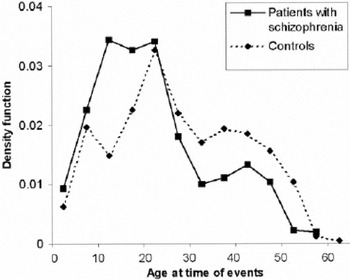
An ANOVA performed on the mean age of participants at the time of the events yielded a significant difference between groups, with patients diagnosed with schizophrenia (mean age = 22 years, SD = 12.7) younger than control participants (27 years, SD = 13.8, F = 14.05, df = 1, p < .001). Moreover, the density function curve of all recalled events (collapsed across private and public events, Fig. 1) showed that the reminiscence bump peaked in the 16 to 25-year period for patients and the 21 to 25-year period for controls. These results indicate that the reminiscence bump peaked earlier in patients than in controls.

Density function curves of all recalled events for controls and patients diagnosed with schizophrenia.
Patients recalled approximately twice as many public events as controls (χ2 = 23.4, P = .0001). In the case of private events, the density function curve showed a reminiscence bump peak in the 21- to 25-year period for both groups. In the case of public events, patients showed a marked reminiscence bump-peak in the 16- to 20-year period (Fig. 2). This peak was attenuated in control participants.

Density function curves of recalled events according to their public and private nature.
The memory specificity ratings were significantly lower in patients (mean = 2.37, SD = .42) than in control participants (mean = 2.91, SD = .13, t = −6.28, df = 52 p < .001). Table 2 shows the frequency of Remember, Know, and Guess responses associated with memories according to what happened and where and when. Most of the control participants' memories were associated with Remember responses for what happened and where, the Remember responses associated with the recall of when events happened being less frequent. Patients diagnosed with schizophrenia provided significantly fewer Remember responses, and more Know and Guess responses, than the controls for what happened, where and when.
In keeping with Holmes and Conway (1999), an exploratory analysis of memories according to the content of the recalled events was carried out (Table 2). Five categories of events were used. The Relationship category consisted of references to marriages, divorces, anniversaries, and other relationship events of prominent public figures, the participant's own family members, or friends. The Births/Deaths category referred to births and deaths, both public and private. The Work/Education category consisted of references to school, university, or work. The Home/Leisure category referred to experiences in the home or to leisure activities such as sport and entertainment. Finally, the Illness category consisted of references to illness.
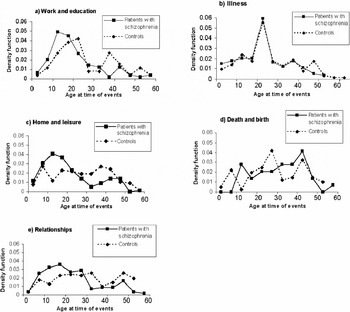
The distribution of memories across categories differed significantly between the two groups (χ2 = 40.1, P < .0001). Patients recalled significantly fewer events relating to births and deaths than controls but more events relating to work and education. The density function curve of the different categories of recalled events shows that in the case of control participants the reminiscence bump peak was in the 21- to 30-year period for events of all but one category, the Home/Leisure category (the density function curves of recalled events relating to home and leisure, work and education, and illness are shown on Fig. 3). Patients exhibited a reminiscence bump peak for events relating to illness in the 21- to 25-year period and a reminiscence bump peak in the 11- to 20-year period for all the remaining event categories. These results indicate that patients diagnosed with schizophrenia exhibited reminiscence bump abnormalities compared to control participants.

Density function curves of recalled events according to their content.
To explore the relationship between the reminiscence bump peak and the age at the onset of schizophrenia, secondary analyses were carried out on three subgroups of patients defined according to their age at the onset of schizophrenia. The early onset group comprised 3 patients with an onset before 15, the intermediate onset group 18 patients with an onset between 15 and 25, and the late onset group 6 patients with an onset after 25. In the intermediate onset group the reminiscence bump peaked in the 21- to 25-year period, compared with the 16- to 20-year period in the other two groups (data not shown). Therefore, there was no linear relationship between the reminiscence bump peak and age at onset of schizophrenia.
The number of Remember responses was not significantly correlated with the BPRS, SAPS, or SANS ratings or with the WCST and fluency performance in the patients' (rs < .30, n = 27, ps > .12) and controls' (rs < .27, n = 27, ps > .17) groups. Finally, the patients' density function curves did not vary with the type of neuroleptics (typical or atypical), the prescription of benzodiazepines, or the clinical subgroups (paranoid versus non paranoid; data not shown).
DISCUSSION
As previously shown (Holmes & Conway, 1999), control participants exhibited an overall reminiscence bump that peaked in the 21- to 25-year period and comprised two components, one, peaking in the 21- to 25-year period, corresponding to private events and the other peaking in the 16- to 20-year period, corresponding to public events. As predicted, patients recalled less private and more public autobiographical events than control participants, and their reminiscence bump for public events was particularly marked. They dated the recalled events earlier than controls and exhibited an early overall reminiscence bump that peaked in the 16- to 25-year period, probably because of the relative abundance of memories of public events. Finally, an exploratory analysis of memories according to the content of the recalled events showed that patients recalled fewer less events relating to births and deaths than controls but more events relating to work and education. Unlike control participants, they exhibited a reminiscence bump that peaked in the 11- to 20-year period for all types of events but one, that of events relating to illness. Taken together, these results indicate that patients diagnosed with schizophrenia exhibited an early and abnormal reminiscence bump, with a predominant impairment of its later component concerning autobiographical memories of private events. This component, peaking in the 20- to 30-year period, corresponds to the last stage of personal identity development, when individuals' goals and desires are to interact with significant others and to form close personal relationships. In contrast, the early component of the reminiscence bump concerning social identity, and corresponding mainly to memories of public events, seemed relatively preserved. These results are consistent with previous evidence that autobiographical memory impairments of patients diagnosed with schizophrenia are particularly marked in late adolescence and early adulthood (Elvevag et al., 2003; Feinstein et al., 1998; Riutort et al., 2003). In keeping with the proposal that impaired personal identity is a fundamental disturbance in schizophrenia (Bleuler, 1911; Jaspers, 1963), suggest that this illness is associated with an impairment of autobiographical memories of events that had occurred during the last stage of personal identity development.
The analysis of memory specificity and the states of awareness associated with the recalled events showed that, compared with control participants, patients diagnosed with schizophrenia gave fewer specific memories and Remember responses and more Know and Guess responses for what happened and where and when. This confirms that the frequency of specific autobiographical memories and conscious recollection is reduced in schizophrenia (Danion et al., 2005). The new finding here is that this reduction concerns memories reflecting the reminiscence bump phenomenon (i.e., memories that are highly relevant to the subjective experience of identity). Because these consciously-recollected memories convey the belief that the self experiencing the present is the same as the self that experienced the past and their reduced frequency, and specificity is likely to be associated with a defective subjective sense of personal identity and an abnormal mental representation of the self. This is in keeping with autobiographical reports and informal interviews, indicating that schizophrenia is associated with an impaired subjective sense of a continuous self extended in time (Freedman & Madison, 1974; see also Sass & Parnas, 2003). The finding of increased frequency of Know and Guess responses is in line with previous evidence from an autobiographical memory study (Danion et al., 2005) which found that simply knowing is intact in schizophrenia. Because the level of Know responses in the control group was low, however, this finding needs to be replicated using a more discriminative protocol.
Patients' results cannot be explained by drug treatment or by a general, non-specific reduction in cognitive functions, because all patients had a Mini-Mental-State Evaluation score of 27 or higher, and their pattern of responses was independent of WCST and fluency performance. The influence of such factors, however, cannot be ruled out completely, given the relatively low number of patients included in the study. The location of the reminiscence bump peak in the two groups is not an artifact of the broad time (5 years) intervals used, because the same location was also found when a one-year interval was used to estimate the density function. Patients' results may also be questioned because it cannot be ensured that the events recalled actually occurred. Literature on false memory in schizophrenia (i.e., memories of events that never occurred or that have become distorted, is conflicting). According to two studies, patients diagnosed with schizophrenia produce a lower number of false memories than control subjects (Elvevag et al., 2004; Huron & Danion, 2002), whereas one study shows no differences between groups (Moritz et al., 2004). The finding that patients recalled more public events and less private events than controls cannot be explained by an over-representation of spared semantic versus impaired episodic memories. The distinction between public and private events is not akin to the distinction between semantic and episodic knowledge because, in this study, both types of events are referring to personally experienced events situated in place and time. Lastly, it could be argued that the patients' response pattern was caused by differences in how patients and comparison subjects interpreted the Remember/Know distinction. However, this seems unlikely. Numerous precautions were taken during the task to ensure participants fully understood the meanings of Remember, Know, and Guess responses. It has also been shown that the qualitative (i.e., perceptual, spatial, temporal, semantic, emotional) characteristics of the subjective experience of conscious awareness are the same for patients as for control participants (Huron et al., 2003).
Several encoding and retrieval mechanisms, not mutually exclusive, may account for the reminiscence bump abnormalities in schizophrenia. First, defective retrieval processes may explain an overall reduction in performance, such as the fewer Remember responses observed in all lifetime periods, and a defect of the subjective sense of self (Danion et al., 2005; Huron et al., 2003). In addition, the defective sense of self may itself reduce the accessibility of highly self-relevant autobiographical memories. Second, a defect of encoding or acquisition processes may account for the aggravation of autobiographical memory abnormalities reported after the onset of the disease (Danion et al., 2005; Elvevag et al., 2003; Riutort et al., 2003). Third, some autobiographical memory abnormalities may merely be caused by the fact that, owing to their illness, patients had a poorer and more restricted life than normal subjects and, hence, encountered few memorable life events. This may explain the reduced frequency of private events recalled by patients, and the finding of a reminiscence bump peak for education and relationships in the 11- to 20-year period, rather than in the 21- to 30-year period: unlike control participants, most patients were unable to go to university or to have a job, and had few relationships during the 21- to 30-year period. However, this hypothesis does not explain the finding that patients recalled significantly fewer events relating to births and deaths than controls but more events relating to work and education. Conversely, it is unclear why patients and controls, despite a different history of illness, exhibited similar reminiscence bumps for events relating to illness.
Fourthly, the reminiscence bump abnormalities observed in patients diagnosed with schizophrenia may be related to the formation of abnormal life goals. It has been proposed that, in non-mentally ill people, the reminiscence bump is the product of privileged encoding of experiences highly relevant to an individual during a critical phase for development and consolidation of the self (Holmes & Conway, 1999). According to the model of autobiographical memories developed by Conway and Pleydell-Pearce (2000), the formation of autobiographical memories is controlled by a set of life goals, the working self. Conway and Pleydell-Pearce (2000) introduced this term to establish a direct link with the concept of working memory developed by Baddeley as a set of control, strategic processes. Through its current life goals, motivation, and desires, the working self functions as a control process that coordinates and modulates the encoding and retrieval of autobiographical memories. Autobiographical memories often occur in response to experiences of goal achievement or failure, and they organize autobiographical knowledge by functioning as self-reference points. The abnormal reminiscence bump observed in patients diagnosed with schizophrenia might therefore reflect the formation of abnormal life goals. There is clinical evidence to show that patients diagnosed with schizophrenia fail to define and maintain coherent and enduring personal life goals. Moreover, such goals may be atypical or inappropriate (Baddeley et al., 1996). Experimental investigations have confirmed that patients diagnosed with schizophrenia exhibit an inability to define appropriate goals and sub-goals in various cognitive tasks (e.g., Gras-Vincendon et al., 1994). Such a view implies that schizophrenia is associated with an impairment of the working self and the construction and consolidation of personal identity.
This study does not make it possible to assess the respective contribution of encoding and retrieval mechanisms to the impairment of the reminiscence bump phenomenon in schizophrenia. Future research should tease apart the role played by these different mechanisms and establish the causal chain of events leading to abnormalities of personal identity. Because they might have important therapeutic and neuropsychological implications, further studies of the relationship between defective life goals and impaired consolidation of personal identity in schizophrenia are needed. There might be room, during the critical period of development of personal identity, for psychotherapeutic and psychosocial measures aimed at helping patients to establish and maintain their personal life goals and, hence, to organize their autobiographical knowledge more effectively.
Evidence of abnormal construction of personal identity may also imply that preexisting brain abnormalities interfere with this construction. Schizophrenia is associated with frontal dysfunction and parietal, temporal, and frontal gray matter loss occurring during adolescence (e.g., Thompson et al., 2001). However, evidence from developmental amnesia indicates that not all preexisting brain abnormalities interfere with the construction of personal identity (Vargha-Khadem et al., 2001). Patients with a history of damage restricted to the medial temporal lobe system sustained perinatally or during childhood exhibit a marked impairment of autobiographical memory, but no gross abnormalities of personal identity. Together with evidence that frontal lobes play a major role in the capacity to represent the self in the past, present, and future (Wheeler et al., 1997); and to form long-term goals (Conway, 2005), these results are consistent with the hypothesis that abnormal construction of personal identity in schizophrenia might be related to a dysfunctional network involving frontal regions and their connections with other cortical structures. According to this view, the abnormal consolidation of personal identity might represent a psychological counterpart of the neurodevelopmental theory of schizophrenia.
ACKNOWLEDGMENTS
This research was supported by Institut National de la Santé Et de la Recherche Médicale (INSERM).