


Introduction
Since April 2023, Sudan’s civil war has placed the country’s archaeological and museum heritage under severe threat. Museums and storerooms have been looted or damaged (Figure 1), heritage professionals displaced and access to sites and museums curtailed. Despite these conditions, Sudan’s authority for archaeological sites and museums—the National Corporation for Antiquities and Museums (NCAM)—along with Sudanese archaeologists and international partners, has implemented emergency responses, including damage assessment, documentation, satellite monitoring, and measures to counter illicit trafficking (Idriss Ahmed & Emberling Reference Idriss Ahmed and Emberling2025). These efforts highlight both the vulnerability of cultural heritage in times of war and the resilience of heritage practitioners (Bashir & Näser Reference Bashir and Näser2025). Within this context, digital and remote initiatives have emerged as critical tools for documentation, access and engagement with endangered Sudanese heritage (Drici Reference Drici2024; Lemos et al. Reference Lemos2025).
View from inside the main building toward the entrance of the Sudan National Museum following extensive destruction and looting; the reconstructed tomb of Djehutyhotep is partially visible on the left (photograph courtesy of the NCAM).

Due to its prominent position within Sudan’s heritage sector, the Sudan National Museum has become a central focus for efforts to mitigate the impact of the current civil war on the country’s cultural heritage (Abusalih Reference Abusalih2025). Before it was targeted by the Rapid Support Forces (RSF) militia, the museum housed an estimated 100 000 objects spanning prehistory (c. 5000 BCE) through the Islamic period (from 1323 CE). Its original holdings included key artefacts from Kerma, the earliest complex state south of the Sahara (c. 2500–1500 BCE); objects from phases of Egyptian occupation during the Bronze Age (c. 1550–1070 BCE); and material from the Napatan and Meroitic kingdoms of Kush (ninth century BCE–fourth century CE). The museum also preserved the exceptional Christian frescoes from Faras Cathedral (seventh–fourteenth centuries CE).
The UNESCO International Campaign to Save the Monuments of Nubia played a decisive role in shaping the Sudan National Museum and its collections (Rilly Reference Rilly2013). In the 1960s, several monumental structures originally built by the ancient Egyptians in Lower Nubia (northern Sudan) were threatened by flooding from the reservoir created by the Aswan High Dam. These monuments were dismantled, transported and reassembled in the museum’s courtyard, becoming a key part of its collection. In addition to the RSF’s looting of the museum’s holdings, these monuments have suffered damage from shelling.
In this article, we describe a digital archaeology project that aims to mitigate the effects of the ongoing civil war on Sudan’s heritage. The Sudan Virtual Museum is the result of a partnership between the Section Française de la Direction des Antiquités du Soudan (SFDAS) and NCAM, with the collaboration of Durham University. The digital museum offers a virtual tour of galleries featuring now-looted objects from the Sudan National Museum’s collection, as well as the tomb of Djehutyhotep, one of the monuments reassembled in the museum’s garden during the UNESCO Nubian campaign.
Rehabilitating the Sudan National Museum
Before the outbreak of the war, a major initiative led by NCAM and UNESCO was underway to restore, modernise and promote Sudan’s principal archaeological museum in Khartoum as a cultural hub and a symbol of national heritage. The Rehabilitation of the Sudan National Museum project, financed by the Italian government, was formally launched with a technical agreement signed on 29 November 2018 between UNESCO, the Italian government and the Sudanese Ministry of Culture, Tourism and Antiquities. The project aimed to rehabilitate the museum’s facilities, redesign its exhibitions in line with contemporary museological standards and strengthen its role in education, tourism and social development. Plans for the renewed museum included updated exhibition layouts, extensive capacity-building programmes for staff and a revitalised cultural agenda designed to support intercultural dialogue and peace-building efforts.
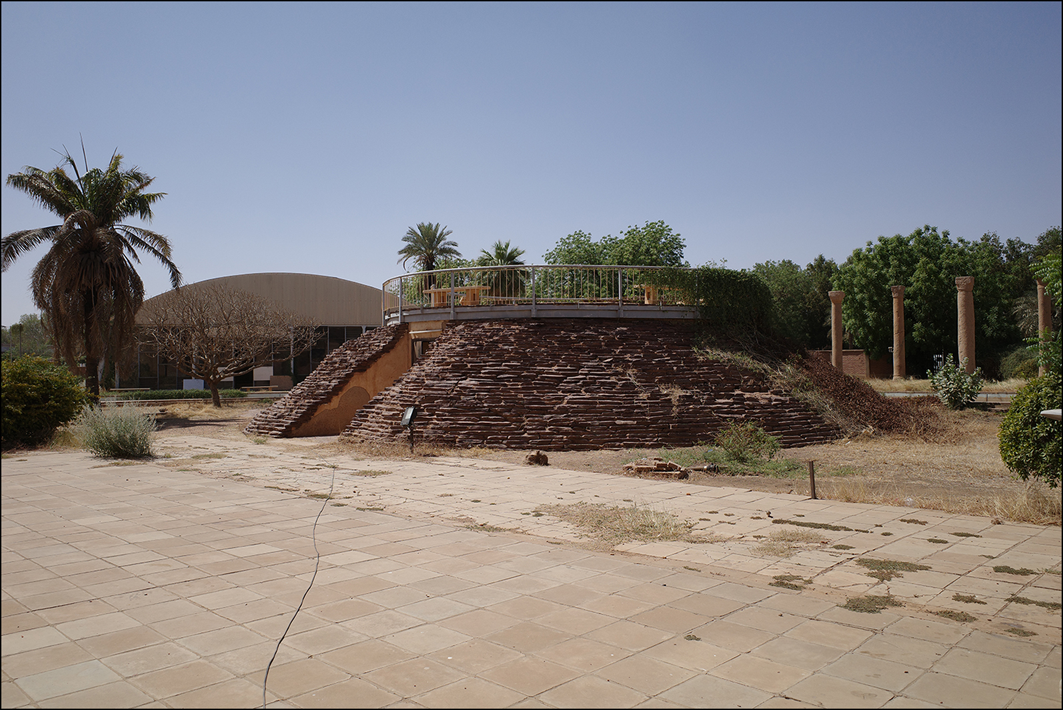
As part of the broader efforts to rehabilitate the Sudan National Museum, a project dedicated to the museum’s external areas—sections not covered in the initial rehabilitation programme—began in April 2023. This initiative centred on the reassembled tomb of Djehutyhotep (Figure 2). Originally located in Debeira East, Lower Nubia, the tomb was dismantled in 1963 and reassembled in 1970 in the garden of the Sudan National Museum. The project aimed to assess the monument’s state of preservation, conduct emergency conservation of its architectural elements and associated objects, and produce comprehensive digital documentation. This documentation was intended to support a wider research programme that incorporated archaeological science approaches to the tomb’s decorated features and material culture. Although the outbreak of the current war abruptly halted the initiative, a preliminary photogrammetric survey of the tomb’s components was conducted before the start of the war, forming the foundation for later digital preservation efforts (Lemos et al. Reference Lemos2025).
The exterior of the artificial mound that houses the reassembled remains of the tomb of Djehutyhotep in the garden of the Sudan National Museum (viewed from approximately the same angle as in Figure 1) (photograph taken in April 2023 by R. Lemos).

Virtual tours of inaccessible heritage
In 2024, the Djehutyhotep Project partnered with the Sudan Virtual Museum Project, led by the SFDAS. Together, these initiatives constitute a key strategy for mitigating the effects of the war on Sudan’s heritage by preserving knowledge of artefacts and monuments in their pre-war state, enabling access to cultural materials that have been damaged, looted or remain inaccessible, and contributing to efforts to curb the illicit trade of archaeological objects.
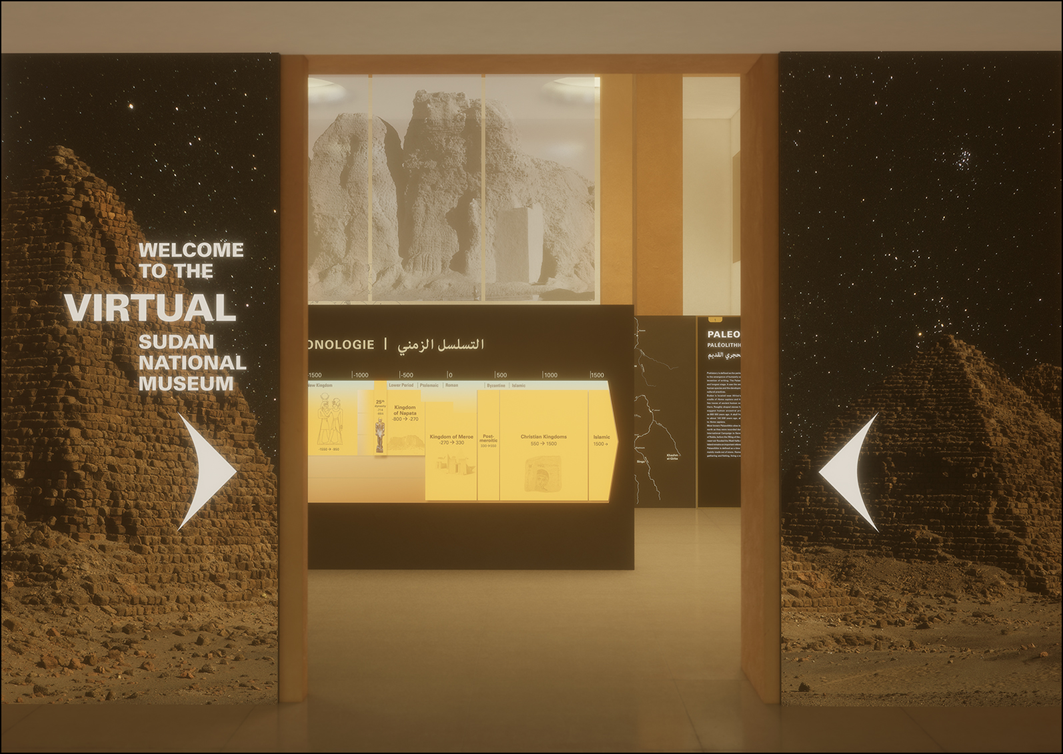
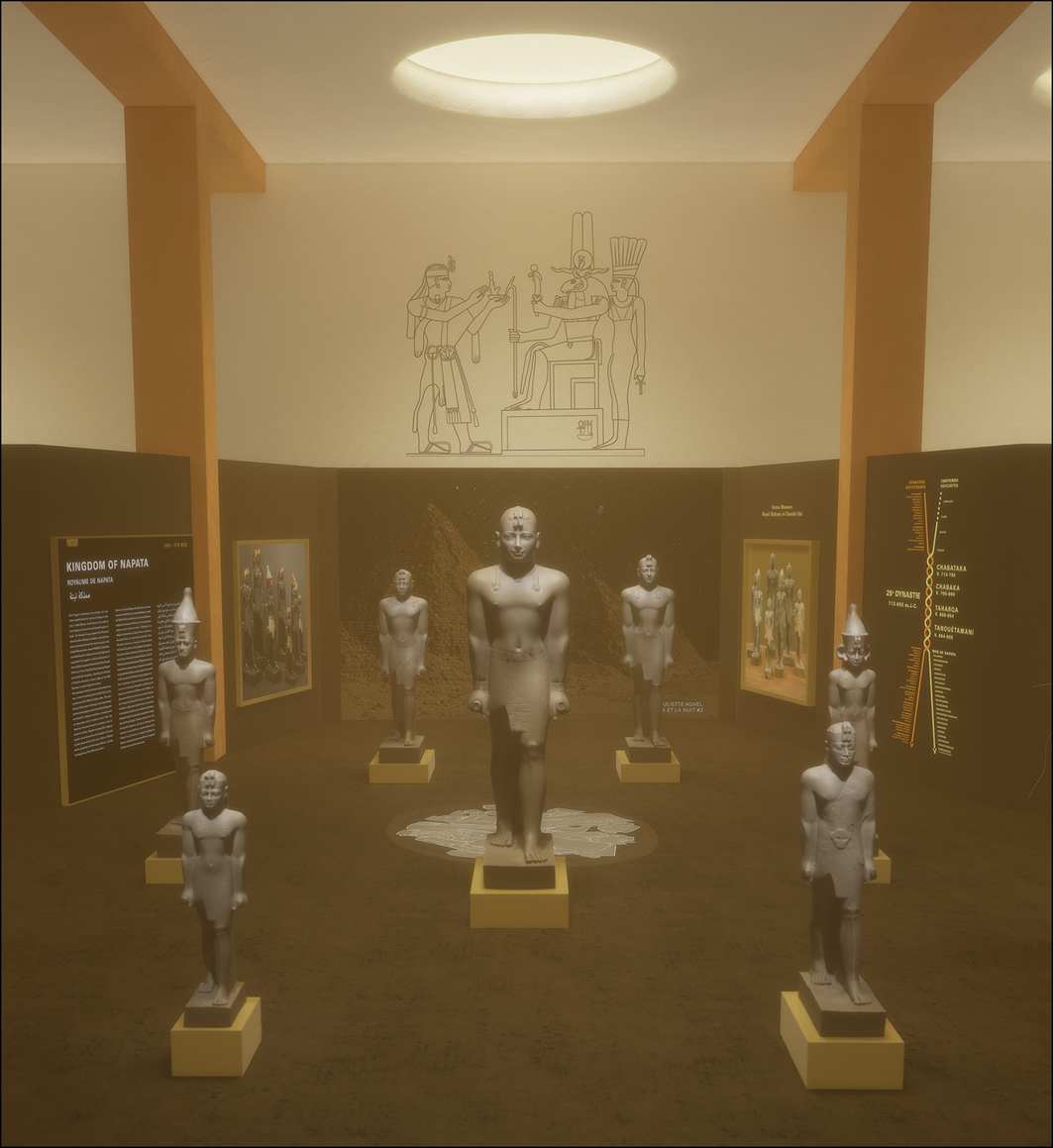
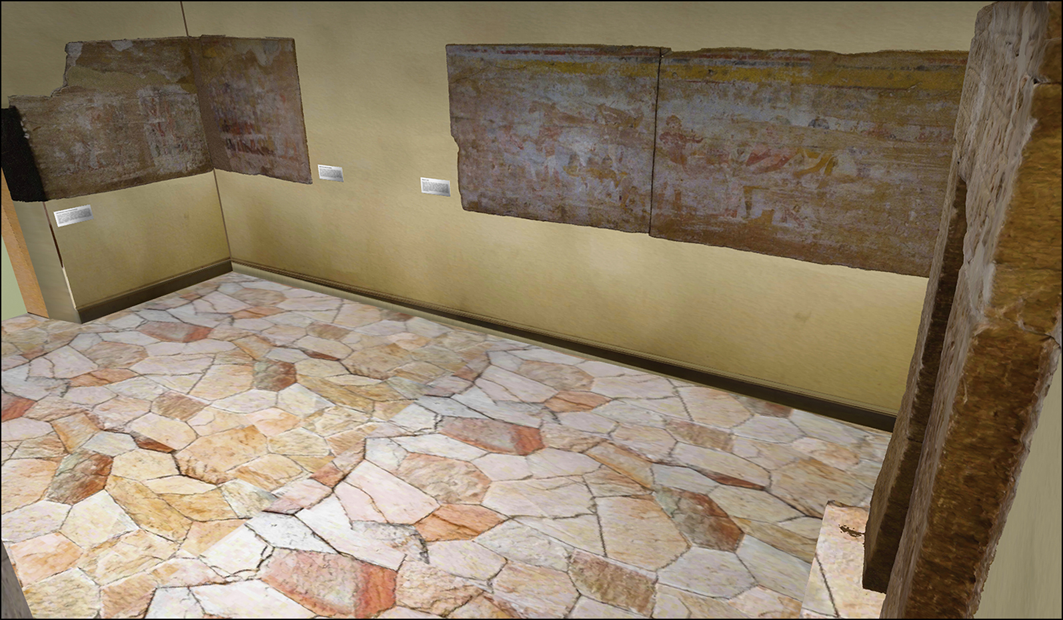
Despite major challenges—including the lack of three-dimensional digital data for much of the museum’s collection, incomplete archival resources and limited photographic documentation, particularly for the tomb of Djehutyhotep—the Sudan Virtual Museum is publicly accessible online (https://archeologie.culture.gouv.fr/soudan-museum/fr). This resource offers a virtual tour of the main museum building, displaying the artefacts that were exhibited at the Sudan National Museum before the war (Figures 3 & 4), as well as a tour of the tomb of Djehutyhotep (Figure 5). Digitally reconstructing the tomb in its current configuration in Khartoum also made it possible to virtually reunite now-submerged elements (left in situ at Debeira East during the UNESCO Nubian Campaign) with those transferred to the capital, including the statues from the tomb’s ancestral shrine.
The Sudan Virtual Museum: entrance to the virtual tour of the main building’s exhibitions (2026 © NCAM-SFDAS. Infographics AGP).

The Sudan Virtual Museum: the Napatan galleries showcasing 3D models of statues found in the royal cache of Doukki Gel (2026 © NCAM-SFDAS. Infographics AGP).

A simulated virtual visit to the tomb of Djehutyhotep as available through the Sudan Virtual Museum, showcasing decorated and inscribed monumental features and coffins retrieved from the tomb (produced by Victor Capuchio).

The Sudan Virtual Museum provides open access—in Arabic, English and French—to these resources at a moment when the physical site remains inaccessible. Despite limitations, our results demonstrate how crucial it is to invest in digital documentation of archaeological sites and museum collections, especially in areas historically afflicted by armed conflict and prone to natural disasters.
Acknowledgements
We are grateful to NCAM for permission to carry out fieldwork in the tomb of Djehutyhotep and for their collaboration throughout the development of both projects. The Sudan Virtual Museum and the virtual tour of the tomb of Djehutythotep are available online thanks to the French Ministry of Culture’s collection Grands Sites Archéologiques.
Funding statement
The Sudan Virtual Museum project was funded by Fonds Équipe France, French Ministry of Europe and Foreign Affairs (funds awarded to Faïza Drici and the French Embassy in Khartoum). The Djehuthyhotep Project was initially funded by the McDonald Institute for Archaeological Research and the Thomas Mulvey Fund at the University of Cambridge, with subsequent support from the Department of Archaeology at Durham University (funds awarded to Rennan Lemos).


 Open access

