Introduction
Coexistence between parasitoid species attacking the same local population of a host species is commonly observed in nature (Mills, Reference Mills1992). This coexistence can be established when the parasitoid species specialize in exploiting a particular developmental stage of a particular host, or niche (Waage & Greathead, Reference Waage and Greathead1986; Mills, Reference Mills1992). Simple, classic competition models (Lotka, Reference Lotka1925; Volterra, Reference Volterra and Chapman1926; MacArthur & Levins, Reference Mac Arthur and Levins1967; May, Reference May1973) bear heavily on a set of assumptions regarding coexistence. One such assumption states that two species with partial overlapping niches can coexist by some resource partitioning (Price et al., Reference Price, Denno, Eubanks, Finke and Kaplan2011).
In parasitoids, larval and adult stages can both compete for hosts. Multiparasitism (i.e., when two or more parasitoid species attack the same host), leads in general, to the death of one of the parasitoid species’ larva by competition (Zwölfer, Reference Zwölfer1971). They can compete directly, by fighting or interfering when occurring simultaneously in a host patch, or indirectly by exploiting a host patch at a different time than a heterospecific competitor. Interspecific competition can be highly asymmetric when the competitors pose different life-history traits. Thus, larval idiobiont parasitoids that are capable of killing or paralysing previously parasitized hosts are generally considered to be competitively superior to koinobionts, because, of their faster developmental times and lethal host feeding behaviour. However, if they are capable of searching and discriminating healthy hosts, interactions will be reduced (Hawkins, Reference Hawkins1994; Mills, Reference Mills, Brodeur and Boivin2006; Bernstein & Jervis, Reference Bernstein, Jervis, Wajnberg, Bernstein and van Alphen2008). In an applied context, understanding competitive interactions and coexistence among potential parasitoid biocontrol agents is worth elucidating to manage a given insect population.
Besides the classical notion of competition interaction, the concept of intra-guild predation has emerged (Polis et al., Reference Polis, Myers and Holt1989; Brodeur & Boivin, Reference Brodeur and Boivin2006). In intra-guild predation, two species belonging to the same guild can switch their trophic relationship and have one species acting as the intra-guild predator and the other species as the intra-guild prey. Therefore, intra-guild predation can be considered as a special case of direct competition, where the immediate energy gain of the intra-guild predator is the most important result (Borer, Reference Borer2002). For interactions involving exclusively parasitoids, intra-guild predation has been studied for species that can turn from primary to facultative secondary (hyper) parasites (Pérez-Lachaud et al., Reference Pérez-Lachaud, Batchelor and Hardy2004; Cusumano et al., Reference Cusumano, Peri, Vinson and Colazza2011). However, primary idiobiont ectoparasitoids, that practice non-concurrent host feeding, could eventually prey on previously endoparasitized hosts, and thus engage in a direct trophic interaction. Intra–guild interactions are reported as being common among biological control agents, with either negative or innocuous effect on the efficiency of this pest management control technique (Rosenheim et al., Reference Rosenheim, Kaya, Ehler, Marois and Jaffee1995; Brodeur & Boivin, Reference Boivin, Brodeur, Brodeur and Boivin2006).
In this study we examined aspects of the interaction between two larval parasitoids of Tuta absoluta (Meyrick) (Lepidoptera: Gelechiidae) an important tomato pest (Desneux et al., Reference Desneux, Wajnberg, Wyckhuys, Burgio, Arpaia, Narváez-Vazquez, González-Cabrera, Catalán Ruescas, Tabone, Frandon, Pizzol, Poncet, Cabello and Urbaneja2010, Reference Desneux, Luna, Guillemaud and Urbaneja2011), the extremely sinovigenic idiobiont ectoparasitoid Dineulophus phthorimaeae De Santis (Hymenoptera: Eulophidae) and the sinovigenic koinobiont endoparasitoid Pseudapanteles dignus (Muesebeck) (Hymenoptera: Braconidae). Both species integrate a natural enemies’ complex in tomato crops in Argentina and are considered potential biological control candidates of T. absoluta (Luna et al., Reference Luna, Sánchez and Wada2010; Savino, Reference Savino2014). The two parasitoid species exploit the host larval stage but use it in different ways (Colomo et al., Reference Colomo, Berta and Chocobar2002; Luna et al., Reference Luna, Sánchez and Pereyra2007, Reference Luna, Sánchez and Wada2010; Savino et al., Reference Savino, Coviella and Luna2012; Nieves et al., Reference Nieves, Pereyra, Luna, Medone and Sánchez2015). In this system, the competitive interaction can occur directly when the D. phthorimaeae female performs obligatory non-concurrent or concurrent lethal host-feeding over a host previously parasitized by P. dignus. Intra-guild predation can take place if D. phthorimaeae attacks P. dignus-parasitized T. absoluta larvae, yielding an energetic advantage, and consequently, increasing its fitness. In indirect competition, D. phthorimaeae host-feeding behaviour will take away suitable hosts for P. dignus. It is presumed that any form of competition will increase D. phthorimaeae parasitism success.
Regarding the economic importance of T. absoluta, the exploration of some significant relationships between the two parasitoid species provide biological foundation for their manipulation for a T. absoluta biological control program (Mills, Reference Mills1992; Hawkins, Reference Hawkins, Hochberg and Ives2000).
We hypothesized that both larval parasitoid species, that present partial niche overlapping, would show some level of competition over the same individual host, and because of the broader host resource usage by D. phthorimaeae, P. dignus will be affected. This work explored interspecific interactions by: (1) observing host search ability by adult D. phthorimaeae and P. dignus female wasps on T. absoluta larvae; and (2) assessing D. phthorimaeae host discrimination against P. dignus parasitized and non-parasitized hosts, at different adult female ages, and its host feeding behaviour as part of its resource use.
Materials and methods
Insect rearing
Host and parasitoid species colonies were established from material collected from commercial organic tomato crops located at the La Plata Horticultural Belt (La Plata City, Buenos Aires, Argentina), a major agricultural region in the country. T. absoluta was reared following the protocol of Luna et al. (Reference Luna, Sánchez and Pereyra2007). T. absoluta larvae were fed with fresh and water-rinsed tomato leaves, extracted from potted tomato plants maintained in an experimental greenhouse at CEPAVE (CONICET-UNLP, Argentina). Adults were kept in 40 × 40 × 40 cm3 voile- meshed cages, provided with a honey solution (ad libitum) with potted tomato plants of approximately 20 cm height, (three fully expanded leaves) as substrate for oviposition. Cages were checked every 2 days to replace plants, which were then placed individually in plastic boxes (20 × 20 × 30 cm3) covered at the top with voile to allow for egg hatching and first-instar larvae strolling to build mines. Thereafter, infested leaves were cut and placed in plastic containers (500 ml) and maintained until pupation with fresh tomato foliage as food.
To establish a D. phthorimaeae colony, parasitoid specimens were collected along with those from the host collected in the field. All T. absoluta mines in damaged leaves were observed using a stereo microscope (Nikon SMZ 645) for searching immobile hosts and ectoparasitoid larvae and pupae. They were maintained in glass vials (5 ml) until parasitoid adult emergence, sexed and paired up to allow mating. Adults were provided with separate drops of water and honey solution, but without hosts until the experiments were conducted.
The endoparasitoid P. dignus colony was reared following Nieves et al. (Reference Nieves, Pereyra, Luna, Medone and Sánchez2015) from material collected in the field (cocoons in damaged tomato leaves). Once the adult wasps emerged, they were sexed, paired for mating and placed in oviposition units (transparent glass containers, 1 L volume), and provided with leaves infested with T. absoluta larvae. After 48 h of exposure, the adults were removed with a manual aspirator and the host larvae were placed in plastic trays to observe P. dignus development until cocoon formation. Pupae were stocked individually in 10 cm diameter × 1.5 cm height Petri dishes with damp filter paper until adult emergence, then sexed and paired to complete a cycle (Nieves et al., Reference Nieves, Pereyra, Luna, Medone and Sánchez2015). Both colonies were maintained in a walk-in controlled-environment room at 25 ± 2°C, 16–h day-length, and 70 ± 10% relative humidity.
Interaction between D. phthorimaeae and P. dignus
Experiment 1 – Host search ability
To analyze the potential exploitative competition between D. phthorimaeae and P. dignus, we examined the oviposition behaviour of adult females in a short-time (15 min) assay. The experimental unit consisted of three-leaved potted tomato seedlings infested with three third- instar T. absoluta larvae already settled in feeding mines, enclosed in a cylindrical clear plastic box (Ø = 8 cm; h = 10 cm). Prior to starting the experiment, 24-h old male and female adults of each parasitoid species were randomly chosen from previously isolated pupae from the rearing stocks. They were paired up by species and each couple was kept in a plastic vial (Ø = 7 cm; h = 4 cm) to allow mating. To ensure the parasitoids were not naïve, they were supplied with a 50% honey solution and exposed to hosts. One 5-day old D. phthorimaeae and one 2-day old P. dignus female wasp were simultaneously released in the unit. Activities displayed in the oviposition behaviour were recorded in the same unit. The following behavioural activities were recorded for 15 min (Al-Wahaibi & Walker, Reference Al-Wahaibi and Walker1999, Reference Al-Wahaibi and Walker2000): (1) general searching, as displayed by fast walking; (2) intensive searching, as slow walking or detention with antennal movements; (3) ovipositor probing; (4) grooming; (5) resting, defined as motionless, non-active state of the wasp in the arena; and (6) parasitizing. Oviposition was distinguished from probing by the typical abdominal contraction the female wasp does when an egg is deposited. The behavioural activities considered are mutually exclusive (i.e., the parasitoid can be engaged in only one kind of behaviour at a time). After the parasitoid exposure, each T. absoluta larva was removed and placed individually in a Petri dish (Ø = 8 cm; h = 2 cm) for 24 h to observe D. phthorimaeae or P. dignus egg/s (the latter upon host dissection) under a stereoscope. Host larvae used only by D. phthorimaeae for host-feeding were also recorded. The behaviour of females of D. phthorimaeae and P. dignus alone in the unit was monitored as in the competition treatment, and considered as controls. Fifteen replicates per treatment in this study (D. phthorimaeae and P. dignus alone- or both species in competition) were conducted. The experiment was held in a walk-in environmental controlled room at 25 ± 1°C, 70 ± 10% relative humidity (RH) with a 16.00:8.00 hours light : dark (L:D) photoperiod.
Experiment 2 – D. phthorimaeae host discrimination and host-feeding behaviour
The ability of D. phthorimaeae to distinguish T. absoluta larvae previously P. dignus parasitized from those unparasitized was tested in similar environmental conditions and using the same experimental unit as in Experiment 1. Six to eight T. absoluta third-stage larvae installed in feeding mines in tomato leaves were firstly exposed for 24 h to one P. dignus mated female. After that period, the wasp was removed and the same T. absoluta larvae were offered to D. phthorimaeae mated females for other 48 h. Since the whole experiment lasted 36 h, parasitoid females of both species used in the experiment were naïve, fed ad libitum with honey, and mated during the first 24 h after hatching. Three D. phthorimaeae female ages were considered: 1, 5 and 7-days old. Adult female ages and host densities were selected on the basis of the D. phthorimaeae reproductive biology information (Savino et al., Reference Savino, Coviella and Luna2012). Fifteen replicates were performed for each age.
Since P. dignus females do not leave any visible marks when parasitizing the host, it was not possible to recognize initially the number of parasitized T. absoluta larvae offered to D. phthorimaeae. Hence, once the test was finished, all host larvae were checked to verify D. phthorimaeae attack, and later dissected to record the number of T. absoluta larvae previously parasitized by P. dignus. Host larvae attacked by D. phthorimaeae can be determined using a stereoscopic microscope by detecting signs of attack (i.e., paralysed, cream yellow colour, necrosed larva) or the presence of the egg or the larva on the host's tegument (Luna et al., Reference Luna, Sánchez and Wada2010). P. dignus immature stages were recognized using the description in Cardona & Oatman (Reference Cardona and Oatman1971). Four possible responses were considered: (1) parasitized by P. dignus; (2) parasitized or host-fed by D. phthorimaeae; (3) endoparasitized by P. dignus and D. phthorimaeae host-fed, or multiparasitized (both parasitoid species larvae in the same host); and (4) healthy.
Statistical analysis
For Experiment 1, the proportion of the time elapsed of each behavioural activity for host search ability (mean ± SEM) for each parasitoid species, alone or in competition, was compared with a paired t-test. Since parasitism was only practised by P. dignus, the mean proportion of parasitized T. absoluta larvae by this parasitoid species was calculated.
For Experiment 2, a balanced two-way analysis of variance (ANOVA) (including both main effects and an interaction term) was used. The two factors were the D. phthorimaeae age and the status of T. absoluta larvae offered (i.e., parasitized or unparasitized) on the proportion of host larvae attacked by D. phthorimaeae. If an interaction was observed, simple effects analysis was conducted, using one-way ANOVA, on individual factors followed by Tukey's HSD test. Response variables did not deviate from normality and homogeneity of variance assumptions. The data collected were analyzed using the STATISTICA software (Statsoft, Inc., 2007). The proportion values were previously transformed to arcsine and then transformed back to proportions for data presentation.
Results
Experiment 1 – Host search ability
Both parasitoid species showed changes in host search ability, modifying behavioural activities and the time spent searching when exposed to one another in the same arena (fig. 1). D. phthorimaeae wasps spent significantly more time in general searching (t = −3.7; df = 33, P = 0.0008) and less in intensive searching in the presence of its competitor than in its absence (t = 3.60; df = 33, P = 0.002), and it was never observed parasitizing T. absoluta larvae. In the presence of D. phthorimaeae, P. dignus females dedicated significantly less time to intensive host searching (t = 2.99; df = 28, P = 0.005) and spent more time resting than in the alone condition (t = −2.80; df = 28, P = 0.009). Interestingly, P. dignus exhibited an evasive behaviour against its antagonist by hiding behind leaves or other parts of the unit, and physical contacts between the two parasitoid species were observed in only five out of 15 replicates. Time spent by P. dignus females in parasitizing alone or in the presence of D. phthorimaeae was similar (t = −0.38; df = 28, P = 0.70). Furthermore, P. dignus parasitism rate was unaffected by D. phthorimaeae, with a mean proportion of 0.44 ± 0.03 of the offered hosts in a fixed 15 min experiment.
Proportion of the time (±SE) spent in different behavioural activities by female parasitoids of D. phthorimaeae and P. dignus when alone, or in the presence of its antagonistic female. Asterisks indicate significant differences in behaviour (P < 0.01); ns: no significant differences.

Experiment 2 – D. phthorimaeae host discrimination and host-feeding behaviour
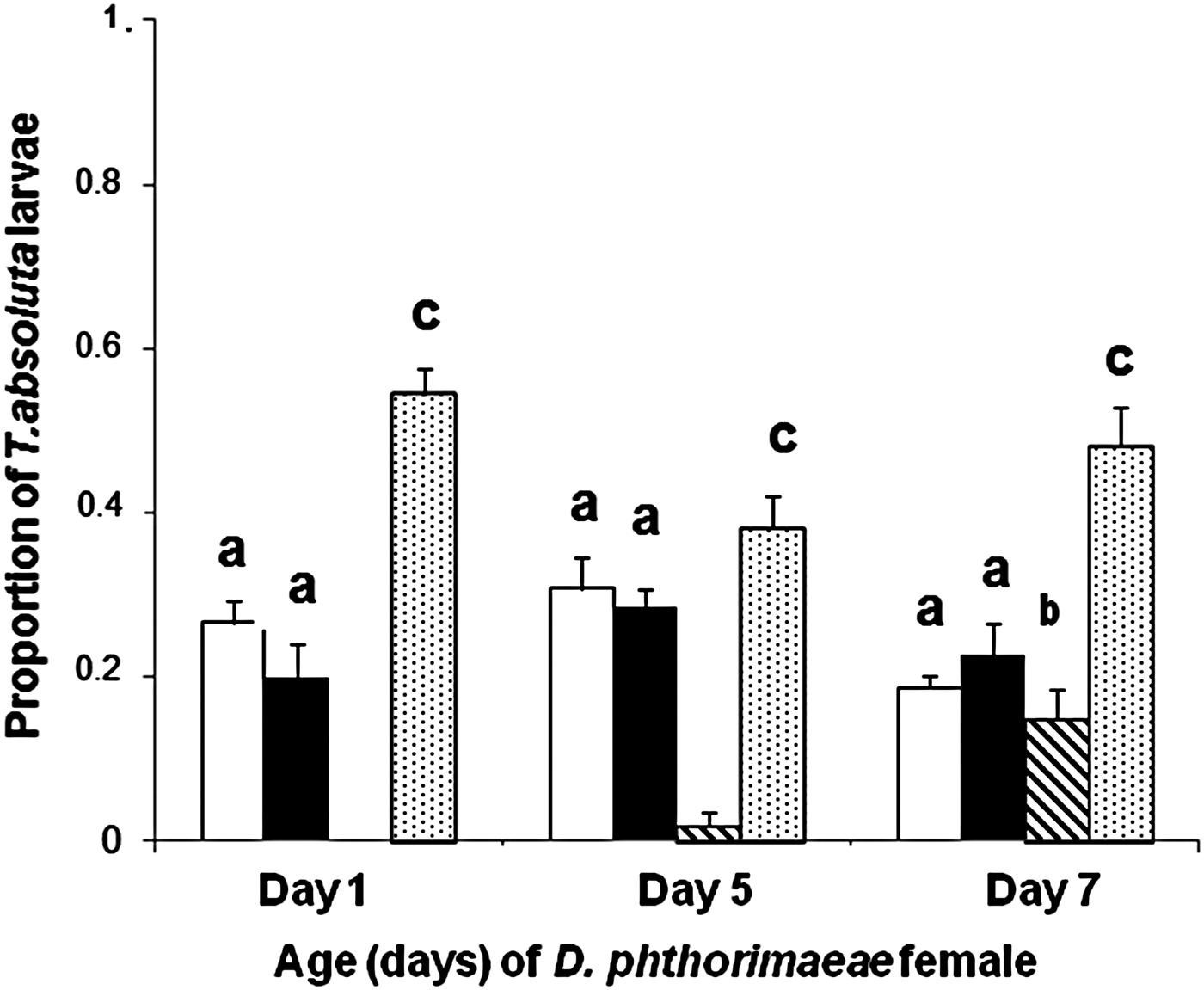
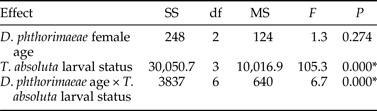
Analysis indicated that there was an interaction between host status and D. phthorimaeae age on T. absoluta larvae attacked (table 1). Older wasps discriminated significantly less (fig. 2) between the two host larvae conditions (parasitized or unparasitized by P. dignus) whilst D. phthorimaeae practised only host-feeding on T. absoluta larvae and parasitism was not observed. Furthermore, D. phthorimaeae attacks varied significantly with the host status (one-way ANOVA, F 3, 176 = 79.1; P < 0.0001), in favour of healthy host larvae. D. phthorimaeae adult age was not significant on the proportion of larvae host-fed (one-way ANOVA F 2, 177 = 0.44; P = 0.644).
Mean proportion of T. absoluta (+SE) previously exposed to P. dignus offered to 1, 5 and 7 day- old adult D. phthorimaeae females for 48 h. The figure shows the portion of T. absoluta larvae at the end of the experiment that were: parasitized by P. dignus only (white bars); the portion of hostfed T. absoluta larvae by D. phthorimaeae (black bars); the portion of larvae attacked by both species (diagonally striped bars), and the portion of healthy larvae (dotted striped bars). The same letter(s) above the bars for respective histograms for D. phthorimaeae age and host larvae status indicate no significant differences (two-way ANOVA; P < 0.01).

Results of the two-way ANOVA conducted to jointly assess the age effects of the D. phthorimaeae and the status of the T. absoluta larvae (parasitized/unparasitized by P. dignus) in reference to the ratio of host larvae offered (*significant statistical differences at P < 0.05).

Discussion
Given that only one host individual represents all the resource that a parasitoid needs for its larval development, the competition between species can be intense at this level (Hochberg & Lawton, Reference Hochberg and Lawton1990). Despite this, in nature, the different communities provide sufficient evidence of coexistence among natural enemies by means of a suite of diverse mechanisms, such as niche partitioning, the segregation behaviour through spatial aggregation, or when the hosts’ density is intermediate (Godfray, Reference Godfray1994; Mills, Reference Mills, Brodeur and Boivin2006).
In this paper we found evidence for the system D. phthorimaeae – P. dignus – T. absoluta, that in the conditions tested, parasitoid female wasps can avoid the same host resource larva. Both species modified their host searching behaviour when confronted with their antagonist. Only P. dignus achieved parasitism and the rates were not reduced by the presence of D. phthorimaeae females, when exposed simultaneously to T. absoluta larvae. Percentage of parasitism by P. dignus (~5%) observed in a fixed 15 min experiment, is coincident with some reproductive traits of this species, such as a higher egg load, a moderate sinovigenic strategy and a Type I functional response (Luna et al., Reference Luna, Sánchez and Pereyra2007; Nieves et al., Reference Nieves, Pereyra, Luna, Medone and Sánchez2015). Conversely, under the same experimental conditions, D. phthorimaeae failed to attack T. absoluta larvae, and even though it exhibits a similar functional response to P. dignus, it is an extremely sinovigenic parasitoid species with a low egg load, which could affect its oviposition behaviour (Savino et al., Reference Savino, Coviella and Luna2012). We observed that D. phthorimaeae did not succeed in parasitizing, which confirmed that this extremely synovigenic parasitoid, with a potential lifetime fecundity <10, behaved as a selective species that allocates eggs only when host physiological and ecological conditions are suitable (Savino et al., Reference Savino, Coviella and Luna2012; Savino, Reference Savino2014). Thus, the divergence of the reproductive strategies of D. phthorimaeae and P. dignus can lead to coexistence by niche partitioning.
Additionally, older D. phthorimaeae females discriminated less and attacked, although without ovipositing, unparasitized and parasitized T. absoluta larvae by P. dignus. Therefore, the competitive interaction took place via the host-feeding behaviour by D. phthorimaeae. Host-feeding represents the mechanism by which D. phthorimaeae females directly compete with P. dignus by eliminating their antagonists’ immature individuals through paralysis or venom injection to the host. Collier & Hunter (Reference Collier and Hunter2001) also observed evidence for direct competition between Eretmocerus eremicus (Rose & Zolnerowich) and Encarsia sophia (Girault) (Hymenoptera: Aphelinidae), parasitoids of whiteflies, using two mechanisms: the usurpation of hosts in cases of multiparasitism and by lethal host-feeding.
Host resource selection could be then explained by D. phthorimaeae reproductive strategy, being that females suffer a significant decrease of egg load with ageing, by resorption (Savino et al., Reference Savino, Coviella and Luna2012), and they need to perform obligatory host consumption in order to gain energy and mature more eggs for the next encounter with hosts (Bernstein & Jervis, Reference Bernstein, Jervis, Wajnberg, Bernstein and van Alphen2008). Heterospecific host discrimination could be possible by the recognition of parasitized host larvae because of some physical or chemical marks left by P. dignus, as well as the detection of movements of the internal larva inside the host (Weisser & Houston, Reference Weisser and Houston1993; Godfray, Reference Godfray1994). Further studies would be necessary to answer this point.
The literature supports diverse evidence of coexistence for other parasitoid-host systems that also avoid attacking heterospecific parasitized hosts, including the solitary ectoparasitoids Cephalonomia stephanoderis Bretem and Prorops nasuta Waterston (Hymenoptera: Bethylidae) (Infante et al., Reference Infante, Mumford, Baker, Barrera and Fowler2001), the pupal endoparasitoid Coptera haywardi Loiácono (Hymenoptera: Diapriidae), and the larval-pupal endoparasitoid Diachasmimorpha longicaudata (Ashmead) (Hymenoptera: Braconidae) (Cancino et al., Reference Cancino, Liedo, Ruiz, López, Montoya, Barrera, Sivinski and Aluja2012). Persad & Hoy (Reference Persad and Hoy2003) showed that Lipolexis scutellaris Mackauer and Lysiphlebus testaceipes Cresson (Hymenoptera: Aphidiidae) promote coexistence by avoiding multiparasitism. Conversely, Leveque et al. (Reference Leveque, Monge, Rojas-Rousse, Van Alebeek and Huignaud1993) found that in the system Dinarmus basalis (Rond.) (Hymenoptera: Pteromalidae) – Eupelmus vuilleti (Craw) (Hymenoptera: Eupelmidae), only the second species increased reproduction in the presence of its antagonist and multiparasitized hosts. Shi et al. (Reference Shi, Li and Li2004) demonstrated that when Cotesia plutellae and Diadegma semiclausum are exposed simultaneously, they attack host larvae already parasitized by the other species, and that this causes a higher joint host mortality. Xu et al. (Reference Xu, Yang and Wan2013) reported for Encarsia sophia and Eretmocerus hayati that they do not avoid multiparasitism and reproduction of both species is negatively affected. Ulyshen et al. (Reference Ulyshen, Duan and Bauer2009) observed that in a similar parasitoid –parasitoid system to that studied in the research presented here, the larval ectoparasitoid Spathius agrili parasitized larvae that were previously parasitized by the larval endoparasitoid Tetrastichus planipennisi completely eliminating the latter in laboratory and field tests.
The prediction that the competition between D. phthorimaeae and P. dignus could favour the idiobiont ectoparasitoid was partially confirmed. Only older D. phthorimaeae wasps killed T. absoluta larvae parasitized or unparasitized by P. dignus, via host-feeding. Other authors have reported superiority of larval ectoparasitoids in their competition for hosts. Varley (Reference Varley1947) found that ca. 25% of the koinobiont Eurytoma curta Walker (Hymenoptera: Eurytomidae) parasitoid larvae were dead by the actions of a complex of idiobiont parasitoid species, with similar biology to D. phthorimaeae. Zaviezo & Mills (Reference Zaviezo and Mills2001) also showed a predominance of the larval ectoparasitoid Hyssopus pallidus (Askew) (Hymenoptera: Eulophidae) over the endoparasitoid Ascogaster quadridentatus Wesm. (Hymenoptera: Braconidae) and Ulyshen et al. (Reference Ulyshen, Duan and Bauer2009) showed similar results for the idiobiont ectoparasitoid S. agrili over the koinobiont endoparasitoid T. planipennis.
The intra-guild predation might have only a minor effect in this system since D. phthorimaeae females majorly avoid attacking previously parasitized hosts by P. dignus, from which it is assumed that the energy gained would be insignificant (Polis et al., Reference Polis, Myers and Holt1989; Borer, Reference Borer2002). Nevertheless, this result indicates that primary larval parasitoid species can eventually be involved in direct trophic interactions by intraguild predation by non-concurrent host feeding.
In conclusion, it is suggested that D. phthorimaeae and P. dignus are able to coexist and that the intensity of the interaction would depend, among other factors, on the age and the state of nutrition of the D. phthorimaeae females. This would be particularly relevant for T. absoluta biological control, where the destructive effect of one of its natural enemies’ can be quite high against other species in the complex.
Acknowledgements
The authors want to acknowledge the help of tomato producers S. Parrillo, N. Olivera, M. Maita, and Cooperativa Colectivo Orgánico that kindly allowed us to collect material for insect rearings. M. Roggiero, G. Reboredo, C. Vallina, M. Zubillaga, C. Di Battista, and Y. Vaio provided laboratory assistance. We also thank the help the Editor and two anonymous reviewers for their comments and insights on an earlier version of this manuscript. This research was supported in part by PRH 2007 No 19 ANPCyT – Depto. Ciencias Básicas UNLu (Argentina), PIP 0112 (CONICET-Argentina), and PI N706 (UNLP).