Adolescence is a developmental period involving many normative changes in physical, cognitive, and emotional development. Adolescence involves the transition from childhood to adulthood (Petersen, Reference Petersen1988). This increased capacity offers opportunities, but can also lead to stress and negative outcomes. In addition to normative stress of adolescence, some young people also experience added stress from challenging environments that make them more vulnerable to harm, including risk-taking behaviour. Adverse consequences from risk-taking can cause lasting damage; therefore, developing the ability to cope with stress may help to prevent more serious problems later (D'Amico, Ellickson, Collins, Martino, & Klein, Reference D'Amico, Ellickson, Collins, Martino and Klein2005). Furthermore, some youth lack adequate coping resources to manage the demands of stressors. It is important to explore positive contexts that may help to minimise risk-taking in vulnerable young people and prevent harmful outcomes. Specifically, extracurricular activities have been found to be a positive environment for young people (Barber, Eccles, & Stone, Reference Barber, Eccles and Stone2001; Fredricks & Eccles, Reference Fredricks and Eccles2008) and may be protective in deterring youth from risk-taking behaviour.
This study examined the role of extracurricular activities in risk-taking. Specifically, we tested how the combined influences of extracurricular activity participation intensity and coping efficacy interacted to buffer against risk-taking for youth with different levels of contextual risk. The bioecological approach (Bronfenbrenner, Reference Bronfenbrenner2005) emphasises the importance of interactions among individual attributes and external environments. Therefore, this study addresses current gaps in understanding activity participation by investigating whether contextual and individual factors condition the link between activity participation and adolescent risk-taking.
Adolescents’ leisure time can provide developmental learning opportunities. There has been strong interest in the benefits of extracurricular activities, which have been linked in previous research with a range of positive outcomes, from better school achievement and reduced school drop-out rates (Barber et al., Reference Barber, Eccles and Stone2001; Fredricks & Eccles, Reference Fredricks and Eccles2008) to improved wellbeing, including higher self-worth and fewer externalising symptoms (Blomfield & Barber, Reference Blomfield and Barber2011; Moilanen, Markstrom, & Jones, Reference Moilanen, Markstrom and Jones2014). Extracurricular activities may also help to curb problem behaviour among adolescents by limiting the time spent in risk-taking activities and by providing youth with positive peer groups (Mahoney, Reference Mahoney2000; Modecki, Barber, & Eccles, Reference Modecki, Barber and Eccles2014). Furthermore, extracurricular activities may deter youth from engaging in delinquent behaviours by providing a pro-social environment that promotes interpersonal development and positive behavioural norms (Hansen & Larson, Reference Hansen and Larson2007).
Protective effects of activities vary by type of activity and by outcome. Although sport participation has been shown to predict positive outcomes (see Barber, Abbott, Neira, & Eccles, Reference Barber, Abbott, Neira and Eccles2014), there is increasing evidence for a link between sports and risk-taking, including delinquency and substance use (Gardner, Roth, & Brooks-Gunn, Reference Gardner, Roth and Brooks-Gunn2011; Modecki et al., Reference Modecki, Barber and Eccles2014). Comparatively less attention has been paid to the relationship between non-sporting activity participation and risk-taking behaviour (Zarrett et al., Reference Zarrett, Lerner, Carrano, Fay, Peltz, Li and Holt2008), but the evidence consistently suggests that activities such as drama and Scouts provide a particularly protective environment (Farb & Matjasko, Reference Farb and Matjasko2012). Because non-sporting activities have been shown to be protective against risk more consistently than sports, our study focuses on the protective role of non-sporting activity participation in predicting adolescent risk-taking and controls for sporting participation.
Higher levels of non-sporting participation are likely to result in more positive outcomes than less intense involvement (Denault & Poulin, Reference Denault and Poulin2009; Mahoney & Vest, Reference Mahoney and Vest2012). Nevertheless, there is evidence that greater intensity may not be equally beneficial to all groups of young people (Busseri, Rose-Krasnor, Willoughby, & Chalmers, Reference Busseri, Rose-Krasnor, Willoughby and Chalmers2006). Mahoney (Reference Mahoney2000) argues that experience of participating in extracurricular activities may be more protective for high-risk adolescents. Therefore, we attempted to determine whether higher levels of activity participation may be more protective for some groups of adolescents than for others.
Questions still remain about the effects of participation among at-risk adolescents. Is activity participation beneficial for adolescents exposed to higher levels of risk? In this study, risk is defined as a condition that may increase the possibility of negative developmental outcomes (Gerard & Buehler, Reference Gerard and Buehler2004). Environmental adversities that may place adolescents at risk include unhappy family environments and poverty (Conger, Conger, & Martin, Reference Conger, Conger and Martin2010). Research has demonstrated that involvement in organised activities may differentially benefit at-risk adolescents. For example, organised activities may be beneficial to high-risk adolescents by providing particular developmental experiences that may not be available in other domains of young people's lives (Blomfield & Barber, Reference Blomfield and Barber2011; Mahoney, Reference Mahoney2000).
Young people at greatest risk for later difficulties are those who experience the additive stress of several environmental risk factors (Gerard & Buehler, Reference Gerard and Buehler2004). Therefore, studying accumulation of adversity is important. The present research examines risk-taking behaviours of adolescents at varying levels of cumulative risk. We focused on four risk indicators: low socio-economic status, parental marital status other than married, unemployed parents, and low family satisfaction, based on the association of these factors with negative adolescent developmental outcomes (Amato, Reference Amato2010; Conger et al., Reference Conger, Conger and Martin2010; Steinberg, Reference Steinberg2001; Strom, Reference Strom2003).
The Role of Coping Efficacy
The potential for adolescents to manage contextual risk is connected to their ability to cope with stress. Coping with stress includes managing emotions, regulating behaviour, and acting on the environment (Compas et al., Reference Compas, Connor-Smith, Saltzman, Harding Thomsen and Wadsworth2001). Successful coping is essential for adolescents, who face a range of stressors and may not yet have fully developed the cognitive abilities to deal with them (Seiffge-Krenke, Reference Seiffge-Krenke2000). Evidence suggests effective coping is associated with healthy outcomes (Compas et al., Reference Compas, Connor-Smith, Saltzman, Harding Thomsen and Wadsworth2001; Sandler et al., Reference Sandler, Tein, Mehta, Wolchik and Ayers2000). Conversely, poor adolescent coping has previously been linked to risky behaviours, including externalising (Seiffge-Krenke, Reference Seiffge-Krenke2000).
Coping efficacy is the belief that one has dealt well with stressors and can deal effectively with them in the future (Sandler, Tein, Mehta, Wolchik, & Ayers, Reference Sandler, Tein, Mehta, Wolchik and Ayers2000). Positive coping efficacy allows young people to feel greater control over their situation and may be associated with better outcomes, including less risk-taking, in the presence of contextual risk factors (Seiffge-Krenke, Reference Seiffge-Krenke2000). Coping efficacy may be a personal resource that helps adolescents facing stressful circumstances to capitalise on positive opportunities they encounter, including extracurricular activities.
Our study aims to test how coping efficacy may enhance the protective nature of activity participation for youths experiencing high-risk environments. In contrast to previous research that has focused on the influence of one risk factor when measuring the benefit of extracurricular activities, this study considers the role of cumulative risk. Because research has shown that problem behaviour varies by age and gender (Bongers, Koot, Van der Ende, & Verhurst, Reference Bongers, Koot, Van der Ende and Verhurst2004; Card, Sawalani, Stucky, & Little, Reference Card, Sawalani, Stucky and Little2008), we controlled for these demographic characteristics. We hypothesised that higher non-sporting activity participation intensity would predict less risk-taking. We expected the association between non-sporting extracurricular activities and adolescent risk-taking would be moderated by coping efficacy and contextual risk.
Method
Participants
The participants were from the Youth Activity Participation Study of Western Australia (YAPS-WA), a longitudinal study of adolescent extracurricular activity participation and developmental outcomes. This study included participants from wave 3 only. Participants were from 34 schools (17 government, 17 non-government) across four metropolitan (68%) and nine regional districts (32%).
The sample was composed of 1,599 adolescents: 1,030 from Grade 10 (587 female, 443 male) and 519 from Grade 12 (285 female, 234 male). The mean age was 15.5 (SD = 1.1 years), ranging from 13 to 19 years. The sample comprised 80% Caucasian, 7.6% Asian, 1.2% African, 1.1% Aboriginal or Torres Strait Islander, 0.6% Middle Eastern, 3.8% other, and 5.9% did not respond.
Procedure
The questionnaire was administered via laptop computers connected to a wireless intranet, or in pen and paper format, depending on the preference of each school. The questionnaire took approximately 40 minutes to complete. Prior to data collection, ethical approval was granted by the university human research ethics committee. Participation required informed consent of both parents and students.
Measures
Extracurricular activity intensity
Participants were presented with a list of 16 non-sporting activities (e.g., drama and Scouts) and 17 sporting activities (e.g., basketball and cricket) and asked to specify which activities they participated in during the school year. An ‘other’ category was provided if an activity was not listed. To control for sporting participation, participants who responded as participating in a sporting activity were coded as 1. Participants who responded as not participating in a sporting activity were coded as zero. The focus of this study was on non-sporting activity intensity. Students reported how many hours per week they participated in each activity. The total number of hours per week reported across all non-sporting activities was used as the measure of intensity of activity participation. The range of participation intensity was 0–21 hours. Participants who reported no non-sporting activity participation were coded as zero.
Risk-taking behaviours
Seven items specifying a range of risk-taking behaviour were used. Each item started with the stem ‘How often in the last 6 months have you . . .?’ (e.g., ‘gotten in a physical fight with another person?’). Items required participants to respond on an 8-point scale ranging from 1 (never) to 8 (31 or more times) (α = .75). Items have been drawn and adapted from previous studies (Eccles & Barber, Reference Eccles and Barber1999), and previous research indicates these items are valid measures of risk-taking (Modecki, Barber, & Vernon, Reference Modecki, Barber and Vernon2013).
Contextual risk index
A composite index of risk was used to represent the additive influence of multiple risk factors in the lives of adolescents. The four risk indicators were low socio-economic status, divorce or separated parental marital status, unemployed parents, and low family satisfaction. Each indicator was scored as present (1) or absent (0) and summed to create a single index. Cut-off points for coding continuous variables were based on both the literature and on frequencies in this sample. Risk cut-off points were designated to characterise the most difficult social contexts, and also to delineate those youth who were facing the most stressful circumstances.
School socio-economic status
The Index of Community Socio-Educational Advantage (ICSEA; Australian Curriculum, Assessment and Reporting Authority [ACARA], 2012) is the measure of school socio-economic status (SES). The ICSEA is computed with information from the Australian Bureau of Statistics and is based on the home addresses of students attending each school. The ICSEA assembles information on the occupation, education, income, ethnicity, and single-parent status, and the school's geographical location. Each school is then placed on a scale that indicates the comparative socio-economic advantage of its students. The ICSEA is scaled to a median of 1,000 (SD = 100; ACARA, 2012). Schools in the current sample had an ICSEA score ranging from 798 to 1,188. Participants were deemed at risk if they attended a school with an ICSEA score that was one SD below the sample mean (<944.24, 10.4%).
Parental marital status
Participants were coded to be at risk if they reported their parents to be either divorced or separated (17.1%).
Unemployed parents
Participants with both their parents unemployed were considered at risk (1.9%).
Family satisfaction
Four items were used to measure family satisfaction (e.g. ‘I enjoy being at home with my family’). Each item was assessed on a 5-point scale ranging from 1 (not at all true for me) to 5 (very true for me) (α = .91). This measure was drawn from the Multidimensional Student Life Satisfaction Scale (Huebner, Reference Huebner1994). Those with a mean score of less than or equal to 2 were on the negative side of neutral and were coded as at-risk (10.1%).
Based on these criteria, 68% of participants reported no risk indicators, 25.1% of participants had one risk indicator, 6.1% of participants had two risk indicators, and 0.7% of participants reported three indicators. No participants reported all four risk indicators. The contextual risk index was correlated with psychological adjustment (e.g., negatively with self-esteem and life satisfaction, r = −.25, p < .001, r = −.29, p < .001, respectively, and positively with depressed mood, r = .12, p < .001) (Heaslip, Modecki & Barber, Reference Heaslip, Modecki and Barber2014).
Coping efficacy
The items were drawn from previous research (Zweig, Barber, & Eccles, Reference Zweig, Barber and Eccles1997), which established the validity of the coping scale. Two items started with the stem ‘How often do you . . .’ (‘feel that you are capable of coping with most of your problems?’ and ‘keep a cool head in emergencies?’). Participants responded on a 6-point scale from 1 (never) to 6 (daily; α = .55).
Results
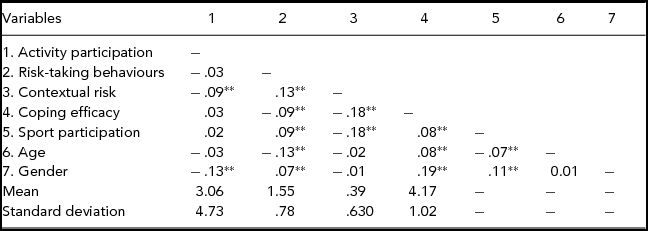
Table 1 presents bivariate correlations and descriptive statistics for all variables. Activity participation was negatively associated with contextual risk and gender, indicating greater activity participation hours were related to lower contextual risk and being female. Coping efficacy was negatively associated with both contextual risk and risk-taking, indicating those with higher levels of coping efficacy reported lower levels of contextual risk and less frequent risk-taking. Risk-taking was positively associated with contextual risk, indicating those with more risk indicators present in their environments reported higher levels of risk-taking. The effect sizes for the correlations were small (Cohen, Reference Cohen1992).
Descriptive Statistics and Correlations for Each Study Measure (N = 1,578)

Note: *<.05; *<.01. Gender (girls = 0; boys = 1); Age (Grade 10 = 0; Grade 12 = 1); Sport participation (no = 0; yes = 1).
Interactive Effects of Activity Participation Intensity, Coping Efficacy, and Contextual Risk on Risk-taking
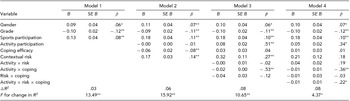
To investigate the interactions between activity participation intensity, coping efficacy, and contextual risk in predicting risk-taking, a hierarchical multiple regression was conducted. Gender, grade level and sporting participation were entered at the first step of the equation as covariates. At step 2, we entered the key variables of interest, activity participation intensity, coping efficacy, and contextual risk index. Next, we entered all of the two-way interaction terms at step 3 (activity participation × coping efficacy; activity participation × risk index; risk index × coping efficacy). Finally, at step 4 we entered the three-way interaction term (activity participation × coping efficacy × risk index). Only significant results are noted in text.
In Table 2, at step 1 of the analysis, the demographic variables significantly predicted risk-taking, F(3, 1,521) = 13.48, p < .001. Specifically, grade level, gender, and sports participation were significant predictors of risk-taking behaviours. Boys, students in Grade 10, and sports participants reported more frequent risk-taking behaviours than did girls, students in Grade 12, and non-sports participants. At step 2, activity participation intensity, coping efficacy and contextual risk were entered into the model, F(6, 1,518) = 14.90, p < .001. Coping efficacy significantly predicted adolescent risk-taking behaviours, indicating lower coping efficacy was related to higher risk-taking. Contextual risk was a significant individual predictor of adolescent risk-taking, with higher contextual risk predicting greater risk-taking.
Summary of Multiple Hierarchical Regression Analysis for Variables Predicting Adolescent Risk-Taking Behaviours From Activity Participation, Contextual Risk and Coping Efficacy (N = 1,524)

Note: *<.05; **<.01. Gender (girls = 0; boys = 1); Grade (Grade 10 = 0; Grade 12 = 1); Sport participation (no = 0; yes = 1).
At step 3, the two-way interaction terms (activity participation × coping efficacy, activity participation × contextual risk, and coping efficacy × contextual risk) significantly predicted adolescent risk-taking behaviours, F(9, 1,515) = 13.63, p < .001. Specifically, the conditional interaction term activity participation × coping efficacy emerged as a significant predictor of adolescent risk-taking. The fourth step of the model explained a significant amount of the variance in adolescent risk-taking, F(10, 1,514) = 12.77, p < .001. Results indicated there was a significant three-way interaction between activity participation × coping efficacy × contextual risk predicting adolescent risk-taking.
Activity Participation Intensity and Coping Efficacy With Risk-Taking Among Low-, Moderate- and High-Risk Adolescents
Because the three-way interaction significantly predicted risk-taking, we ran follow-up analyses exploring the two-way interaction between activity participation and coping efficacy separately for low-, moderate- and high-risk youth. The sample was divided into those reporting no risk indicators (low risk), those reporting one risk indicator (moderate risk) and those reporting two or more indicators (high risk), as measured by the contextual risk index.
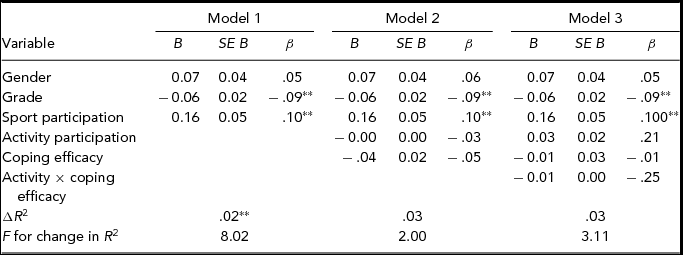
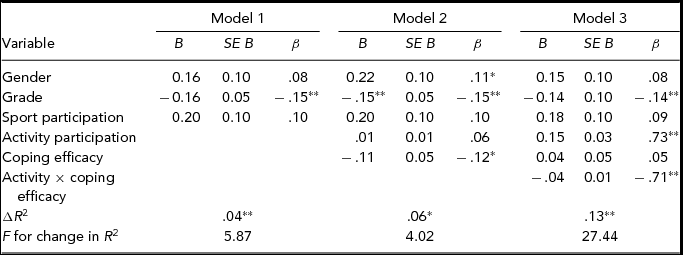
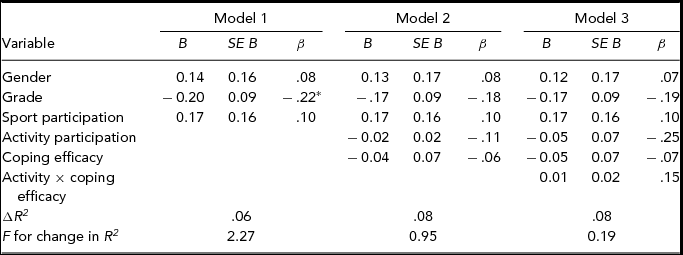
For each risk group, we ran a hierarchical regression analysis, entering gender, grade and sporting participation in step 1, activity participation intensity in step 2, and the two-way interaction term (activity participation × coping efficacy) in step 3. Tables 3–5 present the results for activity participation, coping efficacy and the interaction terms for each risk group.
Summary of Hierarchical Regression Analysis for Variables Predicting Risk-Taking Behaviours Among Low-Risk Adolescents (n = 1,029)

Note: *<.05; **<.01. Gender (girls = 0; boys = 1); Grade (Grade 10 = 0; Grade 12 = 1); Sport participation (no = 0; yes = 1).
Summary of Hierarchical Regression Analysis for Variables Predicting Risk-Taking Behaviours Among Moderate-Risk Adolescents (n = 386)

Note: *<.05; **<.01. Gender (girls = 0; boys = 1); Grade (Grade 10 = 0; Grade 12 = 1); Sport participation (no = 0; yes = 1).
Summary of Hierarchical Regression Analysis for Variables Predicting Risk-Taking Behaviours Among High-Risk Adolescents (n = 107)

Note: *<.05; **<.01. Gender (girls = 0; boys = 1); Grade (Grade 10 = 0; Grade 12 = 1); Sport participation (no = 0; yes = 1).
Low risk
At step 1, the model significantly predicted risk-taking, F(3, 1026) = 8.02, p < .01. Grade and sport participation were significant predictors of risk-taking. The second step significantly predicted risk-taking, F(5, 1024) = 5.63, p < .01, and the third step of the model significantly predicted risk-taking, F(6, 1023) = 5.21, p < .01. However, activity participation and coping efficacy were not significant predictors of risk-taking in adolescents at low risk.
Moderate risk
At step 1, the model significantly predicted risk-taking, F(3, 383) = 5.87, p < .01, with grade being a significant predictor. Results indicate students in Grade 10 reported more frequent risk-taking behaviours than students in Grade 12. At step 2, coping efficacy was a significant negative predictor, F(5, 381) = 5.19, p < .001, indicating adolescents with lower coping efficacy reported more frequent risk-taking behaviours. The final step significantly predicted risk-taking, F(6, 380) = 9.20, p < .001. Activity participation emerged as a significant conditional predictor of risk-taking, with greater activity hours predicting more frequent risk-taking behaviours and the interaction term of activity participation and coping efficacy significantly predicting adolescent risk-taking.
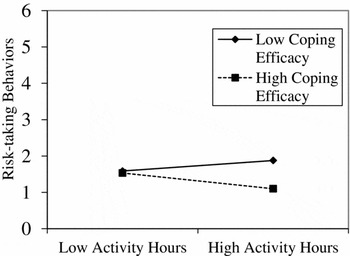
To probe the significant two-way interaction between activity participation and coping efficacy, we followed up with traditional plotting and probing of simple slopes using a computational aid developed by Hayes and Matthes (Reference Hayes and Matthes2009; see Figure 1).
Interaction between activity participation and coping efficacy in the prediction of adolescent risk-taking in moderate risk youth.

To determine the standards represented as high and low activity participation, values were selected that were one standard deviation above or below the mean for each variable, as recommended by Aiken and West (Reference Aiken and West1991). The simple slopes showed that activity participation positively predicted risk-taking at low levels of coping efficacy (B low = .04, t = 3.50, p < .001). Conversely, activity participation negatively predicted risk-taking at high levels of coping efficacy (B high = −.04, t = −2.87, p < .01). In sum, activity participation was differentially related to risk-taking at high and low levels of coping efficacy among moderately at-risk adolescents.
High risk
The model indicated non-significant associations between most variables at all blocks. However, grade significantly and negatively predicted the outcome variable at step 1. In sum, activity participation and coping were not significantly associated with risk-taking in adolescents who were deemed high-risk.
Probing the Conditional Interaction Between Activity Participation Intensity and Coping Efficacy
The final analysis was to probe the significant conditional two-way interaction on risk-taking behaviours that emerged in the final model (presented in Table 2; see Figure 2). As seen in Table 2, the interaction between activity participation intensity and coping efficacy predicting risk-taking was significant, conditioned on the three-way interaction (activity participation × coping efficacy × contextual risk) in the regression equation. To understand the conditional interaction effect, we plotted and probed simple slopes for activity participation on risk at one standard deviation above and below the mean of coping efficacy (see Figure 2; Aiken & West, Reference Aiken and West1991). Analysis of the simple slopes showed activity participation was positively associated with risk-taking at low levels of coping efficacy (B low = .01, t = 2.66, p = .008). Further, activity participation was negatively associated with risk-taking behaviours at high levels of coping efficacy (B high = −.02, t = −3.95, p < .001). Importantly, this interaction is dependent upon the three-way interaction in the model, and so these results, while surprising, must be considered in terms of variance not explained by our three-way interaction
Conditional two-way interaction between activity participation and coping efficacy in the prediction of risk-taking.

Discussion
This study aimed to understand whether spending time in non-sporting extracurricular activities was more strongly protective against risk-taking for adolescents with fewer personal and contextual resources than for those with more resources. Although the bioecological perspective recommends studying interactions of individual factors and external environments, few studies have combined these features in examining non-sporting activity participation. Our research investigated whether coping efficacy and contextual risk moderated the link between non-sporting extracurricular activity participation and adolescent risk-taking. We expected activity participation intensity would predict lower risk-taking behaviours, especially for those with fewer resources; however, we did not anticipate that more time spent participating might be linked to higher risk-taking for some young people. First, we address the significant interaction findings between extracurricular activity intensity, coping efficacy, and contextual risk on adolescent risk-taking. We then discuss the importance of coping efficacy for adolescents. Finally, we consider selection effects.
A significant interaction was found between non-sporting extracurricular activity intensity, coping efficacy, and contextual risk for adolescent risk-taking. For adolescents at moderate risk with high levels of coping efficacy, the relationship between non-sporting activity participation and risk-taking was negative, indicating lower risk-taking for those who participated more. These findings are consistent with previous literature suggesting that those who have adequate coping resources can deal effectively with stressors and hence avoid risk-taking behaviours (Connor-Smith, Compas, Wadsworth, Thomsen, & Saltzman, Reference Connor-Smith, Compas, Wadsworth, Thomsen and Saltzman2000). In this group, greater intensity participation in non-sporting activities is associated with more positive processes, including enabling greater exposure to positive adult supervision. For adolescents who are at moderate risk with good coping abilities, such participation may provide consistent and encouraging role models who may not be available in other environments (Denault & Poulin, Reference Denault and Poulin2009). For adolescents who experience risk in their environments, greater intensity participation may limit time spent in risky situations, thereby protecting youth who have coping efficacy to benefit from activity participation against risk-taking behaviours, as has been shown in previous literature (Mahoney, Reference Mahoney2000).
This research contributes to the literature by showing that the relationship between non-sporting extracurricular activity participation and adolescent risk-taking is conditioned by not only the level of risk experienced by young people, but also by their ability to cope with challenges. The three-way interaction demonstrated that non-sporting extracurricular activities may not match all adolescents’ contextual and individual needs. For adolescents with low levels of coping efficacy, more activity participation predicted more frequent risk-taking behaviours. Therefore, more time in non-sporting extracurricular activities may not provide a protective environment for risk-taking behaviours for adolescents with low coping efficacy and exposure to less auspicious environments. The argument that coping efficacy moderates the relationship between non-sporting activity participation intensity and adolescent risk-taking was also supported in the significant conditional two-way interaction between activity participation and coping efficacy in the final model.
Coping efficacy is an internal resource that enables adolescents to feel empowered and to face challenges successfully; our research further highlights how coping can be linked to better outcomes for young people. Consistent with previous literature, coping efficacy was significantly negatively related to risk-taking, indicating that those with higher levels of coping efficacy reported less frequent risk-taking (Seiffge-Krenke, Reference Seiffge-Krenke2000). Adolescents with higher coping efficacy are able to perceive stress as manageable and to perceive stress as a challenge that they can overcome. Extracurricular activities have been shown to be a unique context where adolescents can experience high motivation and high challenge (Larson, Reference Larson2000). Adolescents with higher coping efficacy may be better equipped with the emotional or behavioural regulatory resources needed to face challenging circumstances (Compas, Reference Compas2009). Such adolescents evince positive internal resources that support important skill development such as overcoming stress and self-regulation when facing demanding environments in extracurricular activities.
The coping resources with which adolescents are equipped with will influence the perception of stress as either a challenge to be overcome or as too much stress for them to manage (Folkman, Lazarus, Dunkel-Schetter, DeLongis, & Gruen, Reference Folkman, Lazarus, Dunkel-Schetter, DeLongis and Gruen1986). Without adequate coping efficacy, young people may worry about how to manage stress that may be encountered in higher intensity activity participation. Furthermore, they may feel helpless and overwhelmed by challenging activities. Experiences in non-sporting activity participation such as competition, time management demands, and the need to develop initiative (Hansen, Larson, & Dworkin, Reference Hansen, Larson and Dworkin2003) may become particularly demanding when at higher intensity for youth with a combination of personal and contextual vulnerabilities.
Adolescents with lower coping efficacy who additionally experience moderate contextual stress may experience discomfort in the challenges that accompany more intense activity participation. While more time spent in non-sporting activity participation appears to be beneficial for at-risk adolescents who have stronger coping abilities, for some young people, more time in activities may not be appraised as a challenge but rather as taxing their limited emotional resources. Combining poor coping abilities with stressful life circumstances may create a particularly powerful dynamic, possibly exacerbated by the demands encountered in high-level participation in structured activities. Therefore, young people with lower coping efficacy beliefs in stressful circumstances may struggle with the level of commitment required in non-sporting extracurricular activities, perhaps acting out by participating in more frequent risk-taking.
Our findings are largely consistent with those of prior research, that activities generally provide an environment that is associated with lower frequency of risk-taking (Mahoney, Reference Mahoney2000; Modecki et al., Reference Modecki, Barber and Eccles2014). Moreover, students in Grade 10, boys, and those at higher contextual risk reported more frequent risk-taking than did those in Grade 12, girls and those at lower risk, respectively. These findings are consistent with previous literature on risk-taking differences between boys and girls (Card et al., Reference Card, Sawalani, Stucky and Little2008), between older and younger students (Steinberg et al., Reference Steinberg, Albert, Cauffman, Banich, Graham and Woolard2008), and for those at more or less risk (Gerard & Buehler, Reference Gerard and Buehler2004). This study, however, found that for some young people, risk-taking is associated with a combination of low levels of coping efficacy, moderate contextual risk and greater intensity of non-sporting activity participation. Although this interaction was not significant for adolescents at the highest level of risk, this may be due to limited power, as only a small group of adolescents were exposed to multiple indicators of risk. The results may be uncovering two processes. First, risk-taking behaviours may be used by some young people as a maladaptive coping strategy. Second, potential selection effects need to be considered.
Some adolescents may use risk-taking such as physical fights and alcohol use as maladaptive coping strategies to feel in control over heightened stress or to avoid challenging circumstances, to experience peer comaraderie, and to increase autonomy (Piko, Reference Piko2001). When challenges are intensified by highly demanding participation and coping resources are low, stress may be more likely. Some forms of risk behaviour, such as alcohol use, can be a form of self-medication when confronting stressful contexts that are beyond adolescents’ personal resources. Youth low in coping efficacy may be particularly drawn to risk-taking in an attempt to self-regulate (Lengua & Long, Reference Lengua and Long2002).
Alternatively, youth with low coping efficacy who participate in non-sporting extracurricular activities that are characterised by less adult supervision may, as a result, attract more risky peers. Busseri et al. (Reference Busseri, Rose-Krasnor, Willoughby and Chalmers2006) found that greater intensity of participation was associated with more frequent risk-taking behaviours. The authors suggested that more troubled adolescents may attempt to compensate for problem behaviour by seeking out more positive environments and spending more time in activities. Alternatively, some adolescents may feel restricted by greater involvement in extracurricular activities and reach out for greater freedom and autonomy by participating in risk-taking behaviours.
It is important to explore the limitations of this study. Our results were cross-sectional, therefore it is not possible to determine direction of effects. Additionally, this study was limited by possible selection effects, consequently, the influence of non-sporting activity participation should not be overestimated. It may be that parents channel their children who are displaying behavioural problems into more participation in non-sporting extracurricular activities in an attempt to steer them in a more positive direction. Because participation in extracurricular activities has generally been found to be beneficial, greater involvement in such activities may generally be seen by parents as a method to assist in correcting risk-taking behaviour. An additional limitation may be use of school SES as a measure of risk. The use of school SES limits our ability to account for individual differences between SES of students who attend the same school. Furthermore, the contextual risk index was skewed, illustrating that most adolescents experienced low risk.
Because previous longitudinal research has found that extracurricular activities can protect against adolescent risk-taking (Modecki et al., Reference Modecki, Barber and Eccles2014), it is not unjustified to propose that extracurricular activities may be protective against risk for some young people. Future longitudinal research is vital to provide knowledge about how trajectories of adolescent risk-taking covary with trajectories of participation in activities. Extracurricular activity participation and risk-taking are linked in complex ways, and research is needed to disentangle the role that coping efficacy during adolescence plays in the developmental dynamics of constructive activity participation and risk behaviours.
Our research builds on previous studies, offering insight into the complex relationship between extracurricular activities and adolescent risk-taking. Building on Mahoney (Reference Mahoney2000), activity participation appears to be protective for moderately at-risk youth if they also have the capacity to cope with the challenges involved in more intense participation. The experiences of young people who participate in non-sporting extracurricular activities depend on a complex interplay of influences, meaning the outcomes of such engagement vary, depending on who the participants are and what environments they are in. Our study suggests that to protect vulnerable young people against risk-taking, we need to consider adolescents’ personal capacities, such as coping efficacy, if they are to fully benefit from non-sporting extracurricular activities.
Acknowledgments
The Youth Activity Participation Study of Western Australia has been funded by grants under the Australian Research Council's Discovery Projects funding scheme: DP0774125 and DP1095791 to Bonnie Barber and Jacquelynne Eccles, and DP130104670 to Bonnie Barber, Kathryn Modecki, and Jacquelynne Eccles. Portions of this research also were supported by an Australian Institute of Criminology grant awarded to Kathryn Modecki, Bonnie Barber, and Wayne Osgood. Kathryn Modecki provided invaluable input on the conceptual framing and analysis for this article. We would like to thank the high school principals, their staff, and the students who participated in the YAPS-WA study. We would also like to thank Melanie Coleman, Bree Abbott, Catherine Drane, Corey Blomfield Neira, Kira McCabe, Lynette Vernon, and Stuart Watson for their contributions to data collection and management.
Conflicts of Interest
None.
Ethical Standards
The authors assert that all procedures contributing to this work comply with the ethical standards of the relevant national and institutional committees on human experimentation and with the Helsinki Declaration of 1975, as revised in 2008.