Introduction
Post-operative infection in head and neck oncological surgery can have devastating effects, including wound dehiscence, pharyngocutaneous fistula formation, a delay in receiving radiotherapy, systemic sepsis and death. Erythema, induration and leukocytosis are common post-operative changes. Diagnosis of infection is therefore often delayed until the septic process has already been established.Reference Simo and French1
In 1990, Tabet and Johnson devised a system for categorising wounds according to risk of infection.Reference Tabet and Johnson2 Procedures such as laryngectomy, which breach a hollow viscus, are deemed clean-contaminated wounds.Reference Tabet and Johnson2 The infections of such wounds are polymicrobial and involve: Gram-positive Staphylococcus aureus (including methicillin-resistant S aureus (MRSA)), streptococcus and corynebacteria, Gram-negative Haemophilus influenzae, pseudomonas, Escherichia coli, and anaerobes.Reference Rubin, Johnson, Wagner and Yu3
One of the great advances in head and neck oncological surgery has been the introduction of prophylactic antibiotics to prevent wound sepsis.Reference Simo and French1 The rate of wound sepsis in total laryngectomy was reported to be as high as 87 per cent,Reference Johnson, Myers, Thearle, Sigler and Schramm4 but antibiotic prophylaxis has reduced rates of infection to 10 per cent.Reference Weber and Callender5 Inappropriate or prolonged use of antibiotics, however, may lead to resistance and systemic sepsis.
Methicillin-resistant S aureus is associated with higher post-operative morbidity. Jeannon et al. detected MRSA in 80 per cent of patients who developed pharyngocutaneous fistula post-laryngectomy.Reference Jeannon, Orabi, Manganaris and Simo6 The authors recommended that an MRSA eradication protocol should be followed for every patient undergoing total laryngectomy.
With the increasing use of primary non-surgical organ preservation strategies such as chemoradiotherapy, salvage head and neck surgery may be the only curative option for patients with locoregional recurrence.Reference Pang, Jeannon and Simo7 Previous chemoradiotherapy has been identified as an independent predictor of post-operative infection and pharyngocutaneous fistula formation.Reference Gil, Gupta, Kummer, Cordeiro, Kraus and Shah8
Choice and duration of antibiotic prophylaxis for primary head and neck surgery has been discussed at length; however, there is no literature on the use of antibiotic prophylaxis in revision or salvage surgery. We constructed a survey to determine current practice and to formulate a consensus approach to antibiotic prophylaxis in primary and salvage total laryngectomy among head and neck surgeons in the UK.
Materials and methods
A questionnaire on antibiotic prophylaxis was designed using SurveyMonkey® software and was piloted at the tertiary regional cancer centre for the South East London Head and Neck Cancer Network. It was subsequently distributed electronically to 270 ENT-UK registered head and neck surgeons within the UK via the ENT-UK survey guardian. Of these, 143 were consultant surgeons. Continuing Professional Development points were awarded for completion of the survey according to ENT-UK policy.
The questions asked in the survey are outlined in Appendix 1. The majority of questions required yes or no answers; however, free text spaces were provided for reflective reasoning and to gain personal opinions.
The survey was released on 1st March 2012. Participants were sent a reminder at week four. The results were collected by ENT-UK at week eight. No ethics approval was necessary.
Results
There are 270 head and neck surgeons registered by ENT-UK and 92 (34 per cent) replied, of which 37 (40 per cent) perform total laryngectomy. The remaining 54 surgeons (60 per cent) were excluded from the survey.
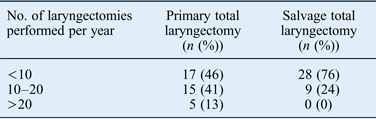
Table I shows that fewer salvage total laryngectomies are performed compared with primary total laryngectomies each year.
Proportion of surgeons performing primary and salvage total laryngectomy

No. = number
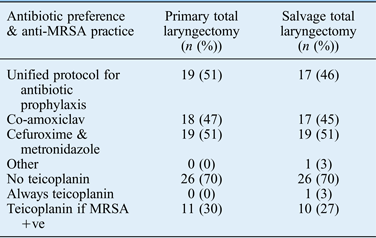
Table II shows that 51 per cent of surgeons follow a unified protocol of antibiotic prophylaxis for primary total laryngectomy and 46 per cent follow a protocol for salvage total laryngectomy. Cefuroxime and metronidazole were more favoured in primary total laryngectomy (51 per cent) and salvage total laryngectomy (51 per cent) than co-amoxiclav (47 per cent and 45 per cent respectively). There was no difference in the use of an anti-MRSA agent for MRSA-positive cases between primary and salvage laryngectomy (30 per cent and 27 per cent respectively); however, one surgeon uses anti-MRSA agents routinely in all salvage cases.
Antibiotic preferences and anti-mrsa practices in primary and salvage total laryngectomy
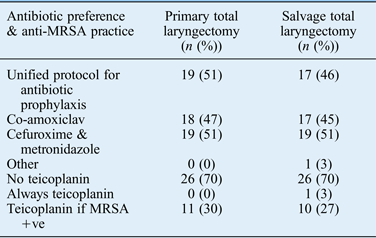
MRSA = methicillin-resistant Staphylococcus aureus; +ve = positive
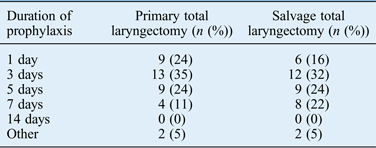
The duration of antibiotic prophylaxis varies considerably from 24 hours to 7 days, as shown in Table III. One surgeon gives prophylaxis at induction only and another prefers to continue antibiotics for as long as drains are in situ.
Duration of antibiotic prophylaxis in primary and salvage total laryngectomy
There was a trend for prolonged use of antibiotics in salvage total laryngectomy, as shown in Figure 1.
Line chart demonstrating the percentage of surgeons employing various durations of antibiotic prophylaxis in primary and salvage total laryngectomy.
Nineteen surgeons (51 per cent) revealed that their choice of antibiotic and duration of the prophylaxis is a result of their training, whereas 9 (24 per cent) attribute their practice to local evidence and microbiological advice. The remaining 9 (24 per cent) did not answer. Twenty-five surgeons (68 per cent) said they would not change their practice as there was a lack of evidence to support this.
At the end of the questionnaire, 35 surgeons (95 per cent) had answered all of the questions appropriately and 2 (5 per cent) had dropped out. Eighty-eight per cent were happy with the contents of the questionnaire, 96 per cent were happy with the clarity of the questions and 96 per cent were satisfied with the ease of its completion.
Discussion
The most common major post-operative complication following total laryngectomy is infection and spontaneous pharyngocutaneous fistula. Wound dehiscence causes pathological communication between the internal mucosa of the pharynx and the external skin that discharges saliva. Oral feeding is suspended, healing is delayed, and the loss of fluids, electrolytes and proteins through the fistula, exacerbates post-operative morbidity.Reference Jeannon, Orabi, Manganaris and Simo6 Altogether, this prolongs hospital stay and delays post-operative radiotherapy, which increases the risk of tumour recurrence.Reference Simo and French1, Reference Violaris and Bridger9 The focus of head and neck surgeons' work is to reduce post-operative infection and the incidence of pharyngocutaneous fistula.
A meta-analysis by Paydarfar and Birkmeyer concluded that previous total laryngectomy, pre-operative tracheostomy, haemoglobin level of less than 12 g/dl, pre-operative radiotherapy and concurrent neck dissection are significant factors in the development of pharyngocutaneous fistula.Reference Paydarfar and Birkmeyer10 Moreover, rates of fistula in salvage surgery have been reported to be as high as 50 per cent.Reference Emerick, Tomycz, Bradford, Lyden, Chepeha and Wolf11
In 2008, the Scottish Intercollegiate Guidelines Network guideline for antibiotic prophylaxis in surgery announced a clear treatment benefit for antibiotic prophylaxis in clean-contaminated head and neck surgery.12 Patients treated with antibiotic prophylaxis are 63 per cent less likely to develop post-operative infection, and one infection is prevented for every six patients treated. However, controversy exists regarding the length and type of antibiotic prophylaxis, as prolonged courses can lead to resistance and systemic sepsis. The guideline therefore advises that a short course over 24 hours is as effective as a longer course in most cases. The cost of preventing one wound infection by such a short course of prophylaxis is £49.38.Reference Simo and French1
Rodrigo et al. showed no statistically significant difference between the effectiveness of Augmentin™, cephazolin, clindamycin or gentamicin in head and neck oncological surgery. Any broad-spectrum antibiotic that covers Gram-negative, aerobic and anaerobic organisms will suffice.Reference Rodrigo, Alvarez, Gomez, Suarez, Fernandez and Martinez13 A combination of agents has proven to be more effective than a single-agent regimen.Reference Seven, Sayin and Turgut14
Jeannon et al. detected MRSA in 80 per cent of patients who developed pharyngocutaneous fistula after total laryngectomy, none of which were carriers of MRSA pre-operatively.Reference Jeannon, Orabi, Manganaris and Simo6 This finding indicates that MRSA is an important risk factor in fistula formation. Head and neck patients are particularly prone to acquiring MRSA because of prolonged hospitalisation, intravenous access, compromised host immunity, prior antibiotics and prolonged operating time.Reference Jeannon, Orabi, Manganaris and Simo6, Reference Nixon and Bingham15, Reference Shiomori, Miyamoto, Udaka, Okochi, Hiraki and Hohchi16 The authors therefore recommend that an MRSA eradication protocol (mupirocin nasal ointment and chlorhexidine soap) is followed for a minimum of 5 days before a patient undergoes total laryngectomy. Post-operatively, an anti-MRSA agent should be administered in addition to the standard antibiotic of choice for a minimum of 72 hours in all salvage patients, and continued further if there is clinical suspicion of infection. The benefit offered by prolonged therapy in this situation is thought to be greater than the risk of selective resistance.Reference Jeannon, Orabi, Manganaris and Simo6 Typical anti-MRSA agents include teicoplanin and vancomycin.
• Antibiotic prophylaxis in primary laryngectomy has reduced rates of infection from 87 to 10 per cent
• Methicillin-resistant Staphylococcus aureus (MRSA) has been detected in 80 per cent of patients who developed pharyngocutaneous fistula post-laryngectomy
• There is no literature on the use of antibiotic prophylaxis in revision or salvage laryngectomy surgery
• Fifty-one per cent of surgeons in our survey have no evidence basis to their antibiotic practice
• It is suggested that an anti-MRSA agent is administered in addition to standard post-operative antibiotics for at least 72 hours in all salvage patients
Current controversy regarding the length and type of antimicrobial agents utilised for antibiotic prophylaxis is clearly reflected in this national survey. Only 51 per cent of surgeons follow a unified protocol of antibiotic prophylaxis, with little consideration for MRSA cover. The duration of prophylaxis varies from 24 hours to 7 days, which reflects highly varied microbiological opinion, and 51 per cent have no evidence basis to their practice. This suggests that the use of antibiotic prophylaxis is still very much unregulated and surgeons still do what they feel works for them, or rely on principles passed down historically through their training, rather than applying a uniform, evidence-based policy.
We appreciate that this survey does have its limitations, and without knowing individuals' surgical outcomes it is difficult to assess the effectiveness of the surgeons' practice. It would have been interesting to compare the incidence of pharyngocutaneous fistula against antibiotic practice; however, it is unlikely that surgeons would volunteer this information. It would also be helpful to gain insight into what factors encourage a surgeon to prolong the antibiotic course during the post-operative period. These are all factors which need addressing in future studies.
Conclusion
Elements of antibiotic prophylaxis practice in primary and salvage total laryngectomy remain controversial. There is enough support to suggest that an evidence-based approach to antibiotic prophylaxis should be applied by all surgeons and units practising major head and neck oncological surgery. This would be an important step in reducing the incidence of pharyngocutaneous fistula and its associated morbidity, as the requirement for salvage total laryngectomy will inevitably increase with chemotherapeutic advances. It will also allow better comparison of complication rates and test best practice. With the imminent disclosure of surgeons' reported outcomes, there is no doubt that having uniform evidence-based policies would be a clear advantage. More research is therefore needed to inform national guidance on antibiotic prophylaxis in primary and salvage total laryngectomy.
Appendix 1. Questionnaire on antibiotic prophylaxis
1. Do you perform laryngectomy surgery?
Yes / No
2. How many PRIMARY laryngectomies do you perform each year?
a) <10 b) 10–20 c) >20
3. How many SALVAGE laryngectomies do you perform each year?
a) <10 b) 10–20 c) >20
4. Does your unit have a unified protocol of antibiotic prophylaxis for PRIMARY laryngectomy?
Yes / No
5. Does your unit have a unified protocol of antibiotic prophylaxis for SALVAGE laryngectomy?
Yes / No
6. Which antibiotic prophylaxis do you use in PRIMARY laryngectomy?
a) Co-amoxiclav b) Cefuroxime & metronidazole c) Other
7. Do you use a special anti-MRSA agent such as teicoplanin as prophylaxis?
a) No b) Always c) If MRSA +ve
8. How long is your antibiotic prophylaxis for?
a) 24 hrs b) 3 days c) 5 days d) 7 days e) 6 weeks f) Other
9. Which antibiotic prophylaxis do you use in SALVAGE laryngectomy?
10. Do you use a special anti-MRSA agent such as teicoplanin as prophylaxis?
a) No b) Always c) If MRSA +ve
11. How long is your antibiotic prophylaxis for?
a) 24 hrs b) 3 days c) 5 days d) 7 days e) 6 weeks f) Other
12. Reasons for your current practice: ___________________________________________
13. Are you considering changing your practice? ___________________________________________
14. Is anything preventing you from changing your practice? ____________________________________
15. How do you rate the quality of this survey? ___________________________________________
16. Has answering the questions in this survey led you to reflect on your own practice?
Yes / No
17. Any further suggestions: ___________________________________________