Psychological debriefing is a crisis mental health intervention. Critical Incident Stress Debriefing (CISD)Reference Mitchell 1 is a specific, 1-session, 7-phase debriefing model that has been integrated into the Critical Incident Stress Management system developed in the 1990s, but modifications of this intervention sometimes include multiple sessions.Reference Mitchell and Everly 2 Debriefing has gained international popularity among many different groups, especially emergency responders and hospitals. It is the most widely used organized intervention following traumatic incidents.Reference Deahl 3 Debriefing was designed as a group intervention to process shared trauma through individuals sharing their experience. It also provides education on psychiatric disorders, coping skills, and social support. Ideally, the debriefing session occurs 24-72 hours after the traumatic incident, but it is not uncommon for CISD to be provided weeks after the disaster ends.Reference Mitchell and Everly 4 It is typically used alongside other crisis support services, including individual crisis intervention, family support services, follow-up services, and referral for professional care. Previous studies have not found significant debriefing beneficial for either treatment or prevention of post-traumatic stress disorder (PTSD), and some evidence suggests that it might even worsen post-traumatic stress symptoms.Reference Greenberg, Brooks and Dunn 5 , Reference van Emmerik, Kamphuis, Hulsbosch and Emmelkamp 6 Because debriefing was not designed to prevent or treat psychiatric disorders, including PTSD, these are therefore not the most logical benchmarks to measure its benefits.Reference van Emmerik, Kamphuis, Hulsbosch and Emmelkamp 6 , Reference North and Pfefferbaum 7 It is currently recommended that psychological debriefing can be offered to trauma-exposed workers, but also that participation should not be mandatory because of potential risk of negative effects of debriefing on individuals with PTSD.Reference van Emmerik, Kamphuis, Hulsbosch and Emmelkamp 6 Instead, referral to formal psychiatric treatment should be made for such individuals.
On April 19, 1995, the Alfred P. Murray Federal Building in downtown Oklahoma City was bombed in a domestic terrorist attack. This incident, known as the Oklahoma City bombing, killed 168 people and caused an estimated property damage of $652 million. In the aftermath of the bombing, firefighters from the Oklahoma City Fire Department participated in the search and rescue effort. The fire department provided mandatory psychological debriefing for all of the recovery and rescue workers. A study was conducted afterward to assess the mental health effects of these workers’ trauma exposure in the aftermath of the bombing.Reference North, Tivis and McMillen 8 Workers were also asked to report their level of satisfaction with the psychological debriefing they received. For this article, data from this study were analyzed to investigate potential associations between debriefing satisfaction level and post-disaster psychopathology. Because of suggestions that debriefing may worsen PTSD symptoms, and because individuals with prominent avoidance and numbing reactions might be anticipated to have difficulties engaging in an intervention that involves confrontation with memories of the trauma, it was hypothesized that workers with PTSD or with prominent avoidance and numbing would be more likely than their counterparts to report dissatisfaction with the debriefing.
METHODS
This study was pre-approved by the Institutional Review Board of Washington University School of Medicine. All participants provided written informed consent.
A volunteer sample of 181 firefighters who served as rescue and recovery workers after the Oklahoma City bombing was recruited. Details of the sample and its recruitment are provided in previous articles describing this study.Reference North, Tivis and McMillen 8 , Reference North, Tivis and McMillen 9
Data collection proceeded over 27 months. Participants were assessed with the National Institute of Mental Health Diagnostic Interview Schedule (DIS) for DSM-III-RReference Robbins, Cottler and Keating 10 and Disaster Supplement.Reference Robins and Smith 11 The DIS obtained lifetime, pre-disaster, and post-disaster prevalence of psychiatric disorders, including PTSD, major depression, panic disorder, generalized anxiety disorder, and alcohol and drug use disorders. In accordance with the DSM-III-R, criteria for the avoidance and numbing symptom group of PTSD required the presence of ≥3 of 7 avoidance/numbing symptoms. Similarly, the intrusion symptom group required the presence of at least 1 of 4 intrusion symptoms, and the hyperarousal symptom group required ≥2 of 6 hyperarousal symptoms. The Disaster Supplement obtained information on experience of the disaster and interventions received, including psychological debriefing and their level of satisfaction with it in 4 categories (very satisfied, mostly satisfied, somewhat dissatisfied, very dissatisfied).
χ 2 Analysis tested associations between 2 categorical variables, with Fisher’s exact tests substituted for instances with expected cell sizes <5. Level of statistical significance was set as α<0.05. Because the hypothesis considered only 1 direction of difference, that is, whether the group that was very dissatisfied with debriefing had more PTSD or avoidance/numbing, a 1-tailed statistical comparison was used.
RESULTS
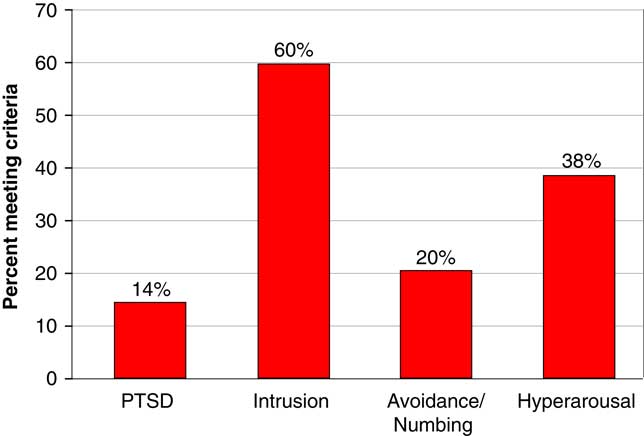
The sample (N=181) was mostly male (97%) and Caucasian (89%) with a mean age of 38.5 (SD=7.9) years. Most were married (76%). Mean (SD) years of education was 13.8 (1.3). Figure 1 shows that 14% of the workers had bombing-related PTSD. The most prevalent symptom group was intrusion, and the least prevalent was avoidance/numbing.
Proportion of Rescue Workers Meeting Criteria for Post-Traumatic Stress Disorder (PTSD) and PTSD Symptom Groups.

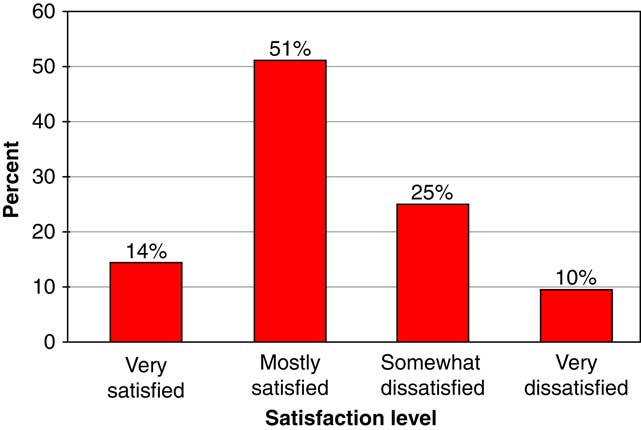
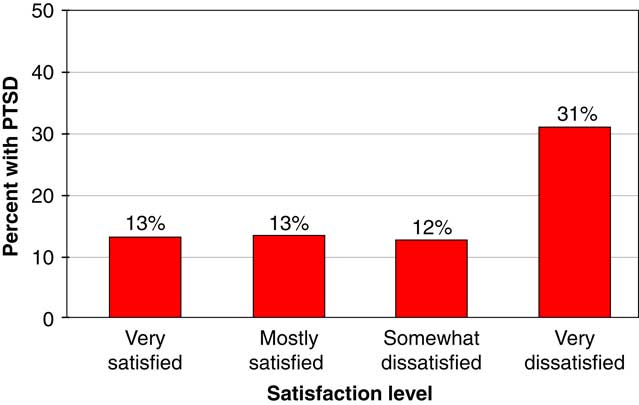
Although participation in the debriefing was intended to be mandatory, only 92% of the workers (167/181) participated in it. Of those who received debriefing, two-thirds (67%) participated daily; approximately half (56%) ended their debriefing by 2 weeks and 86% by a month, with only 1 individual receiving it for >1 year. Figure 2 shows that most workers (65%) were (very or mostly) satisfied with the debriefing, although about one-third (35%) were (somewhat or very) dissatisfied with it. Satisfaction with the debriefing was not associated with any demographic variable. Figure 3 shows the association of PTSD with debriefing satisfaction. PTSD was diagnosed in nearly one-third (5/16) of those who were very dissatisfied with debriefing, far greater than in the 3 other satisfaction levels (P<0.05 for comparisons of all 3 other satisfaction levels with “very dissatisfied”). This unique difference in the “very dissatisfied” group suggested dichotomization of satisfaction level between “very dissatisfied” and the other levels for further analysis. Debriefing satisfaction level was not associated with any other psychiatric disorders, including major depression, panic disorder, generalized anxiety disorder, and alcohol and drug use disorders.
Proportion of Rescue Workers in Each Reported Level of Satisfaction with Debriefing.

Proportion of Rescue Workers with Post-Traumatic Stress Disorder (PTSD) by Level of Satisfaction With Debriefing.

Of the workers with PTSD, 21% (5/24) were very dissatisfied with the debriefings, compared to only 8% (11/143) of the workers without PTSD, a significant difference (P=0.044, 1-sided Fisher’s exact test). In addition, meeting avoidance/numbing criteria was significantly associated with being very dissatisfied with the debriefings (21% vs. 7%; P=0.018, 1-sided Fisher’s exact test).
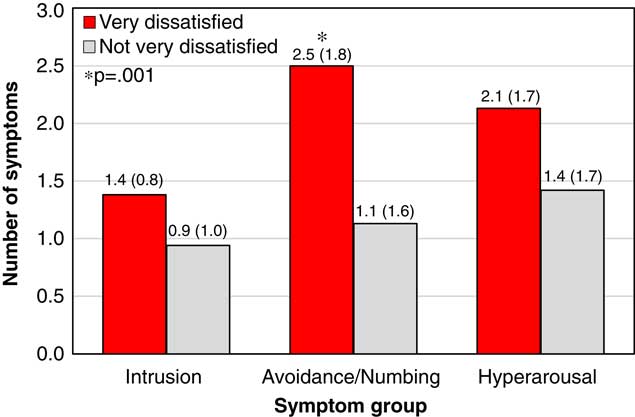
Figure 4 shows the associations of number of symptoms in each PTSD symptom group with being very dissatisfied with debriefing. The numbers of intrusion symptoms (t=1.73, df=165, P=0.085) and of hyperarousal symptoms (t=1.54, df=165, P=0.125) were not significantly associated with being very dissatisfied with the debriefings. The number of avoidance/numbing symptoms, however, was significantly associated with being dissatisfied with the debriefings (t=3.24, df=165, P=0.001).
Mean (SD) Number of Symptoms in Each Symptom Group Comparing Rescue Workers Who Were Very Dissatisfied With Debriefing With the Rest of the Rescue Workers.

The vast majority (90%) of all the rescue workers indicated they would recommend debriefing to their colleagues. Even among those who were very dissatisfied with debriefing, 63% said that they would recommend debriefing, although significantly less likely than the rest (93%; P=0.002, 1-sided Fisher’s exact test).
DISCUSSION
This study hypothesized that rescue and recovery workers responding to the Oklahoma City bombing with PTSD or with prominent avoidance/numbing were significantly more likely than their counterparts to be dissatisfied with the psychological debriefing intervention they received. The rationale for this hypothesis drew from the recognition that people with prominent avoidance/numbing, which is known to represent the core psychopathology of PTSD,Reference North, Suris, Davis and Smith 12 might have difficulties with vivid trauma reminders encountered in debriefing sessions. No prior studies have examined associations of debriefing with avoidance/numbing or PTSD outcomes. This study indeed found that PTSD and prominent avoidance/numbing were significantly associated with debriefing dissatisfaction. The number of avoidance/numbing symptoms was significantly associated with great dissatisfaction with the debriefing, but the numbers of intrusion and hyperarousal symptoms were not.
The construct of dissatisfaction that was examined in this study is not a clinical outcome indicator. The significant association of debriefing dissatisfaction with PTSD and prominent avoidance/numbing, however, suggests that debriefing may not be satisfactory for people with these clinical characteristics. Regardless, it is possible that even the firefighters who were most dissatisfied with the debriefing gained benefit from it. Their dissatisfaction cannot be assumed based on this study’s findings to represent a measure of poor effectiveness of this treatment, as resistance even to established treatment methods is not an uncommon occurrence in clinical practice.
Although the workers with PTSD or prominent avoidance/numbing were significantly more dissatisfied with the debriefing, most workers reporting great dissatisfaction indicated that they would recommend debriefing to others. One possible explanation is that the dissatisfied workers were able to identify the potential benefits of the debriefing sessions for others, but they themselves were unable to access these benefits themselves because of their psychopathology.
Development of PTSD is hypothesized to follow a temporal progression of symptoms, starting with hyperarousal, followed by intrusive memories, both of which may be normal responses in the aftermath of exposure to trauma.Reference Foa, Riggs and Gershuny 13 , Reference Shad, Suris and North 14 When these symptoms become persistent and overwhelming, certain individuals may respond by developing avoidance and numbing responses in efforts to protect against these distressing symptoms. People who experience unbearable distress over their experience of trauma exposure may also find it difficult to confront memories of the experience, further reinforcing their inclinations to avoid these memories. Alternatively, those who cannot avoid them may develop emotional numbing as a means of reducing the emotional impact or even as a result of a neuropsychiatric state that has been rendered too overwhelmed to mount an emotional response. Consistent with the findings of this study, once avoidance and numbing are present, interventions such as debriefing that include reminders of the trauma have the potential to generate an unpleasant or unsatisfactory experience.
An important strength of this study was its use of structured diagnostic interviews to assess full diagnostic criteria for psychiatric disorders, including PTSD and its symptom subgroups. Although the sample was large, the volunteer nature of the sample was a weakness, potentially creating participation bias. Data collection was not completed until 3 years after the bombing and debriefing sessions had occurred, possibly introducing recall bias. This study was limited to examining dissatisfaction in association with PTSD, without testing prospectively whether debriefing led to development or worsening of PTSD. Therefore, contraindications for this intervention for individuals with prominent avoidance and numbing are not specifically warranted based on this study, but the findings suggest that caution may be indicated in recommending this intervention for these workers, and further research is needed for definitive recommendations for them. The data from this study were collected about 2 decades ago, and thus the findings may not reflect the perceptions and opinions of rescue and recovery workers receiving debriefing procedures today. Despite the age of the data, the findings are of relevance because the associations found in this paper have not been previously reported.
CONCLUSIONS
The findings of this study suggest that debriefing may be an unsatisfactory intervention for people with PTSD, particularly those with prominent avoidance/numbing, as reflected in the association of PTSD and avoidance/numbing with great dissatisfaction with the debriefing. Because prominent avoidance/numbing represents an established marker of PTSD psychopathology,Reference North, Suris, Davis and Smith 12 the findings of this study further support the recommendation that people with PTSD and prominent avoidance/numbing should be identified and receive formal treatment instead of participating in debriefing, consistent with prior recommendations against making debriefing mandatory for entire workforce populations. If this constraint is followed, implementation of debriefing for the rest of the workforce to process their trauma experience is likely to be more acceptable and less likely to invoke negative emotional responses. Because PTSD cannot be diagnosed before 1 month, and previous research has demonstrated that avoidance and numbing symptoms begin more slowly (1-2 weeks) than intrusion and hyperarousal symptoms (days),Reference Whitman, North, Downs and Spitznagel 15 delay of implementation of debriefing until enough time has passed to assess avoidance and numbing symptoms might be prudent to minimize such negative responses to it.