Introduction
The ubiquity and popularity of plastic is undeniable (e.g. Madden et al. Reference Madden2012). Alongside its obvious benefits, however, plastic has evident costs to the environment and society when it becomes waste (Barthes Reference Barthes and Lavers1972 [1957]; Gabrys et al. Reference Gabrys, Hawkins and Michael2013), giving form to a “very disturbing future” (Hawkins Reference Hawkins2018: 101). Often seen as a disposable material (e.g. single-use packaging), plastic can have a very short use life, yet its durability means that the story lasts far longer. With only a small proportion of plastic waste being incinerated (12 per cent) or recycled (9 per cent), the majority goes to landfill or enters the natural environment (Geyer et al. Reference Geyer, Jambeck and Law2017). Sherrington (Reference Sherrington2016) estimates that nine million metric tonnes of plastic waste reach the oceans each year. It is hard to conceive that, when Baekeland invented Bakelite in 1907, there would be ‘soups’ of plastic floating around the globe on ocean currents, or that every beach, including those in remote places such as Galápagos (Ecuador) and Antarctica, would have plastic washing up with almost every tide (Thompson et al. Reference Thompson, Moore, vom Saal and Swan2009; Obbard et al. Reference Obbard, Sadri, Wong, Khitun, Baker and Thompson2014; Woodall et al. Reference Woodall, Sanchez-Vidal, Canals, Paterson, Coppock, Sleight and Thompson2014; Lavers et al. Reference Lavers, Dicks, Dicks and Finger2019).
This article describes an innovative and multifaceted methodology built around co-creation and the collaborative opportunities provided by archaeology and behavioural sciences (e.g. psychology). Through close examination of items of marine waste, and the development of ‘intimate relations’ with it (Moreu & Goméz Reference Moreu and Goméz2019), including story-telling, we argue that participants will be encouraged to think differently about it, to develop empathy towards the landscape and its inhabitants on which such waste has an impact, and to adjust their behaviours accordingly. Here we include a short summary of the results, as proof of method. A more detailed analysis of the data and impacts will be published separately.
Plastics can have lethal and sub-lethal effects on wildlife from processes such as ingestion, entanglement and chemical contamination (e.g. Gall & Thompson Reference Gall and Thompson2015; Wilcox et al. Reference Wilcox, van Sebille and Hardesty2015). Plastic waste also affects human health and wellbeing, and has a social cost, including negative economic impacts on maritime industries (e.g. Kershaw & Rochman Reference Kershaw and Rochman2016; Wyles et al. Reference Wyles, Pahl, Thomas and Thompson2016; Wright & Kelly Reference Wright and Kelly2017; Beaumont et al. Reference Beaumont, Aaneson, Austen, Börger, Clark, Cole, Hooper, Lindeque, Pascoe and Wyles2019). The Galápagos archipelago is no exception to this problem. Against this background, a group of scientists and stakeholders met in Galápagos for a ‘Science to Solutions’ workshop in May 2018. Eighty-two representatives from 16 organisations across Ecuador (81 per cent), the UK (16 per cent) and overseas (3 per cent) attended the workshop over the course of four days with the aims of:
• Gathering evidence on the impacts of plastics on Galápagos wildlife.
• Discovering the major sources and concentrations of plastic pollution in Galápagos, and how they can be more effectively tackled.
• Working with science and businesses to find sustainable solutions.
• Building on existing education programmes to empower local community champions to promote behavioural change towards plastic usage.
Central to the four-day workshop was a ‘World Café’ event (described below) involving a combination of members of the Science to Solutions project team (as participants and facilitators) and members of the local community. Some of the methods used to understand marine plastic pollution are well developed and tested. What has not previously been attempted is the combination of close collaboration between disciplines across the natural sciences, social sciences and humanities with the alignment of archaeological and behavioural methods centred around local communities and co-creative storytelling. While this is not the first time archaeological approaches have been taken towards beach (or ‘drift’) materials (e.g. Pétursdóttir Reference Pétursdóttir2017), here the focus is on ‘object narratives’ set within the context of the archaeology of the contemporary past and ‘garbology’—the archaeological study of modern rubbish—in particular (Harrison & Schofield Reference Harrison and Schofield2010; Reno Reference Reno, Graves-Brown, Harrison and Piccini2013; Sosna & Brunclikova Reference Sosna and Brunclikova2017).
Research context
Objects have both a life and agency (Olsen Reference Olsen2003; Moreu & Goméz Reference Moreu and Goméz2019); they are not merely a product of society, but are fundamental to it, becoming intimately entangled with us and society (Thomas Reference Thomas1996; Turkle Reference Turkle2007; Moreu & Goméz Reference Moreu and Goméz2019: 321). As Joy (Reference Joy2009) has observed, in some societies, objects take on the personalities of people or have lives that resemble people's lives. It therefore seems logical to apply a biographical approach to objects, to reveal their life histories and notably their relationships to people through the course of their lives, an idea first promoted by Kopytoff (Reference Kopytoff and Appadurai1986), and taken up by Gosden and Marshall (Reference Gosden and Marshall1999), amongst others.
There is, however, a difference between object biographies, the ‘histories’ revealed by exploring and understanding the relationships between people and things, and object narratives, which are stories told about objects, that may contain elements of fact, but may equally be speculative and fictional (Herman Reference Herman2009). In archaeological work, there is often a fine line between biography and narrative. The research presented here has elements of both. There is an aspiration towards object biography, but a realisation that the most likely outcomes are the discovery of possible trajectories in an object's life and the various courses that objects may have taken to reach their current location and life stage. In our case, a better understanding of the sources and pathways of plastic items can emerge by combining these narratives with in-depth (including some scientific) analysis. How did these objects get here, and what behaviours caused them to follow a particular course that resulted in becoming marine pollution? Oceanographic research also forms part of the narrative, providing data on probable geographic sources, thus narrowing the search area within which the sources responsible for the flow of plastic may be found.
As Humphries and Smith (Reference Humphries and Smith2014: 478) noted, narrative theorists “treat objects as things to tell stories with or about or to narrate meaning through”. Objects therefore become the central character within stories. They both produce and participate in narrative production, while also, and vitally, making a difference through their role and position as agents or entities with the capacity to do something (Latour Reference Latour2007: 53; Humphries & Smith Reference Humphries and Smith2014: 479). These principles form a starting point for the methodology, along with recognition of the benefits of storytelling in co-creative and community-led conservation practice (e.g. Fanini & Fahd Reference Fanini and Fahd2009; Gislason et al. Reference Gislason, Morgan, Mitchell-Foster and Parkes2018), and of the importance of wider ‘storyworlds’, the universes in which these stories are set, and their contribution to building the future (von Stackelberg & McDowell Reference von Stackelberg and McDowell2015).
In summary, this ‘object narratives’ research takes an archaeological approach to the problem of marine pollution, working with other disciplines, and recognising the added value inherent within the framework of public participation. By understanding flow (e.g. ocean currents), activities (e.g. fishing) and behaviours (e.g. carelessness), and through workshops centred around co-creative storytelling with local communities (e.g. Duffy & Popple Reference Duffy and Popple2017), we hope to understand and ultimately change behaviours, and thus mitigate the future impact of plastic pollution on the marine environment. The work involved four stages and was applied in Galápagos, a study area with the benefits of being widely known, tightly defined and with a diverse yet fragile ecosystem on which the impact of plastic pollution would be (and is fast becoming) significant.
Case study: Galápagos
Galápagos is an isolated archipelago situated in the Pacific Ocean 1000km west of Ecuador, at the confluence of three ocean currents. It is a UNESCO World Heritage Site known for its rich and diverse marine environment, its terrestrial ecology and its history in understanding evolution, following Darwin's visit in 1835. The UNESCO Inscription describes it as a ‘living museum and showcase of evolution’, with the confluence of major currents making it one of the richest ecosystems in the world (https://whc.unesco.org/en/list/1; accessed 13 February 2019). The archipelago's history of occupation dates back approximately 200 years, but has received limited archaeological investigation (e.g. Jamieson Reference Jamieson2018). Increased accessibility and affordability, and its growing profile through television programmes such as the BBC's Blue Planet and Blue Planet II, have meant that the archipelago has rapidly increased in popularity as a tourist destination, particularly ecotourism, in recent years (Taylor et al. Reference Taylor, Hardner and Stewart2009; Izurieta Reference Izurieta2017). Consequently, more people are living on the islands to service the needs of visitors. A critical challenge in Galápagos is witnessed in the need to balance the requirements of more residents and tourists with the necessity to conserve the natural environment that has drawn them there (e.g. Quiroga Reference Quiroga2009; Kvan & Karakiewicz Reference Kvan and Karakiewicz2019).
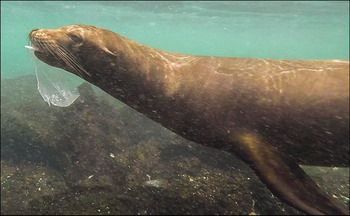
As elsewhere in the world, marine plastic pollution is becoming an increasing threat to the human and non-human residents of this archipelago (Mestanza et al. Reference Mestanza, Botero, Anfuso, Adolfo Chica-Ruiz, Pranzini and Mooser2019). Plastic bags are mistaken for food by turtles and seals (Figure 1), and microplastics are ingested by filter feeders ranging from small mussels to large humpback whales (Schuyler et al. Reference Schuyler, Wilcox, Townsend, Hardesty and Marshall2014; van Cauwenberghe & Janssen Reference van Cauwenberghe and Janssen2014; Besseling et al. Reference Besseling2015). Indeed, as of 2015, globally, 344 species had been affected by entanglement in marine debris, and 331 species by ingesting it (Kühn et al. Reference Kühn, Bravo Rebolledo, Van Franeker, Bergmann, Gutow and Klages2015). Furthermore, in Galápagos, most of the plastic items behind these impacts appear to come from the local region. Specifically, modelling by van Sebille et al. (Reference van Sebille, Delandmeter, Schofield, Hardesty, Jones and Dinnelly2019), using virtual plastic particles (Lange & van Sebille Reference Lange and van Sebille2017), suggests that plastic waste from outside the archipelago itself originates predominantly from northern coastal Peru and southern Ecuador, with the strong probability of additional material coming from fishing fleets in the vicinity of the archipelago, whose presence and movements are now tracked by satellite. In the case of Galápagos, therefore, plastic pollution appears to be a regional problem, requiring regional solutions.
Sea lion with a plastic bag, in Galápagos (photograph: A. Porter).

In recent years, the Directorate of the Galápagos National Park has increased its clean-up operations and has encouraged the development of relationships with not-for-profit organisations with access to the world's foremost international expertise. Over the course of our Science to Solutions meeting in 2018, the group concluded that, due to a combination of oceanographic and societal reasons, Galápagos is best placed of any archipelago to demonstrate how to mitigate the threat of marine plastic pollution in a marine reserve. Subsequently, the team developed a multidisciplinary programme to achieve this. A series of pilot research programmes are being conducted into the physical, biological and human nature of the issue, and a full four-year programme has been proposed based on the results of the first year of pilot work. The methodology described here forms part of this wider programme.
Methods
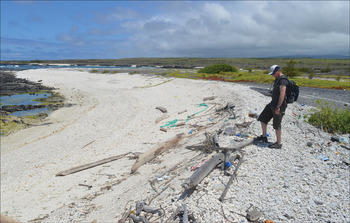
Within this context, an object-narratives methodology was developed and tested in Galápagos. This involved four distinct but related stages, the first of which was surface beach collection. The Science to Solutions team visited a remote beach on San Cristobal Island, Bahia Rosa Blanca (Figure 2). The site is accessible only by boat, and access is restricted to National Park staff in order to protect the wildlife. Unlike the tourist beaches of the archipelago, this beach is rarely cleaned and large areas are therefore covered in an accumulation of plastic. Some of this material, particularly in the backshore area behind the beaches, some distance behind mean high water, is bleached and brittle and appears to have been there for a long time. Other items are obviously recent, as determined by sell-by and use-by dates, and a relative lack of weathering. Some of the older items have been visibly transformed by weathering and possibly animal action into microplastics (items of less than 5mm diameter; Arthur et al. Reference Arthur, Baker and Bamford2009), and are present here in significant quantities.
The remote beach of Bahia Rosa Blanca on San Cristobal Island (photograph: J. Schofield).

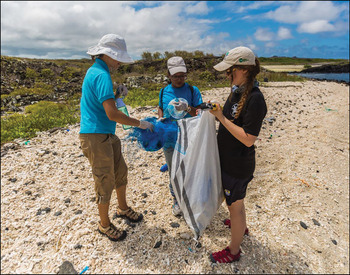
Upon arrival, after a rapid inspection of the entire site, the team employed a stratified, random methodology for collecting artefacts (Figure 3; after Shennan Reference Shennan1988: 315): the beach assemblage was visually inspected for broad categories of artefacts, and then a random sample of objects was drawn for each category from different areas of the beach. The main categories of artefacts were single-use plastic containers of various kinds (e.g. bags, bottles, Styrofoam cups); clothing (e.g. shoes—mostly trainers and flip-flops, hats and caps); fishing equipment, mainly comprising the plastic components of traps, fishing line and parts of fishing rafts; toys (e.g. Lego, dolls, buckets and spades); and, less frequently, a range of other (sometimes unidentifiable) objects, including a syringe, although local knowledge suggests that this may be categorised under ‘fishing equipment’. Artefacts were collected in refuse bags, which were then taken to the laboratories at the Galápagos Science Center. Photographs were taken of the beach collection survey and of the area in general.
Surface collection of a representative sample of the items present on the beach of Bahia Rosa Blanca (photograph: A. Porter).

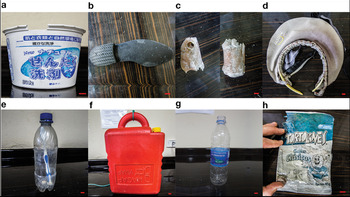
The second stage of the process involved the systematic sampling of this collection to produce a shortlist of eight items, which provided a range representative of the wider beach sample for further investigation, and, specifically, for the object-narratives work. The shortlist comprised (Figure 4 a–h): a plastic pot with Japanese labelling once containing liquid detergent; the sole of a child's shoe; the torso of a doll; a sun visor; a closed plastic bottle containing a toothbrush; a red container that had been reused to act as a marker buoy (the attached string probably tethered it to the boat); a plastic water bottle with a Galápagos label; and a packet that once contained snacks.
The eight objects selected for storytelling, from the sample from Bahia Rosa Blanca; the red scales with each object = 10mm (photographs: A. Porter).

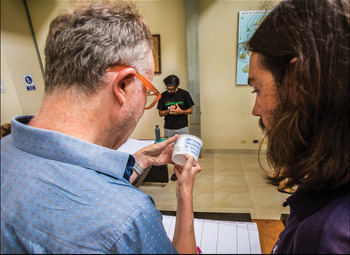
The third stage was the object-narratives workshop itself. This took place in a laboratory and, in a variation of the World Café method (e.g. Carson Reference Carson2011; Fouché & Light Reference Fouché and Light2011; Prewitt Reference Prewitt2011), involved eight teams of 3–5 people each moving around the collection of objects, building a series of narratives around each item (Figure 5). The teams were typically mixed, comprising local participants from non-governmental organisations, the National Park, members of a group working on San Cristobal Island to empower local youth to make a positive difference to their community (https://gecoGalápagos.wordpress.com; accessed 14 February 2019), and local and international members of the Science to Solutions team. For logistical reasons, Spanish- and English-speaking participants generally worked separately, although some participants were bilingual.
Examining the white, round detergent container in the narrative workshops (photograph: A. Porter).

Following the World Café model methodology, the task was intentionally ‘quick-fire’, with five minutes on each object for each of the seven stages of the narrative that we sought to compile. The first six of these stages were framed as questions set out on a grid on large sheets of paper, each on a separate ‘station’:
1) Where was the object from?
2) What was it made of and how was it made?
3) How, by whom and for what had it been used?
4) How had it ended up in the ocean, and eventually on a remote beach in Galápagos?
5) What human actions might have caused this outcome?
6) What actions might have prevented this outcome?
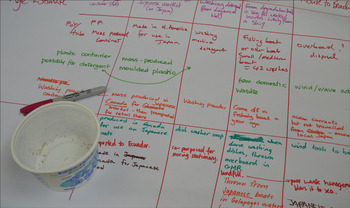
Groups were encouraged to consider the evidence that might support their narratives, and as they progressed through the collection from object to object, each group had access to what the previous groups had already written. They could work on the next stage in the story, or create alternative stories for stages that had already been addressed. They could offer something for each stage if they wished and if they had time. Each team had its own different coloured pen. This allowed us to follow each team's object narratives and their distinctive approach and perspective after the event (Figure 6).
Notes from the narrative workshops (photograph: J. Schofield).

The seventh and final stage brought the groups back to the objects with which they began. They were asked to review the various stories and possibilities that had been produced, and present the one that they preferred, or felt was the most likely, to the wider group. Some of these stories were realistic—the toothbrush in the bottle to keep it clean in a dirty environment was associated with a fishing boat, for example. Crucially though, all participants thought critically about how these objects arrived on a Galápagos beach and the behaviours that might have caused this. They examined the cultural and natural processes that had acted upon these objects. One set of participants trained in marine biology noted how the development of colonies of marine life on the object's surface can indicate how long it had been in a marine environment, a process known as biofouling (or ecocoronas—biology attached to plastic; see Galloway et al. Reference Galloway, Cole and Lewis2017). The participants also considered what might have happened next to the objects had they not been collected, and what will happen to them now that they have.
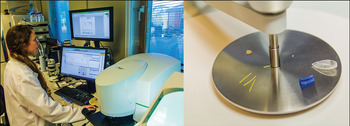
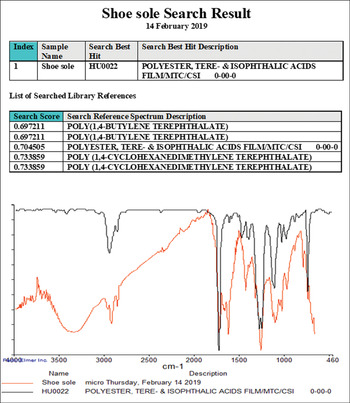
The fourth and final stage involved scientific and web-based analyses, designed to introduce factual elements to the stories. Small samples were taken from each of the eight items in order to examine their composition and degradation. The samples were analysed at the University of Exeter using Fourier transform infrared spectroscopy (attenuated total reflectance) (FTIR-ATR) to determine their polymer signature (Figure 7). A Perkin-Elmer Spotlight 400 was used in ATR scanning mode to identify the spectra of the eight items, compared to spectra from industrial spectral libraries.
FTIR analysis was undertaken on the Perkin Elmer Spotlight 400 μFT-IR Imaging System in ATR mode. Image shows the user setup, as well as cuttings taken from the objects prepared for ATR analysis to determine the plastic types (photographs: A. Porter).

Separate analysis, conducted at the University of York, involved examining and researching the coded information visible on some of the objects. These were mainly stamps, logos and labels, which formed the basis for further web-based research, along with examination for any additional evidence of use. This technique builds on work conducted previously by Myers (Reference Myers2011), as part of Bailey et al.’s (Reference Bailey, Newland, Nilsson and Schofield2009) forensic examination of a Ford Transit van. In future, we hope to build this online research into the workshops themselves, with each team having their own ‘research station’ with web access.
Results
The participating teams created a range of stories and possibilities for each item. For the shoe, for example, stories revolved around its accidental loss. It was clearly a child's shoe (note the scale in Figure 4), and perhaps one for formal occasions, given the pointed toe. One could imagine the child walking home barefoot, perhaps carrying the remaining shoe. Oceanographic data suggest that the loss must have occurred relatively locally—probably from the islands or the nearby mainland. In comparison, the detergent container, it was suggested, was from a fishing boat, the container being ideal for keeping powder dry on board, and small enough to store. Its small size may also suggest that it belonged to one of the crew, and that those on board were perhaps responsible for their own personal hygiene. We could further speculate that the container was discarded to save precious space aboard a crowded fishing boat, away from home for months at a time.
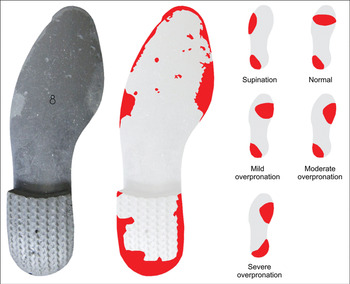
The scientific and web-based analyses produced further information, along with some challenges. The sole of the shoe, for example, has no production codes to identify of what material it is made, or by whom it was manufactured. We can, however, infer something about its use and its user(s). The only text present on this small sole is an ‘8’, indicating the size of the shoe. The item can be further personalised through wear-pattern analysis. Shoes typically display either instep wear (supination) or outside step wear (overpronation). This shoe shows both, perhaps implying two or more users (Figure 8). The fact that this is a child's shoe may provide an explanation, as these are more frequently handed down. FTIR analysis shows a 73 per cent spectral match to polyester (Figure 9). Polyester is a dense polymer (1.37g/cm−3), meaning that the item would not have floated far, and must have been lost in Galápagos, ruling out the nearby mainland as a source for this particular item. Furthermore, the use of polyester in the construction of shoe soles indicates a ‘fast’ or ‘cheap fashion’ culture, as it is less expensive and less durable than other polymers used for the same purpose.
The shoe sole and its wear patterns (analysis and illustration: S. Doherty).

Image from the ATR analysis of the shoe. The graph shows the top five spectra hits, and the hit we selected as best match is at the top. The search score is the percentage match to the library spectra (on the graph, orange = the shoe; black = the Perkin Elmer library spectra) (analysis and illustration: A. Porter & J. Jones).

In contrast, the white, round detergent container revealed details of its age, manufacture and content, but not of its use or users. Moulding on the base of the item indicates that it was made from ♷ (Polypropylene) by ‘Berry [crown symbol] Plastics’, a packaging manufacturer based in Québec, Canada. In 2017, the company changed its name to Berry Global Inc. and dropped the crown logo, suggesting a production date prior to this. Product code ‘140916CP9’ also features in the mould, and represents a line now discontinued. The item was produced via injection moulding, shown by the sprue mark in the centre of the base. A design featuring a globe, Japanese text, a telephone number and website was then screen-printed onto the container. Translation of the writing indicates that the item once contained a sodium bicarbonate-based laundry powder. There is no visible use-by or best-before date on the container, which displays minimal marine growth, weathering and fading of the ink.
The product was sold by Bluebell, based in Kashiwa, Japan. The Internet Archive's Wayback Machine indicates that the ‘Bluebell’ website was active between March 2008 and January 2015, after which date the domain became inactive. A pre-2017 date is supported by the older ‘Berry Plastics’ name, prior to the company's rebranding. FTIR analysis provided additional information on the polymers, yielding a 94 per cent match to polypropylene. This is a buoyant polymer that floats in seawater and is therefore susceptible to dispersion by wind and waves. Polypropylene is a polymer used commonly in packaging, with around 10 million tonnes produced annually in Europe alone (Association of Plastic Manufacturers 2019: 21).
In summary, the workshops and related research proved successful, particularly in terms of the engagement (and enjoyment) of local people, and discussions of behaviours. One item, however, demonstrated the transformative qualities of narrative: the closed water bottle containing a toothbrush. While there was no disputing that the bottle had been repurposed as a storage container, what was the toothbrush for? When the bottle was unscrewed, the contents gave off a strong chemical odour, akin to methylated spirit. This discovery changed the narrative from the initial mundane and reasonable suggestion of a toothbrush being kept clean for its original purpose, to the idea of the toothbrush being re-used as a boat-cleaning item stored in a convenient container.
Conclusions
The workshops and associated analysis undertaken for this project centred around the creation of narratives by a diverse group including young, local people. In creating these narratives, participants were encouraged to think of these items not simply as part of the immense global marine plastic pollution crisis, but as archaeological signatures or ‘traces’ that the individual actions of people have left on the landscape, and which thus contribute to this problem. During the workshops, we reflected on similarities and differences between marine plastic items and the millions of flint artefacts and related debitage found by archaeologists across the globe. For prehistory, each artefact is a signature of past human activity about which archaeologists routinely construct narratives. Plastic is no different. The shoe may have been left on a beach, and its wear patterns say something very specific about its owner(s), while the detergent container may have fallen off, or been thrown from, a boat. We know something of the earlier history of these contemporary artefacts before they were purchased, used and discarded. We know of the raw materials’ origins, and we can say something about their time at sea.
By taking each item of waste, each artefact, as a problem in itself, by revealing how people's actions can have environmental consequences, by constructing narratives about these actions and the objects’ journeys to the beach on which they were collected, we personalise the problem; it becomes our problem, rather than that of somebody else or the world in general. Furthermore, by involving people in the story telling we can draw attention to their own responsibilities, highlighting the key messages: that every action has consequences, and that every plastic item in the sea could have been avoided.
Archaeology concerns the understanding of past human behaviours through the material culture people leave behind. In this particular case, contemporary archaeology, alongside other specialisms, can help develop new frameworks for addressing one of the most pressing issues of this century: the detrimental impact of humanity on the environment. By treating marine plastic items as artefacts, each with a story to tell, and by involving coastal communities, marine industries and politicians in the storytelling, we believe that we can more easily alert people to the fact that behaviours are the root cause of this pollution, and that changing behaviours can be achieved. This emerging project in Galápagos provides a starting point in a place where the need for solutions is keenly felt.
Acknowledgements
This article reports on a multidisciplinary project that, in addition to the archaeological component (John Schofield), involves marine biologists (Ceri Lewis, Adam Porter and Jen Jones, University of Exeter, UK; Juan Pablo Muñoz, University of San Francisco de Quito, Ecuador; Kathy Townsend, University of the Sunshine Coast, Australia; Richard Thompson, University of Plymouth, UK; Denise Hardesty, Commonwealth Scientific and Industrial Research Organisation, Australia), a conservation scientist (Brendan Godley, University of Exeter, UK), an ecotoxicologist (Tamara Galloway, University of Exeter, UK), environmental psychologists (Sabine Pahl, University of Plymouth, and Kayleigh Wyles, University of Surrey, UK), and an oceanographer and climate scientist (Erik van Sebille, Utrecht University, the Netherlands). It is coordinated by the Galapagos Conservation Trust, through Andy Donnelly and Jen Jones (the latter also at the University of Exeter), and supported by the Directorate of the Galápagos National Park. In addition to many of those listed above, the workshop described in this article involved significant participation from the Charles Darwin Research Station and the Galapagos Science Center. Access to the PerkinElmer Frontier FT-IR spectrometer and Spotlight 400 imaging FT-IR microscopy system was made possible under a Research Partnership Agreement between the Greenpeace Research Laboratories and PerkinElmer. We also wish to thank David Santillo at Greenpeace for his continued support and access to the FTIR system. The research into the coding on plastic items was undertaken by Sean Doherty at the University of York (Archaeology). We are grateful to Jerry Aylmer, Brendan Godley and Denise Hardesty for commenting on an earlier draft of this paper, and to two anonymous referees for their perceptive and helpful remarks. The authors also gratefully acknowledge funding provided by The Woodspring Trust, Evolution Education Trust and Accentus Foundation.