




No CrossRef data available.
Article contents
Characterization of proteinases in different isolates of adult Haemonchus contortus
Published online by Cambridge University Press: 01 November 2004
Abstract
A high degree of intra- and inter-geographical variation has been demonstrated previously in the excretory/secretory proteinases released by adult Haemonchus contortus. Proteinase activity has also been associated with host-protective ‘hidden’ antigens isolated from the gut of adult H. contortus. If similar geographical strain variation also exists within the gut-associated proteinases, this will have important implications for the development of a globally effective vaccine. The proteinases active in integral-membrane protein extracts from 3 different strains of adult H. contortus were characterized on the basis of their pH optima and molecular size. Although enzyme activity was detected over a wide pH range, the majority of proteinase activity was detected at acidic pH. Differences in specific activity and size of enzymes were observed between the 3 different parasite strains at different pH values. A high degree of conservation in reactive peptides was observed when protein extracts were probed with antisera raised to the protective hidden gut-antigen complexes isolated from the Moredun strain of H. contortus, or to bacterially expressed subcomponents thereof. Therefore, despite the observed differences in membrane-bound proteinase profiles, the similarity of the immunogenic response against these hidden antigens may be sufficient to prove protective against different geographical isolates of H. contortus.
Information
- Type
- Research Article
- Information
- Copyright
- 2005 Cambridge University Press
INTRODUCTION
Infection with Haemonchus contortus, a highly pathogenic, blood-feeding nematode of small ruminants, is a major source of economic loss to the sheep farming community worldwide (Sykes, 1994). The rapid and widespread emergence of strains of H. contortus resistant to all classes of anthelmintic drugs (Jackson & Coop, 2000) is of increasing concern, necessitating the development of alternative, sustainable control strategies. That protective immunity can develop in sheep against H. contortus infection argues that vaccination has potential as a feasible method of control. The most promising candidate vaccine antigens isolated from H. contortus thus far are covert, or ‘hidden’, antigens that are not normally detected by the host immune system during the course of a natural infection (reviewed by Munn, 1997). Three native antigens isolated from the gut of adult H. contortus, namely H11 (Smith et al. 1993), H-gal-GP (Smith, Smith & Murray, 1994) and TSBP (Knox, Smith & Smith, 1999) induce consistently high levels of host protection against homologous challenge infection. All 3 antigens contain proteinase activity, H11 being identified as a microsomal aminopeptidase (Smith et al. 1997), H-gal-GP showing aspartyl, metallo- and cysteine proteinase activity (Smith et al. 1999) and TSBP being specifically enriched for cysteine proteinases (Knox et al. 1999). Their localization to the luminal surface of the gut of the blood-feeding stages of the parasite (Longbottom et al. 1997; Redmond et al. 1997; Smith et al. 1997; Skuce et al. 1999) suggests a potential role in digestion of the host bloodmeal. As such, these enzymes may be considered critical for parasite survival. Protection is thought to be conferred through the inhibition of these enzymes mediated by binding of host circulatory antibodies ingested with the bloodmeal (Smith et al. 1997), as protection with both H11 and H-gal-GP correlates with host serum IgG levels (Munn et al. 1997; Smith et al. 1999).
The protective antigens described have been isolated from a strain of H. contortus maintained at the Moredun Research Institute for more than 20 years. However, high levels of genetic variability both within and between different H. contortus populations have been reported (Otsen et al. 2000). In addition, both inter- and intra-geographical diversity in the proteinase profiles of excretory/secretory (ES) products of adult H. contortus has been reported (Karanu et al. 1993, 1997) which may reflect significant antigenic variability. Indeed, not one single ES proteinase was identified as being conserved among the restricted number of isolates tested in these studies, as determined by substrate gel analysis. Similarly, modified expression of cysteine proteinase isoforms in the Moredun strain of adult H. contortus has been associated with immune status of lambs (Knox, Redmond & Jones, 1993). It is therefore pertinent to determine whether the Moredun strain of H. contortus is representative of current field isolates, as this may have important implications for the development of a globally effective Haemonchus vaccine, perhaps necessitating the development of a multi-component vaccine.
This study characterizes and compares the proteinases present in integral membrane protein extracts from 3 different isolates of adult H. contortus. In addition, antisera to potential candidate vaccine antigens isolated from the Moredun strain of H. contortus have been used to determine the degree of conservation of their immunogenic peptide components.
MATERIALS AND METHODS
Parasites
Three strains of H. contortus were used. The Moredun strain: maintained at the Moredun Research Institute for more than 20 years and fully susceptible to all classes of anthelmintics; the ISE strain (Roos et al. 2004): an inbred population originally derived from the Moredun strain of H. contortus, susceptible to all classes of anthelmintics; the White River strain (van Wyk et al. 1987): a field strain isolated from South Africa which is fully resistant to all classes of anthelmintics. Strains were maintained by passage through donor lambs and adult H. contortus harvested from the abomasa 21 days post-infection, as described previously (Smith & Smith, 1993).
Protein extraction and SDS-PAGE
Following sequential extraction of water-soluble and membrane-associated proteins, membrane-bound Triton X-100 protein extracts were prepared from ~1 g (wet weight) of adult worms, as described previously (Smith et al. 1994). Protein concentrations were determined spectrophotometrically, and final volumes adjusted such that extracts were at the same protein concentrations. Extracts were stored as 50 μl aliquots at −80 °C, and fresh aliquots used for each analysis. The peptide components of the membrane-bound protein extracts were detected by Coomassie blue staining following fractionation by SDS-PAGE under reducing conditions.
Enzyme activity and pH optima
The proteinase activity of parasite extracts was determined using the colorimetric protein substrate azocasein (Sigma), as described previously (Knox & Kennedy, 1988), over the pH range of 3–11 using the following overlapping buffers, all at 0·1 M: pH 3–5·5, acetate; pH 5·5–7·5, phosphate; pH 7·5–9, Tris; pH 9–11, carbonate–bicarbonate. Briefly, 10 μl of protein sample (~3·5 μg) or phosphate-buffered saline (PBS) as blank were mixed with 100 μl of buffer, 10 μl of a 15 mg/ml solution azocasein containing penicillin (500 U/ml) and streptomycin (5 mg/ml), and incubated overnight at 37 °C. Undigested proteins were precipitated on ice for 30 min by the addition of an equal volume of 5% (w/v) trichloroacetic acid, and subsequently removed by centrifugation. One hundred μl of supernatant were removed, and the absorbance at 405 nm measured spectrophotometrically. All samples were analysed in triplicate and the activities corrected for non-enzymatic hydrolysis by subtraction of appropriate reagent blanks.
Substrate gel analysis
Protein samples (10 μg) were fractionated on 10% non-reducing SDS-PAGE gels containing either 0·1% (w/v) gelatin or bovine haemoglobin. Gels were washed 3×20 min in 2·5% (v/v) Triton X-100 to remove SDS and incubated overnight at 37 °C in the following buffers. For gelatin-substrate gels, 0·1 M acetate buffer, pH 5 containing 5 mM dithiothreitol, 0·1 M phosphate buffer, pH 7, or 0·1 M Tris buffer, pH 9. For haemoglobin-substrate gels, 0·1 M acetate buffer, pH 3 or 0·1 M acetate buffer, pH 5 containing 5 mM dithiothreitol. Proteolysis was detected as clear zones against a blue background following Coomassie blue staining.
Fibrinogen degradation assay
Ten μg of parasite extract (in 10 μl) or a distilled H2O control, were added to 50 μl of a 1% (w/v) solution of ovine fibrinogen (Sigma) prepared in either 0·1 M acetate buffer, pH 5, or 0·1 M phosphate buffer, pH 7. Following incubation for 2 h at 37 °C, 5 μl samples were fractionated on 10% SDS-PAGE gels under reducing conditions, and degradation products detected by Coomassie blue staining.
Western blotting
Ten μg of parasite protein extract were separated on 4–15% gradient minigels (Bio-Rad) under reducing conditions and electrophoretically transferred to Immobilon P membrane (Millipore). Blots were treated with sodium periodate (Woodward, Young & Bloodgood, 1985) prior to blocking overnight at +4 °C in 25 mM Tris, 137 mM NaCl, 2·7 mM KCl, pH 7·4, 0·1% (v/v) Tween 20 (TBST) containing 10% (w/v) skimmed milk powder (Marvel). Blots were probed either with antiserum from lambs which had been immunized with the native antigen complexes TSBP or H-gal-GP and which were shown to be protected against challenge infection with H. contortus, or with antiserum raised to 2 bacterially-expressed recombinant subcomponents of H-gal-GP, pepsinogen (Longbottom et al. 1997) and MEP1 (Redmond et al. 1997), diluted 1/300 in TBST. Following extensive washing in TBST, blots were incubated in peroxidase-conjugated donkey anti-sheep IgG (Sigma) at a 1/1000 dilution in TBST for 1 h, re-washed and reactive peptides detected using FAST™ 3,3′-diaminobenzidine tablet sets (Sigma).
RESULTS
Peptide composition of membrane-bound protein extracts
A complex set of peptides, ranging in size from approximately 30 to 110 kDa, was detected in the membrane-bound, Triton X-100 protein extracts of all 3 strains of H. contortus following separation under reducing SDS-PAGE conditions (Fig. 1). The banding patterns of all 3 isolates were similar, with the exception of the predominant peptides at approximately 110 kDa which were detected as a doublet in the Moredun and White River strains, but which appeared as a single band in the ISE strain (Fig. 1, lane 2), the lower band being absent.

Fig. 1. Peptide profile of the membrane-bound, Triton X-100 protein extracts from the Moredun, ISE and White River strains of adult Haemonchus contortus (lanes 1–3, respectively) fractionated by reducing SDS-PAGE (10%) and detected by Coomassie blue staining. The lower band of the doublet at ~110 kDa is arrowed. Mark12™ molecular weight standards (Invitrogen) were used.
pH optima
Hydrolysis of the general protein substrate azocasein by membrane-bound protein extracts of the 3 strains of H. contortus analysed is shown in Fig. 2. The pH optimum pattern of proteinase activity was similar for all 3 isolates and was observed over a wide range of pH values, extending to pH 9. However, the White River optimum (pH 5·5) was slightly lower than that of the other 2 strains (pH 6·0). Differences in the levels of enzyme activity were recorded between the different isolates, with both the White River and ISE strains showing less total proteinase activity against azocasein compared with the Moredun strain.

Fig. 2. The effect of pH on the degradation of azocasein by proteinases in integral membrane protein extracts of the Moredun, ISE and White River strains of adult Haemonchus contortus. Samples were analysed in triplicate for each buffer/pH point and mean values plotted.
Substrate gel analysis
Analysis of the membrane-bound extracts in gelatin SDS-PAGE gels at pH 5, 7 and 9 showed differences in the molecular weights of enzyme activity in the 3 isolates of H. contortus analysed (Fig. 3A). The majority of the proteinase activity was observed at pH 5, where 3 clear zones of proteolysis were evident at Mr >200, 60 and 45–55 in both the Moredun and White River strains. However, the level of enzyme activity in the 45–55 kDa zone was less in the White River as compared with the Moredun strain. A markedly different pattern of proteinase activity at acidic pH was observed in the ISE strain, with activity at Mr > 200 being almost absent and migration of activity at Mr 45–55 tending to be slower, indicative of a slightly higher molecular weight. All strains exhibited similar activity at Mr 60. At pH 7 and 9, proteolysis was detected only in the >200 kDa region in the Moredun and White River strains, whilst no activity was recorded for the ISE strain.

Fig. 3. (A) Gelatin-substrate gels showing the proteinase activity of integral membrane protein extracts of the Moredun (MO), ISE and White River (WR) strains of adult Haemonchus contortus at pH 5, 7 and 9. (B) Haemoglobin-substrate gel showing proteinase activity of extracts at pH 3. The molecular size of the zones of proteolysis are indicated.
Using haemoglobin as substrate, enzyme activity was detected only at pH 3 and exclusively in the Moredun and White River strains of H. contortus (Fig. 3B). A single faint band of proteolysis at ~45 kDa was detected in the Moredun strain, whilst a doublet of activity was detected in the White River isolate.
Fibrinogen degradation
The ability of the integral membrane proteinases of the 3 different isolates of H. contortus to degrade ovine fibrinogen was analysed at pH 5 and 7. Under reducing SDS-PAGE conditions, fibrinogen resolves into its 3 peptide chain components, α, β and γ, in descending order of molecular weight. Degradation was observed only at pH 5 and was largely restricted to the β chain (Fig. 4; data for pH 7 not shown). Differences in the degree of fibrinogen degradation were observed, the White River and ISE strains showing successively reduced levels of degradation of the β chain as compared with the Moredun strain. In addition, some differences in the pattern of degradation products of <50 kDa in size were evident between the digests.

Fig. 4. Degradation of ovine fibrinogen at pH 5 following incubation with membrane-bound protein extracts of the Moredun (MO), ISE and White River (WR) strains of adult Haemonchus contortus or with H2O (C) as a control. Degradation products were fractionated by reducing SDS-PAGE (10%) and detected by Coomassie blue staining. Migration of the α, β and γ chains of fibrinogen were as indicated, as was the migration of Mark12™ molecular weight standards (Invitrogen).
Western blots
The reactivity of peptide components of the protein extracts of the H. contortus strains with antisera raised to the host-protective integral gut membrane complexes, TSBP and H-gal-GP or to the bacterially expressed recombinant subcomponents of H-gal-GP, pepsinogen and MEP1, is shown in Fig. 5. When probed with anti-TSBP serum (panel A), the lower band of the doublet of ~110 kDa in the Moredun and White River strains was absent from the ISE strain. Similarly, there was evidence that only the upper band of a doublet of peptides at ~45 kDa in the Moredun and White River strains was observed in the ISE strain when probed with anti-recombinant pepsinogen serum (panel C). With these exceptions, the molecular size and pattern of reactive peptides appeared to be very similar among all 3 strains.

Fig. 5. Western blot analysis of membrane-bound protein extracts of the Moredun (MO), ISE and White River (WR) strains of adult Haemonchus contortus probed with antiserum to the host-protective antigens TSBP (panel A) and H-gal-GP (panel B), or to the bacterially expressed recombinant subcomponents of H-gal-GP, pepsinogen (panel C) and MEP1 (panel D). Differences in reactivity are arrowed. Mark12™ molecular weight standards (Invitrogen) were used.
DISCUSSION
This study showed limited variation in the proteinase profiles of integral gut membrane protein extracts from 3 different strains of adult H. contortus characterized biologically by differences in pH optima, molecular size and substrate specificity. The observation of a high degree of conservation of the peptide components of defined host-protective candidate vaccine antigens suggests that these antigens may be effective against heamonchosis on a wider geographical scale.
A peak of enzyme activity was observed at pH 5·5–6 against the protein substrate azocasein in membrane-bound protein extracts from all 3 strains of H. contortus analysed here. This is consistent with previous studies which characterized the enzymes present in whole worm homogenates of the Moredun strain of H. contortus (see Knox et al. 1993) or ES products from isolates of the parasite (Karanu et al. 1993) from the USA and Kenya, with activity at low pH probably reflecting the highly acidic environment of the host abomasum. In blood-feeding nematodes, cleavage of haemoglobin into successively smaller fragments is thought to involve a cascade of intestinal proteolytic enzymes (Williamson et al. 2003). Aspartyl proteinases are thought to be responsible for the initial cleavage of the intact haemoglobin tetramer and native H. contortus pepsinogen (PEP1), a component of the host-protective H-gal-GP complex, does have affinity for haemoglobin as substrate at acidic pH (Smith et al. 1999). Haemoglobin-substrate gel analysis demonstrated weak proteolytic activity at Mr ~45 in the Moredun and White River strains, consistent with the size of native PEP1, and which could be inhibited by the aspartyl proteinase inhibitor, pepstatin (not shown). That activity could not be detected in the ISE strain is perhaps due to the insensitivity of the conditions and substrate.
The significance of the observed differences in the level of total enzyme activity among the 3 strains of H. contortus remains to be determined, as there appears to be no strain difference in parasite establishment or pathology (unpublished observations). The strain differences in unit enzyme activity were also reflected in their varying rates of degradation of ovine fibrinogen. The observed differences in the pattern of degradation products may be attributable to incomplete fibrinogen degradation or, conversely, may reflect differences in enzyme cleavage-site specificity between the 3 strains.
Slight differences in the molecular weights of enzymes were demonstrated by gelatin-substrate SDS-PAGE analysis. A more limited enzyme profile was observed with the ISE as compared with both the Moredun and White River strains, particularly in the high molecular weight zone, where only a single band of proteinase activity could be detected at acidic pH. This may be due to the inbred nature of the ISE strain, which has led to the fixation of many alleles, reducing the diversity of genes (Roos et al. 2004). As determined by azocasein hydrolysis, the majority of enzyme activity was observed at acidic pH, detected as 3 zones of proteolysis of Mr >200, ~60 and 45–55. Previous analysis of a whole worm extract of the Moredun strain of H. contortus reported proteolysis of similar molecular size (Knox et al. 1993). Thus there is evidence that continued passage of the Moredun strain of H. contortus in sheep has not resulted in a significant change in the enzyme profile, as determined by 1-dimensional electrophoresis, and the similarity of the Moredun and White River enzyme profiles shown here also suggests a degree of inter-geographical phenotypic conservation of membrane-bound proteinases. Conversely, Karanu et al. (1997) showed marked diversity in the ES proteases of different geographical isolates of H. contortus and that the ES proteinase profile of a single strain changed significantly after passage in the laboratory. As ES proteins are released by the parasite, they will be recognized by the host in the course of a natural infection and could, therefore, be considered to be under selection pressure to evolve in order to evade the host immune response. Hidden antigens, however, are less likely to be subjected to such selection pressure which would result in reduced antigenic variation. In support of this, Western blot analysis, using antisera to defined host-protective hidden antigen complexes isolated from the gut of the Moredun strain of adult H. contortus or to subcomponents of the H-gal-GP complex, demonstrated a high degree of conservation of immunoreactive peptides between the 3 strains. Differences were noted only with the ISE strain and, as discussed above, are possibly attributable to decreased genetic variation through inbreeding (Roos et al. 2004). The presence of a single band at ~100 kDa in the ISE strain when probed with anti-TSBP serum mirrors the Coomassie blue-stained protein profile of the extracts. Recently, the cysteine proteinase components of the TSBP complex have been identified as the likely mediators of protection (Redmond & Knox, 2004). Cysteine proteinases are ~35 kDa in size, suggesting that differences in the peptide profile at higher molecular weight are unlikely to be significant in terms of the ability of this complex to protect against different strains of H. contortus. However, at a genetic level, variability between cysteine proteinases expressed by the Moredun and American strains of H. contortus has been demonstrated previously (Rehman & Jasmer, 1998; Skuce et al. 1999) and, more recently, between North American and Spanish strains (Ruiz et al. 2004), although the functional implications remain to be evaluated. Further work is required to determine whether this genetic variability extends to the ISE and White River strains of H. contortus described in this study. Differences in the peptides which react with sera raised to recombinant pepsinogen (Moredun strain) may be considered more important given that partial protection can be conferred with a gel cut-out fraction containing the aspartyl proteinase component of the H-gal-GP antigen complex (Smith & Smith, 1996). Again, however, a difference was observed only in the inbred ISE strain. Importantly, field trials in South Africa and America (Kabagambe et al. 2000; Smith, van Wyk & van Strijp, 2001) using native H-gal-GP and H11 in combination, have demonstrated their potential in inducing protection in different geographical areas against different strains of H. contortus and in different breeds of sheep.
In conclusion, the proteinases associated with integral membrane protein fractions of adult H. contortus do show relatively limited variation among different geographical strains of the parasite in terms of their pH optima, molecular size and substrate specificity. A high degree of similarity in the profile of peptides which react with antisera raised to defined host-protective candidate vaccine antigens isolated from the Moredun strain of H. contortus was demonstrated, suggesting that these antigens may prove effective against a broader range of different strains of the parasite.
We wish to thank Dr D. P. Knox for his critical appraisal of the manuscript. This work was funded by SEERAD.
References
REFERENCES
JACKSON, F. &
COOP, R. L. (
2000).
The development of anthelmintic resistance in sheep nematodes.
Parasitology 120 (Suppl.)
S95–S107.CrossRefGoogle Scholar
KABAGAMBE, E. K.,
BARRAS, S. R.,
LI, Y.,
PENA, M. T.,
SMITH, W. D. &
MILLER, J. E. (
2000).
Attempts to control haemonchosis in grazing ewes by vaccination with gut membrane proteins of the parasite.
Veterinary Parasitology 92,
15–23.CrossRefGoogle Scholar
KARANU, F. N.,
RURANGIRWA, F. R.,
McGUIRE, T. C. &
JASMER, D. P. (
1993).
Haemonchus contortus: identification of proteases with diverse characteristics in adult worm excretory-secretory products.
Experimental Parasitology 77,
362–371.CrossRefGoogle Scholar
KARANU, F. N.,
RURANGIRWA, F. R.,
McGUIRE, T. C. &
JASMER, D. P. (
1997).
Haemonchus contortus: Inter- and intrageographic isolate heterogeneity of proteases in adult worm excretory-secretory products.
Experimental Parasitology 86,
89–91.CrossRefGoogle Scholar
KNOX, D. P. &
KENNEDY, M. W. (
1988).
Proteinases released by the parasitic larval stages of Ascaris suum, and their inhibition by antibody.
Molecular and Biochemical Parasitology 28,
207–216.CrossRefGoogle Scholar
KNOX, D. P.,
REDMOND, D. L. &
JONES, D. G. (
1993).
Characterization of proteinases in extracts of adult Haemonchus contortus, the ovine abomasal parasite.
Parasitology 106,
395–404.CrossRefGoogle Scholar
KNOX, D. P.,
SMITH, S. K. &
SMITH, W. D. (
1999).
Immunization with an affinity purified extract from the adult parasite protects lambs against infection with Haemonchus contortus.
Parasite Immunology 21,
201–210.CrossRefGoogle Scholar
LONGBOTTOM, D.,
REDMOND, D. L.,
RUSSELL, M.,
LIDDELL, S.,
SMITH, W. D. &
KNOX, D. P. (
1997).
Molecular cloning and characterisation of a putative aspartate proteinase associated with a gut membrane protein complex from adult Haemonchus contortus.
Molecular and Biochemical Parasitology 88,
63–72.CrossRefGoogle Scholar
MUNN, E. A. (
1997).
Rational design of nematode vaccines: hidden antigens.
International Journal for Parasitology 27,
359–366.CrossRefGoogle Scholar
MUNN, E. A.,
SMITH, T. S.,
SMITH, H.,
JAMES, F. M.,
SMITH, F. C. &
ANDREWS, S. J. (
1997).
Vaccination against Haemonchus contortus with denatured forms of the protective antigen H11.
Parasite Immunology 19,
243–248.CrossRefGoogle Scholar
OTSEN, M.,
PLAS, M. E.,
LENSTRA, J. A.,
ROOS, M. H. &
HOEKSTRA, R. (
2000).
Microsatellite diversity of isolates of the parasitic nematode Haemonchus contortus.
Molecular and Biochemical Parasitology 110,
69–77.CrossRefGoogle Scholar
REDMOND, D. L. &
KNOX, D. P. (
2004).
Protection studies in sheep using affinity-purified and recombinant cysteine proteinases of adult Haemonchus contortus.
Vaccine 22,
4252–4261.CrossRefGoogle Scholar
REDMOND, D. L.,
KNOX, D. P.,
NEWLANDS, G. &
SMITH, W. D. (
1997).
Molecular cloning and characterisation of a developmentally regulated putative metallopeptidase present in a host protective extract of Haemonchus contortus.
Molecular and Biochemical Parasitology 85,
77–87.CrossRefGoogle Scholar
REHMAN, A. &
JASMER, D. P. (
1998).
A tissue specific approach for analysis of membrane and secreted protein antigens from Haemonchus contortus gut and its application to diverse nematode species.
Molecular and Biochemical Parasitology 97,
55–68.CrossRefGoogle Scholar
ROOS, M. H.,
OSTEN, M.,
HOEKSTRA, R.,
VEENSTRA, J. G. &
LENSTRA, J. A. (
2004).
Genetic analysis of inbreeding of two strains of the parasitic nematode Haemonchus contortus.
International Journal for Parasitology 34,
109–115.CrossRefGoogle Scholar
RUIZ, A.,
MOLINA, J. M.,
NJUE, A. &
PRICHARD, R. K. (
2004).
Genetic variability in cysteine proteinase genes of Haemonchus contortus.
Parasitology 128,
549–559.CrossRefGoogle Scholar
SKUCE, P. J.,
REDMOND, D. L.,
LIDDELL, S.,
STEWART, E. M.,
NEWLANDS, G. F. J.,
SMITH, W. D. &
KNOX, D. P. (
1999).
Molecular cloning and characterization of gut-derived cysteine proteinases associated with a host protective extract from Haemonchus contortus.
Parasitology 119,
405–412.CrossRefGoogle Scholar
SMITH, S. K. &
SMITH, W. D. (
1996).
Immunisation of sheep with an integral membrane glycoprotein complex of Haemonchus contortus and with its major polypeptide components.
Research in Veterinary Science 60,
1–6.CrossRefGoogle Scholar
SMITH, S. K.,
PETTIT, D.,
NEWLANDS, G. F. J.,
REDMOND, D. L.,
SKUCE, P. J.,
KNOX, D. P. &
SMITH, W. D. (
1999).
Further immunisation and biochemical studies with a protective antigen complex from the microvillar membrane of the intestine of Haemonchus contortus.
Parasite Immunology 21,
187–199.CrossRefGoogle Scholar
SMITH, T. S.,
GRAHAM, M.,
MUNN, E. A.,
NEWTON, S. E.,
KNOX, D. P.,
COADWELL, W. J.,
McMICHAEL-PHILIPS, D.,
SMITH, H. &
OLIVER, J. J. (
1997).
Cloning and characterization of a microsomal aminopeptidase from the intestine of the nematode Haemonchus contortus.
Biochimica et Biophysica Acta 1338,
295–306.CrossRefGoogle Scholar
SMITH, T. S.,
MUNN, E. A.,
GRAHAM, M.,
TAVERNOR, A. S. &
GREENWOOD, C. A. (
1993).
Purification and evaluation of the integral membrane protein H11 as a protective antigen against Haemonchus contortus.
International Journal for Parasitology 23,
271–280.CrossRefGoogle Scholar
SMITH, W. D. &
SMITH, S. K. (
1993).
Evaluation of aspects of the protection afforded to sheep immunised with a gut membrane protein of Haemonchus contortus.
Research in Veterinary Science 55,
1–9.CrossRefGoogle Scholar
SMITH, W. D.,
SMITH, S. K. &
MURRAY, J. M. (
1994).
Protection studies with integral membrane fractions of Haemonchus contortus.
Parasite Immunology 16,
231–241.CrossRefGoogle Scholar
SMITH, W. D.,
VAN WYK, J. A. &
VAN STRIJP, M. F. (
2001).
Preliminary observations on the potential of gut membrane proteins of Haemonchus contortus as candidate vaccine antigens in sheep on naturally infected pasture.
Veterinary Parasitology 98,
285–297.CrossRefGoogle Scholar
SYKES, A. R. (
1994).
Parasitism and production in farm animals.
Animal Production 59,
155–172.CrossRefGoogle Scholar
VAN WYK, J. A.,
MALAN, F. S.,
GERDER, H. M. &
ALVES, R. M. (
1987).
Two field strains of Haemonchus contortus resistant to rafoxanide.
Journal of Veterinary Research 54,
143–146.Google Scholar
WILLIAMSON, A. L.,
BRINDLEY, P. J.,
KNOX, D. P.,
HOTEZ, P. J. &
LOUKAS, A. (
2003).
Digestive proteases of blood-feeding nematodes.
Trends in Parasitology 19,
417–423.CrossRefGoogle Scholar
WOODWARD, M. P.,
YOUNG, W. W. Jr. &
BLOODGOOD, R. A. (
1985).
Detection of monoclonal antibodies specific for carbohydrate epitopes using periodate oxidation.
Journal of Immunological Methods 78,
143–153.CrossRefGoogle Scholar
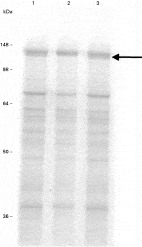
Fig. 1. Peptide profile of the membrane-bound, Triton X-100 protein extracts from the Moredun, ISE and White River strains of adult Haemonchus contortus (lanes 1–3, respectively) fractionated by reducing SDS-PAGE (10%) and detected by Coomassie blue staining. The lower band of the doublet at ~110 kDa is arrowed. Mark12™ molecular weight standards (Invitrogen) were used.
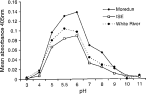
Fig. 2. The effect of pH on the degradation of azocasein by proteinases in integral membrane protein extracts of the Moredun, ISE and White River strains of adult Haemonchus contortus. Samples were analysed in triplicate for each buffer/pH point and mean values plotted.
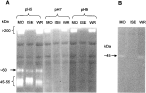
Fig. 3. (A) Gelatin-substrate gels showing the proteinase activity of integral membrane protein extracts of the Moredun (MO), ISE and White River (WR) strains of adult Haemonchus contortus at pH 5, 7 and 9. (B) Haemoglobin-substrate gel showing proteinase activity of extracts at pH 3. The molecular size of the zones of proteolysis are indicated.
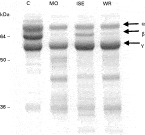
Fig. 4. Degradation of ovine fibrinogen at pH 5 following incubation with membrane-bound protein extracts of the Moredun (MO), ISE and White River (WR) strains of adult Haemonchus contortus or with H2O (C) as a control. Degradation products were fractionated by reducing SDS-PAGE (10%) and detected by Coomassie blue staining. Migration of the α, β and γ chains of fibrinogen were as indicated, as was the migration of Mark12™ molecular weight standards (Invitrogen).
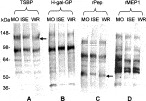
Fig. 5. Western blot analysis of membrane-bound protein extracts of the Moredun (MO), ISE and White River (WR) strains of adult Haemonchus contortus probed with antiserum to the host-protective antigens TSBP (panel A) and H-gal-GP (panel B), or to the bacterially expressed recombinant subcomponents of H-gal-GP, pepsinogen (panel C) and MEP1 (panel D). Differences in reactivity are arrowed. Mark12™ molecular weight standards (Invitrogen) were used.
 You have
Access
- 6
- Cited by